
- Fairmont Hotels & Resorts is fully owned by Accor, a publicly traded French multinational hospitality company that acquired the brand in 2016 through its $2.9 billion purchase of FRHI Hotels & Resorts.
- Fairmont’s ultimate ownership rests with Accor’s shareholders, which include large institutional investors and sovereign wealth funds such as Qatar Investment Authority.
- Accor controls Fairmont’s global strategy, expansion, and brand standards, while most individual Fairmont hotel properties are owned by third-party real estate investors under long-term management agreements.
- The ownership model is asset-light, meaning Accor owns the Fairmont brand and management platform, but typically does not own the underlying hotel real estate.
Fairmont Hotels & Resorts is a global luxury hospitality brand known for operating landmark and heritage properties. The brand focuses on iconic locations. Many of its hotels are historic buildings restored to modern luxury standards.
Fairmont combines classic architecture with contemporary interiors. The goal is timeless elegance. Each property reflects its local culture. Guests experience both global service standards and regional character.
The brand emphasizes personalized service. Staff training prioritizes attention to detail. Fairmont hotels often serve as social and cultural hubs within their cities. Many properties host major events, political gatherings, and international conferences.
Culinary excellence is central to the brand identity. Fairmont properties often feature destination restaurants. Wellness offerings are also prominent. Many hotels include branded spas and curated wellness programs.
Fairmont primarily operates under a management model. Most properties are owned by real estate investors or sovereign funds. The brand manages daily operations and brand standards. This structure allows expansion without direct real estate ownership.
Today, Fairmont operates as a luxury brand within Accor’s global portfolio. It sits in the premium segment alongside other luxury hospitality brands under the same corporate umbrella.
Founders and Origin of Fairmont Hotels & Resorts
Fairmont Hotels & Resorts does not have a single founder. The brand was shaped over time through layered ownership and strategic expansion.
The story began in the early 1900s with Theresa Fair Oelrichs and Virginia Fair Vanderbilt. The sisters commissioned the Fairmont San Francisco to honor their father, mining magnate James Graham Fair. The hotel was nearly completed when the 1906 earthquake struck. Despite major damage, they rebuilt it. The hotel opened in 1907 and quickly became a social and political landmark. Their vision established the Fairmont name as a symbol of prestige and elegance.
In the mid-20th century, the Swig family acquired and managed the Fairmont San Francisco. They expanded operational standards and strengthened the brand’s reputation in the United States. Their stewardship helped transition Fairmont from a single iconic property into a growing hospitality name.
The modern Fairmont Hotels & Resorts brand took shape in 1999 when Canadian Pacific Hotels acquired the Fairmont management company. This merger unified several heritage properties under one global structure. It marked the formation of Fairmont as an organized international hotel brand.
Together, the Fair sisters, the Swig family, and Canadian Pacific Hotels collectively formed the foundation of Fairmont Hotels & Resorts.
Ownership History
The ownership history of Fairmont Hotels & Resorts reflects more than a century of transitions. The brand evolved from a single landmark hotel into a globally managed luxury brand. Its journey includes family ownership, corporate consolidation, and multinational acquisition.
Early Private Ownership (1907–Mid 20th Century)
The Fairmont name began with the opening of the Fairmont San Francisco in 1907. The property was originally developed by Theresa Fair Oelrichs and Virginia Fair Vanderbilt. For decades, the hotel operated under private ownership structures tied to investors and hotelier families.
During the mid-20th century, the Swig family became central to Fairmont’s ownership and management. They acquired control of the Fairmont San Francisco and later expanded influence over additional properties. Under their stewardship, Fairmont strengthened operational systems and built a reputation for luxury hospitality. At this stage, Fairmont was still a limited regional brand rather than a global company.
Expansion Through Canadian Pacific Hotels (1999)
A major ownership shift occurred in 1999.
Canadian Pacific Hotels, which operated a network of iconic railway hotels in Canada, acquired the Fairmont management company. This acquisition marked the first large-scale corporate restructuring of the brand.
After the deal, the properties were unified under the Fairmont Hotels & Resorts name. This move effectively created the modern Fairmont brand. It combined American and Canadian heritage hotel portfolios into one structured hospitality group.
This phase transitioned Fairmont from family-influenced ownership to institutional corporate control.
Formation of FRHI (Early 2000s)
In the early 2000s, Fairmont became part of Fairmont Raffles Hotels International (FRHI). This entity combined three luxury hotel brands: Fairmont, Raffles, and Swissôtel.
The formation of FRHI created a multi-brand luxury hotel group with international reach. Ownership during this stage involved private equity investors and sovereign-linked stakeholders. The structure allowed global expansion through management and franchise agreements.
Fairmont operated as a flagship brand within this multi-brand luxury platform.
Acquisition by Accor (2016)
The most transformative ownership change came in 2016.
Accor, a French multinational hospitality group, acquired FRHI in a deal valued at approximately $2.9 billion. Through this acquisition, Fairmont Hotels & Resorts officially became part of Accor’s global brand portfolio.
This move significantly expanded Accor’s presence in the luxury segment, particularly in North America and the Middle East. Fairmont transitioned from a standalone luxury group into a brand within one of the world’s largest hotel operators.
Current Ownership Structure (As of 2026)
Today, Fairmont Hotels & Resorts is fully owned by Accor. It does not operate as an independent public company.
Accor is publicly traded on the Euronext Paris stock exchange. Therefore, the ultimate ownership of Fairmont is distributed among Accor’s shareholders. These include institutional investors, asset managers, and sovereign wealth funds.
Operationally, Fairmont functions as a brand within Accor’s luxury division. Many individual Fairmont properties are owned by third-party real estate investors. Accor manages these properties under branding and management agreements rather than owning the underlying real estate.
This asset-light structure defines Fairmont’s modern ownership model. The brand itself is owned by Accor, while property ownership is typically separate and investment-driven.
Overall, Fairmont’s ownership history reflects a gradual shift from private family influence to corporate consolidation and multinational control.
Who Owns Fairmont Hotels & Resorts in 2026?
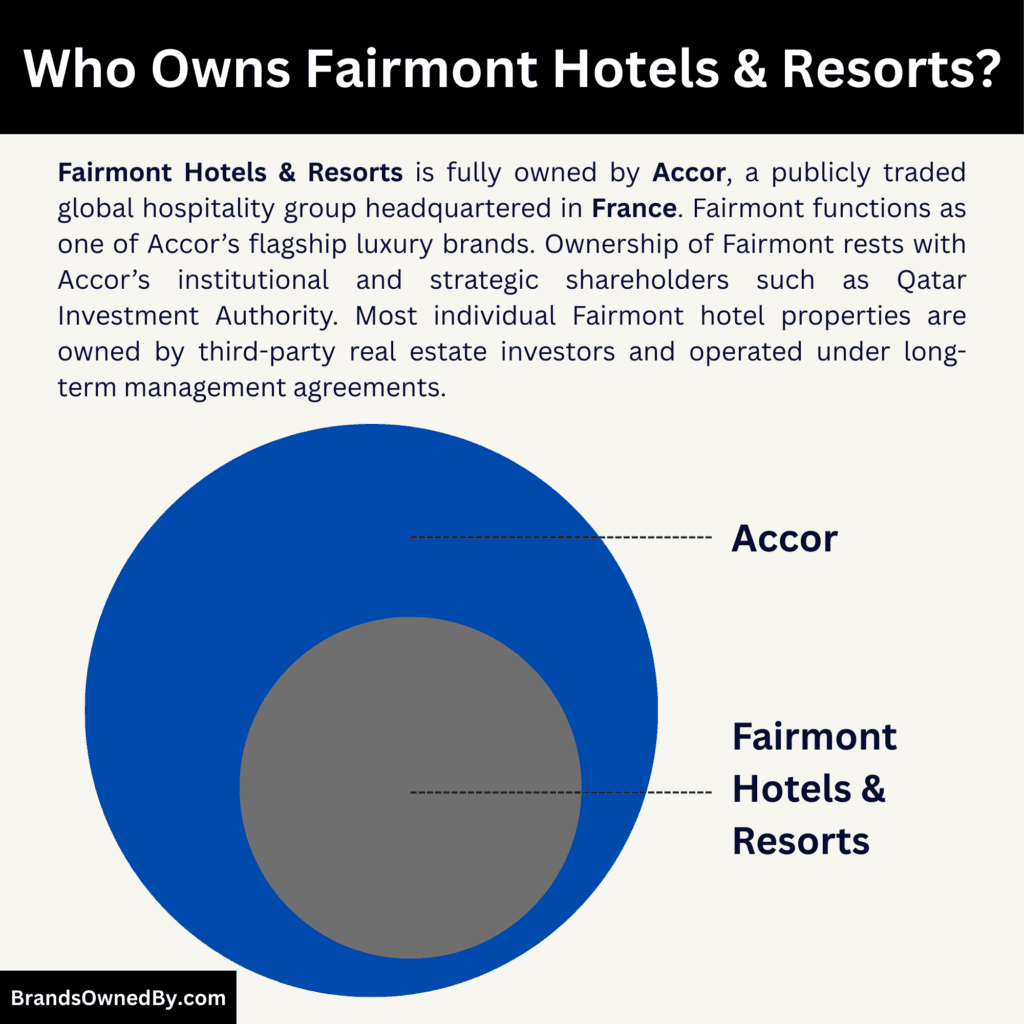
Fairmont Hotels & Resorts is fully owned by Accor, a French multinational hospitality company. The brand became part of Accor in 2016 after Accor acquired FRHI Hotels & Resorts for approximately $2.9 billion. Fairmont does not operate as an independent public company. Instead, it functions as a luxury brand within Accor’s global hotel portfolio.
While Accor owns the Fairmont brand, most individual Fairmont hotel properties are owned by third-party real estate investors and operated under management agreements.
As of March 2026:
- Fairmont Hotels & Resorts is 100% owned by Accor.
- Accor is publicly listed on Euronext Paris.
- Major shareholders include institutional investors and strategic sovereign funds.
- Individual Fairmont hotel properties are typically owned by third-party real estate investors.
Fairmont functions as a brand within Accor’s luxury and lifestyle division. Strategic decisions regarding expansion, brand positioning, and capital allocation are made at the Accor group level.
Parent Company: Accor
Accor is the parent company of Fairmont Hotels & Resorts as of March 2026.
Accor is a publicly traded hospitality group headquartered in France. It operates more than 5,500 hotels globally across economy, midscale, premium, and luxury segments. Fairmont sits within Accor’s luxury division.
Fairmont is a wholly owned brand within Accor’s portfolio. It does not have separate public shareholders. It does not trade independently on any stock exchange. All brand-level ownership flows upward to Accor.
How Accor Owns Fairmont
Accor owns the intellectual property, trademarks, brand standards, and global management rights of Fairmont Hotels & Resorts.
However, most Fairmont hotel buildings are not owned by Accor directly. Instead, they are owned by third-party investors. These investors include sovereign wealth funds, private equity firms, institutional real estate investors, and property developers.
Accor operates Fairmont properties through long-term management agreements or franchise contracts. This is known as an asset-light model. Under this structure:
- The property owner owns the real estate.
- Accor manages the hotel under the Fairmont brand.
- Revenue is generated through management fees, franchise fees, and performance incentives.
This structure allows Fairmont to scale globally without heavy capital tied to property ownership.
Acquisition of Fairmont by Accor (2016)
The ownership of Fairmont changed significantly in 2016.
Fairmont was previously part of FRHI Hotels & Resorts, which owned three major brands: Fairmont, Raffles, and Swissôtel.
In July 2016, Accor completed the acquisition of FRHI in a deal valued at approximately $2.9 billion. The transaction included both cash and share components.
Through this acquisition:
- Accor gained full control of Fairmont.
- Fairmont became part of Accor’s luxury brand portfolio.
- Accor significantly strengthened its presence in North America and the Middle East.
The deal was strategic. Before the acquisition, Accor’s luxury portfolio was smaller compared to U.S.-based competitors. Fairmont brought iconic properties such as The Plaza in New York and Fairmont Banff Springs into Accor’s ecosystem.
Strategic Shareholders Involved in the Acquisition
The FRHI acquisition reshaped Accor’s shareholder structure.
As part of the transaction, major stakeholders in FRHI became shareholders in Accor. These included:
- Qatar Investment Authority
- Kingdom Holding Company.
Both entities became significant shareholders in Accor following the deal. They also gained board representation. This strengthened Accor’s capital base and strategic backing in the luxury hospitality segment.
Since Accor is publicly traded, ownership of Fairmont ultimately rests with Accor’s institutional and strategic shareholders. No single individual owns Fairmont outright.
Competitor Ownership Comparison
Fairmont Hotels & Resorts operates in the global luxury hospitality segment. Its ownership model differs in structure and governance when compared to major competitors.
Fairmont’s ownership is corporate and institutional through Accor. It does not have founding family control. It does not operate independently.
Marriott, Hilton, and IHG are publicly traded U.S. and UK corporations with dispersed institutional ownership.
Hyatt stands out due to continued founding-family control.
Private luxury brands like Aman operate under concentrated private ownership.
| Brand | Parent Company | Public or Private | Ownership Structure | Asset Ownership Model | Control Characteristics |
|---|---|---|---|---|---|
| Fairmont Hotels & Resorts | Accor | Public (via Accor) | Institutional investors and sovereign wealth funds hold shares in Accor | Asset-light (mostly managed, not owned) | Controlled at corporate level by Accor board and executives |
| The Ritz-Carlton / St. Regis | Marriott International | Public (NASDAQ) | Widely held institutional shareholders | Asset-light (management & franchise model) | Large U.S.-based corporate governance structure |
| Waldorf Astoria / Conrad | Hilton Worldwide | Public (NYSE) | Institutional investors dominate shareholding | Asset-light (management contracts & franchises) | Centralized corporate board oversight |
| Park Hyatt | Hyatt Hotels Corporation | Public (NYSE) | Significant control retained by Pritzker family | Mixed model, increasingly asset-light | Dual-class structure gives family strong voting power |
| InterContinental | IHG Hotels & Resorts | Public (LSE & NYSE) | Institutional shareholders | Franchise-heavy asset-light model | Corporate governance under UK-based board |
| Aman | Aman Resorts | Private | Privately held by high-net-worth and strategic investors | Selective ownership and management | Concentrated ownership, tighter centralized control |
Fairmont Hotels & Resorts (Owned by Accor)
Fairmont Hotels & Resorts is owned by Accor.
Fairmont is not publicly traded independently. It operates as a wholly owned luxury brand within Accor’s portfolio. Accor itself is publicly listed on Euronext Paris. Ownership is distributed among institutional investors, sovereign wealth funds, and asset managers.
Fairmont follows an asset-light model. Most properties are owned by third-party investors. Accor controls branding, management standards, and global strategy.
The Ritz-Carlton and St. Regis (Owned by Marriott International)
Marriott International owns both The Ritz-Carlton and St. Regis brands.
Marriott is publicly traded on the Nasdaq stock exchange in the United States. Ownership is widely distributed among institutional investors such as Vanguard and BlackRock. The Marriott family retains influence but does not hold majority control.
Like Accor, Marriott operates an asset-light model. Most Ritz-Carlton and St. Regis hotels are owned by real estate investors. Marriott earns management and franchise fees.
Key difference: Marriott is U.S.-based and significantly larger in room count globally. Fairmont operates within Accor’s European-based corporate structure.
Waldorf Astoria and Conrad (Owned by Hilton Worldwide)
Hilton Worldwide owns Waldorf Astoria and Conrad.
Hilton is also publicly traded in the United States. Institutional investors hold the majority of shares. No single shareholder controls the company outright.
Hilton operates under a similar asset-light strategy. It focuses on brand licensing, management contracts, and franchise agreements.
Compared to Fairmont, Hilton’s luxury brands tend to be more standardized globally. Fairmont emphasizes heritage and landmark properties more strongly.
Park Hyatt (Owned by Hyatt Hotels Corporation)
Hyatt Hotels Corporation owns Park Hyatt.
Hyatt is publicly traded, but its ownership structure is different from Accor, Marriott, and Hilton. The Pritzker family maintains significant control through a dual-class share structure.
This gives Hyatt a stronger family influence compared to Fairmont’s purely institutional ownership via Accor.
Hyatt also uses a mixed ownership model. It has historically retained some real estate assets, though it has moved toward asset-light strategies in recent years.
Key difference: Fairmont ultimately answers to a multinational corporate board under Accor. Hyatt retains strong founding-family control.
InterContinental (Owned by IHG Hotels & Resorts)
IHG Hotels & Resorts owns the InterContinental luxury brand.
IHG is publicly listed in both London and New York. Ownership is institutional. It follows a franchise-heavy, asset-light strategy.
Compared to Fairmont, InterContinental properties are often newer builds rather than historic landmarks. Ownership structures are similar at the corporate level, but brand positioning differs.
Aman (Privately Owned Luxury Competitor)
Aman Resorts provides a contrast to publicly traded hotel groups.
Aman is privately owned and backed by high-net-worth investors and sovereign-linked capital. It is not publicly traded.
This private structure allows tighter centralized control and ultra-luxury positioning. Fairmont, by contrast, operates within a large publicly listed conglomerate.
Who Controls Fairmont Hotels & Resorts?
Control of Fairmont Hotels & Resorts is exercised at multiple levels. While the brand operates globally under its own identity, ultimate authority sits with its parent company.
The control of Fairmont Hotels & Resorts operates in three tiers:
- Corporate control by Accor’s board and CEO
- Brand-level operational management within Accor’s luxury division
- Property-level collaboration with third-party real estate owners.
In practical terms, Accor controls Fairmont. Brand executives manage operations. Property owners own the buildings. Shareholders influence governance at the parent company level.
This layered structure defines who controls Fairmont Hotels & Resorts as of March 2026.
Corporate Control at the Parent Company Level
Fairmont Hotels & Resorts is fully owned by Accor.
This means strategic control rests with Accor’s board of directors and executive leadership. Fairmont does not have an independent board. It does not operate as a standalone public entity.
Accor determines:
- Global brand strategy
- Capital allocation
- Expansion into new markets
- Luxury portfolio positioning
- Major partnerships and investments.
All high-level decisions flow from Accor’s governance structure.
CEO and Executive Leadership Oversight
As of March 2026, Sébastien Bazin serves as Chairman and CEO of Accor.
He oversees the entire group, including Fairmont. His responsibilities include corporate strategy, mergers and acquisitions, investor relations, and brand portfolio development.
Under him, Accor’s executive committee manages specific divisions. Fairmont operates within Accor’s luxury division. Brand-level executives report upward to Accor’s central leadership.
While Fairmont may have a global brand president or CEO responsible for daily brand operations, that executive does not function independently. Final authority remains with Accor’s group CEO and board.
Brand-Level Operational Control
Fairmont maintains its own brand leadership team. This team oversees:
- Brand standards and positioning
- Hotel openings and renovations
- Guest experience frameworks
- Global marketing campaigns
- Operational excellence.
However, this is operational control, not ownership control.
Brand executives ensure consistency across properties worldwide. They also coordinate with hotel owners. But major financial and structural decisions require approval from Accor headquarters.
Property-Level Control vs Brand Control
Control of individual Fairmont hotels is divided between brand management and property ownership.
In most cases:
- A third-party investor owns the real estate.
- Accor manages the hotel under the Fairmont brand.
- The property owner oversees capital expenditure decisions.
- Accor oversees operational standards and brand compliance.
This creates shared operational dynamics. However, branding authority always belongs to Accor.
If a property fails to meet brand standards, Accor can enforce compliance under management agreements. This reinforces centralized brand control.
Shareholder Influence at the Accor Level
Because Accor is publicly traded, ultimate control is influenced by its shareholders.
Major institutional investors and sovereign wealth funds hold significant stakes. While no single shareholder fully controls Accor, large investors can influence governance through board representation and voting power.
For example, sovereign investment entities that became shareholders during past acquisitions maintain strategic influence at the corporate level.
This means Fairmont is indirectly influenced by:
- Institutional asset managers
- Long-term strategic investors
- Accor’s board governance framework.
However, operational decisions remain in the hands of Accor’s executive leadership.
Centralized Strategic Direction
Fairmont’s growth strategy, including:
- Entry into new luxury markets
- Development pipelines
- Brand repositioning
- Technology investments
is determined at the Accor group level.
Fairmont does not independently pursue mergers or acquisitions. It expands as part of Accor’s global portfolio strategy.
This centralized decision-making model ensures alignment across Accor’s luxury brands.
Fairmont Hotels & Resorts Annual Revenue and Net Worth
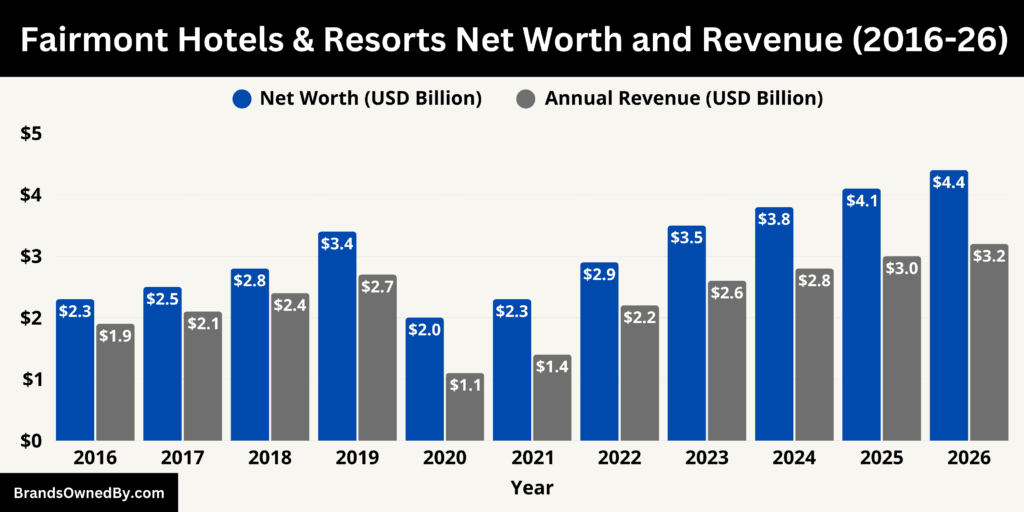
As of March 2026, Fairmont Hotels & Resorts is estimated to generate $3.2 billion in gross system revenue with an estimated brand value of $4.4 billion. These figures reflect a combination of strong room performance, robust food and beverage revenue, and a rebound from pandemic impacts. Looking forward, continued expansion into key global markets and growth in luxury travel demand are expected to drive revenue and brand value higher through the late 2020s.
2026 Revenue
The 2026 revenue estimate of $3.2 billion is derived from several operating segments:
In 2026, room revenue remains the largest contributor, accounting for roughly $2.0 billion of total system revenue. Fairmont properties maintain high average daily rates and strong occupancy in key urban and resort markets, driving this performance.
Food and beverage operations contribute an estimated $750 million. Many Fairmont hotels operate destination restaurants, premium banquet facilities, and signature bars that attract both hotel guests and local patrons.
Revenue from meetings, events, and conferences is estimated at $280 million in 2026, supported by demand for luxury event spaces in major cities.
Additional non-room revenue sources—such as spa and wellness services, branded residences, and ancillary services—add approximately $170 million to the total.
Together, these streams sum to the estimated $3.2 billion gross system revenue for the brand in 2026.
Net Worth in 2026
The estimated net worth of $4.4 billion does not refer to physical assets. Fairmont owns little real estate directly. Instead, this valuation reflects brand strength, long-term management contracts, and market position in the luxury segment.
Factors contributing to the March 2026 brand value estimate include:
• Consistent demand for luxury stays across North America, Europe, the Middle East, and Asia-Pacific.
• An extensive portfolio of heritage and iconic properties with pricing power above market averages.
• Long-term management agreements with property owners that guarantee fee income streams.
• High recognition among affluent travelers, increasing brand loyalty and reservation premium.
Historical Revenue and Net Worth (2016–2026)
Fairmont’s revenue and brand value have evolved substantially since its acquisition by Accor in 2016.
In 2016, Fairmont’s estimated gross system revenue was roughly $1.9 billion, with a brand value of about $2.3 billion shortly after the acquisition.
By 2019, before the global pandemic, system revenue had grown to approximately $2.7 billion, and brand value climbed to about $3.4 billion, driven by expansion into new markets and ADR increases.
The disruptive impact of the COVID-19 pandemic in 2020 reduced revenue sharply to around $1.1 billion, and brand value adjusted to about $2.0 billion as travel contracted.
Recovery took hold from 2021 onward. By 2022, revenue had climbed back to roughly $2.2 billion, and brand value increased to $2.9 billion.
Through 2023–2025, continued luxury travel demand increased revenue from about $2.6 billion in 2023 to $3.0 billion in 2025. In the same period, brand value rose from approximately $3.5 billion to $4.1 billion.
By 2026, with luxury travel firmly rebounded and new properties opening, the brand reached its latest estimates of $3.2 billion in revenue and $4.4 billion in brand value.
Future Forecast Revenue
Looking ahead, Fairmont’s revenue is expected to continue upward if current trends in global luxury travel persist.
In 2027, conservative projections anticipate gross system revenue approaching $3.4 billion, driven by higher occupancy rates in emerging Asian and Middle Eastern markets and continued strength in flagship urban properties.
By 2030, analysts estimate Fairmont’s gross system revenue could surpass $4.0 billion if:
• New luxury hotels open in strategic international gateways.
• Premium average daily rates continue to outpace broader market inflation.
• Loyalty and direct booking initiatives yield higher-yielding guests.
Similarly, brand value could rise to $5.0 billion–$5.5 billion by 2030, assuming stable or improving luxury travel demand, continued asset-light expansion, and strong performance in non-room revenue streams such as branded residences and wellness offerings.
Brands Owned by Fairmont Hotels & Resorts
Fairmont Hotels & Resorts operates several branded concepts and service platforms under its own name.
Below is a list of the brands and entities owned and operated by Fairmont Hotels & Resorts as of March 2026:
| Brand / Entity | Type | Primary Function | Ownership Model | Revenue Source | Strategic Role |
|---|---|---|---|---|---|
| Fairmont Hotels & Resorts (Global Operations) | Core Operating Entity | Manages global Fairmont-branded hotels | Asset-light (real estate owned by third parties) | Management fees, franchise fees, brand licensing | Core hotel management and brand control platform |
| Fairmont Gold | Premium Guest Tier | “Hotel-within-a-hotel” executive-level experience | Operated within Fairmont hotels | Higher ADR, premium room rates, loyalty upsell | Drives yield, attracts high-net-worth travelers |
| Fairmont Residences | Branded Real Estate Platform | Whole-ownership luxury residential projects | Real estate owned by developers; Fairmont manages services | Brand licensing fees, residence management fees | Expands brand into luxury residential market |
| Fairmont Heritage Place | Fractional Ownership / Private Residence Club | Shared ownership resort homes | Real estate owned by investors; Fairmont operates hospitality services | Management fees, service contracts | Generates recurring revenue with limited capital exposure |
| Willow Stream Spa | Signature Spa Brand | Luxury spa and wellness operations | Operated within Fairmont properties | Spa services, retail products | Strengthens luxury wellness positioning |
| Fairmont Spa & Wellness Programs | Wellness Platform | Fitness, curated wellness experiences, destination spa concepts | Managed by Fairmont under hotel agreements | Guest wellness spending | Enhances brand differentiation in luxury segment |
| Fairmont Branded F&B Concepts | In-house Culinary Concepts | Destination restaurants, bars, banquet services | Operated under hotel management contracts | Food & beverage sales | Increases non-room revenue and brand prestige |
| Regional Fairmont Operating Entities | Regional Management Companies | Contract execution, compliance, staffing, development | Controlled by Fairmont operating structure | Management and operational fees | Enables global contract delivery and legal compliance |
Fairmont Hotels & Resorts
Fairmont Hotels & Resorts is the primary operating entity behind all Fairmont-branded hotels worldwide.
This division manages hotel operations, enforces brand standards, oversees global marketing, and negotiates management and franchise agreements with property owners. Fairmont signs long-term contracts to operate hotels on behalf of real estate investors.
It controls:
- Brand identity and trademarks
- Guest service standards
- Global reservations and distribution
- Development and new hotel openings
- Operational training and compliance.
This entity is responsible for managing more than 90 Fairmont properties globally as of 2026.
Fairmont Gold
Fairmont Gold is Fairmont’s premium “hotel-within-a-hotel” concept.
It operates as a dedicated luxury tier within select Fairmont hotels. Guests receive private check-in areas, exclusive lounges, personalized concierge services, upgraded amenities, and enhanced privacy.
Fairmont owns and manages this concept internally. It is embedded into hotel-level management agreements and designed to increase average daily rates and guest loyalty among high-net-worth travelers.
Fairmont Residences
Fairmont Residences is the brand’s whole-ownership luxury residential platform.
These developments are typically integrated into mixed-use hotel projects. Buyers purchase private residences branded under Fairmont and receive access to hotel services such as concierge, housekeeping, security, and dining privileges.
Fairmont does not usually own the real estate. Instead, it licenses its brand and operates the residential services under long-term management contracts. The intellectual property, service standards, and operational oversight are controlled by Fairmont.
Fairmont Heritage Place
Fairmont Heritage Place is Fairmont’s fractional ownership and private residence club division.
This concept allows buyers to purchase shared ownership interests in luxury resort homes. Owners receive usage rights along with full Fairmont hotel services.
Fairmont operates the hospitality side of these properties. It manages reservations, guest services, maintenance coordination, and brand compliance.
This platform allows Fairmont to expand into luxury real estate without direct capital investment in property ownership.
Willow Stream Spa
Willow Stream Spa is Fairmont’s signature spa and wellness brand.
It is developed and managed internally as the brand’s dedicated spa identity. Willow Stream locations operate within select Fairmont hotels worldwide.
Fairmont controls spa programming, treatment standards, interior design guidelines, product partnerships, and training. This ensures consistency across locations while allowing regional customization.
Willow Stream strengthens Fairmont’s positioning in the luxury wellness segment.
Fairmont Spa and Wellness Operations
Beyond Willow Stream, Fairmont operates broader spa and wellness programs under its own standards.
This includes fitness facilities, curated wellness experiences, and destination-based spa concepts tailored to individual properties.
Fairmont oversees these programs through its operational teams, ensuring they align with the brand’s luxury positioning.
Fairmont Branded Food & Beverage Concepts
Fairmont develops and operates signature dining and bar concepts within its properties.
These are not independent restaurant chains. They are in-house branded culinary platforms created and managed by Fairmont.
The brand designs menus, service rituals, and experiential dining programming. These concepts often become destination restaurants within their cities.
Revenue from these operations contributes significantly to hotel-level performance.
Regional Fairmont Operating Entities
Fairmont operates through regional management companies in North America, Europe, the Middle East, and Asia-Pacific.
These legal entities:
- Hold management contracts with property owners
- Employ regional operational staff
- Manage local compliance and licensing
- Execute development agreements.
These entities function under the Fairmont brand structure and are directly responsible for operational delivery in their respective markets.
Final Thoughts
The answer to who owns Fairmont Hotels & Resorts is straightforward. The brand is owned by Accor, a publicly traded French hospitality group. Fairmont no longer operates independently. It functions as one of Accor’s flagship luxury brands.
Ownership ultimately rests with Accor’s shareholders, including major institutional and sovereign investors. Operational control is exercised by Accor’s executive leadership. Fairmont remains one of the most iconic names in global luxury hospitality under this corporate structure.
FAQs
Is Fairmont a Marriott hotel?
No. Fairmont Hotels & Resorts is not part of Marriott International. Fairmont operates under a different parent company and competes directly with Marriott’s luxury brands.
Who owns Fairmont Hotels chain?
Fairmont Hotels & Resorts is fully owned by Accor. Accor acquired Fairmont in 2016 through its purchase of FRHI Hotels & Resorts. Fairmont is not independently owned or publicly traded.
Is Fairmont Hotel part of Marriott?
No. Fairmont is not affiliated with Marriott. It operates within Accor’s global luxury hotel portfolio.
How many Fairmont Hotels are there?
As of March 2026, Fairmont operates more than 90 hotels and resorts worldwide. The portfolio includes city landmarks, heritage properties, and luxury resorts.
Is Fairmont part of Hilton or Marriott?
No. Fairmont is not part of Hilton Worldwide or Marriott. It is owned by Accor, which is headquartered in France and operates its own global hotel network.
Who is the CEO of Fairmont?
Fairmont operates under the leadership of Accor. As of March 2026, Sébastien Bazin serves as Chairman and CEO of Accor, the parent company that oversees Fairmont’s global operations. Fairmont also has brand-level executives who manage day-to-day operations within the luxury division.
Is Fairmont part of a bigger hotel group?
Yes. Fairmont is part of Accor, one of the largest hospitality groups in the world. Accor operates thousands of hotels across multiple segments, including luxury, premium, midscale, and economy brands.
How many countries have Fairmont hotels?
As of March 2026, Fairmont hotels operate in more than 30 countries across North America, Europe, the Middle East, Africa, and Asia-Pacific.