- ArcelorMittal is primarily owned by the Mittal family, which holds about 39.81% of the company’s shares, making it the largest and controlling shareholder.
- The remaining ownership is held by institutional investors (about 42%) and public shareholders (about 18%), including major asset managers such as BlackRock and Vanguard.
- Even though the company is publicly traded, the large ownership stake of the Mittal family gives it significant influence over strategic decisions and corporate governance.
- For readers asking who owns ArcelorMittal, the company operates as a public corporation with strong founder control, combining family ownership with global institutional investment.
ArcelorMittal is a Luxembourg-based multinational steel and mining company. It is one of the largest steel producers in the world and the largest outside China.
As of March 2026, the company operates steelmaking facilities in 15 countries and sells steel products in over 120 countries. Its industrial network includes more than 37 steel plants and hundreds of production and distribution sites worldwide.
ArcelorMittal produces a wide range of steel products including:
- Flat steel used in automobiles and appliances
- Long steel used in construction and infrastructure
- Plates and tubular steel for energy and heavy industry.
The company produced about 55.6 million tonnes of crude steel in 2025, making it the second-largest steel producer globally after China Baowu.
ArcelorMittal also operates large mining assets. These mines are located in:
- Canada
- Brazil
- Mexico
- Liberia
- Bosnia
- Ukraine
- South Africa.
The company produced 48.8 million tonnes of iron ore in 2025 to supply its steel plants and external markets.
ArcelorMittal’s steel is widely used in major industries including automotive manufacturing, infrastructure, energy projects, and construction. The company also produces over 200 steel grades for automotive applications, including advanced ultra-high-strength steel used in modern vehicle structures.
With operations across Europe, the Americas, Africa, and Asia, ArcelorMittal remains one of the most influential companies in the global steel industry.
Founders of ArcelorMittal
ArcelorMittal was created through the merger of two major steel groups in 2006. The company’s creation is closely linked to the expansion strategy of steel entrepreneur Lakshmi Mittal and the European steel conglomerate Arcelor.
The modern company, therefore, has one primary founder and several historical industrial founders that built the companies merged into ArcelorMittal.
Lakshmi Mittal
Lakshmi Mittal is the key founder behind ArcelorMittal. He built the global steel empire that later merged with Arcelor.
Mittal began his international steel business in 1976 when he established PT Ispat Indo, a steel plant in Indonesia. This move marked the start of his global expansion strategy.
Instead of building new factories, Mittal focused on acquiring underperforming or privatized steel plants and improving their operations.
Major acquisitions during his expansion included:
- 1989: Acquisition of the state-owned steel plant in Trinidad and Tobago
- 1995–2000: Purchases of steel mills in Mexico, Canada, Kazakhstan, and Germany
- 2004: Creation of Mittal Steel Company, which became the world’s largest steel producer at the time.
Mittal’s biggest move came in 2006 when Mittal Steel launched a takeover bid for European steel giant Arcelor.
Key facts about the takeover:
- Deal value: about $33 billion
- Completion: August 2006
- Result: creation of ArcelorMittal, the world’s largest steel company at the time.
Lakshmi Mittal served as CEO from 2006 to 2021. He now serves as Executive Chairman and remains the company’s largest shareholder with about 39.9% ownership.
Industrial Founders Behind Arcelor
The second half of ArcelorMittal’s foundation comes from Arcelor, a major European steel group created before the 2006 merger.
Arcelor itself was formed in 2001 through the merger of three historic European steel companies:
- Arbed (Luxembourg) – a steel company founded in 1911 and one of Europe’s largest producers
- Usinor (France) – a major French steel manufacturer created from earlier national steel companies
- Aceralia (Spain) – Spain’s largest steel producer formed from the restructuring of Spanish state steel assets.
These companies supplied steel to major European industries including automotive manufacturing, shipbuilding, and infrastructure.
When Mittal Steel acquired Arcelor in 2006, the merger combined:
- Mittal’s global steel operations across the Americas, Africa, and Asia
- Arcelor’s advanced European steel production network.
The merger created ArcelorMittal, which immediately produced around 10% of the world’s steel output at the time and became the dominant global steel producer.
Ownership History
ArcelorMittal’s ownership history reflects the consolidation of the global steel industry over several decades. It did not begin as a single organization. It emerged through acquisitions, mergers, and industry restructuring that eventually created the modern ArcelorMittal group. The ownership structure evolved from a privately controlled steel business led by Lakshmi Mittal into a publicly traded multinational company with strong family influence.
Global Expansion of Mittal’s Steel Business (1976–2004)
The ownership roots of ArcelorMittal trace back to Lakshmi Mittal’s international steel operations.
In 1976, Mittal established PT Ispat Indo in Indonesia. This plant became the starting point for his global expansion strategy. Instead of building new factories, Mittal focused on acquiring struggling steel plants and improving their efficiency.
During the late 1980s and 1990s, he acquired several steel facilities across multiple regions. These acquisitions helped build a large international steel network.
Major acquisitions during this expansion included:
- 1989: Caribbean Ispat steel plant in Trinidad and Tobago
- 1992: Sibalsa steel operations in Mexico
- 1995: Sidbec-Dosco steel plant in Canada
- 1995–1997: Karmet steel complex in Kazakhstan.
These assets were organized under two corporate entities: Ispat International and LNM Holdings.
In 2004, these businesses were consolidated to create Mittal Steel Company. The new entity quickly became the largest steel producer in the world. Ownership of Mittal Steel remained largely controlled by the Mittal family, with Lakshmi Mittal holding the dominant stake.
Formation of Arcelor (2001)
While Mittal Steel was expanding internationally, Europe was consolidating its steel industry.
In 2001, three major European steel companies merged to create Arcelor:
- Arbed from Luxembourg
- Usinor from France
- Aceralia from Spain.
Each of these companies had a long industrial history and played a key role in supplying steel to the European automotive and manufacturing sectors.
Unlike Mittal Steel, Arcelor had a dispersed ownership structure. It was publicly traded and owned by a wide mix of shareholders including institutional investors, banks, and public investors across Europe.
Mittal Steel Acquisition of Arcelor (2006)
The most important event in ArcelorMittal’s ownership history occurred in 2006 when Mittal Steel launched a takeover bid for Arcelor.
The takeover attempt initially faced strong opposition from several European governments and industry leaders. Arcelor was considered a strategic industrial company in Europe.
After several months of negotiations, Mittal Steel increased its offer and Arcelor’s board agreed to the acquisition.
Key details of the merger:
- Deal value: approximately $33 billion
- Completion date: August 2006
- New company name: ArcelorMittal.
The merger created the largest steel producer in the world at the time.
After the transaction, Arcelor shareholders received shares in the newly formed ArcelorMittal. However, the Mittal family emerged as the largest shareholder due to their significant ownership in Mittal Steel before the merger.
Ownership Structure After the Merger
Following the 2006 merger, ArcelorMittal became a publicly traded global corporation. The company listed its shares on major exchanges including the New York Stock Exchange and Euronext Amsterdam.
The ownership structure combined a dominant founding shareholder with a large base of institutional investors.
Over time, global asset managers, pension funds, and investment firms accumulated shares in the company. These investors collectively hold a significant portion of ArcelorMittal stock.
Despite the broad shareholder base, the Mittal family has remained the largest shareholder and continues to influence the company’s long-term strategy.
Ownership Structure as of 2026
As of March 2026, ArcelorMittal operates as a publicly traded company with a hybrid ownership model.
The Mittal family remains the largest shareholder, holding roughly 39–40% of the company’s shares and voting power through family-controlled holding companies.
The remaining shares are held by a mix of institutional investors and public shareholders around the world.
Major institutional investors include global asset management firms and pension funds that hold smaller individual stakes compared to the Mittal family.
This ownership structure allows ArcelorMittal to maintain strong strategic direction through its founding shareholders while still benefiting from global capital markets.
Today, the company continues to be heavily influenced by the Mittal family, with Lakshmi Mittal serving as Executive Chairman and Aditya Mittal serving as Chief Executive Officer.
Who Owns ArcelorMittal: Top Shareholders
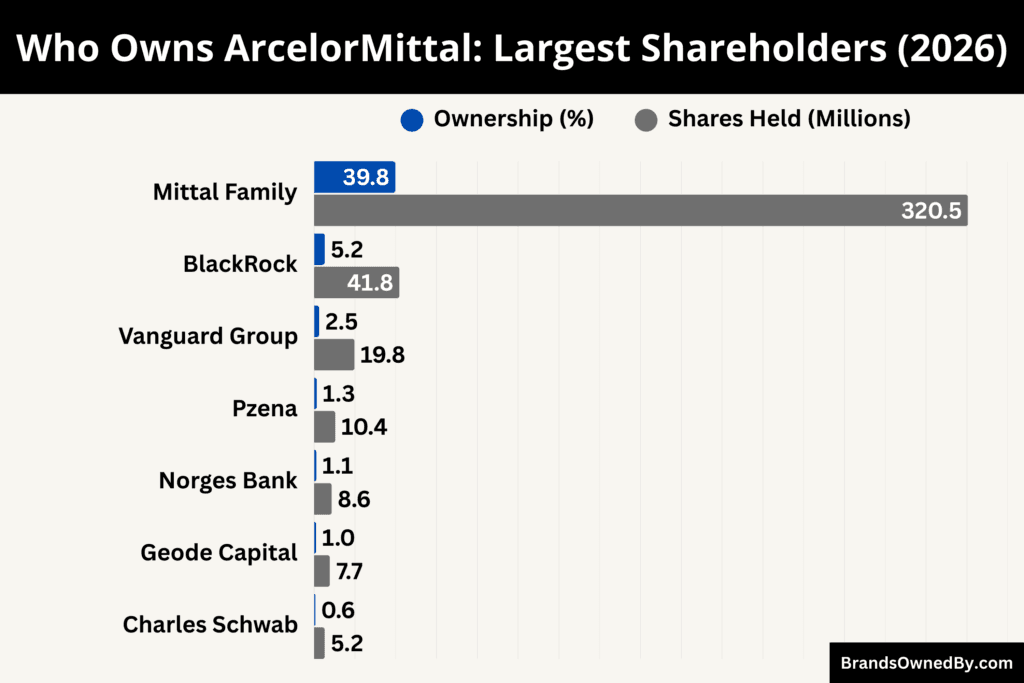
ArcelorMittal is a publicly traded company, but its ownership is heavily concentrated in the hands of its founding family. The company’s shares are listed on major stock exchanges including the New York Stock Exchange and Euronext Amsterdam.
As of March 2026, the ownership structure consists of three main groups:
- The Mittal family, which holds the largest controlling stake (39.81%)
- Institutional investors, such as global asset management firms (42.23%)
- Public shareholders, including retail investors and smaller funds (17.96%).
The Mittal family owns roughly 39–40% of the company’s shares and controls an even larger portion of voting rights. This makes the family the dominant shareholder and gives them strong influence over strategic decisions and board appointments.
The remaining shares are widely distributed among institutional investors and global financial firms. While these investors hold significant capital, none individually come close to the ownership level of the Mittal family.
Below are the major shareholders of ArcelorMittal as of March 2026:
Lakshmi Mittal and the Mittal Family
The Mittal family is the largest shareholder of ArcelorMittal.
As of 2026, the family owns 39.81% of the company’s shares through investment vehicles connected to Lakshmi Mittal. This stake also gives the family a substantial portion of the voting rights in the company.
Lakshmi Mittal built the global steel empire that later became ArcelorMittal. After the 2006 merger between Mittal Steel and Arcelor, the family retained a large ownership stake in the combined company.
The family’s influence goes beyond share ownership. Lakshmi Mittal currently serves as Executive Chairman, while his son Aditya Mittal serves as Chief Executive Officer. Because of this structure, the Mittal family plays a central role in shaping the company’s long-term strategy and major investment decisions.
BlackRock Inc.
BlackRock is the largest institutional investor in ArcelorMittal.
As of the most recent filings, BlackRock owns 5.19% of the company’s shares through its global asset management funds.
BlackRock manages trillions of dollars in assets and invests in large multinational companies through index funds and exchange-traded funds. Many of its funds track major global stock indices that include ArcelorMittal.
Although BlackRock does not control the company, its ownership gives it an important voice in shareholder voting and corporate governance matters.
The Vanguard Group
The Vanguard Group is another major institutional shareholder of ArcelorMittal.
The firm owns 2.46% of the company’s shares through its global index funds and investment portfolios.
Vanguard is one of the largest asset management companies in the world. Its investment strategy focuses heavily on long-term index investing. As a result, Vanguard holds shares in many large industrial companies included in international equity indices.
Its stake in ArcelorMittal reflects the company’s position as a major global steel producer.
Pzena Investment Management
Pzena Investment Management is a well-known value-focused investment firm and one of the institutional shareholders of ArcelorMittal.
The firm owns 1.29% of the company’s shares.
Pzena specializes in investing in large global companies that it believes are undervalued compared to their long-term earnings potential. Industrial and manufacturing companies often appear in its portfolios.
Its investment in ArcelorMittal aligns with this strategy because steel companies often experience cyclical market valuations.
Norges Bank Investment Management
Norges Bank Investment Management is the manager of the Norwegian Government Pension Fund Global, one of the world’s largest sovereign wealth funds.
The fund owns 1.07% of ArcelorMittal shares.
This sovereign fund invests globally across thousands of companies. Its stake in ArcelorMittal represents an investment in the global industrial and materials sector.
Although the stake is relatively small compared to the Mittal family, Norges Bank remains one of the largest sovereign investors in the company.
Geode Capital Management
Geode Capital Management is another institutional investor that holds shares in ArcelorMittal.
The firm owns 0.96% of the company’s shares.
Geode manages assets for institutional clients and is closely associated with index-based investment strategies. Many of its investments track global stock market benchmarks.
Its ownership in ArcelorMittal reflects the company’s inclusion in several international equity indices.
Charles Schwab Investment Management
Charles Schwab Investment Management also holds a stake in ArcelorMittal through its investment funds.
The firm owns 0.64% of the company’s shares.
Schwab’s investment division manages a wide range of exchange-traded funds and mutual funds that invest in global equities. ArcelorMittal appears in some of these portfolios because of its large industrial footprint.
Although the firm does not play a direct management role, it participates in shareholder voting and governance decisions.
Other Institutional and Public Shareholders
Apart from the major investors listed above, ArcelorMittal has thousands of additional shareholders around the world.
These include pension funds, mutual funds, insurance companies, hedge funds, and retail investors who buy shares through public stock exchanges.
Collectively, these investors hold about 48% of the company’s shares. However, their holdings are widely distributed, meaning no single investor within this group has enough shares to influence company strategy independently.
This combination of strong family ownership and broad institutional investment creates ArcelorMittal’s current ownership structure. The Mittal family maintains long-term control while global investors provide capital and liquidity through public markets.
Competitor Ownership Comparison
The global steel industry includes a mix of state-owned companies, publicly traded corporations, and privately controlled firms. Ownership structures vary widely across major steel producers. Some companies are controlled by governments, while others are dominated by institutional investors or founding families.
Compared to many competitors, ArcelorMittal has a hybrid ownership model. It is publicly traded but strongly influenced by the Mittal family, which remains the largest shareholder.
| Company | Country / Headquarters | Ownership Structure | Largest Shareholder | Ownership Stake | Key Ownership Characteristics |
|---|---|---|---|---|---|
| ArcelorMittal | Luxembourg | Public company with dominant family shareholder | Mittal Family | 39.81% | Hybrid ownership structure. Publicly traded but strongly influenced by the founding Mittal family through a large controlling stake. |
| China Baowu Steel Group | China | State-owned enterprise | Chinese Government (SASAC) | 100% | Fully owned and controlled by the Chinese government. Strategic decisions often align with national industrial policy. |
| Nippon Steel Corporation | Japan | Publicly traded corporation | Japanese institutional investors (trust banks and financial institutions) | Largest shareholder typically holds under 10% | Ownership is widely dispersed among institutional investors, pension funds, and financial institutions. No controlling family shareholder. |
| POSCO Holdings | South Korea | Public corporation | National Pension Service of South Korea | ~7% | Originally government-owned but fully privatized. Shares are widely distributed among institutional investors and global asset managers. |
| Nucor Corporation | United States | Public corporation | Institutional investors (BlackRock, Vanguard) | Largest shareholders typically hold around 7–8% each | Ownership is dominated by institutional investors. No founding family control. Governance is led by management and the board. |
China Baowu Steel Group
China Baowu Steel Group is the largest steel producer in the world. Unlike ArcelorMittal, Baowu is fully state-owned.
The company is owned by the State-owned Assets Supervision and Administration Commission (SASAC) of China. This government body oversees major Chinese state enterprises and appoints top leadership at Baowu.
Because of this ownership structure, Baowu operates as a government-controlled industrial group. Strategic decisions, including mergers and industry consolidation, often align with China’s national industrial policy.
The company has expanded rapidly through mergers with several other state-owned steel companies, including Baosteel and Wuhan Iron and Steel.
This state-backed structure gives Baowu strong financial support and access to national industrial resources, which is very different from ArcelorMittal’s market-driven ownership model.
Nippon Steel Corporation
Nippon Steel is the largest steel producer in Japan and one of the largest globally.
The company operates as a publicly traded corporation listed on the Tokyo Stock Exchange. Its shares are widely distributed among institutional investors, financial institutions, and public shareholders.
Major shareholders typically include Japanese financial institutions such as trust banks and insurance companies. These investors manage shares on behalf of pension funds and long-term investment portfolios.
Unlike ArcelorMittal, Nippon Steel does not have a single dominant shareholder. Ownership is widely dispersed across multiple institutions.
This structure means corporate decisions are primarily shaped by management and the board of directors rather than by a controlling family shareholder.
POSCO Holdings
POSCO Holdings is the parent company of South Korean steel giant POSCO.
The company is publicly traded and has a widely distributed ownership structure. Institutional investors, pension funds, and international asset managers hold most of its shares.
One of the most significant shareholders is the National Pension Service of South Korea, one of the largest pension funds in the world.
POSCO originally began as a government-owned company but was fully privatized in the late 1990s. Today, it operates as a private corporation with no controlling family or government owner.
Compared with ArcelorMittal, POSCO’s ownership is much more dispersed, with corporate governance led primarily by professional management and institutional investors.
Nucor Corporation
Nucor is the largest steel producer in the United States.
The company is publicly traded on the New York Stock Exchange and is primarily owned by institutional investors.
Major shareholders include global asset managers such as:
- BlackRock
- Vanguard
- State Street.
These investors hold shares through mutual funds, pension funds, and exchange-traded funds.
Nucor does not have a founding family controlling the company. Its ownership is highly distributed among institutional investors and public shareholders.
This governance structure differs significantly from ArcelorMittal, where the Mittal family maintains strong influence through its large ownership stake.
United States Steel Corporation
United States Steel Corporation (commonly called U.S. Steel) historically operated as a publicly traded company listed on the New York Stock Exchange. For decades, its ownership was widely distributed among institutional investors and public shareholders.
However, the company’s ownership structure changed after its acquisition agreement with Nippon Steel. Following the completion of the deal, U.S. Steel transitioned away from being an independent publicly traded company and became part of Nippon Steel’s corporate group.
This means U.S. Steel is no longer primarily owned by dispersed institutional investors. Instead, it now operates as a subsidiary within Nippon Steel’s global steel operations. Strategic decisions are therefore aligned with the broader corporate strategy of its Japanese parent company.
Compared with ArcelorMittal, this ownership model reflects a parent company controlled structure rather than founder influence or dispersed institutional ownership.
Key Ownership Differences in the Steel Industry
Ownership structures across the global steel industry fall into three main categories:
State-controlled companies
- China Baowu Steel Group
These companies are owned by national governments and often support national industrial strategies.
Institutionally owned public corporations
- Nippon Steel
- POSCO Holdings
- Nucor.
These companies have dispersed ownership dominated by institutional investors.
Family-influenced public corporations
- ArcelorMittal
This structure combines public market investment with strong influence from a founding shareholder.
ArcelorMittal stands out because it maintains one of the largest founder-controlled stakes among major global steel producers, while still operating as a publicly traded multinational company.
Who Controls ArcelorMittal?
Control of ArcelorMittal comes from a combination of share ownership, executive leadership, and board governance. Although the company is publicly traded, its strategic direction is heavily influenced by the Mittal family, which holds the largest ownership stake.
Operational control is exercised by the executive leadership team led by the Chief Executive Officer. Major decisions are overseen by the Board of Directors, which represents the interests of shareholders.
Together, these three elements — ownership, management, and board oversight — determine how ArcelorMittal is controlled.
Aditya Mittal – Chief Executive Officer
Aditya Mittal is the Chief Executive Officer of ArcelorMittal. He assumed the role in February 2021, becoming the second CEO in the company’s history.
Before becoming CEO, Aditya Mittal served as Chief Financial Officer for many years. In that role, he played a central role in several major company initiatives, including debt restructuring, portfolio optimization, and strategic investments.
As CEO, he is responsible for overseeing:
- global steel and mining operations
- corporate strategy and capital allocation
- major investments and acquisitions
- operational efficiency across production facilities.
Aditya Mittal also leads the company’s transformation toward low-carbon steel production. Under his leadership, ArcelorMittal has launched multiple projects focused on hydrogen-based steelmaking, electric arc furnace expansion, and carbon reduction technologies.
Because the CEO manages day-to-day operations, Aditya Mittal plays the most direct role in controlling the company’s global business activities.
Lakshmi Mittal – Executive Chairman
Lakshmi Mittal serves as Executive Chairman of ArcelorMittal and remains the most influential figure in the company.
He founded the steel business that eventually became ArcelorMittal and led the company as CEO from 2006 until 2021.
Today, his role focuses on:
- long-term corporate strategy
- major global partnerships and industry relationships
- board leadership and governance
- oversight of major capital investment decisions.
Lakshmi Mittal also represents the interests of the Mittal family as the company’s largest shareholder, which strengthens his influence within the company.
Even though he is no longer CEO, his position as Executive Chairman and controlling shareholder means he continues to play a major role in guiding the company’s direction.
Board of Directors
ArcelorMittal is governed by a Board of Directors responsible for overseeing management and protecting shareholder interests.
The board includes a mix of executive directors, independent directors, and industry experts. Members bring experience from sectors such as global manufacturing, finance, energy, and international business.
Key responsibilities of the board include:
- approving major acquisitions and divestitures
- supervising financial performance
- setting executive compensation
- overseeing corporate governance and risk management.
Independent directors are particularly important because they help ensure that the company operates in the interests of all shareholders, not just the controlling family.
Executive Leadership Team
The broader executive leadership team helps manage ArcelorMittal’s global operations.
This leadership group includes executives responsible for:
- regional steel operations
- mining activities
- finance and capital management
- sustainability and decarbonization strategy
- global supply chains and manufacturing.
Each major region — including Europe, the Americas, and emerging markets — has leadership responsible for managing local operations and production facilities.
This structure allows ArcelorMittal to coordinate large-scale global operations across dozens of production sites.
How Control Works in Practice
In practice, ArcelorMittal’s control structure works through three layers.
First, the Mittal family controls the largest shareholding, giving it strong influence over shareholder votes and board composition.
Second, executive leadership led by the CEO manages daily operations and corporate strategy.
Third, the Board of Directors provides oversight and governance, ensuring that major decisions align with the interests of shareholders.
This structure allows ArcelorMittal to operate as a global public corporation while still maintaining strong influence from its founding family.
ArcelorMittal Annual Revenue and Net Worth
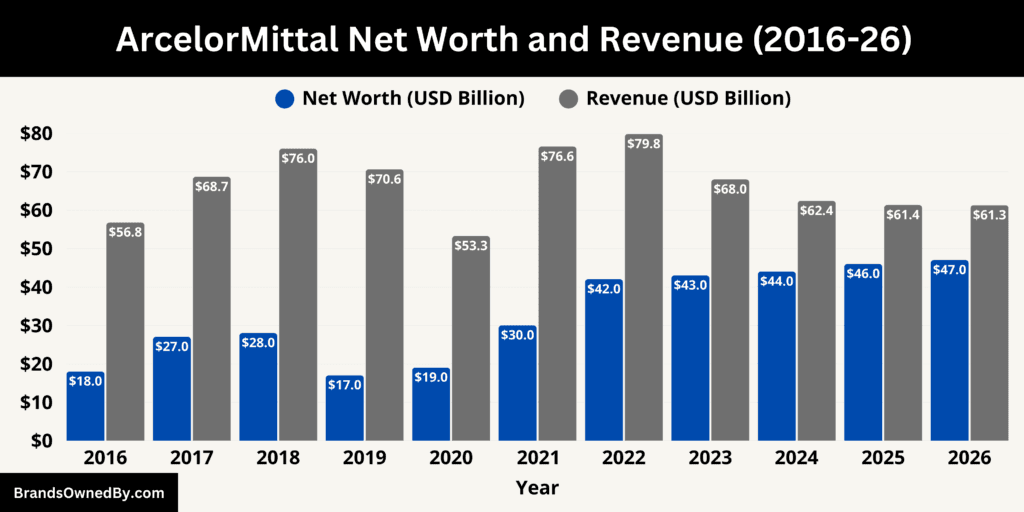
ArcelorMittal remains one of the largest steel producers globally. As of March 2026, the company generates about $61.4 billion in annual revenue and has a market capitalization of roughly $47 billion based on its publicly traded shares. The company shipped around 54 million tonnes of steel in 2025 and produced 55.6 million tonnes of crude steel, placing it among the world’s top steelmakers.
ArcelorMittal’s revenue comes from a diversified portfolio of operations including regional steel production divisions and mining assets. Its global structure allows the company to generate revenue across several major markets such as Europe, North America, Brazil, and emerging economies.
Revenue Breakdown by Business Segments
ArcelorMittal organizes its operations into five main segments: Europe, NAFTA (North America), Brazil, ACIS (Africa and Commonwealth of Independent States), and Mining.
Each segment contributes a different portion of the company’s total revenue.
Europe Segment
Europe is ArcelorMittal’s largest revenue-generating region.
In 2025, the European division contributed roughly $24 billion in revenue, representing about 39% of total company sales.
The segment operates large steel plants in countries such as:
- France
- Germany
- Belgium
- Spain
- Poland.
European operations primarily produce flat steel products, including hot-rolled and cold-rolled steel used in automotive manufacturing, appliances, packaging, and infrastructure projects.
The automotive sector remains one of the largest customers in Europe. Major car manufacturers rely on ArcelorMittal’s high-strength automotive steel grades for vehicle production.
NAFTA Segment (United States, Canada, Mexico)
The NAFTA segment represents ArcelorMittal’s North American operations.
In 2025, this segment generated approximately $16 billion in revenue, contributing about 26% of total company sales.
Operations include steel mills and finishing facilities across:
- the United States
- Canada
- Mexico.
Products from this region include flat steel plates, coated steel products, and structural steel used in construction and heavy manufacturing.
The acquisition of full control of the AM/NS Calvert steel facility in Alabama in 2025 strengthened ArcelorMittal’s North American presence and expanded its production capacity in the region.
Brazil Segment
Brazil is one of ArcelorMittal’s most profitable emerging-market operations.
In 2025, the Brazil segment produced about $8 billion in revenue, accounting for roughly 13% of total company sales.
Brazilian facilities produce long steel products such as:
- wire rod
- rebars
- billets
- structural steel.
These products are heavily used in infrastructure and construction projects across Latin America.
Brazil’s growing construction sector and urban development continue to drive strong steel demand in the region.
ACIS Segment (Africa and CIS)
The ACIS segment covers operations in Africa and the Commonwealth of Independent States.
In 2025, this segment generated roughly $6 billion in revenue, contributing around 10% of total company sales.
The division operates steel and mining facilities in regions such as:
- Kazakhstan
- Ukraine
- South Africa.
These operations primarily produce long steel products and semi-finished steel used in regional infrastructure and industrial markets.
Mining Segment
The Mining segment supplies iron ore and raw materials used in steel production.
In 2025, the mining business generated approximately $3.5 billion in revenue, contributing about 6% of total company sales.
ArcelorMittal operates iron ore mines in:
- Canada
- Brazil
- Mexico
- Liberia.
Mining operations are strategically important because they reduce the company’s dependence on external raw-material suppliers and stabilize production costs.
Higher iron ore shipments helped improve operating income in late 2025 as global iron ore prices increased.
Net Worth and Market Capitalization
ArcelorMittal’s market capitalization, often referred to as its net worth in public market terms, fluctuates with steel prices and investor sentiment.
As of March 2026, the company’s market value is about $47 billion.
This valuation reflects the company’s extensive global assets, which include:
- more than 37 steel production plants
- large mining operations
- integrated logistics and distribution networks
- research and development facilities across 14 R&D sites in 9 countries.
These assets make ArcelorMittal one of the largest industrial manufacturers in the global materials sector.
Revenue Outlook and Forecast
Industry forecasts suggest that global steel demand will gradually increase during the second half of the decade.
ArcelorMittal expects global steel demand outside China to grow modestly, with improvements in infrastructure investment and industrial production supporting the market.
Several factors will likely drive the company’s revenue growth toward 2030.
First, infrastructure spending across developing economies such as India, Southeast Asia, and Latin America will increase demand for construction steel.
Second, the company is investing heavily in green steel technologies, including hydrogen-based steelmaking and electric arc furnaces. These technologies will allow ArcelorMittal to meet stricter environmental regulations and maintain market access in Europe and North America.
Third, expansion projects in India and Brazil are expected to increase production capacity in high-growth regions.
Based on current industry forecasts and internal expansion plans, analysts expect ArcelorMittal’s annual revenue to gradually rise toward $70–$80 billion by 2030, assuming stable steel prices and moderate growth in global construction and manufacturing demand.
Despite cyclical fluctuations in the steel industry, ArcelorMittal’s diversified geographic presence, integrated mining operations, and strategic investments in low-carbon steel production position the company for long-term financial stability.
Companies Owned by ArcelorMittal
ArcelorMittal operates through a large network of subsidiaries, joint ventures, and controlled companies across the steel and mining value chain. These entities manage integrated steel plants, iron ore mining operations, downstream processing businesses, and regional steel production companies.
Many of these companies were created through acquisitions and mergers during the global expansion of Mittal Steel and later ArcelorMittal. Others were established to manage regional operations or specialized industrial segments such as automotive steel and mining.
As of 2026, the following companies represent some of the most important subsidiaries, joint ventures, and controlled entities within the ArcelorMittal group:
| Company | Country / Headquarters | Ownership Stake | Type | Key Operations / Details |
|---|---|---|---|---|
| ArcelorMittal Dofasco Inc. | Canada | 100% | Steel manufacturing subsidiary | Operates a large integrated steel plant in Hamilton, Ontario producing flat carbon steel mainly for the automotive, appliance, and construction industries. |
| ArcelorMittal Brasil S.A. | Brazil | 97.08% | Regional steel production company | One of the largest steel producers in Latin America operating multiple plants producing flat steel, long steel, and semi-finished products. |
| ArcelorMittal Mexico S.A. de C.V. | Mexico | 100% | Steel and mining subsidiary | Operates a large integrated steel plant in Lázaro Cárdenas and nearby iron ore mines supplying steel production. |
| ArcelorMittal Kryvyi Rih | Ukraine | 95.13% | Integrated steel company | Ukraine’s largest steel producer producing rebar, wire rod, billets, and rolled steel products for domestic and export markets. |
| ArcelorMittal Zenica | Bosnia and Herzegovina | Majority owned | Integrated steel plant | Produces long steel products including rebar and wire rod used in construction markets across Southeast Europe. |
| ArcelorMittal Mining Canada G.P. | Canada | 85% | Mining subsidiary | Operates iron ore mines, pellet plants, and rail infrastructure in Quebec and Labrador supplying raw materials for steel production. |
| ArcelorMittal Liberia Ltd. | Liberia | 85% | Mining subsidiary | Operates large iron ore mining operations and export infrastructure including railways and port facilities. |
| ArcelorMittal Poland S.A. | Poland | 100% | Steel production company | The largest steel producer in Poland with several plants producing flat steel, rails, and structural steel products. |
| ArcelorMittal Bremen GmbH | Germany | 100% | Steel manufacturing subsidiary | Produces flat steel products used in automotive manufacturing and heavy industry in Europe. |
| ArcelorMittal Eisenhüttenstadt GmbH | Germany | 100% | Steel manufacturing subsidiary | Integrated steel plant producing hot-rolled and cold-rolled steel coils for industrial applications. |
| ArcelorMittal Hamburg GmbH | Germany | 100% | Long steel production company | Produces billets and reinforcing steel using electric arc furnace technology and recycled scrap. |
| ArcelorMittal Belgium N.V. | Belgium | 100% | European steel subsidiary | Operates major steel production facilities including the Ghent steel plant serving automotive and industrial customers. |
| ArcelorMittal France S.A.S. | France | 100% | Steel manufacturing subsidiary | Manages major steel plants including Dunkerque and Fos-sur-Mer producing flat steel products for European markets. |
| ArcelorMittal España S.A. | Spain | 99.85% | Steel production company | Operates several steel plants including Asturias facilities producing flat steel and long steel products. |
| Acindar Industria Argentina de Aceros S.A. | Argentina | 100% | Steel manufacturing subsidiary | Produces long steel products such as rebar and wire rod for construction and infrastructure projects in South America. |
| ArcelorMittal Pecém | Brazil | 100% | Steel plant subsidiary | Operates a major slab production plant in northeastern Brazil serving global export markets. |
| ArcelorMittal South Africa Ltd. | South Africa | 69.22% | Publicly listed steel company | One of the largest steel producers in Africa with multiple steel plants supplying construction and industrial sectors. |
| ArcelorMittal International Luxembourg S.A. | Luxembourg | 100% | Trading and distribution subsidiary | Handles global steel trading, logistics, and international distribution for ArcelorMittal products. |
ArcelorMittal Dofasco
ArcelorMittal Dofasco is one of the most important subsidiaries of ArcelorMittal in North America.
The company operates a large integrated steel plant located in Hamilton, Ontario, Canada. This facility produces flat carbon steel used primarily in the automotive, construction, and appliance industries.
Dofasco has a long history in the Canadian steel industry and was originally founded in 1912. ArcelorMittal acquired the company as part of the Arcelor acquisition in 2006.
Today, ArcelorMittal Dofasco remains one of the largest steel producers in Canada and supplies steel to major North American automotive manufacturers.
ArcelorMittal Brasil
ArcelorMittal Brasil is the company’s main steel production subsidiary in Brazil.
It operates several steel plants and rolling mills across Brazil and produces both long steel and flat steel products. These products are used in construction, infrastructure, and industrial manufacturing across Latin America.
ArcelorMittal Brasil is also one of the largest steel producers in South America. The company supplies steel for major infrastructure projects including bridges, buildings, and transportation systems.
Brazil remains one of the most important emerging markets for ArcelorMittal due to strong demand from construction and infrastructure development.
ArcelorMittal Canada
ArcelorMittal Canada manages the company’s steel and mining operations in Canada.
One of its major operations is ArcelorMittal Mining Canada, which operates iron ore mining facilities in Quebec and Newfoundland and Labrador.
These mining operations produce millions of tonnes of iron ore annually. A large portion of this production is exported globally while some is used internally by ArcelorMittal steel plants.
The Canadian operations are strategically important because they provide access to high-quality iron ore reserves.
ArcelorMittal Liberia
ArcelorMittal Liberia is a major mining subsidiary operating in West Africa.
The company manages large iron ore mining operations in northern Liberia and operates associated rail and port infrastructure used to transport iron ore for export.
ArcelorMittal has invested heavily in Liberia’s mining sector, developing railways, processing facilities, and export terminals to support iron ore shipments.
This subsidiary plays a key role in supplying iron ore to global markets and to the company’s steel operations.
ArcelorMittal Mexico
ArcelorMittal Mexico operates steel production and mining facilities in Mexico.
The company’s main steel plant is located in Lázaro Cárdenas, one of the largest integrated steel plants in Latin America. This facility produces flat steel, long steel, and semi-finished steel products.
ArcelorMittal Mexico also operates iron ore mines that supply raw materials for steel production.
The subsidiary serves both the Mexican domestic market and exports steel to North American customers.
ArcelorMittal Kryvyi Rih
ArcelorMittal Kryvyi Rih is one of the largest steel plants in Ukraine.
The company acquired this facility in 2005 when Mittal Steel purchased the Kryvorizhstal steel plant from the Ukrainian government during a privatization process.
The plant produces long steel products such as billets and rebar used in construction and infrastructure projects.
ArcelorMittal Kryvyi Rih remains one of the largest industrial enterprises in Ukraine and a major exporter of steel products.
ArcelorMittal Zenica
ArcelorMittal Zenica operates an integrated steel plant located in Bosnia and Herzegovina.
The plant produces long steel products including wire rod and reinforcing bars used in regional construction markets.
This facility serves customers across Southeast Europe and plays an important role in supplying steel to infrastructure projects in the Balkans.
ArcelorMittal Tubarão
ArcelorMittal Tubarão is a major steel production company located in Espírito Santo, Brazil.
The facility produces flat steel slabs that are exported to rolling mills and steel processors around the world.
Tubarão is one of the largest slab-producing steel plants globally and plays an important role in supplying semi-finished steel products to other ArcelorMittal operations.
ArcelorMittal Nippon Steel India
ArcelorMittal Nippon Steel India is a major joint venture between ArcelorMittal and Nippon Steel.
The company was formed after the acquisition of Essar Steel India through a bankruptcy resolution process.
The joint venture operates a large integrated steel plant in Hazira, Gujarat, and produces flat steel products used in automotive manufacturing, pipelines, appliances, and infrastructure.
India is one of the fastest-growing steel markets in the world, making this joint venture a key part of ArcelorMittal’s long-term expansion strategy.
ArcelorMittal Mining Canada
ArcelorMittal Mining Canada is a major iron ore producer located in Quebec and Labrador.
The company operates large mining complexes, pellet plants, and railway infrastructure used to transport iron ore to ports for export.
The mining operations produce iron ore pellets used in steel production and are a key part of ArcelorMittal’s vertically integrated supply chain.
ArcelorMittal South Africa
ArcelorMittal South Africa is a publicly listed steel company in which ArcelorMittal holds a significant ownership stake.
The company operates multiple steel plants across South Africa and produces flat and long steel products used in construction, manufacturing, and infrastructure projects.
Although it operates independently as a listed company, ArcelorMittal has historically played a major role in its operations and development.
ArcelorMittal Eisenhüttenstadt
ArcelorMittal Eisenhüttenstadt operates a major steel production facility in Germany.
The plant produces flat steel products such as hot-rolled and cold-rolled coils used in automotive manufacturing and industrial applications.
This facility is part of ArcelorMittal’s European steel network and supplies steel to customers across the European Union.
These subsidiaries and controlled companies form the backbone of ArcelorMittal’s global operations. Through this network of steel plants, mining companies, and joint ventures, the company manages one of the largest integrated steel production systems in the world.
Final Words
ArcelorMittal remains one of the most influential companies in the global steel industry. The company operates a vast network of steel plants, mining operations, and industrial subsidiaries across multiple continents. Its scale and integrated supply chain allow it to serve major industries such as automotive manufacturing, construction, infrastructure, and energy.
For those asking who owns ArcelorMittal, the company is publicly traded but strongly influenced by its founding shareholders. The Mittal family holds the largest ownership stake, while institutional investors and public shareholders collectively own the remaining shares.
This ownership structure allows ArcelorMittal to combine long-term strategic control with access to global capital markets. With major investments in advanced steel technologies and low-carbon production, the company continues to play a central role in shaping the future of the global steel industry.
FAQs
Who owns ArcelorMittal steel?
ArcelorMittal is a publicly traded steel company, but the Mittal family is the largest shareholder. As of 2026, the family owns about 39.81% of the company’s shares, giving it significant influence over corporate decisions. The remaining shares are held by institutional investors such as global asset managers and by public shareholders.
Who is the founder of ArcelorMittal?
ArcelorMittal was founded by Lakshmi Mittal, an Indian-born steel entrepreneur. He built the company through decades of global acquisitions under Mittal Steel and later merged it with the European steel group Arcelor in 2006 to create ArcelorMittal.
Who owns ArcelorMittal South Africa?
ArcelorMittal South Africa is a publicly listed steel company, but ArcelorMittal holds the controlling stake. As of 2026, ArcelorMittal owns about 69% of the company, making it the majority shareholder and giving it operational influence over the business.
Where is ArcelorMittal headquarters?
ArcelorMittal is headquartered in Luxembourg City, Luxembourg. The headquarters serves as the company’s global corporate center where major strategic and financial decisions are managed.
Is ArcelorMittal an Indian company?
No, ArcelorMittal is not an Indian company. It is headquartered in Luxembourg and operates as a global multinational corporation. However, the company’s founder, Lakshmi Mittal, is originally from India, and ArcelorMittal also operates large steel plants in India through joint ventures.
Who bought out ArcelorMittal?
ArcelorMittal has not been bought out by another company. Instead, it was formed when Mittal Steel acquired and merged with Arcelor in 2006. The combined entity became ArcelorMittal, which remains an independent publicly traded company.
Who is the owner of Mittal Steel company?
Mittal Steel was owned and controlled by Lakshmi Mittal and the Mittal family. The company later merged with Arcelor in 2006 to form ArcelorMittal, and the Mittal family remained the largest shareholder in the new company.
Who is the largest steel mill in the world?
The largest steel producer in the world is China Baowu Steel Group, a Chinese state-owned company. It produces more steel annually than any other company globally. ArcelorMittal ranks among the largest steel producers outside China.
What country is ArcelorMittal from?
ArcelorMittal is based in Luxembourg. Although the company operates globally and was founded by Indian-born entrepreneur Lakshmi Mittal, its corporate headquarters and legal base are located in Luxembourg.