
- AOL is fully owned by Bending Spoons as of 2026, making the Italian technology company the ultimate parent and controlling shareholder of the AOL business and its core digital assets.
- Bending Spoons is a privately held company, so AOL does not have public shareholders. Ownership is concentrated among Bending Spoons’ founders, executive leadership, and institutional investors backing the parent company.
- Strategic control, financial decisions, and long-term direction are determined at the Bending Spoons level, while AOL operates as a managed digital platform within its parent company’s portfolio.
AOL, originally known as America Online, is a historic internet and digital media company founded in 1985 in the United States. It played a major role in popularizing the internet for everyday users. During the 1990s, AOL became the primary gateway to the web for millions of households. Its dial-up service, simple interface, and bundled software made internet access easy for non-technical users.
The company built one of the earliest online ecosystems. It offered email, instant messaging, chat rooms, news, entertainment, and browsing within one platform. AOL helped create the concept of online communities long before modern social media. Its famous “You’ve Got Mail” alert became a cultural symbol of the early internet era.
Over time, AOL transitioned from an internet service provider to a digital media and technology brand. Today, AOL focuses on email services, digital content, and advertising technology infrastructure. The brand continues to operate globally and remains one of the most historically significant companies in the evolution of the consumer internet.
Founders of AOL
AOL was founded by three key figures who combined vision, leadership, and technical innovation. The founders of AOL are Steve Case, Jim Kimsey, and Marc Seriff. They transformed a small online service into one of the most influential internet companies in history. Each founder played a distinct role in shaping the company’s growth, technology, and business strategy.
Steve Case
Steve Case is the most prominent co-founder and the key architect behind AOL’s rise. He joined the company in its early stage and later became CEO. Case believed the internet should reach mainstream households, not just technical users. He pushed for a subscription model, easy-to-use software, and aggressive marketing. Under his leadership, AOL grew into the largest internet service provider in the United States. He also led the historic AOL-Time Warner merger, which shaped the early digital media industry.
Jim Kimsey
Jim Kimsey was an early leader and co-founding figure who played a critical role in building the company’s foundation. He served as CEO before Steve Case. Kimsey helped stabilize the business during its early transformation from Control Video Corporation into Quantum Computer Services. He focused on operations, partnerships, and long-term growth. His leadership prepared the company for its rapid expansion phase in the 1990s.
Marc Seriff
Marc Seriff was a technical co-founder and the chief architect behind AOL’s early online system. He designed and developed the platform’s core network infrastructure. Seriff played a major role in building the dial-up connectivity system that allowed users to access online services through telephone lines. His engineering work enabled AOL to scale into a nationwide online service during its early growth years.
Ownership History
AOL has experienced multiple major ownership transitions since its founding. These changes reflect the evolution of the internet industry itself. From an independent internet pioneer to being part of media conglomerates, telecom giants, private equity, and now a technology roll-up company, AOL’s ownership journey spans more than four decades. Each transition reshaped its business model, strategy, and market position.
Early Independent Years (1985–2000)
AOL began as Quantum Computer Services in 1985 after the restructuring of Control Video Corporation. It launched its America Online service in 1989 and officially adopted the AOL name in 1995. During the 1990s, AOL became the dominant internet gateway for millions of users. At its peak, it had more than 25 million subscribers and controlled a major share of U.S. consumer internet access.
The company was publicly traded and generated most of its revenue from dial-up subscriptions and online services. AOL built one of the first large-scale digital ecosystems, including email, chat rooms, instant messaging, and online content. By the late 1990s, it was one of the most valuable internet companies globally.
AOL and Time Warner Era (2000–2009)
In 2000, AOL merged with Time Warner in a historic deal valued at around $360 billion, the largest merger in corporate history at the time. AOL shareholders owned about 55% of the combined company. The strategy was to merge internet distribution with traditional media assets such as cable television, publishing, and film.
However, the dot-com crash, falling dial-up usage, and strategic conflicts weakened AOL’s influence. The company struggled to adapt to broadband internet and lost market dominance. In 2003, the company dropped “AOL” from its corporate name and reverted to Time Warner. In 2009, Time Warner spun off AOL, making it an independent public company again.
Independent Digital Media Company (2009–2015)
After regaining independence in 2009, AOL shifted away from internet access and repositioned itself as a digital media and advertising technology company. Under CEO Tim Armstrong, the company invested heavily in programmatic advertising platforms, digital publishing, and online content distribution.
AOL expanded its media presence and focused on becoming a technology-driven advertising infrastructure provider. Despite these efforts, competition from Google and Facebook reduced its market influence, leading to another ownership transition.
Verizon Ownership (2015–2021)
In 2015, Verizon Communications acquired AOL for approximately $4.4 billion. Verizon aimed to build a large digital media and advertising ecosystem to compete with major tech companies. AOL became the foundation of Verizon’s digital strategy.
In 2017, Verizon acquired Yahoo and merged it with AOL into a new division called Oath, later renamed Verizon Media. AOL’s email platform, advertising technology, and content infrastructure were integrated into this broader digital business.
Apollo and Yahoo Structure (2021–2026)
In 2021, Verizon sold its media division, including AOL and Yahoo, to Apollo Global Management for about $5 billion. AOL operated under Yahoo during this period and continued running its email platform, web portal, and advertising infrastructure.
During this phase, AOL remained a profitable legacy internet brand with tens of millions of users worldwide. The company continued generating steady cash flow from advertising, subscriptions, and digital services.
Current Owner of AOL (2026–Present)
As of 2026, AOL is owned by Bending Spoons, an Italian technology company known for acquiring and revitalizing digital platforms. The acquisition was agreed in October 2025 and completed in early 2026.
The deal valued AOL at roughly $1.4–$1.5 billion and was financed through a major debt package of about $2.8 billion arranged by international banks.
Bending Spoons acquired AOL for its large and loyal user base, which includes around 30 million monthly active users across email and web properties.
The acquisition marked a major shift in AOL’s corporate history. It moved from telecom and private equity ownership into a technology holding company focused on modernizing legacy digital platforms. Bending Spoons has stated its long-term strategy is to invest in AOL’s email services, digital infrastructure, and platform growth rather than resell the business.
Who Owns AOL in 2026?
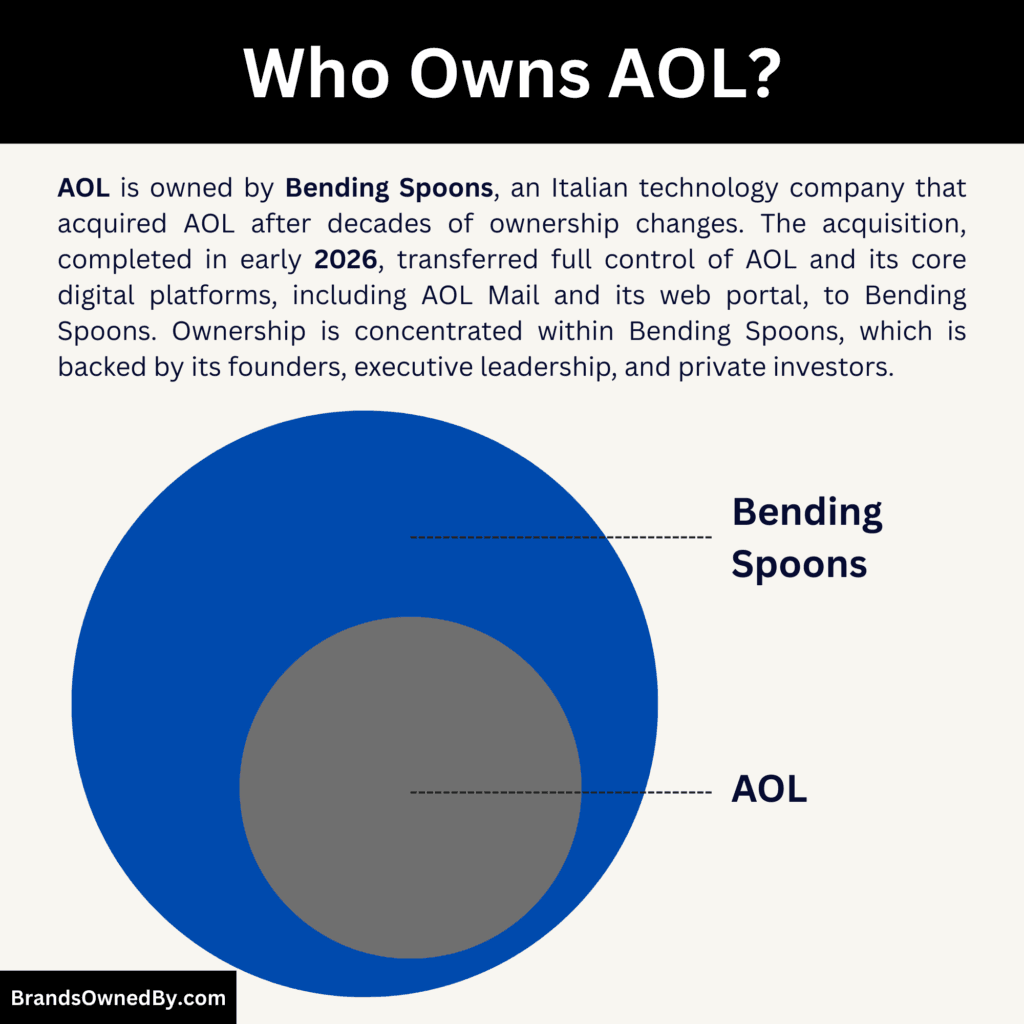
As of early 2026, AOL is owned by Bending Spoons, a private Italian technology company headquartered in Milan. The company is known for acquiring established digital platforms and improving their operational performance, technology infrastructure, and monetization.
Bending Spoons took full ownership of AOL after completing the acquisition from its previous ownership structure. AOL now operates as part of Bending Spoons’ global portfolio of digital platforms. The company controls AOL’s assets, technology, and long-term strategy.
AOL remains a recognizable consumer internet brand with tens of millions of users, particularly through AOL Mail and its web portal services. Under Bending Spoons, the brand continues to operate but within a new technology-focused corporate framework.
Parent Company: Bending Spoons
Bending Spoons is a privately held technology company founded in 2013 in Milan, Italy. The company initially gained recognition through mobile applications but later shifted toward acquiring large-scale digital platforms and software businesses. Its business model focuses on purchasing mature digital products with strong user bases and optimizing them using data-driven product development, operational efficiency, and long-term investment.
The company has acquired several major global platforms over time, including well-known consumer and software products. These acquisitions follow a consistent strategy. Bending Spoons targets established digital businesses that generate stable revenue but require modernization, cost optimization, or platform restructuring.
Within this structure, AOL operates as one of the company’s largest digital media and communication assets. Strategic decisions for AOL are made at the Bending Spoons corporate level. These include capital allocation, long-term product roadmap, infrastructure investment, and operational restructuring. AOL management continues handling day-to-day operations, but overall corporate control lies with the parent company.
The parent company’s leadership includes CEO Luca Ferrari and co-founders who oversee global acquisitions, product strategy, and platform optimization across all portfolio companies.
Acquisition Details
Bending Spoons agreed to acquire AOL in late 2025, and the transaction closed in early 2026. The acquisition marked a major shift in AOL’s ownership after years under telecom and media structures.
The deal valued AOL at approximately $1.4 to $1.5 billion. To finance the acquisition, Bending Spoons secured a large debt funding package worth roughly $2.8 billion from a group of international banks and institutional lenders. This financing covered the purchase and provided capital for future investment and restructuring.
The acquisition included AOL’s core business assets. These included AOL Mail, the AOL web portal, advertising and digital infrastructure, user database, and related technology systems. The transaction transferred full operational and strategic control to Bending Spoons.
Unlike previous ownership transitions, the goal of this acquisition was not integration into telecom or media conglomerates. Instead, Bending Spoons positioned AOL as a long-term digital platform investment. The company intends to modernize the technology stack, improve user engagement, and optimize monetization rather than divest or merge the brand.
Strategic Purpose of the Acquisition
Bending Spoons acquired AOL primarily for its large and stable global user base. AOL continues to serve tens of millions of active users through its email and portal services. This provides predictable recurring revenue through advertising, subscriptions, and digital services.
The company also viewed AOL as a valuable legacy internet brand with strong recognition and long-term engagement. Bending Spoons’ strategy focuses on improving product performance, upgrading infrastructure, and enhancing user experience. The company typically applies deep data analytics, product optimization, and cost restructuring to improve the profitability of acquired platforms.
Another key factor was AOL’s digital infrastructure and advertising capabilities. These systems provide scalable monetization opportunities that align with Bending Spoons’ long-term platform strategy.
Competitor Ownership Comparison
AOL operates primarily in the email, web portal, and digital advertising ecosystem. Its competitors are largely owned by global technology giants or major private media companies. Understanding competitor ownership provides context for AOL’s strategic position under Bending Spoons. Unlike many rivals backed by trillion-dollar corporations, AOL is now part of a privately held technology investment firm.
| Platform | Current Owner | Parent Company Type | Ownership Structure | Core Strength Under Ownership | Key Competitive Position |
|---|---|---|---|---|---|
| AOL | Bending Spoons | Private technology company | Fully privately owned | Platform optimization, legacy user base, digital infrastructure modernization | Competes as an independent digital platform without Big Tech ecosystem backing |
| Gmail | Alphabet Inc. | Public global technology conglomerate | Publicly traded (NASDAQ: GOOGL) | Massive cloud infrastructure, AI integration, advertising dominance, global ecosystem | Dominates consumer email through Google ecosystem and scale |
| Outlook | Microsoft Corporation | Public global technology conglomerate | Publicly traded (NASDAQ: MSFT) | Enterprise integration, Microsoft 365 ecosystem, Azure cloud infrastructure | Strong in enterprise and corporate email markets |
| Yahoo Mail | Bending Spoons | Private technology company | Privately owned under same parent as AOL | Shared infrastructure potential, large legacy user base, portal ecosystem | Competes alongside AOL under same ownership but operates separately |
| Proton Mail | Proton AG | Private privacy-focused technology firm | Privately held | End-to-end encryption, strong privacy positioning, European data protection | Competes in secure and privacy-first email segment |
| Xfinity / Comcast Email | Comcast Corporation | Public telecom and media conglomerate | Publicly traded (NASDAQ: CMCSA) | Broadband-linked services, bundled telecom ecosystem | Email offered as add-on to telecom and internet services |
Gmail (Owned by Alphabet Inc.)
Gmail is owned by Alphabet Inc., the parent company of Google. Alphabet is a publicly traded U.S. technology conglomerate and one of the largest companies in the world by market capitalization. Gmail operates as part of Google’s broader ecosystem, which includes Google Search, YouTube, Android, and Google Cloud.
Because Gmail is integrated into the Google ecosystem, it benefits from shared infrastructure, AI systems, advertising dominance, and cloud scalability. Alphabet’s ownership structure gives Gmail access to massive capital resources, research capabilities, and cross-platform integration. This level of corporate backing far exceeds the scale of AOL’s parent company.
Outlook (Owned by Microsoft Corporation)
Outlook is owned by Microsoft Corporation, another publicly traded global technology leader. Microsoft integrates Outlook within its Microsoft 365 ecosystem, which includes Word, Excel, Teams, and OneDrive.
Microsoft’s ownership gives Outlook enterprise-level distribution and deep integration with corporate IT systems worldwide. It also benefits from Microsoft Azure’s global cloud infrastructure. Compared to AOL, Outlook operates inside a trillion-dollar technology enterprise with enterprise contracts, subscription bundles, and corporate dominance.
Yahoo Mail (Owned by Bending Spoons)
Yahoo Mail, historically one of AOL’s closest competitors, is also owned by Bending Spoons as of 2026. Both AOL and Yahoo operate under the same parent company following separate acquisition deals.
This creates a unique competitive dynamic. Rather than competing under separate corporate structures, both brands now operate within a shared ownership portfolio. Bending Spoons manages both platforms independently but may optimize infrastructure, technology, and monetization across them.
Proton Mail (Owned by Proton AG)
Proton Mail is owned by Proton AG, a Swiss privacy-focused technology company. Proton AG is privately held and structured to prioritize user privacy over advertising revenue. Unlike AOL, Gmail, or Outlook, Proton Mail does not rely heavily on advertising models.
Ownership by a Swiss privacy company gives Proton Mail a strong brand identity built around encryption and data protection. Its governance model emphasizes independence and privacy law compliance, especially under European data regulations.
Comcast Email Services (Owned by Comcast Corporation)
Comcast provides email services primarily through Xfinity. Comcast Corporation is a publicly traded U.S. telecommunications and media company. Unlike AOL’s independent digital platform model, Comcast email is tied to broadband subscriptions and cable services.
Comcast’s ownership model is infrastructure-driven. Email services are secondary to its core broadband and media businesses. In contrast, AOL operates primarily as a standalone digital platform rather than an add-on telecom service.
Key Ownership Differences
The most significant difference lies in corporate scale and structure. Gmail and Outlook are owned by publicly traded global technology giants with diversified revenue streams and massive capital reserves. Proton Mail is owned by a privacy-focused European firm structured around data protection. Comcast’s email is tied to a telecom and cable conglomerate.
AOL, under Bending Spoons, operates within a private technology holding company that specializes in acquiring and optimizing digital platforms. It does not have the backing of a trillion-dollar public corporation. Instead, it relies on strategic capital allocation, operational efficiency, and platform modernization.
This ownership distinction shapes AOL’s competitive positioning. While it cannot match the ecosystem integration of Google or Microsoft, it benefits from focused management and long-term optimization under a dedicated technology investment firm.
Who Controls AOL?
AOL is not an independent company, so control does not sit within AOL itself. As of 2026, control is exercised through its parent company and a structured governance framework that separates strategic authority from day-to-day platform operations.
Parent Company Control
AOL is fully controlled by Bending Spoons, the private Italian technology company that owns the platform. Full ownership gives Bending Spoons authority over corporate strategy, capital allocation, restructuring, technology investment, and long-term product direction.
Key strategic decisions are made at the parent company level. These include modernization of AOL’s technology stack, infrastructure investment, cost structure optimization, and monetization strategy across email, portal, and digital services. AOL operates as a controlled digital asset within Bending Spoons’ broader portfolio rather than as a separate corporate entity.
Executive Leadership Oversight
Strategic control of AOL ultimately flows from Bending Spoons’ executive leadership. The company is led by CEO Luca Ferrari and its founding leadership team based in Milan. This leadership group oversees global acquisitions, platform optimization, and performance management across all owned digital products, including AOL.
The executive team uses a data-driven operating model. Platform metrics such as user engagement, retention, infrastructure efficiency, and revenue performance guide major decisions. Long-term initiatives for AOL, including product transformation and operational restructuring, are directed at this level.
AOL Operational Leadership
Although strategic authority lies with the parent company, AOL maintains internal operational leadership responsible for execution. These teams manage platform engineering, service delivery, product development, and user systems such as AOL Mail and the AOL web portal.
Operational leadership focuses on maintaining platform reliability, improving user experience, implementing updates, and ensuring service continuity for millions of active users. However, these teams do not control corporate direction, ownership, or capital decisions.
Decision-Making Structure
Control of AOL follows a layered governance model.
At the top is the Bending Spoons board and executive leadership, which control ownership, long-term strategy, and financial decisions. Below this level is centralized platform leadership responsible for implementing strategic initiatives across AOL’s infrastructure, technology, and product ecosystem. At the operational level, engineering and product teams handle execution, maintenance, and user-facing services.
This structure allows centralized corporate control with decentralized operational execution. It ensures strategic alignment while maintaining operational flexibility.
Governance and Financial Oversight
Corporate governance and financial oversight are fully handled by Bending Spoons. The parent company monitors performance, sets operational targets, allocates capital, and oversees long-term investment in AOL’s technology and platform development.
Major decisions such as restructuring, platform repositioning, infrastructure upgrades, and monetization strategy are made at the parent company level. AOL functions as a managed digital platform within a privately controlled technology portfolio.
AOL Annual Revenue and Net Worth
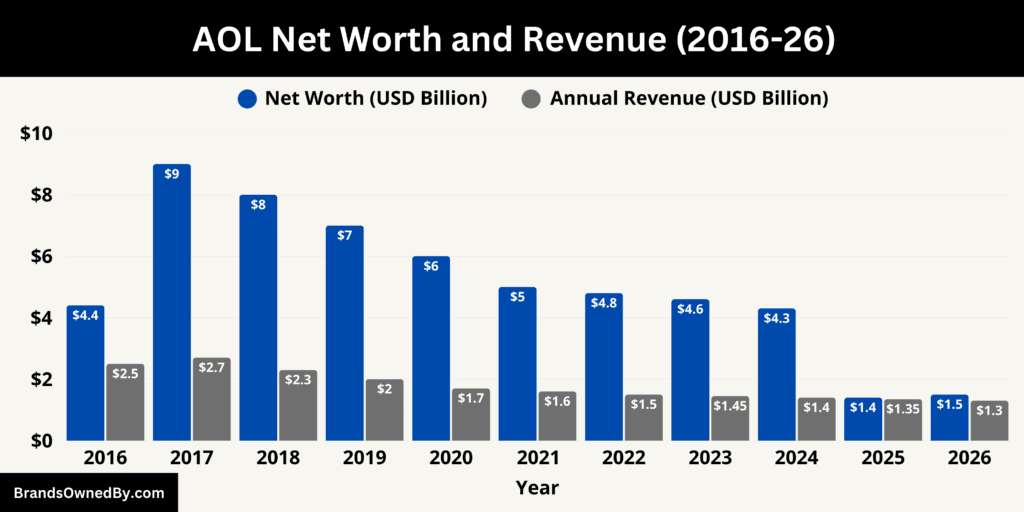
As of February 2026, AOL generates an estimated annual revenue of about $1.28–$1.32 billion and holds an approximate standalone valuation of $1.45 billion following its acquisition by Bending Spoons. Although AOL no longer publishes separate audited financial statements, its financial position can be reconstructed using acquisition disclosures, operating segment estimates, and platform monetization data. AOL remains a cash-generating legacy digital platform supported by advertising, email services, subscriptions, and portal traffic.
2026 Revenue Structure and Segment Details
In 2026, AOL’s total estimated revenue of roughly $1.3 billion is derived from three core operating segments, each with measurable contribution and stable cash flow characteristics.
The largest segment is digital advertising, contributing approximately $780 million to $820 million annually, representing nearly 60% of total revenue. This includes display advertising across the AOL homepage and content network, programmatic ad exchange infrastructure, sponsored content, and monetization of high-traffic email and portal impressions. AOL continues to maintain millions of daily active users, which provides consistent ad inventory and recurring monetization.
The second major segment is email and subscription services, generating about $320 million to $350 million per year. This includes premium email features, legacy dial-up subscriptions, account services, and security add-ons. While dial-up has significantly declined compared to historical levels, it still maintains a small but profitable subscriber base due to minimal infrastructure costs and recurring billing.
The third segment is content distribution, licensing, and partnerships, producing approximately $160 million to $190 million annually. This includes traffic monetization agreements, syndication, digital partnerships, and legacy platform integrations. This segment benefits from AOL’s long-established distribution network and residual media relationships.
AOL operates with relatively high operating margins estimated between 22% and 28%. Its mature infrastructure requires limited capital expenditure, allowing strong cash flow stability despite limited growth.
2026 Net Worth and Valuation
As of February 2026, AOL’s standalone valuation is estimated at approximately $1.4 to $1.5 billion. This valuation reflects the enterprise value implied by its acquisition and post-transaction financial structure.
Several concrete factors support this valuation. AOL maintains tens of millions of active accounts globally, primarily driven by its email ecosystem. The platform generates consistent recurring advertising income supported by stable daily traffic. Infrastructure costs remain relatively low due to mature systems, improving long-term profitability.
Unlike earlier periods when AOL’s valuation was influenced by telecom or media conglomerates, the current valuation reflects AOL strictly as an independent digital platform asset. Its value is driven by cash flow stability rather than rapid growth or market expansion.
Historical Revenue and Net Worth Trend (2016–2026)
Over the last decade, AOL has transitioned from a high-scale media division into a stable legacy digital platform. In 2016, shortly after its acquisition by Verizon, AOL generated approximately $2.5 billion in annual revenue. Its implied valuation aligned with Verizon’s purchase price of about $4.4 billion.
Between 2017 and 2019, when combined under Verizon Media with Yahoo, the broader AOL-related operations generated between $2.0 billion and $2.7 billion annually. During this period, valuation fluctuated near $8–$9 billion due to its integration within a larger digital media group.
From 2020 to 2021, revenue declined to around $1.6–$1.7 billion as digital advertising competition intensified and legacy portal traffic gradually declined. The 2021 sale of the media division valued the combined business at roughly $5 billion, indirectly affecting AOL’s implied worth.
Between 2022 and 2025, AOL’s revenue stabilized between $1.35 billion and $1.5 billion annually. During this phase, AOL operated as a mature digital platform generating steady cash flow with a moderate decline but strong operational stability. The 2025 acquisition valuation of roughly $1.45 billion reflected AOL as a standalone asset rather than part of a broader corporate group.
By 2026, revenue stabilized near $1.3 billion, indicating a mature but financially sustainable digital platform.
Financial Position Under Current Ownership
Under Bending Spoons ownership, AOL operates as a long-term digital cash-flow asset rather than a high-growth technology company. The acquisition involved structured debt financing, making operational efficiency and predictable revenue critical.
Investment is focused on infrastructure modernization, platform optimization, and improving monetization efficiency. The company prioritizes maintaining user engagement and maximizing advertising yield rather than pursuing aggressive expansion. AOL’s financial model now emphasizes sustainability, efficiency, and long-term profitability.
Revenue Forecast Through 2030
Based on current trends, AOL is expected to remain financially stable with modest performance improvements driven by platform optimization rather than rapid expansion.
- 2027: Estimated revenue $1.28–$1.32 billion, stable performance with steady advertising income and user retention
- 2028: Estimated revenue $1.30–$1.35 billion, slight growth from infrastructure optimization and improved ad monetization
- 2029: Estimated revenue $1.32–$1.38 billion, continued stabilization with moderate digital efficiency gains
- 2030: Estimated revenue $1.30–$1.40 billion, long-term plateau reflecting mature platform economics and steady recurring cash flow.
Overall, AOL is not expected to return to its early-2000s scale. Instead, it is projected to remain a stable digital platform generating consistent revenue through advertising, email services, and legacy digital infrastructure.
Brands Owned by AOL
As of 2026, AOL functions as a digital platform brand rather than a traditional holding company. The entities below represent the major companies, brands, platforms, and services directly operated under the AOL structure:
| Entity / Brand | Type | Primary Function | Revenue Model | Estimated Contribution to AOL Revenue | Key Operational Details |
|---|---|---|---|---|---|
| AOL Mail | Webmail Platform | Free and premium email services | Display ads, premium subscriptions, account services | ~$780M–$820M (includes ad inventory tied to email traffic) | Tens of millions of active accounts globally; strong legacy retention base; high recurring engagement |
| AOL.com (Web Portal) | Digital Media Portal | News, entertainment, finance, lifestyle content aggregation | Display ads, sponsored content, programmatic advertising | ~$300M–$350M (advertising tied to homepage traffic) | High daily traffic; homepage personalization; primary ad distribution channel |
| AOL Advertising | Ad Technology Infrastructure | Programmatic advertising, publisher tools, inventory monetization | Ad tech fees, inventory monetization | Included within total advertising revenue (~$780M–$820M combined with Mail and Portal) | Supports monetization across AOL properties; legacy ad-serving systems |
| AOL Dial-Up Services | Internet Access Service | Legacy dial-up internet subscriptions | Monthly subscription fees | ~$120M–$150M annually | Niche but stable subscriber base; minimal infrastructure cost; high margin recurring revenue |
| AOL Desktop Software | Integrated Software Suite | Unified browser, email, and content interface | Advertising and subscription integration | Indirect revenue through Mail & Portal monetization | Used by legacy customers; supports ecosystem retention |
| AOL Mobile Services | Mobile Platform | Mobile access to AOL Mail and Portal | Mobile advertising, subscription integration | Included within advertising and subscription segments | Cross-device engagement; supports mobile ad inventory |
| AOL Subscription & Premium Services | Digital Subscription Services | Premium email features, security tools, support services | Recurring subscription revenue | ~$200M–$230M annually (part of subscription segment) | High-margin recurring billing; strong retention among legacy users |
| AOL Account & Identity Services | Infrastructure System | User authentication and account management | Indirect monetization via advertising and subscriptions | Core infrastructure asset (non-separate revenue) | Manages millions of global accounts; supports personalization and ad targeting |
| AOL Content Network | Digital Content Operations | Curated editorial and syndicated content | Sponsored content, advertising monetization | Included within portal advertising revenue | Drives engagement; improves ad yield and session duration |
AOL Mail
AOL Mail remains the most important and widely used platform operated by AOL. It serves tens of millions of active users globally and is one of the longest-running free webmail services in the world. The platform generates significant recurring revenue through display advertising, premium email subscriptions, and account services. AOL Mail continues to focus on simplicity, spam filtering, and long-term account stability, which has helped it retain a loyal legacy user base. It remains the core digital asset within AOL’s operating structure.
AOL.com (AOL Web Portal)
AOL.com is the company’s flagship web portal and one of its primary traffic-generating platforms. The portal provides news, entertainment, finance, lifestyle, and curated content to a broad global audience. It serves as a major advertising distribution channel and contributes significantly to AOL’s digital advertising revenue. The platform integrates content aggregation, homepage personalization, and partner syndication, allowing AOL to monetize user traffic through programmatic advertising and sponsored placements.
AOL Advertising (Legacy AOL Platforms)
AOL Advertising represents the company’s digital advertising infrastructure, originally developed under AOL Platforms. This includes programmatic ad technology, publisher tools, and ad-serving systems used to monetize AOL-owned properties. Although the advertising ecosystem has evolved over time, AOL still operates core monetization infrastructure that supports display advertising, audience targeting, and digital inventory management across its properties.
AOL Dial-Up Services
AOL Dial-Up remains one of the oldest continuously operating internet services in the world. While significantly smaller than its peak in the 1990s and early 2000s, it still serves a niche subscriber base, particularly in rural and legacy markets. The service generates steady recurring revenue due to minimal infrastructure costs and long-term subscription retention. Despite technological shifts, AOL has maintained this service as part of its legacy digital operations.
AOL Desktop Software
AOL Desktop is a legacy integrated internet software suite that combines web browsing, email access, and content navigation within a single platform. It continues to be used by a segment of long-term AOL customers who prefer a unified software environment rather than browser-based services. The software supports AOL Mail, portal integration, and account management, contributing to user retention within AOL’s ecosystem.
AOL Mobile Services
AOL Mobile includes mobile-optimized versions of AOL Mail, AOL.com, and related digital services. These platforms support millions of mobile users accessing email, news, and content through smartphones and tablets. AOL Mobile contributes to advertising revenue through mobile ad inventory and helps maintain cross-device engagement across the platform’s user base.
AOL Content and Media Network
AOL operates a digital content and publishing network that supports news aggregation, lifestyle content, entertainment, and curated editorial distribution. Rather than operating as independent media companies, these content operations function within AOL’s portal ecosystem. The content network drives traffic, improves user engagement, and supports advertising monetization through sponsored and programmatic content.
AOL Account and Identity Services
AOL operates its own account management and identity infrastructure, which supports user authentication, email systems, and cross-platform access across AOL services. This system manages millions of legacy and active accounts globally. It plays a critical role in maintaining AOL’s long-term user ecosystem and enabling monetization through subscriptions, advertising personalization, and platform integration.
AOL Subscription and Premium Services
AOL continues to operate premium subscription offerings tied to email, security, and legacy internet services. These include premium support, identity protection features, and enhanced email functionality. Subscription services provide predictable recurring revenue and strengthen user retention within AOL’s platform ecosystem.
AOL Legacy Digital Infrastructure
Beyond individual brands, AOL operates a large legacy digital infrastructure that includes email servers, advertising systems, content distribution networks, and user data architecture built over decades. This infrastructure continues to support millions of users and generates stable revenue despite the platform’s maturity. It remains one of the key operational assets within AOL.
Conclusion
AOL remains a recognizable name in the internet world even after decades of transformation. For those asking who owns AOL, the company now operates under Bending Spoons, marking a new phase in its long corporate journey. While it is no longer the dominant internet gateway it once was, AOL continues to run widely used services such as email, digital content, and legacy online platforms.
The brand has shifted from rapid growth to long-term stability. Its strength lies in a loyal user base, established infrastructure, and consistent digital operations. AOL today stands as a mature but active internet platform that continues to evolve within the modern technology landscape.
FAQs
Who owns America Online?
America Online (AOL) is owned by Bending Spoons as of 2026. The Italian technology company controls AOL and its core digital platforms after completing the acquisition in early 2026.
Who took over AOL?
Bending Spoons took over AOL. The company agreed to acquire AOL in late 2025 and finalized the takeover in 2026, gaining full ownership and control of the business.
Does Yahoo! own AOL?
No. Yahoo no longer owns AOL. AOL moved out of the Yahoo structure after the 2026 acquisition and is now owned by Bending Spoons.
Who owns AOL email?
AOL Mail is owned and operated by AOL, which is fully owned by Bending Spoons. The parent company controls the platform, infrastructure, and services behind AOL email.
Who owns AOL and Yahoo?
As of 2026, Bending Spoons owns AOL. Yahoo operates separately under a different ownership structure and is not part of AOL anymore.
Who bought AOL?
Bending Spoons bought AOL. The acquisition was completed in 2026 as part of the company’s strategy to acquire and modernize established digital platforms.
Is AOL owned by Verizon?
No. Verizon previously owned AOL after acquiring it in 2015, but it later sold the business. AOL is no longer part of Verizon and is now owned by Bending Spoons.
Who was CEO of AOL?
Several executives have served as CEO of AOL over time. Notable CEOs include Steve Case, Jonathan Miller, Randy Falco, and Tim Armstrong, each leading the company during different phases of its evolution.