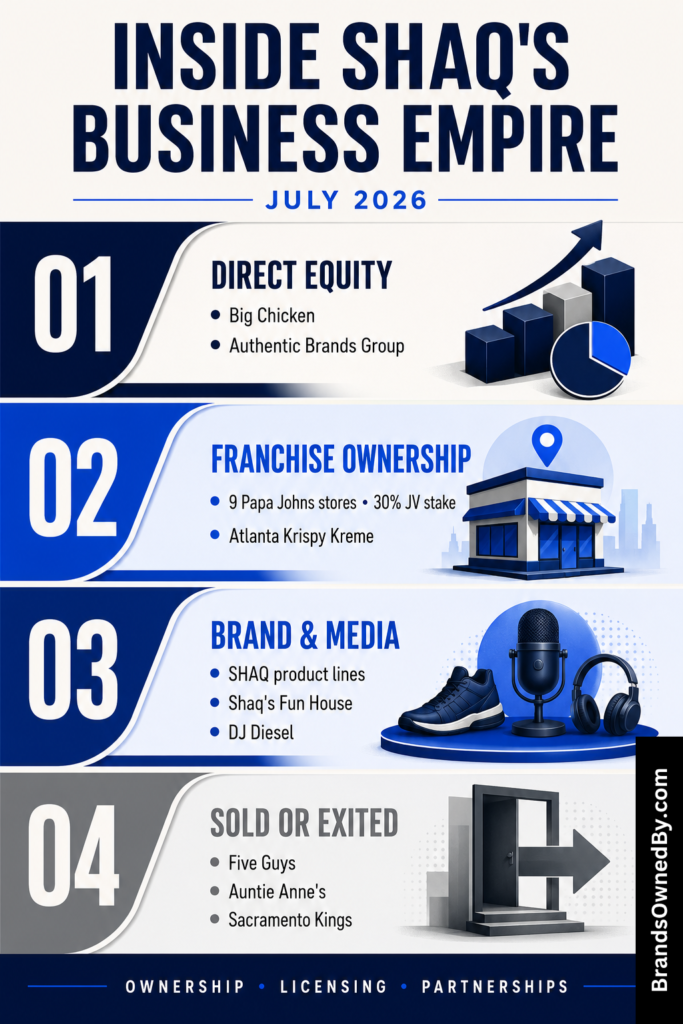
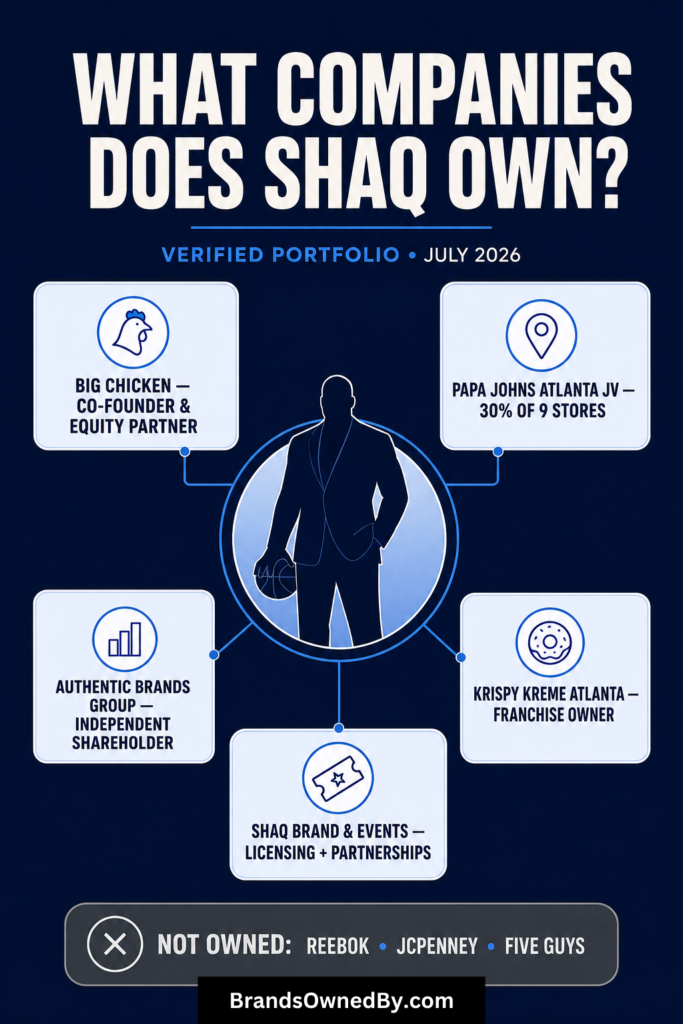
- Shaquille O’Neal is an equity partner and co-founder of Big Chicken, alongside JRS Hospitality, Authentic Brands Group, and Craveworthy Brands.
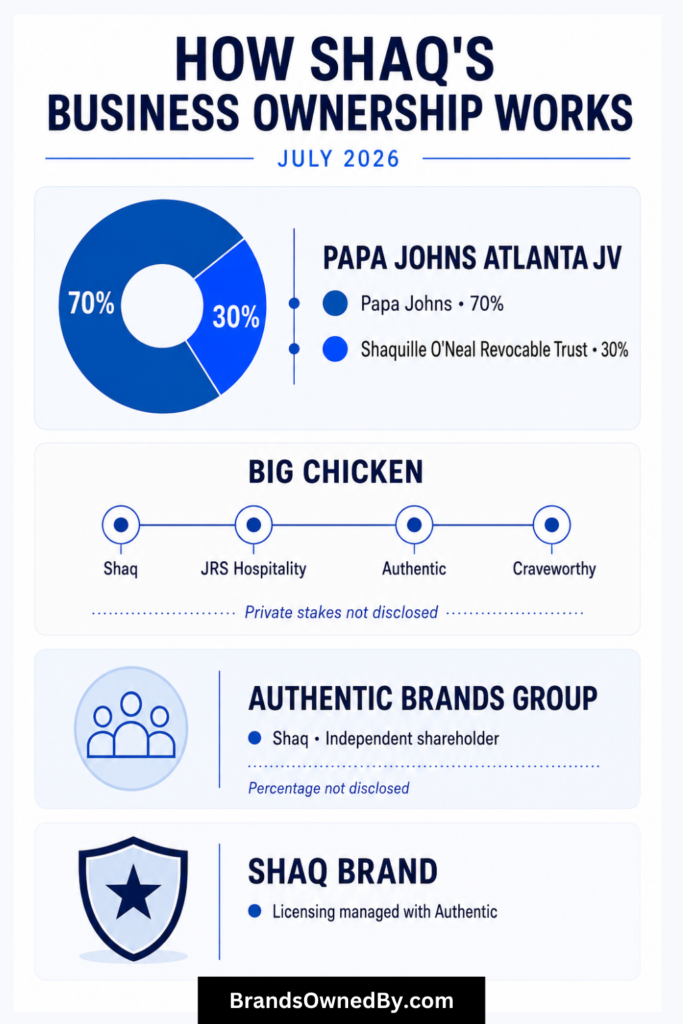
- The Shaquille O’Neal Revocable Trust owns 30% of O’Neal Boyz, LLC, which operates nine Papa John’s restaurants in the Atlanta area. Papa John’s owns the remaining 70%.
- Shaq owns an interest in Atlanta’s historic Ponce de Leon Krispy Kreme location and is an independent shareholder in Authentic Brands Group.
- Five Guys, Auntie Anne’s, and the Sacramento Kings are former investments. Reebok, JCPenney, and The General are partnerships or indirect associations, not companies Shaq personally owns.
Shaquille Rashaun O’Neal is the founder and central economic force behind the Shaq business portfolio. There is no single public company called “Shaq Holdings” that contains every investment.
Instead, his interests are held through private companies, trusts, joint ventures, licensed brands, franchise entities, and investment partnerships. Each business has its own ownership arrangement.
O’Neal was born in Newark, New Jersey, in 1972. His business capital initially came from basketball salaries and endorsement deals. He earned approximately $292 million in NBA salary during his 19-season career. That figure excludes sponsorship income.
His earliest financial lesson came shortly after signing his first professional contract. O’Neal has explained that he spent heavily before understanding taxes and long-term financial planning. He later hired qualified advisers and adopted a more disciplined investment model.
Origin of the Shaq Business Portfolio
O’Neal’s business strategy developed in several stages.
The first stage involved endorsements and affordable consumer products. His original SHAQ footwear strategy focused on selling lower-priced shoes through mass-market retailers. This distinguished the brand from premium basketball footwear.
The second stage centered on franchises. O’Neal invested in proven businesses rather than attempting to build every concept from the beginning. Five Guys, Auntie Anne’s, Krispy Kreme, fitness centers, and car washes became part of this strategy.
The third stage focused on intellectual property. In 2015, Authentic Brands Group acquired the right to manage Shaq’s name, likeness, endorsements, and merchandise. O’Neal retained a significant economic interest and became an Authentic shareholder.
The fourth stage involved building original brands. Big Chicken, Shaq’s Fun House, SHAQ product lines, DJ Diesel, and the Dunkman professional league are examples.
This progression is important. Shaq moved from being paid to promote companies toward retaining equity, licensing income, and ownership rights.
List of Companies Owned by Shaq
Below is a list of the major companies and brands owned by Shaquille O’Neal:
Big Chicken
Big Chicken is the most recognizable operating restaurant brand associated with Shaquille O’Neal.
The fast-casual concept launched in 2018. Its menu draws inspiration from meals prepared by O’Neal’s mother, Lucille. The menu includes oversized chicken sandwiches, tenders, wings, shakes, and macaroni and cheese.
Big Chicken is not wholly owned by Shaq. It is a privately held partnership backed by:
- Shaquille O’Neal.
- JRS Hospitality.
- Authentic Brands Group.
- Craveworthy Brands.
The final bullet list item ends with a period as required.
Craveworthy Brands became a managing partner, investor, and stakeholder in 2025. The company provides operational support covering training, supply chains, restaurant systems, and franchise development.
Big Chicken had more than 40 locations open when the Craveworthy partnership was announced. It also reported more than 350 locations in development. A development commitment does not mean every proposed restaurant will open. Franchise deals can be delayed, transferred, or canceled.
Shaq’s ownership percentage has not been publicly disclosed. Therefore, describing him as the sole owner would be inaccurate. He is a founding equity partner and the brand’s central public identity.
A practical example is a franchised Big Chicken restaurant in another state. The local franchisee may own and operate that location. The underlying brand remains controlled through the Big Chicken partnership. Shaq benefits through his equity and licensing position rather than personally managing each restaurant.
O’Neal Boyz, LLC and the Papa John’s Atlanta Joint Venture
Shaq owns part of O’Neal Boyz, LLC. This company operates nine Papa John’s restaurants in the Atlanta area.
The ownership structure is publicly documented:
- Papa John’s owns approximately 70%.
- The Shaquille O’Neal Revocable Trust owns approximately 30%.
The final bullet list item ends with a period as required.
O’Neal originally contributed approximately $840,000 for his 30% interest. The arrangement began in 2019.
The joint venture generated $914,550 in combined net income for its partners in 2024. Papa John’s earned $640,185 based on its majority interest. Shaq’s trust earned $274,365.
This provides a practical illustration of Shaq’s franchise strategy. He does not own the entire Papa Johns chain. He owns a minority position in an entity operating nine branded restaurants.
O’Neal also served on the Papa Johns board from 2019 until 2024. He did not stand for reelection because of his business and broadcasting schedule. He continued as a franchise partner and brand representative after leaving the board.
Atlanta Krispy Kreme Franchise
Shaq owns an interest in the historic Krispy Kreme restaurant on Ponce de Leon Avenue in Atlanta.
He acquired the franchise in 2016. The location originally opened in 1965 and became an Atlanta landmark.
A fire severely damaged the store in 2021. O’Neal committed to rebuilding it. The reconstructed restaurant reopened with a modernized layout, drive-thru service, and an expanded doughnut-production area.
This ownership does not give Shaq control over Krispy Kreme, Inc. It gives him an interest in a specific franchised location operating under the Krispy Kreme system.
The ownership percentage within the local franchise entity has not been publicly disclosed.
Authentic Brands Group
Shaquille O’Neal is an independent shareholder in Authentic Brands Group, commonly known as Authentic.
Authentic is a private brand management, licensing, sports, media, and entertainment company. Its portfolio includes Reebok, Sports Illustrated, Brooks Brothers, Forever 21, and numerous celebrity-related brands.
In 2015, Authentic acquired the right to manage Shaq’s name and licensing business. The transaction converted part of his personal brand into an institutional licensing platform. O’Neal received an economic interest in Authentic as part of the relationship.
His exact percentage is private.
Some reports have described him as Authentic’s second-largest individual shareholder. However, Authentic has added investors and other celebrity shareholders over time. Its current official shareholder materials do not publish individual ownership percentages.
Shaq’s Authentic investment gives him indirect exposure to the performance of the wider company. It does not mean he personally owns every brand in Authentic’s portfolio.
For example, Authentic owns Reebok. Shaq is an Authentic shareholder and serves as president of Reebok Basketball. That combination gives him influence and indirect economic exposure. It does not make him Reebok’s sole owner.
The SHAQ Brand
The SHAQ name operates as a commercial brand across footwear, apparel, nutrition, merchandise, fragrances, food, entertainment, and other categories.
The brand is managed through the relationship between O’Neal and Authentic. ABG-Shaq, LLC appears in commercial and endorsement arrangements involving his name and services.
The ownership structure is more complex than a conventional celebrity-owned company. Authentic controls or manages key commercial rights. O’Neal remains the personality behind the brand and retains a significant economic interest.
The model allows specialist companies to manufacture and distribute products. Shaq and Authentic can earn licensing income without owning every factory, retailer, or distributor.
SHAQ Footwear
SHAQ Footwear is a licensed consumer brand associated with O’Neal.
Its positioning differs from many athlete-backed footwear businesses. Shaq has consistently emphasized affordability. The products are commonly sold through mass-market and department-store channels.
O’Neal does not personally manufacture the shoes. Product development, manufacturing, distribution, and retail operations are handled by commercial partners.
The SHAQ brand benefits from licensing revenue and continued consumer recognition. This makes footwear an intellectual-property business rather than a directly operated shoe manufacturer.
Shaquille O’Neal XLG
Shaquille O’Neal XLG is a big-and-tall clothing brand sold through JCPenney.
The collection includes suits, shirts, activewear, outerwear, underwear, sleepwear, accessories, and footwear. Sizes extend into categories that are often underserved by conventional fashion brands.
XLG is connected to the SHAQ licensing platform. It does not mean Shaq owns JCPenney.
JCPenney is a retail and operating partner. It sells the merchandise and provides national distribution. Shaq’s side contributes the brand identity, product positioning, and associated licensing rights.
Shaq-A-Licious XL Gummies
Shaq-A-Licious XL Gummies is a candy line developed with The Hershey Company.
The products use O’Neal’s name and larger-than-standard shapes as their primary branding concept. The line has also supported promotional collaborations with convenience retailers.
The product demonstrates how Shaq’s licensing model works. Hershey produces and distributes the candy. The SHAQ brand supplies the identity and promotional reach.
Shaq does not own Hershey. Shaq-A-Licious is best classified as a branded licensing collaboration rather than an independently operated confectionery company.
Shaq’s Fun House
Shaq’s Fun House is a live entertainment and hospitality platform built around major sporting weekends.
It combines concerts, DJ performances, food, carnival attractions, corporate sponsorships, and premium hospitality. The event has become particularly associated with Super Bowl weekend.
O’Neal created the concept with Medium Rare. Medium Rare produces and operates the event platform. Authentic also participates through Shaq’s brand and commercial rights.
Shaq’s Fun House returned for its eighth edition in San Francisco in February 2026. That continuity gives it more commercial value than a one-time celebrity appearance.
However, its internal equity percentages are private. It should be described as a Shaq-created event brand operated with specialist partners.
DJ Diesel and Shaq’s Bass All-Stars
DJ Diesel is Shaq’s electronic-music identity.
The brand supports festival appearances, recorded music, merchandise, sponsorships, and the Shaq’s Bass All-Stars event. It is a revenue-producing entertainment property rather than a separate publicly reported corporation.
This part of the portfolio expands Shaq beyond sports and restaurant ownership. It also reaches a younger audience that may not have watched his NBA career.
The business model combines performance fees with brand licensing, ticketing, sponsorships, and merchandise.
Dunkman Professional League
Shaq founded the Dunkman professional league in 2026 and became its inaugural commissioner.
The league is dedicated to competitive dunking. Its launch format includes 24 athletes, four group-stage events, and a championship event. A $500,000 prize is available to the champion.
The competition is being developed in partnership with TNT Sports. Events are expected to appear across TNT, TBS, truTV, HBO Max, and social platforms.
Equity percentages have not been disclosed. It is therefore more accurate to call Dunkman a Shaq-founded sports venture than to claim he owns 100% of the operating business.
The league could create income from media rights, sponsorships, ticket sales, licensing, and athlete-related content. Its long-term commercial value will depend on audience retention after the initial launch.
Real Estate Partnerships
Shaq has participated in real estate developments, particularly in Newark, New Jersey.
He has worked with Boraie Development on residential, retail, and entertainment projects. These have included One Rector Street and the 777 McCarter apartment development.
This is partnership-based ownership. Boraie handles development expertise, construction coordination, financing, and property operations. O’Neal contributes capital, visibility, local relationships, and project support.
Private real estate ventures rarely publish complete capitalization tables. As a result, Shaq’s percentage in each development is not available.
Car Washes and Fitness Centers
Shaq has repeatedly been associated with approximately 150 car washes and 40 fitness locations.
These figures originated in older reports about his private franchise portfolio. There is no current public filing that identifies every location, holding company, ownership percentage, or subsequent sale.
It is reasonable to describe these businesses as reported private operating investments. It is not reasonable to present the historical totals as fully verified July 2026 location counts.
This distinction matters because private franchise portfolios change regularly. Locations may be sold, closed, refinanced, or transferred into new ownership entities.
Private Technology and Consumer Investments
Shaq has invested in technology and consumer companies at different stages of their development.
His best-known early investment was Google before its 2004 initial public offering. He has also been connected to Ring, Lyft, Vitaminwater, Muscle Milk, Beachbody, and other companies.
These positions should not be treated as current controlled companies. Ring was acquired by Amazon. Vitaminwater was acquired by Coca-Cola. Muscle Milk was acquired by Hormel. The status and size of any remaining public-company holdings are private.
These investments contributed to Shaq’s wealth. They are not companies he currently controls.
Who Owns Shaq’s Businesses?
Shaquille O’Neal owns his personal assets through trusts, private entities, and contractual arrangements.
The more useful question is who owns the businesses and commercial rights associated with the Shaq brand.
Shaquille O’Neal and His Trust
O’Neal is the beneficial owner behind his personal investment portfolio.
The Shaquille O’Neal Revocable Trust owns 30% of O’Neal Boyz, LLC. The trust can also hold investments and protect continuity in estate and financial planning.
A revocable trust does not mean another person owns Shaq’s assets. O’Neal generally retains control of the trust while he is alive and legally capable.
Papa John’s International: 70% of O’Neal Boyz, LLC
Papa John’s owns approximately 70% of the joint venture operating the nine Atlanta restaurants.
This gives Papa John’s majority economic ownership of that specific entity. It does not give the company control over Shaq’s wider investment portfolio.
Shaquille O’Neal Revocable Trust: 30% of O’Neal Boyz, LLC
Shaq’s trust owns the remaining 30%.
This is the clearest publicly disclosed percentage within his current restaurant portfolio.
Big Chicken Partners
Big Chicken is backed by Shaquille O’Neal, JRS Hospitality, Authentic Brands Group, and Craveworthy Brands.
The company has not published the percentage held by each partner. Any article assigning exact percentages would be speculative.
Craveworthy has operational influence as the managing partner. Shaq retains strategic importance as a founder, shareholder, and the public identity of the brand.
Authentic Brands Group
Authentic manages important commercial rights attached to Shaq’s name, likeness, merchandise, and endorsements.
It does not own Shaquille O’Neal as a person. Its rights arise from a commercial agreement.
O’Neal remains an independent shareholder in Authentic. His exact percentage has not been disclosed.
Authentic’s Major Shareholders
Authentic is privately held. Its institutional shareholder group includes General Atlantic, CVC Capital Partners, HPS Investment Partners, Leonard Green & Partners, GIC, Brookfield, Lion Capital, Jasper Ridge Partners, Temasek, Qatar Investment Authority, and Oaktree.
Independent shareholders include Shaquille O’Neal, David Beckham, and Kevin Hart.
Authentic does not publish percentage ownership for these shareholders. Therefore, credible ownership analysis must list the investors without manufacturing percentages.
Competitor Ownership Comparison
Shaq competes with other athlete-entrepreneurs for investment opportunities, licensing partnerships, media audiences, and consumer attention. However, each has built wealth through a different ownership model. Magic Johnson focuses on institutional investments and professional sports teams. Michael Jordan relies heavily on premium licensing and sports ownership. LeBron James and Kevin Durant emphasize media and venture capital. Shaq’s model stands out for combining affordable consumer products, restaurant franchises, entertainment ventures, endorsements, and private equity interests.
Magic Johnson Enterprises
Magic Johnson’s portfolio is more centralized than Shaq’s.
Magic Johnson Enterprises operates as an established investment conglomerate. Johnson serves as chairman and CEO. Its interests have included financial services, infrastructure, real estate, food services, entertainment, and professional sports.
Johnson’s reported 60% ownership of EquiTrust Life Insurance gives him a significant controlling asset. He also holds minority interests in teams including the Los Angeles Dodgers, Los Angeles Sparks, LAFC, Washington Commanders, and Washington Spirit.
Shaq’s portfolio is more dependent on personal-brand licensing, restaurants, franchises, and entertainment. Johnson has greater exposure to institutional finance and sports-team ownership.
Michael Jordan
Michael Jordan has shifted from NBA team ownership toward racing, premium consumer products, licensing, and investments.
He sold his controlling interest in the Charlotte Hornets in 2023. He remains a co-owner of 23XI Racing with Denny Hamlin and Curtis Polk. Jordan also co-founded Cincoro Tequila.
Jordan’s greatest commercial asset remains his long-term relationship with Nike and the Jordan Brand. However, Nike owns the Jordan Brand business. Jordan receives substantial royalties rather than owning Nike.
Shaq uses a similar licensing principle but targets more affordable, mass-market products. Jordan’s brand occupies a premium position.
LeBron James
LeBron James built a media-focused business portfolio around SpringHill.
SpringHill merged with Fulwell 73 to create a larger entertainment group. The combined business is supported by investors including RedBird Capital Partners, Fenway Sports Group, Nike, Epic Games, and other institutional backers.
James also owns equity in Fenway Sports Group, giving him indirect exposure to sports properties and related businesses.
Compared with Shaq, LeBron’s portfolio places greater emphasis on film, television, branded content, and institutional sports ownership. Shaq’s model is more diversified across licensing, restaurants, live events, broadcasting, and franchises.
Kevin Durant
Kevin Durant and Rich Kleiman co-founded Thirty Five Ventures.
The company includes Boardroom, a sports business media platform, production operations, professional-team interests, and investments in more than 75 companies.
Durant’s strategy resembles an athlete-led venture capital and media platform. Shaq’s strategy relies more heavily on consumer familiarity and everyday retail categories.
Both approaches use personal credibility to gain equity. Durant is more technology-oriented. Shaq is more franchise and licensing-oriented.
Serena Williams
Serena Williams founded Serena Ventures as an early-stage investment firm.
The firm backs companies in software, consumer products, healthcare, financial technology, and other growth sectors. It is more closely structured like a venture capital organization than Shaq’s private portfolio.
Shaq often combines equity with promotion and brand licensing. Serena Ventures evaluates investments through a dedicated institutional platform.
Who Controls Shaq’s Business Empire?
Shaq controls his personal time, public appearances, strategic relationships, and investment decisions.
He determines whether to support a company, appear in advertising, launch a project, or invest personal capital. His credibility is a central asset across the portfolio.
However, he does not manage restaurant shifts, footwear factories, retail stores, or licensing administration.
Authentic Controls Much of the Licensing Process
Authentic manages major parts of the SHAQ intellectual-property business.
Its responsibilities include finding licensees, negotiating commercial relationships, protecting trademarks, extending products into new categories, and coordinating brand marketing.
This gives Authentic meaningful operational influence over commercial uses of the SHAQ brand.
Craveworthy Manages Big Chicken Operations
Craveworthy Brands has a managing role at Big Chicken.
Its responsibilities include restaurant systems, franchisee support, supply-chain management, training, operations, and expansion. Big Chicken’s CEO and operating team handle daily execution.
Shaq influences brand identity, product storytelling, promotion, and strategy. He does not exercise exclusive operational control.
Papa John’s Controls the Atlanta Joint Venture
Papa John’s owns 70% of O’Neal Boyz, LLC. This makes it the majority owner of the nine-store Atlanta joint venture.
Shaq’s trust owns 30%. He participates economically but does not hold majority voting power based on the disclosed ownership structure.
There Is No Central Shaq Board of Directors
Shaq’s businesses do not report to one public holding company or unified board.
Control changes from venture to venture. Shaq may be a founder in one project, a minority shareholder in another, a franchise owner elsewhere, and a licensed personality in a different arrangement.
That decentralized structure is one reason online ownership lists often become inaccurate.
Shaq Annual Revenue and Net Worth
Shaq does not publish consolidated financial statements. His businesses are held through different private entities, trusts, contracts, and partnerships.
Therefore, “Shaq revenue” is better understood as estimated annual income from broadcasting, endorsements, licensing, appearances, investments, franchises, music, and business ventures.
The following figures are analytical estimates. They are not audited revenue or personal tax-return data.
Shaq’s 2026 Annual Income
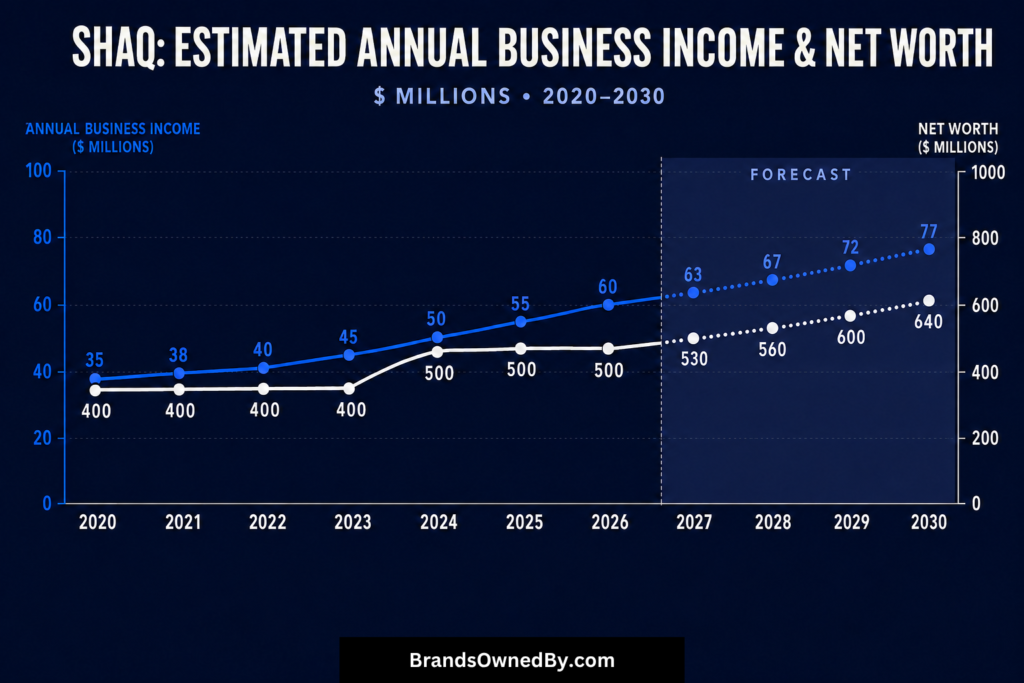
Shaq’s annual business-related income is estimated at approximately $60 million in 2026.
The estimate includes broadcasting compensation, endorsements, licensing, franchise distributions, appearance fees, live entertainment, investment income, and commercial partnerships.
His long-term TNT Sports contract reportedly pays more than $15 million annually. That provides a relatively stable income base.
Other income is less predictable. Licensing payments depend on product sales. Restaurant distributions depend on profitability. Appearance fees and advertising contracts can change from year to year.
Some reports place Shaq’s annual earnings as high as $95 million. However, those estimates may combine gross business revenue, investment appreciation, and endorsement values. A $60 million estimate is more conservative.
Shaq’s Net Worth in 2026
Shaquille O’Neal’s net worth is estimated at approximately $500 million in July 2026.
Net worth is different from cash. The estimate includes the value of private-company interests, investments, real estate, intellectual-property economics, financial assets, and other property. Liabilities and taxes reduce the final amount.
Authentic and Big Chicken are private. Their internal valuations and Shaq’s percentages are not public. This creates a wide margin of uncertainty.
A private investment may become more valuable without producing immediate cash. It can also be difficult to sell.
Revenue and Net Worth Forecast for 2027–2030
Annual business income is forecast to rise from approximately $63 million in 2027 to $77 million in 2030.
This represents a moderate annual growth rate. It assumes continued broadcasting income, stable endorsement demand, expanded SHAQ licensing, and gradual conversion of Big Chicken development agreements into operating restaurants.
The estimate does not assume that all 350 proposed Big Chicken locations will open. Such an assumption would be too aggressive.
Net worth is forecast to increase to approximately $640 million in 2030. The estimate assumes that O’Neal reinvests part of his earnings and that his private assets appreciate at a reasonable rate.
Big Chicken could create upside if franchise expansion produces sustainable royalties and store-level economics. Authentic could also create value through acquisitions, licensing growth, or a future liquidity event.
The Dunkman league offers another possible growth channel. However, a new sports property requires sustained audience demand. It should not receive a large valuation until media viewership, sponsorships, and recurring events are demonstrated.
The forecast does not place Shaq at billionaire status in 2030. Reaching $1 billion would likely require a major liquidity event, exceptional appreciation in Authentic, substantial Big Chicken expansion, or another large investment success.
Risks to the Forecast
Restaurant expansion carries execution risk. Big Chicken has already experienced closures in some markets. Franchise development commitments do not guarantee successful openings.
Personal-brand businesses also depend on reputation, visibility, and consumer relevance.
Private investments are difficult to value. A headline valuation for a company does not translate directly into personal liquid wealth.
Taxes, spending, charitable giving, investment losses, and economic conditions can also affect net worth.
Final Words
Shaquille O’Neal owns a diversified but decentralized business portfolio.
His strongest verified current interests are Big Chicken, the nine-store Papa Johns Atlanta joint venture, an Atlanta Krispy Kreme franchise, and a private Authentic Brands Group shareholding. He also earns from SHAQ product lines, live events, music, broadcasting, real estate partnerships, and licensing.
The important distinction is between ownership and association. Shaq does not own Reebok, JCPenney, Hershey, The General, or Papa John’s as entire companies. He may hold indirect exposure, franchise interests, executive roles, endorsement agreements, or licensing partnerships with them.
That distinction makes his portfolio less sensational than many viral lists. It also makes the underlying strategy more credible. Shaq combines his personal brand with experienced operators instead of attempting to control every business himself.
FAQs
What companies does Shaq currently own?
Shaq’s verified current portfolio includes an equity interest in Big Chicken, a 30% interest in the nine-store O’Neal Boyz Papa John’s joint venture, an interest in Atlanta’s Ponce de Leon Krispy Kreme franchise, and a private shareholding in Authentic Brands Group. He also has economic interests in licensed SHAQ products and entertainment ventures.
Does Shaq own Big Chicken?
Shaq is a co-founder and equity partner in Big Chicken. He does not own 100% of the company. Its other partners include JRS Hospitality, Authentic Brands Group, and Craveworthy Brands.
How much of Papa John’s does Shaq own?
Shaq does not own a disclosed percentage of Papa John’s International. His revocable trust owns 30% of a joint venture that operates nine Papa John’s restaurants in Atlanta. Papa John’s owns the remaining 70%.
Does Shaq still own nine Papa Johns restaurants?
Yes. Current corporate disclosures and Papa John’s consumer materials continue to identify O’Neal as a franchise partner connected to nine Atlanta-area restaurants.
Does Shaq own Krispy Kreme?
Shaq does not own the Krispy Kreme corporation. He owns an interest in the historic Ponce de Leon Krispy Kreme franchise in Atlanta.
Does Shaq own Five Guys?
No. Shaq previously owned 155 Five Guys franchises but sold them. He never owned the Five Guys corporate brand.
Does Shaq own Auntie Anne’s?
No. Shaq previously invested in 17 Auntie Anne’s locations. He later said he sold the investment.
Does Shaq own Reebok?
No. Authentic Brands Group owns Reebok. Shaq is an independent shareholder in Authentic and serves as president of Reebok Basketball. This gives him influence and indirect exposure, but not direct ownership of Reebok.
Does Shaq own JCPenney?
No. Shaq does not own JCPenney. His Shaquille O’Neal XLG apparel collection is sold through the retailer. Authentic, which manages the SHAQ brand, also has an ownership relationship with JCPenney.
Does Shaq own The General insurance company?
No. Shaq is a prominent spokesperson for The General. An endorsement agreement is not the same as company ownership.
How much of Authentic Brands Group does Shaq own?
Shaq’s percentage has not been publicly disclosed. Authentic officially identifies him as an independent shareholder.
Does Shaq own Elvis Presley’s brand?
No. Authentic Brands Group has an ownership interest in Elvis Presley-related intellectual property. Shaq’s stake in Authentic gives him indirect exposure to the company’s overall performance. It does not make him the personal owner of the Elvis brand.
How many businesses does Shaq own?
There is no reliable single number. Shaq holds interests through private companies, franchises, trusts, real estate partnerships, licensed products, and investment funds. Public evidence confirms several major holdings, but many private entities do not disclose complete ownership information.
What is Shaq’s net worth in 2026?
Shaquille O’Neal’s estimated net worth is approximately $500 million as of July 2026. The figure is an estimate because his private investments, licensing agreements, and business interests do not publish complete valuations.
Is Shaq a billionaire?
No. Shaq’s estimated $500 million net worth places him well below billionaire status. Strong growth at Big Chicken or a major liquidity event involving Authentic could increase his wealth, but billionaire projections remain speculative.