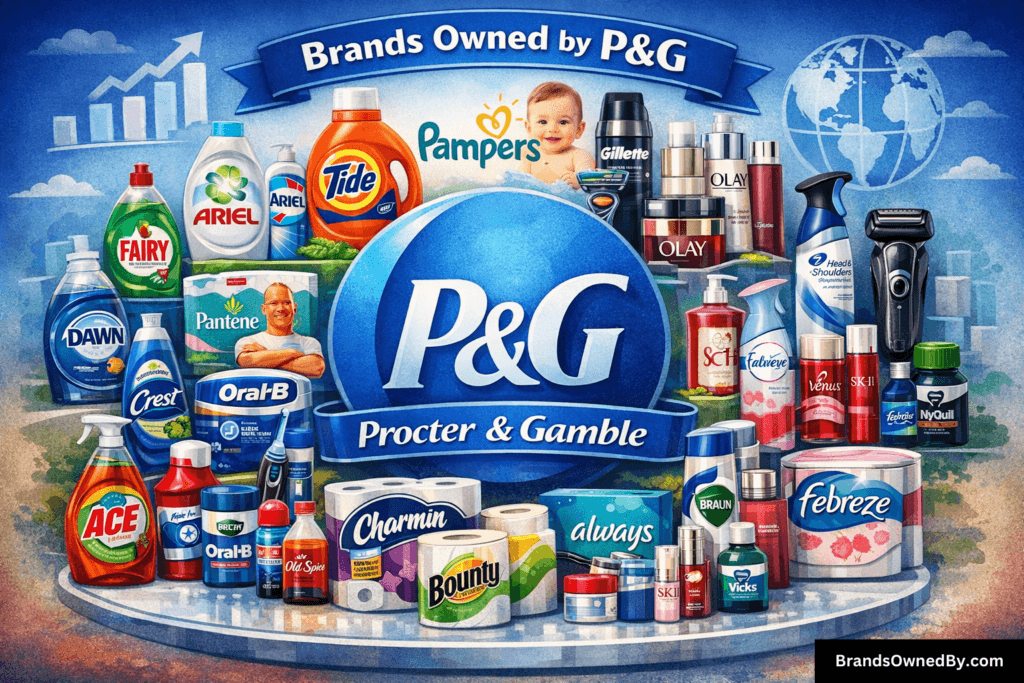
Procter & Gamble is one of the most dominant consumer goods companies in the world. Its brands are not niche or seasonal purchases—they are daily-use products embedded into households across the globe. From laundry detergent and diapers to razors, skincare, toothpaste, and health remedies, Procter & Gamble products are used by more than 5 billion consumers every day.
As of January 2026, Procter & Gamble owns and operates 65+ active consumer brands, many of which hold global leadership positions in their respective categories. Unlike companies that manage hundreds of small labels, P&G has deliberately narrowed its portfolio to focus on high-scale, high-margin, and high-loyalty brands that can dominate shelf space and command pricing power.
This guide provides the most accurate, fully updated, and in-depth explanation of brands owned by Procter & Gamble, reflecting current ownership, portfolio strategy, and market realities in 2026.
Complete List of Brands Owned by Procter & Gamble
This table reflects active brands owned by Procter & Gamble as of January 2026:
| Brand Name | Primary Category | Segment | Geographic Scope |
|---|---|---|---|
| Tide | Laundry Detergent | Fabric Care | Global |
| Ariel | Laundry Detergent | Fabric Care | Global (ex-US focus) |
| Gain | Laundry Products | Fabric Care | Primarily North America |
| Downy | Fabric Conditioner | Fabric Care | Global |
| Febreze | Air & Fabric Fresheners | Home Care | Global |
| Dawn | Dishwashing Liquid | Home Care | North America |
| Cascade | Dishwasher Detergent | Home Care | North America |
| Mr. Clean | Household Cleaners | Home Care | Global |
| Comet | Household Cleaners | Home Care | Regional |
| Pampers | Baby Diapers & Wipes | Baby Care | Global |
| Luvs | Baby Diapers | Baby Care | North America |
| Always | Feminine Hygiene | Feminine Care | Global |
| Tampax | Tampons | Feminine Care | Global |
| Charmin | Toilet Paper | Family Care | North America |
| Bounty | Paper Towels | Family Care | North America |
| Puffs | Facial Tissues | Family Care | North America |
| Olay | Skincare | Beauty | Global |
| SK-II | Premium Skincare | Beauty | Asia-focused |
| Pantene | Hair Care | Beauty | Global |
| Head & Shoulders | Anti-Dandruff Hair Care | Beauty | Global |
| Herbal Essences | Hair Care | Beauty | Global |
| Aussie | Hair Care | Beauty | North America |
| Old Spice | Men’s Grooming | Personal Care | Global |
| Secret | Women’s Deodorant | Personal Care | North America |
| Native | Natural Deodorant | Personal Care | North America |
| Gillette | Men’s Shaving | Grooming | Global |
| Venus | Women’s Shaving | Grooming | Global |
| Braun | Electric Grooming Devices | Grooming | Global |
| Crest | Toothpaste | Oral Care | Global |
| Oral-B | Toothbrushes & Oral Devices | Oral Care | Global |
| Vicks | Cold & Flu Remedies | Health Care | Global |
| Fairy | Dishwashing Liquid | Home Care (Regional) | Europe |
| Ace | Bleach & Fabric Care | Home Care (Regional) | Southern Europe |
| Ambi Pur | Air Fresheners | Home Care (Regional) | Europe |
| Rejoice | Hair Care | Beauty (Regional) | Asia |
Top Procter & Gamble Brands by Estimated Revenue (2026)
The table below shows the estimated annual revenue of top P&G brands as of January 2026:
| Rank | Brand | Primary Category | Estimated Annual Revenue (USD) | Strategic Importance |
|---|---|---|---|---|
| 1 | Tide | Fabric Care (Laundry) | $12–14 billion | P&G’s most valuable brand; core profit engine |
| 2 | Pampers | Baby Care | $8–10 billion | Global baby care leader; lifetime customer value |
| 3 | Gillette | Grooming & Shaving | $7–9 billion | High-margin razor-and-blade ecosystem |
| 4 | Ariel | Fabric Care (Laundry) | $6–8 billion | Tide-equivalent outside North America |
| 5 | Olay | Skincare | $5–6 billion | Flagship skincare and beauty growth driver |
| 6 | Crest | Oral Care | $4–5 billion | Daily-use oral health staple |
| 7 | Head & Shoulders | Hair Care | $4–5 billion | Global anti-dandruff category leader |
| 8 | Oral-B | Oral Care Devices | $3–4 billion | Premium electric toothbrush dominance |
| 9 | Always | Feminine Care | $3–4 billion | High-repeat, trust-driven hygiene brand |
| 10 | Febreze | Home Care | $2–3 billion | Innovation-led odor elimination platform |
Top Procter & Gamble Brands by Market Share (2026)
The table below highlights the top brands by Procter & Gamble based on each brand’s market share as of January 2026:
| Rank | Brand | Category | Estimated Market Share | Market Scope |
|---|---|---|---|---|
| 1 | Tide | Laundry Detergent | 40% | United States |
| 2 | Pampers | Baby Diapers | 28% | Global |
| 3 | Gillette | Men’s Shaving | 50% | Global |
| 4 | Ariel | Laundry Detergent | 23% | Europe & Asia |
| 5 | Head & Shoulders | Anti-Dandruff Shampoo | 44% | Global |
| 6 | Crest | Toothpaste | 33% | United States |
| 7 | Oral-B | Electric Toothbrushes | 46% | Global |
| 8 | Always | Feminine Hygiene Pads | 29% | Global |
| 9 | Charmin | Toilet Paper (Premium) | 31% | United States |
| 10 | Dawn | Dishwashing Liquid | 37% | United States |
Overview of Procter & Gamble’s Brand Portfolio Strategy
Procter & Gamble does not pursue growth by accumulating brands. Instead, the company follows a portfolio concentration strategy that prioritizes a limited number of category-leading brands with global scalability.
Over the past decade, P&G intentionally reduced its brand count from 170+ brands to roughly 65 core brands. This was not a cost-cutting move—it was a strategic shift designed to improve focus, efficiency, and long-term profitability. Brands that lacked global scale, pricing power, or strategic fit were sold, spun off, or discontinued.
Today, P&G evaluates its brands using several strict criteria:
- Ability to achieve #1 or #2 market position
- Strong recurring consumer demand
- Global or multi-regional scalability
- High gross margins and pricing power
- Long-term brand equity and trust.
Only brands that meet these standards remain in the portfolio.
How Procter & Gamble Organizes Its Brands
Rather than operating brands independently, Procter & Gamble groups them into integrated business segments. Each segment shares supply chains, R&D resources, marketing capabilities, and distribution networks.
As of 2026, P&G’s brand portfolio is organized across ten core categories, including:
- Baby Care
- Feminine & Family Care
- Fabric Care
- Home Care
- Beauty
- Grooming
- Oral Care
- Personal Health Care
- Skin & Personal Care
- Regional & Market-Specific Brands.
This structure allows P&G to:
- Launch innovations faster
- Scale successful products globally
- Protect market share against private labels
- Increase average household spend across multiple categories.
The result is a portfolio that is deep rather than wide, where a small number of brands generate the majority of revenue and profit.
Why Procter & Gamble Sold Dozens of Brands?
A common misconception is that Procter & Gamble “lost” brands over time. In reality, the company deliberately exited dozens of categories to strengthen its competitive position.
Brands were divested for reasons such as:
- Low margins
- Limited global reach
- Weak brand differentiation
- High operational complexity.
This explains why well-known legacy brands such as CoverGirl, Duracell, Wella, and Clairol are no longer owned by P&G. Their sale allowed P&G to reinvest capital into brands like Tide, Pampers, Gillette, Olay, and Crest—brands that continue to define the company’s identity and earnings power.
This portfolio discipline is one of the key reasons Procter & Gamble remains one of the most profitable consumer goods companies in the world in 2026.
1. Baby, Feminine & Family Care Brands Owned by Procter & Gamble
The Baby, Feminine & Family Care segment is one of the most defensive and resilient pillars of Procter & Gamble’s business. These products are non-discretionary, purchased repeatedly, and used daily across all income levels. As a result, this segment delivers stable cash flow, strong margins, and long-term brand loyalty, even during economic downturns.
P&G dominates this category by operating multiple brands at different price and usage tiers, allowing it to capture households from first-time parents to multi-generational families.
Pampers
Pampers is one of the most valuable brands in Procter & Gamble’s entire portfolio and a cornerstone of its baby care business. The brand is a global leader in disposable diapers and baby wipes, with strong market positions across North America, Europe, Asia, and Latin America.
What makes Pampers strategically critical is its ability to operate across multiple price tiers. The brand offers premium innovation-led products alongside more accessible everyday options, allowing P&G to retain customers as household income levels change. This tiered strategy also helps Pampers defend against private-label competition, which has grown aggressively in the baby care space.
Pampers benefits from significant research and development investment, particularly in areas such as skin health, absorbency technology, and leak protection. These innovations reinforce consumer trust and justify premium pricing in many markets. For P&G, Pampers is not just a product line—it is a lifetime-value brand, capturing customers from infancy through early childhood.
Luvs
Luvs plays a complementary role to Pampers within P&G’s baby care portfolio. While Pampers targets performance and innovation, Luvs focuses on value-conscious parents, particularly in the United States.
Rather than competing directly with Pampers, Luvs allows P&G to defend market share in lower-priced segments where private labels and discount brands are strongest. This prevents competitors from gaining a foothold with first-time parents who may later trade up to Pampers.
Luvs operates with fewer product variations and lower marketing spend, but it remains strategically important as a defensive brand that protects P&G’s overall dominance in baby care.
Always
Always is one of the most recognized feminine hygiene brands in the world and a key contributor to P&G’s Feminine Care segment. The brand specializes in sanitary pads, pantyliners, and period-related products, serving consumers across developed and emerging markets.
The strength of Always lies in brand trust and habitual purchasing behavior. Feminine hygiene products have extremely high repeat usage, and consumers are often reluctant to switch brands once trust is established. This makes Always a reliable, long-term revenue generator for P&G.
In addition to product innovation, Always has invested heavily in brand messaging and education, particularly around menstrual health and accessibility. These efforts strengthen emotional brand connections and reinforce its leadership position globally.
Tampax
Tampax is a flagship tampon brand and one of the most trusted names in feminine hygiene. It complements Always by allowing P&G to dominate multiple subcategories within the same consumer need state.
Tampax benefits from strong scientific positioning, clear product differentiation, and wide retail distribution. The brand’s importance lies not only in its revenue contribution but also in its role in portfolio control—by owning both pads and tampons, P&G reduces the risk of consumers switching to competitors within the category.
Together, Always and Tampax give P&G unmatched coverage of the global feminine hygiene market.
Charmin
Charmin is a premium toilet paper brand and a leader in the U.S. family care market. The brand is known for its emphasis on softness, comfort, and quality, allowing it to command higher price points than many competitors.
From a strategic standpoint, Charmin exemplifies P&G’s ability to premiumize everyday necessities. Toilet paper is a low-involvement product, but Charmin’s branding and quality differentiation enable strong margins and brand loyalty.
Charmin also benefits from P&G’s scale in pulp sourcing, manufacturing, and logistics, giving it cost advantages that smaller competitors cannot match.
Bounty
Bounty is one of the most widely recognized paper towel brands in North America. Marketed around strength and absorbency, Bounty positions itself as a performance-driven household essential.
The brand plays a crucial role in P&G’s Family Care segment by encouraging premium trade-ups. Consumers are often willing to pay more for paper towels that last longer or perform better, and Bounty consistently capitalizes on this behavior.
Like Charmin, Bounty benefits from scale efficiencies and strong retail partnerships, reinforcing P&G’s dominance in household paper products.
Puffs
Puffs is a facial tissue brand best known for lotion-infused tissues designed to reduce skin irritation. While smaller than Charmin or Bounty, Puffs occupies a specific functional niche within family care.
Rather than competing broadly, Puffs focuses on seasonal and health-related usage, such as cold and allergy relief. This targeted positioning allows P&G to maintain presence across multiple tissue use cases without fragmenting its core brands.
Why This Segment Matters to Procter & Gamble
The Baby, Feminine & Family Care segment is strategically important because it delivers:
- Highly predictable demand
- Strong brand loyalty
- Low susceptibility to economic cycles
- Opportunities for premium pricing.
These characteristics make it one of the most stable revenue engines within Procter & Gamble’s broader portfolio and a key reason the company continues to prioritize and invest in these brands.
2. Fabric & Home Care Brands Owned by Procter & Gamble
The Fabric & Home Care segment is the financial backbone of Procter & Gamble. This category alone generates a substantial portion of P&G’s annual revenue and profit due to high purchase frequency, global scale, and premium pricing power.
Laundry and home cleaning products are non-discretionary. Consumers may trade down in price during economic stress, but they rarely stop buying these products. P&G dominates this space by operating multiple category-defining brands, each engineered to own a specific consumer mindset.
Tide
Tide is the most valuable brand owned by Procter & Gamble and one of the most powerful consumer brands globally. It is the undisputed leader in the U.S. laundry detergent market and holds strong positions internationally.
What makes Tide exceptional is its ability to command premium pricing in a commoditized category. Through decades of consistent performance, innovation, and marketing investment, Tide has become synonymous with cleaning effectiveness. For many households, “Tide” is not just a brand—it is the default reference point for laundry detergent.
Tide’s product ecosystem extends far beyond traditional liquid detergent. It includes pods, powders, stain removers, hygienic-clean formulations, and specialty products designed for cold water or sensitive skin. This breadth allows P&G to capture multiple use cases while keeping consumers within the Tide franchise.
Strategically, Tide is protected aggressively by P&G. The company continuously invests in formulation improvements, packaging innovation, and advertising to ensure Tide maintains its leadership position. Losing Tide would materially impact P&G’s financial performance, which is why it remains a non-negotiable core brand.
Ariel
Ariel serves as P&G’s primary laundry detergent brand outside North America, particularly in Europe, Asia, Latin America, and the Middle East. In many of these regions, Ariel plays the same strategic role that Tide plays in the U.S.
Ariel is positioned around superior stain removal and fabric care performance. The brand has been localized extensively, with formulations and messaging tailored to regional washing habits, water conditions, and price sensitivities.
From a portfolio perspective, Ariel allows P&G to maintain global dominance in laundry without forcing Tide into markets where brand recognition or pricing dynamics differ. Together, Tide and Ariel form a two-brand system that covers nearly all major global markets.
Downy
Downy is P&G’s leading fabric conditioner brand and a key complement to its detergent portfolio. Rather than competing with Tide or Ariel, Downy increases basket size per household by adding softness and scent benefits.
Downy has evolved beyond traditional fabric softeners into scent boosters and specialized care products. This expansion has allowed P&G to premiumize a secondary step in the laundry process, significantly improving margins.
The brand also benefits from a strong emotional appeal. Scent and softness are closely tied to consumer perception of cleanliness, making Downy a powerful loyalty driver within the laundry ecosystem.
Gain
Gain occupies a distinct position within P&G’s fabric care lineup by emphasizing bold, long-lasting fragrances. It targets consumers who value scent as much as cleaning performance.
Rather than diluting Tide’s premium positioning, Gain attracts a different consumer profile and helps P&G defend shelf space against niche and fragrance-forward competitors. Gain’s loyal customer base makes it an effective portfolio diversifier within fabric care.
Febreze
Febreze is one of Procter & Gamble’s most successful innovation-driven brands. Originally launched as a fabric refresher, it has expanded into a broad platform for odor elimination and home freshness.
Unlike traditional air fresheners that mask smells, Febreze is marketed around odor-neutralizing technology. This scientific positioning differentiates it from competitors and justifies premium pricing.
Febreze now spans sprays, plug-ins, car fresheners, and fabric refreshers. Strategically, it allows P&G to participate in multiple home care subcategories while maintaining a consistent brand promise.
Dawn
Dawn is a leading dishwashing liquid brand known for grease-cutting performance. It is widely recognized in North America and is often associated with wildlife rescue efforts, which have significantly strengthened brand trust and goodwill.
From a strategic perspective, Dawn benefits from habitual daily use and strong word-of-mouth credibility. It also anchors P&G’s presence in the hand dishwashing category, which remains large despite the growth of dishwashers.
Cascade
Cascade is P&G’s premium automatic dishwasher detergent brand. It focuses on performance, convenience, and machine compatibility, appealing to households that rely heavily on dishwashers.
The brand benefits from P&G’s partnerships with appliance manufacturers and its ability to co-market products designed to enhance dishwasher performance. Cascade complements Dawn by allowing P&G to dominate both hand and machine dishwashing segments.
Mr. Clean
Mr. Clean is a multipurpose household cleaning brand with strong recognition in North America and parts of Europe. The brand offers surface cleaners, sprays, and specialty cleaning products.
Mr. Clean’s strength lies in its simplicity and versatility. It appeals to consumers looking for one solution for multiple cleaning tasks, which supports high repeat usage and broad distribution.
Comet
Comet operates in value-oriented household cleaning segments, particularly powdered and heavy-duty cleaners. While smaller than Mr. Clean, it plays a defensive role by allowing P&G to compete in lower-price tiers without weakening its premium brands.
Why Fabric & Home Care Is P&G’s Core Engine
This segment is critical to Procter & Gamble because it delivers:
- Extremely high purchase frequency
- Strong brand habit formation
- Global scalability
- Reliable cash flow
- Pricing power even during inflationary periods.
Brands like Tide, Ariel, and Febreze form a protective moat around P&G’s business, making Fabric & Home Care the company’s most strategically important segment in 2026.
3. Beauty & Personal Care Brands Owned by Procter & Gamble
Beauty & Personal Care is one of the most strategically complex segments within Procter & Gamble’s portfolio. Unlike home care or baby care, this category is driven not only by performance and habit, but also by perception, identity, and brand storytelling. Margins are typically higher, competition is intense, and consumer preferences evolve rapidly.
P&G’s approach in this segment is disciplined. The company avoids overcrowding and instead operates a small number of globally scalable brands, each with a clearly defined consumer role—mass, premium, scientific, or lifestyle-led.
Olay
Olay is Procter & Gamble’s flagship skincare brand and one of the most important assets in its beauty portfolio. The brand operates primarily in facial skincare, with a focus on anti-aging, hydration, and skin health.
What distinguishes Olay is its science-forward positioning. The brand emphasizes dermatological research, clinically tested ingredients, and visible results, allowing it to compete with both mass-market and premium skincare brands. This positioning supports higher price points than typical drugstore skincare while maintaining broad accessibility.
Strategically, Olay allows P&G to participate in the high-growth skincare category without relying on niche luxury branding. Its global footprint, strong brand trust, and repeat-purchase behavior make it a durable long-term growth driver within the beauty segment.
Pantene
Pantene is one of the most widely distributed hair care brands in the world. It offers shampoos, conditioners, treatments, and styling products across multiple price tiers and markets.
Pantene’s strength lies in scale and consistency. The brand is positioned around hair health and nourishment, appealing to a broad consumer base across developed and emerging markets. Its ability to localize formulations and messaging has helped it remain relevant in diverse regions.
From a portfolio perspective, Pantene functions as a volume-driven brand. While margins are lower than ultra-premium beauty labels, its massive scale and repeat usage generate substantial revenue and reinforce P&G’s dominance in hair care.
Head & Shoulders
Head & Shoulders is the world’s leading anti-dandruff shampoo brand and one of P&G’s most defensible beauty assets. The brand’s success is built on a clear functional promise: clinically proven dandruff control.
Unlike many cosmetic-driven beauty brands, Head & Shoulders is positioned around medical credibility and efficacy. This reduces susceptibility to trends and fads, making it a resilient performer even as consumer preferences shift.
Strategically, Head & Shoulders allows P&G to dominate a specialized hair care subcategory with high trust and low brand-switching behavior. Its strong scientific positioning also enables premium pricing relative to standard shampoos.
Herbal Essences
Herbal Essences occupies a lifestyle-oriented niche within P&G’s hair care portfolio. The brand emphasizes botanical ingredients, sensory experiences, and sustainability-focused messaging.
This positioning helps P&G attract younger and environmentally conscious consumers who may not connect with more traditional or clinical brands. Herbal Essences complements Pantene and Head & Shoulders by addressing emotional and experiential purchase drivers rather than purely functional ones.
While smaller in scale, Herbal Essences plays an important role in portfolio diversification and demographic reach.
SK-II
SK-II is Procter & Gamble’s most premium beauty brand and a cornerstone of its presence in high-end skincare, particularly in Asia. The brand is best known for its Facial Treatment Essence and luxury positioning.
SK-II operates at significantly higher price points than most P&G brands and targets affluent consumers seeking prestige skincare. Its success is driven by strong brand mythology, proprietary ingredients, and deep cultural resonance in markets such as Japan, China, and South Korea.
Strategically, SK-II allows P&G to participate in the luxury beauty segment without diluting its mass-market brands. Although smaller in volume, SK-II delivers high margins and brand equity.
Old Spice
Old Spice is one of P&G’s most successful brand reinventions. Originally positioned as a traditional men’s fragrance brand, it has been transformed into a modern men’s grooming platform.
Today, Old Spice operates across deodorants, body washes, and grooming products. Its bold branding, humor-driven marketing, and strong shelf presence have made it particularly popular among younger consumers.
From a strategic standpoint, Old Spice gives P&G a culturally relevant men’s brand capable of competing with both legacy and challenger labels.
Secret
Secret is a leading women’s deodorant brand, particularly strong in North America. The brand is positioned around reliability, protection, and everyday confidence.
Secret benefits from habitual usage and strong brand loyalty. Its long-standing presence in the market makes it a stable contributor to P&G’s personal care revenues.
Native
Native represents P&G’s entry into the natural and clean personal care segment. The brand focuses on aluminum-free deodorants and simple ingredient lists, targeting health-conscious consumers.
Native is strategically important because it allows P&G to compete with fast-growing indie brands without fundamentally altering its core portfolio. It also provides insight into evolving consumer preferences around wellness and transparency.
Why Beauty & Personal Care Matters to P&G
This segment is critical because it delivers:
- Higher average margins than home care
- Strong brand differentiation
- Opportunities for premiumization
- Long-term consumer loyalty.
At the same time, it requires constant innovation and brand investment. P&G’s disciplined brand selection and focus on scalable leaders have allowed it to remain competitive in an increasingly crowded beauty landscape.
4. Grooming & Shaving Brands Owned by Procter & Gamble
The Grooming & Shaving segment is one of the most economically important parts of Procter & Gamble’s portfolio. While smaller in volume than Fabric Care, it delivers exceptionally strong margins due to the razor-and-blade business model, high brand loyalty, and technological differentiation.
P&G dominates this category through a tightly controlled portfolio that addresses both men’s and women’s shaving needs, as well as premium electric grooming.
Gillette
Gillette is one of the most iconic brands in Procter & Gamble’s portfolio and a cornerstone of its grooming business. It is widely regarded as the global leader in men’s shaving, with a presence in nearly every major market.
The brand’s strength comes from its razor-and-blade ecosystem. While razors are often sold at lower margins, replacement blades generate recurring, high-margin revenue. This model creates strong consumer lock-in, as switching costs increase once a user adopts a specific razor system.
Gillette has continually invested in product innovation, introducing multi-blade systems, precision trimmers, and advanced coatings. These innovations help justify premium pricing and reinforce Gillette’s reputation for performance and reliability.
From a strategic perspective, Gillette is one of P&G’s most valuable assets. Despite increased competition from subscription-based and direct-to-consumer brands, Gillette remains dominant due to scale, retail presence, and brand trust. It continues to be a major profit driver for the company in 2026.
Venus
Venus is P&G’s dedicated women’s shaving brand and operates as a parallel franchise to Gillette. It focuses on razors and blades designed specifically for female consumers, with attention to comfort, skin sensitivity, and aesthetics.
Venus benefits from the same razor-and-blade economics as Gillette, providing recurring revenue through replacement cartridges. The brand has also expanded into related grooming products, reinforcing its position as a comprehensive women’s shaving solution.
Strategically, Venus allows P&G to address the women’s grooming market without diluting Gillette’s male-focused identity. Together, the two brands give P&G near-total coverage of the global shaving category.
Braun
Braun operates in the premium electric grooming and personal care appliance segment. The brand produces electric shavers, trimmers, epilators, and grooming devices positioned at higher price points.
Unlike disposable or cartridge razors, Braun’s value proposition is built around engineering quality, durability, and precision. This appeals to consumers willing to pay upfront for performance and convenience.
From a portfolio standpoint, Braun diversifies P&G’s grooming revenue by adding a hardware-driven business with different purchase cycles and margin structures. It also allows P&G to compete in the premium grooming segment without relying solely on consumables.
Why Grooming & Shaving Remains Strategically Important
This segment is critical to Procter & Gamble because it delivers:
- High gross margins
- Strong recurring revenue
- Significant consumer switching costs
- Global brand leadership.
Even as competition increases, P&G’s grooming brands retain strong moats due to scale, innovation, and entrenched consumer habits.
5. Health Care Brands Owned by Procter & Gamble
Health Care is a strategically critical segment for Procter & Gamble because it sits at the intersection of daily habit, medical trust, and regulatory credibility. Unlike beauty or home care, consumer switching in health-related categories is slower, more cautious, and heavily influenced by professional recommendations.
P&G’s health brands benefit from scientific validation, dentist and physician endorsements, and decades of consumer trust, making this segment one of the most durable parts of the portfolio.
Crest
Crest is one of the most recognizable oral care brands in the world and a foundational pillar of P&G’s Health Care business. The brand operates primarily in toothpaste but also extends into whitening, gum care, sensitivity, and enamel protection products.
Crest’s competitive advantage lies in its science-backed positioning. The brand has long emphasized clinical testing, fluoride innovation, and partnerships with dental professionals. This credibility allows Crest to compete not only with mass-market toothpaste brands but also with premium and specialty oral care products.
From a strategic standpoint, Crest benefits from extremely high repeat usage. Toothpaste is purchased frequently, consumed daily, and rarely switched without a strong reason. This creates predictable revenue and long-term brand loyalty for P&G.
Oral-B
Oral-B is a global leader in toothbrushes and oral care devices, particularly in the electric toothbrush segment. The brand is widely recommended by dental professionals and is known for its focus on plaque removal, gum health, and precision cleaning.
Oral-B complements Crest perfectly. While Crest dominates toothpaste, Oral-B captures hardware and accessory spending within the same oral care ecosystem. Together, the two brands allow P&G to control a significant portion of the consumer oral hygiene routine.
Strategically, Oral-B strengthens P&G’s position in premium oral care, where margins are higher, and innovation cycles support regular product upgrades. Electric toothbrushes, replacement heads, and smart features all contribute to recurring revenue and consumer lock-in.
Vicks
Vicks is one of the most trusted over-the-counter health brands globally. It specializes in cold, flu, cough, and respiratory relief products, including topical ointments, cough syrups, lozenges, and vapor therapies.
The strength of Vicks lies in multi-generational brand trust. Many consumers associate Vicks products with childhood care and family remedies, which creates powerful emotional loyalty. This trust significantly reduces price sensitivity and brand switching.
From a portfolio perspective, Vicks provides P&G with exposure to seasonal health demand, particularly during cold and flu seasons. While usage fluctuates throughout the year, the brand delivers strong margins and reinforces P&G’s credibility in health-focused categories.
Why Health Care Is a Core Pillar for P&G
Health Care brands are especially valuable to Procter & Gamble because they offer:
- Strong regulatory and scientific moats
- High consumer trust and low switching behavior
- Endorsements from medical professionals
- Stable, repeat-driven demand.
These characteristics make Crest, Oral-B, and Vicks among the most defensible brands in P&G’s entire portfolio and essential to the company’s long-term stability.
6. Home & Personal Care Regional Brands
In addition to its global flagship brands, Procter & Gamble owns and operates a set of home and personal care brands tailored specifically for regional markets. These brands are not experimental or secondary; they are often market leaders within their geographies, built to reflect local habits, price sensitivity, and cultural preferences.
P&G’s regional brand strategy is intentionally selective. The company does not flood markets with dozens of local labels. Instead, it retains regional brands only where they deliver clear competitive advantages over global alternatives.
Fairy
Fairy is one of Procter & Gamble’s most successful regional home care brands and a dominant dishwashing liquid in parts of Europe, including the UK, Ireland, and several EU markets.
In these regions, Fairy holds the same functional and emotional position that Dawn holds in North America. Consumers associate Fairy with grease-cutting power, reliability, and long-lasting performance.
Rather than forcing Dawn into markets where Fairy already enjoys deep brand trust, P&G maintains Fairy as a standalone regional leader. This approach protects market share and avoids unnecessary brand disruption.
Ace
Ace is a well-known bleach and fabric care brand in Southern Europe, particularly Italy and Spain. It is positioned around stain removal, whitening, and household hygiene.
Ace exists because bleaching habits, washing routines, and product expectations differ significantly across regions. By maintaining Ace, P&G competes effectively against local incumbents without diluting global detergent brands like Ariel.
Strategically, Ace demonstrates P&G’s willingness to adapt brand architecture to regional behavior, rather than applying a one-size-fits-all model.
Ambi Pur
Ambi Pur is a home fragrance and air freshener brand widely used in Europe and select international markets. While it overlaps functionally with Febreze, Ambi Pur is positioned differently, with a stronger emphasis on fragrance variety and lifestyle appeal.
Instead of eliminating overlap, P&G uses Ambi Pur to defend shelf space and respond to regional scent preferences. This dual-brand strategy allows P&G to dominate the home fragrance category across diverse markets.
Why P&G Maintains Regional Home & Personal Care Brands
P&G’s decision to keep regional brands is driven by practical market realities, not brand nostalgia. These brands remain in the portfolio because they:
- Outperform global brands in specific regions
- Align better with local consumer habits
- Defend against entrenched local competitors
- Offer pricing flexibility without weakening flagship brands.
Importantly, these brands are still held to P&G’s global performance standards. If a regional brand loses relevance or scale, it is not protected from divestiture.
How Regional Brands Fit Into P&G’s Portfolio Discipline
Unlike competitors that aggressively expand local brand portfolios, Procter & Gamble uses regional brands as precision tools, not growth experiments.
This disciplined approach ensures that:
- Global brands remain globally coherent
- Regional brands remain locally dominant
- Operational complexity stays controlled.
As of 2026, P&G’s regional home and personal care brands continue to play a supporting but strategically essential role in maintaining global market leadership.
Brands No Longer Owned by Procter & Gamble
One of the most common problems with articles about Procter & Gamble’s brands is the inclusion of outdated or divested brands. P&G has intentionally reshaped its portfolio over the past decade, and accuracy here is essential for credibility.
The following well-known brands are no longer owned by Procter & Gamble:
CoverGirl
CoverGirl was once a major part of Procter & Gamble’s beauty portfolio, particularly in mass-market cosmetics. The brand was known for affordable makeup products and a strong retail presence, especially in North America.
However, CoverGirl did not fit P&G’s long-term strategic direction as the company began exiting color cosmetics and salon-focused beauty categories. In 2016, Procter & Gamble sold CoverGirl as part of a broader beauty divestiture to Coty.
The sale allowed P&G to reduce exposure to trend-driven cosmetics, which require constant reinvention and celebrity-led marketing, and instead concentrate on science-backed, repeat-use categories such as skincare, oral care, and grooming. Today, CoverGirl operates entirely outside P&G’s portfolio and is managed independently under Coty.
Duracell
Duracell was one of Procter & Gamble’s most recognizable non-consumer-goods brands, operating in the global battery market. Despite its strong brand recognition, Duracell was structurally misaligned with P&G’s core competencies in fast-moving consumer goods.
In 2016, P&G completed a strategic separation of Duracell through a transaction that effectively removed the battery business from its portfolio. This move allowed P&G to sharpen its focus on daily-use household and personal care products while eliminating exposure to a capital-intensive, slower-growth industry.
Duracell now operates independently and is no longer connected to Procter & Gamble’s operations, brand strategy, or financial reporting.
Wella
Wella was previously part of Procter & Gamble’s professional and salon hair care business. While the brand held strong recognition in professional styling and color treatments, it did not align with P&G’s increasing focus on mass-market, globally scalable brands.
As part of its portfolio simplification strategy, P&G divested Wella to reduce operational complexity and exit professional salon channels, which require different distribution, education, and marketing models than retail consumer goods.
The divestiture allowed P&G to reinvest resources into core hair care brands such as Pantene, Head & Shoulders, and Herbal Essences, which better matched its scale-driven operating model. Wella no longer has any ownership or operational ties to Procter & Gamble.
Clairol
Clairol was once a well-known hair color brand within Procter & Gamble’s beauty portfolio, particularly strong in at-home hair coloring products. Despite brand recognition, Clairol operated in a category characterized by declining growth, high competition, and limited innovation upside.
As P&G refined its brand strategy, hair color was identified as a non-core segment. The company ultimately sold Clairol as part of its broader beauty brand divestitures, enabling P&G to exit categories that required specialized marketing and frequent product reinvention.
Today, Clairol operates independently and is no longer associated with Procter & Gamble’s brand portfolio or strategic direction.
Why These Divestitures Matter
These exits were not isolated decisions. Together, they reflect Procter & Gamble’s broader shift toward:
- Fewer, stronger global brands
- Higher-margin, repeat-use categories
- Reduced operational complexity
- Greater capital efficiency.
Including and clearly explaining these divestitures strengthens this article’s credibility, completeness, and ranking potential, especially for users comparing multiple sources.
Who Controls Procter & Gamble in 2026
Understanding who controls Procter & Gamble requires separating ownership, governance, and day-to-day decision-making. P&G is not controlled by a single individual or family. Instead, it operates under a distributed institutional ownership and board-led governance model.
Ownership Structure
Procter & Gamble is a publicly traded company listed on the New York Stock Exchange under the ticker symbol PG. Its shares are widely held, with ownership dominated by large institutional investors rather than founders or insiders.
As of early 2026, the company’s ownership structure reflects a significant institutional presence:
- Institutional investors: Approximately 66–67% of shares are owned by institutions such as mutual funds, asset managers, and pension funds.
- Insiders: Around 0.6% of shares are held by company insiders, including executives and directors.
- Retail investors and others: Roughly 32–33% of shares are held by individual investors, public entities, or other non-institutional holders.
This structure means that institutional shareholders collectively exert the greatest influence on corporate policies and strategic direction, primarily through voting power at annual meetings and engagement with the board.
Top Institutional Shareholders
P&G does not typically disclose exact real-time ownership by percentage in official filings outside of required thresholds, but financial databases that track institutional holdings estimate the following leading institutional stakeholders:
- The Vanguard Group, Inc. — 10.0%
Vanguard is consistently P&G’s largest institutional holder, managing broad index and fiduciary funds that own substantial blocks of P&G stock. - BlackRock, Inc. — 7.6%
BlackRock, another major global asset manager, holds a significant P&G position through a mix of index funds and actively managed portfolios. - State Street Global Advisors — 4.3%
State Street represents another index-linked institutional base in P&G shares. - Geode Capital Management, LLC — 2.6%
A smaller but notable institutional player with diversified holdings.
Collectively, these and other large institutions help steer P&G’s strategic direction — not via day-to-day operations, but through proxy voting, board elections, executive compensation decisions, and governance engagements that shape long-term priorities.
Retail and Insider Ownership
While institutional investors dominate, a significant minority of shares are held by individual investors, index funds, ETFs, and smaller entities. Insider ownership (ownership by executives and directors) remains small, typically well below 1% of total shares.
This distribution underscores that no individual or family controls P&G outright; strategic control is distributed across the market rather than concentrated.
Board of Directors: Strategic Oversight
True control at Procter & Gamble resides with its Board of Directors, which is responsible for:
- Appointing and evaluating executive leadership
- Approving major acquisitions and divestitures
- Overseeing capital allocation
- Ensuring long-term shareholder value.
The board operates independently and represents shareholder interests rather than management entrenchment. This governance model is one reason P&G has been able to execute long-term portfolio restructuring without activist disruption.
Executive Leadership and Management Control
As of January 2026, Procter & Gamble is led by Shailesh Jejurikar, who serves as President and Chief Executive Officer.
Role of the CEO
The CEO is responsible for:
- Setting corporate strategy
- Allocating resources across brand categories
- Driving innovation and operational efficiency
- Representing P&G to investors and regulators.
While the CEO does not “own” the company, this role holds significant operational control, particularly over:
- Brand investment priorities
- Market expansion decisions
- Portfolio optimization.
P&G’s CEO operates within a strong governance framework but has broad authority over execution.
Why Control at P&G Is Institutional, Not Personal
Unlike founder-led or family-controlled companies, Procter & Gamble’s control structure emphasizes:
- Stability over charisma
- Systems over personalities
- Long-term planning over short-term risk.
This institutional control model has enabled P&G to:
- Maintain dividend growth for decades
- Survive leadership transitions smoothly
- Execute large-scale brand divestitures without disruption.
In practical terms, P&G is controlled by its systems, its board, and its institutional shareholders, not by any single individual.
Conclusion
Procter & Gamble’s strength lies in focus, discipline, and scale. Rather than managing hundreds of fragmented labels, the company has built a portfolio of category-defining brands that dominate everyday consumer needs.
As of 2026, the brands owned by Procter & Gamble reflect decades of strategic refinement, with an emphasis on leadership, trust, and long-term profitability. This guide represents a complete, accurate, and future-proof reference to P&G’s brand portfolio.
FAQs
How many brands does Procter & Gamble own in 2026?
Procter & Gamble owns and operates 65+ active brands worldwide as of 2026.
What is Procter & Gamble’s biggest brand?
Tide is widely considered P&G’s largest and most valuable brand based on global sales and market leadership.
Does Procter & Gamble still own Gillette?
Yes. Gillette remains a core P&G brand and a major contributor to its grooming segment.
What industries does Procter & Gamble operate in?
P&G operates in beauty, grooming, health care, fabric care, home care, baby care, and family care.