
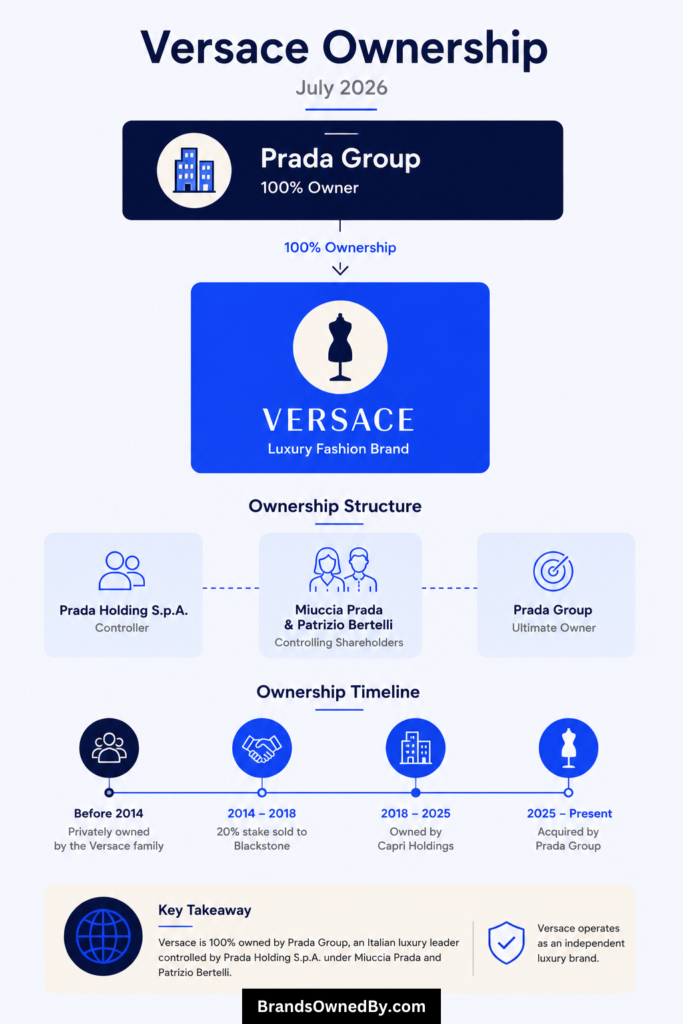
- Prada Group owns 100% of Versace. The Italian luxury group acquired the fashion house from Capri Holdings in 2025, making Versace a wholly owned subsidiary while preserving its independent brand identity and operations.
- Versace is not publicly traded and has no independent shareholders. Its ultimate ownership rests with Prada Group, which is controlled by Prada Holding S.p.A., the investment company of Miuccia Prada and Patrizio Bertelli, the group’s controlling shareholders.
- Before Prada Group, Versace was owned by Capri Holdings (2018–2025). Earlier, the company was controlled by the Versace family, with Blackstone holding a 20% minority stake from 2014 to 2018 before Capri acquired the business.
- Although Prada Group owns Versace, the brand continues to operate independently. It maintains its own creative identity, management structure, global boutiques, product lines, and luxury positioning while benefiting from Prada Group’s financial resources, manufacturing expertise, and worldwide retail network.
Versace is an Italian luxury fashion house specializing in designer clothing, handbags, footwear, jewelry, watches, fragrances, eyewear, and home furnishings. Founded in Milan, the brand has become one of the most recognizable names in global luxury fashion, known for its bold prints, vibrant colors, Baroque-inspired designs, and the iconic Medusa logo.
The company serves customers through a worldwide network of boutiques, luxury department stores, franchise locations, and its online store. Its collections include men’s and women’s ready-to-wear, haute couture, accessories, children’s fashion, and home décor.
Versace has built its reputation by combining Italian craftsmanship with distinctive and expressive designs. Its products are frequently worn by celebrities, athletes, musicians, and public figures at international fashion events and red-carpet appearances. The brand has also collaborated with luxury hotels, automotive companies, and lifestyle brands to extend its presence beyond fashion.
Today, Versace operates as an independent luxury brand within the Prada Group portfolio. Although its ownership has changed over the years, the company continues to preserve the creative identity that made it one of Italy’s most influential fashion houses.
Founders of Versace
Versace was founded by Italian fashion designer Gianni Versace, whose creative vision transformed the company into one of the world’s most influential luxury fashion brands. While Gianni established the business, his siblings played important roles in its early growth and long-term success. Together, they built a fashion house that became known for its bold aesthetics, premium craftsmanship, and celebrity appeal.
Gianni Versace
Gianni Maria Versace founded Versace in 1978 in Milan, Italy, after several years of designing collections for established Italian fashion labels. His passion for fashion began in his mother’s tailoring workshop in Reggio Calabria, where he learned garment construction and developed an appreciation for fine fabrics and craftsmanship.
Unlike many luxury designers of the time, Gianni embraced vibrant colors, dramatic silhouettes, artistic prints, and classical Greek influences. His signature Medusa logo and Baroque-inspired patterns became defining elements of the brand and remain instantly recognizable today.
Under his leadership, Versace expanded from a clothing label into a global luxury fashion house offering apparel, accessories, fragrances, jewelry, watches, eyewear, and home furnishings. His innovative approach to combining fashion, music, art, and celebrity culture helped redefine luxury fashion during the 1980s and 1990s.
Donatella Versace
Donatella Versace is Gianni Versace’s younger sister and has been closely associated with the company since its early years. Although she was not a founder, she played a significant role in developing the brand’s creative identity and public image.
After Gianni’s death in 1997, Donatella became Creative Director and led the brand for nearly three decades. She introduced modern collections while preserving the bold design language that made Versace famous. During her tenure, the company expanded its global presence and strengthened relationships with celebrities, luxury retailers, and fashion enthusiasts.
In 2025, Donatella transitioned from Chief Creative Officer to Chief Brand Ambassador, where she continues to represent Versace worldwide and promote its heritage.
Santo Versace
Santo Versace, the older brother of Gianni Versace, co-founded the business from a commercial perspective and managed its financial and operational activities during its formative years.
While Gianni focused on design, Santo oversaw business strategy, international expansion, licensing agreements, and corporate operations. His leadership helped transform Versace from a family-run fashion label into a globally recognized luxury company with boutiques and distribution networks across major international markets.
The partnership between Gianni’s creative talent, Santo’s business expertise, and Donatella’s branding and design contributions laid the foundation for Versace’s long-term success as one of Italy’s most iconic luxury fashion houses.
Ownership History
Versace has undergone several important ownership changes since it was founded in 1978. What began as a family-owned Italian fashion house gradually attracted private equity investment before becoming part of two major luxury groups. Each stage of ownership influenced the company’s global expansion, product strategy, and market position.
1978–1997: Founded and Owned by Gianni Versace
Versace was established in 1978 by Gianni Versace in Milan, Italy. From the beginning, the company operated as a family business with clearly defined roles.
Gianni Versace led the creative direction and designed every major collection. His brother, Santo Versace, managed the financial and operational side of the business, while his sister, Donatella Versace, worked closely with Gianni on design, branding, and public relations.
During this period, Versace evolved from a new Italian fashion label into one of the world’s most prestigious luxury brands. The company expanded rapidly through flagship boutiques, international fashion shows, licensing agreements, and collaborations with celebrities.
By the mid-1990s, Versace had established a strong presence across Europe, North America, Asia, and the Middle East while broadening its product portfolio to include accessories, fragrances, watches, jewelry, home furnishings, and haute couture.
1997–2014: The Versace Family Continues the Business
After Gianni Versace’s death in July 1997, ownership remained within the Versace family.
Gianni had left a substantial share of the company to his niece, Allegra Versace Beck. Donatella Versace became the company’s Creative Director, while Santo Versace continued overseeing business operations as Chairman and later Vice Chairman.
The company remained privately owned and family controlled throughout this period. Despite facing increased competition from larger luxury conglomerates such as LVMH and Kering, the family maintained independent control over the brand.
Versace continued opening boutiques worldwide, strengthening its licensing business, and expanding into new luxury categories. The company also invested heavily in digital retail and international marketing to reach younger luxury consumers.
2014–2018: Blackstone Becomes a Strategic Investor
In February 2014, U.S.-based private equity firm Blackstone acquired a 20% stake in Versace.
The investment was designed to accelerate the company’s international growth rather than change its identity. The Versace family retained approximately 80% ownership and continued managing the brand.
Blackstone provided financial resources and strategic expertise that helped Versace modernize its operations, improve supply chain efficiency, expand its retail footprint, and strengthen its digital commerce capabilities.
The partnership also prepared the company for its next phase of expansion and increased its attractiveness to larger luxury groups seeking premium global brands.
2018–2025: Acquisition by Capri Holdings
In September 2018, Capri Holdings Limited, then known as Michael Kors Holdings, announced the acquisition of Versace in a deal valued at approximately $2.1 billion.
Following the acquisition, Versace became part of a luxury portfolio that also included Michael Kors and Jimmy Choo.
Capri Holdings invested heavily in growing the Versace brand. The company expanded retail stores, increased its online presence, introduced new product categories, and sought to strengthen the brand’s position in North America and Asia.
Despite the ownership change, Versace continued operating under its own name, maintaining its Italian design heritage and creative independence.
During this period, Donatella Versace remained Chief Creative Officer and continued shaping the company’s collections and global image.
2025–Present: Prada Group Acquires Versace
In April 2025, Prada Group announced that it had reached an agreement to acquire 100% of Versace from Capri Holdings. The transaction was completed later that year after receiving the necessary regulatory approvals.
The acquisition marked a significant milestone for the Italian luxury industry. For the first time in several years, Versace returned to Italian ownership under one of the country’s most respected luxury fashion groups.
Prada Group stated that Versace would continue operating as an independent luxury brand while benefiting from the group’s manufacturing expertise, global retail network, product development capabilities, and operational support.
In March 2025, Donatella Versace stepped down as Chief Creative Officer after nearly three decades in the role and became Chief Brand Ambassador, ensuring continuity of the brand’s heritage and global identity.
In June 2026, Emmanuel Gintzburger departed as Chief Executive Officer. As of July 2026, Prada Group is continuing its leadership transition while integrating Versace into its broader luxury portfolio. The company has emphasized long-term brand development, improved operational efficiency, and sustainable global growth.
Today, Versace remains one of the world’s most recognizable luxury fashion houses. Although its ownership has evolved from a family-run business to part of a global luxury group, the brand continues to preserve the distinctive design philosophy established by Gianni Versace more than four decades ago.
Who Owns Versace?
Versace is wholly owned by Prada Group, one of Italy’s largest luxury fashion companies. The iconic fashion house is no longer an independent or publicly traded company. Instead, it operates as a wholly owned subsidiary within Prada Group while maintaining its own brand identity, creative direction, product portfolio, and global retail network.
The acquisition marked a major shift in the luxury fashion industry by bringing one of Italy’s most recognizable brands back under Italian ownership. Although Versace has a new parent company, customers continue to see the brand operate under the Versace name, with its distinctive design philosophy and luxury positioning remaining intact.
Who Owns Versace?
Ownership Structure (July 2026)
Prada Group
Italian Luxury Group
Versace
Luxury Fashion House
Global Business
Boutiques • Fashion • Accessories • Fragrance
Parent Company
Prada Group
Owns and oversees the entire Versace business.
Previous Owner
Capri Holdings
Owned Versace from 2018 until the 2025 acquisition.
Current Status
Private Subsidiary
Not publicly traded as an independent company.
Brand Identity
Independent Operations
Retains its own creative direction and luxury positioning.
Acquisition Highlights
Prada Group: The Parent Company
Prada Group is the parent company of Versace. Founded in Milan in 1913, Prada Group is one of the world’s leading luxury goods companies with operations spanning fashion, leather goods, footwear, accessories, eyewear, fragrances, jewelry, and lifestyle products.
The group manages several internationally recognized luxury brands, including:
- Prada.
- Miu Miu.
- Church’s.
- Car Shoe.
- Marchesi 1824.
- Luna Rossa.
With the acquisition of Versace, Prada Group further strengthened its position in the global luxury market, allowing it to compete more effectively with industry giants such as LVMH and Kering.
Unlike many luxury conglomerates that standardize operations across brands, Prada Group allows each brand to maintain its own creative identity while benefiting from shared manufacturing expertise, supply chain capabilities, technology platforms, and retail infrastructure.
Acquisition by Prada Group
In April 2025, Prada Group announced an agreement to acquire 100% of Versace from Capri Holdings in a transaction valued at approximately €1.25 billion. The acquisition received regulatory approvals and was officially completed in December 2025.
The purchase represented one of the largest acquisitions in the Italian luxury industry in recent years. It also reversed the ownership change that occurred in 2018 when Capri Holdings acquired Versace.
Prada Group stated that the objective was not to change Versace’s identity but to invest in its long-term growth while preserving the brand’s unique creative heritage. Following the acquisition, Versace continued operating as an independent luxury label within the Prada Group portfolio.
Why Prada Acquired Versace
The acquisition was driven by several strategic objectives.
First, Prada Group wanted to expand its portfolio beyond the Prada and Miu Miu brands. Versace added a globally recognized luxury name with strong brand awareness, particularly in North America, Europe, the Middle East, and Asia.
Second, Prada saw significant long-term growth opportunities for Versace. Although the brand experienced slower sales growth before the acquisition, it retained substantial value because of its worldwide recognition, premium positioning, and loyal customer base.
Third, Prada believed its expertise in manufacturing, product development, retail management, and supply chain operations could improve Versace’s profitability and operational efficiency.
Finally, the acquisition reinforced Italy’s position in the global luxury industry by bringing another historic Italian fashion house under domestic ownership.
Ownership Structure
Versace is not listed on any stock exchange and does not have independent public shareholders.
Its ownership structure is straightforward:
- Prada Group owns 100% of Gianni Versace S.r.l.
- Gianni Versace S.r.l. owns and operates the global Versace business.
- Versace manages its boutiques, e-commerce platforms, licensed products, and international operations under the supervision of Prada Group.
Since Versace is wholly owned, Prada Group has complete authority over major corporate decisions, including executive appointments, capital investments, international expansion, and long-term business strategy.
Does the Versace Family Still Own the Company?
No. The Versace family no longer has an ownership stake in the company.
The family’s ownership gradually ended after the sale to Capri Holdings in 2018. When Prada Group acquired Versace in 2025, it purchased the company from Capri Holdings rather than from members of the Versace family.
Although the family no longer owns the business, Donatella Versace continues to play an important role in representing the brand. After serving as Chief Creative Officer for nearly three decades, she transitioned to the role of Chief Brand Ambassador in 2025, where she focuses on promoting Versace’s heritage, global image, and cultural influence.
How Prada Group Manages Versace
Prada Group follows a decentralized management model for its luxury brands.
Rather than merging Versace into the Prada brand, the group allows it to operate independently with its own creative teams, merchandising, marketing, product development, and retail operations.
At the same time, Versace benefits from shared resources across the group, including manufacturing facilities, sourcing capabilities, logistics, digital technology, sustainability initiatives, and global distribution networks.
This structure enables Versace to preserve its bold design identity while gaining access to the operational strengths of one of the world’s most experienced luxury fashion companies.
What the Acquisition Means for Versace
The acquisition provides several long-term advantages for the brand.
Prada Group’s manufacturing expertise can improve production quality and operational efficiency. Its established supplier relationships and retail experience help strengthen Versace’s global distribution network.
The brand also gains access to greater investment in digital commerce, customer experience, sustainability, and international expansion. At the same time, Prada has emphasized that Versace will continue to operate under its own name and maintain the distinctive style that has defined the fashion house since 1978.
As of July 2026, Versace remains a wholly owned subsidiary of Prada Group and continues to operate as one of the flagship luxury brands within the group’s growing portfolio.
Competitor Ownership Comparison
Versace competes with some of the world’s most prestigious luxury fashion brands. While each brand has its own design philosophy and target audience, their ownership structures differ significantly. Some are part of global luxury conglomerates, while others remain founder-controlled or operate as independent public companies.
Understanding who owns Versace compared to its competitors provides valuable insight into how the global luxury fashion industry is organized and how major brands compete for market share.
Luxury Fashion Ownership Comparison
Who Owns Versace vs Major Competitors (July 2026)
Versace
Gucci
Louis Vuitton
Dior
Burberry
Balenciaga
Dolce & Gabbana
Valentino
Luxury Ownership Landscape
Brands owned by Prada Group shown here
Brands owned by LVMH
Brands owned by Kering
Independent Public Brand
Founder-Controlled Brand
Gucci
Gucci is owned by Kering, a French multinational luxury goods company headquartered in Paris.
Kering acquired a controlling interest in Gucci in 1999 after a highly publicized takeover battle with LVMH. Today, Gucci is one of Kering’s flagship brands and contributes a significant share of the group’s revenue.
In addition to Gucci, Kering owns luxury brands such as Saint Laurent, Balenciaga, Bottega Veneta, Alexander McQueen, Brioni, Pomellato, and Creed.
Unlike Versace, which is owned by an Italian luxury group, Gucci operates under a French luxury conglomerate with a diversified portfolio of fashion, jewelry, and beauty brands.
Louis Vuitton
Louis Vuitton is owned by LVMH Moët Hennessy Louis Vuitton, the world’s largest luxury goods company.
Founded in 1854, Louis Vuitton has become LVMH’s flagship fashion brand and is widely recognized for its leather goods, handbags, travel accessories, footwear, ready-to-wear collections, and fine jewelry.
LVMH owns more than 75 luxury brands across fashion, cosmetics, jewelry, wines and spirits, hospitality, and selective retailing. Its portfolio includes Dior, Tiffany & Co., Fendi, Celine, Bulgari, Givenchy, Loewe, Rimowa, Sephora, and Dom Pérignon.
Compared to Versace, Louis Vuitton benefits from the extensive financial resources, manufacturing capabilities, and global distribution network of the world’s largest luxury conglomerate.
Prada
Prada is the flagship brand of Prada Group, which also owns Versace.
Unlike many competitors that operate as separate companies, Prada and Versace now share the same parent organization while maintaining independent creative teams, marketing strategies, and product development.
This ownership structure allows Prada Group to serve different customer segments. Prada focuses on minimalist luxury and timeless sophistication, while Versace is known for bold, glamorous, and expressive designs.
Although both brands belong to the same corporate group, they continue to compete with other luxury houses rather than directly replacing one another.
Dior
Christian Dior is also part of LVMH.
The fashion house operates independently under the LVMH portfolio while benefiting from the group’s global supply chain, retail infrastructure, and investment capabilities.
Dior competes directly with Versace in haute couture, ready-to-wear fashion, handbags, footwear, fragrances, beauty products, and accessories.
The backing of LVMH enables Dior to invest heavily in marketing, celebrity partnerships, innovation, and international retail expansion.
Burberry
Burberry differs from many luxury competitors because it operates as an independent publicly traded company.
The British luxury fashion house is listed on the London Stock Exchange and is owned by thousands of institutional and retail shareholders rather than a single parent company.
Its board of directors and executive management oversee strategic decisions on behalf of shareholders.
Unlike Versace, Burberry is not controlled by a luxury conglomerate, giving it greater independence but also requiring it to compete without the financial support of a larger luxury group.
Dolce & Gabbana
Dolce & Gabbana remains one of the few major luxury fashion brands that is still privately owned by its founders.
The company is controlled through Dolce & Gabbana Holding and continues to operate independently without being part of LVMH, Kering, or Prada Group.
Its ownership model allows the founders to retain significant control over creative direction, product development, and business strategy.
This makes Dolce & Gabbana one of Versace’s closest competitors in terms of Italian heritage and luxury positioning, although their ownership structures are very different.
Balenciaga
Balenciaga is owned by Kering and operates as one of the group’s premium luxury fashion brands.
Originally founded in Spain, Balenciaga has evolved into a global luxury label known for contemporary fashion, footwear, handbags, and streetwear-inspired collections.
As part of Kering, Balenciaga benefits from shared investment in technology, sustainability initiatives, sourcing, manufacturing, and international retail operations.
Like Versace, Balenciaga maintains its own creative identity despite being part of a larger luxury group.
Valentino
Valentino is controlled by Mayhoola for Investments, a Qatar-based investment company that has owned the brand since 2012. In 2023, Kering acquired a 30% stake in Valentino with an agreement that gives it the option to acquire full ownership in the future.
This hybrid ownership structure differs from Versace’s, which is now fully integrated into Prada Group.
Valentino continues to operate independently while benefiting from long-term strategic investment and access to additional resources through its shareholders.
How Versace’s Ownership Compares
Compared with its competitors, Versace is now part of a major luxury conglomerate, similar to Gucci under Kering and Louis Vuitton under LVMH. This provides access to significant financial resources, manufacturing expertise, global sourcing, and retail infrastructure while allowing the brand to preserve its distinct creative identity.
The key difference is that Prada Group follows a relatively focused brand portfolio compared with larger rivals such as LVMH and Kering. This enables Prada Group to devote substantial attention and investment to each brand within its portfolio. For Versace, this means benefiting from shared operational capabilities while continuing to operate as a distinct luxury fashion house with its own heritage, design language, and global customer base.
Who Controls Versace?
Although Prada Group owns Versace, ownership and control are not the same. Ownership determines who holds the company’s equity, while control refers to the individuals responsible for making strategic, financial, and creative decisions.
As of July 2026, Versace operates as a wholly owned subsidiary of Prada Group. The company’s overall direction is guided by Prada Group’s leadership, while Versace’s day-to-day operations are managed by its own executive team. This structure allows the brand to preserve its unique identity while benefiting from the resources and governance of its parent company.
Prada Group Sets the Long-Term Strategy
As the parent company, Prada Group has ultimate authority over Versace’s long-term business strategy.
The group approves major corporate decisions, including executive appointments, capital investments, international expansion, acquisitions, sustainability initiatives, and long-term financial planning. It also determines how Versace fits within Prada Group’s broader luxury brand portfolio.
Rather than integrating Versace into the Prada brand, the group allows it to operate independently while providing access to shared manufacturing facilities, supply chain expertise, digital infrastructure, and global retail capabilities.
This decentralized management model is similar to how other luxury conglomerates, such as LVMH and Kering, manage their portfolio companies.
Lorenzo Bertelli Oversees Strategic Direction
Following Prada Group’s acquisition of Versace, Lorenzo Bertelli was appointed Executive Chairman of Versace.
In this role, he oversees the company’s strategic direction and serves as the link between Versace and Prada Group’s executive leadership. His responsibilities include supervising long-term business planning, supporting management decisions, and ensuring that the brand’s development aligns with the group’s overall strategy.
Lorenzo Bertelli is also regarded as the next generation of leadership within Prada Group. His growing involvement in corporate strategy, digital transformation, sustainability, and international expansion reflects Prada Group’s long-term vision for Versace.
CEO Leadership
Until June 2026, Emmanuel Gintzburger served as Chief Executive Officer (CEO) of Versace. During his tenure, he led the company’s global retail operations, commercial strategy, merchandising, licensing, and international expansion.
In June 2026, Gintzburger stepped down from the position. As of July 2026, Prada Group has not yet announced a permanent successor.
During this leadership transition, operational responsibilities continue under Versace’s senior executive team with strategic oversight from Prada Group. Once a new CEO is appointed, that executive will assume responsibility for managing the company’s global business operations while reporting to Prada Group’s leadership.
Creative Leadership
Creative leadership is separate from corporate management.
After serving as Chief Creative Officer for nearly three decades, Donatella Versace stepped down from the role in 2025. She now serves as Chief Brand Ambassador, where she represents the company globally, promotes its heritage, and supports important brand initiatives.
The role of Chief Brand Ambassador allows Donatella to remain closely associated with Versace while the company develops its next creative chapter under Prada Group ownership.
The creative direction of seasonal collections, runway presentations, marketing campaigns, and brand image is now overseen by the company’s creative leadership team, which operates independently from corporate management.
Prada Family Influence
Although Prada Group is publicly listed on the Hong Kong Stock Exchange, effective control remains with the Prada family through Prada Holding S.p.A.
Miuccia Prada and Patrizio Bertelli continue to play central roles in shaping the group’s strategic priorities. Their influence extends across every brand within the Prada portfolio, including Versace.
Major decisions involving executive appointments, investment priorities, international expansion, manufacturing strategy, and significant capital expenditures ultimately require approval from Prada Group’s leadership and its controlling shareholders.
How Decisions Are Made
Versace follows a multi-level governance structure that balances creative independence with corporate oversight.
At the corporate level, Prada Group establishes long-term objectives, allocates investment capital, and approves major strategic initiatives.
Versace’s executive management team oversees daily business operations, including merchandising, retail, marketing, supply chain management, licensing, and customer experience.
Creative teams remain responsible for designing collections, developing new products, and maintaining the brand’s distinctive aesthetic. This separation allows business decisions and creative decisions to complement each other without compromising the brand’s identity.
Who Ultimately Controls Versace?
While Versace operates with its own management team and creative leadership, ultimate control rests with Prada Group and its controlling shareholders. The parent company determines the brand’s long-term strategy, approves major corporate decisions, appoints senior executives, and provides the financial and operational resources needed to support future growth.
This governance model enables Versace to retain its iconic identity while benefiting from the stability, expertise, and global reach of one of the world’s leading luxury fashion groups.
Versace Annual Revenue and Net Worth
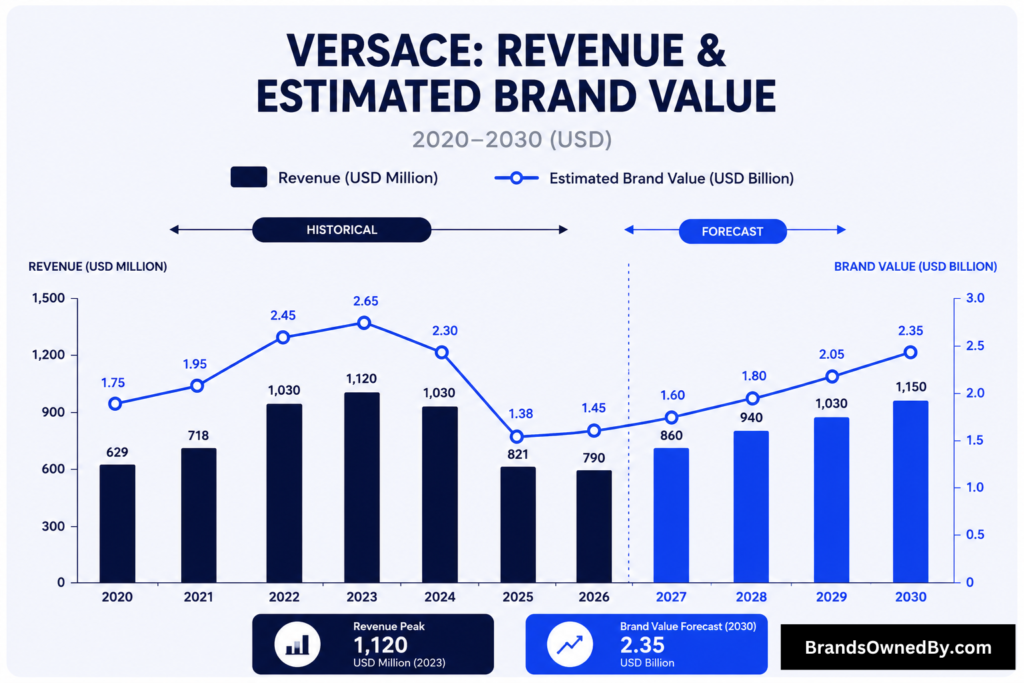
As of July 2026, the company is generating an estimated $790 million in annual revenue and has an estimated brand value of approximately $1.45 billion. While these figures remain below the brand’s peak performance in 2022 and 2023, Prada Group has identified Versace as a long-term strategic investment and expects operational improvements to gradually restore growth over the coming years.
Unlike publicly traded fashion companies, Versace does not disclose standalone financial statements because it operates as a wholly owned subsidiary of Prada Group. Historical revenue figures were previously reported by Capri Holdings, while current valuations are based on Prada’s acquisition price, management commentary, and industry estimates.
2026 Revenue Performance
During 2026, Versace remained in a transition phase following its acquisition by Prada Group. The company is estimated to generate $790 million in annual revenue, representing a 3.8% decline from approximately $821 million in 2025.
The modest decline reflects Prada Group’s deliberate strategy of improving the quality of sales rather than maximizing volume. Management has focused on reducing discount-driven sales, limiting reliance on outlet stores, streamlining lower-priced product lines, and strengthening Versace’s positioning within the ultra-luxury segment. These initiatives are expected to temporarily reduce revenue while improving profitability over the long term.
Revenue Breakdown by Business Segment
Although Prada Group does not publish a detailed breakdown for Versace, industry estimates indicate that revenue is generated across several core product categories.
Ready-to-wear collections continue to represent one of the company’s largest revenue contributors, accounting for approximately 35% of annual sales. Leather goods, including handbags and small accessories, contribute roughly 28%, while footwear generates around 15%.
Fragrances, eyewear, jewelry, watches, and licensed products collectively account for approximately 17% of revenue. The remaining 5% comes from home furnishings, hospitality partnerships, and other lifestyle categories.
This diversified revenue mix allows Versace to reduce dependence on any single product category while maintaining its position as a global luxury lifestyle brand.
Geographic Revenue Distribution
Versace generates revenue from more than 100 countries through directly operated boutiques, wholesale partners, franchise stores, and digital channels.
Europe remains the company’s largest market, contributing an estimated 34% of annual sales. North America accounts for approximately 31%, reflecting the brand’s strong presence in the United States and Canada.
Asia-Pacific contributes around 23%, supported by demand from Japan, South Korea, and Southeast Asia. The Middle East, Africa, and Latin America together generate the remaining 12% of revenue.
Prada Group has identified Asia and North America as two of the most important long-term growth markets for Versace.
Brand Value
Versace’s estimated brand value in 2026 is approximately $1.45 billion.
This estimate reflects the company’s globally recognized name, premium pricing power, intellectual property, retail network, customer loyalty, and long-term earnings potential. Although the brand’s valuation declined significantly from its peak in 2023, it remains one of the world’s most valuable luxury fashion labels.
The current valuation is closely aligned with Prada Group’s acquisition of Versace, which valued the company at approximately €1.25 billion (around $1.38 billion) in late 2025. Since the acquisition, analysts expect the brand’s value to gradually improve as operational efficiencies and product repositioning begin to deliver results.
Factors Affecting Revenue and Brand Value
Several factors continue to influence Versace’s financial performance.
The global slowdown in luxury spending has affected consumer demand, particularly for aspirational luxury products. At the same time, Prada Group is intentionally reducing promotional activity and outlet sales to improve brand exclusivity and pricing discipline.
The appointment of new creative leadership, investments in leather goods and accessories, improvements in manufacturing efficiency, and enhanced digital commerce capabilities are expected to strengthen the company’s long-term competitiveness.
Prada has also announced plans to discontinue diffusion lines such as Versace Jeans Couture and place greater emphasis on the core Versace label and Atelier Versace, further reinforcing the brand’s premium positioning.
Revenue Outlook Through 2030
Industry analysts expect Versace’s financial performance to improve gradually as Prada Group completes its strategic turnaround.
Key expectations include:
- 2027: Revenue projected to reach approximately $860 million as retail optimization and product repositioning begin to contribute to growth.
- 2028: Revenue forecast to increase to around $940 million, supported by stronger leather goods sales and improved operating efficiency.
- 2029: Revenue expected to recover above $1.03 billion, returning the brand to the billion-dollar sales milestone.
- 2030: Revenue projected to reach approximately $1.15 billion, with estimated brand value increasing to about $2.35 billion as Prada Group’s long-term investment strategy matures.
These projections assume stable global luxury demand, successful execution of Prada Group’s transformation strategy, and continued expansion across high-growth international markets.
Brands Owned by Versace
Unlike luxury conglomerates such as LVMH, Kering, or Prada Group, Versace does not own a portfolio of independent fashion companies. Instead, the company has expanded by developing its own luxury product lines, lifestyle businesses, and licensed categories under the Versace name.
As of July 2026, Versace’s business is centered around a single global luxury brand supported by several specialized divisions. Following Prada Group’s acquisition, the company is simplifying its brand architecture by focusing on its premium collections while gradually discontinuing lower-priced diffusion lines.
Brands & Businesses Operated by Versace
Luxury Portfolio • July 2026
Atelier Versace
Haute Couture
Ready-to-Wear
Men & Women
Accessories
Bags & Leather Goods
Footwear
Luxury Shoes
Versace Home
Furniture & Décor
Fragrances
Global Perfumes
Eyewear
Frames & Sunglasses
Watches
Swiss Made
Jewelry
Fine Jewelry
Kids
Children’s Fashion
Palazzo Versace
Luxury Hotels
Home & Lifestyle
Tableware & Living
Brand Evolution
Versace Jeans Couture Created
Joined Prada Group
Focus on Core Luxury
Luxury Product Categories
Independent Companies Owned
Global Luxury Brand
Countries Served
Atelier Versace
Atelier Versace is the company’s highest-end fashion division and represents its official haute couture business.
The label designs custom-made garments for celebrities, royalty, fashion collectors, and private clients. Every piece is handcrafted using premium fabrics, embroidery, and traditional Italian couture techniques.
Atelier Versace is internationally recognized for dressing celebrities at the Academy Awards, Cannes Film Festival, Venice Film Festival, Met Gala, and other prestigious events. The division also creates exclusive bridal couture and bespoke eveningwear.
Following Prada Group’s strategic review in 2026, Atelier Versace became the centerpiece of the company’s luxury positioning. The brand plans to strengthen its haute couture business and return Atelier Versace to the official Paris Haute Couture schedule beginning in 2027.
Versace Ready-to-Wear
The Ready-to-Wear division is Versace’s core business and generates the largest share of the company’s fashion revenue.
It produces seasonal men’s and women’s collections showcased during Milan Fashion Week. These collections include jackets, dresses, tailoring, knitwear, denim, eveningwear, outerwear, and luxury casualwear.
The Ready-to-Wear business combines Italian craftsmanship with bold prints, vibrant colors, Greca motifs, and the iconic Medusa emblem. It serves as the foundation for the brand’s global retail operations and is sold through flagship boutiques, luxury department stores, selected wholesale partners, and Versace’s official e-commerce platform.
Versace Accessories
Accessories represent one of Versace’s fastest-growing business segments.
The division designs and markets handbags, wallets, belts, scarves, small leather goods, hats, gloves, and fashion accessories.
Many of the company’s signature handbags, including the Medusa and Greca-inspired collections, have become important drivers of brand recognition and profitability.
Prada Group has identified accessories as one of the primary areas for future investment because leather goods generally generate higher profit margins than apparel.
Versace Footwear
Versace operates a dedicated footwear business covering both men’s and women’s luxury shoes.
Its collections include sneakers, pumps, sandals, loafers, boots, formal shoes, and casual footwear featuring the brand’s signature Medusa hardware and Greca patterns.
The footwear division continues to expand through seasonal collections that complement the company’s apparel and accessories business.
Versace Home
Versace Home extends the luxury fashion brand into interior design and home furnishings.
The collection includes luxury furniture, dining tables, chairs, sofas, lighting, decorative accessories, bedding, cushions, towels, rugs, porcelain, glassware, and home décor.
The division collaborates with specialized manufacturing partners to produce Italian-made luxury furniture while maintaining Versace’s distinctive design language.
Versace Home has become one of the world’s most recognizable luxury home furnishing brands, serving both residential and hospitality projects.
Versace Fragrances
Versace operates one of the largest fragrance businesses among Italian luxury fashion houses through long-term licensing partnerships.
Its fragrance portfolio includes internationally recognized collections for both men and women.
Popular fragrances include:
- Eros.
- Dylan Blue.
- Bright Crystal.
- Crystal Noir.
- Yellow Diamond.
- Pour Homme.
- Eros Flame.
- Dylan Purple.
The fragrance division introduces new products regularly and remains an important source of recurring global revenue due to its broad international distribution.
Versace Eyewear
Versace Eyewear is one of the company’s most successful licensed businesses.
The collection includes luxury sunglasses, prescription frames, fashion eyewear, and limited-edition designs featuring signature Medusa and Greca branding.
Rather than manufacturing eyewear internally, Versace licenses the category to an industry-leading eyewear manufacturer while retaining control over product design, branding, and quality standards.
The division continues to expand globally through optical retailers, luxury boutiques, and department stores.
Versace Watches
Versace designs and markets luxury Swiss-made watches for both men and women.
Its watch collections combine Italian design with Swiss watchmaking expertise and include dress watches, fashion watches, chronographs, and jewelry-inspired timepieces.
The business primarily targets consumers seeking luxury fashion accessories rather than traditional haute horology.
Versace Fine Jewelry
Versace Fine Jewelry produces luxury necklaces, bracelets, rings, earrings, pendants, and high-end jewelry collections.
The division incorporates precious metals, gemstones, diamonds, and the company’s signature Greca and Medusa motifs into contemporary Italian jewelry designs.
These collections complement the company’s fashion business while strengthening its position within the global luxury accessories market.
Versace Children’s Collection
Versace designs luxury clothing and accessories for infants, children, and teenagers.
The collection includes apparel, footwear, accessories, swimwear, and seasonal fashion inspired by the company’s adult collections.
Children’s products are distributed through selected boutiques, department stores, and licensed retail partners in international markets.
Palazzo Versace Hotels
Versace has expanded beyond fashion through the Palazzo Versace luxury hospitality brand.
Although the hotels are developed and operated with hospitality partners rather than owned directly by Versace, the company licenses its brand, interior design concepts, furniture, textiles, and lifestyle aesthetics.
The best-known properties include:
- Palazzo Versace Dubai.
- Palazzo Versace Gold Coast.
These hotels showcase the company’s luxury lifestyle vision and help strengthen the global recognition of the Versace brand beyond fashion.
Licensed Luxury Categories
In addition to its core businesses, Versace operates several licensed product categories that extend the brand into new luxury segments.
These include luxury ceramics, porcelain tableware, textiles, decorative accessories, and selected lifestyle products developed with specialist manufacturing partners.
This licensing strategy enables the company to expand globally while maintaining consistent quality standards and protecting the exclusivity of the Versace brand.
Versace Jeans Couture
Versace Jeans Couture has historically served as Versace’s diffusion line, offering contemporary fashion at lower price points than the main Versace collection.
The brand was created by combining earlier diffusion labels, including Versus Versace, Versace Jeans, and Versace Collection.
It offered men’s and women’s apparel, footwear, handbags, accessories, and denim through dedicated boutiques and international wholesale partners.
Following Prada Group’s strategic review in 2026, the company announced that Versace Jeans Couture will be phased out as part of its long-term plan to simplify the brand portfolio and focus exclusively on premium luxury collections. The label continues limited operations during the transition period but is expected to be fully discontinued as Prada completes the restructuring of the Versace business.
Final Thoughts
If you are asking who owns Versace, the answer is straightforward. Prada Group is the sole owner of the iconic Italian fashion house following its acquisition from Capri Holdings.
Although ownership has changed over the years, Versace has maintained its distinctive identity built on bold design, luxury craftsmanship, and Italian heritage. Backed by Prada Group’s financial strength and industry expertise, the brand is well positioned to strengthen its presence in the global luxury market while preserving the creative legacy established by Gianni Versace.
FAQs
When was Versace founded?
Versace was founded in 1978 by Italian fashion designer Gianni Versace in Milan, Italy. The company quickly gained recognition for its bold designs, vibrant prints, and luxury craftsmanship, becoming one of the world’s leading fashion houses.
Who owns Versace company now?
As of July 2026, Prada Group owns 100% of Versace. Prada Group completed its acquisition of the luxury fashion brand from Capri Holdings in late 2025. Versace now operates as a wholly owned subsidiary while maintaining its own brand identity, creative direction, and global operations.
Did Versace get bought by Prada?
Yes. Prada Group agreed to acquire Versace from Capri Holdings in April 2025, and the transaction was completed in December 2025 after receiving regulatory approvals. The acquisition returned one of Italy’s most iconic luxury brands to Italian ownership.
Why did Versace sell to Prada?
Versace itself did not independently decide to sell. At the time of the transaction, the brand was owned by Capri Holdings, which chose to divest Versace as part of its broader corporate strategy. For Prada Group, the acquisition offered an opportunity to expand its luxury portfolio, strengthen its position against competitors such as LVMH and Kering, and invest in Versace’s long-term growth while preserving its Italian heritage.
Does Donatella Versace own Versace?
No. Donatella Versace no longer owns Versace. The Versace family’s ownership ended when the company was acquired by Capri Holdings in 2018. Today, the brand is wholly owned by Prada Group. Donatella continues to be associated with the company as Chief Brand Ambassador, promoting the brand and its heritage worldwide.
Who inherited Versace’s money?
After Gianni Versace’s death in 1997, much of his estate was inherited by his family. His niece, Allegra Versace Beck, inherited a 50% stake in the company, while his brother Santo Versace and sister Donatella Versace also inherited significant ownership interests and other assets. Those ownership stakes were later sold as part of the company’s eventual acquisition by Capri Holdings.
Who owns Versace perfume?
The Versace brand owns its fragrance business and intellectual property. However, the perfumes are developed, manufactured, and distributed under a long-term global licensing agreement with EuroItalia, an Italian fragrance company. Popular fragrances such as Eros, Bright Crystal, Dylan Blue, and Crystal Noir are produced through this licensing partnership.
Who owned Versace before Prada?
Immediately before Prada Group acquired Versace, the company was owned by Capri Holdings Limited, an American luxury fashion group. Capri Holdings purchased Versace in 2018 for approximately US$2.1 billion and owned the brand until its sale to Prada Group in 2025. Prior to Capri Holdings, Versace was primarily owned by the Versace family, with Blackstone holding a 20% minority stake between 2014 and 2018.