
- Harbor Freight Tools is a privately owned company controlled by founder Eric Smidt, who serves as the company’s Owner, Chairman, and Chief Executive Officer. Unlike publicly traded competitors, Harbor Freight does not have publicly traded shares or institutional shareholders.
- Eric Smidt became Harbor Freight’s controlling shareholder after acquiring the ownership interest of co-founder Allan Smidt in 1999. As of June 2026, he remains the company’s largest and controlling shareholder.
- Harbor Freight is not owned by a parent company and operates as an independent business. Strategic decisions, expansion plans, capital investments, and brand development initiatives are ultimately controlled by Eric Smidt and the company’s executive leadership team.
- The company’s private ownership structure allows Harbor Freight to focus on long-term growth, resulting in more than 1,600 stores nationwide, an estimated $9.8 billion in annual revenue, and an estimated $16.5 billion enterprise value as of June 2026.
Harbor Freight Tools is one of the largest specialty tool retailers in the United States. The company sells a wide range of products for mechanics, contractors, tradespeople, small businesses, and DIY users. Its product catalog includes hand tools, power tools, automotive equipment, generators, welding machines, air compressors, tool storage systems, and safety equipment.
Headquartered in Calabasas, California, the company operates more than 1,600 retail locations across the country as of June 2026. Over nearly five decades, it has evolved from a small mail-order business into a nationwide retail chain serving millions of customers annually.
A key differentiator is its private-brand strategy. Rather than relying heavily on third-party manufacturers, the company develops and markets many products under its own brands. This approach gives greater control over product design, pricing, and distribution while helping maintain competitive prices across multiple categories.
The company has also invested heavily in logistics, distribution infrastructure, and store expansion. Today, it competes directly with retailers such as Home Depot, Lowe’s, Northern Tool + Equipment, and Grainger in several product segments.
The company’s business model is built around direct sourcing and private-label products. By working directly with manufacturers, it reduces supply-chain costs that are often passed on to consumers through traditional distribution channels.
Its proprietary brands play an important role in this strategy. Product lines such as Hercules, Icon, Bauer, Daytona, Predator, and Vulcan target specific customer groups ranging from professional contractors to automotive enthusiasts and hobbyists.
For example, the Icon brand focuses on professional-grade mechanic tools, while Hercules is positioned as a premium power-tool platform for tradespeople. This segmentation allows the company to serve different customer needs without relying heavily on external brands.
The result is a retail model that combines broad product selection, nationwide availability, and competitive pricing.
Harbor Freight Tools Founders
The company was founded in 1977 by Allan Smidt and his son, Eric Smidt. Their original vision was relatively simple: provide quality tools at prices that ordinary consumers and small businesses could afford.
The business began as a mail-order operation in Southern California. At the time, many industrial and professional tools carried significant retail markups. The founders saw an opportunity to source products more efficiently and sell them directly to customers.
What started as a small catalog business eventually grew into one of the largest privately owned retail chains in the American tool industry. While both founders contributed to the company’s early development, Eric Smidt would later become the primary architect of its long-term growth strategy.
Allan Smidt
Allan Smidt co-founded the company and helped establish its early operations. He played a central role during the startup years, helping build the catalog business and develop relationships with suppliers.
His entrepreneurial experience provided the foundation upon which the business was built. During the company’s formative years, he worked alongside his son to expand the customer base and create a scalable retail model.
Although Allan later exited ownership, his contribution remains an important part of the company’s history.
Eric Smidt
Eric Smidt is widely regarded as the driving force behind the company’s transformation from a regional mail-order operation into a national retail leader.
He became deeply involved in the business at a young age and quickly focused on improving sourcing, merchandising, and retail expansion. His emphasis on direct purchasing and private-brand development became a cornerstone of the company’s long-term strategy.
In 1985, he became president of the company. In 1999, he acquired his father’s ownership interest and became the sole owner. Under his leadership, the business expanded aggressively across the United States while maintaining its focus on value-oriented pricing and operational efficiency.
Today, he serves as Chairman and Chief Executive Officer, overseeing the company’s strategic direction and long-term growth initiatives.
Ownership History
The ownership history of Harbor Freight has been remarkably stable compared to most large American retailers. While many retail chains have gone through multiple acquisitions, private equity buyouts, or public stock market listings, Harbor Freight has remained under the control of its founding family since its creation in 1977.
The company’s ownership evolution can be divided into three distinct phases: the founding partnership era, the ownership transition period, and the sole ownership era that continues today.
Harbor Freight Ownership Timeline
June 2026
Privately held • 100% controlled by Eric Smidt • Chairman & CEO
Founding Partnership (1977–1999)
Harbor Freight was established in 1977 by Allan Smidt and his son, Eric Smidt. The business initially operated as Harbor Freight Salvage, a small mail-order company specializing in tools and industrial equipment. The founders worked together to build the company from a modest operation in Southern California into a growing national retailer.
During this period, ownership was shared between the father and son. Allan Smidt focused on helping establish the business and expand its customer base, while Eric became increasingly involved in sourcing, merchandising, and long-term growth strategy. Their partnership played a critical role in shaping the company’s direct-sourcing model, which remains a cornerstone of the business today.
As the company expanded through the 1980s and 1990s, Eric gradually assumed greater operational responsibility. In 1985, he became president of the company at the age of 25, signaling a shift toward second-generation leadership.
The 1999 Ownership Transition
A major turning point occurred in 1999 when Eric Smidt purchased his father’s ownership stake in the company. The transaction transformed Harbor Freight from a family-owned partnership into a business controlled by a single shareholder.
According to publicly reported information, Eric acquired Allan Smidt’s stake for approximately $21 million. Following the transaction, he became the sole shareholder of Harbor Freight.
This ownership transition was significant because it gave Eric complete authority over the company’s strategic direction. Without multiple family shareholders or outside investors, decision-making became more centralized. The company subsequently accelerated its expansion across the United States through new store openings, distribution infrastructure investments, and private-brand development.
Sole Ownership Era (1999–Present)
Since acquiring full ownership in 1999, Eric Smidt has remained the sole owner of Harbor Freight. Unlike many retailers of similar size, the company has never pursued an initial public offering (IPO) and has not sold controlling ownership to private equity firms or institutional investors.
This structure gives Harbor Freight a unique position within the retail industry. Strategic decisions can be made without pressure from public shareholders, quarterly earnings expectations, or activist investors. Instead, management can focus on long-term initiatives such as product development, supply-chain improvements, employee investment, and store expansion.
A practical example is the company’s continued investment in proprietary brands such as Hercules, Icon, Bauer, Predator, and Daytona. Developing these brands required substantial long-term capital commitments that may have been more difficult under a short-term shareholder-driven ownership model.
Ownership Dispute and Resolution
Although ownership remained concentrated under Eric Smidt after 1999, the company experienced a family dispute more than a decade later.
In 2010, Allan Smidt filed a lawsuit against his son regarding corporate management and financial matters. The dispute attracted media attention because it involved the founder and sole owner of one of America’s largest private retailers. However, the matter was eventually resolved outside court, and ownership of the company remained unchanged. Eric Smidt continued as sole shareholder and chief executive officer.
The dispute did not affect the company’s ownership structure, operational strategy, or long-term growth plans.
Ownership Structure as of June 2026
As of June 2026, Harbor Freight remains a privately held company wholly owned by Eric Smidt. There are no publicly traded shares, no controlling institutional investors, and no parent corporation above Harbor Freight. Eric Smidt serves as the company’s owner, Chairman, and Chief Executive Officer, giving him both ownership control and executive authority over the business.
This ownership structure makes Harbor Freight one of the largest founder-controlled retail companies in the United States and one of the few major national retailers that remains under the direct ownership of its founding family.
Who Owns Harbor Freight Tools?
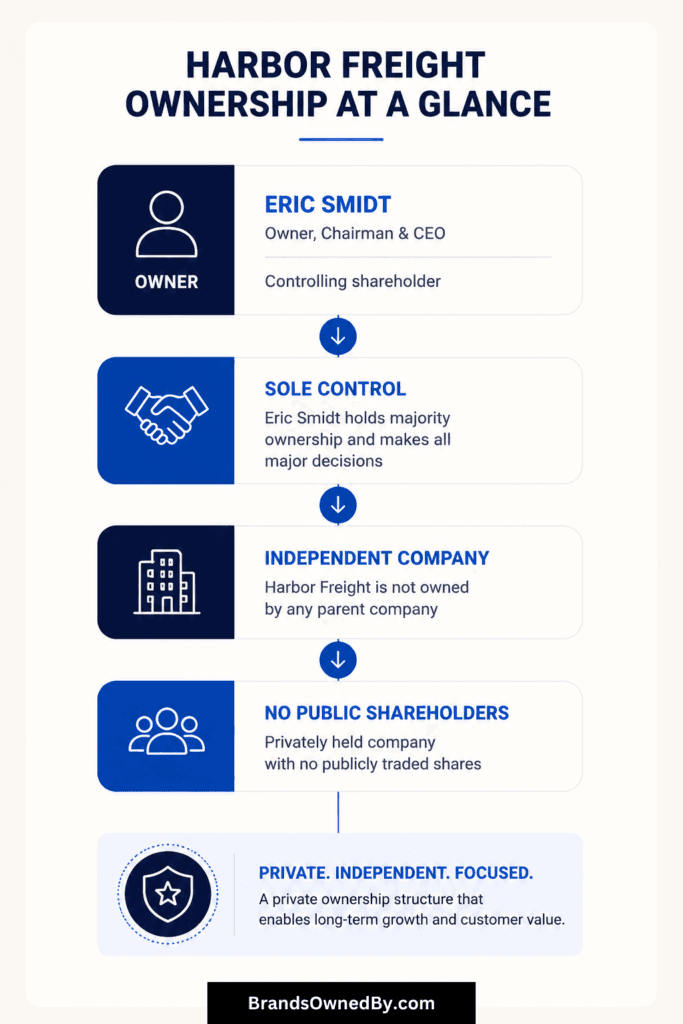
Harbor Freight is one of the largest privately owned retail companies in the United States. Unlike publicly traded competitors such as Home Depot and Lowe’s, the company does not disclose a detailed shareholder register or ownership percentages. As a private business, it is not required to file ownership reports with the Securities and Exchange Commission (SEC).
As of June 2026, Harbor Freight is controlled by Eric Smidt, who serves as the company’s Chairman and Chief Executive Officer. Publicly available information indicates that he became the sole owner after acquiring his father’s ownership interest in 1999. Since then, the company has remained privately held and under his control.
This ownership structure is unusual for a retailer of Harbor Freight’s size. Many competitors have thousands of shareholders, institutional investors, and pension funds influencing corporate decisions. Harbor Freight operates differently. Ownership and strategic control are concentrated in a single individual, allowing the company to pursue long-term growth initiatives without pressure from public markets.
Eric Smidt
Eric Smidt is the controlling owner of Harbor Freight and is widely recognized as the company’s principal shareholder. He co-founded the business alongside his father, Allan Smidt, in 1977 and has spent nearly five decades building it into one of America’s largest tool retailers.
His influence extends beyond ownership. As Chairman and CEO, he oversees the company’s strategic direction, expansion plans, product development initiatives, supply-chain investments, and executive leadership decisions.
A major turning point occurred in 1999 when Eric acquired his father’s ownership stake. The transaction consolidated ownership and made him the sole owner of the company. Since then, Harbor Freight has expanded from a regional retailer into a nationwide chain with more than 1,600 stores.
Because Harbor Freight is privately held, the company does not publicly disclose the exact percentage owned by Eric Smidt. However, publicly available information indicates that he exercises effective ownership and voting control over the business.
Allan Smidt
Allan Smidt co-founded Harbor Freight and was one of the company’s original shareholders. During the early years, he helped establish the business, develop supplier relationships, and expand its mail-order operations.
For more than two decades, Harbor Freight operated as a family-owned business with both Allan and Eric involved in ownership and management. This structure remained in place until 1999, when Allan sold his ownership interest to Eric.
Following that transaction, Allan ceased to be a shareholder in Harbor Freight. While he remains an important figure in the company’s history, he no longer has an ownership stake in the business.
Family Ownership Structure
One reason Harbor Freight has been able to maintain a consistent long-term strategy is its concentrated ownership structure. Unlike many retailers that answer to institutional investors, Harbor Freight remains effectively founder-controlled.
This allows management to focus on initiatives that may take years to generate returns. Examples include the development of proprietary brands such as Hercules, Icon, Bauer, Predator, Daytona, and Vulcan, along with major investments in distribution centers and retail expansion.
The absence of outside shareholders also simplifies corporate governance. Strategic decisions can be implemented more quickly because approval processes are less complex than those of publicly traded corporations.
Competitor Ownership Comparison
Harbor Freight’s competitors operate under very different ownership structures. Some are controlled by large institutional investors, while others remain family-owned businesses. Understanding who owns these competing companies provides valuable insight into how strategic decisions are made, how capital is allocated, and how management teams are held accountable.
One of the biggest differences between Harbor Freight and many of its competitors is that most major retail and industrial supply companies are publicly traded. This means ownership is spread across millions of shares held by investment firms, pension funds, mutual funds, ETFs, and retail investors.
Ownership Comparison: Harbor Freight vs Competitors
A visual comparison of ownership structures across major tool, industrial supply, and home improvement retailers as of June 2026. While most competitors are controlled by institutional investors, Harbor Freight remains founder-controlled and Northern Tool remains family-owned.
Home Depot
Home Depot is the largest home improvement retailer in the United States and one of the biggest competitors in the tools and hardware market.
As of June 2026, Home Depot’s ownership is dominated by institutional investors. The largest shareholder is Vanguard, which owns approximately 6.5% of the company. State Street is another major shareholder with roughly 4.7%, while BlackRock also maintains a significant ownership position through its various investment funds.
Together, these institutional investors control a substantial portion of the company’s outstanding shares.
Because ownership is distributed among thousands of investors, Home Depot is governed through a board of directors and executive management team. Strategic decisions must ultimately align with shareholder interests and market expectations. This differs significantly from founder-controlled companies where decision-making authority is concentrated.
Lowe’s
Lowe’s is another major competitor in the home improvement and tools market. The company operates thousands of stores across North America and competes directly in categories such as hand tools, power tools, storage systems, and workshop equipment.
Ownership of Lowe’s is also heavily institutional. As of June 2026, institutional investors collectively control more than three-quarters of the company. BlackRock is the largest disclosed shareholder with approximately 7.1% ownership. State Street owns roughly 4.4%, while Vanguard maintains another significant stake through its investment funds.
This ownership structure means Lowe’s management team is accountable to large investment firms whose primary focus is shareholder returns, earnings growth, and capital efficiency. Institutional investors play an important role in corporate governance through voting rights and board elections.
Northern Tool + Equipment
Northern Tool + Equipment represents one of the closest ownership comparisons among major competitors because it remains privately held.
The company is controlled by the Kotula family, which founded the business and continues to maintain ownership. Unlike publicly traded competitors, Northern Tool does not disclose detailed shareholder percentages because it is privately owned.
Family ownership allows management to pursue long-term business objectives without pressure from quarterly earnings reports or activist shareholders. This structure has enabled the company to maintain a consistent strategy focused on specialty tools, industrial equipment, and outdoor power products.
While Northern Tool operates on a smaller scale than many public competitors, its ownership model demonstrates how family-controlled businesses can remain competitive in highly fragmented retail markets.
W.W. Grainger
W.W. Grainger is one of the largest industrial supply distributors in North America and competes in several professional tool and equipment categories.
The company has a more complex ownership structure than most retailers because both institutional investors and members of the founding Grainger family maintain meaningful ownership positions.
As of 2026, institutional investors collectively own more than 70% of the company. Vanguard is the largest institutional shareholder with ownership estimated at around 11%. BlackRock and State Street are also among the largest investors. At the same time, members of the Grainger family continue to hold significant ownership interests. David W. Grainger alone controls more than 15% of outstanding shares, making him the largest individual shareholder.
This creates a hybrid ownership model that combines family influence with institutional oversight. The structure provides long-term stability while still giving public investors significant influence over governance.
Tractor Supply Company
Tractor Supply Company competes in categories such as tools, generators, outdoor equipment, trailers, compressors, and workshop supplies.
Like many large public retailers, ownership is concentrated among institutional investors rather than founders or family members. Large asset managers such as Vanguard, BlackRock, and State Street are among the company’s most influential shareholders through their mutual funds and ETFs.
The company’s governance structure reflects this ownership model. Management is accountable to a broad shareholder base and must consistently demonstrate growth, profitability, and efficient capital allocation to maintain investor confidence.
This institutional ownership structure is common among large retail chains and contrasts sharply with founder-controlled businesses.
Fastenal
Fastenal is a major supplier of industrial tools, fasteners, safety products, and maintenance equipment. The company serves manufacturers, contractors, construction firms, and industrial customers throughout North America.
As of 2026, Fastenal’s ownership is dominated by institutional investors. Vanguard is the largest shareholder with an ownership stake of approximately 11.6%. BlackRock owns roughly 7.7%, while State Street controls nearly 5%. Several other investment firms also maintain meaningful positions in the company.
This ownership structure provides access to substantial capital while also creating strong shareholder oversight. Institutional investors can influence executive compensation, board appointments, governance policies, and major corporate decisions through shareholder voting rights.
What the Comparison Reveals
A clear pattern emerges when comparing ownership structures across the industry.
Most large competitors are controlled primarily by institutional investors such as Vanguard, BlackRock, and State Street. These investment firms manage trillions of dollars and often rank among the largest shareholders in publicly traded companies. Their influence extends across the retail, industrial, and home improvement sectors.
Only a small number of major competitors continue to operate under founder or family control. Northern Tool remains family-owned, while Grainger combines institutional ownership with significant family influence. Most other competitors answer primarily to public shareholders and institutional investors.
These ownership differences often shape how companies approach growth, acquisitions, dividends, capital spending, and long-term strategy. Companies with concentrated ownership typically have greater flexibility to pursue multi-year initiatives, while publicly traded competitors operate within a framework that requires balancing long-term objectives with shareholder expectations and market performance.
Who Controls Harbor Freight?
Harbor Freight operates under a highly centralized leadership structure. Unlike publicly traded retailers where ownership, management, and governance are often separated, Harbor Freight’s ownership and executive authority are concentrated among a small group of leaders led by founder Eric Smidt.
As of June 2026, the company remains privately owned and controlled by Eric Smidt, who serves as Owner, Chairman, and Chief Executive Officer. This combination of ownership and executive authority gives him ultimate control over Harbor Freight’s strategic direction, capital allocation, expansion plans, product development initiatives, and senior leadership appointments.
While Harbor Freight employs thousands of people and operates more than 1,600 stores nationwide, final decision-making authority remains concentrated at the top of the organization.
Eric Smidt: The Ultimate Decision Maker
Eric Smidt is the most powerful figure within Harbor Freight. As the sole owner and CEO, he controls both the economic and operational aspects of the business.
Unlike CEOs at publicly traded companies who report to shareholders and boards of directors, Smidt effectively combines the roles of principal shareholder, chairman, and chief executive. This structure gives him significant influence over every major aspect of the business.
His responsibilities include:
- Corporate strategy.
- Store expansion initiatives.
- Executive leadership appointments.
- Capital investments.
- Supply chain strategy.
- Product development.
- Brand management.
- Long-term growth planning.
Smidt has led the company since becoming president in 1985 and later CEO in 1999. Under his leadership, Harbor Freight evolved from a regional retailer into one of America’s largest privately owned retail chains.
Allan Mutchnik: President
One of the most important executives below Eric Smidt is Allan Mutchnik, who serves as President of Harbor Freight.
As president, Mutchnik oversees many aspects of the company’s day-to-day operations and execution strategy. While Smidt focuses on long-term leadership and ownership responsibilities, the president plays a critical role in translating strategy into operational performance across the business.
His position places him among the most influential executives within Harbor Freight’s leadership structure. As president, he works closely with the CEO and executive leadership team to manage retail operations, merchandising initiatives, distribution activities, and organizational performance.
Tomas Kokko: Chief Financial Officer
Financial strategy is overseen by Tomas Kokko, Executive Vice President and Chief Financial Officer.
As CFO, Kokko is responsible for financial planning, budgeting, capital allocation, financial reporting, treasury management, and overall fiscal strategy.
For a retailer operating thousands of locations and managing billions of dollars in annual sales, the CFO plays a critical role in determining where the company invests its resources. Decisions involving distribution centers, store openings, technology upgrades, inventory investments, and operational improvements typically involve the finance organization led by Kokko.
Jason Sprong: Product Development and Global Sourcing
Jason Sprong serves as Executive Vice President of Product Development, Quality, and Global Sourcing.
This is one of the most strategically important positions within Harbor Freight because the company’s competitive advantage depends heavily on sourcing products directly from manufacturers and developing proprietary brands.
Sprong’s responsibilities include:
- Global sourcing operations.
- Supplier relationships.
- Product development.
- Quality assurance.
- Manufacturing oversight.
- Trade compliance initiatives.
Brands such as Hercules, Icon, Bauer, Predator, Daytona, and Vulcan rely heavily on the functions overseen by his organization.
Peter Racine: Distribution and Supply Chain Leadership
Peter Racine serves as Senior Vice President of Distribution.
Harbor Freight’s nationwide retail network depends on an extensive logistics and distribution infrastructure. Racine oversees critical supply-chain functions that ensure products move efficiently from suppliers to distribution centers and ultimately to retail stores.
Given Harbor Freight’s scale, distribution management directly impacts inventory availability, operating efficiency, and customer satisfaction. This makes supply-chain leadership one of the most important operational functions within the company.
Jean-Michel Kientz: Technology Leadership
Jean-Michel Kientz serves as Chief Technology Officer (CTO).
As Harbor Freight continues expanding its e-commerce capabilities, retail technology infrastructure, and data systems, technology leadership has become increasingly important.
The CTO oversees:
- Enterprise technology systems.
- Digital infrastructure.
- Retail technology platforms.
- Cybersecurity initiatives.
- IT modernization efforts.
Technology investments increasingly influence customer experience, inventory management, supply-chain visibility, and operational efficiency across the company.
Meryl Chae: Legal and Corporate Governance
Meryl Chae serves as Executive Vice President and General Counsel.
The General Counsel is responsible for overseeing Harbor Freight’s legal affairs, regulatory compliance, intellectual property matters, litigation management, and corporate governance support.
As Harbor Freight continues expanding nationally, legal oversight plays an important role in managing risk and ensuring compliance across multiple jurisdictions.
Senior Operational Leadership
Several additional executives oversee critical operational functions throughout the organization.
These include:
- Wes Harmelink, Senior Vice President responsible for engineering, quality, and product development.
- Rick Smith, Senior Vice President of Inventory and Transportation.
- Nakoa Gardner, Division Vice President of Retail Operations.
- Jason Jones, Divisional Vice President of Information Technology.
- Brad Snyder, Division Vice President of Human Resources and Learning & Development.
Together, these leaders manage the systems, inventory, technology, workforce, and operational processes that support Harbor Freight’s nationwide retail footprint.
Control Structure as of June 2026
As of June 2026, Harbor Freight’s control hierarchy is relatively straightforward.
At the top sits Eric Smidt as Owner, Chairman, and CEO. Below him is President Allan Mutchnik and a group of executive vice presidents and senior vice presidents responsible for finance, sourcing, technology, legal affairs, distribution, merchandising, and retail operations.
Unlike publicly traded competitors where institutional investors often influence strategy through boards and shareholder votes, Harbor Freight’s governance structure remains founder-controlled. Strategic authority ultimately flows through Eric Smidt, making him both the company’s controlling shareholder and its primary decision maker.
Harbor Freight Annual Revenue and Net Worth
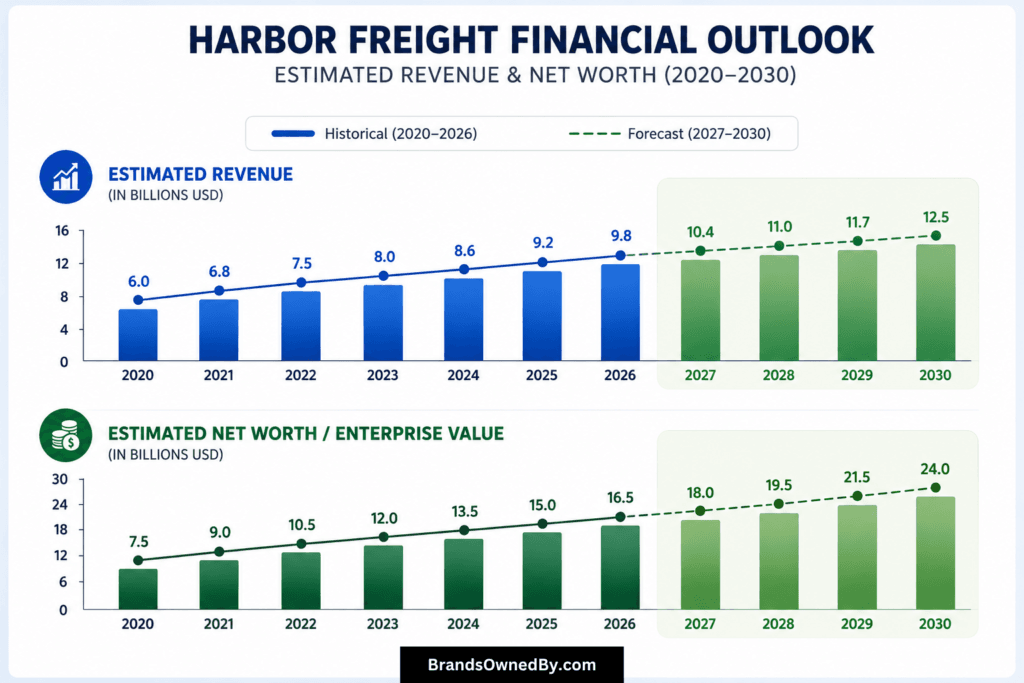
As of June 2026, Harbor Freight is estimated to generate approximately $9.8 billion in annual revenue, up from roughly $9.2 billion in 2025. At the same time, analysts estimate the company’s enterprise value or net worth at approximately $16.5 billion, reflecting its nationwide store network, strong private-label brands, and growing market share within the tool retail sector.
Harbor Freight 2026 Revenue
Estimated revenue reached approximately $9.8 billion in 2026, representing annual growth of roughly 6.5% compared to the previous year. This growth is particularly notable because it comes from an already large revenue base and follows several years of sustained expansion.
Between 2020 and 2026, Harbor Freight’s estimated annual revenue increased from approximately $6.0 billion to $9.8 billion, adding nearly $3.8 billion in annual sales within six years. This represents cumulative growth of more than 63% during the period.
The growth has been supported by three major factors. First, Harbor Freight continues opening new stores across the United States, expanding its footprint into underserved markets. Second, the company has successfully increased sales of higher-priced proprietary brands such as Hercules and Icon. Third, Harbor Freight has expanded its appeal beyond DIY customers to include professional mechanics, contractors, fabricators, and tradespeople.
Revenue Breakdown by Product Category
Harbor Freight does not publicly disclose revenue by business segment. However, industry analysts and retail market estimates suggest the company’s revenue mix is concentrated in a handful of core categories.
| Product Category | Estimated Share of Revenue | Estimated 2026 Revenue |
|---|---|---|
| Automotive Tools & Equipment | 28% | $2.74 Billion |
| Power Tools | 22% | $2.16 Billion |
| Hand Tools | 18% | $1.76 Billion |
| Tool Storage & Workshop Equipment | 14% | $1.37 Billion |
| Generators & Outdoor Power Equipment | 10% | $0.98 Billion |
| Welding, Air Compressors & Other Equipment | 8% | $0.79 Billion |
These figures are estimates based on product assortment, category prominence, industry benchmarks, store merchandising allocation, and customer demand patterns.
Automotive Tools and Equipment
Automotive products remain one of Harbor Freight’s most important revenue generators. Based on estimated category sales, automotive tools and equipment contribute approximately $2.7 billion annually.
The category includes floor jacks, jack stands, diagnostic tools, engine hoists, battery chargers, impact wrenches, specialty mechanic tools, and repair equipment. Harbor Freight’s Daytona and Icon brands have strengthened its position among professional mechanics and automotive enthusiasts.
The automotive segment benefits from recurring demand because vehicles require continuous maintenance and repair regardless of broader economic conditions.
Power Tools
Power tools are estimated to generate more than $2.1 billion in annual revenue, making them one of Harbor Freight’s fastest-growing product categories.
The Hercules and Bauer brands have become central to this growth. Hercules targets professional users who traditionally purchased brands such as DeWalt, Milwaukee, and Makita. Bauer focuses on value-oriented consumers looking for cordless tool systems at lower price points.
The cordless tool ecosystem creates repeat purchases because customers often buy additional batteries, chargers, and compatible tools after entering the platform.
Hand Tools
Hand tools remain a foundational category for Harbor Freight and are estimated to generate approximately $1.8 billion in annual revenue.
Products include socket sets, ratchets, wrenches, pliers, screwdrivers, torque wrenches, specialty mechanic tools, and tool kits. The Pittsburgh and Icon brands continue to drive significant demand within this segment.
Although growth rates are generally lower than power tools, hand tools provide consistent sales due to their broad customer appeal and recurring replacement demand.
Tool Storage and Workshop Equipment
Tool chests, rolling cabinets, workbenches, shelving systems, and garage organization products are estimated to contribute approximately $1.4 billion annually.
This category has benefited from the expansion of premium Icon tool storage products, which compete directly with higher-priced alternatives from established professional tool brands.
Because these products carry higher average transaction values, they contribute significantly to overall revenue despite lower sales volumes.
Generators and Outdoor Power Equipment
Predator generators have become one of Harbor Freight’s most recognizable product lines. Combined with pressure washers, engines, pumps, and outdoor equipment, this category is estimated to generate approximately $1.0 billion annually.
Demand often increases during hurricane seasons, power outages, severe weather events, and periods of heightened consumer preparedness spending.
Harbor Freight Net Worth in June 2026
Harbor Freight’s estimated enterprise value stands at approximately $16.5 billion in June 2026.
Unlike public companies, Harbor Freight does not have a market capitalization because its shares are not traded on a stock exchange. Instead, analysts estimate value using retail industry valuation multiples, comparable company transactions, revenue growth rates, profitability assumptions, and store network strength.
The estimated valuation implies that Harbor Freight is worth roughly 1.7 times annual revenue, a multiple that aligns with successful specialty retail businesses possessing strong private-label portfolios and nationwide distribution capabilities.
What Makes Harbor Freight Worth $16.5 Billion?
Several factors support Harbor Freight’s estimated valuation.
The company operates more than 1,600 stores, making it one of the largest specialty tool retail networks in North America.
Its proprietary brands represent another major value driver. Products sold under Icon, Hercules, Bauer, Predator, Vulcan, and Daytona generally produce stronger margins than third-party brands because Harbor Freight controls sourcing, design, and distribution.
The company also maintains substantial competitive advantages through its distribution infrastructure, purchasing scale, direct sourcing relationships, and strong brand recognition among professional and DIY users.
These assets create barriers to entry that would be difficult and expensive for competitors to replicate.
Revenue Forecast Through 2030
Harbor Freight Revenue & Net Worth (2020–2030)
Estimated historical figures through 2026 and projected growth through 2030.
Industry forecasts suggest Harbor Freight could continue growing at a mid-single-digit annual rate through the remainder of the decade.
Several factors support this outlook. Store expansion remains a major growth driver. If Harbor Freight continues opening approximately 50 to 70 net new stores annually, its retail footprint could approach or exceed 1,850 locations by 2030.
The company is also increasing the penetration of premium brands such as Icon and Hercules. These brands command higher average selling prices and stronger margins than entry-level alternatives.
Another growth catalyst is the continued shift toward professional customers. Contractors, mechanics, and tradespeople generally spend substantially more per year than casual consumers, creating opportunities for higher revenue per store.
Below is the revenue forecast up to 2030:
- 2027: $10.4 billion.
- 2028: $11.0 billion.
- 2029: $11.7 billion.
- 2030: $12.5 billion.
Below is an overview of the forecasted net worth:
- 2027: $18.0 billion.
- 2028: $19.5 billion.
- 2029: $21.5 billion.
- 2030: $24.0 billion.
What Could Drive Revenue Beyond $12 Billion?
If Harbor Freight successfully executes its current strategy, several developments could push revenue beyond the projected figures.
Continued expansion of the Hercules and Icon product ecosystems could increase average transaction values across stores. Greater adoption among professional users could further improve revenue productivity. Additional distribution investments may support faster inventory turnover and better product availability. E-commerce growth could also contribute incremental sales without requiring proportional increases in physical retail space.
Under these conditions, Harbor Freight could realistically surpass $12.5 billion in annual revenue and approach $24 billion in enterprise value by 2030, further cementing its position as one of the largest and most valuable privately held retailers in the United States.
Brands Owned by Harbor Freight
As of June 2026, Harbor Freight does not own a large portfolio of separate operating companies comparable to conglomerates such as Stanley Black & Decker, Berkshire Hathaway, or Home Depot. The majority of its assets are concentrated within Harbor Freight Tools itself and the numerous proprietary brands that it develops, markets, and distributes exclusively through its retail and online channels.
The company’s growth strategy has historically emphasized creating in-house brands rather than acquiring established tool manufacturers. This approach gives Harbor Freight greater control over product specifications, manufacturing relationships, pricing, quality standards, and profit margins.
Harbor Freight Brand Ecosystem (2026)
Harbor Freight primarily grows through proprietary brands rather than acquisitions. Its ecosystem spans professional tools, automotive equipment, generators, welding systems, storage solutions, and workshop machinery.
Harbor Freight Tools
Core Retail Business • 1,600+ Stores • Private Ownership • Nationwide Distribution Network
Professional & Premium Brands
Consumer & DIY Brands
Industrial & Equipment Brands
Specialty Brands
Harbor Freight Tools
Harbor Freight Tools is the company’s primary operating entity and largest business asset.
Founded in 1977, the company operates more than 1,600 retail stores across the United States and serves millions of professional and DIY customers annually. The business encompasses all retail operations, e-commerce activities, sourcing operations, distribution centers, logistics infrastructure, and proprietary product brands.
Unlike many competitors, Harbor Freight generates a significant portion of its sales from brands that it owns and controls rather than relying heavily on third-party manufacturers.
Hercules
Hercules is Harbor Freight’s flagship professional-grade power tool brand.
The brand was developed to compete directly with premium manufacturers such as Milwaukee, DeWalt, Makita, and Bosch. Over the past several years, Harbor Freight has significantly expanded the Hercules ecosystem to include cordless drills, impact drivers, circular saws, grinders, reciprocating saws, rotary hammers, batteries, chargers, and jobsite accessories.
The Hercules platform has become one of the company’s most strategically important assets because it helps attract contractors, electricians, plumbers, builders, and professional tradespeople who historically purchased tools from higher-priced competitors.
As of 2026, Hercules represents one of Harbor Freight’s fastest-growing proprietary brands.
Icon
Icon is Harbor Freight’s premium automotive and professional hand tool brand.
The brand was introduced to compete in the professional mechanic market, which has traditionally been dominated by Snap-on, Matco Tools, Mac Tools, and Cornwell Quality Tools.
Icon’s product lineup includes ratchets, socket sets, wrenches, screwdrivers, torque wrenches, diagnostic tools, pry bars, tool storage systems, and specialty automotive tools.
The brand has become particularly important because it allows Harbor Freight to target professional users willing to spend significantly more than traditional value-oriented customers. The expansion of Icon has also helped improve average transaction values and profit margins throughout the company’s retail network.
Bauer
Bauer serves as Harbor Freight’s primary consumer and prosumer power tool platform.
Positioned below Hercules in the company’s brand hierarchy, Bauer targets homeowners, DIY enthusiasts, hobbyists, and light commercial users.
The brand includes cordless drills, impact drivers, saws, sanders, grinders, oscillating tools, outdoor equipment, batteries, and accessories.
One of Bauer’s strengths is its expanding battery ecosystem. Customers who purchase into the platform often continue adding compatible tools, creating repeat purchase opportunities for Harbor Freight.
The brand has become one of the company’s largest volume sellers across many retail locations.
Predator
Predator is Harbor Freight’s engine and power equipment brand.
The product line includes portable generators, inverter generators, pressure washers, water pumps, engines, and other power equipment.
Predator generators have become particularly popular among homeowners, contractors, RV owners, emergency preparedness customers, and small businesses.
The success of Predator has allowed Harbor Freight to compete in a market traditionally dominated by brands such as Honda, Generac, Champion, and Briggs & Stratton.
Today, Predator is widely recognized as one of Harbor Freight’s most successful proprietary brands.
Daytona
Daytona specializes in automotive lifting equipment and garage products.
The brand is best known for its floor jacks, jack stands, hydraulic lifting equipment, shop presses, and garage service tools.
Daytona products are frequently used by professional mechanics, automotive enthusiasts, and repair shops due to their combination of affordability and performance.
The brand’s floor jacks have become some of Harbor Freight’s most recognizable products and remain among the company’s strongest-selling automotive items.
Vulcan
Vulcan is Harbor Freight’s welding equipment brand.
The product portfolio includes MIG welders, TIG welders, stick welders, plasma cutters, welding helmets, protective equipment, and welding accessories.
The brand targets both professional fabricators and hobbyist welders.
The expansion of Vulcan has enabled Harbor Freight to increase its presence in industrial and fabrication markets while reducing reliance on third-party welding manufacturers.
Titanium
Titanium is another welding-focused brand within Harbor Freight’s portfolio.
While Vulcan generally targets higher-end users, Titanium products are positioned toward value-conscious customers seeking affordable welding equipment.
The brand includes compact welders, inverter welding systems, and welding accessories.
Together, Titanium and Vulcan allow Harbor Freight to address multiple customer segments within the welding market.
Pittsburgh
Pittsburgh remains one of Harbor Freight’s oldest and most widely recognized brands.
The product line includes hand tools, mechanic tool sets, sockets, ratchets, wrenches, pliers, screwdrivers, specialty automotive tools, and workshop equipment.
For many consumers, Pittsburgh was their first introduction to Harbor Freight products.
Although newer premium brands such as Icon have expanded the company’s market reach, Pittsburgh continues to generate substantial sales volume due to its affordability and broad product selection.
Pittsburgh Automotive
Pittsburgh Automotive focuses specifically on automotive repair and maintenance equipment.
The brand includes battery chargers, diagnostic tools, fluid transfer equipment, shop accessories, specialty repair tools, and vehicle service equipment.
The separation from the core Pittsburgh line allows Harbor Freight to market products more directly to automotive customers.
Central Machinery
Central Machinery is Harbor Freight’s woodworking and workshop equipment brand.
Products include drill presses, band saws, bench grinders, lathes, milling equipment, wood lathes, dust collection systems, and workshop machinery.
The brand primarily serves hobbyists, woodworkers, makers, and small workshops.
Central Machinery has remained a core part of Harbor Freight’s product portfolio for many years and continues to attract customers seeking affordable workshop equipment.
Central Forge
Central Forge specializes in metalworking and striking tools.
Its products include hammers, chisels, anvils, forging equipment, punches, and related workshop tools.
The brand has developed a strong following among blacksmithing enthusiasts, metalworkers, and hobby fabricators.
U.S. General
U.S. General is Harbor Freight’s premium storage and tool organization brand.
The lineup includes tool cabinets, roller cabinets, workstations, tool carts, storage lockers, and garage organization systems.
U.S. General products are frequently compared with tool storage systems costing significantly more from established professional brands.
The continued expansion of this brand has helped Harbor Freight strengthen its position within garage and workshop storage markets.
Apache
Apache is Harbor Freight’s protective storage and equipment case brand.
The products are designed for transporting and protecting tools, electronics, cameras, firearms, drones, and sensitive equipment.
The brand has become popular among professionals and hobbyists seeking rugged storage solutions at lower prices than competing products.
Franklin
Franklin focuses on ladders, hand trucks, carts, moving equipment, and material handling products.
The brand serves homeowners, contractors, warehouses, and commercial users who need equipment for lifting and transporting materials.
Braun
Braun is Harbor Freight’s lighting and illumination brand.
The product range includes work lights, flashlights, rechargeable lighting systems, magnetic lights, headlamps, and inspection lights.
The brand supports customers across automotive, construction, maintenance, and workshop applications.
Gordon
Gordon specializes in outdoor and landscaping tools.
Products include pruning tools, gardening equipment, cutting tools, and lawn-care accessories.
The brand has expanded Harbor Freight’s presence in outdoor maintenance and landscaping categories.
Warrior
Warrior represents Harbor Freight’s entry-level power tool and accessory brand.
The product portfolio includes drills, grinders, saws, sanders, blades, abrasives, and accessories designed for occasional users.
Warrior helps Harbor Freight maintain its value-oriented reputation while providing an entry point for budget-conscious customers.
Drill Master
Drill Master is another value-focused power tool brand within Harbor Freight’s portfolio.
Although the company has increasingly shifted attention toward Bauer and Hercules, Drill Master products remain available in various categories and continue serving entry-level consumers.
Chicago Electric
Chicago Electric is one of Harbor Freight’s longest-running proprietary brands.
Historically, the brand covered power tools, welding equipment, generators, pumps, and electrical products.
While Harbor Freight has gradually introduced newer brands such as Hercules, Bauer, Titanium, and Vulcan, Chicago Electric products continue to exist in selected categories.
Final Thoughts
For anyone wondering who owns Harbor Freight Tools, the answer is Eric Smidt. He became the sole owner after purchasing his father’s stake in 1999 and continues to serve as Chairman and CEO.
His ownership has allowed Harbor Freight to remain independent while expanding into one of America’s largest tool retailers. The company operates thousands of stores, generates billions in annual revenue, and manages a portfolio of successful in-house brands.
The combination of private ownership, centralized leadership, and a value-focused retail strategy has helped Harbor Freight compete effectively against much larger public companies.
FAQs
Is Harbor Freight Publicly Traded?
No, Harbor Freight is not publicly traded. The company is privately owned and does not have shares listed on any stock exchange. Unlike competitors such as Home Depot, Lowe’s, Fastenal, and Grainger, Harbor Freight has never completed an initial public offering (IPO). As of June 2026, the company remains under the ownership and control of founder Eric Smidt.
What Company Owns Harbor Freight?
Harbor Freight is not owned by another company. It operates as an independent private company known as Harbor Freight Tools. The business is controlled by Eric Smidt, who serves as the company’s Owner, Chairman, and Chief Executive Officer. There is no parent corporation above Harbor Freight, and the company is not a subsidiary of any larger retail group.
How Many Harbor Freight Stores Are There?
As of June 2026, Harbor Freight operates more than 1,600 retail stores across the United States. The company continues to expand its footprint by opening dozens of new locations each year. Its stores are present in nearly every state and serve professional tradespeople, contractors, mechanics, small businesses, and DIY consumers.
Harbor Freight’s extensive retail network makes it one of the largest specialty tool retailers in North America.
Who Started Harbor Freight?
Harbor Freight was founded in 1977 by Allan Smidt and his son, Eric Smidt. The company began as a small mail-order business operating under the name Harbor Freight Salvage in Southern California.
The founders built the business around a simple concept: sell quality tools directly to consumers at lower prices by reducing distribution costs and eliminating unnecessary middlemen. Over time, the company expanded from catalog sales into a nationwide retail chain.
Today, Eric Smidt remains the controlling owner and leader of the company.
Why Are Harbor Freight Tools So Cheap?
Harbor Freight’s lower prices are largely the result of its business model rather than simply lower product quality.
The company works directly with manufacturers instead of relying on multiple distributors and wholesalers. This direct-sourcing strategy reduces supply-chain costs and allows Harbor Freight to offer products at lower prices.
Another factor is the company’s focus on proprietary brands such as Hercules, Icon, Bauer, Predator, Daytona, Vulcan, and Pittsburgh. Because Harbor Freight owns these brands, it avoids paying premiums associated with third-party manufacturers.
The company also benefits from large purchasing volumes, efficient distribution networks, and private-label product development. These advantages help keep prices competitive while maintaining acceptable quality standards.
Are Harbor Freight Tools All Made in China?
No, not all Harbor Freight products are made in China, although a significant portion of the company’s merchandise is sourced from Chinese manufacturers.
Harbor Freight also works with suppliers in countries such as Taiwan, Vietnam, India, Mexico, and several other manufacturing markets. The country of origin varies depending on the product category, supplier relationships, and manufacturing requirements.
Many of the company’s hand tools, power tools, and equipment are manufactured overseas because it allows Harbor Freight to maintain its competitive pricing strategy.
Customers can typically find the country of origin on product packaging, product labels, or individual product listings.
Is Anything at Harbor Freight Made in America?
Yes, Harbor Freight sells certain products that are manufactured or assembled in the United States.
While most of the company’s inventory is sourced internationally, selected products and product categories are made in America through domestic manufacturing partners. The availability of U.S.-made products can vary over time based on supplier contracts and product lines.
In recent years, Harbor Freight has highlighted some American-made products through dedicated promotional programs and product collections. However, U.S.-manufactured items represent a relatively small portion of the company’s overall inventory compared with imported products.
Customers specifically seeking American-made products should review product descriptions and packaging information, as country-of-origin details are generally disclosed on individual products.