
- Rolex is fully owned by the Hans Wilsdorf Foundation as of 2026, making it one of the few major luxury watch companies not controlled by public shareholders, private equity firms, or luxury conglomerates.
- The Hans Wilsdorf Foundation holds an effective 100% ownership stake in Rolex Group, while professional executives led by CEO Jean-Frédéric Dufour manage daily operations and long-term business strategy.
- Rolex’s foundation-controlled ownership structure allows the company to maintain limited production, strong resale values, controlled retail distribution, and long-term brand exclusivity without pressure from stock market investors.
- Rolex also controls major entities including Tudor, Bucherer, Rolex SA, Rolex Industrie SA, and vertically integrated Swiss manufacturing facilities, helping the company dominate the global luxury watch market with an estimated 2026 revenue of $12.6 billion and an estimated net worth of nearly $50 billion.
Rolex is a Swiss luxury watch manufacturer headquartered in Geneva, Switzerland. The company is known worldwide for premium mechanical watches, precision engineering, and long-term durability.
The brand specializes in high-end sports watches, dress watches, and professional timepieces. Some of its most recognized collections include the Submariner, Daytona, Datejust, GMT-Master II, Day-Date, and Oyster Perpetual.
Rolex built its reputation through innovation and reliability. The company introduced several major watchmaking advancements that later became industry standards.
These innovations include:
- The Oyster case, one of the first waterproof watch cases.
- The Perpetual rotor, which helped popularize self-winding automatic watches.
- Chronometer-certified movements focused on precision and durability.
Rolex is also known for controlling nearly every part of production internally. The company manufactures movements, bracelets, dials, and precious metal components through its own facilities in Switzerland.
Another important part of Rolex’s business strategy is controlled distribution. The company carefully selects authorized dealers and limits production for many popular models. This approach helps maintain exclusivity and strong resale demand.
Rolex has also built strong brand recognition through partnerships with sports, motorsports, tennis, golf, sailing, and exploration events. The brand has long-standing sponsorship relationships with Wimbledon, Formula 1, The Masters Tournament, and other prestigious events.
Unlike many fashion-oriented luxury brands, Rolex focuses heavily on product continuity. Watch designs evolve gradually instead of changing dramatically every few years.
Rolex Founders
Rolex was founded in 1905 by Hans Wilsdorf and Alfred Davis in London, England. The original company name was Wilsdorf and Davis.
Hans Wilsdorf
Hans Wilsdorf is considered the true driving force behind Rolex. He was born in Germany and entered the watch industry at a young age.
Wilsdorf believed wristwatches would eventually replace pocket watches at a time when most people still viewed wristwatches as unreliable. His focus on precision, branding, and innovation helped Rolex grow rapidly.
He played a major role in developing several important Rolex technologies and marketing strategies.
One of his biggest achievements came in 1926 with the launch of the Rolex Oyster, one of the first waterproof wristwatches. Rolex later promoted the watch globally after swimmer Mercedes Gleitze wore it during an English Channel swim attempt.
Hans Wilsdorf also introduced the Perpetual self-winding mechanism in 1931, another major milestone in watchmaking history.
Beyond product innovation, Wilsdorf helped create Rolex’s premium image through careful advertising, sports partnerships, and strict quality standards.
Alfred Davis
Alfred Davis was the co-founder of Rolex and Hans Wilsdorf’s brother-in-law. He helped manage the business during its early years, particularly on the commercial and operational side.
Although Davis was important during the company’s foundation period, Hans Wilsdorf became the public face and long-term strategic leader of Rolex.
Davis later left the company, while Wilsdorf continued expanding Rolex internationally.
Why the Founders Still Matter Today
The influence of Hans Wilsdorf is still visible throughout Rolex’s business model as of 2026.
Several strategies introduced during the early years remain central to the company today:
- Focus on mechanical precision.
- Limited production philosophy.
- Premium brand positioning.
- Long product life cycles.
- Conservative business expansion.
- Strong control over distribution and manufacturing.
Even the ownership structure of Rolex reflects Wilsdorf’s long-term vision. Before his death, he transferred Rolex ownership to the Hans Wilsdorf Foundation to ensure the company would remain independent.
Ownership History
Rolex has one of the most unusual ownership histories in the luxury industry. Unlike many major watch brands, Rolex was never controlled by a large public corporation or luxury conglomerate. Its ownership evolved through a carefully planned long-term structure created by founder Hans Wilsdorf.
The company’s ownership history explains why Rolex remains private, independent, and highly secretive as of 2026.
Early Ownership Structure
When Rolex was founded in 1905, the company operated under the name Wilsdorf and Davis in London, England.
The business was initially owned by its founders:
- Hans Wilsdorf.
- Alfred Davis.
Hans Wilsdorf handled branding, strategy, and product development. Alfred Davis focused more on financial and operational matters during the company’s early years.
At the time, the business imported watch movements from Switzerland and assembled watches in the United Kingdom. Wristwatches were still relatively new in the market, and many consumers preferred pocket watches.
Hans Wilsdorf strongly believed wristwatches would become the future of personal timekeeping. This vision became the foundation of Rolex’s long-term growth.
Rolex Brand Registration
In 1908, Hans Wilsdorf officially registered the Rolex trademark.
The name “Rolex” was selected because it was short, easy to pronounce in multiple languages, and simple to place on watch dials.
This was an important moment in Rolex ownership history because the brand identity became separated from the founders’ personal names. That decision later helped Rolex evolve into a globally recognized standalone luxury brand.
Relocation to Switzerland
Rolex moved its headquarters from London to Geneva, Switzerland in 1919.
Several factors influenced this move:
- Heavy taxes in post-war Britain.
- Economic instability after World War I.
- Switzerland’s growing reputation for watchmaking expertise.
After relocating, Rolex became fully integrated into the Swiss watch industry.
Hans Wilsdorf gradually strengthened control over manufacturing and supplier relationships. This strategy later helped Rolex maintain higher quality standards than many competitors.
Alfred Davis Leaves the Business
Alfred Davis eventually left the company during the early growth period.
After Davis departed, Hans Wilsdorf became the dominant leader and controlling force behind Rolex.
From that point onward, Wilsdorf shaped nearly every major aspect of the company, including:
- Product innovation.
- Marketing strategy.
- International expansion.
- Manufacturing standards.
- Brand positioning.
Under his leadership, Rolex transformed from a small watch importer into one of the most respected luxury watchmakers in the world.
Creation of the Hans Wilsdorf Foundation
The biggest change in Rolex ownership history happened in 1944.
After the death of his wife, Hans Wilsdorf created the Hans Wilsdorf Foundation, a private charitable foundation based in Switzerland.
Wilsdorf transferred Rolex ownership to the foundation. This decision ensured the company would remain independent after his death.
This ownership model was highly unusual.
Most luxury companies are either:
- Passed down to family heirs.
- Sold to investors.
- Acquired by larger corporations.
- Listed on stock exchanges.
Rolex followed a completely different path.
Instead of creating a family dynasty, Wilsdorf structured Rolex to operate under foundation control indefinitely.
Why Hans Wilsdorf Chose Foundation Ownership
Hans Wilsdorf wanted Rolex to remain stable and independent over the long term.
Foundation ownership offered several advantages:
- Protection from hostile takeovers.
- Freedom from stock market pressure.
- Long-term strategic planning.
- Greater operational secrecy.
- Preservation of brand exclusivity.
This structure also reduced the risk of future ownership disputes among heirs or outside investors.
As a result, Rolex was able to maintain a consistent business strategy across multiple decades.
A practical example is product design continuity. Many luxury brands dramatically redesign products to follow fashion trends. Rolex instead evolves designs slowly. Watches like the Submariner and Datejust still maintain strong similarities to earlier generations.
Rolex Remains Independent
As of 2026, Rolex remains fully independent.
The company is not owned by:
This independence is rare in the luxury watch sector.
Many competing brands became part of large luxury conglomerates during industry consolidation periods in the late 20th century and early 21st century.
Rolex avoided that trend because the Hans Wilsdorf Foundation retained full control.
Expansion Through Vertical Integration
Over the decades, Rolex strengthened ownership control over its supply chain.
Instead of depending heavily on outside suppliers, the company invested in internal manufacturing operations.
Rolex expanded ownership and control over:
- Movement production.
- Dial manufacturing.
- Bracelet manufacturing.
- Gem setting.
- Precious metal casting.
- Research and development facilities.
This vertical integration became one of Rolex’s biggest competitive advantages.
For example, Rolex can maintain tighter quality control because it produces most critical components internally rather than outsourcing them.
Ownership of Tudor
Rolex also expanded its influence through Tudor, a separate watch brand founded by Hans Wilsdorf in 1926.
Tudor was designed to offer more affordable luxury watches while benefiting from Rolex engineering expertise and distribution systems.
Although Tudor operates as a separate brand, it remains closely connected to Rolex ownership and management structures.
In recent years, Tudor has become an increasingly important part of Rolex’s overall business strategy, especially in the mid-luxury sports watch segment.
Modern Ownership Structure
Today, the Hans Wilsdorf Foundation remains the sole controlling owner of Rolex.
The foundation oversees long-term governance while professional executives manage daily operations.
This structure allows Rolex to focus on:
- Long-term brand value.
- Controlled production.
- Premium positioning.
- Manufacturing quality.
- Retail exclusivity.
Because Rolex is privately owned, the company releases very limited public financial information.
This secrecy has become part of the company’s identity and competitive strategy.
How Ownership History Shapes Rolex Today
Rolex’s ownership history directly affects how the company operates today.
The foundation structure allows Rolex to prioritize brand prestige over rapid expansion. The company does not need to satisfy public shareholders seeking short-term profit growth.
This approach influences several areas of the business:
- Limited production for popular models.
- Conservative product launches.
- Tight retail network control.
- Long development cycles.
- Heavy investment in manufacturing quality.
A practical example is the Rolex Daytona. Demand consistently exceeds supply, yet Rolex continues limiting production rather than dramatically increasing output.
This strategy helps preserve exclusivity and resale value, which strengthens the overall brand image.
The ownership decisions made by Hans Wilsdorf decades ago still shape Rolex’s business model as of 2026.
Who Owns Rolex?
![Who owns Rolex [infographic]](https://brandsownedby.com/wp-content/uploads/2026/05/Who-owns-Rolex-infographic-683x1024.png)
Rolex has one of the most unique ownership structures in the global luxury industry. Unlike most major watch brands, Rolex is not publicly traded and is not controlled by a billionaire family, private equity firm, or luxury conglomerate.
As of 2026, Rolex is fully owned by the Hans Wilsdorf Foundation, a private Swiss charitable foundation established by Rolex founder Hans Wilsdorf. The foundation controls Rolex Group and its related businesses, including Tudor.
There are no public shareholders in Rolex. No shares are available on stock exchanges. This means the company does not answer to Wall Street investors or quarterly earnings pressure.
The ownership structure gives Rolex several long-term advantages:
- Strong operational independence.
- Protection from hostile takeovers.
- Long-term strategic planning.
- Controlled production levels.
- Greater secrecy around finances and operations.
- Freedom to preserve exclusivity instead of maximizing short-term growth.
This model is extremely rare in the luxury sector. Most competing brands are owned by publicly traded corporations such as LVMH, Richemont, or Swatch Group.
Rolex’s ownership structure also affects how the company operates commercially. The business focuses heavily on brand prestige, limited supply, and manufacturing control rather than rapid expansion.
For example, Rolex continues limiting production for highly demanded models like the Daytona and GMT-Master II despite years of waiting lists. Public companies often increase supply aggressively to boost short-term sales. Rolex has largely avoided that strategy because it is protected from shareholder pressure.
Rolex Shareholders and Ownership Structure
Rolex does not have traditional shareholders like publicly traded companies. However, the ownership structure can still be explained through the controlling foundation and related entities inside the Rolex Group.
As of 2026, the Hans Wilsdorf Foundation remains the controlling and effective 100% owner of Rolex Group.
Hans Wilsdorf Foundation
The Hans Wilsdorf Foundation is the sole controlling owner and largest stakeholder of Rolex.
The foundation was established in 1945 by Hans Wilsdorf after the death of his wife, Florence Wilsdorf. Because the couple had no children, Wilsdorf decided not to transfer Rolex ownership to family heirs.
Instead, he created a long-term structure designed to preserve the company permanently.
When Hans Wilsdorf died in 1960, his Rolex ownership stake was fully transferred to the foundation. Since then, the foundation has controlled Rolex operations and long-term governance.
The foundation operates under Swiss private foundation laws. Unlike public corporations, it is not required to release detailed public financial reports or disclose internal voting structures.
This secrecy has become part of Rolex’s corporate identity.
The Hans Wilsdorf Foundation reportedly supports:
- Educational initiatives.
- Scholarships.
- Cultural programs.
- Social welfare projects.
- Employment assistance programs.
- Arts and music institutions in Geneva.
Industry estimates suggest the foundation distributes hundreds of millions of Swiss francs annually toward charitable activities, although exact figures remain private.
The foundation also reinvests heavily into Rolex manufacturing, research, retail operations, and long-term infrastructure projects.
Rolex Group Internal Ownership Structure
Although the Hans Wilsdorf Foundation is the ultimate owner, Rolex operates through multiple corporate entities inside the Rolex Group.
These entities include:
- Rolex SA.
- Rolex Holding SA.
- Rolex Industrie SA.
- Montres Tudor SA.
This structure allows Rolex to separate manufacturing, intellectual property, logistics, and brand management functions internally.
Because the group is privately held, exact ownership percentages between subsidiaries are not publicly disclosed. However, the Hans Wilsdorf Foundation remains the top controlling entity across the organization.
Competitor Ownership Comparison
Rolex operates under one of the most unusual ownership structures in the luxury industry. As of May 2026, the company remains fully controlled by the Hans Wilsdorf Foundation, a private Swiss foundation established by founder Hans Wilsdorf.
Most major competitors follow a completely different model. They are either owned by publicly traded luxury conglomerates or controlled by wealthy founding families. That difference affects how these companies approach production, expansion, pricing, retail strategy, and long-term growth.
Rolex focuses heavily on independence, controlled production, and long-term brand protection. Many competitors, especially publicly traded groups, operate under stronger revenue growth pressure from investors and shareholders.
| Company | Ownership Type | Main Controlling Owner (May 2026) | Publicly Traded | Ownership Details | Key Strategic Impact |
|---|---|---|---|---|---|
| Rolex | Private foundation ownership | Hans Wilsdorf Foundation | No | The Hans Wilsdorf Foundation holds an effective 100% ownership stake in Rolex Group. | Allows Rolex to prioritize exclusivity, controlled production, and long-term brand value without shareholder pressure. |
| Omega | Public conglomerate ownership | Swatch Group / Hayek family control | Yes | Omega operates under Swatch Group, where the Hayek family maintains controlling voting power. | Focus on scale, broader market coverage, and higher production volumes. |
| Cartier | Public conglomerate ownership | Richemont / Rupert family control | Yes | Cartier is owned by Richemont, with the Rupert family holding significant voting control through holding structures. | Strong global retail expansion and diversified luxury business integration. |
| TAG Heuer | Public conglomerate ownership | LVMH / Arnault family control | Yes | TAG Heuer operates under LVMH, controlled by Bernard Arnault and family holding companies. | Aggressive marketing, rapid expansion, and broader luxury positioning. |
| Patek Philippe | Private family ownership | Stern family | No | The Stern family has controlled Patek Philippe since acquiring the company in 1932. | Maintains ultra-premium positioning and low production volumes. |
| Audemars Piguet | Private family ownership | Audemars and Piguet family descendants | No | The founding families continue controlling the company privately as of 2026. | Greater flexibility in exclusivity and boutique-driven expansion. |
| Breitling | Private equity ownership | Partners Group and CVC Capital Partners | No | Breitling operates under private equity-backed ownership structures. | Strong focus on growth, commercial scaling, and market expansion. |
| Hublot | Public conglomerate ownership | LVMH / Arnault family control | Yes | Hublot operates as part of LVMH’s watch division alongside TAG Heuer and Zenith. | Faster product cycles and celebrity-driven luxury marketing. |
| IWC Schaffhausen | Public conglomerate ownership | Richemont / Rupert family control | Yes | IWC is owned by Richemont and operates within its luxury watch portfolio. | Benefits from large corporate retail and distribution infrastructure. |
| Longines | Public conglomerate ownership | Swatch Group / Hayek family control | Yes | Longines is one of Swatch Group’s largest global watch brands. | Positioned for large-scale international distribution and mid-luxury growth. |
Rolex vs Omega Ownership
Omega is owned by Swatch Group, the largest watch conglomerate in Switzerland.
As of May 2026, Swatch Group remains publicly traded on the SIX Swiss Exchange. The Hayek family continues holding controlling voting power through major ownership stakes and voting shares.
Unlike Rolex, Omega operates inside a large corporate portfolio that includes Longines, Blancpain, Breguet, Tissot, Hamilton, and Rado.
This structure creates major operational differences.
Omega benefits from Swatch Group’s large-scale manufacturing network, supplier relationships, and global retail infrastructure. However, Omega also operates within a publicly traded environment where revenue growth and market share expansion remain important priorities.
Rolex operates differently.
Because Rolex is foundation-owned, the company has more flexibility to limit production and protect exclusivity even during periods of extremely high demand. This is one reason Rolex waiting lists remain significantly longer than Omega’s across many sports watch categories.
Another major difference is pricing strategy. Omega frequently introduces new collections, special editions, and broader pricing segmentation. Rolex maintains a far more conservative product cycle with slower design evolution and tighter inventory control.
Rolex vs Cartier Ownership
Cartier is owned by Richemont, a Swiss luxury conglomerate founded by South African businessman Johann Rupert.
As of 2026, the Rupert family maintains effective control over Richemont through significant voting power and holding structures. Richemont itself is publicly traded.
Cartier operates alongside other Richemont brands such as:
- IWC.
- Jaeger-LeCoultre.
- Panerai.
- Vacheron Constantin.
- Van Cleef & Arpels.
- A. Lange & Söhne.
Richemont’s business model is much broader than Rolex’s. The company generates revenue from jewelry, watches, leather goods, and fashion accessories across multiple luxury categories.
This gives Cartier access to enormous financial resources and global retail networks. However, it also means Cartier operates within a larger shareholder-driven corporate structure.
Rolex remains far more centralized.
The Hans Wilsdorf Foundation controls Rolex independently without external corporate oversight from a larger luxury group. This allows Rolex to maintain tighter control over manufacturing, distribution, and product positioning.
The difference is visible in retail strategy. Cartier aggressively expands boutiques globally, especially in luxury shopping districts and tourist markets. Rolex continues maintaining a more selective authorized dealer structure.
Rolex vs TAG Heuer Ownership
TAG Heuer is owned by LVMH Moët Hennessy Louis Vuitton, the world’s largest luxury conglomerate.
As of May 2026, the Arnault family remains the controlling force behind LVMH through family holding companies. LVMH is publicly traded on Euronext Paris and controls dozens of luxury businesses.
TAG Heuer operates within a portfolio that includes:
- Louis Vuitton.
- Dior.
- Tiffany & Co.
- Bulgari.
- Hublot.
- Zenith.
The ownership structure creates a much more aggressive commercial environment than Rolex.
TAG Heuer focuses heavily on celebrity partnerships, Formula 1 marketing, digital campaigns, connected watches, and younger luxury buyers. Product launches occur more frequently, and the company moves faster with technology integration and design experimentation.
Rolex follows a slower and more conservative strategy.
For example, Rolex avoided entering the smartwatch category despite industry pressure during the rise of connected watches. TAG Heuer moved aggressively into that market segment through its Connected Watch lineup.
This difference reflects ownership priorities. LVMH emphasizes market expansion and category diversification. Rolex prioritizes long-term stability and brand consistency.
Rolex vs Patek Philippe Ownership
Patek Philippe remains one of the closest ownership comparisons to Rolex because it is still privately controlled.
As of 2026, Patek Philippe remains owned by the Stern family, which acquired the company in 1932.
Unlike Rolex, Patek Philippe operates under direct family ownership rather than foundation control. However, both companies share several strategic similarities.
Both prioritize:
- Long-term independence.
- Controlled production.
- Slow product evolution.
- Strong resale value protection.
- High manufacturing standards.
The scale difference is substantial though.
Rolex produces significantly more watches annually and operates a much larger global distribution network. Patek Philippe focuses more heavily on ultra-high-end complications and lower-volume watchmaking.
Another difference is accessibility. Rolex maintains broader global visibility and stronger mainstream luxury recognition. Patek Philippe targets a narrower ultra-wealthy collector segment.
Rolex vs Audemars Piguet Ownership
Audemars Piguet remains privately controlled by descendants of the founding families.
As of May 2026, the company continues operating independently without public shareholders or luxury conglomerate ownership.
This ownership structure gives Audemars Piguet greater flexibility than publicly traded competitors. Like Rolex, the company can prioritize exclusivity and long-term brand equity instead of quarterly earnings growth.
However, Audemars Piguet follows a more concentrated business strategy.
The Royal Oak collection dominates the company’s commercial identity and market positioning. Rolex, by comparison, maintains a broader portfolio across sports, professional, and dress watch categories.
Audemars Piguet has also accelerated boutique expansion and direct-to-consumer retail more aggressively than Rolex in recent years.
Rolex still relies heavily on carefully controlled authorized dealer relationships instead of large-scale direct retail ownership.
Rolex vs Breitling Ownership
Breitling operates under a completely different ownership model.
As of 2026, Breitling remains primarily controlled by private equity-backed ownership groups led by Partners Group, with CVC Capital Partners holding a significant stake after recent transactions.
Private equity ownership creates different strategic priorities.
Breitling has aggressively expanded product categories, marketing partnerships, and lifestyle positioning over the past several years. The company has also pursued faster commercial scaling and broader consumer targeting.
Rolex does not face private equity pressure related to exit timelines, valuation growth, or IPO preparation.
This allows Rolex to move more slowly and maintain stricter control over production growth and retail expansion.
Why Rolex’s Ownership Structure Matters
Rolex’s foundation-controlled ownership model remains one of the company’s biggest strategic advantages as of May 2026.
The company operates without pressure from:
- Public shareholders.
- Institutional investors.
- Private equity firms.
- Family succession disputes.
This stability allows Rolex to maintain long-term consistency across product development, pricing, manufacturing, and retail strategy.
A practical example is the Submariner and Daytona lineup. Demand has exceeded supply for years, yet Rolex continues resisting major production increases that could weaken exclusivity and resale pricing.
Most publicly traded luxury companies would likely prioritize higher production to capture additional short-term revenue.
Rolex instead prioritizes long-term brand strength, which continues separating it from nearly every major competitor in the luxury watch industry.
Who Controls Rolex?
Rolex is controlled through a combination of foundation ownership, executive leadership, and centralized internal management.
As of May 2026, the Hans Wilsdorf Foundation remains the ultimate controlling entity behind Rolex Group, while day-to-day operations are managed by Rolex SA executives based in Geneva, Switzerland.
The company operates with one of the most centralized governance structures in the luxury industry. Major decisions involving production, retail distribution, manufacturing investment, product launches, and long-term strategy are controlled internally with very limited outside influence.
Hans Wilsdorf Foundation Controls Long-Term Governance
The Hans Wilsdorf Foundation has controlled Rolex since 1960, following the death of founder Hans Wilsdorf.
As of May 2026, the foundation remains the sole controlling owner of Rolex Group. The foundation is headquartered in Carouge, Geneva, and operates under Swiss private foundation law.
The foundation oversees Rolex’s long-term ownership stability and strategic continuity.
Unlike publicly traded luxury companies, Rolex does not answer to:
- Institutional investors.
- Public shareholders.
- Activist hedge funds.
- Private equity firms.
The foundation itself is led by a board structure.
Costin van Berchem: President of the Hans Wilsdorf Foundation
Costin van Berchem has served as President of the Hans Wilsdorf Foundation since 2013.
He oversees foundation governance and long-term ownership supervision connected to Rolex. The foundation itself remains highly private, and detailed trustee structures are not publicly disclosed under Swiss foundation law.
Marc Maugué: Secretary General
Marc Maugué serves as Secretary General of the Hans Wilsdorf Foundation.
He is one of the few publicly identified senior figures connected to the foundation structure. In recent public comments, Maugué confirmed the foundation allocates roughly CHF300 million annually toward charitable activities and social initiatives.
Jean-Frédéric Dufour Runs Rolex Operations
As of May 2026, Jean-Frédéric Dufour serves as Chief Executive Officer of Rolex SA.
Dufour joined Rolex leadership in 2014 after previously serving as CEO of Zenith.
He is responsible for:
- Global operations.
- Manufacturing strategy.
- Product development.
- Distribution policy.
- Retail relationships.
- Corporate expansion.
- Brand positioning.
Dufour has become one of the most influential executives in Swiss watchmaking.
Under his leadership, Rolex expanded manufacturing investments significantly while maintaining strict production discipline. During public comments in late 2025, Dufour stated Rolex invests roughly CHF100 million annually into machinery modernization and manufacturing equipment upgrades.
He also confirmed Rolex maintains more than 500 apprentices across its watchmaking operations, reflecting the company’s long-term workforce strategy.
Rolex Corporate Structure
Rolex operates primarily through Rolex SA, headquartered in Geneva.
The broader business structure includes several connected Swiss entities responsible for manufacturing, logistics, intellectual property, and operations.
Key operational entities include:
| Entity | Role in Rolex Structure |
|---|---|
| Rolex SA | Main operating company and global watch business. |
| Rolex Industrie SA | Manufacturing and industrial operations. |
| Rolex Holding SA | Corporate holding functions and internal control structure. |
| Montres Tudor SA | Tudor brand operations and management. |
Rolex does not publicly disclose detailed internal reporting lines or executive committee structures like publicly traded corporations.
The company maintains an unusually private governance model compared to competitors such as Richemont, Swatch Group, and LVMH.
Rolex Maintains Centralized Manufacturing Control
One of Rolex’s biggest operational advantages is its vertically integrated manufacturing structure.
As of 2026, Rolex controls nearly every major production stage internally through Swiss facilities located across Geneva, Bienne, Chêne-Bourg, and Plan-les-Ouates.
These facilities handle:
- Mechanical movement manufacturing.
- Case production.
- Bracelet manufacturing.
- Dial production.
- Precious metal refining.
- Gem setting.
- Final assembly.
- Quality testing.
This centralized manufacturing model gives Rolex tighter control over quality, supply chain security, and production timelines than many competitors.
It also allows the company to maintain consistent product standards across large production volumes.
Rolex Controls Distribution and Retail Allocation
Rolex tightly controls how watches enter the market.
The company maintains a selective authorized dealer network and carefully manages allocation volumes for high-demand models.
As of May 2026, watches such as the Daytona, Submariner, and GMT-Master II continue facing multi-year waiting lists in many global markets because Rolex deliberately controls supply levels.
This distribution strategy is directed centrally through Rolex management rather than independent regional distributors.
One of the biggest shifts in Rolex’s retail control came in 2023 with the acquisition of Bucherer, one of the world’s largest luxury watch retailers.
The acquisition increased Rolex’s direct influence over:
- Retail presentation.
- Customer experience.
- Secondary market positioning.
- Certified pre-owned programs.
- Dealer operations.
Despite the acquisition, Rolex CEO Jean-Frédéric Dufour stated in late 2025 that the company would continue prioritizing traditional authorized dealer networks rather than shifting heavily toward direct retail ownership.
Rolex Leadership Philosophy
Rolex operates with a highly conservative leadership philosophy.
The company prioritizes:
- Long product cycles.
- Slow design evolution.
- Controlled production growth.
- Strict quality standards.
- Long-term brand protection.
This approach differs sharply from competitors owned by publicly traded luxury groups, where faster expansion and more aggressive product launches are common.
A practical example is the Daytona lineup.
Demand has exceeded supply for years, yet Rolex continues resisting aggressive production increases that could weaken resale values and exclusivity.
This long-term control strategy remains one of the defining characteristics of Rolex’s business structure as of May 2026.
Rolex Annual Revenue and Net Worth
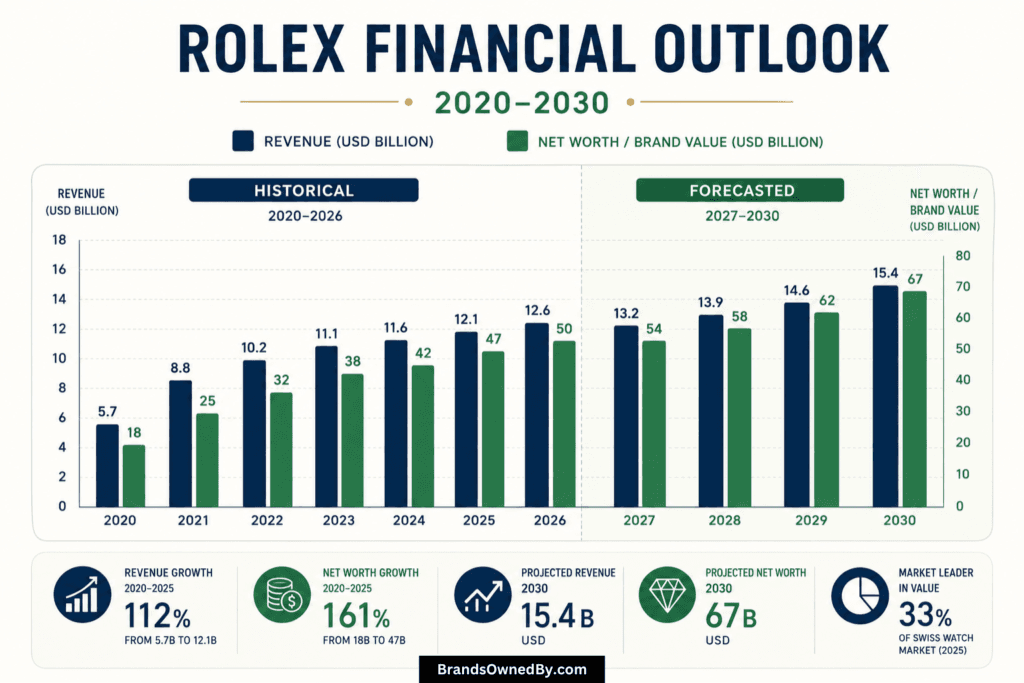
As of May 2026, Rolex remains the largest luxury watch brand in the world by sales revenue and market share. Industry estimates place Rolex’s 2026 annual revenue at approximately $12.6 billion, while the company’s estimated brand value and enterprise worth have reached nearly $50 billion.
Rolex has maintained consistent financial growth despite keeping production volumes relatively controlled. The company’s strategy focuses heavily on pricing power, limited supply, premium positioning, and long-term brand exclusivity rather than aggressive mass expansion.
Between 2020 and 2026, Rolex more than doubled its estimated annual revenue. During the same period, the company strengthened its dominance in the global luxury sports watch market through strong demand for collections such as the Daytona, Submariner, GMT-Master II, and Datejust.
Rolex 2026 Revenue
Rolex’s estimated 2026 revenue of $12.6 billion is driven primarily by luxury mechanical watch sales.
Industry analysts estimate Rolex produces roughly 1.2 million to 1.3 million watches annually. Despite this relatively controlled production volume, the company generates significantly higher revenue than most competitors because of high average selling prices and strong dealer demand.
The largest revenue contributors remain:
- Professional sports watches.
- Stainless steel luxury models.
- Precious metal collections.
- Certified pre-owned programs.
- Global retail partnerships.
The Daytona, GMT-Master II, and Submariner collections continue generating some of the strongest retail demand in the luxury watch sector.
Rolex also benefits from repeated annual price increases across major markets including:
- United States.
- Europe.
- China.
- UAE.
- Japan.
This pricing strategy helped Rolex increase revenue between 2024 and 2026 even while maintaining tight production discipline.
Revenue Growth From 2020 to 2026
Rolex experienced major financial expansion after the global luxury recovery that followed the pandemic period.
In 2020, estimated Rolex revenue stood near $5.7 billion due to disruptions in Swiss watch exports, retail closures, and weaker international travel demand.
The recovery accelerated rapidly afterward.
Estimated annual revenue progression:
| Year | Estimated Revenue |
|---|---|
| 2020 | $5.7 billion |
| 2021 | $8.8 billion |
| 2022 | $10.2 billion |
| 2023 | $11.1 billion |
| 2024 | $11.6 billion |
| 2025 | $12.1 billion |
| 2026 | $12.6 billion |
This represents estimated revenue growth of more than 120% between 2020 and 2026.
One of the biggest reasons for this expansion was Rolex’s ability to maintain strong pricing power while demand consistently exceeded supply.
Unlike many competitors, Rolex avoided aggressive production increases that could weaken exclusivity or secondary market pricing.
Rolex Net Worth and Brand Value in 2026
As of May 2026, Rolex’s estimated enterprise value and brand worth are approximately $50 billion.
This valuation is based on several major factors:
- Global brand recognition.
- Luxury pricing power.
- Strong operating margins.
- High resale values.
- Large secondary market demand.
- Vertical manufacturing integration.
- Dominant Swiss watch market share.
Rolex also controls one of the strongest resale ecosystems in the luxury industry.
Many stainless steel sports models regularly trade above retail prices in secondary markets. In some cases, models such as the Daytona and GMT-Master II maintain resale premiums exceeding retail pricing by several thousand dollars depending on rarity and configuration.
This resale strength reinforces Rolex’s overall brand value and long-term pricing stability.
Rolex Market Share and Financial Dominance
Rolex continues controlling roughly one-third of the Swiss watch market by value entering mid-2026.
The company remains significantly larger than major competitors including:
- Omega.
- Cartier.
- Patek Philippe.
- Audemars Piguet.
- Breitling.
- Richard Mille.
Industry estimates also suggest Rolex alone generates more revenue than several large Swiss competitors combined.
Another major financial advantage is vertical integration.
Rolex controls nearly every major manufacturing stage internally, including:
- Movement production.
- Bracelet manufacturing.
- Dial production.
- Case manufacturing.
- Precious metal refining.
- Final assembly.
This structure allows Rolex to maintain tighter quality control and stronger operating margins compared to brands that depend heavily on third-party suppliers.
Why Rolex Revenue Keeps Growing
Rolex’s financial growth is driven by long-term brand strategy rather than rapid expansion.
The company focuses heavily on:
- Controlled production volumes.
- Premium pricing.
- Conservative product launches.
- Limited retail distribution.
- Strong global demand management.
A practical example is the Submariner lineup.
Despite years of waiting lists and global demand, Rolex continues limiting availability rather than dramatically increasing supply. This keeps resale values strong and protects the brand’s premium positioning.
Rolex also benefits from global luxury demand growth among high-net-worth consumers, especially in markets such as:
- United States.
- China.
- Middle East.
- Singapore.
- Japan.
Rolex Revenue and Net Worth Forecast Through 2030
Industry forecasts suggest Rolex will continue growing steadily through 2030 because of strong pricing power, luxury demand expansion, and controlled supply management.
Projected financial estimates:
- 2027 revenue forecast: $13.2 billion with estimated net worth of $54 billion.
- 2028 revenue forecast: $13.9 billion with estimated net worth of $58 billion.
- 2029 revenue forecast: $14.6 billion with estimated net worth of $62 billion.
- 2030 revenue forecast: $15.4 billion with estimated net worth of $67 billion.
These forecasts assume Rolex maintains:
- Stable global market leadership.
- Continued pricing increases.
- Strong secondary market demand.
- Controlled production growth.
- Long-term luxury consumer demand.
As of 2026, Rolex remains one of the most financially powerful and strategically disciplined companies in the global luxury sector.
Brands Owned by Rolex
As of 2026, Rolex operates through a tightly controlled corporate structure focused primarily on luxury watch manufacturing, retail control, movement production, and vertically integrated operations.
Unlike luxury conglomerates such as LVMH or Richemont, Rolex does not own dozens of unrelated fashion or jewelry brands. The company follows a concentrated ownership strategy centered around watchmaking, manufacturing control, retail infrastructure, and long-term brand positioning.
Rolex’s most important owned entities include Tudor, Bucherer, manufacturing subsidiaries, and movement-related operations connected to the broader Rolex Group structure.
| Company / Entity | Type | Role Within Rolex Group | Year Founded / Acquired | Key Details as of 2026 |
|---|---|---|---|---|
| Rolex SA | Luxury watch manufacturer | Main operating company of Rolex Group | 1905 | Oversees global Rolex operations including manufacturing, product development, marketing, retail allocation, and international distribution. Headquartered in Geneva, Switzerland. |
| Tudor | Luxury watch brand | Secondary watch brand owned by Rolex | 1926 | Created by Hans Wilsdorf to offer more accessible luxury watches. Major collections include Black Bay, Pelagos, Ranger, and Tudor Royal. Competes heavily in the mid-luxury sports watch segment. |
| Montres Tudor SA | Watch operating entity | Corporate operating entity behind Tudor | 1926 | Manages Tudor’s branding, operations, product development, and global distribution while remaining under Rolex Group control. |
| Bucherer | Luxury watch and jewelry retailer | Retail and distribution acquisition | Acquired in 2023 | One of the world’s largest luxury watch retailers. Operates stores across Europe and the United States. Strengthened Rolex’s control over retail distribution and certified pre-owned sales. |
| Rolex Industrie SA | Manufacturing entity | Industrial and production operations | Internal Rolex entity | Handles movement manufacturing, case production, bracelet production, assembly operations, and industrial manufacturing activities across Rolex facilities. |
| Rolex Holding SA | Corporate holding company | Ownership and governance coordination | Internal Rolex entity | Supports internal corporate management, ownership coordination, and group-level operational structures inside Rolex Group. |
| Kenissi | Mechanical movement manufacturer | Movement production partner linked to Rolex and Tudor | 2016 expansion phase | Produces automatic mechanical movements used by Tudor and other luxury brands. Important part of Rolex-linked movement manufacturing infrastructure. |
| Rolex Certified Pre-Owned Program | Certified resale platform | Official pre-owned watch certification and resale system | Expanded globally from 2022 | Allows authorized dealers to sell certified pre-owned Rolex watches with authentication and warranty coverage. Expanded significantly across Europe, North America, and Asia by 2026. |
| Plan-les-Ouates Facility | Manufacturing facility | Case manufacturing and final assembly | Modern Rolex production facility | Produces Rolex watch cases, handles precious metal operations, and manages final assembly processes. One of Rolex’s most advanced production sites. |
| Bienne Facility | Manufacturing facility | Mechanical movement production | Rolex manufacturing expansion site | Main center for Rolex movement manufacturing, caliber development, and mechanical research operations. |
| Chêne-Bourg Facility | Manufacturing facility | Dial production and gem-setting | Rolex manufacturing facility | Produces watch dials and handles gem-setting operations under tightly controlled manufacturing conditions. |
Tudor
Tudor is the most important brand owned and operated by Rolex.
Hans Wilsdorf officially created Tudor in 1926 to offer watches with Rolex reliability and engineering standards at lower price points. While Tudor operates independently in branding and marketing, the company remains deeply connected to Rolex operationally and strategically.
As of 2026, Tudor has become one of the fastest-growing luxury sports watch brands in the world.
The brand competes heavily in the mid-luxury segment against:
- Omega Seamaster entry models.
- Breitling sports watches.
- TAG Heuer Carrera collections.
- Longines Spirit lineup.
Tudor’s strongest collections include:
- Black Bay.
- Pelagos.
- Ranger.
- Tudor Royal.
- Black Bay Chrono.
Rolex uses Tudor strategically to target younger luxury buyers and consumers priced out of Rolex sports models because of rising prices and long waiting lists.
Tudor also benefits from Rolex-linked manufacturing infrastructure, movement development partnerships, and retail distribution networks.
By 2026, Tudor had become a major global growth driver inside the broader Rolex Group structure.
Bucherer
Bucherer became one of Rolex’s most important acquisitions after the company officially acquired the luxury watch retailer in 2023.
Founded in 1888, Bucherer operates one of the world’s largest luxury watch and jewelry retail networks.
The acquisition gave Rolex much greater control over:
- Authorized dealer operations.
- Luxury retail distribution.
- Customer experience.
- Certified pre-owned watch sales.
- Secondary market positioning.
As of 2026, Bucherer operates major retail locations across:
- Switzerland.
- Germany.
- Austria.
- France.
- United Kingdom.
- United States.
Bucherer remains operationally independent in branding but now sits inside Rolex’s broader retail control structure.
The acquisition was considered one of the biggest luxury watch industry deals of the decade because it significantly expanded Rolex’s direct influence over luxury retail distribution.
Montres Tudor SA
Montres Tudor SA is the formal operating entity behind the Tudor brand.
The company manages Tudor’s:
- Product development.
- Brand operations.
- Marketing.
- Distribution.
- Retail coordination.
Although Tudor operates separately from Rolex in consumer branding, Montres Tudor SA remains part of the broader Rolex corporate structure headquartered in Geneva.
This structure allows Rolex to maintain separation between Rolex and Tudor positioning while still controlling operations internally.
Rolex SA
Rolex SA is the central operating company responsible for Rolex’s global watch business.
As of 2026, Rolex SA oversees:
- Product development.
- Global sales operations.
- Manufacturing strategy.
- Marketing partnerships.
- Distribution systems.
- Retail allocation.
The company operates from Geneva, Switzerland and serves as the core decision-making entity behind the Rolex brand worldwide.
Rolex SA also manages relationships with:
- Authorized dealers.
- Sports sponsorship partners.
- International distributors.
- Certified service centers.
The company remains privately controlled under the Hans Wilsdorf Foundation.
Rolex Industrie SA
Rolex Industrie SA handles major industrial and manufacturing operations across the Rolex Group structure.
The entity oversees much of Rolex’s vertically integrated production network, including:
- Mechanical movement production.
- Bracelet manufacturing.
- Case manufacturing.
- Precious metal processing.
- Assembly operations.
Rolex’s industrial structure is one of the company’s biggest competitive advantages.
Unlike many competitors that rely heavily on external suppliers, Rolex controls nearly every major production stage internally.
As of 2026, Rolex manufacturing operations are spread across several Swiss locations including:
- Geneva.
- Bienne.
- Chêne-Bourg.
- Plan-les-Ouates.
This manufacturing control allows Rolex to maintain:
- High quality consistency.
- Tight production secrecy.
- Supply chain stability.
- Long-term manufacturing independence.
Rolex Holding SA
Rolex Holding SA functions as part of the broader Rolex corporate ownership structure.
The entity helps manage:
- Corporate governance.
- Internal ownership structures.
- Financial coordination.
- Group-level operations.
Because Rolex is privately owned, the company does not publicly disclose detailed internal corporate reporting structures. However, Rolex Holding SA remains one of the major legal entities connected to Rolex Group operations as of 2026.
Kenissi
Kenissi is a Swiss mechanical movement manufacturer strongly connected to Rolex and Tudor operations.
Although Rolex does not publicly present Kenissi as a traditional consumer-facing subsidiary, the company plays an important strategic role inside the broader Rolex-linked manufacturing ecosystem.
Kenissi produces automatic mechanical movements used by:
- Tudor.
- Breitling.
- Chanel.
- Norqain.
The company became increasingly important after Tudor expanded its use of in-house calibers across major collections.
Kenissi strengthened Rolex Group’s influence over Swiss movement manufacturing while also reducing dependence on outside suppliers.
As of 2026, Kenissi remained one of the most strategically important industrial entities linked to Rolex’s manufacturing network.
Rolex Certified Pre-Owned Program
Rolex expanded aggressively into the certified pre-owned luxury watch market beginning in late 2022 and throughout 2023–2026.
The Rolex Certified Pre-Owned program became one of the company’s most important operational expansions in recent years.
The program allows authorized dealers to sell authenticated pre-owned Rolex watches with official certification and warranty coverage.
This move gave Rolex greater influence over:
- Secondary market pricing.
- Watch authentication.
- Resale standards.
- Dealer inventory control.
- Consumer trust in pre-owned sales.
The certified pre-owned market became strategically important because Rolex watches consistently trade above retail prices in many global markets.
By 2026, the program had expanded significantly across Europe, North America, and Asia.
Rolex Manufacturing Facilities
Rolex directly operates one of the largest vertically integrated watch manufacturing systems in Switzerland.
Its manufacturing facilities function as critical operational entities within the company.
Key Rolex production centers include:
Plan-les-Ouates Facility
This site handles case manufacturing, precious metal operations, and final assembly for many Rolex watches.
The facility is considered one of the most advanced luxury watch manufacturing centers in Switzerland.
Bienne Facility
The Bienne site focuses heavily on mechanical movement manufacturing and research operations.
Rolex produces its own calibers internally at this location.
Chêne-Bourg Facility
This facility specializes in dial production and gem-setting operations.
Many Rolex dial components are manufactured internally here under highly controlled conditions.
Major Acquisitions by Rolex
Rolex historically avoided aggressive acquisition activity compared to large luxury conglomerates.
However, several strategic acquisitions significantly strengthened its operational control.
Bucherer Acquisition (2023)
The Bucherer acquisition remains Rolex’s largest and most important modern acquisition.
The deal strengthened Rolex’s control over luxury watch retail infrastructure globally.
Manufacturing and Supplier Integration
Over several decades, Rolex gradually expanded control over suppliers, industrial production systems, and specialized manufacturing operations inside Switzerland.
Rather than acquiring fashion brands, Rolex focused acquisitions primarily on:
- Manufacturing independence.
- Supply chain control.
- Retail infrastructure.
- Movement production capabilities.
This strategy helped Rolex maintain one of the most vertically integrated operations in the luxury watch industry as of 2026.
Final Thoughts
Rolex is owned by the Hans Wilsdorf Foundation, making it one of the most unique companies in the global luxury industry. The absence of public shareholders has allowed Rolex to focus on long-term brand strength instead of short-term financial pressure.
This ownership structure has helped Rolex maintain exclusivity, pricing power, and manufacturing control for decades.
As of 2026, Rolex remains one of the most valuable and influential watchmakers in the world. Its foundation-controlled business model continues to shape every aspect of the company, from product development to retail strategy.
FAQs
Who owns Rolex USA?
Rolex USA is owned and operated by Rolex SA, the Swiss parent company headquartered in Geneva, Switzerland. Rolex USA functions as the company’s American subsidiary and manages U.S. operations including distribution, marketing, servicing, and authorized dealer relationships.
The entire Rolex Group, including Rolex USA, is ultimately controlled by the Hans Wilsdorf Foundation as of 2026.
Who manufactures Rolex?
Rolex manufactures its watches internally through its own vertically integrated Swiss production network.
The company controls nearly every major manufacturing stage, including:
- Mechanical movement production.
- Case manufacturing.
- Bracelet production.
- Dial manufacturing.
- Precious metal refining.
- Final assembly.
- Quality testing.
Rolex operates major production facilities in Geneva, Bienne, Chêne-Bourg, and Plan-les-Ouates, Switzerland.
Unlike many competitors, Rolex relies very little on third-party manufacturing suppliers.
Who owns Rolex and Tudor?
Rolex and Tudor are both owned by the Hans Wilsdorf Foundation through the broader Rolex Group structure.
Tudor was founded by Rolex founder Hans Wilsdorf in 1926 as a separate watch brand designed to offer more affordable luxury watches while benefiting from Rolex engineering and distribution expertise.
As of 2026, Rolex controls Tudor through Montres Tudor SA.
Who owns Rolex UK?
Rolex UK is owned by Rolex SA, the Swiss parent company behind Rolex worldwide operations.
Rolex UK handles regional operations including:
- Authorized dealer management.
- Marketing.
- Servicing.
- Retail coordination.
Like Rolex USA, Rolex UK ultimately falls under the ownership control of the Hans Wilsdorf Foundation.
When was Rolex founded?
Rolex was founded in 1905 by Hans Wilsdorf and Alfred Davis in London, England.
The company originally operated under the name Wilsdorf and Davis before the Rolex trademark was officially registered in 1908.
Rolex later moved its headquarters to Geneva, Switzerland in 1919.
Is Rolex owned by the Hans Wilsdorf Foundation?
Yes. As of 2026, Rolex is fully owned and controlled by the Hans Wilsdorf Foundation.
Hans Wilsdorf created the foundation in 1945 to ensure Rolex would remain independent after his death. The foundation became the controlling owner of Rolex in 1960 following Wilsdorf’s death.
The foundation remains the sole controlling entity behind Rolex Group today.
Does Rolex donate 90% of its profit?
No verified public evidence shows Rolex donates exactly 90% of its profits.
Because Rolex is privately owned, the company does not publicly release full financial statements or detailed profit allocation data.
However, the Hans Wilsdorf Foundation does fund charitable, educational, and social initiatives in Switzerland. Public statements from foundation representatives have indicated annual charitable spending of hundreds of millions of Swiss francs, but the exact percentage of Rolex profits donated is not publicly disclosed.
Is Rolex still family owned?
No. Rolex is not family owned as of 2026.
The company is owned by the Hans Wilsdorf Foundation, a private Swiss charitable foundation established by founder Hans Wilsdorf.
Because Hans Wilsdorf had no children, he transferred ownership of Rolex to the foundation instead of passing it to family heirs.