

- Procter & Gamble is publicly owned and traded on the New York Stock Exchange under the ticker symbol “PG,” meaning the company is controlled by shareholders rather than a single owner or family.
- The Vanguard Group is the largest shareholder of Procter & Gamble as of 2026, owning more than 10% of the company, followed by BlackRock and State Street Global Advisors, which together control a significant portion of total voting power.
- Institutional investors collectively own nearly 70% of Procter & Gamble shares, giving major asset managers strong influence over board elections, executive compensation, corporate governance, and long-term business strategy.
- Procter & Gamble operates under a distributed ownership structure where executive leadership manages daily operations, while institutional shareholders and the board of directors shape long-term strategic and financial decisions.
Procter & Gamble, commonly called P&G, is an American multinational consumer goods company headquartered in Cincinnati, Ohio. The company specializes in household and personal care products used daily by consumers around the world.
P&G operates across several major product categories. These include fabric care, home cleaning, grooming, oral care, skincare, baby care, feminine hygiene, and healthcare products. The company sells products through supermarkets, online retailers, pharmacies, convenience stores, and wholesale distribution networks.
One of P&G’s biggest strengths is brand management. The company focuses heavily on building long-term consumer trust through advertising, product innovation, and large-scale distribution. Many of its brands are market leaders in their categories.
P&G also uses a global manufacturing and supply chain system. This allows the company to maintain product availability in developed and emerging markets. Its products are sold in more than 180 countries.
The company is known for investing heavily in research and development. It regularly introduces product improvements, packaging innovations, and premium product lines. For example, P&G expanded Tide into detergent pods and advanced stain-removal products. Gillette evolved from traditional razors into heated razors and grooming technology products.
Over the years, P&G shifted its strategy toward focusing on high-performing brands. The company sold or discontinued weaker brands to concentrate resources on globally scalable businesses with stronger consumer demand.
Today, Procter & Gamble remains one of the most influential companies in the global consumer goods industry.
Founders of Procter & Gamble
Procter & Gamble was founded in 1837 by William Procter and James Gamble.
William Procter was a candle maker originally from England. James Gamble was a soap maker from Ireland. Both immigrants settled in Cincinnati, Ohio, where they eventually became business partners after marrying sisters from the same family.
Their father-in-law, Alexander Norris, encouraged them to combine their businesses instead of competing separately. This partnership led to the creation of Procter & Gamble.
In its early years, the company focused mainly on soap and candle production. Demand increased significantly during the American Civil War because the company supplied products to Union soldiers. This helped P&G establish nationwide recognition.
The founders built the business around product consistency and manufacturing quality. Those principles later became core elements of P&G’s corporate culture.
William Procter primarily managed the candle-making side of the business, while James Gamble handled soap production and operational processes. Their combined expertise helped the company expand rapidly during the 19th century.
The legacy of the founders still influences the company today. P&G continues to emphasize product reliability, consumer trust, and long-term brand building.
Ownership History
The ownership history of Procter & Gamble reflects the company’s transformation from a small family-operated soap business into one of the largest publicly traded consumer goods corporations in the world. Over nearly two centuries, P&G moved from founder-controlled ownership to institutional investor dominance.
Founding and Early Family Ownership (1837–1800s)
Procter & Gamble was founded in 1837 by William Procter and James Gamble in Cincinnati, Ohio. During the early decades, ownership remained entirely within the founders’ control and their families.
The company initially operated as a private partnership. William Procter managed candle production while James Gamble handled soap manufacturing. Their business grew steadily because candles and soap were essential household products during the 19th century.
Family ownership allowed the founders to make long-term decisions without outside shareholder pressure. Most profits were reinvested into manufacturing expansion, distribution, and product development.
During the American Civil War, P&G secured contracts to supply soap and candles to Union soldiers. This dramatically increased brand recognition across the United States. The company expanded rapidly after the war due to growing national demand.
Transition Into a Public Company
As Procter & Gamble expanded, the company needed additional capital to support larger manufacturing operations and nationwide distribution. This eventually led to the transition toward public ownership.
P&G became publicly traded in the late 19th century. Listing shares allowed the company to attract outside investors while reducing dependence on family-controlled financing.
The move to public ownership marked a major turning point. It enabled the company to:
- Expand manufacturing facilities.
- Increase advertising spending.
- Develop new product categories.
- Enter international markets.
- Improve distribution infrastructure.
Even after becoming public, founding family influence remained important for many years because family members still held substantial shares and leadership positions.
Growth Through Brand Expansion (1900s–1950s)
During the early and mid-20th century, Procter & Gamble strengthened its ownership base through continuous business growth and investor confidence.
The company introduced several major brands during this period, including:
- Ivory Soap.
- Crisco.
- Camay.
- Tide.
- Crest.
These products helped P&G become one of America’s leading household goods companies.
Institutional investors slowly began increasing their ownership positions during this era. Banks, insurance companies, and early investment funds started viewing P&G as a stable long-term investment because of its strong consumer demand and reliable business model.
At the same time, the company expanded internationally. This increased its attractiveness to larger investors looking for global exposure.
Rise of Institutional Ownership (1960s–1990s)
The ownership structure of Procter & Gamble changed significantly during the second half of the 20th century.
Institutional investors gradually became the dominant shareholders. This shift occurred because pension funds, mutual funds, and asset management firms started investing heavily in large blue-chip corporations.
P&G became particularly attractive due to:
- Consistent dividend payments.
- Strong brand loyalty.
- Stable earnings.
- Global expansion.
- Defensive consumer product demand.
During this period, ownership became widely dispersed. No individual shareholder gained majority control. Instead, large financial institutions accumulated smaller percentage stakes through diversified investment portfolios.
The rise of retirement investing in the United States also contributed to this shift. Millions of Americans indirectly became P&G shareholders through pension plans and mutual funds.
The Gillette Acquisition and Ownership Transformation (2005)
One of the most important moments in P&G’s ownership history came in 2005 when the company acquired Gillette in a deal valued at approximately $57 billion.
This acquisition significantly reshaped the company’s shareholder structure and business operations.
Gillette shareholders received Procter & Gamble shares as part of the transaction. As a result:
- P&G’s total shareholder base expanded.
- Institutional ownership increased further.
- The company gained major grooming brands.
- Market influence grew substantially.
The acquisition added several globally recognized brands to P&G’s portfolio, including:
- Gillette.
- Braun.
- Duracell.
- Oral-B.
The deal also strengthened P&G’s position in men’s grooming and personal care markets.
Activist Investor Influence
During the 2010s, activist investors became more involved in Procter & Gamble’s ownership landscape.
One of the most notable examples was Nelson Peltz and his investment firm, Trian Fund Management. Trian acquired a substantial stake in P&G and pushed for operational improvements and organizational restructuring.
The activist campaign focused on concerns related to:
- Slower sales growth.
- Bureaucratic management structures.
- Brand performance.
- Profit margins.
Although Trian did not gain control of the company, the campaign increased pressure on management and influenced strategic decisions.
This period demonstrated how even minority shareholders could affect decision-making in large public corporations.
Brand Simplification and Strategic Ownership Changes
Around the mid-2010s, Procter & Gamble began simplifying its business structure. The company sold, merged, or discontinued many smaller brands to focus on its strongest global businesses.
One major example was the sale of several beauty brands to Coty.
P&G reduced its brand portfolio significantly to improve efficiency and concentrate resources on higher-performing categories.
This strategy changed investor perception of the company. Many institutional shareholders supported the move because it improved profitability and operational focus.
Modern Ownership Structure
As of 2026, Procter & Gamble remains a publicly traded corporation with highly diversified ownership.
The largest shareholders are institutional investment firms such as:
- Vanguard Group.
- BlackRock.
- State Street Global Advisors.
These firms own shares mainly through index funds, exchange-traded funds, retirement accounts, and mutual funds.
No single shareholder controls the company outright. Instead, ownership is distributed across thousands of institutions and millions of retail investors worldwide.
This ownership model provides stability because the company is not dependent on one controlling family or individual investor.
At the same time, institutional investors hold significant influence over:
- Board elections.
- Executive compensation.
- Corporate governance.
- ESG policies.
- Long-term strategy.
Today, Procter & Gamble’s ownership history reflects the evolution of modern corporate America, where large institutional investors play a central role in controlling globally recognized public companies.
Who Owns Procter & Gamble: Top Shareholders
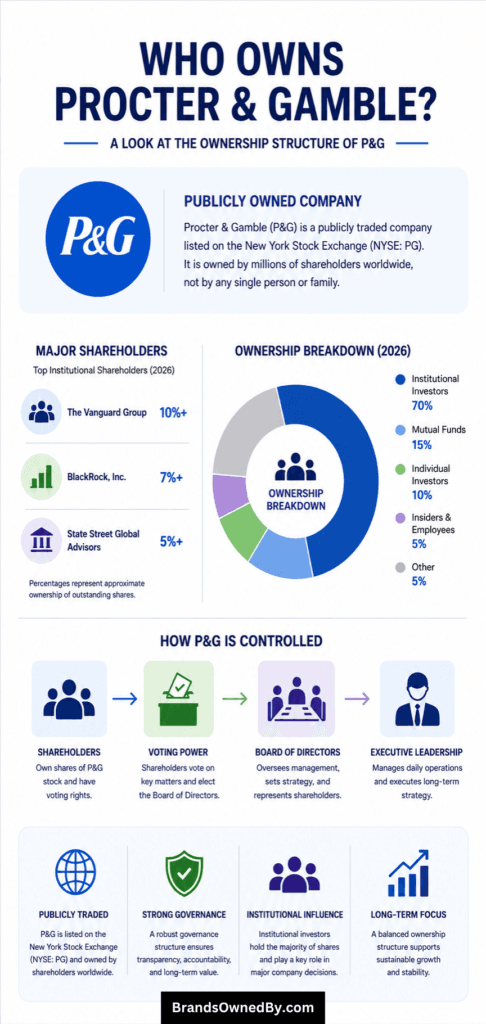
Procter & Gamble is a publicly traded company listed on the New York Stock Exchange under the ticker symbol “PG.” This means the company is not owned by a single individual, family, or parent corporation. Instead, ownership is divided among institutional investors, mutual funds, pension funds, ETFs, insiders, and millions of retail shareholders worldwide.
Institutional investors control the majority of P&G shares. These firms manage investment portfolios on behalf of retirement funds, sovereign wealth funds, insurance companies, and individual investors. Because P&G is considered a stable blue-chip company, it is heavily included in major index funds and long-term investment portfolios.
As of 2026, institutional investors collectively control around 68% to 70% of the company’s outstanding shares. The remaining ownership is divided between retail investors and insiders such as executives and board members.
The company’s ownership structure provides stability because no single shareholder has majority control. However, the largest institutional investors still have significant influence over corporate governance, board elections, executive compensation, ESG initiatives, and long-term business strategy.
The Vanguard Group
The Vanguard Group is the largest shareholder of Procter & Gamble as of 2026. Vanguard owns more than 237 million shares, representing roughly 10.2% of the company.
Vanguard’s ownership comes mainly through index funds and exchange-traded funds. Since P&G is a major component of the S&P 500 and Dow Jones Industrial Average, Vanguard automatically holds large positions through passive investment products.
Some major Vanguard funds holding P&G shares include:
- Vanguard Total Stock Market Index Fund.
- Vanguard 500 Index Fund.
- Vanguard Institutional Index Fund.
- Vanguard S&P 500 ETF.
Although Vanguard does not actively manage P&G’s daily operations, its voting power is extremely important. The company participates in shareholder voting on matters such as:
- Board member elections.
- Executive compensation packages.
- Sustainability policies.
- Corporate governance reforms.
Vanguard typically supports long-term stability and operational consistency rather than aggressive activist strategies.
BlackRock
BlackRock is the second-largest shareholder of Procter & Gamble. As of 2026, BlackRock controls approximately 178 million to 184 million shares, equal to roughly 7.7% to 7.9% ownership.
BlackRock is the world’s largest asset management company. Its P&G ownership mainly comes through iShares ETFs, retirement portfolios, and institutional investment products.
P&G is widely held across BlackRock-managed funds because the company is viewed as:
- Financially stable.
- Dividend reliable.
- Recession resistant.
- Globally diversified.
BlackRock’s influence extends beyond ownership percentages. The company regularly engages with corporate leadership regarding environmental, social, and governance policies.
Its large stake gives it substantial influence during shareholder voting periods.
State Street Global Advisors
State Street Global Advisors is another major institutional shareholder of Procter & Gamble. The firm owns more than 100 million shares, representing approximately 4.3% to 4.4% of total ownership.
State Street’s ownership mainly comes through passive investment funds and ETF products, especially SPDR index funds.
Like Vanguard and BlackRock, State Street benefits from P&G’s reputation as a stable dividend-paying company with predictable consumer demand.
The company also plays an important role in governance oversight. State Street frequently focuses on:
- Board diversity.
- Long-term shareholder value.
- Risk management.
- Corporate accountability.
Together, Vanguard, BlackRock, and State Street control more than 22% of Procter & Gamble shares. This gives the “Big Three” enormous influence over corporate decisions.
Geode Capital Management
Geode Capital Management is another significant shareholder in Procter & Gamble. As of 2026, the firm owns more than 60 million shares, equal to roughly 2.6% ownership.
Geode primarily manages index-based investment strategies and institutional portfolios. Its ownership reflects P&G’s strong weighting in major U.S. equity benchmarks.
Although Geode is less publicly visible than Vanguard or BlackRock, it still represents billions of dollars in voting power.
Morgan Stanley
Morgan Stanley is among the largest institutional holders of Procter & Gamble stock. The company owns over 51 million shares, representing slightly more than 2% ownership.
Its holdings come from wealth management services, institutional portfolios, and investment funds managed for clients globally.
Morgan Stanley’s investment position demonstrates strong confidence in P&G’s long-term profitability and defensive market position.
Norges Bank Investment Management
Norges Bank Investment Management, which manages Norway’s sovereign wealth fund, also holds a major stake in P&G.
As of 2026, Norges Bank owns approximately 32 million shares, representing around 1.3% ownership.
The fund invests heavily in large multinational corporations with strong global market positions and stable cash flows. P&G fits this strategy due to its consistent consumer demand and strong brand portfolio.
T. Rowe Price Associates
T. Rowe Price Associates is another notable institutional shareholder. The investment firm owns approximately 25 million shares of Procter & Gamble as of 2026.
The company includes P&G across multiple mutual funds and retirement-focused investment products.
T. Rowe Price generally favors companies with:
- Long operating histories.
- Stable dividend growth.
- Strong consumer loyalty.
- Predictable earnings performance.
Retail Shareholders
Retail investors collectively own a significant portion of Procter & Gamble stock. Millions of people worldwide hold P&G shares directly or indirectly through:
- Retirement accounts.
- Mutual funds.
- ETFs.
- Brokerage accounts.
- Pension plans.
P&G remains popular among long-term investors because of its dividend history and relatively stable stock performance during economic downturns.
For example, many retirees hold P&G shares as part of income-focused portfolios because the company has increased dividends for decades.
Insider Ownership
Insider ownership at Procter & Gamble is relatively small compared to institutional ownership. Company executives and board members own less than 1% of total outstanding shares combined.
However, senior leadership still holds meaningful stock positions tied to compensation packages and long-term incentives.
Some notable insider shareholders include:
- Jon Moeller.
- Shailesh Jejurikar.
- Senior executive leadership members.
Insider ownership helps align executive interests with shareholder value creation. Executives benefit directly when the company performs well and the stock price increases.
Shareholder Influence on P&G Strategy
Because Procter & Gamble has no controlling owner, major shareholders can strongly influence strategic decisions.
Institutional investors regularly evaluate management performance based on:
- Revenue growth.
- Profit margins.
- Brand performance.
- Cost efficiency.
- Dividend stability.
- ESG performance.
Large shareholders also influence decisions regarding:
- CEO succession planning.
- Acquisitions and divestitures.
- Share buyback programs.
- Sustainability initiatives.
- Corporate restructuring.
For example, activist investor Nelson Peltz and Trian Fund Management previously pressured P&G to improve efficiency and simplify its brand portfolio. Although Trian never controlled the company, its involvement influenced management strategy and operational reforms.
Today, Procter & Gamble’s ownership structure reflects the modern corporate investment landscape, where large institutional asset managers hold substantial influence over globally recognized public companies.
Competitor Ownership Comparison
Procter & Gamble competes with some of the largest consumer goods companies in the world. These businesses operate across categories such as personal care, home cleaning, oral care, beauty products, baby care, and healthcare products.
One important similarity among these companies is their ownership structure. Most are publicly traded corporations dominated by institutional investors rather than founder-controlled businesses. Large asset management firms like Vanguard, BlackRock, and State Street appear repeatedly as major shareholders across the consumer goods industry.
However, there are also important differences in shareholder concentration, geographic influence, strategic control, and corporate governance models.
| Company | Ownership Type | Largest Shareholders | Founder/Family Control | Main Product Categories | Ownership Characteristics | Competitive Position Against P&G |
|---|---|---|---|---|---|---|
| Procter & Gamble | Publicly traded corporation | Vanguard Group, BlackRock, State Street Global Advisors | No | Household care, grooming, beauty, baby care, oral care, healthcare | Highly institutionalized ownership with broad shareholder distribution. No controlling shareholder. | Industry leader with one of the world’s largest consumer goods portfolios. |
| Unilever | Publicly traded multinational | BlackRock, Vanguard, Norges Bank | No | Food, beauty, personal care, home care | Strong international institutional ownership with major European investor influence. | Competes heavily with P&G in beauty, personal care, and cleaning products. |
| Colgate-Palmolive | Publicly traded corporation | Vanguard Group, BlackRock, State Street | No | Oral care, personal hygiene, home cleaning, pet nutrition | Ownership dominated by institutional investors and index funds. | Strong competitor in toothpaste and oral care categories. |
| Kimberly-Clark | Publicly traded corporation | Vanguard Group, BlackRock, State Street | No | Baby care, tissue products, feminine care | Institutional investors hold the majority of shares. Focused ownership around hygiene products. | Major rival to Pampers through Huggies and other hygiene brands. |
| Johnson & Johnson | Publicly traded corporation | Vanguard Group, BlackRock, State Street | No | Pharmaceuticals, medical devices, consumer healthcare | Diversified institutional ownership with healthcare-focused investor interest. | Competes with P&G in baby products, skincare, and consumer health segments. |
| Henkel | Public company with family influence | Henkel family, institutional investors | Yes | Laundry products, adhesives, beauty care | Significant family voting control combined with public shareholders. | Strong European competitor in detergents and hair care products. |
| Reckitt | Publicly traded corporation | BlackRock, Vanguard, global pension funds | No | Health products, cleaning products, hygiene brands | Institutionally controlled with globally diversified shareholders. | Competes with P&G in cleaning, disinfectants, and health-related consumer products. |
Procter & Gamble vs Unilever Ownership
Unilever is one of Procter & Gamble’s biggest global competitors. The company owns brands across food, personal care, beauty, cleaning, and nutrition categories.
Like P&G, Unilever is publicly traded and heavily owned by institutional investors. Major shareholders include:
- BlackRock.
- Vanguard Group.
- Norges Bank.
- Legal & General Investment Management.
One major difference is Unilever’s international ownership structure. The company has stronger European institutional investor influence because of its British origins and global corporate structure.
P&G, in comparison, has a stronger concentration of U.S.-based institutional ownership.
Another difference is business diversification. Unilever has major food brands, while Procter & Gamble focuses more heavily on household essentials and personal care products.
From an ownership perspective, both companies operate without controlling founders or dominant family ownership. Shareholder influence comes mainly from institutional voting power.
Procter & Gamble vs Colgate-Palmolive Ownership
Colgate-Palmolive competes directly with P&G in oral care, personal hygiene, and household cleaning products.
The ownership structure of Colgate-Palmolive is very similar to Procter & Gamble.
Its largest shareholders include:
- Vanguard Group.
- BlackRock.
- State Street.
- Geode Capital Management.
Institutional investors own the majority of Colgate shares, just as they do with P&G.
However, Colgate-Palmolive is smaller in overall scale and brand diversification. The company is more concentrated in oral care and personal hygiene markets, while P&G operates across a much broader portfolio.
For example:
- Colgate dominates toothpaste.
- P&G dominates several categories including detergents, diapers, grooming, and feminine care.
Because Colgate is more specialized, shareholders often evaluate the company differently. Investors typically focus heavily on oral care market share and international growth performance.
Procter & Gamble vs Kimberly-Clark Ownership
Kimberly-Clark is another major competitor, especially in baby care and personal hygiene products.
The company owns brands such as:
- Huggies.
- Kleenex.
- Kotex.
- Scott.
Like P&G, Kimberly-Clark is publicly traded and institutionally owned. Vanguard and BlackRock are also among its largest shareholders.
One important distinction is product concentration. Kimberly-Clark relies heavily on tissue and diaper products, while P&G has broader exposure across multiple consumer categories.
This difference affects investor perception.
P&G shareholders benefit from diversification across dozens of brands and product segments. Kimberly-Clark investors are more exposed to fluctuations in pulp prices, tissue demand, and hygiene product competition.
Kimberly-Clark also tends to have a smaller global scale compared to Procter & Gamble, giving P&G stronger negotiating power with retailers and suppliers.
Procter & Gamble vs Johnson & Johnson Ownership
Johnson & Johnson competes with P&G in healthcare, baby products, skincare, and consumer wellness categories.
Ownership structures are again very similar. Institutional investors dominate both companies.
Major J&J shareholders include:
- Vanguard Group.
- BlackRock.
- State Street.
However, Johnson & Johnson differs significantly because of its healthcare focus. The company generates major revenue from:
- Pharmaceuticals.
- Medical devices.
- Consumer health products.
P&G, in contrast, focuses primarily on consumer packaged goods.
This creates different shareholder expectations.
Johnson & Johnson investors often prioritize:
- Drug pipelines.
- Regulatory approvals.
- Healthcare innovation.
- Patent protection.
P&G investors focus more on:
- Consumer demand stability.
- Brand performance.
- Retail distribution.
- Advertising efficiency.
J&J also historically maintained a stronger insider influence through healthcare-focused leadership and scientific operations.
Procter & Gamble vs Henkel Ownership
Henkel provides an interesting ownership contrast because it still has significant family influence.
Henkel competes with P&G in laundry detergents, adhesives, and consumer care products through brands like Persil and Schwarzkopf.
Unlike P&G, Henkel maintains substantial control through the Henkel family. Family shareholders hold voting power through preferred ownership structures.
This creates a different governance environment compared to Procter & Gamble’s widely dispersed shareholder base.
P&G’s decisions are mainly influenced by institutional investors and public markets. Henkel balances both public shareholder interests and family control priorities.
Family ownership can provide long-term stability but may reduce outside investor influence.
Procter & Gamble vs Reckitt Ownership
Reckitt competes with P&G in cleaning products, health products, and household essentials.
The company owns brands such as:
- Lysol.
- Dettol.
- Durex.
- Finish.
Reckitt’s ownership structure resembles P&G’s institutional model. Major shareholders include BlackRock, Vanguard, and global pension funds.
However, Reckitt’s ownership is more internationally distributed because of its British corporate base.
Reckitt investors often focus heavily on health and hygiene product growth, especially after increased global demand for disinfectant products during the pandemic years.
How Ownership Impacts Competition
Ownership structure directly affects how consumer goods companies operate and compete.
For example, institutional investors generally prioritize:
- Long-term profitability.
- Dividend growth.
- Operational efficiency.
- Market share stability.
- ESG compliance.
Because the same major institutions often own stakes in competing companies, firms like P&G, Unilever, and Colgate face pressure to maintain consistent shareholder returns rather than pursue extremely risky strategies.
At the same time, companies with family influence, such as Henkel, may prioritize long-term brand preservation over short-term investor demands.
P&G’s ownership structure gives it flexibility to focus on:
- Large-scale brand investment.
- Share repurchase programs.
- Global expansion.
- Premium product positioning.
- Cost optimization.
This institutional ownership model has helped Procter & Gamble remain one of the most stable and influential companies in the global consumer products industry.
Who Controls Procter & Gamble?
Procter & Gamble operates under a corporate governance structure where control is shared between executive leadership, the board of directors, and major institutional shareholders. Since P&G is a publicly traded company, no founder, family, or single investor has majority control.
As of May 2026, the company is primarily controlled through its executive management structure and board oversight system. Institutional investors such as Vanguard, BlackRock, and State Street also influence major governance decisions because together they control a substantial percentage of voting shares.
Shailesh Jejurikar: CEO of Procter & Gamble
As of May 2026, Shailesh Jejurikar serves as the President and Chief Executive Officer of Procter & Gamble. He officially became CEO on January 1, 2026, succeeding Jon Moeller.
Jejurikar is a long-time P&G executive who joined the company in 1989. Before becoming CEO, he served as Chief Operating Officer and led several of P&G’s largest global businesses.
His leadership background includes oversight of:
- Fabric Care.
- Home Care.
- Enterprise Markets.
- Health & Beauty divisions.
- Global operations across North America, Europe, Asia, and Latin America.
One of his most important leadership roles was managing P&G’s Fabric & Home Care division, which includes major brands such as Tide, Ariel, Downy, Gain, and Febreze. This division represents one of the company’s most profitable and globally dominant business segments.
Jejurikar’s appointment reflects P&G’s long-standing preference for promoting internal executives rather than hiring outside CEOs. The company values leaders with deep operational experience across multiple regions and product categories.
His transition to CEO came during a period when P&G was dealing with:
- Slowing consumer spending.
- Inflation-related cost pressures.
- Supply chain restructuring.
- Workforce reductions.
- Portfolio optimization initiatives.
Investors viewed the leadership transition as a continuity move rather than a radical strategic shift.
Jon Moeller’s Role as Executive Chairman
Although Shailesh Jejurikar now leads daily operations, Jon Moeller continues to hold major influence over Procter & Gamble as Executive Chairman of the Board.
Moeller transitioned into the Executive Chairman role on January 1, 2026. In this position, he leads the board of directors and advises the CEO and executive leadership team on company strategy and governance matters.
Moeller remains highly influential because he previously served as:
- Chief Financial Officer.
- Chief Operating Officer.
- Vice Chairman.
- President and CEO.
During his leadership tenure, P&G focused heavily on:
- Premium product positioning.
- Brand portfolio simplification.
- Productivity improvements.
- Margin expansion.
- Supply chain modernization.
Moeller also oversaw P&G during a volatile economic environment marked by inflation, rising commodity costs, and changing consumer behavior.
Even after stepping down as CEO, his role as Executive Chairman ensures leadership continuity and board-level strategic oversight.
Role of the Board of Directors
The board of directors is one of the most powerful governing bodies inside Procter & Gamble.
The board oversees long-term strategy, executive accountability, governance standards, and shareholder interests. It also approves major corporate actions such as acquisitions, restructuring programs, executive compensation packages, and leadership succession decisions.
As of 2026, P&G’s board includes executives and business leaders from industries such as:
- Consumer goods.
- Technology.
- Healthcare.
- Logistics.
- Finance.
- Retail.
Notable board members include:
- Jon Moeller.
- Shailesh Jejurikar.
- Christopher Kempczinski (CEO of McDonald’s).
- Raj Subramaniam (CEO of FedEx).
- Joe Jimenez (former Novartis CEO).
The presence of external CEOs and global business executives gives the board significant operational and strategic expertise.
How Institutional Investors Influence Control
Although institutional shareholders do not directly run P&G’s operations, they exert substantial influence through shareholder voting rights.
The company’s largest shareholders include:
- Vanguard Group.
- BlackRock.
- State Street Global Advisors.
Together, these firms control more than 22% of P&G shares.
Their influence affects areas such as:
- Board elections.
- Executive compensation approval.
- ESG policies.
- Governance reforms.
- Shareholder proposals.
- Long-term capital allocation decisions.
Because these investors manage retirement funds and index portfolios, they generally prioritize stability, consistent earnings growth, and dividend reliability rather than aggressive risk-taking.
Institutional pressure also influences restructuring decisions and productivity initiatives.
Internal Leadership Structure
P&G operates through a highly centralized but globally integrated management structure.
The company divides operations into major business segments including:
- Fabric & Home Care.
- Baby, Feminine & Family Care.
- Beauty.
- Grooming.
- Health Care.
Each division is led by senior executives who report to the CEO and the leadership committee.
P&G also manages operations through geographic regions. This allows the company to adapt pricing, product development, and distribution strategies for local markets while maintaining centralized corporate oversight.
Decision-making is heavily data-driven. P&G relies extensively on consumer analytics, retail data, supply chain forecasting, and market research before making strategic changes.
Activist Investors and Governance Pressure
P&G has historically faced pressure from activist investors, particularly during periods of slower growth.
The most notable example involved Nelson Peltz and Trian Fund Management, which acquired a significant stake in the company and pushed for operational restructuring and organizational simplification.
Although Trian never gained direct control, its campaign increased shareholder pressure on management regarding:
- Operational efficiency.
- Brand portfolio performance.
- Organizational complexity.
- Profitability improvements.
This activism contributed to broader restructuring efforts inside the company, including portfolio simplification and productivity initiatives.
Restructuring and Strategic Control in 2026
As of 2026, P&G’s leadership is focused heavily on operational restructuring and efficiency improvements.
The company announced plans to cut approximately 7,000 jobs over a two-year period while also evaluating certain category exits and potential divestitures in specific markets.
These decisions are being driven by several factors:
- Rising input costs.
- Pressure on consumer spending.
- Slower volume growth.
- Competitive pricing pressure.
- Supply chain optimization needs.
The restructuring program demonstrates how control at P&G is tied closely to shareholder expectations for profitability, efficiency, and long-term margin improvement.
Who Ultimately Controls Procter & Gamble?
In practical terms, Procter & Gamble is controlled through a combination of executive leadership, board oversight, and institutional shareholder influence.
Shailesh Jejurikar controls day-to-day operations as CEO. Jon Moeller maintains strategic influence as Executive Chairman. The board supervises governance and long-term strategy, while institutional investors shape broader shareholder priorities through voting power.
Because ownership is widely distributed, no single person or organization has absolute control over the company. Instead, P&G operates through a layered governance system designed to balance executive authority, shareholder interests, and long-term corporate stability.
Procter & Gamble Annual Revenue and Net Worth 2020-30
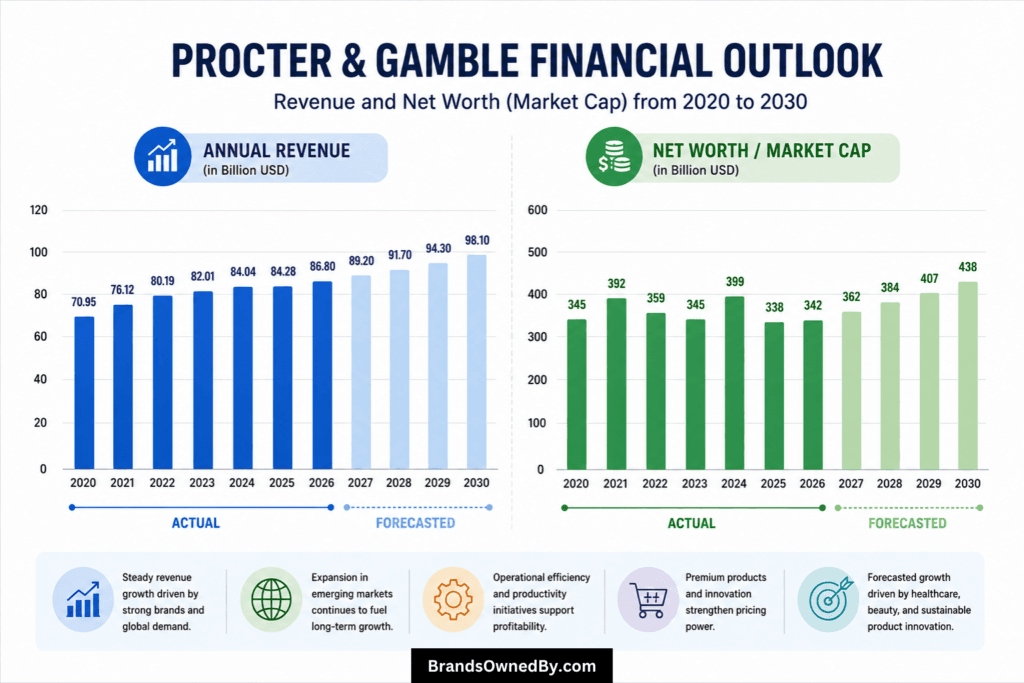
As of May 2026, Procter & Gamble remains one of the most valuable consumer goods companies in the world. The company continues to generate strong annual revenue through its global portfolio of household and personal care brands including Tide, Pampers, Gillette, Ariel, Oral-B, Pantene, Olay, and Head & Shoulders.
P&G’s estimated annual revenue for 2026 stands at approximately $86.80 billion, while its market capitalization, often used as a measure of corporate net worth, is valued at around $342 billion. The company maintains strong profitability due to premium pricing strategies, global scale, recurring consumer demand, and operational efficiency programs.
Unlike many consumer brands that rely heavily on seasonal demand, P&G benefits from consistent year-round purchases across categories such as detergents, baby products, feminine care, oral care, grooming products, and healthcare items. This gives the company strong cash flow stability even during periods of economic uncertainty.
Procter & Gamble 2026 Revenue
Procter & Gamble generates revenue from five major business segments. Fabric and Home Care remains the company’s largest division and contributes the highest share of total sales.
As of 2026, estimated revenue contribution by segment includes:
| Business Segment | Estimated 2026 Revenue Contribution | Key Brands |
|---|---|---|
| Fabric & Home Care | $31.4 billion | Tide, Ariel, Gain, Downy, Febreze |
| Baby, Feminine & Family Care | $20.1 billion | Pampers, Always, Charmin, Bounty |
| Beauty | $15.3 billion | Pantene, Head & Shoulders, Olay |
| Grooming | $8.7 billion | Gillette, Venus, Braun |
| Health Care | $11.3 billion | Oral-B, Crest, Vicks, Pepto-Bismol |
Fabric and Home Care remains particularly important because products like laundry detergent and cleaning supplies generate recurring consumer purchases. Tide alone continues to hold one of the strongest detergent market shares in North America.
The Baby, Feminine & Family Care division also contributes heavily to overall sales. Pampers remains one of the world’s largest diaper brands, while Always dominates several feminine hygiene markets globally.
Geographic Revenue Distribution
P&G earns revenue from nearly every major global region. North America remains the company’s largest market, but international operations account for a substantial share of total revenue.
As of 2026, estimated geographic revenue distribution includes:
| Region | Estimated Share of Revenue |
|---|---|
| North America | 52% |
| Europe | 22% |
| Asia Pacific | 12% |
| Greater China | 8% |
| Latin America | 4% |
| India, Middle East & Africa | 2% |
North America remains dominant because of strong consumer loyalty, premium product adoption, and extensive retail partnerships with major chains such as Walmart, Costco, Target, and Amazon.
However, emerging markets continue to play a major role in long-term growth strategy. P&G continues expanding premium skincare, baby care, and healthcare products across Asia, Latin America, and Africa.
Profitability and Operating Performance
P&G’s profitability remains one of the strongest in the consumer goods industry.
The company benefits from:
- Large-scale manufacturing efficiency.
- Strong pricing power.
- Premium brand positioning.
- High-margin product categories.
- Extensive retailer relationships.
As of 2026, Procter & Gamble maintains an estimated operating margin above 22%, which remains strong compared to many global competitors.
The company also continues investing heavily in automation, supply chain optimization, and AI-driven forecasting systems to improve operational efficiency.
During 2025 and 2026, P&G implemented restructuring initiatives that included workforce reductions and operational streamlining to improve long-term margins and productivity.
Procter & Gamble Net Worth and Market Capitalization
P&G’s estimated market capitalization of $342 billion in 2026 makes it one of the most valuable companies in the global consumer goods sector.
Its valuation is supported by several factors:
- Strong global brand portfolio.
- Stable recurring consumer demand.
- Consistent dividend payments.
- High institutional investor ownership.
- Global distribution scale.
- Strong free cash flow generation.
Institutional investors continue viewing P&G as a defensive stock because consumer essentials maintain demand even during economic downturns.
The company also remains highly attractive to dividend-focused investors. P&G has increased its dividend for more than 65 consecutive years, making it one of the strongest long-term dividend growth companies in the market.
Procter & Gamble Revenue Forecast Through 2030
Procter & Gamble is expected to maintain steady long-term revenue growth through 2030 due to its strong portfolio of recurring-consumption brands and global distribution scale. Analysts and industry forecasts suggest the company will continue benefiting from premium pricing strategies, healthcare expansion, digital commerce growth, and increasing demand in emerging markets.
Unlike technology companies that often experience volatile revenue swings, P&G’s growth model is built around stable consumer demand for everyday essentials. Products such as detergents, diapers, oral care products, shampoos, razors, and feminine hygiene items generate repeat purchases regardless of economic cycles.
The company is also focusing heavily on premiumization. Higher-margin products such as advanced skincare items, electric toothbrushes, premium detergents, and specialized healthcare products are expected to increase average revenue per customer over time.
2027 Forecast
P&G’s projected revenue for 2027 is approximately $89.20 billion.
This growth is expected to come primarily from stronger international demand and gradual recovery in consumer purchasing volumes after inflation-related pressure in previous years. Fabric & Home Care and Health Care divisions are expected to remain major growth drivers.
Management is also expected to continue expanding AI-powered supply chain systems and automation initiatives to improve efficiency and support profitability.
2028 Forecast
Projected 2028 revenue is estimated at $91.70 billion.
By this period, P&G is expected to benefit more heavily from e-commerce growth and premium product expansion across Asia and Latin America. Oral-B, Olay, and premium Tide product lines are projected to contribute significantly to higher-margin revenue growth.
The company’s digital retail partnerships with Amazon, Walmart, Costco, and regional online marketplaces are also expected to strengthen direct-to-consumer sales performance.
2029 Forecast
P&G’s estimated revenue for 2029 stands at approximately $94.30 billion.
At this stage, healthcare and wellness categories are expected to become increasingly important revenue contributors. Consumer demand for preventative healthcare products, hygiene products, and wellness-focused household goods is projected to rise globally.
P&G is also expected to continue investing in sustainable packaging and environmentally friendly manufacturing processes, which could improve brand perception and support premium pricing strategies.
2030 Forecast
By 2030, Procter & Gamble’s projected annual revenue is expected to reach approximately $98.10 billion.
Long-term growth is expected to be supported by:
- Expansion in emerging consumer markets.
- Continued product innovation.
- Premium beauty and skincare growth.
- Increased healthcare product demand.
- AI-driven operational efficiency.
- Strong global brand loyalty.
By the end of the decade, P&G is expected to remain one of the largest consumer goods companies globally with a stronger focus on high-margin product categories and digital commerce ecosystems.
Procter & Gamble Net Worth Forecast Through 2030
P&G’s market capitalization is also projected to increase steadily through 2030 due to consistent earnings growth, stable dividend performance, and strong institutional investor confidence.
The company continues to attract long-term investors because of its defensive business model. During economic downturns, consumer staples companies like P&G often maintain stronger stability than cyclical industries.
2027 Market Cap Forecast
P&G’s projected market capitalization for 2027 is approximately $362 billion.
This increase is expected to be driven by stronger earnings performance, productivity improvements, and investor confidence in the company’s restructuring initiatives under CEO Shailesh Jejurikar.
2028 Market Cap Forecast
The company’s estimated market value for 2028 is projected to reach $384 billion.
By this period, investors are expected to reward P&G’s improving operational efficiency and stronger premium product margins. Continued dividend growth is also expected to support institutional demand for the stock.
2029 Market Cap Forecast
P&G’s projected 2029 market capitalization stands at approximately $407 billion.
Analysts expect valuation growth to be supported by expanding healthcare and beauty segments, stronger international sales, and continued free cash flow generation.
The company’s global scale and retailer relationships are also expected to strengthen its competitive position against rivals such as Unilever, Colgate-Palmolive, and Kimberly-Clark.
2030 Market Cap Forecast
By 2030, Procter & Gamble’s estimated market capitalization could reach approximately $438 billion.
This projection reflects expectations of:
- Long-term global consumer demand stability.
- Strong dividend investor interest.
- Expansion of premium product categories.
- Continued institutional ownership growth.
- Improved operating margins through automation and supply chain modernization.
If these projections materialize, P&G will likely remain among the most valuable consumer goods companies in the world through the end of the decade.
Brands Owned by Procter & Gamble
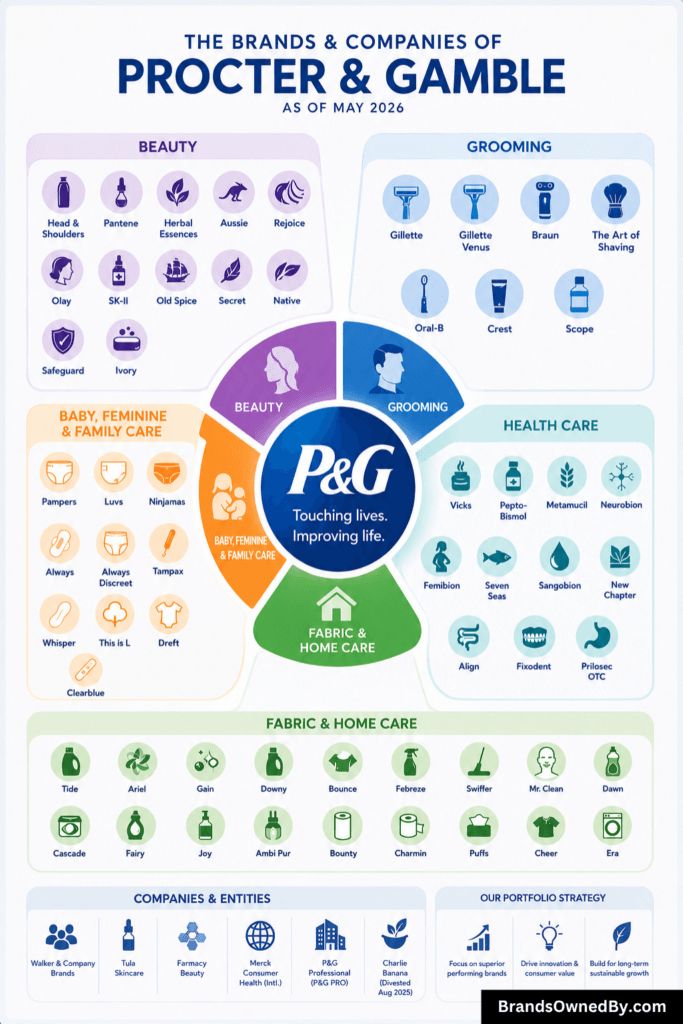
Procter & Gamble owns and operates one of the largest portfolios of consumer brands in the world. Unlike many conglomerates that operate through separate subsidiaries, P&G mainly controls brands directly under centralized corporate management.
As of 2026, it focuses heavily on high-performing categories including fabric care, baby care, grooming, skincare, oral care, feminine hygiene, and healthcare products. Over the past decade, P&G simplified its portfolio by selling weaker or non-core brands while concentrating on globally scalable businesses with strong profitability.
Many of P&G’s brands hold leading market share positions in their industries and generate billions of dollars in annual sales.
| Brand / Entity | Category | Main Products / Services | Key Details as of 2026 |
|---|---|---|---|
| Tide | Fabric Care | Laundry detergents, pods, stain removers | P&G’s largest detergent brand and a market leader in North America. Strong premium positioning and recurring consumer demand. |
| Ariel | Fabric Care | Laundry detergents and washing solutions | Major international detergent brand with strong market share across Europe, Asia, and Latin America. |
| Gain | Fabric Care | Detergents, scent boosters, fabric softeners | Popular fragrance-focused laundry brand with strong U.S. consumer loyalty. |
| Downy | Fabric Care | Fabric softeners, dryer sheets, scent products | Leading fabric enhancement brand known for long-lasting fragrance products. |
| Febreze | Home Care | Air fresheners, odor eliminators, plug-ins | Major home fragrance and odor-control brand with expanding premium product lines. |
| Pampers | Baby Care | Diapers, wipes, training pants | One of the world’s largest diaper brands with strong hospital partnerships and global distribution. |
| Luvs | Baby Care | Budget diapers and wipes | Value-focused diaper brand primarily operating in North America. |
| Always | Feminine Care | Sanitary pads, liners, period products | Global feminine hygiene brand with strong international market penetration. |
| Tampax | Feminine Care | Tampons and feminine hygiene products | Leading tampon brand with strong pharmacy and retail presence. |
| Bounty | Household Care | Paper towels and cleaning paper products | Premium household paper towel brand focused on durability and absorbency. |
| Charmin | Household Care | Toilet paper products | One of the largest toilet tissue brands in North America. |
| Gillette | Grooming | Razors, blades, trimmers, shaving products | Acquired in 2005. Remains one of P&G’s most valuable grooming businesses globally. |
| Venus | Grooming | Women’s razors and shaving products | Female-focused grooming brand positioned in premium personal care markets. |
| Braun | Grooming Electronics | Electric shavers, trimmers, grooming devices | Acquired through Gillette deal. Major premium grooming technology brand. |
| Head & Shoulders | Hair Care | Anti-dandruff shampoos and scalp products | One of the world’s best-selling anti-dandruff shampoo brands. |
| Pantene | Hair Care | Shampoo, conditioner, hair treatments | Large global hair care brand focused on repair and nourishment products. |
| Herbal Essences | Hair Care | Botanical shampoos and conditioners | Natural-inspired hair care brand targeting younger consumers. |
| Olay | Skincare | Moisturizers, serums, anti-aging skincare | Premium skincare brand competing with major global beauty companies. |
| SK-II | Luxury Skincare | Luxury skincare and anti-aging products | High-end Japanese skincare brand with strong presence in Asian beauty markets. |
| Old Spice | Men’s Personal Care | Deodorants, body wash, grooming products | Major men’s grooming brand successfully repositioned for younger consumers. |
| Safeguard | Personal Hygiene | Antibacterial soaps and hygiene products | Hygiene-focused soap brand with strong international presence. |
| Oral-B | Oral Care | Toothbrushes, electric toothbrushes, floss | One of the world’s largest oral care brands with strong premium positioning. |
| Crest | Oral Care | Toothpaste, whitening products, mouthwash | Leading toothpaste brand focused on oral health and whitening technology. |
| Vicks | Healthcare | Cold medicines, vaporizers, lozenges | Major respiratory and cold relief healthcare brand. |
| Pepto-Bismol | Digestive Health | Stomach relief and digestive products | Well-known digestive healthcare brand with strong pharmacy sales. |
| Metamucil | Wellness & Digestive Health | Fiber supplements and digestive products | Wellness-focused digestive health brand benefiting from preventive healthcare demand. |
| Native | Natural Personal Care | Natural deodorants, body wash, toothpaste | Acquired to strengthen P&G’s clean-label and natural personal care business. |
| Consumer Healthcare Operations | Healthcare Division | Oral care, digestive health, wellness products | Strategic healthcare segment focused on recurring wellness and personal health demand. |
| Gillette Acquisition | Major Acquisition | Grooming and oral care expansion | Transformational $57 billion acquisition completed in 2005 that expanded P&G’s global grooming business. |
| Merck KGaA Consumer Health Assets | Healthcare Acquisition | Consumer health product portfolio | Expanded P&G’s international healthcare presence in selected markets. |
Tide
Tide is P&G’s flagship laundry detergent brand and one of the most valuable detergent brands globally. The brand dominates the premium laundry detergent market in the United States and maintains strong international presence across Asia, Latin America, and the Middle East.
P&G expanded Tide far beyond traditional liquid detergent products. The brand now includes:
- Tide Pods.
- Tide Hygienic Clean.
- Tide Ultra OXI.
- Tide Simply.
- Tide Professional cleaning solutions.
Tide remains one of P&G’s largest revenue-generating brands because laundry detergent is a recurring consumer purchase category with strong customer loyalty.
Ariel
Ariel is another major detergent brand owned by P&G. The brand is particularly dominant outside North America and performs strongly across Europe, India, Latin America, and emerging markets.
Ariel competes directly with brands such as Persil and Surf Excel. P&G positions Ariel as a premium cleaning solution with strong stain-removal technology and advanced washing performance.
In several international markets, Ariel holds larger market share than Tide.
Gain
Gain operates within the fabric care division and focuses heavily on fragrance-based detergent products. The brand built strong consumer loyalty through scent-focused marketing strategies.
Gain products include detergents, scent boosters, dryer sheets, dishwashing liquids, and fabric softeners.
The brand performs especially well in North America.
Downy
Downy is one of the world’s leading fabric softener and scent-enhancement brands. P&G expanded the brand into multiple home fragrance and fabric care categories.
The company markets Downy heavily around premium scent experiences and long-lasting freshness.
Downy remains an important contributor to P&G’s Fabric & Home Care division.
Febreze
Febreze specializes in odor elimination and home freshness products. The brand became a major global success after P&G repositioned it from a simple odor remover into a broader home fragrance brand.
The product portfolio includes:
- Air fresheners.
- Fabric sprays.
- Plug-in fragrance systems.
- Car air fresheners.
- Pet odor products.
Febreze continues growing due to rising consumer demand for premium home care products.
Pampers
Pampers is one of the largest diaper brands in the world and one of P&G’s most profitable businesses.
The brand operates across:
- Baby diapers.
- Training pants.
- Baby wipes.
- Sensitive skin baby products.
Pampers maintains strong hospital partnerships and extensive pediatric marketing programs. The brand competes directly with Kimberly-Clark’s Huggies.
Emerging markets remain particularly important for Pampers because rising birth rates and middle-class expansion support long-term demand.
Luvs
Luvs is P&G’s value-focused diaper brand primarily sold in North America.
Unlike Pampers, which targets premium consumers, Luvs competes more aggressively on affordability while still benefiting from P&G’s manufacturing and distribution infrastructure.
Always
Always is one of P&G’s largest feminine hygiene brands. The company sells sanitary pads, liners, period underwear, and related hygiene products under the Always brand.
Always holds strong market share across North America, Europe, and several developing markets.
P&G also invests heavily in awareness campaigns related to menstrual health and women’s hygiene education.
Tampax
Tampax is a major tampon brand owned by P&G. It remains one of the best-selling tampon brands in the United States.
The brand benefits from strong pharmacy distribution, healthcare positioning, and recurring consumer demand.
Bounty
Bounty is a major paper towel brand known for premium absorbency and household cleaning performance.
The brand competes directly with Kimberly-Clark and private-label paper towel products.
P&G positions Bounty as a premium household paper product with superior durability and cleaning efficiency.
Charmin
Charmin is one of the most recognized toilet paper brands in North America.
The brand is heavily marketed around softness, comfort, and premium quality. P&G maintains strong retail shelf positioning for Charmin across supermarkets, wholesale retailers, and e-commerce channels.
Gillette
Gillette became part of P&G after the company completed its massive acquisition in 2005.
The acquisition significantly strengthened P&G’s grooming business and remains one of the most important deals in company history.
Gillette products include:
- Razors.
- Replacement blades.
- Trimmers.
- Shaving creams.
- Grooming products.
The brand remains dominant in premium shaving despite increasing competition from direct-to-consumer razor startups.
Venus
Venus operates as P&G’s women-focused shaving and grooming brand.
The brand includes razors, replacement cartridges, shaving gels, and skincare-focused grooming products.
P&G markets Venus heavily toward premium female grooming consumers.
Braun
Braun is a major grooming and personal care electronics brand acquired through the Gillette transaction.
The brand sells:
- Electric shavers.
- Beard trimmers.
- Hair removal devices.
- Grooming technology products.
Braun also operates in certain home appliance categories internationally.
Head & Shoulders
Head & Shoulders is one of the world’s leading anti-dandruff shampoo brands.
The brand has particularly strong market penetration in Asia and emerging markets. P&G continuously expands Head & Shoulders through new formulations focused on scalp health, hair repair, and hydration.
Pantene
Pantene remains one of P&G’s largest hair care brands globally.
The brand sells shampoos, conditioners, hair masks, and treatment products across multiple price segments.
P&G positions Pantene as a science-backed hair repair and nutrition brand.
Herbal Essences
Herbal Essences focuses on botanical and fragrance-driven hair care products.
The brand targets younger consumers and competes in the natural-inspired beauty category.
P&G repositioned Herbal Essences in recent years toward sustainability and plant-based ingredients.
Olay
Olay is one of P&G’s most valuable skincare brands.
The company competes against L’Oréal, Estée Lauder, Neutrogena, and Unilever skincare products through Olay’s anti-aging and premium skincare portfolio.
Olay’s products include:
- Moisturizers.
- Retinol treatments.
- Serums.
- Cleansers.
- Vitamin C skincare products.
The brand performs especially well in North America and China.
SK-II
SK-II is P&G’s luxury skincare brand originally developed in Japan.
The brand focuses on premium anti-aging skincare and is particularly strong across Asian luxury beauty markets.
SK-II products often sell at significantly higher price points than mainstream skincare brands, helping improve P&G’s premium beauty margins.
Old Spice
Old Spice is one of P&G’s largest men’s personal care brands.
The company transformed Old Spice from a legacy aftershave brand into a modern grooming business through aggressive marketing campaigns and product expansion.
The brand now includes:
- Deodorants.
- Body wash.
- Shampoo.
- Hair styling products.
- Beard care products.
Safeguard
Safeguard is a hygiene-focused soap and antibacterial cleaning brand.
The brand experienced increased visibility during global hygiene awareness growth and remains strong in several international markets.
Oral-B
Oral-B is one of the world’s largest oral care brands.
P&G expanded Oral-B aggressively into premium electric toothbrush technology, competing directly with Philips Sonicare.
The brand portfolio includes:
- Electric toothbrushes.
- Manual toothbrushes.
- Mouthwash.
- Dental floss.
- Water flossing devices.
Crest
Crest is one of the leading toothpaste brands globally.
The brand focuses heavily on cavity protection, whitening, enamel repair, and gum health products.
Crest and Oral-B together form one of P&G’s most important healthcare businesses.
Vicks
Vicks is a major healthcare brand specializing in cold and flu products.
The brand portfolio includes:
- Vapor rubs.
- Cough medicines.
- Vaporizers.
- Lozenges.
- Nasal products.
Vicks generates particularly strong seasonal sales during winter periods and flu outbreaks.
Pepto-Bismol
Pepto-Bismol is one of P&G’s leading digestive health brands.
The product remains highly recognized for treating stomach discomfort, nausea, and digestive issues.
Metamucil
Metamucil is a fiber supplement and digestive health brand owned by P&G.
The brand benefits from rising consumer focus on digestive wellness and preventative healthcare.
Native
Native is a personal care brand acquired by P&G to strengthen its position in the natural deodorant and clean-label personal care market.
The brand focuses on:
- Natural deodorants.
- Body wash.
- Shampoo.
- Toothpaste.
- Plastic-free products.
Native became strategically important because it helped P&G compete with emerging direct-to-consumer wellness brands.
Merck KGaA Consumer Health Acquisition
One of P&G’s important healthcare acquisitions involved acquiring Merck KGaA’s consumer health business in certain markets.
This transaction strengthened P&G’s international healthcare portfolio and expanded its over-the-counter product reach.
Gillette Acquisition
The Gillette acquisition remains the most transformative deal in P&G history.
Completed in 2005 for approximately $57 billion, the transaction added several major brands including:
- Gillette.
- Braun.
- Oral-B.
- Duracell.
Although P&G later sold Duracell, the acquisition fundamentally reshaped the company’s global grooming and healthcare businesses.
Consumer Healthcare Operations
Beyond individual brands, P&G operates large-scale global consumer healthcare operations focused on:
- Oral health.
- Digestive health.
- Respiratory products.
- Personal wellness.
- Feminine hygiene.
Healthcare remains one of the company’s most strategically important long-term growth areas because of aging populations and increasing consumer focus on wellness products.
Final Words
Procter & Gamble is owned by public shareholders, with institutional investors like Vanguard, BlackRock, and State Street holding the largest stakes. The company remains one of the most influential consumer goods businesses globally due to its enormous brand portfolio, financial stability, and consistent consumer demand.
P&G controls many household essentials used by millions every day. Its leadership structure, global distribution network, and brand dominance continue to make it one of the strongest companies in the consumer products industry.
FAQs
Who currently owns Procter and Gamble?
Procter & Gamble is publicly owned. The company is controlled by shareholders who own its stock on the New York Stock Exchange under the ticker symbol “PG.” The largest shareholders as of 2026 are institutional investment firms including Vanguard Group, BlackRock, and State Street Global Advisors.
Who owns P&G stock?
P&G stock is owned by a mix of institutional investors, mutual funds, pension funds, ETFs, and individual retail investors. Institutional shareholders collectively own nearly 70% of the company. Vanguard Group is the largest shareholder, followed by BlackRock and State Street.
Who started Procter & Gamble?
Procter & Gamble was started in 1837 by William Procter and James Gamble in Cincinnati, Ohio. William Procter was a candle maker, while James Gamble was a soap maker. The two became business partners after marrying sisters from the same family.
Did Procter & Gamble buy Merck?
Procter & Gamble did not acquire the entire Merck company. However, P&G acquired certain consumer healthcare assets and product rights from Merck KGaA in selected international markets. This helped strengthen P&G’s healthcare and over-the-counter product business.
Does Warren Buffett own Procter & Gamble?
Warren Buffett personally does not own a major direct stake in Procter & Gamble as of 2026. However, Berkshire Hathaway previously held a large investment in P&G after the Gillette acquisition because Berkshire was a major Gillette shareholder before the merger.
Over time, Berkshire Hathaway significantly reduced its P&G holdings.
Is P&G owned by BlackRock?
No, Procter & Gamble is not owned solely by BlackRock. BlackRock is one of the company’s largest institutional shareholders, but it does not control the company outright. P&G is publicly traded and owned by many shareholders globally.
Who founded Procter and Gamble?
Procter & Gamble was founded by William Procter and James Gamble in 1837. The company began as a soap and candle business before expanding into one of the world’s largest consumer goods corporations.