
- Five Guys Enterprises is a privately owned company primarily controlled by the Murrell family, which reportedly holds around 75% ownership of the business as of 2026.
- Jerry Murrell and the Murrell family maintain direct influence over major business decisions including franchise expansion, operational standards, executive leadership, and long-term growth strategy.
- Miller Investment Management is believed to hold an estimated 20% minority stake in Five Guys, making it the company’s largest outside shareholder while the Murrell family retains controlling ownership.
Five Guys Enterprises is an American fast-casual restaurant chain that specializes in burgers, fries, hot dogs, and milkshakes. The company is known for its simple menu, fresh ingredients, and highly customizable burger options.
The business started in Arlington, Virginia, and gradually expanded into one of the most recognizable premium burger chains in the world. Unlike many fast-food companies that constantly add new products, Five Guys built its reputation around a focused menu and consistent food quality.
One of the company’s defining features is its open-kitchen concept. Customers can often see burgers being prepared in real time. The brand also became famous for serving hand-cut fries cooked in peanut oil and offering free peanut snacks in many locations.
Five Guys operates through a combination of company-owned restaurants and franchise locations. The brand has expanded into international markets across Europe, Asia, and the Middle East while maintaining strict operational standards.
The company competes in the premium fast-casual segment rather than the low-cost fast-food category. This positioning helped Five Guys attract customers looking for larger portions, fresh preparation, and customizable meals.
Business Model
Five Guys primarily operates using a franchise-driven expansion model. Franchise partners operate restaurants under detailed operational guidelines established by the parent company.
The company maintains strong control over:
- Restaurant layouts
- Ingredient sourcing
- Cooking processes
- Branding standards
- Customer service expectations.
This approach helps maintain consistency across locations worldwide.
Brand Reputation
Five Guys built strong brand recognition through customer experience rather than aggressive advertising campaigns. The company relied heavily on word-of-mouth growth during its early expansion years.
Its reputation grew because of:
- Fresh beef burgers
- Large fries portions
- Simple menu execution
- Fast customization process
- Consistent food quality.
The company also avoided heavy discounting strategies commonly used by traditional fast-food chains.
Founders of Five Guys
Five Guys Enterprises was founded in 1986 in Arlington, Virginia, by Jerry Murrell and Janie Murrell. The couple started the business using family savings after deciding to enter the restaurant industry instead of investing in other business ventures.
The company was built as a family-operated burger restaurant from the beginning. Their sons also became involved in the business over time, which helped shape the company’s identity and naming strategy. The “Five Guys” name originally referred to Jerry Murrell, Janie Murrell, and their first three sons before later representing the five Murrell brothers after another son was born.
Jerry Murrell
Jerry Murrell is the primary founder behind Five Guys. He played a major role in shaping the company’s operational philosophy and long-term business strategy.
Before launching the restaurant, Jerry Murrell reportedly advised his sons to either “go to college or start a business.” The family decided to invest in the restaurant industry instead.
Murrell focused heavily on food consistency and operational simplicity. This philosophy became a core reason behind Five Guys’ long-term success.
He also resisted rapid menu expansion for years. Instead, he focused on perfecting a limited number of products.
Janie Murrell
Janie Murrell co-founded the company alongside Jerry Murrell. She helped manage the family business during its early years and played an important role in operations and business development.
The Murrell family approach helped create a strong family-oriented business culture that remained part of the company even after major expansion.
The Murrell Brothers
The Five Guys name was inspired by the Murrell family sons. The original “five guys” referred to Jerry and Janie Murrell along with their first three sons. After the birth of another son, the name evolved to represent the five Murrell brothers.
The brothers became involved in different parts of the business over time, including operations and expansion efforts.
Their involvement helped preserve the company’s family-controlled identity even as the brand expanded internationally.
Ownership History
The ownership history of Five Guys Enterprises is different from many major restaurant chains. Instead of selling the business to a large corporation or private equity group, Five Guys remained closely controlled by the Murrell family throughout its growth.
The company expanded from a single family-owned burger restaurant into a global fast-casual chain while maintaining private ownership.
Founding and Early Family Ownership (1986–2002)
Five Guys was founded in 1986 by Jerry Murrell and Janie Murrell in Arlington, Virginia.
During its early years, the business operated as a small regional restaurant company owned and managed by the Murrell family. The founders focused heavily on product consistency and customer experience instead of rapid expansion.
For nearly two decades, the company remained concentrated in the Washington, D.C. metropolitan area. The Murrell family directly controlled restaurant operations, hiring decisions, food preparation standards, and expansion planning.
At this stage, ownership was highly centralized within the family. There were no outside institutional investors or public shareholders involved in the business.
Expansion Through Franchising (2003–2010)
A major turning point came in 2003 when Five Guys decided to launch its franchising program.
Instead of opening every restaurant themselves, the Murrell family allowed outside operators to purchase franchise rights. This changed the company’s growth model significantly.
The franchising strategy helped Five Guys expand rapidly across the United States without giving up ownership of the parent company.
Under this structure:
- Franchisees owned and operated individual restaurant locations
- The parent company retained control over branding and operational systems
- Franchise operators paid royalty fees and franchise fees to Five Guys Enterprises.
This approach allowed the company to scale quickly while preserving family ownership at the corporate level.
Within a few years, thousands of franchise development agreements were signed across different markets.
Maintaining Private Ownership
Many successful restaurant chains eventually sell ownership stakes to private equity firms or go public through stock market listings. Five Guys chose a different path.
The Murrell family kept the company privately held even as the brand expanded internationally.
This decision allowed the company to avoid pressures commonly faced by public restaurant chains, including:
- Quarterly earnings expectations
- Shareholder activism
- Pressure for aggressive cost-cutting
- Short-term profit demands.
Private ownership also gave the company greater flexibility in maintaining operational standards and controlling expansion speed.
For example, Five Guys avoided excessive menu expansion despite industry trends pushing chains to constantly introduce new products.
International Growth and Ownership Control
As Five Guys entered international markets, the company used partnerships and franchise agreements to expand globally.
The parent company retained ownership of the Five Guys brand and intellectual property while allowing regional operators to manage local restaurant networks under licensing agreements.
This model helped the company expand into countries including:
- United Kingdom
- France
- Germany
- Saudi Arabia
- United Arab Emirates
- South Korea.
Even during international expansion, ownership control remained tied to the Murrell family and the privately held corporate structure.
Role of Franchise Ownership
One important distinction in Five Guys ownership history is the difference between franchise ownership and corporate ownership.
Many individual restaurant locations are owned by franchise operators. However, these franchisees do not own the parent company itself.
For example, a franchise group may own dozens of Five Guys restaurant locations in a region. However, the Five Guys brand, corporate systems, trademarks, and overall business control remain under Five Guys Enterprises.
This structure allowed the company to grow globally without diluting core ownership control.
Who Owns Five Guys: Top Shareholders
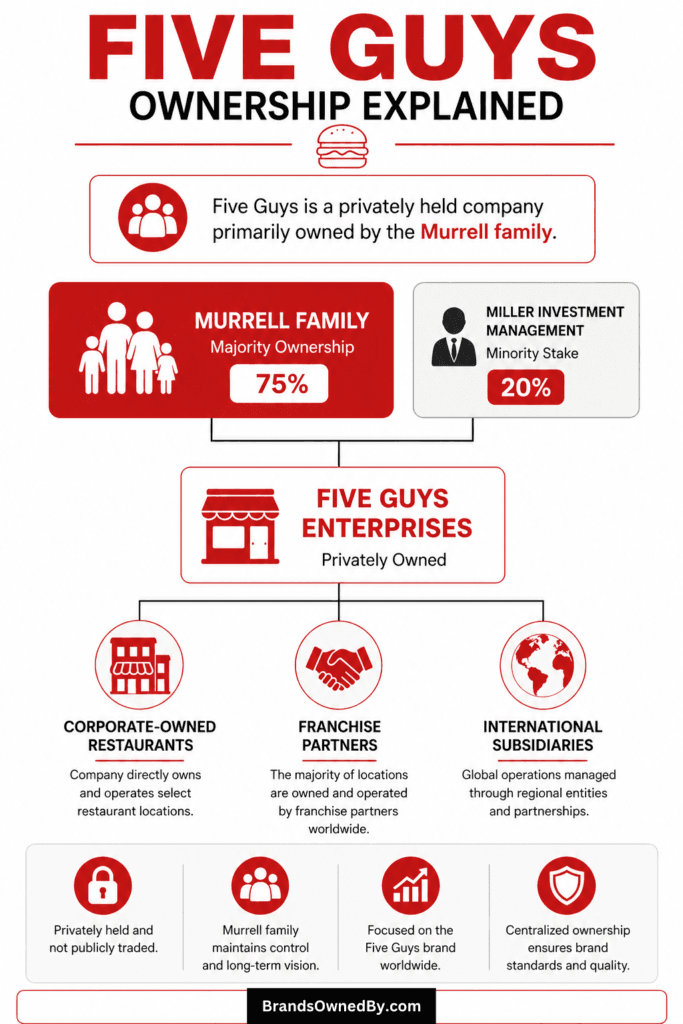
As of April 2026, Five Guys Enterprises remains a privately held company controlled primarily by the Murrell family. Unlike publicly traded restaurant chains, Five Guys does not publish annual shareholder filings or detailed equity disclosures. However, ownership data from long-standing company reports, investor records, and historical ownership disclosures continues to provide a clear picture of how the company is structured.
The ownership model is heavily concentrated among the founders and their family members. A minority stake is held by outside investment firms and early private investors. This structure has allowed Five Guys to maintain founder-led control while still accessing outside capital during its expansion phase.
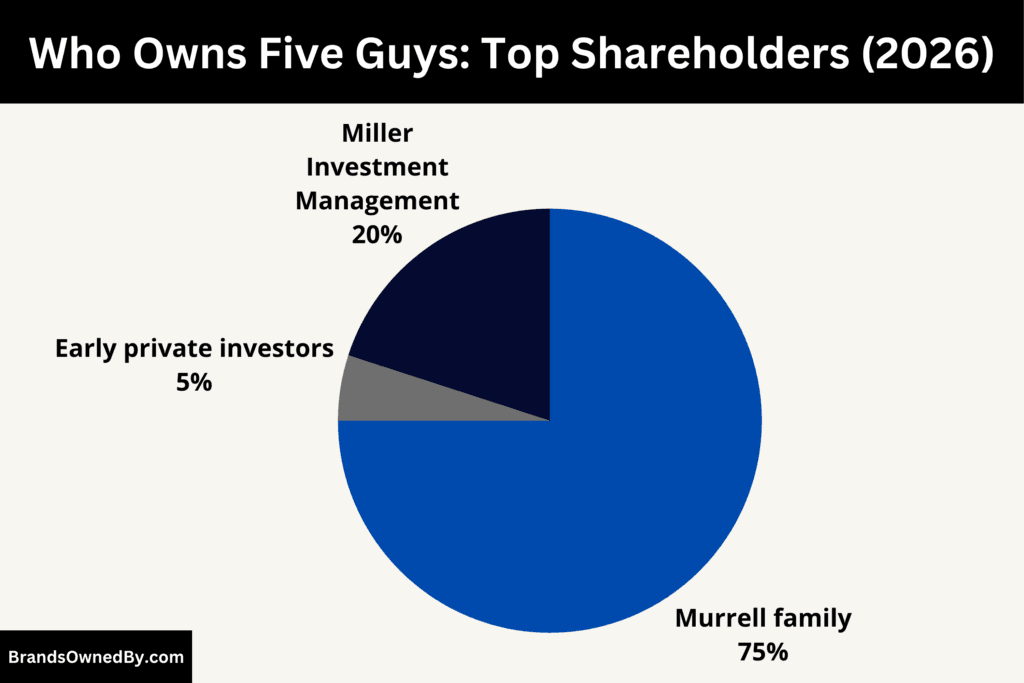
Murrell Family: 75% Ownership
The Murrell family remains the controlling shareholder group behind Five Guys.
Historical ownership disclosures stated that the family collectively owned approximately 75% of the company. That ownership stake was reportedly divided equally among the seven core family members connected to the business.
The ownership group includes:
- Jerry Murrell
- Janie Murrell
- The five Murrell sons involved in the business.
If the ownership remains equally divided under the original reported structure, each family member would control an estimated stake of slightly above 10%.
The Murrell family’s ownership influence extends beyond equity holdings. Several family members have historically remained involved in:
- Franchise approvals
- Operations management
- Expansion strategy
- Training systems
- Quality control oversight.
This level of operational involvement is uncommon for a restaurant chain operating internationally at Five Guys’ scale.
The family also maintained control by avoiding a public stock market listing. As of 2026, Five Guys has never launched an IPO. This allowed the Murrell family to avoid dilution from public shareholders and institutional activist investors.
Miller Investment Management: 20% Ownership
Miller Investment Management is believed to remain the largest outside shareholder in Five Guys.
Historical ownership disclosures identified the firm as holding approximately 20% ownership in the company. The investment firm became involved during Five Guys’ expansion years as the brand scaled aggressively through franchising.
The firm still lists Five Guys within its active investment portfolio as of 2026.
Despite holding a significant minority stake, Miller Investment Management has not been publicly identified as having operational control over the business. Strategic control appears to remain firmly with the Murrell family.
The investment relationship likely provided Five Guys with additional financial support and strategic guidance during major expansion phases without forcing the founders to surrender majority ownership.
Early Private Investors: 5% Ownership
A small minority ownership stake has historically been linked to early private investors associated with Jerry Murrell.
Past ownership disclosures stated that roughly 5% of the company was held by a small group of personal associates and early investors connected to the founders.
These shareholders were never publicly identified as active operational decision-makers within the company.
Their minority stake likely originated during Five Guys’ earlier expansion years before the brand became a major international chain.
Franchise Owners and Their Role
Many people confuse franchise ownership with corporate ownership.
Thousands of Five Guys restaurant locations are operated by franchisees across different countries. However, these franchise operators do not own equity in the parent company unless they have separately invested as shareholders.
For example, a regional franchise group may operate dozens of Five Guys restaurants while having no voting power or ownership control over Five Guys Enterprises itself.
The parent company retains control over:
- Brand trademarks
- Restaurant standards
- Supply chain systems
- Franchise approvals
- International licensing.
This structure helped Five Guys expand globally while keeping ownership concentrated among a small group of shareholders.
Competitor Ownership Comparison
The ownership structure of Five Guys Enterprises is very different from many of its competitors in the burger and fast-casual restaurant industry. Some competitors are publicly traded corporations controlled by institutional investors. Others are owned by private equity firms or family-controlled holding companies.
These ownership structures influence how companies make decisions about expansion, pricing, franchising, menu development, and long-term strategy.
| Company | Ownership Structure | Main Controlling Owners | Public or Private |
|---|---|---|---|
| Five Guys Enterprises | Family-controlled ownership | Murrell family | Private |
| McDonald’s | Institutional shareholder ownership | Vanguard, BlackRock, State Street | Public |
| Burger King | Parent holding company ownership | Restaurant Brands International | Public |
| Shake Shack | Institutional shareholder ownership | Institutional investors | Public |
| In-N-Out Burger | Family ownership | Snyder family | Private |
| Wendy’s | Institutional shareholder ownership | Asset management firms | Public |
Five Guys: Family-Controlled Private Ownership
Five Guys Enterprises remains privately controlled by the Murrell family as of 2026.
The Murrell family reportedly controls around 75% of the company, while minority stakes are held by outside investors such as Miller Investment Management.
Because the company is privately held, Five Guys operates with greater independence than many publicly traded restaurant chains.
This ownership structure allows the company to:
- Maintain long-term decision-making.
- Avoid quarterly earnings pressure.
- Control franchise expansion carefully.
- Preserve strict operational standards.
- Resist aggressive menu expansion trends.
For example, Five Guys spent years focusing almost entirely on burgers, fries, and hot dogs while competitors constantly introduced limited-time menu items and product experiments.
McDonald’s: Publicly Owned Corporate Structure
McDonald’s operates under a completely different ownership structure.
McDonald’s is a publicly traded company listed on the New York Stock Exchange. Ownership is spread across institutional investors, mutual funds, pension funds, and retail shareholders.
As of April 2026, the company’s largest shareholders include firms such as:
No single family controls McDonald’s.
Because of this structure, McDonald’s management must prioritize shareholder returns and quarterly financial performance.
This often leads to:
- Aggressive international expansion.
- Heavy marketing spending.
- Large-scale cost optimization.
- Frequent menu experimentation.
- Technology investments focused on operational efficiency.
Unlike Five Guys, McDonald’s decisions are heavily influenced by institutional investor expectations.
Burger King: Controlled Through a Parent Holding Company
Burger King is owned by Restaurant Brands International.
Restaurant Brands International also owns brands including:
- Tim Hortons.
- Popeyes.
- Firehouse Subs.
The parent company itself is publicly traded.
A major influence behind Restaurant Brands International is Brazilian investment firm 3G Capital, which became known for aggressive cost-cutting strategies in the restaurant industry.
This ownership model differs sharply from Five Guys because Burger King operates within a multi-brand corporate structure designed to maximize shareholder value across several restaurant chains.
Shake Shack: Public Shareholder Ownership
Shake Shack is another major competitor in the premium burger segment.
Unlike Five Guys, Shake Shack is publicly traded.
Its ownership is largely controlled by institutional investors, including:
- The Vanguard Group.
- BlackRock.
- Various hedge funds and asset managers.
Because Shake Shack operates under public market pressure, the company focuses heavily on:
- Revenue growth.
- New market expansion.
- Investor expectations.
- Quarterly earnings performance.
Shake Shack also invests aggressively in digital ordering systems and international expansion to satisfy shareholder growth expectations.
Five Guys, in contrast, maintained slower and more controlled growth for much of its history.
In-N-Out Burger: Family-Owned Competitor
In-N-Out Burger is one of the closest ownership comparisons to Five Guys.
The company remains privately owned by the Snyder family.
Lynsi Snyder controls the company as the heir to the Snyder family business.
Like Five Guys, In-N-Out has resisted public ownership and private equity acquisition.
This ownership structure allows the company to:
- Maintain strict quality control.
- Expand slowly.
- Preserve brand identity.
- Avoid investor-driven expansion pressure.
However, In-N-Out has historically expanded more slowly than Five Guys and operates in fewer international markets.
Wendy’s: Institutional Investor Ownership
Wendy’s is another publicly traded competitor.
Ownership is spread across institutional shareholders and investment firms.
Major shareholders include:
- The Vanguard Group.
- BlackRock.
- Other asset management firms.
Public ownership pushes Wendy’s toward strong financial performance metrics and shareholder-focused growth strategies.
The company frequently launches new products, promotions, and pricing campaigns designed to compete aggressively with rivals.
Five Guys takes a more brand-focused approach centered on product consistency rather than heavy promotional competition.
Ownership Structure Impact on Strategy
Ownership structures directly influence how restaurant chains operate.
Family-controlled companies like Five Guys and In-N-Out often prioritize:
- Brand consistency.
- Long-term growth.
- Operational control.
- Quality standards.
Publicly traded competitors often prioritize:
- Quarterly earnings growth.
- Shareholder returns.
- Rapid expansion.
- Cost efficiency.
This difference explains why Five Guys maintained a relatively simple menu and tighter operational control while many competitors aggressively diversified products and expanded promotional campaigns.
The ownership model also affects risk tolerance. Public restaurant chains may pursue aggressive expansion strategies to satisfy investors, while privately controlled companies often expand more selectively.
Who Controls Five Guys?
Control of Five Guys Enterprises remains heavily concentrated within the Murrell family as of 2026. Although the company expanded into an international restaurant chain with thousands of locations, the founding family still maintains significant influence over strategic decisions, operational standards, franchising policies, and long-term expansion plans.
Because Five Guys is privately owned, control is not determined by public shareholders or institutional investor voting power like many publicly traded restaurant companies. Instead, decision-making authority remains closely tied to the company’s majority ownership structure and executive leadership team.
The Murrell Family’s Control Over the Company
The Murrell family controls Five Guys through its majority ownership stake in the company.
Historical ownership disclosures have consistently indicated that the family collectively controls around 75% of the business. This ownership concentration gives the family strong influence over major corporate decisions.
This control allows the family to shape decisions involving:
- Franchise expansion approvals.
- International market entry.
- Brand positioning.
- Operational standards.
- Menu strategy.
- Executive leadership appointments.
Unlike publicly traded restaurant chains where activist investors or institutional shareholders can pressure management teams, Five Guys operates with centralized family influence.
This structure helped the company maintain its long-standing operational philosophy centered on product consistency and simplified menu execution.
Jerry Murrell’s Leadership Influence
Jerry Murrell remains one of the most influential figures in the company’s control structure.
As founder of the business, Murrell shaped many of the operational systems that still define Five Guys today.
His leadership philosophy focused heavily on:
- Food quality consistency.
- Limited menu complexity.
- Strong franchise oversight.
- Operational discipline.
- Customer experience standards.
One example of this influence is the company’s long resistance to expanding into large product categories commonly adopted by competitors. While many fast-food chains aggressively introduced breakfast menus, plant-based products, or large promotional campaigns, Five Guys remained focused on its core burger-and-fries identity.
Murrell also played a major role in controlling franchise expansion. The company became known for being selective with franchise approvals compared to some aggressively expanding restaurant chains.
Executive Leadership Structure
Five Guys Enterprises operates through a centralized executive leadership structure that manages global operations, franchising, international expansion, finance, and brand strategy.
While the Murrell family maintains ownership control, day-to-day corporate management is handled by senior executives and operational leadership teams.
As of April 2026, the leadership structure includes key executives responsible for overseeing different parts of the business.
Jerry Murrell: Founder and Chairman Influence
Jerry Murrell remains one of the most influential leaders connected to the company.
Although Five Guys expanded into a global restaurant chain, Murrell continues to shape the company’s long-term operational philosophy and strategic direction.
His influence is still visible in areas such as:
- Franchise approval standards.
- Menu simplicity strategy.
- Operational consistency.
- Brand positioning.
- Quality control expectations.
Murrell helped create the company’s tightly controlled operating culture that continues today.
Mike Veseth: Chief Executive Officer
Mike Veseth serves as the Chief Executive Officer of Five Guys as of 2026.
As CEO, Veseth oversees the company’s global business operations and long-term expansion strategy.
His responsibilities include:
- International growth management.
- Franchise system oversight.
- Corporate operations leadership.
- Strategic expansion planning.
- Executive decision-making coordination.
The CEO position plays a critical role because Five Guys operates across multiple international markets with a large franchise network.
Role of Family Members in Operations
Several Murrell family members have historically remained involved in operational leadership roles within the business.
Different family members reportedly participated in areas such as:
- Franchise inspections.
- Training systems.
- Restaurant operations.
- Expansion oversight.
- Quality assurance reviews.
This operational involvement helped preserve consistency across the company as it expanded internationally.
In many public restaurant corporations, founders eventually lose operational influence after acquisitions or shareholder dilution. Five Guys followed a different path by keeping family involvement deeply integrated into company operations.
Franchise Control and Corporate Oversight
One of the most important aspects of Five Guys control is its franchise management system.
Although many restaurant locations are operated by franchisees, the parent company maintains strict centralized control over operational standards.
Franchise operators must follow detailed company requirements involving:
- Ingredient sourcing.
- Kitchen procedures.
- Restaurant layouts.
- Equipment standards.
- Branding guidelines.
- Customer service protocols.
This level of oversight allows Five Guys to maintain consistency across markets.
For example, franchise operators cannot freely redesign menus or dramatically alter restaurant concepts without corporate approval.
This centralized control model differs from some franchise-heavy restaurant chains where local operators have greater operational flexibility.
Decision-Making Structure
Major business decisions at Five Guys are believed to flow through a centralized leadership structure influenced heavily by ownership leadership.
Important strategic decisions typically involve:
- Executive leadership teams.
- Ownership stakeholders.
- Senior operational managers.
- Franchise development leadership.
Because the Murrell family controls the majority ownership stake, the family maintains strong influence over high-level strategic direction.
This includes decisions involving:
- International expansion pace.
- Franchise territory approvals.
- Brand partnerships.
- Long-term investment planning.
- Corporate growth strategy.
Five Guys Annual Revenue and Net Worth
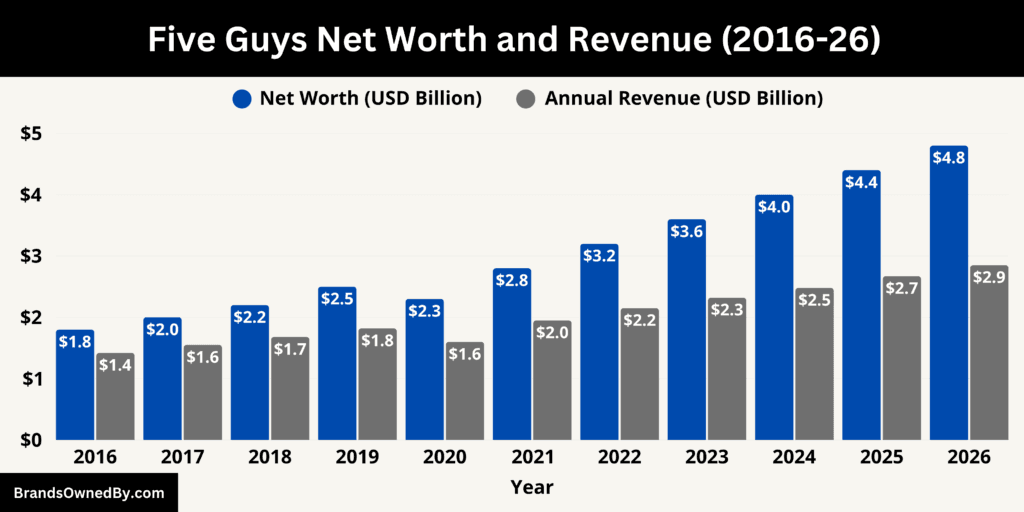
As of April 2026, Five Guys Enterprises is estimated to generate more than $3.8 billion in global systemwide sales annually, making it one of the largest privately owned fast-casual burger chains in the world. Industry valuation estimates place the company’s net worth and enterprise valuation between $4.5 billion and $5 billion based on franchise performance, international growth, revenue multiples, and brand strength.
The financial growth accelerated after international expansion and aggressive franchising. Five Guys now operates in nearly 30 countries and has more than 2,000 locations globally, with over 1,550 restaurants located in the United States alone.
2026 Revenue Performance
Five Guys’ estimated 2026 systemwide sales are heavily driven by franchise restaurant sales across North America, Europe, and the Middle East.
Industry restaurant data from 2024 showed the brand generating approximately $3.6 billion in global systemwide sales. Based on continued international expansion and pricing increases during 2025 and early 2026, analysts estimate the business crossed roughly $3.8 billion in annualized systemwide revenue in 2026.
One of the strongest financial indicators for Five Guys is average unit volume performance.
U.S. Five Guys restaurants generated an estimated average unit volume of approximately $1.536 million per location in 2024. That placed the chain among the stronger-performing burger brands in the fast-casual category.
With more than 1,558 U.S. locations operating in 2026, domestic sales alone likely contribute over $2.3 billion annually to systemwide revenue.
International markets contribute a growing share of overall sales. European operations, especially in the United Kingdom and France, became major revenue drivers during the 2020s.
Revenue Breakdown by Business Segment
Five Guys generates revenue through several major channels tied to its franchise-heavy business model.
Company-operated restaurants contribute direct restaurant sales revenue. These stores generate income from food and beverage sales across corporate-owned locations.
Franchise royalty revenue is another major income source. Franchise operators pay recurring royalty fees tied to gross restaurant sales performance. Given the scale of the franchise network, royalty income likely contributes hundreds of millions of dollars annually.
The company also generates revenue through franchise development agreements and international licensing partnerships.
Based on industry estimates for 2026, the company’s revenue structure is believed to break down approximately as follows:
Company-owned restaurant operations likely contribute roughly $1.4 billion to $1.6 billion annually.
Franchise royalty income is estimated at approximately $850 million to $950 million annually.
International licensing and development agreements likely contribute another $400 million to $500 million.
Additional operational income from supply chain arrangements and partnerships contributes further recurring revenue streams.
Net Worth and Private Valuation in 2026
Five Guys remains privately owned, so its exact market valuation is not publicly disclosed.
However, private restaurant industry analysts estimate the company’s valuation at approximately $4.8 billion as of April 2026.
Several factors support this valuation.
The company has strong global brand recognition in the premium burger category.
Its franchise-heavy structure generates recurring royalty income with lower operational risk compared to fully company-operated restaurant chains.
The business also benefits from strong customer loyalty and premium pricing power.
Unlike many lower-priced fast-food competitors, Five Guys charges premium menu prices. In several U.S. markets, a standard burger, fries, and drink combination now exceeds $20 per customer transaction.
This higher average transaction value increases revenue per customer compared to traditional quick-service burger chains.
International Expansion and Revenue Growth
International expansion became one of the biggest financial growth drivers for Five Guys during the 2020s.
The company aggressively expanded into markets including:
- United Kingdom.
- France.
- Germany.
- Spain.
- Saudi Arabia.
- United Arab Emirates.
- South Korea.
International franchising allowed Five Guys to scale rapidly without directly funding every restaurant opening.
This reduced capital expenditure pressure while increasing royalty revenue streams.
As of 2026, approximately 85% of Five Guys restaurants outside North America operate under franchise structures.
That model significantly improves scalability and long-term profitability potential.
Pricing Strategy and Revenue Impact
Five Guys positioned itself as a premium fast-casual burger chain rather than a discount fast-food operator.
This pricing strategy substantially increased revenue growth during the inflation-heavy years of the early 2020s.
Reports showed that some Five Guys menu prices increased nearly 40% between 2021 and 2022 across certain markets.
While this created criticism around affordability, it also increased average transaction revenue and strengthened short-term revenue growth.
The company relied on strong brand loyalty to maintain customer demand despite higher pricing.
Revenue Challenges and Margin Pressure
Despite strong top-line revenue growth, Five Guys also faced operational pressure.
The company operates with higher food costs than many traditional fast-food competitors because it uses fresh beef and premium ingredients.
Industry estimates suggest Five Guys food costs operate in the 30% to 35% range compared to the broader quick-service restaurant average of roughly 25% to 30%.
Labor costs, international supply chain expenses, and rising commercial real estate costs also affected profitability across the restaurant sector.
In addition, average unit volumes declined from the company’s 2022 peak levels due to changing consumer spending patterns and rising menu prices.
Future Revenue Forecast Through 2030
Industry analysts expect Five Guys to continue expanding globally through franchise growth and international market development.
Projected future revenue estimates include:
- 2027: Estimated global revenue could exceed $4.1 billion.
- 2028: Revenue may approach $4.5 billion as international expansion accelerates.
- 2029: Revenue could surpass $4.8 billion with additional franchise market penetration.
- 2030: Global systemwide sales may exceed $5.2 billion if expansion continues at current growth rates.
Future growth will likely depend on international consumer demand, franchise expansion speed, pricing strategy sustainability, and competition within the premium burger category.
Brands Owned by Five Guys
As of 2026, Five Guys operates through multiple corporate entities, international subsidiaries, franchise structures, and operational divisions tied directly to the Five Guys brand.
| Company / Entity | Type | Role Within Five Guys Business Structure | Key Details as of 2026 |
|---|---|---|---|
| Five Guys Enterprises | Parent company | Main corporate entity controlling the Five Guys brand | Privately owned by the Murrell family. Controls global operations, franchising, branding, and expansion strategy. Operates nearly 2,000 restaurants globally. |
| Five Guys Burgers and Fries | Restaurant brand | Core operating restaurant brand | Main business operation specializing in burgers, fries, hot dogs, and milkshakes. Operates across North America, Europe, Asia, and the Middle East. |
| Five Guys Operations LLC | Operations company | Supports operational management and franchise oversight | Handles restaurant operations support, operational compliance, franchise systems, and corporate operational management. |
| Five Guys Holdings Inc. | Holding company | Ownership and investment management entity | Supports ownership structuring, investment management, and corporate expansion activities tied to Five Guys operations. |
| Five Guys Foods UK Limited | International subsidiary | Manages United Kingdom operations | Oversees UK restaurant expansion, staffing, operations, and regional management. Supports one of Five Guys’ largest international markets with more than 170 UK locations. |
| FGE International | International entity | Supports global expansion and licensing operations | Handles parts of international franchise coordination and overseas operational management. |
| FGO International BV | International holding entity | Supports international corporate operations | Used for global operational and financial structuring tied to overseas expansion activities. |
| FG Coöperatief U.A. | International corporate entity | Supports international operational coordination | Connected to international ownership and operational administration tied to global franchise activities. |
| FGH International C.V. | International holding structure | Supports international investment and expansion activities | Linked to international holding operations and global investment structures supporting overseas growth. |
| Encore Restaurants | Acquired franchise operator | Former franchise group acquired by Five Guys | Operated 106 Five Guys locations before acquisition by Five Guys in a deal valued at roughly $200 million. Helped expand corporate-owned restaurant operations. |
| Five Guys Korea | Regional operating business | Manages South Korean operations | One of the company’s fastest-growing international markets. Generated strong sales growth after launch in South Korea. |
| Five Guys Middle East Franchise Operations | Regional franchise network | Oversees Middle East expansion partnerships | Supports franchise growth across Saudi Arabia, UAE, and surrounding markets through regional licensing partnerships. |
Five Guys Burgers and Fries
Five Guys Enterprises operates its flagship brand, Five Guys Burgers and Fries, which remains the company’s core business operation.
The brand specializes in:
- Burgers.
- Hand-cut fries.
- Hot dogs.
- Milkshakes.
- Customizable toppings.
The business operates nearly 2,000 restaurants globally as of 2026. The majority of locations operate under franchise agreements, while hundreds are corporate-owned restaurants directly managed by the company.
The company built the brand around a simplified operational model focused on product consistency and high-volume kitchen efficiency.
Unlike competitors that frequently launch limited-time products, Five Guys maintained a relatively narrow menu strategy for decades.
Five Guys Operations LLC
Five Guys Operations LLC is one of the major operational entities connected to the Five Guys business structure.
The entity was established to help manage operational activities tied to restaurant systems, corporate operations, and franchise support infrastructure.
This operational structure became increasingly important as the company expanded internationally and scaled its franchise operations.
The entity supports functions involving:
- Restaurant operations.
- Corporate management.
- Franchise oversight.
- Operational compliance.
- Supply chain coordination.
Five Guys Holdings Inc.
Five Guys Holdings Inc. functions as a holding entity connected to the broader Five Guys ownership structure.
The company was established during the rapid expansion years of the brand after franchising accelerated across North America.
Holding entities like this are often used to manage ownership interests, investment structures, intellectual property rights, and expansion-related financial activities.
Five Guys Foods UK Limited
Five Guys Foods UK Limited manages significant parts of the company’s operations in the United Kingdom.
The UK became one of Five Guys’ most successful international markets after the brand entered London in 2013.
By 2026, the United Kingdom represented one of the company’s largest international restaurant networks with more than 170 locations operating across the country.
The UK subsidiary supports:
- Restaurant expansion.
- Regional operations.
- Supply chain management.
- Local staffing operations.
- Franchise coordination.
The success of the UK business helped establish Five Guys as a major international premium burger brand outside North America.
FGE International
FGE International is part of the company’s international corporate structure connected to overseas expansion activities.
The entity supports the company’s global business development strategy and international operational management.
As Five Guys expanded into Europe, Asia, and the Middle East, international corporate structures became increasingly important for handling licensing agreements, franchise operations, and regional expansion partnerships.
FGO International BV
FGO International BV operates as part of the company’s international corporate structure based in the Netherlands.
The entity is tied to Five Guys’ international operational and financial infrastructure supporting overseas growth activities.
International holding structures like this are commonly used by multinational restaurant businesses managing cross-border operations and franchise systems.
FG Coöperatief U.A.
FG Coöperatief U.A. is another entity connected to Five Guys’ international corporate structure.
The organization is based in the Netherlands and forms part of the company’s broader global expansion infrastructure.
This structure likely supports operational coordination involving international ownership structures, financial administration, and cross-border franchise activities.
FGH International C.V.
FGH International C.V. is part of the company’s international holding network.
The entity is reportedly linked to Bermuda-based operations within the broader Five Guys international structure.
Large international restaurant companies often use complex global corporate structures to manage international investments, tax structures, and franchise expansion activities.
Encore Restaurants
One of the most significant operational acquisitions connected directly to Five Guys occurred in 2022.
Five Guys acquired 106 restaurant locations from Encore Restaurants, which was previously one of the company’s largest franchise operators in the United States. The deal was reportedly valued at approximately $200 million.
Encore Restaurants operated locations across states including:
- California.
- Colorado.
- Massachusetts.
- Oklahoma.
- Texas.
This acquisition increased the number of corporate-owned Five Guys restaurants and gave the parent company more direct operational control over important regional markets.
The acquisition also shifted part of the company’s operational strategy toward increased corporate ownership in selected high-performing territories.
International Franchise Partnerships
Five Guys operates through multiple international franchise and licensing partnerships across global markets.
These partnerships are not separate brands, but they represent major operational entities tied directly to Five Guys expansion.
As of 2026, major international franchise operations exist across:
- United Kingdom.
- Germany.
- France.
- South Korea.
- Saudi Arabia.
- United Arab Emirates.
- Australia.
These regional operations help Five Guys scale internationally while limiting direct capital expenditure requirements.
For example, in Saudi Arabia, franchise operations tied to the Five Guys brand became part of major acquisition activity in 2025 and 2026 involving regional operators and restaurant investment companies.
Five Guys Korea Operations
Five Guys significantly expanded into South Korea beginning in 2023.
The Korean business operations quickly became one of the company’s most closely watched international growth markets due to strong consumer demand and premium positioning.
By 2025, the Korean operation reportedly generated approximately KRW 46.5 billion in annual sales.
The Korean operations became valuable enough that investment firms later explored acquisition opportunities tied to the regional operating entity.
Conclusion
Five Guys remains one of the few major restaurant chains still strongly controlled by its founding family. The Murrell family continues to hold ownership influence over the business as of 2026.
The company’s private ownership structure helped it maintain strict operational standards and long-term strategic control. Instead of chasing aggressive diversification, Five Guys focused on a simple menu, premium positioning, and controlled expansion.
That strategy helped transform a small Virginia burger shop into a global fast-casual brand worth billions.
FAQs
Who owns Five Guys UK?
Five Guys Foods UK Limited operates the United Kingdom business of Five Guys. The UK operations are ultimately controlled by Five Guys Enterprises, which is primarily owned by the Murrell family. The UK division manages restaurant operations, expansion, staffing, and regional business activities across the British market.
Who owns Five Guys restaurant?
Five Guys Enterprises is primarily owned by the Murrell family as of 2026. The family reportedly controls around 75% of the company. Minority ownership stakes are linked to outside investors such as Miller Investment Management. Individual restaurant locations may be operated by franchise owners, but the parent company itself remains under Murrell family control.
Where was 5 Guys founded?
Five Guys Enterprises was founded in Arlington, Virginia, United States, in 1986 by Jerry Murrell and Janie Murrell.
Where did 5 Guys start?
Five Guys started in Arlington, Virginia, where the Murrell family opened the first restaurant in 1986. The original location focused on burgers and fries with a simple menu strategy that later became the foundation for the company’s global expansion.
Does Shaq still own Five Guys?
Shaquille O’Neal previously owned several Five Guys franchise locations during the company’s rapid U.S. expansion years. However, he does not own the parent company itself. As of 2026, there is no public evidence showing that he still owns Five Guys franchise restaurants.
How rich is Jerry Murrell?
Jerry Murrell is estimated to have a net worth in the hundreds of millions of dollars due to his ownership stake in Five Guys. Because the company is privately held, exact figures are not publicly disclosed. However, based on Five Guys’ estimated $4.5 billion to $5 billion valuation as of 2026 and the Murrell family’s reported majority ownership stake, his personal wealth is believed to be substantial.
Is Five Guys owned by private equity?
No. Five Guys Enterprises is not owned by a private equity firm as of 2026. The company remains privately controlled by the Murrell family. Although outside investors such as Miller Investment Management hold minority stakes, Five Guys has not been acquired by a major private equity group.