
- Lenovo is a publicly traded company with a concentrated yet non-controlling ownership structure, led by Legend Holdings, which holds 32.34% (4 billion shares), making it the dominant and most influential shareholder.
- Major institutional investors such as BlackRock (5.79%) and The Vanguard Group (2.68%) hold significant stakes, alongside other global funds, creating strong institutional oversight.
- A large portion of ownership remains with public and retail investors, who collectively hold around 38%, ensuring high liquidity and broad global participation in Lenovo’s equity.
- Control is shared across layers: CEO Yang Yuanqing manages operations, while shareholders and the board influence strategy, resulting in a hybrid governance model that balances stability with accountability.
Lenovo is a global technology company headquartered in Beijing and Morrisville, North Carolina. Founded in 1984 as Legend, it has grown into one of the world’s leading PC and device manufacturers.
Lenovo designs and sells laptops, desktops, tablets, smartphones, and enterprise infrastructure solutions. Its key product families include ThinkPad, IdeaPad, Yoga, Legion, and Motorola smartphones.
As of April 2026, Lenovo operates in more than 180 markets. It has built a strong global manufacturing and supply chain network. The company focuses on innovation in areas like artificial intelligence, edge computing, and hybrid cloud solutions. Its business spans both consumer and enterprise segments, making it one of the most diversified technology firms globally.
Founders of Lenovo
Lenovo was founded in 1984 by Liu Chuanzhi along with a team of 10 engineers from the Chinese Academy of Sciences. Liu Chuanzhi is widely recognized as the key founder and driving force behind the company’s early growth. This concise answer addresses who founded Lenovo and is optimized for quick reference.
Liu Chuanzhi
Liu Chuanzhi is the principal founder of Lenovo. He established the company with a small group of researchers and limited capital.
He initially focused on distributing imported computers in China. Over time, he shifted toward building Lenovo’s own products and brand. His leadership helped transform Lenovo from a domestic startup into an international technology company.
Liu also played a critical role in Lenovo’s expansion strategy. He supported major decisions like entering global markets and acquiring IBM’s PC division. Even after stepping down from executive roles, he remained influential in guiding Lenovo’s long-term direction.
Founding Team
Lenovo’s founding team consisted of engineers and researchers from the Chinese Academy of Sciences. Their technical expertise formed the backbone of the company’s early operations.
This team contributed to product development, innovation, and early market positioning. Their research-driven approach helped Lenovo establish credibility in China’s emerging technology sector.
The support and institutional backing of the Chinese Academy of Sciences provided stability during Lenovo’s early years. This foundation played a key role in enabling the company’s long-term growth and global expansion.
Ownership History
Lenovo’s ownership structure has changed through clearly defined phases. It began as a state-backed entity, moved into a listed company with concentrated control, and is now a globally held public corporation with a dominant anchor shareholder.
State-Backed Origins and Initial Control (1984–1993)
Lenovo was founded in 1984 with funding of approximately RMB 200,000 (around $25,000 at the time) from the Chinese Academy of Sciences.
In this phase, ownership and control were effectively held by the Chinese Academy of Sciences through its research institutes. Lenovo operated as a government-affiliated enterprise. Strategic direction, leadership appointments, and capital allocation were closely tied to the institution.
There were no external shareholders. Equity was not publicly traded. The company’s early focus was on computer distribution and localized technology development within China.
Incorporation and Hong Kong Listing (1994)
In 1994, Lenovo (then Legend) was listed on the Hong Kong Stock Exchange. This was the first major structural shift in ownership.
The listing introduced external shareholders, including international institutional investors and retail investors. However, control did not shift. The Chinese Academy of Sciences maintained influence through its corporate vehicle.
To formalize this, Legend Holdings became the principal shareholder. It consolidated the state-linked stake and acted as the long-term controlling entity.
Post-listing, Legend Holdings held a majority or near-majority stake, ensuring continued control despite public float.
Ownership Restructuring and Pre-Global Expansion (Late 1990s–2003)
During the late 1990s and early 2000s, Lenovo gradually reduced direct state exposure in its operating structure while retaining indirect control via Legend Holdings.
Equity participation expanded to include:
- International institutional investors
- Hong Kong-listed public shareholders
- Strategic minority investors.
Despite this diversification, Legend Holdings remained the largest shareholder with a controlling or near-controlling stake.
This phase prepared Lenovo for international expansion. Governance structures were aligned with global standards. Independent directors and board committees were introduced.
IBM PC Division Acquisition and Strategic Equity Shift (2004–2005)
In 2004, Lenovo announced the acquisition of the personal computer division of IBM for $1.75 billion. The deal closed in 2005.
The transaction included a stock component. IBM received an equity stake of approximately 18.9% in Lenovo at the time of closing. This made IBM the second-largest shareholder.
This was a critical ownership shift:
- It diluted Legend Holdings’ percentage stake
- It introduced a major U.S.-based strategic shareholder
- It increased global institutional participation.
IBM’s stake was gradually reduced over the following years through market sales. By around 2008–2011, IBM had exited most of its holdings.
Transition to Widely Held Public Company (2010s)
Through the 2010s, Lenovo’s ownership became more distributed. Several factors drove this shift:
- Secondary share offerings
- Increased institutional investment inflows
- Expansion into global equity indices.
Major asset managers such as BlackRock and The Vanguard Group accumulated positions through index funds and actively managed portfolios.
Despite this, Legend Holdings consistently maintained a significant minority stake, typically in the 25%–30% range. It remained the single largest shareholder but without absolute majority control.
Current Ownership Structure
As of April 2026, Lenovo operates under a dispersed but strategically anchored ownership model.
- Legend Holdings holds approximately 29% of Lenovo’s shares, making it the largest shareholder
- Institutional investors collectively hold a substantial portion, including global firms like BlackRock and Vanguard
- The remaining shares are held by public investors across global markets.
No single shareholder has majority control. However, Legend Holdings retains significant influence due to:
- It’s a large voting stake
- Board representation
- Historical ties to the company’s founding structure.
This results in a hybrid ownership model. Lenovo is neither state-controlled nor founder-controlled. Instead, it combines:
- A dominant anchor shareholder (Legend Holdings)
- Strong institutional investor presence
- Broad public market participation.
This structure allows Lenovo to maintain strategic continuity while operating under global corporate governance standards.
Who Owns Lenovo: Major Shareholders
Lenovo is a publicly traded global technology company listed on the Hong Kong Stock Exchange under the ticker 0992. It has a widely distributed ownership structure, but one dominant shareholder plays a central role in its governance.
As of April 2026, Lenovo has approximately 12.4 billion outstanding shares. The company does not have a single owner. Instead, it operates under a hybrid ownership model that combines a large anchor shareholder with global institutional and public investors.
The largest shareholder is Legend Holdings, which owns over 4 billion shares, making it the most influential stakeholder in Lenovo. This position allows Legend Holdings to exert significant influence over board decisions and long-term strategy, even without majority control.
Ownership is divided across three core groups:
- A controlling anchor shareholder with the largest block
- Strategic and insider shareholders with meaningful influence
- Institutional and public investors holding the majority of free-floating shares.
This structure ensures no single party has full control. However, one entity clearly stands above the rest in terms of influence.
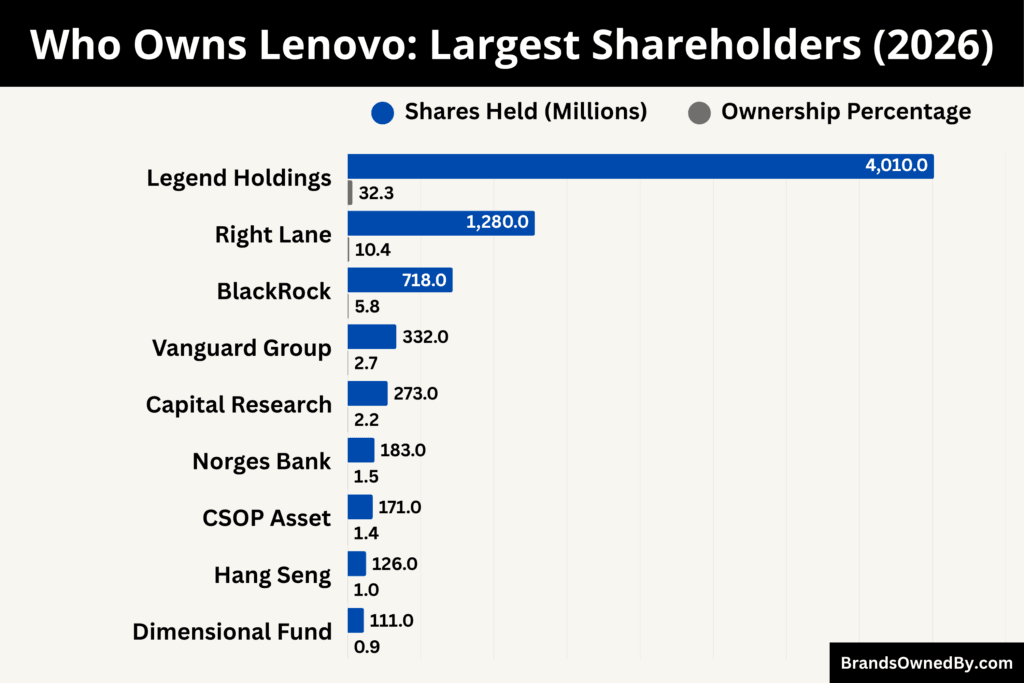
Below is a list of the major shareholders of Lenovo as of April 2026:
Legend Holdings
Legend Holdings is the largest shareholder of Lenovo and the most influential entity in its ownership structure.
As of early 2026, Legend Holdings owns approximately 4.01 billion Lenovo shares, representing about 32.34% of total shares.
This stake was strengthened in late 2025 when the company acquired an additional 115 million shares from the open market.
Legend Holdings plays a strategic role rather than acting as a passive investor. It has board representation and long-term influence over major decisions. Its position originates from Lenovo’s founding structure, as both entities were created under the Chinese Academy of Sciences ecosystem.
Even though it does not hold a majority stake, its ownership is large enough to exert effective control and strategic direction.
Right Lane Limited
Right Lane Limited is the second-largest shareholder in Lenovo.
As of 2026, it holds approximately 1.28 billion shares, equal to about 10.36% of the company.
Right Lane Limited is closely linked to Lenovo’s historical ownership structure. It is often associated with early investors and internal corporate arrangements tied to the company’s founding ecosystem.
Its stake is significant because it adds another layer of concentrated ownership. Combined with Legend Holdings, it strengthens the core shareholder bloc that supports Lenovo’s long-term strategy.
BlackRock
BlackRock is the largest institutional investor in Lenovo.
As of March 2026, BlackRock holds approximately 718 million shares, representing about 5.79% of the company.
This stake is spread across multiple funds, including index funds and actively managed portfolios. BlackRock’s role is important because it represents global institutional capital.
Although it does not control Lenovo, it influences corporate governance through shareholder voting. Its presence also signals strong confidence from global financial markets.
The Vanguard Group
The Vanguard Group is another major institutional shareholder.
As of early 2026, Vanguard owns approximately 332 million shares, equal to about 2.68% of Lenovo.
Vanguard primarily invests through passive index funds. This means its stake reflects Lenovo’s inclusion in major global indices.
While Vanguard does not actively manage Lenovo, it contributes to stability in the shareholder base and participates in governance through proxy voting.
Capital Research and Management Company
Capital Research and Management Company is a major active institutional investor.
It holds approximately 273 million shares, representing about 2.20% of Lenovo.
Unlike passive investors, this firm actively manages its investments. It may engage with Lenovo’s management on strategic decisions, capital allocation, and performance improvements.
Norges Bank Investment Management
Norges Bank Investment Management is another key shareholder.
It owns approximately 183 million shares, or about 1.48% of Lenovo.
The fund follows strict governance and ESG (environmental, social, and governance) principles. Its investment in Lenovo indicates confidence in the company’s global operations, transparency standards, and long-term growth potential.
Unlike activist investors, Norges Bank typically does not interfere in daily management. However, it actively participates in shareholder voting and corporate governance decisions. Its presence strengthens Lenovo’s credibility among global institutional investors.
CSOP Asset Management
CSOP Asset Management holds approximately 171 million shares, representing about 1.39% of Lenovo.
This firm provides exposure to Chinese and Hong Kong-listed companies. Its stake highlights strong regional institutional participation.
This stake reflects Lenovo’s strong position in regional benchmarks such as the Hang Seng Index. CSOP’s involvement ensures consistent capital inflow through passive investment vehicles.
In addition, CSOP provides exposure for mainland Chinese investors seeking access to globally recognized Chinese companies. Its ownership strengthens Lenovo’s connection to Asian capital markets and reinforces its position as a flagship technology stock in the region.
Hang Seng Investment Management
Hang Seng Investment Management owns approximately 126 million shares, or about 1.02% of Lenovo.
Its investment is largely tied to index tracking and regional fund allocations.
Because Lenovo is a key component of these indices, Hang Seng Investment Management maintains consistent exposure through its funds. This creates a stable and predictable ownership base.
While it does not actively influence corporate strategy, its role is critical in maintaining liquidity and market stability. Its holdings also reflect Lenovo’s continued relevance in Hong Kong’s equity markets.
Dimensional Fund Advisors
Dimensional Fund Advisors holds approximately 111 million shares, equal to about 0.90% of the company.
The firm focuses on systematic investment strategies. Its presence adds further institutional depth to Lenovo’s shareholder base.
Dimensional typically invests in companies with strong fundamentals, efficient market positioning, and scalable operations. Its stake in Lenovo indicates that the company meets these criteria within global equity portfolios.
The firm does not engage in direct management influence. However, it contributes to a diversified and stable institutional shareholder base. Its presence also reflects Lenovo’s inclusion in global factor-based investment strategies.
Lazard Asset Management
Lazard Asset Management owns approximately 82 million shares, representing about 0.66% of Lenovo.
Lazard is an active investor. It may engage with management on performance and strategic direction. This means Lazard may engage with Lenovo’s management on key issues such as:
- Business strategy and expansion
- Profitability and operational efficiency
- Capital allocation and shareholder returns.
Its involvement adds a layer of accountability to Lenovo’s leadership. Active investors like Lazard often push for performance improvements and strategic clarity.
As a result, Lazard’s stake is not just financial. It plays a role in shaping investor expectations and influencing long-term corporate performance.
Public and Institutional Shareholders (Free Float)
A large portion of Lenovo’s shares is held by public investors and institutions combined.
As of 2026:
- Institutional investors collectively hold over 7.6 billion shares
- Retail and public investors hold approximately 4.78 billion shares.
This means the majority of Lenovo’s shares are widely distributed across global markets.
This broad ownership base provides:
- High liquidity in the stock
- Global investor participation
- Balanced governance through diversified voting power.
Competitor Ownership Comparison
Lenovo’s ownership model sits between fully dispersed public companies and founder-controlled firms. To understand its uniqueness, it is essential to compare it with its closest competitors.
As of 2025–2026, the global PC market is dominated by a few players: Lenovo (27.2%), HP (21.3%), Dell (15.3%), Apple (9.2%), and Acer (6.3%). Despite competing in the same industry, their ownership structures differ significantly.
Lenovo vs HP Inc.
HP Inc. operates under a fully institutional ownership model with no controlling shareholder.
HP’s largest shareholders are global asset managers like The Vanguard Group and BlackRock. These firms typically hold large but non-controlling stakes through index funds.
This results in a highly fragmented cap table where:
- No shareholder owns a double-digit controlling stake
- Board decisions are driven by consensus governance
- Management operates with strong market accountability.
In contrast, Lenovo has a clearly defined anchor shareholder in Legend Holdings, which owns over 4 billion shares. This gives Lenovo a centralized influence layer that HP does not have.
The implication is structural: HP is more sensitive to short-term investor sentiment, while Lenovo can pursue longer-term strategic initiatives with backing from its anchor shareholder.
Lenovo vs Dell Technologies
Dell Technologies represents the opposite extreme of Lenovo’s model.
Dell is controlled by its founder, Michael Dell, along with private equity firm Silver Lake. Together, they hold a controlling interest.
This creates a highly concentrated ownership structure with:
- Centralized decision-making power
- Minimal dependence on public shareholders
- Strong alignment between ownership and management.
Dell’s model allows for rapid execution of strategy, especially in enterprise and infrastructure segments. However, it also concentrates risk and control in a small group.
Lenovo differs in a critical way. Its largest shareholder does not have majority control. This creates a hybrid governance model, where:
- Strategic direction is anchored by Legend Holdings
- Institutional investors still influence governance
- Management retains operational independence.
This balance makes Lenovo less dependent on a single individual compared to Dell.
Lenovo vs Apple Inc.
Apple Inc. has one of the most dispersed ownership structures among major tech firms.
Its largest shareholders include BlackRock, The Vanguard Group, and Berkshire Hathaway. However, even the largest of these typically hold single-digit percentages.
This means:
- No controlling shareholder exists
- Ownership is spread across thousands of institutions and millions of investors
- Governance is entirely board-driven.
Apple’s structure is a pure public ownership model. It relies heavily on executive leadership and board oversight rather than shareholder dominance.
Lenovo differs because its largest shareholder holds a materially larger stake than any Apple investor. This gives Lenovo more concentrated influence at the top, even though both companies are publicly traded.
Lenovo vs Acer
Acer operates with a widely distributed ownership base, similar to HP but with even less concentration.
Acer does not have a dominant corporate parent or anchor shareholder. Its shares are held by:
- Institutional investors
- Founders and insiders (in smaller proportions)
- Public shareholders.
In terms of market position, Acer holds about 6.3% global PC market share, far below Lenovo’s leadership position.
The lack of a dominant shareholder results in:
- Lower strategic centralization
- Greater dependence on market conditions
- More fragmented voting power.
Compared to Acer, Lenovo’s ownership provides greater continuity and long-term strategic alignment through Legend Holdings.
Structural Comparison Across Competitors
When analyzed structurally, the differences are clear:
- Lenovo: Anchor shareholder (Legend Holdings) + institutional investors
- HP: Fully institutional ownership, no dominant shareholder
- Dell: Founder-controlled with private equity backing
- Apple: Highly dispersed global institutional ownership
- Acer: Fragmented public ownership with no anchor entity.
This places Lenovo in a middle position between concentrated and dispersed ownership models.
Strategic Impact of Ownership Differences
Ownership structure directly affects how these companies compete.
Lenovo’s model enables it to maintain long-term strategic consistency, especially in supply chain, pricing, and global expansion. This is one reason it has maintained the top global PC market share position at over 27% as of 2025–2026.
HP and Acer, with fully dispersed ownership, are more influenced by quarterly performance expectations. Dell, with concentrated ownership, can execute bold long-term strategies but relies heavily on its core leadership group.
Apple operates differently. Its dispersed ownership is balanced by strong internal control through management and brand dominance rather than shareholder influence.
Lenovo’s hybrid structure allows it to combine:
- Stability from a large anchor shareholder
- Accountability from institutional investors
- Flexibility of a publicly traded company.
This combination is rare among global PC manufacturers and is a key factor behind its sustained leadership in the industry.
Who Controls Lenovo?
Control of Lenovo is exercised through a combination of executive leadership, board governance, and influence from its largest shareholder. As of April 2026, no single entity has absolute control. Instead, Lenovo operates under a hybrid control structure where authority is shared but clearly anchored.
CEO Leadership and Executive Control
The strongest operational control sits with CEO Yang Yuanqing.
Yang has led Lenovo for most of the past two decades, including continuous leadership since 2009. This long tenure is unusual for a company of Lenovo’s scale and has created consistent execution across global markets.
As CEO, he directly oversees Lenovo’s three core business groups: Intelligent Devices Group, Infrastructure Solutions Group, and Solutions and Services Group. These divisions collectively drive Lenovo’s global operations across PCs, enterprise infrastructure, and IT services.
What distinguishes Lenovo from many competitors is that strategic execution is highly centralized under the CEO. Major initiatives such as global supply chain restructuring, expansion into enterprise solutions, and integration of acquisitions have been driven directly by Yang’s office rather than delegated loosely across divisions.
His control is operational, not ownership-based. However, his long tenure and internal authority make him the most influential decision-maker inside the company.
Board of Directors and Formal Governance
Lenovo’s formal control structure is defined by its board of directors. As a Hong Kong–listed company, Lenovo follows international corporate governance standards, including independent board oversight.
The board is responsible for approving major capital allocation decisions, acquisitions, and leadership appointments. It also evaluates executive performance and ensures compliance across jurisdictions.
In practice, the board acts as a balancing mechanism. It does not run the company day to day, but it determines whether management strategy aligns with shareholder interests.
Because Lenovo has a large anchor shareholder, board composition becomes critical. Directors linked to major shareholders, along with independent members, collectively shape high-level control without allowing any single party to dominate.
Strategic Influence of Legend Holdings
Legend Holdings is the most powerful external influence on Lenovo’s control structure.
As of April 2026, it holds over 4 billion shares, making it the largest shareholder by a wide margin. This stake gives it significant voting power in board decisions and strategic direction.
However, Legend Holdings does not manage Lenovo’s daily operations. Its control is indirect but meaningful. It influences board composition, supports long-term strategy, and provides continuity rooted in Lenovo’s founding structure.
Because its stake is not a majority, Legend cannot unilaterally dictate outcomes. It must align with other shareholders and board members. This creates a system where it has strong influence but not absolute control.
Institutional Investors and Governance Pressure
Global institutional investors such as BlackRock and The Vanguard Group collectively hold a substantial portion of Lenovo’s shares.
Individually, these firms do not control Lenovo. However, their combined voting power plays an important role in governance. They influence board elections, executive compensation, and corporate policies.
In recent years, institutional investors have also increased focus on transparency, capital efficiency, and ESG standards. This creates external pressure on Lenovo’s management to maintain global governance standards despite its concentrated anchor shareholder.
Their influence is subtle but important. It ensures that Lenovo’s control structure remains aligned with international investor expectations.
Internal Control Through Business Group Structure
Lenovo’s operational control is further reinforced through its internal structure. The company is organized into three major business groups, each led by senior executives who report directly to the CEO.
This structure allows centralized strategic control while maintaining execution at scale. Unlike decentralized tech companies where divisions operate semi-independently, Lenovo maintains tighter integration across its units.
For example, decisions related to supply chain, component sourcing, and global pricing are coordinated centrally. This has been a key factor in Lenovo maintaining its leading position in global PC shipments as of 2025–2026.
Control Evolution from Founder to Corporate Governance
Lenovo’s control has shifted significantly since its founding. Early control was concentrated under Liu Chuanzhi, who combined ownership influence with executive authority.
Following Lenovo’s listing and global expansion, control transitioned to a more structured corporate model. The founder stepped back, and professional management took over.
Today, control is no longer founder-driven. It is defined by a combination of executive leadership, board oversight, and shareholder influence.
Lenovo Annual Revenue and Net Worth
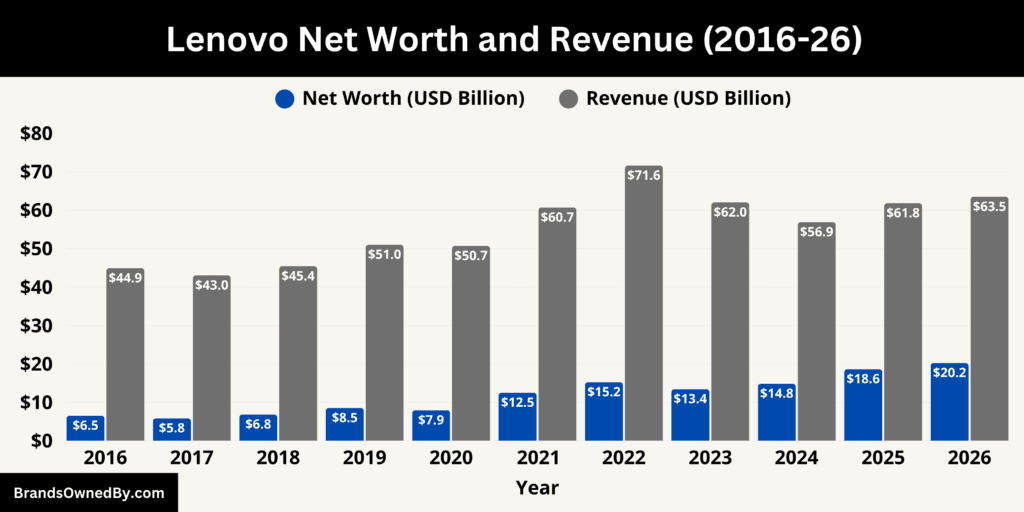
Lenovo continues to show strong financial momentum as of April 2026. The company is currently generating annual revenue of approximately $69–$70 billion, based on its latest full-year results and fiscal performance trends.
Its net worth (market capitalization) is estimated at around $18–$22 billion in 2026, depending on stock market fluctuations. This valuation reflects Lenovo’s position as the world’s largest PC manufacturer and its growing presence in AI infrastructure and enterprise services.
What makes Lenovo’s financial profile notable in 2026 is the shift toward AI-driven revenue streams, which are now contributing a significant portion of total business performance.
Revenue Breakdown and Growth Drivers (2026)
Lenovo’s 2026 revenue is not evenly distributed. It comes from three major business segments, each contributing differently to overall growth.
The Intelligent Devices Group (IDG) remains the largest contributor. This segment includes PCs, laptops, tablets, and smartphones. In Q3 FY2025/26 alone, this division generated about $15.8 billion in quarterly revenue, driven by strong global PC demand and premium device upgrades.
The Infrastructure Solutions Group (ISG) has emerged as the fastest-growing segment. It generated approximately $5.2 billion in quarterly revenue, with growth exceeding 30% year-over-year. This surge is largely due to demand for AI servers and data center solutions.
The Solutions and Services Group (SSG) contributed around $2.7 billion in quarterly revenue, providing high-margin recurring income through IT services, cloud solutions, and enterprise support.
A key shift in 2026 is the rise of AI-related revenue. Nearly 32% of Lenovo’s total revenue now comes from AI-driven products and services, making it a central growth engine for the company.
Record Financial Performance in 2026
Lenovo’s fiscal 2025–2026 performance shows strong upward momentum.
The company reported record quarterly revenue of $22.2 billion in Q3 FY2025/26, representing an 18% year-over-year increase.
Earlier in the same fiscal year, Lenovo posted:
- $18.8 billion in Q1 revenue
- $20.5 billion in Q2 revenue.
These figures indicate consistent growth across all quarters, putting Lenovo on track for one of its strongest annual performances.
This growth is not just volume-driven. It is supported by higher-margin segments such as services and AI infrastructure, which are improving overall profitability and business quality.
Net Worth and Market Position (2026)
Lenovo’s market capitalization in 2026 reflects both its scale and its evolving business model.
The company’s valuation is supported by:
- Its leadership in the global PC market
- Expansion into enterprise infrastructure
- Rapid growth in AI-related products and services.
While Lenovo’s net worth is lower than companies like Apple, it remains one of the most valuable hardware-focused technology firms globally.
Its valuation has become more stable compared to earlier years. This is due to diversification beyond PCs into higher-growth and higher-margin segments.
Financial Trend Analysis (2016–2026)
Over the past decade, Lenovo’s financial trajectory shows three distinct phases.
From 2016 to 2019, revenue growth was moderate as the company stabilized after major acquisitions. Between 2020 and 2022, revenue surged significantly due to global demand for PCs and remote work infrastructure.
From 2023 onward, Lenovo experienced a temporary slowdown due to declining global PC shipments. However, recovery began in 2025 and accelerated into 2026, driven by AI demand and enterprise expansion.
This cycle demonstrates Lenovo’s ability to adapt to changing market conditions while maintaining long-term growth.
Future Revenue Forecast (2026–2030)
Based on current analyst projections and Lenovo’s growth trajectory, the company is expected to continue expanding over the next five years.
- 2026: $69–70 billion
- 2027: $80 billion
- 2028: $86 billion
- 2029: $90+ billion
- 2030: $95–100 billion.
These projections are supported by increasing demand for AI infrastructure, enterprise services, and next-generation computing devices.
Lenovo’s future growth will depend heavily on its ability to scale AI-related offerings and maintain its leadership in global hardware markets.
Companies Owned by Lenovo
Lenovo operates through a mix of acquired businesses, internally developed brands, and specialized divisions. As of 2026, its portfolio spans consumer devices, enterprise infrastructure, mobile technology, and IT services.
Below is a detailed breakdown of the key companies, brands, and entities owned and operated directly by Lenovo:
| Company / Brand | Type | Core Focus | Key Details (2026) | Strategic Role |
|---|---|---|---|---|
| Motorola Mobility | Subsidiary | Smartphones | Acquired in 2014; strong presence in North & Latin America; Moto G, Edge, Razr lineup | Drives global mobile business and brand presence outside China |
| ThinkPad | Brand | Business Laptops | Acquired from IBM; widely used by enterprises and governments; premium segment leader | Core enterprise revenue driver with high margins |
| ThinkCentre | Brand | Enterprise Desktops | Used in corporate, education, and government sectors; includes all-in-one and compact PCs | Completes enterprise hardware ecosystem |
| ThinkStation | Brand | Workstations | High-performance systems for AI, engineering, and media workloads | Targets high-margin professional computing market |
| IdeaPad | Brand | Consumer Laptops | Mass-market laptops; strong global volume sales; popular in emerging markets | Drives global PC shipment leadership |
| Yoga | Brand | Premium Consumer Devices | 2-in-1 convertible laptops; premium design and innovation focus | Strengthens high-end consumer positioning |
| Legion | Brand | Gaming Devices | Gaming laptops, desktops, and accessories; competes with Alienware and OMEN | Captures high-growth gaming market |
| LOQ | Brand | Entry Gaming Devices | Budget-friendly gaming devices; complements Legion lineup | Expands reach in mid-range gaming segment |
| ThinkBook | Brand | SMB Laptops | Designed for small and medium businesses; blends business and consumer features | Targets fast-growing SMB segment |
| Lenovo Tab & Smart Devices | Brand / Product Line | Tablets & Smart Devices | Android tablets, smart displays, and connected home devices | Expands ecosystem beyond PCs |
| Infrastructure Solutions Group (ISG) | Division | Servers & Data Centers | Built from IBM x86 acquisition; strong growth in AI servers and cloud infrastructure | Key enterprise and AI infrastructure driver |
| Solutions and Services Group (SSG) | Division | IT Services | Includes cloud, DaaS, and managed services; over $8B revenue segment | Generates recurring, high-margin revenue |
| Lenovo TruScale | Platform | As-a-Service IT | Subscription-based infrastructure and device services | Enables shift to service-based business model |
| Lenovo AI & Edge Computing | Business Unit | AI & Edge Solutions | AI-ready infrastructure, edge devices, enterprise AI deployments | Positions Lenovo in next-gen computing markets |
Motorola Mobility
Motorola Mobility is Lenovo’s most significant acquisition in the mobile segment. Lenovo acquired Motorola from Google in 2014 for $2.91 billion.
As of 2026, Motorola is Lenovo’s primary global smartphone brand. It generates billions in annual revenue and has strong positions in Latin America, North America, and parts of Europe. The brand focuses on mid-range and premium smartphones, including the Moto G, Edge, and Razr foldable series.
Motorola is strategically important because Lenovo’s own-branded smartphones have limited global reach. Motorola gives Lenovo brand recognition, carrier partnerships, and distribution strength outside China. It also plays a role in Lenovo’s AI ecosystem, with newer devices integrating AI-powered features and cross-device connectivity.
ThinkPad
ThinkPad is Lenovo’s most valuable and globally recognized brand. It was acquired from IBM as part of the $1.75 billion PC division deal in 2005.
As of 2026, ThinkPad remains the backbone of Lenovo’s enterprise business. It dominates the corporate laptop segment, especially in North America, Europe, and Asia-Pacific. ThinkPad devices are known for durability, enterprise-grade security, and reliability.
Large corporations, governments, and institutions standardize on ThinkPad for fleet deployments. The brand also commands premium pricing, contributing significantly to Lenovo’s profitability. It continues to evolve with AI-enabled PCs and enterprise security features.
ThinkCentre
ThinkCentre represents Lenovo’s enterprise desktop computing line.
As of 2026, it includes traditional desktops, compact systems, and all-in-one machines used in corporate and institutional environments. ThinkCentre is widely deployed in sectors such as banking, education, healthcare, and government.
The brand plays a critical role in enterprise IT infrastructure. While laptops dominate modern workplaces, desktops remain essential for fixed workstations and high-performance office setups. ThinkCentre ensures Lenovo maintains a full-stack enterprise hardware offering alongside ThinkPad.
ThinkStation
ThinkStation is Lenovo’s high-performance workstation brand.
These systems are designed for professionals working in engineering, architecture, AI development, video production, and scientific computing. ThinkStation machines support advanced GPUs, high-core-count CPUs, and large memory configurations.
As of 2026, demand for AI workloads, simulation, and content creation has increased the importance of workstations. ThinkStation allows Lenovo to compete in high-margin professional computing segments, directly challenging Dell Precision and HP Z-series workstations.
IdeaPad
IdeaPad is Lenovo’s mainstream consumer laptop brand.
It targets students, home users, and everyday productivity needs. As of 2026, IdeaPad devices are among the highest-selling laptops globally, particularly in emerging markets.
The brand focuses on affordability, versatility, and wide availability. It plays a volume-driven role in Lenovo’s business, helping the company maintain its leading global PC shipment share of over 27%.
IdeaPad is also evolving with AI-enabled features, improved battery performance, and hybrid work capabilities, aligning with changing consumer demand.
Yoga
Yoga is Lenovo’s premium consumer and innovation-focused brand.
It is known for its 2-in-1 convertible laptops and high-end design. Yoga devices combine flexibility, touchscreen functionality, and premium materials.
As of 2026, Yoga sits at the higher end of Lenovo’s consumer portfolio. It competes directly with premium ultrabooks from Apple and HP. The brand is also a testing ground for new technologies, including AI-powered productivity tools and advanced form factors.
Yoga strengthens Lenovo’s position in the premium consumer segment, which typically delivers higher margins.
Legion
Legion is Lenovo’s flagship gaming brand.
It includes gaming laptops, desktops, monitors, and accessories. As of 2026, Legion has become a major contributor to Lenovo’s high-performance computing segment.
The brand competes directly with Dell’s Alienware and HP’s OMEN. Legion devices are designed with high-end GPUs, advanced cooling systems, and performance optimization for gaming and esports.
Gaming demand continues to grow globally, and Legion allows Lenovo to capture this high-growth, high-margin market.
LOQ
LOQ is Lenovo’s newer gaming sub-brand, introduced to target entry-level and mid-range gamers.
As of 2026, LOQ expands Lenovo’s reach in the gaming segment by offering more affordable gaming devices. It complements Legion by addressing a broader customer base.
This dual-brand strategy allows Lenovo to cover both premium and budget gaming markets, increasing overall market share.
ThinkBook
ThinkBook is designed specifically for small and medium-sized businesses (SMBs).
It bridges the gap between consumer and enterprise devices. ThinkBook offers business features such as enhanced security and productivity tools but at a lower cost than ThinkPad.
As of 2026, the SMB segment is growing rapidly due to digital transformation. ThinkBook positions Lenovo to capture this demand without diluting the premium positioning of ThinkPad.
Lenovo Infrastructure Solutions Group (ISG)
The Infrastructure Solutions Group is Lenovo’s enterprise hardware division.
It was significantly strengthened by Lenovo’s acquisition of IBM’s x86 server business in 2014. As of 2026, ISG generates over $20 billion annually and is one of Lenovo’s fastest-growing segments.
ISG provides servers, storage, and data center solutions. It is heavily involved in AI infrastructure, cloud computing, and edge computing deployments.
This division is critical to Lenovo’s transformation beyond PCs. It allows the company to compete with Dell and HP in enterprise infrastructure.
Lenovo Solutions and Services Group (SSG)
The Solutions and Services Group focuses on IT services and recurring revenue.
As of 2026, SSG generates over $8 billion annually with high operating margins. It includes services such as device management, cloud solutions, cybersecurity, and digital workplace solutions.
This division is strategically important because it reduces Lenovo’s reliance on hardware sales. It also builds long-term customer relationships through subscription-based models.
Lenovo TruScale
Lenovo TruScale is a key platform within its services strategy.
It offers infrastructure-as-a-service (IaaS) and device-as-a-service (DaaS) solutions. Businesses can access IT infrastructure on a subscription basis rather than purchasing hardware outright.
As of 2026, TruScale is expanding rapidly, driven by enterprise demand for flexible IT consumption models. It plays a central role in Lenovo’s shift toward recurring revenue and cloud-based services.
Lenovo AI and Edge Computing Business
Lenovo has developed dedicated capabilities in AI and edge computing.
As of 2026, AI-related products and services contribute a growing share of Lenovo’s revenue. The company provides AI-ready infrastructure, edge computing devices, and integrated solutions for enterprises.
This segment is tightly integrated with ISG and SSG. It enables Lenovo to compete in next-generation computing markets, including autonomous systems, smart cities, and industrial AI.
Final Thoughts
Lenovo is not owned by a single individual or entity. Instead, it operates under a layered ownership structure where Legend Holdings remains the largest shareholder, while institutional investors and public shareholders hold a significant portion of the company.
Control is equally structured. Executive leadership, led by Yang Yuanqing, manages operations, while the board and shareholders influence long-term direction. This separation between ownership and control allows Lenovo to operate efficiently on a global scale.
The answer to who owns Lenovo ultimately reflects a hybrid model. It combines strategic stability from a major shareholder with the flexibility of a publicly traded company, enabling consistent growth across consumer, enterprise, and emerging technology markets.
FAQs
Who owns Lenovo PC company?
Lenovo is a publicly traded company, so it is not owned by a single person or entity. The largest shareholder is Legend Holdings, which holds about 32.34% of the company. The remaining shares are owned by institutional investors and the public.
Who makes Lenovo computers?
Lenovo designs and manufactures its own computers through its global operations. The company produces devices in multiple countries and manages its own supply chain, engineering, and product development.
Who owns Lenovo brand?
The Lenovo brand is fully owned by Lenovo itself. It is not licensed from another company. However, some of its brands like ThinkPad were originally acquired from IBM.
Is Lenovo a Chinese company?
Yes, Lenovo is a Chinese company. It was founded in Beijing and still maintains its global headquarters in China, although it operates internationally.
Is Lenovo fully Chinese?
Lenovo has Chinese origins, but it is not fully Chinese in terms of ownership or operations. It is a global company with international shareholders, global leadership, and operations in more than 180 markets.
Is Lenovo owned by HP?
No, Lenovo is not owned by HP Inc.. Both are separate companies and competitors in the global PC market.
Is Lenovo still owned by IBM?
No, IBM does not own Lenovo anymore. IBM sold its PC division to Lenovo in 2005 and later exited its remaining stake.
Is Lenovo under Microsoft?
No, Lenovo is not owned or controlled by Microsoft. Lenovo does use Microsoft’s Windows operating system on many of its devices, but both companies are independent.
Who is the largest shareholder of Lenovo?
The largest shareholder of Lenovo is Legend Holdings, which owns approximately 32.34% of the company, making it the most influential stakeholder.