
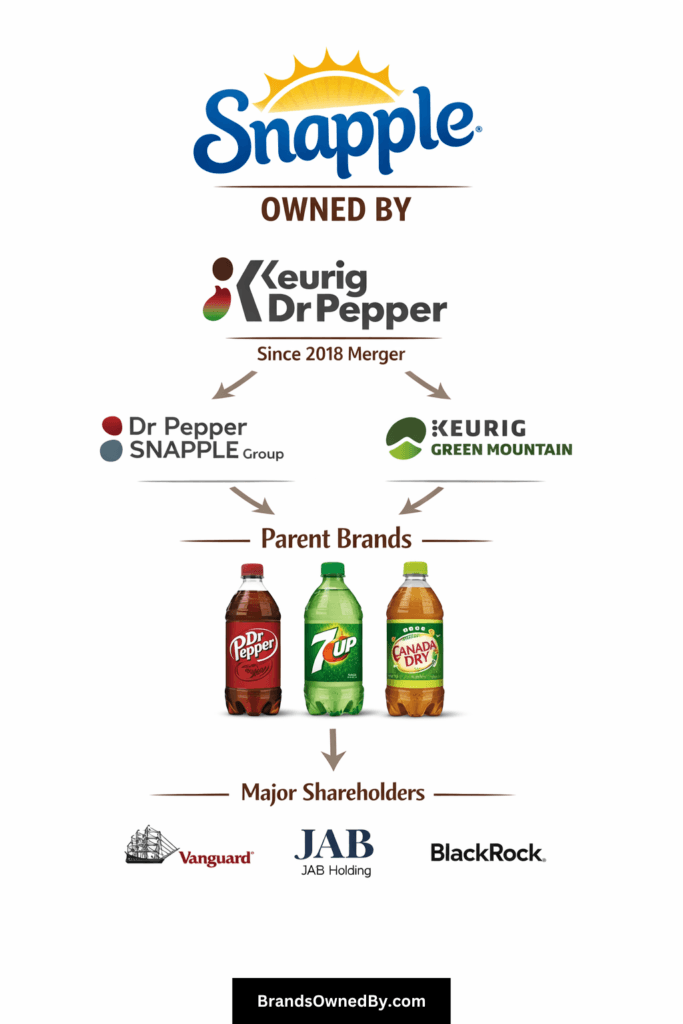
- Snapple is wholly owned by Keurig Dr Pepper, a publicly traded beverage conglomerate listed on Nasdaq under the ticker KDP. Snapple is not an independent company and operates as one of Keurig Dr Pepper’s major non-carbonated beverage brands.
- Snapple became part of Keurig Dr Pepper in 2018 after Dr Pepper Snapple Group merged with Keurig Green Mountain in an $18.7 billion transaction, transferring Snapple into the newly formed company’s portfolio.
- The largest shareholders of Snapple’s parent company as of April 2026 are The Vanguard Group (11.85%), JAB Holding affiliates (9.87%), BlackRock (8.80%), Capital Research (8.70%), and Fidelity/FMR LLC (7.21%), all of which indirectly own Snapple through their stakes in Keurig Dr Pepper.
- Snapple is controlled by Keurig Dr Pepper’s executive leadership and board, led by CEO Tim Cofer, meaning all major strategic, financial, and operational decisions for the brand are made at the parent-company level rather than by a standalone Snapple management team.
Snapple is an American beverage brand known for producing ready-to-drink teas, juice drinks, lemonades, flavored water, and fruit beverages. The company is one of the most recognized names in the bottled beverage industry and has built a strong reputation for offering flavorful, convenient drinks to consumers.
It offers a wide range of beverages across several categories. Its product lineup includes iced teas, fruit punches, juice cocktails, lemonades, and zero-sugar drinks. Some of its most popular flavors include Peach Tea, Lemon Tea, Kiwi Strawberry, Mango Madness, and Fruit Punch.
Snapple became highly popular due to its unique glass bottle packaging, creative marketing campaigns, and the famous “Snapple Facts” printed under bottle caps. The brand is sold in supermarkets, convenience stores, restaurants, vending machines, and retail outlets across the United States and other select international markets.
Founders of Snapple
Snapple was founded in 1972 by Leonard Marsh, Hyman Golden, and Arnold Greenberg.
The three founders originally operated a health food business in New York before entering the beverage market. They began by selling fruit juices and natural drinks to local health food stores under their company, Unadulterated Food Products.
Leonard Marsh
Leonard Marsh was one of the three co-founders of Snapple and played a leading role in the company’s overall business strategy and expansion. Before founding Snapple, Marsh had experience working in the food and beverage industry, which gave him insight into consumer trends and product demand.
He was instrumental in helping transform Snapple from a small health drink business into a nationally recognized beverage company. Marsh focused heavily on scaling the business, building the company’s sales strategy, and overseeing major operational decisions during Snapple’s early growth years.
He remained one of the most visible figures behind the company as Snapple rapidly expanded throughout the 1980s and 1990s.
Hyman Golden
Hyman Golden co-founded Snapple alongside Marsh and Greenberg and brought valuable experience in health food distribution to the business. Before launching Snapple, Golden worked in the health food industry and had a strong understanding of how to market products to health-conscious consumers.
His expertise helped Snapple initially gain traction in health food stores before the brand entered mainstream retail channels. Golden played an important role in developing the company’s sales network and early customer relationships.
He was also involved in promoting the brand’s original image as a healthier beverage alternative compared to traditional sugary sodas.
Arnold Greenberg
Arnold Greenberg was the third co-founder of Snapple and contributed heavily to the company’s production, logistics, and day-to-day operations. He helped manage the operational side of the business and ensured that production could scale as demand for Snapple products increased.
Greenberg played a critical role in building the company’s manufacturing and supply chain systems during its formative years. His operational oversight helped Snapple manage rapid growth while maintaining product consistency and availability.
Ownership History
Snapple’s ownership history reflects a rare journey through multiple major acquisitions and corporate restructurings. It has moved from founder ownership to private equity, then through several multinational corporations before ending up under its present parent company.
Its ownership timeline is:
- 1972–1992: Owned by founders
- 1992–1994: Owned by Thomas H. Lee Partners
- 1994–1997: Owned by Quaker Oats
- 1997–2000: Owned by Triarc Companies
- 2000–2008: Owned by Cadbury Schweppes
- 2008–2018: Owned by Dr Pepper Snapple Group
- 2018–Present: Owned by Keurig Dr Pepper.
This long acquisition history shows how Snapple evolved from a small startup beverage company into a strategic brand within a multibillion-dollar beverage conglomerate.
Founded as an Independent Beverage Business (1972)
Snapple was founded in 1972 by Leonard Marsh, Hyman Golden, and Arnold Greenberg under their original company, Unadulterated Food Products. The business initially focused on selling natural fruit juices and health drinks to health food stores in New York before later expanding into flavored beverages. For roughly two decades, Snapple remained independently owned and operated by its founders as they gradually built the brand into a regional beverage business.
During the 1980s, Snapple began shifting toward ready-to-drink teas and juice beverages, which significantly increased its popularity. This period marked the brand’s transition from a niche health drink company into a mainstream beverage player.
Sold to Thomas H. Lee Partners (1992)
In 1992, the founders sold Snapple to private equity firm Thomas H. Lee Partners (THL) in a deal valued at approximately $135 million. This was the first major ownership transition in the company’s history.
THL acquired Snapple when the brand was rapidly growing but still had room for national expansion. Under the firm’s ownership, Snapple scaled aggressively through expanded distribution, stronger advertising campaigns, and wider retail placement. The company’s value increased dramatically during this period as Snapple became one of the fastest-growing beverage brands in America.
THL’s ownership is often viewed as the phase that transformed Snapple from a successful regional brand into a national beverage powerhouse.
Acquired by Quaker Oats (1994)
In 1994, The Quaker Oats Company purchased Snapple for approximately $1.7 billion, one of the largest beverage acquisitions of the decade. The acquisition came just two years after THL had purchased the company, showing how quickly Snapple’s valuation had surged.
Quaker Oats wanted Snapple to strengthen its beverage portfolio alongside Gatorade and believed the brand could become another dominant national drink business. However, the acquisition quickly turned problematic.
Quaker attempted to integrate Snapple into its corporate structure but struggled to manage the brand properly. Snapple’s business model relied heavily on independent distributors and convenience-store channels, while Quaker was more accustomed to supermarket-focused distribution. This mismatch caused distribution disruptions, retailer pushback, and declining sales.
The failure of the Snapple acquisition is still widely referenced in business schools and M&A case studies as one of the worst large corporate acquisitions of the 1990s.
Purchased by Triarc Companies (1997)
After failing to revive growth, Quaker sold Snapple in 1997 to Triarc Companies for just $300 million, representing a loss of roughly $1.4 billion from its original purchase price.
Triarc acquired Snapple at a steep discount and immediately began restructuring the brand. Management focused on restoring Snapple’s original brand personality, rebuilding distributor relationships, and reviving its unconventional marketing image.
This turnaround strategy proved effective. Under Triarc, Snapple regained consumer attention and improved performance after several difficult years under Quaker.
Acquired by Cadbury Schweppes (2000)
In 2000, Cadbury Schweppes purchased Snapple from Triarc for approximately $1.45 billion.
This acquisition placed Snapple into Cadbury’s broader North American beverage portfolio alongside brands such as Dr Pepper, 7UP, and Mott’s. Under Cadbury, Snapple benefited from stronger corporate distribution infrastructure and broader retail integration.
Cadbury’s ownership helped stabilize Snapple and further integrate the brand into mainstream beverage channels, though the brand’s explosive early-1990s growth had already slowed by this stage.
Became Part of Dr Pepper Snapple Group (2008)
In 2008, Cadbury Schweppes separated its U.S. beverage business from its confectionery operations and created a new standalone beverage company called Dr Pepper Snapple Group.
As part of this restructuring, Snapple officially became one of the flagship brands inside the newly formed beverage company. In fact, Snapple was considered so important to the portfolio that its name was included directly in the company’s corporate branding.
This move gave Snapple a more focused beverage-centered ownership structure, with leadership dedicated specifically to drink brands rather than broader food and candy operations.
Ownership Transferred to Keurig Dr Pepper (2018–Present)
In July 2018, Keurig Green Mountain merged with Dr Pepper Snapple Group in an $18.7 billion transaction, creating Keurig Dr Pepper, Snapple’s current owner as of April 2026.
Following the merger, Snapple became part of one of North America’s largest beverage conglomerates. It now operates alongside more than 125 beverage brands within Keurig Dr Pepper’s portfolio.
Today, Snapple remains fully owned and managed by Keurig Dr Pepper, which oversees the brand’s manufacturing, marketing, distribution, and strategic development. While Snapple still maintains its own identity and branding, all major business decisions now fall under Keurig Dr Pepper’s executive leadership structure.
Who Owns Snapple?
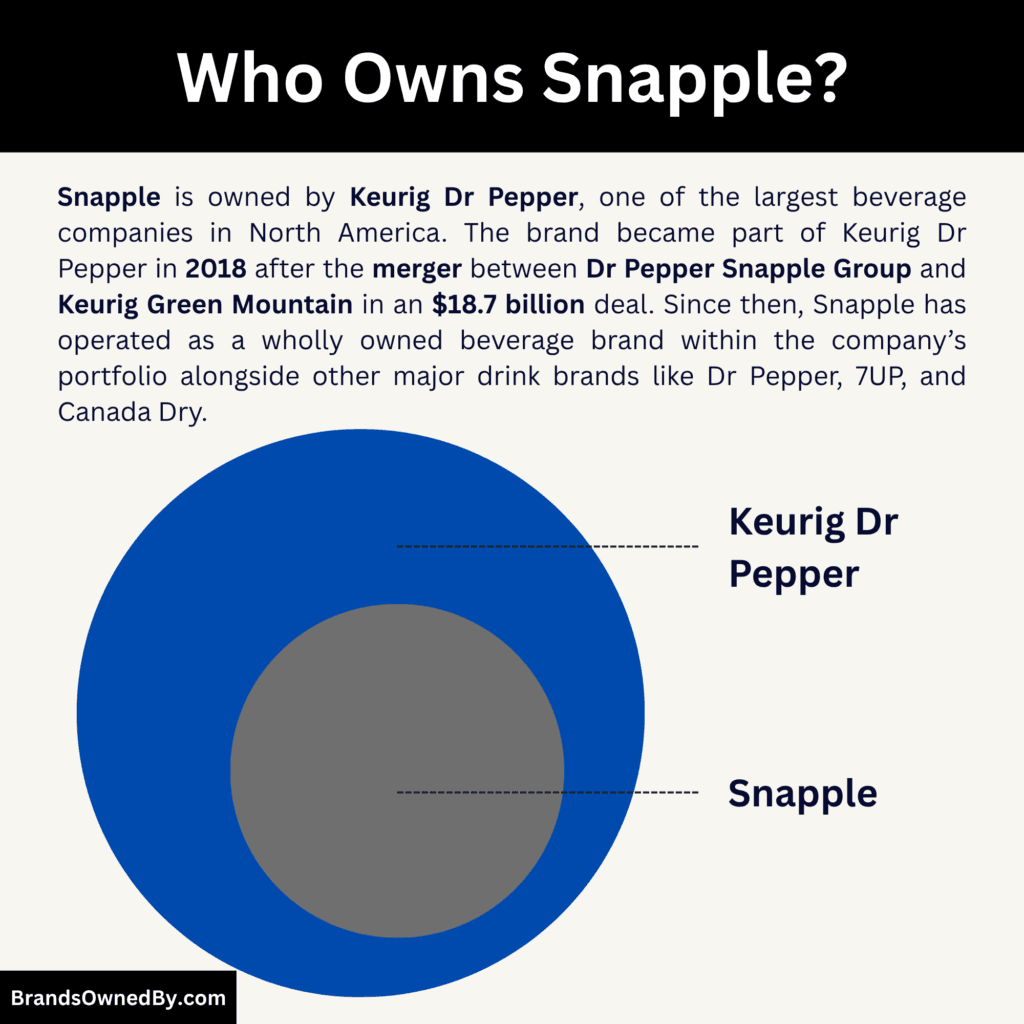
Snapple is owned by Keurig Dr Pepper Inc., a publicly traded beverage conglomerate listed on the Nasdaq under the ticker KDP. It operates as one of the many beverage brands fully controlled by Keurig Dr Pepper.
Because Keurig Dr Pepper is a public company, ownership of Snapple is indirectly divided among the corporation’s institutional investors, major strategic shareholders, and public stockholders. However, the largest shareholders of Keurig Dr Pepper hold the greatest influence over Snapple’s parent company and therefore indirectly impact Snapple’s strategic direction, financial planning, and long-term corporate decisions.
As of April 2026, Keurig Dr Pepper has approximately 1.36 billion shares outstanding. Its ownership is spread across several major institutional and strategic investors, with no single shareholder owning an outright majority stake.
Parent Company: Keurig Dr Pepper
Snapple’s parent company is Keurig Dr Pepper, one of the largest beverage manufacturers and distributors in North America. The company was created in July 2018 after Keurig Green Mountain merged with Dr Pepper Snapple Group in an approximately $18.7 billion transaction, forming a beverage conglomerate that combined hot beverages, soft drinks, juices, teas, and bottled drink brands under one corporate umbrella.
As of April 2026, Keurig Dr Pepper operates a portfolio of more than 125 owned, licensed, and partner beverage brands, with leadership positions across multiple drink categories including carbonated soft drinks, bottled water, coffee, tea, juice, mixers, and sports hydration. Its brand portfolio includes major names such as Dr Pepper, 7UP, Canada Dry, A&W, Mott’s, Bai, Core Hydration, Green Mountain Coffee, Ghost, Clamato, and Snapple.
The company maintains one of the most extensive beverage distribution systems in North America, servicing supermarkets, convenience stores, restaurants, vending operators, gas stations, and foodservice channels. This distribution infrastructure is one of the main reasons Snapple remains widely available nationwide.
As of February 2026, Keurig Dr Pepper had approximately 1.359 billion shares outstanding, reflecting its broad public ownership base. Because the company is publicly traded on Nasdaq under ticker KDP, ownership is spread among institutional investors, strategic shareholders, and public market investors.
Largest Shareholders of Keurig Dr Pepper
Below is a list of the major shareholders of Keurig Dr Pepper as of April 2026:
The Vanguard Group: The Vanguard Group is the largest shareholder of Keurig Dr Pepper as of April 2026, owning approximately 11.85% of the company.
Vanguard is one of the world’s largest investment management firms and holds its stake through numerous ETFs, mutual funds, pension funds, and retirement investment vehicles. Because of its large ownership position, Vanguard has significant voting power in board elections, governance proposals, executive compensation approvals, and shareholder resolutions.
JAB Holding Company: JAB Holding through its affiliated holding entities, owns approximately 9.87% of Keurig Dr Pepper.
JAB is particularly important because it was the original architect behind the 2018 merger that created Keurig Dr Pepper. JAB previously held a controlling majority stake in the company after the merger but gradually reduced its position through multiple secondary stock offerings between 2020 and 2025. Despite reducing its ownership, JAB remains one of the company’s most influential long-term strategic shareholders.
BlackRock: It owns approximately 8.80% of Keurig Dr Pepper.
BlackRock is the world’s largest asset manager and holds its position through institutional investment portfolios, ETFs, and retirement funds. As one of the company’s largest shareholders, BlackRock has substantial influence over shareholder voting and long-term governance decisions.
Capital Research and Management Company: It holds approximately 8.70% of the business.
Capital Research is the investment manager behind American Funds and is one of Keurig Dr Pepper’s largest long-term institutional shareholders. The firm has maintained a sizable position in the company for years and is considered a major supporter of its long-term strategy.
FMR LLC (Fidelity): FMR LLC, the parent company of Fidelity Investments, owns around 7.21% of Keurig Dr Pepper.
Fidelity’s position makes it another highly influential shareholder in the company’s institutional ownership base.
How Snapple Became Part of Keurig Dr Pepper?
Snapple became part of Keurig Dr Pepper through the 2018 merger between Keurig Green Mountain and Dr Pepper Snapple Group, the corporate owner that already controlled Snapple at the time. This transaction officially closed in July 2018 and was valued at approximately $18.7 billion, making it one of the largest beverage-sector mergers of the decade.
Importantly, Keurig did not acquire Snapple directly as a standalone brand. Instead, Snapple transferred into the new company because it was already owned by Dr Pepper Snapple Group, and that entire corporation merged with Keurig Green Mountain to form what is now Keurig Dr Pepper.
Structure of the 2018 Merger
The merger was structured as a combination of cash, stock, and debt financing. Under the agreement, Dr Pepper Snapple shareholders received:
- $103.75 per share in cash, and
- Retained approximately 13% ownership in the newly combined company.
Meanwhile, Keurig’s existing ownership group, led primarily by JAB Holding Company, retained the remaining majority stake in the merged entity. This structure gave JAB effective control over the newly formed business immediately after closing.
The transaction was heavily debt-financed, with the combined company assuming substantial leverage in order to complete the deal. Despite this, executives positioned the merger as transformational due to the scale and strategic fit of both businesses.
Strategic Reason Behind the Acquisition
The merger was designed to combine Keurig’s dominant coffee and at-home beverage platform with Dr Pepper Snapple’s cold beverage distribution network and soft drink portfolio.
For Keurig, acquiring Dr Pepper Snapple brought several strategic advantages:
- Immediate access to a massive cold-drink distribution network across North America
- Ownership of established beverage brands including Snapple, Dr Pepper, 7UP, and Canada Dry
- Greater diversification beyond coffee and single-serve beverage systems
- Expansion into convenience stores, supermarkets, vending, and foodservice channels.
For Dr Pepper Snapple, the merger provided access to Keurig’s at-home beverage ecosystem and additional capital backing from JAB.
Why Snapple Was Included in the Deal
Because Snapple was one of Dr Pepper Snapple Group’s flagship beverage brands, it automatically became part of the transaction. Snapple was not carved out, sold separately, or excluded from the merger.
At the time of the merger, Snapple was already deeply integrated into Dr Pepper Snapple Group’s beverage portfolio and distribution system. As a result, ownership of Snapple transferred in full to the new Keurig Dr Pepper entity upon merger completion.
Snapple’s Role After the Acquisition
Following the merger, Snapple remained within the company as one of its major non-carbonated beverage brands. Keurig Dr Pepper continued operating Snapple under its existing brand name while integrating its production, logistics, and strategy into the broader corporate structure.
Today, Snapple benefits from:
- Access to Keurig Dr Pepper’s nationwide bottling and distribution network
- Expanded retail placement opportunities across major U.S. chains
- Shared corporate marketing and advertising resources
- Integration into a portfolio of over 125 beverage brands.
Although consumers still see Snapple as its own standalone brand, from a business standpoint it has operated entirely under Keurig Dr Pepper since the 2018 merger.
Long-Term Impact of the Transaction
The 2018 merger permanently transformed Snapple’s ownership structure. Prior to the deal, Snapple operated under Dr Pepper Snapple Group, a beverage-focused standalone public company. After the transaction, Snapple became part of a far larger diversified beverage conglomerate with exposure to both hot and cold beverage markets.
This gave Snapple stronger institutional backing, broader operational resources, and deeper financial support than at any prior point in its history, while also placing the brand under the control of one of North America’s largest beverage corporations.
Major Historical Acquisition Details
Snapple has gone through several major acquisitions before reaching its current ownership.
Acquisition by Quaker Oats (1994)
One of the most notable acquisitions in Snapple’s history occurred in 1994 when The Quaker Oats Company purchased Snapple for $1.7 billion. At the time, Snapple was one of the fastest-growing beverage brands in America, and Quaker hoped to use the acquisition to strengthen its beverage business alongside Gatorade.
However, Quaker struggled to manage Snapple properly after the acquisition. The company failed to maintain Snapple’s independent distributor relationships and misunderstood the brand’s unconventional sales model. Sales declined rapidly, and the deal became widely known as one of the worst corporate acquisitions of the 1990s.
Sale to Triarc Companies (1997)
After the failed Quaker ownership period, Snapple was sold to Triarc Companies in 1997 for only $300 million, meaning Quaker lost roughly $1.4 billion on the investment.
Triarc helped rebuild Snapple’s image and restore much of the brand’s former market strength.
Acquisition by Cadbury Schweppes (2000)
In 2000, Triarc sold Snapple to Cadbury Schweppes for approximately $1.45 billion. Snapple then became part of Cadbury’s growing beverage business in North America and remained under that ownership until the formation of Dr Pepper Snapple Group.
Competitor Ownership Comparison
Snapple competes in the ready-to-drink tea, juice beverage, flavored drink, and bottled refreshment markets against several major beverage brands. While Snapple is owned by Keurig Dr Pepper, many of its direct competitors are controlled by some of the largest beverage corporations in the world.
The biggest distinction in Snapple’s competitive landscape is that most rival brands are controlled by either The Coca-Cola Company or PepsiCo, the two largest beverage corporations globally. Snapple competes against these giants through Keurig Dr Pepper, which is smaller than both but still ranks among the leading beverage companies in North America.
This means Snapple benefits from strong corporate backing, but still operates in a market dominated by even larger multinational competitors with greater global scale and broader international distribution.
| Brand | Parent Company / Owner | Ownership Type | Key Ownership Details | How It Compares to Snapple |
|---|---|---|---|---|
| Snapple | Keurig Dr Pepper | Publicly Traded | Snapple is fully owned by Keurig Dr Pepper and operates as one of its flagship non-carbonated beverage brands. | Backed by a major North American beverage conglomerate with strong U.S. distribution and retail presence. |
| Gold Peak | The Coca-Cola Company | Publicly Traded | Gold Peak is wholly owned by Coca-Cola and forms part of its global tea and juice beverage portfolio. | Benefits from Coca-Cola’s larger global bottling, advertising, and international distribution network. |
| Pure Leaf | PepsiCo | Publicly Traded | Pure Leaf operates under PepsiCo’s beverage portfolio and competes heavily in premium bottled tea. | Supported by PepsiCo’s global beverage and snack distribution ecosystem. |
| Lipton Iced Tea | PepsiCo / Unilever Partnerships | Joint Venture / Partnership | Lipton ready-to-drink tea is operated through beverage partnerships between PepsiCo and Unilever in various markets. | Uses partnership-based ownership rather than full ownership by one beverage company. |
| AriZona Beverages | Privately Owned by Don Vultaggio and Ownership Group | Private Company | AriZona remains privately held and is not publicly traded or owned by a conglomerate. | Operates independently without institutional shareholders or public market pressure. |
| Brisk | PepsiCo / Lipton Partnership | Joint Venture / Partnership | Brisk is operated through PepsiCo’s tea beverage arrangements under Lipton branding agreements. | Positioned more toward youth-focused and affordable tea beverage segments. |
Snapple vs Gold Peak
Snapple is owned by Keurig Dr Pepper, while Gold Peak is owned by The Coca-Cola Company.
Gold Peak is one of Snapple’s biggest competitors in the ready-to-drink tea segment. Coca-Cola launched Gold Peak in 2006 and has since expanded it into one of the leading premium tea brands in the U.S. market. Unlike Snapple, which is one brand within Keurig Dr Pepper’s non-carbonated beverage portfolio, Gold Peak benefits from the full global distribution and marketing power of Coca-Cola.
Coca-Cola’s ownership gives Gold Peak several strategic advantages, including international distribution reach, larger advertising budgets, and integration into Coca-Cola’s global bottling network. However, Snapple maintains stronger brand heritage in flavored teas and fruit drinks due to its longer history in the category.
Snapple vs Pure Leaf
Snapple is owned by Keurig Dr Pepper, whereas Pure Leaf is owned by PepsiCo.
Pure Leaf was developed through PepsiCo’s partnership with Unilever before PepsiCo later took broader operational control of the brand in many markets. It has grown into one of Snapple’s strongest rivals in the premium bottled tea market.
Because Pure Leaf is backed by PepsiCo, it benefits from one of the largest beverage and snack distribution systems in the world. PepsiCo’s ownership allows Pure Leaf to secure strong shelf placement in major retailers and leverage the company’s deep marketing resources.
Compared to Snapple, Pure Leaf is positioned more heavily toward premium brewed tea products, while Snapple maintains a broader product mix that includes teas, juice drinks, and flavored beverages.
Snapple vs Lipton Iced Tea
Snapple is owned by Keurig Dr Pepper, while Lipton Iced Tea is owned through beverage partnerships involving PepsiCo and Unilever, depending on the market.
Lipton is one of the oldest and most globally recognized tea brands in the world. Its ready-to-drink tea business has historically been managed through joint ventures between PepsiCo and Unilever in multiple regions.
This ownership structure differs from Snapple’s because Lipton operates under a partnership model rather than full ownership by one beverage company. Despite that, Lipton competes directly with Snapple in bottled tea sales and has a significantly larger international footprint.
Snapple, however, tends to compete more heavily in flavored and specialty tea products, while Lipton emphasizes traditional tea offerings and mainstream iced tea products.
Snapple vs AriZona Beverages
Snapple is owned by Keurig Dr Pepper, while AriZona Beverages remains privately owned.
AriZona is one of Snapple’s most unique competitors because it is not controlled by a public corporation or major multinational conglomerate. Instead, AriZona remains privately held by founder Don Vultaggio and related ownership groups.
This private ownership gives AriZona more flexibility in pricing and strategy, allowing the company to maintain its famous large-can low-price model without shareholder pressure from Wall Street.
Compared to Snapple, AriZona operates more independently and with less corporate oversight, while Snapple benefits from the financial backing and infrastructure of a large public parent company.
Snapple vs Brisk
Snapple is owned by Keurig Dr Pepper, while Brisk is owned by PepsiCo through its partnership with Lipton/Unilever branding arrangements.
Brisk targets a younger demographic with heavily marketed flavored tea beverages and fruit drinks. PepsiCo uses Brisk as a value-focused, high-volume competitor to brands like Snapple in convenience stores and fast-food channels.
Unlike Snapple’s more nostalgic and premium-style branding, Brisk is positioned as a youth-focused and affordable beverage brand.
Who Controls Snapple?
Snapple is controlled by Keurig Dr Pepper, its parent company, through the corporation’s executive leadership team, board of directors, and senior brand management structure. Since Snapple is not an independent company, it does not have its own CEO or standalone governing board. Instead, all major decisions involving the brand are made within Keurig Dr Pepper’s corporate structure.
This includes decisions regarding Snapple’s marketing, product innovation, distribution strategy, budgeting, long-term investments, retail expansion, and overall business direction. While Snapple has internal brand managers handling daily operations, final authority rests with Keurig Dr Pepper’s senior leadership.
As of April 2026, Snapple’s control structure is centralized within Keurig Dr Pepper and can be summarized as follows:
- Primary Executive Control: Tim Cofer, CEO
- Operational Beverage Oversight: Roger Johnson, President of U.S. Refreshment Beverages
- Marketing Oversight: Andrew Springate, Chief Marketing Officer
- Financial Oversight: Sudhanshu Priyadarshi, CFO
- Strategic Governance: Keurig Dr Pepper Board of Directors led by Bob Gamgort.
Tim Cofer: Chief Executive Officer
As of April 2026, the top executive overseeing Snapple is Tim Cofer, the Chief Executive Officer of Keurig Dr Pepper.
Cofer became CEO in July 2024 after succeeding longtime company leader Bob Gamgort. Before joining Keurig Dr Pepper, Cofer held senior executive roles at Mondelēz International, where he served as CEO of Central Europe and later Executive Vice President/Chief Growth Officer, and also spent years at PepsiCo in leadership roles.
As CEO, Cofer has ultimate executive authority over all Keurig Dr Pepper brands, including Snapple. He is responsible for:
- Approving overall corporate strategy and long-term business priorities
- Authorizing major investments and capital allocation across brands
- Overseeing acquisitions, partnerships, and strategic initiatives
- Leading executive decision-making across the entire organization
- Managing company-wide operational and financial performance.
Because Snapple is part of KDP’s beverage portfolio, any major brand-level initiative ultimately falls under Cofer’s executive oversight.
Executive Leadership Team Managing Snapple’s Parent Company
In addition to the CEO, Snapple is indirectly managed by Keurig Dr Pepper’s wider executive leadership team. As of April 2026, the most important senior executives involved in controlling company operations include:
Sudhanshu Priyadarshi – Chief Financial Officer
Sudhanshu Priyadarshi serves as Chief Financial Officer of Keurig Dr Pepper and oversees the company’s financial planning, budgeting, capital structure, and investment strategy.
His department influences Snapple through approval of:
- Annual brand budgets
- Marketing and advertising spending
- Capital investments in production and packaging
- Financial performance targets and profitability goals.
Andrew Springate – Chief Marketing Officer
Andrew Springate serves as Chief Marketing Officer and oversees enterprise-wide marketing strategy, brand positioning, advertising effectiveness, and consumer engagement initiatives across KDP’s portfolio.
Because Snapple is a consumer-facing beverage brand, Springate plays a key role in influencing:
- Snapple advertising campaigns
- Brand messaging and positioning
- Marketing investment priorities
- Consumer branding strategy.
Roger Johnson – President, U.S. Refreshment Beverages
Roger Johnson oversees U.S. Refreshment Beverages, the division where Snapple primarily sits within Keurig Dr Pepper’s operating structure.
His division directly manages many of KDP’s cold beverage brands, including teas, juices, flavored drinks, and soft drinks. This makes him one of the most operationally involved executives in Snapple’s day-to-day strategic execution.
Johnson’s responsibilities include:
- Beverage portfolio strategy
- Distribution performance
- Retail channel execution
- Product commercialization
- Brand growth initiatives.
Board of Directors Overseeing Snapple’s Parent Company
Keurig Dr Pepper’s Board of Directors provides strategic oversight and governance over the company, meaning they indirectly influence all major decisions affecting Snapple.
As of April 2026, key board members include:
Bob Gamgort – Executive Chairman
Bob Gamgort serves as Executive Chairman of Keurig Dr Pepper’s Board. He previously served as CEO and played a major role in leading the 2018 merger that created Keurig Dr Pepper.
As Executive Chairman, he helps shape long-term corporate strategy and works closely with executive leadership on major strategic decisions.
Olivier Goudet – Board Director
Olivier Goudet is a major board member and former CEO of JAB Holding, the investment firm instrumental in creating the Keurig Dr Pepper merger.
Due to JAB’s historical importance and investment stake, Goudet remains one of the most influential figures on the board.
Monique Oxender – Independent Director
Monique Oxender brings financial and corporate governance expertise to the board, helping oversee operational strategy and shareholder accountability.
Maria Sastre – Independent Director
Maria Sastre contributes expertise in consumer branding, hospitality, and operational leadership, which is relevant to KDP’s consumer product strategy.
How Snapple is Managed Operationally
While top executives and the board control strategy, Snapple’s day-to-day operations are handled by internal business and brand teams within Keurig Dr Pepper.
These teams oversee:
Brand Management
Dedicated brand teams manage Snapple’s product portfolio, promotions, packaging updates, and competitive positioning in the beverage market.
Product Development
Innovation teams evaluate new flavors, formula updates, packaging changes, and product launches for Snapple.
Sales and Distribution
National sales teams coordinate Snapple’s placement in retailers, supermarkets, convenience stores, vending channels, and foodservice accounts.
Supply Chain and Manufacturing
KDP’s operations teams manage Snapple’s production, bottling, inventory planning, and logistics through company-wide infrastructure.
How Shareholders Influence Control
Although executives and directors run the company, major shareholders also influence Snapple indirectly through ownership of Keurig Dr Pepper stock.
Large investors such as:
- The Vanguard Group
- BlackRock
- JAB Holding affiliates
- Capital Research.
influence company leadership by voting on:
- Board appointments
- Executive compensation
- Governance matters
- Major shareholder proposals.
However, shareholders do not directly manage Snapple itself. Their influence comes through shaping the leadership team that controls Keurig Dr Pepper.
Snapple Annual Revenue and Net Worth
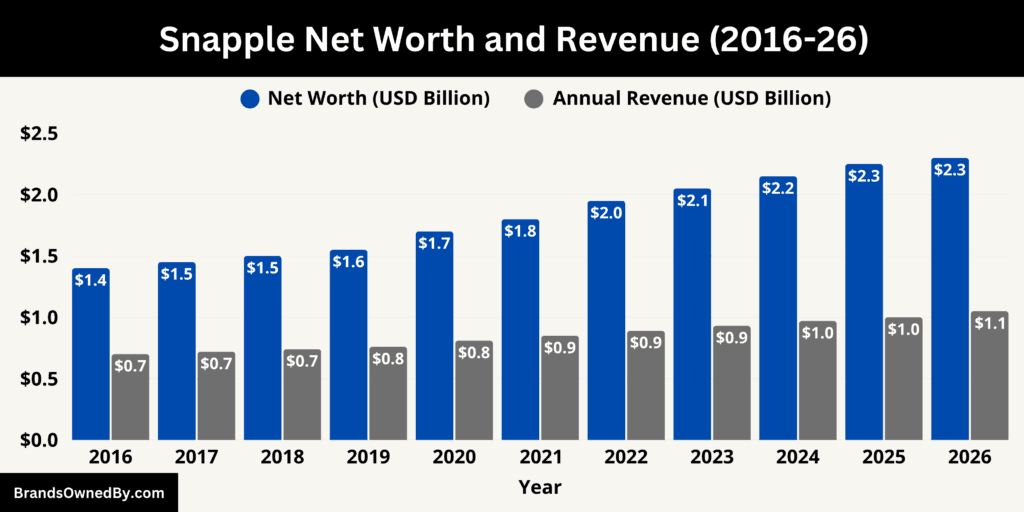
As of April 2026, Snapple generates an estimated $1.05 billion in annual revenue and holds an estimated standalone brand net worth of approximately $2.30 billion based on market valuation models, comparable beverage brand multiples, retail sales performance, and brand equity estimates.
Snapple continues to remain one of the most valuable tea and juice-focused beverage brands in North America, contributing meaningfully to Keurig Dr Pepper’s U.S. refreshment beverage segment, which has shown strong growth in recent periods.
Snapple Revenue in 2026
Snapple’s estimated 2026 revenue of $1.05 billion reflects continued growth from both pricing expansion and stable consumer demand in the ready-to-drink beverage market. This places Snapple among the larger tea and juice beverage brands in the United States despite operating in a highly competitive market dominated by Coca-Cola and PepsiCo-backed competitors.
A significant portion of Snapple’s revenue comes from its ready-to-drink tea segment, which remains the brand’s strongest category. Industry estimates suggest approximately 55% to 60% of Snapple’s total sales come from iced tea and tea-based beverages. Based on that split, Snapple’s tea products alone likely generate roughly $580 million to $630 million annually.
Its juice drinks and fruit beverages represent the second-largest contributor, estimated to account for around 25% to 30% of revenue, equating to approximately $260 million to $315 million annually. These include products such as Kiwi Strawberry, Mango Madness, and Fruit Punch, which remain some of the brand’s best-selling offerings.
The remaining portion of Snapple’s revenue comes from lemonades, water products, zero-sugar drinks, and specialty seasonal offerings, estimated at around 10% to 15% of total revenue, or roughly $105 million to $160 million annually.
Snapple’s revenue growth has also benefited from broader pricing improvements across the beverage industry, as Keurig Dr Pepper’s refreshment beverage segment has posted notable sales gains in recent reporting periods.
Snapple Net Worth in 2026
As of April 2026, Snapple’s estimated brand net worth stands at approximately $2.30 billion. This figure reflects the estimated enterprise value of the Snapple brand itself, including its trademarks, intellectual property, customer loyalty, distribution value, and market positioning.
Snapple’s valuation is supported by several major factors.
First, the company maintains decades of established brand equity, having operated since 1972 and remaining one of the most recognized tea beverage names in America.
Second, Snapple benefits from significant retail penetration, with products sold in thousands of grocery stores, gas stations, convenience stores, and foodservice locations across North America.
Third, the brand has strong consumer loyalty and repeat purchasing behavior, particularly among long-time customers familiar with Snapple’s legacy flavors and nostalgic branding.
Fourth, Snapple holds meaningful shelf-space value within retailers due to its longstanding distribution agreements and national presence.
When applying standard beverage industry valuation multiples, Snapple’s estimated $2.30 billion valuation implies a revenue multiple of approximately 2.2x revenue, which aligns with typical consumer packaged goods brand valuations for mature beverage businesses.
Revenue and Valuation Growth Trends
Snapple has steadily increased in both revenue and valuation over the past decade. In 2016, the brand was estimated to generate approximately $0.70 billion in annual revenue with an estimated valuation near $1.40 billion. By 2026, those figures have grown to $1.05 billion and $2.30 billion, respectively.
This reflects approximately:
- 50% total revenue growth over ten years
- 64% increase in estimated brand valuation over ten years.
This long-term expansion shows that while Snapple is no longer experiencing explosive hyper-growth, it remains a highly stable and steadily appreciating beverage brand.
Although Snapple is only one part of Keurig Dr Pepper’s broader beverage portfolio, it remains an important contributor to the company’s non-carbonated beverage segment. Snapple is particularly valuable because it strengthens Keurig Dr Pepper’s position in tea and juice beverages, diversifying the parent company beyond carbonated soft drinks.
Within the company’s beverage hierarchy, Snapple ranks below mega-brands like Dr Pepper and Canada Dry in scale but remains one of the stronger specialty beverage brands in the portfolio.
Snapple Revenue Forecast and Long-Term Financial Outlook
Based on Snapple’s historical performance, pricing trends, beverage market growth, and projected consumer demand, the brand is expected to continue generating steady revenue growth through the end of the decade. Analysts estimate that Snapple’s annual revenue could rise from $1.05 billion in 2026 to nearly $1.30 billion by 2030, assuming the brand maintains its current market position and growth trajectory.
Below is the estimated future revenue forecast for Snapple through 2030:
- 2027: Estimated $1.10 billion
- 2028: Estimated $1.16 billion
- 2029: Estimated $1.22 billion
- 2030: Estimated $1.29 billion.
The projected 2027 revenue of $1.10 billion reflects expected continued momentum from retail price increases, modest unit sales growth, and stronger performance in zero-sugar and healthier beverage offerings. Snapple is likely to benefit from Keurig Dr Pepper’s continued investment in premium beverage positioning and product innovation.
By 2028, revenue is forecast to climb to $1.16 billion, driven by broader expansion into convenience retail channels, increased promotional activity, and greater shelf space optimization across supermarkets and major retail chains. Continued demand for ready-to-drink tea products is also expected to support this growth.
For 2029, Snapple is projected to reach $1.22 billion in annual revenue, helped by inflation-adjusted pricing strategies, portfolio diversification, and stronger penetration into younger consumer demographics through updated marketing and product modernization efforts.
By 2030, Snapple could generate approximately $1.29 billion annually, placing the brand well above its current billion-dollar threshold and reinforcing its status as one of the most valuable tea and juice beverage brands in North America.
Overall, this forecast suggests Snapple may deliver approximately 23% cumulative revenue growth between 2026 and 2030. While the brand is not expected to experience explosive growth, it remains financially strong due to its loyal customer base, strong retail presence, and backing from Keurig Dr Pepper’s large-scale distribution network.
Snapple’s long-term financial outlook remains stable because the brand operates in a mature but resilient beverage category. Consumer demand for bottled teas, flavored drinks, and healthier refreshment options continues to support moderate long-term expansion. Combined with strong brand recognition and nationwide distribution, this positions Snapple as a dependable long-term revenue-generating asset within Keurig Dr Pepper’s beverage portfolio.
Brands Owned by Snapple
Snapple expanded its business mainly by developing new drink categories, flavor extensions, and branded beverage lines under the Snapple name instead of acquiring outside companies. As of 2026, the core entities and branded product divisions operated directly under the Snapple label include the following:
| Company / Brand / Entity | Type | Description | Strategic Importance |
|---|---|---|---|
| Snapple Tea | Core Beverage Division | Snapple Tea is the flagship product line and the brand’s largest operating segment. It includes ready-to-drink iced teas such as Peach Tea, Lemon Tea, Raspberry Tea, Diet Peach Tea, Half ’n Half, and Zero Sugar Tea varieties. This division helped establish Snapple’s identity in the U.S. beverage market and remains the company’s most recognized offering. | Primary revenue-generating segment and foundation of Snapple’s brand identity. |
| Snapple Juice Drinks | Beverage Division | Snapple Juice Drinks represent the company’s fruit beverage and juice cocktail lineup. This includes popular flavors such as Kiwi Strawberry, Mango Madness, Fruit Punch, Apple, and Grapeade. These beverages broaden Snapple’s market beyond tea drinkers and help diversify its customer base. | Second-largest product category and major contributor to revenue diversification. |
| Snapple Elements | Specialty Beverage Sub-Brand | Snapple Elements is a specialty beverage line originally launched in the late 1990s and later revived due to strong consumer demand. The lineup includes unique themed drinks inspired by natural elements such as Fire, Rain, Air, and Earth. It is one of Snapple’s most nostalgic and premium-oriented product offerings. | Enhances premium branding and leverages nostalgia-driven consumer demand. |
| Snapple Zero Sugar | Health Beverage Division | Snapple Zero Sugar focuses on low-calorie and sugar-free versions of Snapple’s most popular beverages. This division was created to align with changing consumer demand for healthier beverage alternatives and reduced-sugar drink options. | Critical growth area supporting health-conscious consumer trends. |
| Snapple Apple | Legacy Product Entity | Snapple Apple is one of the brand’s oldest and most historically significant beverage offerings. It traces its roots back to the original “Snappy Apple” drink that inspired the Snapple name. It remains one of the company’s signature legacy beverages. | Historically important product tied directly to Snapple’s founding identity. |
| Snapple Lemonades | Beverage Category | Snapple Lemonades includes lemonade-based drinks and tea-lemonade hybrid beverages sold under the Snapple branding umbrella. This category allows Snapple to compete in the flavored refreshment and mixed beverage market. | Broadens Snapple’s product reach into adjacent beverage categories. |
| Snapple Water / Hydration Products | Beverage Segment | Snapple operates select bottled water, flavored water, and enhanced hydration beverage offerings under limited product launches and category expansion initiatives. | Provides diversification into hydration and wellness beverage segments. |
| Snapple Seasonal / Limited Edition Releases | Innovation Program | Snapple periodically launches seasonal beverages, promotional flavors, and limited-edition drinks to test new concepts and drive temporary sales growth. These products often support brand engagement and market experimentation. | Helps maintain innovation pipeline and consumer engagement. |
| Snapple Intellectual Property Portfolio | Intangible Asset Division | Snapple controls a portfolio of trademarks, proprietary recipes, product formulas, packaging rights, branding assets, and marketing intellectual property including its famous “Snapple Facts” concept. | Protects long-term brand equity and supports licensing/branding value. |
Snapple Tea
Snapple Tea is the company’s flagship and most recognizable product division. It represents the largest portion of Snapple’s business and includes the ready-to-drink iced tea lineup that made the brand famous across the United States.
This product segment includes some of Snapple’s best-selling beverages such as Peach Tea, Lemon Tea, Raspberry Tea, Diet Peach Tea, Half ’n Half Tea Lemonade, and Zero Sugar Tea varieties. Snapple Tea remains the foundation of the brand’s market identity and contributes the majority of Snapple’s estimated annual sales.
The tea segment has been central to Snapple’s growth since the 1980s when the company helped pioneer the ready-to-drink premium bottled tea market in America. Even as of 2026, Snapple Tea remains one of the brand’s most valuable and strategically important operating divisions.
Snapple Juice Drinks
Snapple Juice Drinks represent the second-largest branded product category operated by the company. This division focuses on fruit-flavored beverages and juice cocktails marketed under the Snapple name.
The lineup includes products such as Kiwi Strawberry, Mango Madness, Fruit Punch, Apple, Grapeade, and Fruit Blend drinks. These beverages are positioned as flavorful alternatives to traditional sodas and appeal to consumers seeking sweeter, fruit-forward refreshment drinks.
Snapple’s juice drink segment has become a major part of the brand’s long-term strategy, helping diversify the company beyond tea and broaden its consumer base.
Snapple Elements
Snapple Elements is one of Snapple’s most notable specialty beverage sub-brands. Originally launched in the late 1990s and later revived due to consumer demand, this product line features beverages inspired by natural elements and marketed with unique branding themes.
Popular drinks in this lineup include Fire, Rain, Air, and Earth-inspired flavors. Snapple Elements was reintroduced after years of discontinuation due to strong nostalgic demand from longtime consumers and remains one of the company’s most recognizable specialty offerings.
This sub-brand demonstrates Snapple’s strategy of leveraging legacy brand nostalgia to drive consumer engagement and premium product sales.
Snapple Zero Sugar
Snapple Zero Sugar is the company’s health-conscious beverage line focused on reduced-calorie and sugar-free versions of its most popular drinks.
This division has become increasingly important as consumer preferences shift toward healthier beverage alternatives. Snapple Zero Sugar includes no-sugar versions of teas and fruit drinks that maintain the brand’s classic flavors while appealing to calorie-conscious buyers.
As of 2026, this product category continues growing in strategic importance due to broader health and wellness trends within the beverage market.
Snapple Apple
Snapple Apple is one of the brand’s oldest and most historically significant beverage offerings. While technically a product rather than a standalone company, it remains an iconic branded entity within Snapple’s portfolio because of its direct connection to the company’s original identity.
The Snapple name itself originated from an early carbonated apple drink known as “Snappy Apple,” making Apple one of the most historically important products operated by the brand.
Due to this legacy status, Snapple Apple remains one of the brand’s core permanent offerings and a signature part of its product lineup.
Snapple Lemonades
Snapple Lemonades operate as another branded beverage category within the company’s broader portfolio. This segment includes lemonade-based drinks and tea-lemonade hybrid beverages designed to compete in the flavored refreshment market.
Products in this division include traditional lemonade offerings, flavored lemonades, and Arnold Palmer-style mixed beverages. This category helps Snapple compete more directly with other non-carbonated refreshment brands in the convenience and grab-and-go beverage segments.
Snapple Water and Enhanced Water Products
Snapple also operates limited bottled water and enhanced hydration beverage lines under its branding umbrella. Although smaller in scale compared to tea and juice, these products help expand Snapple’s reach into adjacent beverage categories.
These offerings include flavored water, enhanced water beverages, and low-calorie hydration products launched periodically to capitalize on changing consumer demand.
Snapple Product Innovations and Seasonal Releases
Beyond permanent product divisions, Snapple regularly develops limited-edition flavors, seasonal releases, and promotional beverage launches under its internal innovation program.
These rotating product launches help the company test new flavors, drive temporary consumer demand spikes, and maintain relevance in a highly competitive beverage market.
Final Thoughts
Snapple is owned by Keurig Dr Pepper, one of the largest beverage conglomerates in North America. While Snapple began as a small independent juice business in the 1970s, it has since evolved into a globally recognized beverage brand under corporate ownership.
Its parent company provides the financial backing, marketing power, and distribution infrastructure that keep Snapple competitive in today’s beverage market. With continued brand recognition and nostalgic popularity, Snapple remains an important part of Keurig Dr Pepper’s beverage lineup.
FAQs
Who owns Snapple beverage company?
Snapple beverage company is owned by Keurig Dr Pepper, a major American beverage corporation that controls more than 125 beverage brands across North America. Snapple operates as a wholly owned brand within Keurig Dr Pepper and is not an independent standalone company.
Who owns Snapple tea?
Snapple Tea is owned by Keurig Dr Pepper because it is part of the broader Snapple beverage brand portfolio. All Snapple tea products, including Peach Tea, Lemon Tea, and other tea varieties, are produced and managed under Keurig Dr Pepper’s ownership.
Who makes Snapple?
Snapple is made by Keurig Dr Pepper, which handles the production, manufacturing, bottling, distribution, and marketing of all Snapple beverages through its beverage operations and bottling network across North America.
Who owns Snapple brand?
The Snapple brand is fully owned by Keurig Dr Pepper. This includes ownership of the Snapple name, trademarks, product formulas, intellectual property, branding rights, and all associated beverage product lines.
What company owns Snapple?
The company that owns Snapple is Keurig Dr Pepper Inc., a publicly traded beverage conglomerate headquartered in the United States. Snapple became part of the company after the 2018 merger between Keurig Green Mountain and Dr Pepper Snapple Group.
Is Snapple owned by Coke or Pepsi?
No, Snapple is not owned by Coca-Cola or PepsiCo. It is owned by Keurig Dr Pepper, which is a separate beverage company and one of the largest competitors to both Coca-Cola and PepsiCo in the North American beverage market.
Who originally owned Snapple?
Snapple was originally owned by its founders Leonard Marsh, Hyman Golden, and Arnold Greenberg, who launched the company in 1972 under the name Unadulterated Food Products before later building Snapple into a nationally recognized beverage brand.
Is Snapple owned by Coke?
No, Snapple is not owned by Coca-Cola. While Coca-Cola owns competing beverage brands such as Gold Peak and Minute Maid, Snapple remains under the ownership of Keurig Dr Pepper.