

- Bath & Body Works is a publicly traded company (NYSE: BBWI), so ownership is spread across shareholders rather than a single owner or parent company.
- Institutional investors dominate ownership, led by The Vanguard Group (12.8%), BlackRock (10.4%), and Fidelity Investments (8.3%), giving them significant influence over governance and strategic decisions.
- Les Wexner holds the largest individual stake (16.6%), but no single shareholder has majority control, making ownership distributed.
- The top shareholders collectively control a large portion of the company, while control is exercised through shareholder voting, the board of directors, and executive leadership rather than centralized authority.
Bath & Body Works, Inc. is a specialty retail company focused on personal care and home fragrance products. The brand is widely known for its scented lotions, shower gels, candles, and hand sanitizers.
The company was founded in 1990 in New Albany, Ohio. It was designed to offer affordable luxury products with a strong emphasis on fragrance. Over time, it built a loyal customer base through seasonal collections, frequent product launches, and a consistent in-store experience.
Bath & Body Works operates through a large network of retail stores and an expanding e-commerce platform. Its stores are designed to be highly engaging, with strong visual merchandising and product sampling.
The brand’s success is driven by its ability to create emotional connections through scent. It frequently introduces new fragrances while maintaining a lineup of popular core products. This strategy keeps customers returning throughout the year.
Unlike diversified beauty conglomerates, Bath & Body Works focuses on a single core brand. This allows it to maintain a clear identity and strong positioning in the fragrance and personal care segment.
Founder of Bath & Body Works
Les Wexner is the key figure behind the creation of Bath & Body Works. He founded the brand under his retail company, L Brands, which was previously known as The Limited.
Les Wexner was already a well-established retail entrepreneur before launching Bath & Body Works. He built L Brands into a major retail group with multiple successful chains, including Victoria’s Secret.
Bath & Body Works was developed as part of L Brands’ strategy to expand into personal care and fragrance retail. Wexner and his team identified a gap in the market for high-quality, affordable scented products.
While there is no single individual credited as a standalone founder within the brand itself, Wexner’s leadership and vision were central to its creation and growth. The company was built using L Brands’ existing retail expertise, supply chain, and real estate network.
Ownership History
The ownership history of Bath & Body Works, Inc. is a clear example of how a brand can evolve from being tightly controlled by a single retail empire to becoming a widely held public company. The transition did not happen overnight. It involved decades of centralized control, mounting investor pressure, a failed private equity deal, and finally a major corporate split that redefined who actually owns the business today.
Inside L Brands: Complete Control Under One Parent (1990–2019)
Bath & Body Works was created in 1990 as an internal brand under L Brands, which was originally known as The Limited. From day one, it was not an independent company. It operated entirely under the ownership and strategic direction of L Brands.
During this period, control was highly centralized. L Brands made all key decisions, including product development, store expansion, and marketing strategy. The brand benefited from the parent company’s scale, including access to prime mall locations, established supply chains, and shared operational systems.
At the center of this structure was Les Wexner, who built L Brands into a dominant force in specialty retail. Through his leadership and significant ownership stake, Wexner effectively controlled Bath & Body Works for nearly three decades.
Bath & Body Works grew rapidly under this model. It became one of the strongest-performing assets within L Brands, especially as consumer demand for fragrance and personal care products increased.
Growing Imbalance and Investor Pressure (2015–2019)
By the mid to late 2010s, a clear imbalance had emerged within L Brands. Bath & Body Works continued to grow steadily, while Victoria’s Secret began to decline due to changing consumer preferences and brand positioning issues.
This divergence became a major concern for investors. Large institutional shareholders began pushing for structural changes. Their argument was straightforward: a high-performing business like Bath & Body Works was being undervalued because it was tied to a struggling division.
Although ownership had not yet changed, influence had started to shift. Institutional investors were playing a more active role in shaping the company’s future. This marked the beginning of the transition from founder-led control to shareholder-driven pressure.
The Failed Sycamore Deal and Leadership Shake-Up (2020)
In 2020, L Brands attempted to partially restructure its ownership by selling a 55% stake in Victoria’s Secret to Sycamore Partners, a private equity firm. The plan was to separate the weaker business and allow Bath & Body Works to stand out as the core growth engine.
However, the deal collapsed during the COVID-19 pandemic. This failure had major consequences.
It triggered a leadership transition. Les Wexner stepped down as CEO, ending an era of founder-led control. Andrew Meslow took over leadership during a critical period.
More importantly, the failed deal forced L Brands to abandon partial restructuring and move toward a full separation. This moment was the tipping point that set the stage for a complete ownership transformation.
The 2021 Separation: A Structural Reset
In 2021, L Brands executed a full corporate split between Bath & Body Works and Victoria’s Secret. This was not a simple divestment. It was a complete restructuring of ownership and identity.
Victoria’s Secret became an independent publicly traded company. At the same time, L Brands renamed itself Bath & Body Works, Inc., effectively turning the former division into the primary standalone company.
Existing shareholders of L Brands received shares in both businesses. This meant ownership of Bath & Body Works was now directly in the hands of public investors rather than being filtered through a parent company.
This event fundamentally changed how the company was owned. Bath & Body Works was no longer part of a retail conglomerate. It became a pure-play, single-brand public company.
Post-Separation Ownership: Institutional Dominance (2021–2026)
After the separation, Bath & Body Works transitioned into a widely held public company. Ownership is now distributed across institutional investors, funds, and individual shareholders.
Large asset managers such as The Vanguard Group, BlackRock, and Fidelity Investments hold significant stakes. These firms manage capital on behalf of millions of investors, which gives them substantial influence over corporate decisions.
At the same time, Les Wexner remains one of the largest individual shareholders. While he no longer runs the company, his retained stake keeps him financially connected to its performance.
What is important here is that no single entity has majority control. Ownership is concentrated but not dominant. Power is exercised collectively through shareholder voting and board governance.
Who Owns Bath & Body Works: Major Shareholders
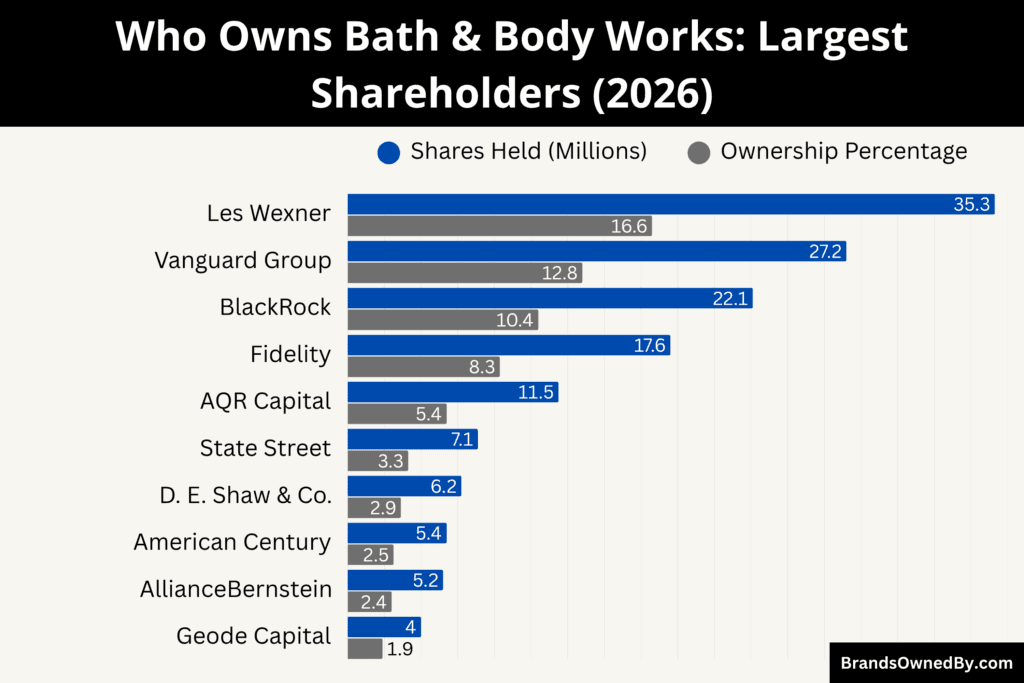
Bath & Body Works, Inc. is a publicly traded company listed on the New York Stock Exchange (NYSE: BBWI). This means ownership is divided into shares that are bought and sold by investors in the stock market.
As of April 2026, over 90% of the company is owned by institutional investors, while insiders and individuals hold smaller but still influential stakes.
This means control is not concentrated in one hand. Instead, it is distributed across asset managers, hedge funds, and investment firms that collectively influence decisions through voting power and board representation.
Below is a detailed breakdown of the major shareholders of Bath & Body Works, Inc. as of April 2026:
The Vanguard Group
The Vanguard Group holds 27.2 million shares, representing 12.8% of Bath & Body Works, making it the largest institutional shareholder.
Vanguard’s ownership comes almost entirely through its index funds and ETFs. These funds are designed to track major indices like the S&P 500, meaning Vanguard does not actively pick Bath & Body Works as a short-term bet. Instead, it holds the stock as part of a long-term, diversified portfolio.
Despite this passive strategy, Vanguard’s influence is substantial. With over 27 million shares, it has significant voting power in shareholder meetings. It participates in decisions such as electing board members, approving executive compensation, and shaping governance policies.
What makes Vanguard particularly important is its long-term stability. Unlike hedge funds that may enter and exit positions quickly, Vanguard rarely makes drastic changes to its holdings. This provides Bath & Body Works with a stable ownership base, which supports consistent strategic planning and reduces volatility in shareholder sentiment.
BlackRock
BlackRock owns 22.1 million shares, equal to 10.4% of the company, making it the second-largest shareholder.
BlackRock’s position is distributed across its iShares ETFs and actively managed portfolios. Unlike Vanguard, BlackRock takes a more engaged ownership approach. It regularly interacts with company management and evaluates performance beyond just stock price.
With over 22 million shares, BlackRock has strong voting influence. It often focuses on governance standards, operational efficiency, and long-term value creation. For a consumer-focused brand like Bath & Body Works, BlackRock’s oversight is important because it pushes for consistency in brand positioning, disciplined capital allocation, and resilience in changing retail conditions.
BlackRock also plays a signaling role in the market. Its continued investment indicates confidence in the company’s ability to maintain margins and customer demand, especially in categories like home fragrance and personal care.
FMR LLC (Fidelity Investments)
Fidelity Investments, through FMR LLC, holds 17.6 million shares, representing 8.3% ownership.
Fidelity operates differently from passive giants like Vanguard. It actively manages its funds, meaning it can increase or reduce its position based on company performance, valuation, and future outlook.
Holding over 17 million shares, Fidelity has both financial influence and strategic flexibility. Its investment in Bath & Body Works suggests confidence in the company’s ability to sustain revenue through repeat purchases, seasonal product cycles, and strong brand loyalty.
Fidelity also contributes to market perception. Because it is an active manager, its continued ownership signals to other investors that the company meets key performance and growth expectations. If Fidelity were to significantly change its position, it could impact investor sentiment quickly.
Les Wexner
Les Wexner owns 35.3 million shares, representing 16.6% of Bath & Body Works, making him the largest individual shareholder.
This stake is a direct result of his decades-long control of the company under L Brands. Even after stepping down from leadership, Wexner retained a large portion of equity, which keeps him financially tied to the company’s performance.
Owning over 35 million shares gives Wexner significant voting power as an individual. However, it is important to note that he does not have majority control. His influence is now balanced against large institutional investors.
His presence in the ownership structure is still meaningful. It represents continuity and long-term alignment with the company’s success. At the same time, the shift toward institutional ownership means strategic control is no longer centralized around him.
State Street Corporation
State Street Corporation holds 7.1 million shares, representing 3.3% ownership.
State Street is one of the “Big Three” asset managers, alongside Vanguard and BlackRock. Its holdings are primarily tied to SPDR ETFs, which track major stock indices.
Even though it follows a passive strategy, State Street is highly active in governance. With over 7 million shares, it participates in proxy voting and pushes for strong governance practices, including board accountability and transparency.
Its role is particularly important in maintaining checks and balances within the company. It ensures that management decisions align with shareholder interests and that governance standards remain high.
AQR Capital Management
AQR Capital Management owns 11.5 million shares, representing 5.4% of the company.
AQR is known for its quantitative investment strategies. It uses data models and statistical analysis to identify companies with strong financial characteristics.
Its stake in Bath & Body Works reflects favorable metrics such as profitability, pricing power, and consistent consumer demand. Holding over 11 million shares gives AQR a meaningful presence among top shareholders.
While AQR does not typically engage in activist behavior, its trading activity can influence stock performance. Large quantitative funds like AQR can affect liquidity and short-term price movements, especially if they adjust their positions based on model-driven signals.
D. E. Shaw & Co.
D. E. Shaw & Co. holds 6.2 million shares, representing 2.9% ownership.
This firm combines quantitative models with fundamental research. Its investment approach is more dynamic compared to traditional asset managers.
With over 6 million shares, D. E. Shaw has the ability to influence market sentiment, particularly through trading activity. Hedge funds like this often look for opportunities to optimize returns, which means their positions can change based on short-term and medium-term outlooks.
Its presence in Bath & Body Works suggests that the company meets strict performance and valuation criteria used by sophisticated investors.
American Century Investments
American Century Investments owns 5.4 million shares, representing 2.5% of the company.
American Century focuses on actively managed investment strategies. It typically invests in companies that demonstrate consistent earnings, operational efficiency, and long-term growth potential.
Its stake in Bath & Body Works indicates confidence in the company’s ability to generate stable cash flows and maintain customer engagement through product innovation and seasonal offerings.
With millions of shares under management, American Century also contributes to shareholder voting, reinforcing institutional oversight.
AllianceBernstein
AllianceBernstein holds 5.2 million shares, representing 2.4% ownership.
AllianceBernstein is a research-driven investment firm. It focuses heavily on company fundamentals, including brand strength, customer retention, and operational performance.
Bath & Body Works aligns well with its investment criteria due to its strong brand identity and repeat purchase model. Its stake reflects long-term confidence rather than short-term speculation.
With over 5 million shares, AllianceBernstein also plays a role in governance decisions, particularly those related to strategic direction and executive accountability.
Geode Capital Management
Geode Capital Management owns 4.0 million shares, representing 1.9% of the company.
Geode primarily manages index-linked assets and often works alongside larger firms like Vanguard. Its holdings are tied to passive investment flows.
Although it does not actively influence corporate strategy, its ownership adds to the overall institutional base. Large passive holdings like Geode’s contribute to stability in the shareholder structure.
Competitor Ownership Comparison
When analyzing who owns Bath & Body Works, it is important to compare its ownership structure with other major beauty and personal care companies. Each competitor operates under a different ownership model. Some are controlled by global conglomerates, while others are influenced by founding families or private equity firms.
Bath & Body Works stands out as a publicly traded, independent company with no single controlling shareholder. This gives it a unique position in the market. In contrast, competitors like Sephora and The Estée Lauder Companies follow more centralized ownership structures.
| Company | Ownership Type | Major Owner(s) | Control Structure | Key Characteristics |
|---|---|---|---|---|
| Bath & Body Works, Inc. | Public (Standalone) | Vanguard, BlackRock, Fidelity, Les Wexner | No single controlling owner; institutional dominance | Pure-play brand; independent; strong shareholder governance |
| Sephora | Subsidiary | LVMH | Controlled by parent company | Backed by luxury conglomerate; shared global resources |
| Ulta Beauty | Public | Vanguard, BlackRock, institutional investors | No controlling shareholder | Multi-brand retailer; diversified product portfolio |
| The Estée Lauder Companies | Public (Family-influenced) | Lauder Family, institutional investors | Family-controlled voting power | Strong brand portfolio; centralized strategic control |
| The Body Shop | Private | Private equity investors | Centralized private ownership | Focus on restructuring and profitability; less transparency |
| Victoria’s Secret & Co. | Public | Institutional investors | No single controlling owner | Spin-off from L Brands; similar structure to Bath & Body Works |
Bath & Body Works: Pure Public Ownership Model
Bath & Body Works, Inc. operates as a standalone public company.
Ownership is concentrated among institutional investors such as The Vanguard Group and BlackRock, along with a significant individual stake held by Les Wexner.
There is no parent company and no controlling family. Strategic decisions are influenced collectively through shareholder voting and executed by the executive team and board of directors.
This structure gives Bath & Body Works:
- High independence in decision-making
- Strong accountability to shareholders
- Focus on a single core brand and category.
Sephora: Conglomerate Ownership Under LVMH
Sephora operates under LVMH.
LVMH is controlled by Bernard Arnault and his family, who hold a controlling stake in the group.
This means Sephora is not independently owned. Its strategy, expansion, and financial decisions are aligned with LVMH’s broader luxury portfolio, which includes brands like Louis Vuitton and Dior.
Compared to Bath & Body Works:
- Ownership is centralized under a parent company
- Decision-making is influenced by a controlling family
- Sephora benefits from shared resources across a global luxury ecosystem.
Ulta Beauty: Public Company with Distributed Ownership
Ulta Beauty is structurally the closest to Bath & Body Works.
It is a publicly traded company with ownership spread across institutional investors. Major shareholders include firms like Vanguard and BlackRock, similar to Bath & Body Works.
However, Ulta differs in its business model. It operates as a multi-brand retailer, selling products from hundreds of beauty brands rather than focusing on its own private-label products.
Ownership comparison:
- Both companies are institutionally owned
- Neither has a controlling shareholder
- Ulta is diversified across brands, while Bath & Body Works is brand-focused.
The Estée Lauder Companies: Family-Influenced Public Company
The Estée Lauder Companies is a publicly traded company, but its ownership is heavily influenced by the Lauder family.
The Lauder family holds a significant portion of voting power through special share structures. This gives them effective control over strategic decisions, even without majority economic ownership.
Compared to Bath & Body Works:
- Estée Lauder has family-controlled governance
- Bath & Body Works has institutional governance
- Estée Lauder owns a wide portfolio of brands, including MAC, Clinique, and La Mer.
This makes Estée Lauder more centralized in decision-making despite being publicly listed.
The Body Shop: Private Equity Ownership Model
The Body Shop has gone through multiple ownership changes. It was previously owned by Natura & Co and later acquired by private equity investors.
Under private equity ownership, control is typically highly centralized. Decisions are driven by financial performance, restructuring goals, and eventual exit strategies such as resale or IPO.
Compared to Bath & Body Works:
- Ownership is private, not public
- Decision-making is faster but more financially driven
- There is less transparency compared to a listed company.
Victoria’s Secret: Parallel Spin-Off with Similar Ownership
Victoria’s Secret & Co. is particularly relevant because it was separated from Bath & Body Works in 2021.
Like Bath & Body Works, it is now a publicly traded company with institutional ownership.
However, the two companies differ in performance and positioning. Bath & Body Works has maintained stronger and more stable growth, which is reflected in investor confidence and ownership stability.
Ownership comparison:
- Both companies have similar shareholder structures
- Both are influenced by institutional investors
- Bath & Body Works has a stronger concentration of long-term holders.
Key Differences Across Competitors
When comparing ownership structures, clear distinctions emerge:
- Bath & Body Works → Public, institutionally owned, no controlling entity
- Sephora (LVMH) → Conglomerate-owned, family-controlled
- Ulta Beauty → Public, institutionally owned, multi-brand model
- Estée Lauder → Public, but family-controlled governance
- The Body Shop → Privately owned by investment firms
- Victoria’s Secret → Public, similar structure post-spin-off.
Who Controls Bath & Body Works?
Control of Bath & Body Works, Inc. in 2026 is shaped by a modern corporate governance structure, not by a single owner or legacy founder. The company is run through a combination of executive leadership, board oversight, and institutional shareholder influence.
This structure has become more defined after recent leadership changes, making control more performance-driven and less founder-centric.
CEO Leadership and Strategic Direction
As of 2026, Bath & Body Works is led by Daniel Heaf, who became CEO in 2025. His appointment marked a clear shift in how the company is controlled and managed.
Heaf was brought in during a period when the company was facing slowing growth and declining valuation despite stable revenue. His mandate has been to improve execution, strengthen margins, and reposition the brand for long-term growth.
Under his leadership, the company has focused on tightening its operating model. This includes reducing excessive discounting, improving inventory management, and increasing full-price sell-through. These changes directly impact profitability, which is a key concern for investors given the company’s $7.8 billion revenue versus a $4.93 billion market cap gap.
Heaf also plays a central role in product strategy. Bath & Body Works launches hundreds of fragrances each year, and leadership decisions around product mix, pricing, and seasonal timing directly influence revenue performance. This makes the CEO one of the most critical control points in the company.
Unlike earlier periods under founder-led influence, control today is execution-focused, with the CEO actively driving operational improvements rather than maintaining an existing model.
Executive Team and Operational Control
Control at Bath & Body Works is not limited to the CEO. It extends across a structured executive team responsible for key business functions such as merchandising, supply chain, finance, and marketing.
This team is responsible for translating strategy into measurable outcomes. For example, decisions around pricing strategy, promotional intensity, and product launches directly affect margins and revenue mix. Even small adjustments in discounting levels can shift profitability by hundreds of millions of dollars annually.
Recent leadership restructuring has also introduced more accountability across functions. Performance metrics are closely tied to financial outcomes, particularly operating margin and inventory efficiency. This reflects a shift toward data-driven control, where decisions are guided by performance indicators rather than legacy practices.
Board of Directors and Governance Control
The board of directors provides the highest level of oversight and plays a decisive role in controlling the company’s long-term direction.
The board is responsible for appointing and evaluating the CEO, approving major strategic initiatives, and ensuring that the company operates in the best interests of shareholders. The appointment of Daniel Heaf itself demonstrates the board’s authority, as it directly reshaped leadership to address performance concerns.
In a company without a controlling shareholder, the board becomes the central governance body. It balances management decisions with shareholder expectations and ensures accountability at the highest level.
Board decisions can influence major areas such as capital allocation, cost restructuring, and long-term growth strategy. This makes the board a key layer of control, even though it does not manage daily operations.
Institutional Shareholders and Voting Power
Institutional investors remain the most influential force behind the company’s control structure, even though they do not directly manage operations.
Large shareholders such as The Vanguard Group (12.8%), BlackRock (10.4%), and Fidelity Investments (8.3%) collectively hold a substantial portion of the company’s shares.
Their influence is exercised through voting rights. They elect board members, approve executive compensation, and influence corporate governance policies. Because these investors represent millions of underlying stakeholders, their decisions are typically focused on long-term value rather than short-term gains.
Institutional ownership exceeding 90% means that control is effectively market-driven. If performance declines or strategy fails, these investors have the power to push for leadership changes or strategic adjustments.
Role of Les Wexner in Current Control
Les Wexner remains the largest individual shareholder with a 16.6% stake, but his role in control is now limited.
He no longer participates in management or strategic decision-making. His influence exists primarily through voting power as a shareholder. While his stake is significant, it is not enough to override institutional investors collectively.
This represents a complete shift from the past, when Wexner exercised direct control through L Brands. Today, his role is financial rather than operational.
Bath & Body Works Annual Revenue and Net Worth
Bath & Body Works, Inc. remains a high-revenue, mid-cap retail company as of 2026.
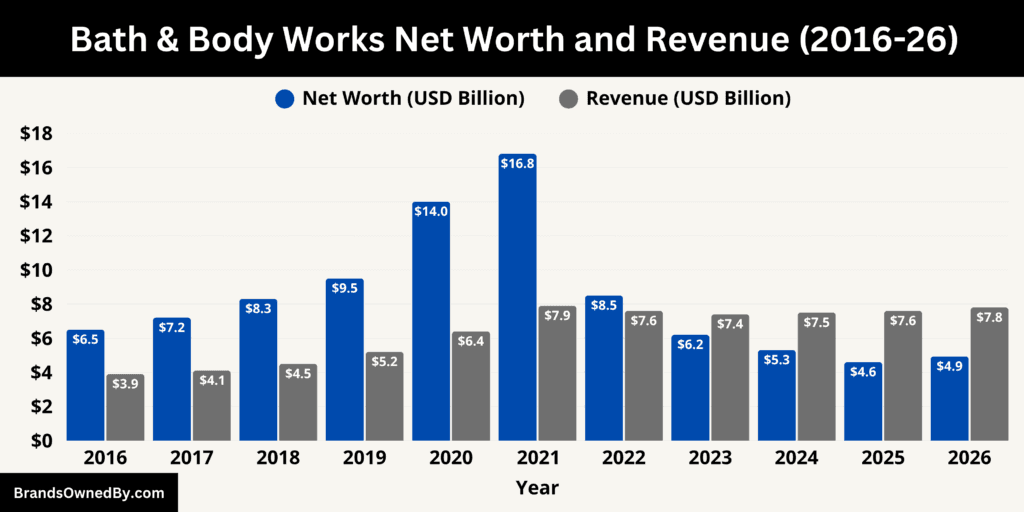
As of April 2, 2026, the company generates approximately $7.8 billion in annual revenue and has a market capitalization of $4.93 billion. This creates a price-to-sales (P/S) ratio of around 0.63x, which is relatively low for a consumer brand with strong margins and repeat demand.
2026 Revenue Breakdown and Business Performance
In 2026, Bath & Body Works reports $7.8 billion in total revenue, reflecting stable performance compared to previous years. The company operates with a highly focused product mix, and its revenue is concentrated in a few key categories.
Body care products contribute an estimated $3.2–$3.4 billion, accounting for roughly 42%–44% of total revenue. These include lotions, body creams, shower gels, and fine fragrance mists. These products benefit from high repeat purchase rates and strong brand loyalty.
Home fragrance products generate approximately $2.7–$2.9 billion, representing about 35%–37% of revenue. This segment includes candles, Wallflowers, and diffusers. It is one of the highest-margin categories due to premium pricing and seasonal demand.
Hand soaps and sanitizers contribute around $1.0–$1.1 billion, or roughly 13%–14% of total revenue. While demand normalized after the pandemic, this category remains a consistent revenue driver.
The remaining $400–$600 million (5%–7%) comes from other categories, including gift sets, accessories, and limited-edition collections.
From a channel perspective, approximately 75%–78% of revenue comes from physical retail stores, while 22%–25% is generated through e-commerce. Digital sales continue to grow steadily, supported by improved logistics and online engagement.
Geographically, over 90% of revenue is generated in North America, with international markets contributing less than 10%, indicating significant expansion potential.
2026 Net Worth
As of April 2026, Bath & Body Works has a market capitalization of $4.93 billion, down significantly from its peak of approximately $16.8 billion in 2021. This represents a decline of nearly 70% from peak valuation, despite revenue remaining relatively stable.
This valuation compression is driven by multiple measurable factors.
First, operating margins have narrowed. Gross margins, which were previously above 45%, have moved closer to the 40%–42% range due to higher input costs, increased promotions, and supply chain expenses.
Second, earnings growth has slowed. While revenue has remained in the $7.4–$7.8 billion range since 2021, net income growth has not kept pace, leading to lower valuation multiples.
Third, investor sentiment toward retail stocks has shifted. The average P/S ratio for specialty retailers has declined from around 1.5x–2.0x in 2021 to below 1.0x in 2026, placing Bath & Body Works at the lower end of the sector.
Fourth, the company’s dependence on North America limits its growth narrative. With over 90% revenue concentration in one region, investors assign a lower growth premium compared to globally diversified brands.
As a result, even with strong revenue, the company trades at a relatively modest valuation.
Revenue vs Net Worth: Quantitative Perspective
The relationship between revenue and market value provides a clearer picture of the company’s positioning.
Bath & Body Works generates $7.8 billion in revenue but is valued at $4.93 billion, meaning:
- The company is valued at 63 cents for every $1 of revenue
- Its valuation multiple is below many consumer peers
- Market expectations are priced for low-to-moderate growth.
In comparison, high-growth consumer brands often trade at 2x–4x revenue, while mature retailers typically trade between 0.5x–1.2x revenue. Bath & Body Works sits toward the lower-middle of this range.
This suggests that investors view the company as stable but not rapidly expanding.
Future Revenue Forecast (2026–2030)
Bath & Body Works is expected to grow at a compound annual growth rate (CAGR) of approximately 3%–4% over the next five years. This growth is driven by incremental improvements rather than major structural expansion.
- 2026: $7.8 billion
- 2027: $8.1 billion (growth of $300 million, 3.8%)
- 2028: $8.4 billion (growth of $300 million, 3.7%)
- 2029: $8.7 billion (growth of $300 million, 3.6%)
- 2030: $9.1 billion (growth of $400 million, 4.6%).
This projected increase of $1.3 billion over five years reflects steady demand in core categories and gradual expansion in digital and international markets.
Growth is expected to come from:
- Expansion of e-commerce share from 25% to 30%+ of total revenue
- International revenue increasing from <10% to 12%–15%
- Continued product innovation in fragrance and personal care.
However, without diversification into new categories or major acquisitions, the company is likely to remain in a moderate growth bracket, rather than a high-growth trajectory.
Brands Owned by Bath & Body Works
Bath & Body Works, Inc. operates as a focused, single-brand company as of 2026. It builds depth within its core ecosystem through sub-brands, product platforms, and retail concepts.
This strategy allows the company to maintain a strong brand identity while maximizing revenue across multiple product categories.
Below is a detailed breakdown of the brands, entities, and business segments owned and operated by Bath & Body Works as of 2026:
| Entity / Brand | Type | Core Focus | Revenue Contribution | Key Details |
|---|---|---|---|---|
| Bath & Body Works (Core Brand) | Primary Brand | Personal care (lotions, mists, shower gels) | $3.2–$3.4 billion (42%–44%) | Main revenue driver; over 1,800 stores in North America; strong brand loyalty |
| White Barn | Sub-brand | Home fragrance (candles, diffusers) | $2.7–$2.9 billion (35%–37%) | Premium positioning; integrated in stores and standalone locations |
| Bath & Body Works E-Commerce | Digital Platform | Online retail and direct-to-consumer sales | $1.7–$1.9 billion (22%–25%) | Fast-growing segment; expected to exceed 30% share by 2030 |
| Bath & Body Works Retail Stores | Physical Retail Network | In-store sales and customer experience | $5.8–$6.1 billion (75%–78%) | Core distribution channel; high footfall and conversion rates |
| International Operations (Franchise & Licensing) | Global Expansion Unit | Licensed retail operations in global markets | <$700 million (<10%) | Presence in 40+ countries; asset-light expansion model |
| My Bath & Body Works Rewards | Loyalty Program | Customer retention and engagement | Indirect revenue impact | Tens of millions of users; drives repeat purchases and data insights |
| Seasonal & Limited Collections | Product Platform | Holiday, aromatherapy, and themed launches | Variable (high seasonal impact) | Drives peak sales periods; creates urgency and repeat visits |
Bath & Body Works (Core Brand)
The core Bath & Body Works brand is the foundation of the entire business. It generates the majority of the company’s $7.8 billion annual revenue.
This brand focuses on personal care products such as body lotions, shower gels, fragrance mists, and hand creams. It is built around fragrance-led innovation, with hundreds of scent variations launched every year.
The brand operates through more than 1,800 retail stores in North America, along with a strong e-commerce platform. It follows a high-frequency product refresh model, introducing new collections every few weeks to drive repeat purchases.
Signature product lines such as Japanese Cherry Blossom, Warm Vanilla Sugar, and A Thousand Wishes continue to generate consistent revenue. The brand’s pricing strategy positions it as an affordable luxury option, balancing accessibility with perceived premium quality.
White Barn
White Barn is a key sub-brand focused exclusively on home fragrance products.
It operates both as a standalone concept in select locations and as an integrated section within Bath & Body Works stores. White Barn is positioned as a slightly more premium offering compared to the core brand.
The brand specializes in:
- 3-wick candles
- Wallflowers (plug-in fragrance systems)
- Room sprays and diffusers
White Barn plays a critical role in revenue generation, contributing a large portion of the $2.7–$2.9 billion home fragrance segment.
Its minimalist packaging and elevated branding help attract customers looking for a more refined aesthetic, while still staying within the company’s pricing structure.
Bath & Body Works E-Commerce Platform
The company’s digital platform is a major operational entity rather than just a sales channel.
The Bath & Body Works website and mobile experience generate approximately 22%–25% of total revenue, translating to over $1.7 billion annually.
This platform supports:
- Direct-to-consumer sales
- Seasonal promotions and exclusive launches
- Customer data collection and personalization.
The company has invested heavily in logistics, fulfillment centers, and digital marketing to strengthen this segment. E-commerce is one of the fastest-growing areas of the business and is expected to exceed 30% of total revenue by 2030.
Bath & Body Works International Operations
Bath & Body Works operates internationally through a mix of franchise and licensing partnerships.
As of 2026, the brand is present in over 40 countries, including regions in the Middle East, Asia, and Latin America.
These international operations are not always company-owned stores. Instead, they are often run by local partners under licensing agreements. This model allows Bath & Body Works to expand globally without heavy capital investment.
International revenue currently contributes less than 10% of total sales, but it represents a significant long-term growth opportunity.
Bath & Body Works Loyalty Program
The company operates a large-scale customer loyalty ecosystem known as My Bath & Body Works Rewards.
This program has tens of millions of active members and plays a key role in driving repeat purchases and customer retention.
Members earn points on purchases and receive personalized offers, early access to product launches, and exclusive promotions.
The loyalty program is a major data asset. It allows the company to:
- Track customer preferences
- Optimize product launches
- Improve marketing efficiency.
This system directly contributes to higher customer lifetime value and consistent revenue generation.
Seasonal and Limited-Edition Product Platforms
Bath & Body Works operates a structured system of seasonal and limited-edition collections, which function as internal product brands.
These include:
- Holiday collections (Christmas, Halloween, etc.)
- Summer and tropical fragrance lines
- Aromatherapy collections focused on wellness.
These platforms are not separate companies but are critical revenue drivers. They create urgency and encourage frequent store visits.
Seasonal collections can account for a significant portion of quarterly revenue, especially during peak retail periods.
Bath & Body Works Retail Store Network
The company’s retail network itself is a major operational entity.
As of 2026, Bath & Body Works operates:
- Over 1,800 company-owned stores in North America
- Hundreds of additional franchised international locations.
These stores are designed for high engagement, with strong visual merchandising and product sampling.
Physical retail still contributes approximately 75% of total revenue, making it the backbone of the company’s business model.
Conclusion
Bath & Body Works is not owned in the traditional sense of a single person or parent company. It operates as an independent public business where control is spread across major institutional investors and supported by a remaining founder stake.
This ownership model keeps the company flexible and focused. It allows management to run the brand without external corporate interference while still being guided by shareholder expectations.
If you are looking at who owns Bath & Body Works, the real answer is a combination of large investment firms and public shareholders rather than a single controlling entity.
FAQs
Who is the owner of Bath & Body Works?
Bath & Body Works, Inc. is a publicly traded company, so it does not have a single owner. It is owned by shareholders, with major stakes held by institutional investors such as The Vanguard Group, BlackRock, and Fidelity Investments, along with a significant individual stake held by Les Wexner.
Where is Bath and Body Works headquartered?
Bath & Body Works is headquartered in Columbus, Ohio, United States.
Who is CEO of Bath and Body Works?
As of 2026, the CEO of Bath & Body Works is Daniel Heaf, who took over leadership in 2025.
Who is the sister company of Bath and Body Works?
The closest sister company is Victoria’s Secret & Co.. Both companies were previously part of L Brands before being separated into independent businesses in 2021.
Which country company is Bath and Body Works?
Bath & Body Works is an American company based in the United States.
Are Bath and Body Works and Victoria’s Secret the same company?
No, they are not the same company anymore. They were part of the same parent company, L Brands, but became separate publicly traded companies in 2021.
Who sued Bath and Body Works?
Bath & Body Works has faced multiple lawsuits over time, including cases related to product labeling, labor practices, and intellectual property. These lawsuits have been filed by consumers, employees, and other businesses, rather than a single specific entity.
Is Bath & Body Works made in the USA?
Many Bath & Body Works products are manufactured in the United States, but the company also sources and produces products globally through third-party manufacturers.
Who owns Bath & Body Works perfume?
Bath & Body Works perfumes and fragrances are owned by the company itself. They are developed and sold under its own brand, not licensed from external perfume houses.
Who is the manufacturer of Bath and Body Works?
Bath & Body Works uses a mix of in-house development and third-party manufacturers. Production is handled through a network of suppliers, primarily in the United States and other global locations.
Is Bath and Body Works owned by Victoria Secret?
No, Bath & Body Works is not owned by Victoria’s Secret. Both companies are independent and publicly traded.
How many stores does Bath and Body Works have?
As of 2026, Bath & Body Works operates over 1,800 company-owned stores in North America, along with hundreds of additional franchised locations internationally.