
- Domino’s is a publicly traded company with no controlling owner. Ownership is distributed among shareholders.
- The largest shareholders include Vanguard (11.2%), Berkshire Hathaway (8.9%), and BlackRock (6.7%), together holding a significant portion of total shares.
- Institutional investors control about 94%–95% of Domino’s shares, giving them strong influence over governance through voting rights.
- No single investor has majority control, so decisions are overseen by the board and executed by the CEO and management team.
Domino’s Pizza, Inc. is a global pizza delivery and carryout company headquartered in Ann Arbor, Michigan. It operates in more than 90 countries and has built a strong presence through a franchise-driven business model.
The company focuses heavily on convenience and speed. Its core offering is quick-service pizza, supported by a wide menu that includes sides, desserts, and beverages. Domino’s is widely recognized for its efficient delivery system and consistent product quality.
A key strength of Domino’s is its investment in technology. The company has developed advanced digital ordering platforms, including mobile apps and online systems. A large portion of its orders now comes through digital channels. This has helped Domino’s stay competitive in a fast-changing food delivery market.
Most Domino’s stores are owned and operated by franchisees. This allows the company to expand rapidly without directly managing every location. The parent company supports these franchisees with supply chain services, branding, and operational systems.
Overall, Domino’s is known for its strong global brand, tech-driven approach, and highly scalable franchise model.
Founders of Domino’s
Domino’s was built on the vision of two brothers, Tom Monaghan and James Monaghan, who started with a single pizza store and a simple idea. The founders played a crucial role in shaping the company’s early direction, especially its focus on fast delivery and operational efficiency. While both were involved at the beginning, Tom Monaghan quickly took full control and led Domino’s expansion into a global brand.
Tom Monaghan
Tom Monaghan is the primary founder of Domino’s and the driving force behind its early growth. He purchased the original pizza store in 1960 along with his brother. Soon after, he took full control of the business.
Tom focused on simplifying operations and improving delivery speed. He introduced the concept of fast pizza delivery, which became the foundation of Domino’s success. Under his leadership, the company expanded rapidly across the United States.
He also established the franchise model that allowed Domino’s to grow internationally. His vision turned a small local store into a global brand.
Tom Monaghan remained involved with the company until he sold a majority stake in 1998. After that, he stepped away from active management.
James Monaghan
James Monaghan co-founded Domino’s with his brother Tom. He played a role in the early days of the business. However, his involvement was short-lived.
Shortly after starting the company, James decided to leave the business. He sold his share to Tom in exchange for a car. This decision gave Tom full ownership and control of Domino’s.
Although James was not involved in the company’s long-term growth, he remains an important part of Domino’s founding history.
Ownership History
Domino’s ownership has evolved through well-defined phases. Each phase changed how the company was financed, governed, and scaled. The transition from a founder-led business to a widely held public company reflects Domino’s transformation into a global enterprise.
Founder-Led Era Under Tom Monaghan (1960–1998)
Domino’s began in 1960 when Tom Monaghan and James Monaghan acquired a small pizza store in Ypsilanti, Michigan. Within a short period, James Monaghan exited the business. Tom became the sole owner, giving him complete control over all strategic and operational decisions.
During this era, Domino’s operated as a privately held company. There were no external shareholders. Tom Monaghan personally shaped the company’s identity. He focused on a limited menu, standardized processes, and fast delivery. These decisions were not random. They were designed to simplify operations and improve consistency across locations.
One of the most important developments in this phase was the franchise model. Instead of owning every store, Domino’s allowed independent operators to open locations under its brand. This reduced capital requirements and accelerated expansion. Franchise agreements also ensured that Domino’s maintained control over quality, branding, and supply chain standards.
By the 1980s and 1990s, Domino’s had scaled rapidly across the United States and entered international markets. The company built a strong logistics network to support franchisees. It also established regional supply centers to maintain product consistency.
Despite its growth, ownership remained concentrated in Tom Monaghan’s hands. This meant decisions could be made quickly without external approval. However, it also limited access to large-scale capital needed for the next phase of global expansion.
Private Equity Ownership by Bain Capital (1998–2004)
In 1998, Tom Monaghan sold approximately 93% of Domino’s to Bain Capital. The transaction was valued at around $1 billion. This marked a structural shift from individual ownership to institutional ownership.
Bain Capital approached Domino’s with a private equity strategy. The goal was to increase enterprise value within a defined time horizon. This required operational improvements, financial restructuring, and scalable growth initiatives.
During this period, Domino’s refined its business systems. Bain focused on improving margins and strengthening unit economics. Supply chain operations were optimized to reduce costs and improve efficiency. Franchise support systems were also enhanced, making it easier for operators to expand.
Another key focus was international growth. Domino’s expanded into new markets using master franchise agreements. This allowed the company to scale globally without direct operational involvement in every country.
The company also began preparing for public markets. This included strengthening corporate governance, improving financial reporting, and building a more formal management structure. These changes were necessary to attract public investors in the future.
Although Bain Capital controlled the company, Tom Monaghan initially retained a minority stake. However, strategic control clearly shifted to Bain and its appointed leadership team.
Initial Public Offering and Market Entry (2004)
Domino’s went public in July 2004. The IPO marked its transition from private equity ownership to public ownership. Shares were listed on the New York Stock Exchange under the ticker DPZ.
The IPO served multiple purposes. It provided liquidity to Bain Capital, allowing it to begin exiting its investment. It also enabled Domino’s to reduce debt that had accumulated during the leveraged buyout. At the same time, it gave the company access to public capital markets for future growth.
Public listing introduced a new ownership structure. Shares were now distributed among institutional investors, mutual funds, and individual investors. This broadened the ownership base significantly.
The company also became subject to regulatory oversight. It had to publish quarterly and annual financial reports. Transparency and accountability became more important. The board of directors gained a more formal role in governance, representing shareholder interests.
Even after the IPO, Bain Capital remained the dominant shareholder for several years. However, its influence gradually declined as it sold shares.
Gradual Exit of Bain Capital (2004–2010)
Following the IPO, Bain Capital began a phased exit. It did not sell all its shares at once. Instead, it reduced its stake through multiple secondary offerings and market sales.
This gradual exit strategy helped maintain market stability. Large, sudden sell-offs could have negatively impacted the stock price. By spacing out transactions, Bain was able to maximize returns while minimizing disruption.
As Bain reduced its ownership, new investors entered. Institutional investors, including asset managers and pension funds, began building positions in Domino’s. This marked the beginning of a more diversified ownership base.
By around 2010, Bain Capital had fully exited Domino’s. This ended the private equity phase of ownership. The company was now entirely owned by public shareholders.
This transition also shifted influence away from a single controlling investor. Decision-making became more distributed, with the board and executive team taking a central role.
Rise of Institutional Ownership (2010–2026)
After Bain’s exit, Domino’s ownership became increasingly institutional. Large asset managers began accumulating shares through index funds, ETFs, and actively managed portfolios.
As of 2025–2026, firms like Vanguard Group, BlackRock, and State Street are among the largest shareholders. These firms do not invest for control in the traditional sense. Instead, they manage capital on behalf of clients, including retail investors, pension funds, and sovereign entities.
Their influence comes from voting power. They participate in shareholder meetings and vote on key issues such as board appointments, executive compensation, and major corporate decisions.
This period also coincided with Domino’s transformation into a technology-driven company. Investments in digital ordering, data analytics, and delivery optimization increased investor confidence. As a result, institutional ownership continued to grow.
Another important trend is passive investing. Because Domino’s is part of major stock indices, index funds automatically include it in their portfolios. This ensures a steady base of long-term investors.
Despite the dominance of institutional investors, no single entity holds a controlling stake. Ownership remains widely distributed.
Current Ownership Structure
As of 2026, Domino’s operates as a fully independent, publicly traded company with a dispersed ownership structure. The company does not have a parent organization or controlling shareholder.
Ownership is divided among:
- Large institutional investors holding significant but non-controlling stakes
- Mutual funds and ETFs representing pooled investments
- Retail investors owning individual shares
- Company insiders with relatively small holdings.
This structure creates a balance of power. Institutional investors provide stability and long-term capital. Retail investors contribute to market liquidity. Insiders align management interests with shareholder value.
Control is exercised through corporate governance mechanisms. The board of directors oversees major decisions. Shareholders influence the company through voting rights rather than direct management.
This modern ownership model supports scalability and resilience. It allows Domino’s to raise capital efficiently while maintaining strategic flexibility. The shift from a single owner to a broad investor base reflects the company’s evolution into a mature global corporation.
Who Owns Domino’s: Major Shareholders
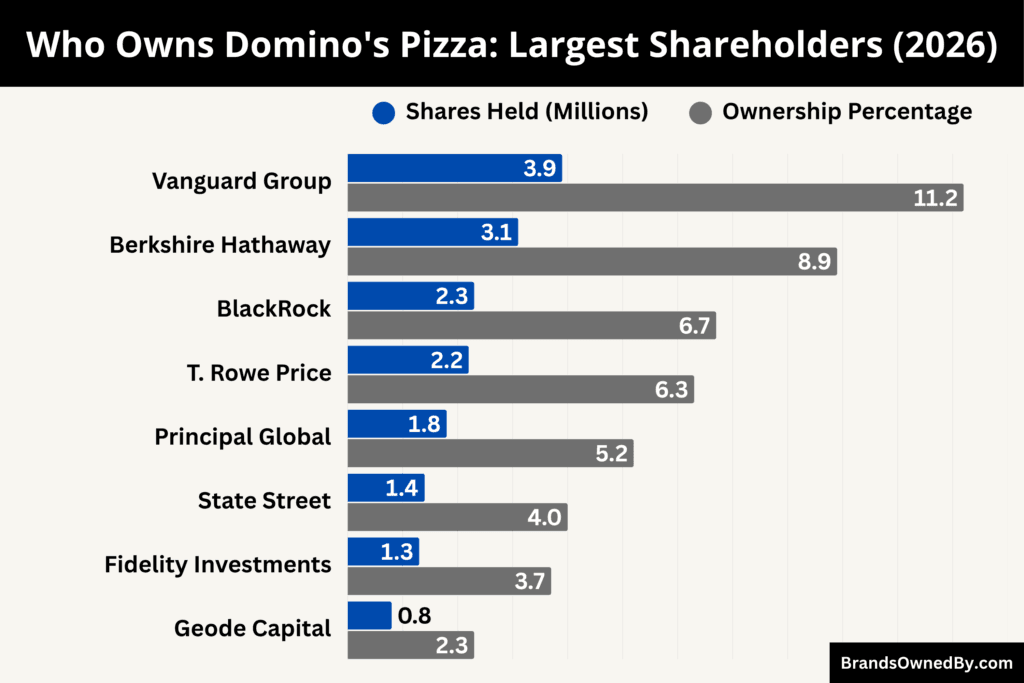
Domino’s Pizza, Inc. operates as a publicly traded company with a highly institutional ownership structure. This means ownership is spread across large investment firms, mutual funds, and individual shareholders rather than being concentrated in one entity.
As of March 2026, institutional investors control the vast majority of Domino’s shares. Estimates show that over 94% of outstanding shares are held by institutions, reflecting strong confidence from long-term investors. These institutions invest on behalf of millions of individuals, retirement funds, and global portfolios.
The company has approximately 34–35 million shares outstanding. Domino’s ownership is concentrated among top institutional investors, but it remains widely distributed overall.
Key characteristics include:
- No single shareholder exceeds 12% ownership
- Total shares outstanding: 34–35 million
- Institutional ownership: 94%–95%
- The top 6–8 shareholders control a large combined stake.
Below is a detailed breakdown of the top shareholders and their holdings as of March 2026:
The Vanguard Group
The Vanguard Group is the largest shareholder of Domino’s, holding approximately 3.7 million to 4.0 million shares, which represents around 10.5% to 11.5% ownership.
Vanguard’s stake is primarily held through its index funds such as the Vanguard Total Stock Market Index Fund and S&P 500 ETFs. These funds automatically include Domino’s as part of broader market exposure. Because of this structure, Vanguard’s investment is typically long-term and stable.
The size of Vanguard’s holding gives it substantial influence in shareholder voting. While it does not actively manage the company, it plays a critical role in governance decisions. These include electing board members, approving executive compensation packages, and voting on major corporate policies.
Vanguard’s large position also signals that Domino’s is considered a core holding in diversified portfolios. This reflects confidence in the company’s franchise model, global expansion strategy, and consistent performance.
Berkshire Hathaway
Berkshire Hathaway is one of the most notable shareholders, holding approximately 3.0 million to 3.2 million shares, or about 8.5% to 9% of Domino’s.
This investment is significant because Berkshire Hathaway typically invests in companies with strong brand equity and predictable cash flows. Its stake in Domino’s reflects confidence in the company’s long-term competitive advantages, especially its technology-driven ordering system and franchise scalability.
Unlike passive investors, Berkshire Hathaway follows a more selective and strategic investment approach. Its holdings are often concentrated in companies it believes have durable economic moats. Domino’s fits this profile due to its global footprint and operational efficiency.
Although Berkshire does not interfere in daily operations, its presence as a top shareholder adds credibility. It also strengthens investor sentiment, as the firm is known for long-term, disciplined investing.
BlackRock
BlackRock holds approximately 2.2 million to 2.4 million shares of Domino’s, representing around 6.5% to 7% ownership.
As the world’s largest asset manager, BlackRock’s stake is spread across a wide range of investment products. These include index funds, ETFs such as iShares, and actively managed portfolios.
BlackRock’s role in Domino’s ownership is both large and consistent. It participates actively in corporate governance through voting and engagement with management. The firm emphasizes long-term value creation, sustainability, and risk management.
Its multi-million shareholding ensures that it remains one of the most influential voices in shareholder decisions. However, like Vanguard, it does not seek operational control.
T. Rowe Price Investment Management
T. Rowe Price holds approximately 2.1 million to 2.3 million shares, giving it around 6% to 6.5% ownership in Domino’s.
This firm is known for its active investment strategy. Unlike passive index funds, T. Rowe Price conducts deep research and selectively invests in companies with strong growth potential.
Its investment in Domino’s highlights confidence in the company’s long-term strategy. This includes its focus on digital innovation, international expansion, and franchise efficiency.
Because it is an active manager, T. Rowe Price may engage more directly with Domino’s leadership. It can influence strategic decisions through dialogue and voting. Its stake size gives it meaningful influence, though not control.
Principal Global Investors
Principal Global Investors owns approximately 1.7 million to 1.9 million shares, representing about 5% to 5.5% of the company.
This firm manages assets for institutional clients, including retirement funds and insurance portfolios. Its investment approach focuses on stability, diversification, and long-term returns.
Principal’s position in Domino’s reflects the company’s consistent performance and resilient business model. The franchise-heavy structure and recurring revenue streams make Domino’s attractive for long-term institutional investors.
While Principal does not play a direct operational role, its voting power contributes to shaping corporate governance.
State Street Corporation
State Street holds approximately 1.3 million to 1.5 million shares, or around 3.5% to 4.2% ownership.
It is one of the “big three” asset managers, alongside Vanguard and BlackRock. State Street primarily invests through index funds and ETFs, making it a passive but highly influential investor.
Its ownership stake ensures steady demand for Domino’s shares. Like other passive investors, it focuses on governance rather than management. It votes on key corporate matters and supports long-term strategic direction.
State Street’s presence adds further institutional depth to Domino’s ownership base.
FMR LLC
FMR LLC, the parent company of Fidelity Investments, holds approximately 1.2 million to 1.4 million shares, representing around 3% to 4% ownership.
Fidelity combines both active and passive investment strategies. Some of its funds actively select Domino’s as a growth investment, while others include it as part of broader indices.
Fidelity’s stake reflects confidence in Domino’s ability to generate consistent returns. Its research-driven approach often leads to deeper engagement with company management compared to purely passive investors.
This makes Fidelity an important stakeholder in both ownership and governance discussions.
Geode Capital Management
Geode Capital Management holds approximately 700K to 900K shares, equating to around 2% to 2.5% ownership.
Geode primarily manages index-based strategies and works closely with large institutional investors. Its role is part of the broader passive investment ecosystem.
Although its stake is smaller compared to top shareholders, it still represents a meaningful position. Its holdings contribute to overall institutional dominance in Domino’s ownership.
Competitor Ownership Comparison
Domino’s operates in a competitive global QSR pizza and food delivery market. Its ownership structure stands out when compared with both direct pizza competitors and broader restaurant and delivery platforms.
As of March 2026, most large competitors fall into three categories: publicly traded parent-owned brands, independent public companies, and privately owned businesses. Each structure directly affects control, capital access, and strategic flexibility.
| Company / Brand | Ownership Type | Major Shareholders / Owners | Institutional Ownership | Control Structure | Key Strategic Impact |
|---|---|---|---|---|---|
| Domino’s Pizza | Public (Independent) | Vanguard (11.2%), BlackRock (6.7%), Berkshire (8.9%) | 94%–95% | No controlling shareholder. Board + CEO lead | High independence. Strong focus on tech and delivery. |
| Pizza Hut (Yum! Brands) | Public (Parent-Owned) | Yum! Brands: Vanguard (9.3%), BlackRock (7.1%) | 90%+ (Yum level) | Controlled by Yum! Brands | Shared resources but limited independence. |
| Papa John’s | Public (Independent) | Vanguard (11.0%), BlackRock (9.2%), Starboard (8.1%) | 88%–90% | Institutional + activist influence | Higher shareholder pressure and strategic changes. |
| Little Caesars | Private (Family-Owned) | Ilitch Family (100%) | 0% | Full family control | High flexibility. No public reporting pressure. |
| McDonald’s | Public (Independent) | Vanguard (9.1%), BlackRock (7.0%), State Street (4.2%) | 90%+ | Dispersed institutional control | Stable governance. Massive global scale. |
| Restaurant Brands Intl. (RBI) | Public (Concentrated Ownership) | 3G Capital (30%+), Vanguard (6.5%), BlackRock (5.8%) | 85%+ | Strong influence by 3G Capital | Centralized decision-making and cost focus. |
| DoorDash | Public (Platform Company) | Vanguard (8.2%), SoftBank (7.5%) | 85%+ | Institutional ownership | Platform-driven model controlling delivery layer. |
| Uber (Uber Eats) | Public (Platform Company) | Vanguard (8.0%), BlackRock (6.2%) | 75%–80% | Dispersed institutional ownership | Marketplace model with global scale. |
Domino’s: Independent Public Company with Dispersed Institutional Ownership
Domino’s is an independent, publicly traded company with no parent organization. Around 94%–95% of its shares are held by institutional investors, including Vanguard, BlackRock, and Berkshire Hathaway. The largest shareholder holds just over 11%, and no investor has controlling interest.
This creates a governance model where control is exercised collectively. Institutional investors influence decisions through voting, while management retains operational authority. Domino’s benefits from full strategic independence. It does not compete internally for capital or attention, unlike brands owned by larger restaurant groups.
This structure has allowed Domino’s to prioritize technology, delivery logistics, and franchise efficiency without external brand conflicts.
Pizza Hut: Controlled by Yum! Brands
Pizza Hut operates as a division of Yum! Brands, one of the largest restaurant companies in the world. Yum! Brands is publicly traded and has a market capitalization exceeding $35 billion as of 2026.
Ownership of Yum! Brands is highly institutional. Major shareholders include Vanguard (about 9%), BlackRock (about 7%), and State Street (about 4%). Because Pizza Hut is not a separate listed company, it does not have its own shareholders.
Strategic decisions for Pizza Hut are made at the Yum! Brands level. This includes capital allocation, expansion priorities, and operational changes. Pizza Hut competes internally with other Yum! brands like KFC and Taco Bell for investment.
This structure provides scale advantages. Pizza Hut benefits from shared supply chains, marketing resources, and global infrastructure. However, it lacks full autonomy. Unlike Domino’s, it cannot independently set a long-term strategy without alignment from the parent company.
Papa John’s: Public Company with Institutional Control
Papa John’s International is a publicly traded company with a structure similar to Domino’s but with lower institutional concentration.
As of March 2026, institutional ownership is around 88%–90%. Major shareholders include Vanguard (11%), BlackRock (9%), and Starboard Value (a notable activist investor with around 8% stake).
The presence of an activist investor is a key difference. Firms like Starboard Value actively push for operational changes, cost improvements, and strategic shifts. This creates a more dynamic governance environment compared to Domino’s.
Papa John’s previously had strong founder control under John Schnatter. However, his stake has been significantly reduced. Today, ownership is more aligned with institutional investors, though with greater activist influence than Domino’s.
Little Caesars: Privately Owned by Ilitch Holdings
Little Caesars is owned by Ilitch Holdings, a privately held company controlled by the Ilitch family. This structure has remained unchanged as of 2026.
Because it is private, Little Caesars does not disclose detailed financial or ownership data. However, full control rests with the Ilitch family. There are no public shareholders or institutional investors.
This allows for complete strategic freedom. The company can make long-term decisions without pressure from quarterly earnings expectations. Pricing strategies, expansion plans, and operational changes can be implemented quickly.
However, private ownership limits access to public capital. Growth must be funded through internal cash flow or private financing. Compared to Domino’s, this can slow large-scale international expansion.
McDonald’s: Public Company with Global Institutional Ownership
While not a pizza-focused competitor, McDonald’s competes directly in the QSR and delivery space. It provides a strong benchmark for ownership comparison.
As of March 2026, McDonald’s has over 90% institutional ownership. Its largest shareholders include Vanguard (9%), BlackRock (7%), and State Street (4%).
McDonald’s operates a franchise-heavy model similar to Domino’s. However, it is significantly larger and more diversified. Its ownership structure is also more mature, with a broader global investor base.
Unlike Domino’s, McDonald’s has a highly diversified menu and revenue streams. This reduces reliance on a single product category but also increases operational complexity.
Restaurant Brands International: Parent of Tim Hortons, Burger King, and Popeyes
Restaurant Brands International (RBI) is another major competitor group in the QSR space. It owns Burger King, Tim Hortons, and Popeyes.
As of 2026, RBI is publicly traded but has a more concentrated ownership structure. 3G Capital remains a major shareholder with around 30%+ ownership, making it a significant controlling influence.
Institutional investors like Vanguard and BlackRock also hold stakes, but 3G Capital’s position gives it outsized control compared to Domino’s ownership model.
This structure allows for strong centralized decision-making. However, it also means strategic direction is heavily influenced by a single investment firm. Domino’s, in contrast, operates without such concentrated control.
Delivery Platforms: Uber Eats and DoorDash
Delivery platforms are indirect but critical competitors. They influence how customers order food and how restaurants distribute products.
DoorDash is publicly traded, with institutional ownership exceeding 85%. Major shareholders include Vanguard (8%) and SoftBank (historically a major investor, though reduced over time).
Uber, which operates Uber Eats, also has a widely distributed ownership structure. Institutional investors dominate, but no single shareholder controls the company.
These platforms differ from Domino’s in one key way. They act as intermediaries rather than restaurant operators. Domino’s, in contrast, maintains control over its delivery ecosystem. This reduces reliance on third-party platforms and protects margins.
Key Ownership Differences Across Competitors
Comparing these companies highlights several structural differences:
- Domino’s operates independently with no controlling shareholder
- Pizza Hut is controlled by a parent company with centralized decision-making
- Papa John’s has institutional ownership but includes activist investor influence
- Little Caesars is privately owned with full family control
- McDonald’s mirrors Domino’s in institutional ownership, but operates at larger scale
- RBI has concentrated ownership with a dominant private equity firm
- Delivery platforms are publicly owned but operate as intermediaries.
Strategic Impact of Ownership Structures
Ownership structure directly shapes competitive behavior.
Domino’s benefits from independence and focus. It can invest heavily in technology and delivery without internal competition. Its institutional ownership ensures stability while avoiding control concentration.
Parent-owned brands like Pizza Hut gain scale but lose flexibility. Their strategy must align with broader corporate priorities.
Privately owned companies like Little Caesars can act quickly but lack access to large-scale public capital.
Companies with concentrated ownership, such as RBI, can execute bold strategies but may reflect the priorities of a single dominant investor.
Overall, Domino’s ownership model strikes a balance. It combines access to capital, strong governance, and strategic independence. This balance has been a key factor in its sustained competitive advantage in the global pizza and delivery market.
Who Controls Domino’s?
Domino’s is a publicly traded company, so ownership is spread across shareholders. However, control is exercised through a structured governance system. This system combines executive leadership, board oversight, and shareholder influence.
As of March 2026, control is clearly defined across these layers, with management running operations and the board representing shareholder interests.
CEO and Executive Leadership Control
The CEO is the most powerful decision-maker in Domino’s day-to-day operations. As of 2026, Russell Weiner serves as Chief Executive Officer.
Russell Weiner took over in May 2022. Before becoming CEO, he was Chief Operating Officer and President of Domino’s U.S. business. He led the company’s digital transformation, including mobile ordering, loyalty programs, and AI-driven ordering systems.
As CEO, he controls:
- Global operations across more than 90 markets
- Franchise performance and expansion strategy
- Technology investments and digital platforms
- Brand positioning and marketing direction.
He works closely with a defined executive team that handles core business functions.
Key executives as of 2026 include:
- Sandeep Reddy – Chief Financial Officer
- Kelly Garcia – Chief Technology Officer
- Art D’Elia – Executive Vice President, International
- Frank Garrido – Executive Vice President, U.S. Operations and Support.
Each executive has authority over their division. However, all major decisions flow through the CEO. This creates centralized operational control with functional specialization.
Board of Directors and Governance Authority
The board of directors is responsible for strategic oversight and governance. It does not run daily operations, but it has the authority to approve or reject major decisions.
As of 2026, the board includes a mix of independent directors and senior leadership. The Chairman of the Board is David Brandon, a former CEO of Domino’s.
The board’s responsibilities include:
- Appointing, evaluating, and if necessary replacing the CEO
- Approving long-term strategy and major investments
- Overseeing financial performance and risk management
- Setting executive compensation structures.
Board committees play a key role in control:
- Audit Committee oversees financial reporting and compliance
- Compensation Committee determines executive pay
- Nominating and Governance Committee manages the board structure.
This governance layer ensures that management decisions align with shareholder interests. It also creates accountability at the highest level.
Institutional Shareholder Influence
Although shareholders do not directly manage the company, large institutional investors exert meaningful influence through voting power.
As of March 2026, the largest shareholders include:
- Vanguard Group (over 3.9 million shares, about 11% ownership)
- Berkshire Hathaway (about 3.1 million shares, nearly 9%)
- BlackRock (around 2.3 million shares, about 6%–7%).
These firms do not control daily operations. However, they influence:
- Election of board members
- Approval of executive compensation
- Major corporate actions such as acquisitions or restructuring.
Because Domino’s ownership is widely distributed, no single investor controls the company. However, the top 10–15 shareholders collectively hold a large portion of voting power. Their combined influence shapes governance decisions.
Franchise System and Operational Control
A critical part of Domino’s control structure is its franchise model. More than 98% of Domino’s stores are operated by franchisees rather than the company itself.
This creates a unique control dynamic.
Domino’s does not directly manage most stores. Instead, it controls operations through:
- Franchise agreements that define operational standards
- Centralized supply chain systems
- Proprietary technology platforms used by all stores
- Strict brand and quality guidelines.
Franchisees must follow Domino’s systems. This ensures consistency across global markets. At the same time, franchisees handle local execution, staffing, and store-level decisions.
This model allows Domino’s to scale globally while maintaining centralized strategic control.
Balance of Control Across the Organization
Control at Domino’s is not concentrated in a single entity. It is distributed across clearly defined roles:
- The CEO and executive team control operations and execution
- The board of directors controls oversight and long-term strategy
- Institutional investors influence governance through voting
- Franchisees control store-level execution within company systems.
This structure creates a layered control system. Each group has defined authority, but none operates in isolation.
The result is a balance between centralized leadership and distributed execution. Domino’s can maintain consistency across thousands of locations while still adapting to local markets.
This governance model has been a key factor in Domino’s ability to scale globally while remaining operationally efficient and strategically focused.
Domino’s Annual Revenue and Net Worth
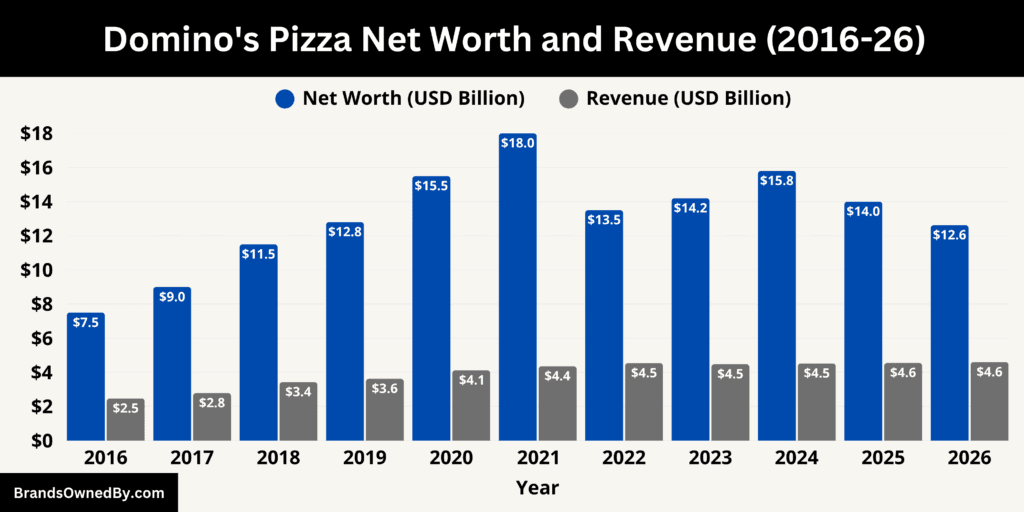
Domino’s continues to deliver stable financial performance as of 2026. The company generates close to $5 billion in annual revenue, with strong contributions from its supply chain and franchise operations. As of March 2026, Domino’s market capitalization stands at $12.62 billion, reflecting a more normalized valuation after earlier peaks. Despite valuation fluctuations, the company’s underlying revenue and profitability remain consistent.
2026 Revenue Structure and Segment Breakdown
Domino’s revenue model is highly structured and diversified across three core segments. This segmentation is critical to understanding how the company generates and scales revenue globally.
The supply chain segment is the largest contributor. It generates approximately $2.9–$3.0 billion annually, accounting for over 60% of total revenue. This segment includes the manufacturing and distribution of dough, toppings, and other ingredients to franchise stores. It is a high-volume, relatively stable revenue stream that benefits directly from global store growth.
The U.S. segment contributes roughly $1.6 billion in revenue, representing about 30%–32% of total revenue. This includes royalty fees, franchise income, and sales from company-owned stores. Growth in this segment is driven by same-store sales, pricing strategies, and digital ordering penetration.
The international segment generates approximately $330–$350 million, contributing around 7% of total revenue. While smaller in direct revenue contribution, this segment is critical for long-term expansion. Domino’s earns royalties from international franchisees, making it a high-margin growth driver.
In total, Domino’s revenue has reached approximately $4.9–$5.0 billion as of 2026, supported by steady global demand and strong franchise economics.
Profitability and Margin Strength
Domino’s operates with strong profitability due to its franchise-heavy model. The company does not bear the full cost of operating most stores, which improves margins.
As of the latest available data:
- Operating income exceeds $950 million annually
- Net income is around $600 million
- Operating margins remain above 18%–19%.
These margins are high for the restaurant industry. The supply chain business and franchise royalties contribute significantly to this efficiency. Domino’s also benefits from economies of scale, especially in procurement and logistics.
Net Worth 2026
As of March 2026, Domino’s market capitalization is $12.62 billion. This represents the company’s current net worth in the public market.
This valuation reflects several key factors:
First, Domino’s has a price-to-earnings (P/E) ratio in the range of 20–22, indicating moderate growth expectations. This is lower than its peak valuation multiples during 2020–2021, when delivery demand surged.
Second, the company maintains a strong enterprise value supported by consistent cash flow generation. Domino’s generates hundreds of millions in annual free cash flow, which supports dividends, share buybacks, and debt servicing.
Third, Domino’s carries a leveraged balance sheet, with long-term debt exceeding $5 billion. This is a result of past recapitalization strategies. Despite this, the company maintains strong interest coverage due to stable earnings.
The decline from its peak valuation of around $18 billion in 2021 to $12.62 billion in 2026 is driven by:
- Market-wide valuation compression due to higher interest rates
- Slower growth in delivery demand after the pandemic surge
- Increased competition from aggregators like DoorDash and Uber Eats.
However, this lower valuation does not indicate weak fundamentals. Instead, it reflects a shift toward more sustainable growth expectations.
Long-Term Revenue Growth Trends
Domino’s revenue growth over the past decade has been consistent and disciplined. The company has expanded from under $2.5 billion in 2016 to nearly $5 billion in 2026.
This growth has been driven by:
- Expansion of global store count, now exceeding 20,000 locations
- Increased digital adoption, with over 75% of U.S. orders placed online
- Strong franchise unit economics encouraging new store openings
- Continuous innovation in delivery and ordering systems.
Unlike many QSR brands, Domino’s growth is less dependent on company-owned stores. Its franchise model allows it to scale with lower capital investment while maintaining revenue growth.
Future Revenue Forecast (2027–2030)
Domino’s is expected to maintain steady revenue growth over the next five years, supported by global expansion and digital leadership.
- 2027: $5.3 billion
- 2028: $5.7 billion
- 2029: $6.1 billion
- 2030: $6.5 billion.
This projected growth implies a compound annual growth rate (CAGR) of approximately 6%–7%.
Several factors support this outlook:
Domino’s plans to continue expanding its global store network, particularly in high-growth markets such as Asia, the Middle East, and Latin America. Each new store increases both supply chain revenue and royalty income.
Digital ordering will remain a key growth driver. Investments in AI, personalization, and delivery optimization are expected to improve order frequency and customer retention.
Menu innovation and pricing strategies will also contribute to revenue growth. Domino’s has consistently introduced new products and bundled offers to maintain customer demand.
At the same time, the company is expected to focus on operational efficiency. This includes optimizing delivery costs and improving franchisee profitability.
Brands Owned by Domino’s
Domino’s operates a focused business model centered around a single global brand. Unlike diversified restaurant groups, it does not own multiple consumer-facing brands. Instead, it owns and operates a set of internal business units, subsidiaries, and strategic entities that support its global operations. These entities are critical to its supply chain control, technology leadership, and franchise expansion as of 2026.
Domino’s Pizza
Domino’s Pizza is the core and only global consumer-facing brand owned by the company. It operates more than 20,000 stores across over 90 markets as of 2026.
The brand is built around a delivery-first model. It focuses on speed, convenience, and digital ordering. Domino’s generates revenue from franchise royalties, company-owned stores, and supply chain sales.
The company has invested heavily in digital infrastructure. More than 75% of U.S. orders are placed online through mobile apps, websites, and voice-enabled systems. This makes Domino’s one of the most technologically advanced QSR brands.
The brand also benefits from strong global standardization. Menu items, store design, and operations follow strict guidelines. This ensures consistency across all markets.
Domino’s Supply Chain Services
Domino’s Supply Chain Services is one of the most important internal divisions. It is responsible for producing and distributing ingredients to franchisees.
This division operates a network of regional supply chain centers across North America and international markets. It manufactures fresh dough and sources key ingredients such as cheese, meats, and vegetables.
As of 2026, this segment generates over $2.9 billion in annual revenue, making it the largest contributor to Domino’s total revenue.
The supply chain system gives Domino’s a major competitive advantage. It ensures quality control, reduces costs, and creates a recurring revenue stream. Franchisees are required to purchase ingredients through this system, which strengthens integration across the network.
Domino’s Technology Division
Domino’s operates a dedicated technology division that develops and manages its digital ecosystem. This includes mobile apps, websites, point-of-sale systems, and delivery tracking platforms.
The company has built proprietary systems such as:
- Real-time order tracking
- AI-based ordering assistants
- Voice and chatbot ordering platforms
- Data-driven personalization engines.
This division is not a separate brand but functions as a core operational entity. It supports both customers and franchisees.
Technology is central to Domino’s strategy. It improves customer experience, increases order frequency, and enhances operational efficiency. It also reduces reliance on third-party delivery platforms.
Domino’s International Franchising Entities
Domino’s operates through a network of international subsidiaries and master franchise agreements. These entities manage operations in specific regions.
Key international entities include:
- Domino’s Pizza UK & Ireland (listed entity with franchise rights)
- Domino’s Pizza Enterprises (Australia-based master franchisee covering multiple regions)
- Domino’s Pizza India (operated by Jubilant FoodWorks under franchise rights).
While these are not fully owned subsidiaries in all cases, Domino’s controls the global brand and collects royalties. These partnerships allow rapid international expansion with limited capital investment.
The company maintains strict operational and branding control through franchise agreements.
Domino’s U.S. Company-Owned Stores
Although most Domino’s locations are franchised, the company directly owns and operates a portion of its U.S. stores.
These company-owned stores serve multiple purposes:
- Testing new products and menu items
- Piloting operational improvements
- Training franchisees
- Maintaining direct market presence.
Revenue from these stores is included in the U.S. segment. While they represent a small percentage of total locations, they are strategically important.
Domino’s Global Procurement and Logistics Entities
Domino’s also operates internal entities focused on procurement and logistics. These units manage supplier relationships, inventory systems, and distribution networks.
They ensure:
- Consistent ingredient quality across markets
- Cost optimization through bulk purchasing
- Efficient delivery to franchise locations.
These entities work closely with supply chain centers and franchisees. They are critical for maintaining operational efficiency at scale.
Domino’s Marketing and Digital Platforms
Domino’s owns and operates its global marketing infrastructure. This includes digital platforms, loyalty programs, and advertising systems.
Key assets include:
- Domino’s mobile app and website
- Domino’s Rewards loyalty program
- Customer data platforms and analytics systems.
These platforms are fully owned and controlled by Domino’s. They allow the company to engage directly with customers, reducing reliance on third-party platforms.
The loyalty program plays a major role in customer retention. It drives repeat orders and increases lifetime customer value.
Domino’s Franchise Network
While franchisees are independent operators, the entire franchise system functions as an extended controlled network.
Domino’s enforces strict standards through franchise agreements. These agreements govern:
- Store operations
- Menu offerings
- Pricing frameworks
- Technology usage.
As of 2026, over 98% of Domino’s stores are franchised. This makes the franchise network one of the largest operational ecosystems owned and controlled by a single brand.
Although franchisees are not owned in a traditional sense, Domino’s maintains significant control over how they operate.
Final Words
Understanding who owns Domino’s comes down to its structure as a publicly traded company with broad institutional ownership. No single entity controls the business. Instead, ownership is spread across major investors, while control sits with its leadership and board.
This balance allows Domino’s to stay independent, scalable, and consistent in its strategy. Its focused business model, strong franchise system, and internal operations continue to support long-term stability and growth.
FAQs
Who owns Domino’s pizza?
Domino’s Pizza is owned by public shareholders. It is a publicly traded company listed on the New York Stock Exchange, so ownership is distributed among institutional investors and individual shareholders.
What company owns Domino’s?
No parent company owns Domino’s. Domino’s Pizza, Inc. operates as an independent publicly traded company and is not a subsidiary of any larger corporation.
Who is the real owner of Domino’s Pizza?
There is no single real owner of Domino’s Pizza. The company is collectively owned by its shareholders, with institutional investors holding the majority of shares.
Who is the largest shareholder of Domino’s?
The largest shareholder of Domino’s is The Vanguard Group, which holds about 11.2% of the company’s shares, making it the most influential investor.
Is Domino’s owned by India?
No, Domino’s is not owned by India. It is an American company. However, Domino’s operates in India through a master franchise agreement with Jubilant FoodWorks, which runs Domino’s stores in the country.