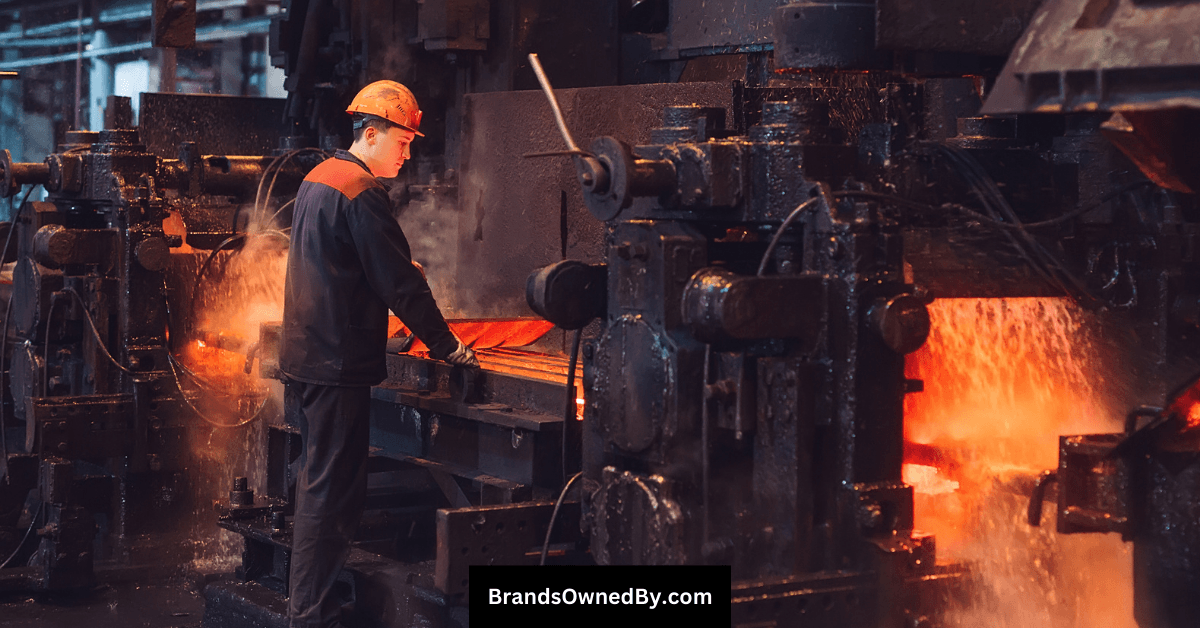

- Cleveland-Cliffs is a publicly traded company, meaning ownership is distributed among institutional investors, hedge funds, and retail shareholders rather than a single controlling owner.
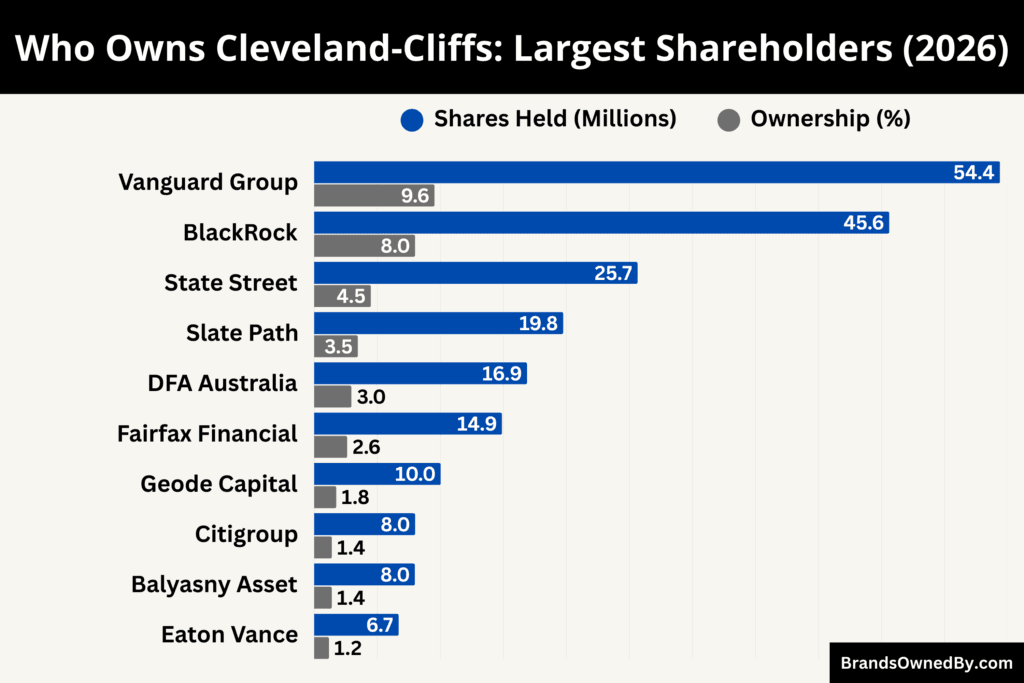
- The largest shareholders as of 2026 include The Vanguard Group (about 9.55%), BlackRock (about 8.01%), and State Street Corporation (about 4.50%), making institutional investors the dominant owners of the company.
- Other major shareholders include Slate Path Capital, Dimensional Fund Advisors, Fairfax Financial Holdings, and Geode Capital Management, each holding notable stakes that contribute to the company’s diversified ownership structure.
- Operational control is led by Chairman and CEO Lourenco Goncalves and the board of directors, while shareholders influence governance through voting rights rather than direct management control.
Cleveland-Cliffs Inc. is one of the largest steel producers in the United States. The company is headquartered in Cleveland, Ohio. It operates as a vertically integrated steel and mining company. This means it controls both iron ore mining and steel manufacturing.
The company produces flat-rolled steel used in automobiles, construction, infrastructure, appliances, and industrial equipment. Cleveland-Cliffs is a major supplier to the North American automotive industry. Many large car manufacturers rely on its advanced steel products.
Cleveland-Cliffs operates several iron ore mines in Minnesota and Michigan. These mines produce iron ore pellets that are used in steelmaking. The company also operates multiple steel mills and finishing facilities across the United States.
The company’s modern structure formed after two major acquisitions in 2020. Cleveland-Cliffs acquired AK Steel and the U.S. operations of ArcelorMittal. These deals transformed the company from a mining-focused business into a large integrated steel manufacturer.
As of 2026, Cleveland-Cliffs is one of the largest flat-rolled steel producers in North America. Its operations include iron ore mining, pellet production, blast furnace steelmaking, and finishing facilities that produce specialized steel products.
Founders of Cleveland-Cliffs
Cleveland-Cliffs traces its origins to the Cleveland Iron Mining Company, which was founded in 1847 to develop iron ore deposits in Michigan’s Upper Peninsula. The company later evolved into Cleveland-Cliffs Inc.
Samuel Livingston Mather
Samuel Livingston Mather was one of the key founders and early investors behind the Cleveland Iron Mining Company. He was a Cleveland-based businessman who recognized the value of iron ore resources near Lake Superior.
Mather helped finance and organize mining operations in the Marquette Iron Range. He also supported the development of shipping routes across the Great Lakes. These routes allowed iron ore to reach steel mills in major industrial cities such as Cleveland, Detroit, and Chicago.
His early investments helped establish the company as a major iron ore supplier in the United States.
William Gwinn Mather
William Gwinn Mather, the son of Samuel Livingston Mather, later became one of the most influential leaders in the company’s early history. He served as president and chairman during the late 19th and early 20th centuries.
Under his leadership, the company expanded its mining operations and improved transportation systems for moving iron ore across the Great Lakes. He also helped strengthen long-term relationships with American steel producers.
These efforts helped Cleveland-Cliffs become one of the most important iron ore mining companies in North America.
Ownership History
The ownership structure of Cleveland-Cliffs has changed significantly since the company was founded in the 19th century. It evolved from a privately controlled mining venture into a widely held public corporation. Over time, mergers, corporate restructuring, and stock market listings reshaped the company’s ownership base.
Early Private Ownership (1847–1890s)
Cleveland-Cliffs traces its origins to the Cleveland Iron Mining Company, which was founded in 1847 to develop iron ore deposits in Michigan’s Upper Peninsula. In its early decades, the company was privately owned by a group of investors and industrial entrepreneurs from Cleveland, Ohio.
One of the most influential figures behind the company’s early ownership was Samuel Livingston Mather. He and other investors financed the development of iron ore mines in the Marquette Iron Range. Ownership during this period was concentrated among a small group of private shareholders and mining investors.
The company focused on extracting iron ore and transporting it across the Great Lakes to steel producers in the Midwest. As demand for steel increased during the industrial expansion of the United States, the business grew rapidly.
Expansion Under the Mather Family (Late 1800s–Mid 1900s)
During the late 19th and early 20th centuries, the Mather family became closely associated with the leadership and ownership of the company. William Gwinn Mather, the son of Samuel Livingston Mather, played a key role in expanding Cleveland-Cliffs’ operations.
Under his leadership, the company developed additional mining properties across Michigan and Minnesota. It also strengthened its transportation network for shipping iron ore across the Great Lakes.
During this era, ownership remained relatively concentrated among a limited group of investors and industrial partners. The company built long-term supply relationships with major steel manufacturers across the United States.
These partnerships helped establish Cleveland-Cliffs as one of the most important iron ore suppliers to the American steel industry.
Transition to a Publicly Traded Company
As the company expanded, Cleveland-Cliffs gradually transitioned toward a more modern corporate structure. Shares became more widely distributed among investors through public markets.
Listing on the New York Stock Exchange allowed the company to raise capital for expansion and mining development. This shift marked a major change in ownership structure. Instead of being controlled by a small group of private investors, the company became owned by thousands of shareholders.
Public ownership allowed Cleveland-Cliffs to finance new mines, infrastructure projects, and technological improvements in iron ore processing.
Ownership Changes During Industry Consolidation (1980s–2010s)
The global steel industry experienced major restructuring during the late 20th and early 21st centuries. Cleveland-Cliffs also went through significant strategic changes during this time.
For decades, the company primarily focused on mining and supplying iron ore to steel producers. Its ownership remained widely distributed among public shareholders and institutional investors.
As institutional investing grew in the United States, asset managers such as Vanguard, BlackRock, and State Street gradually became major shareholders. These firms purchased shares through mutual funds, index funds, and pension portfolios.
By the early 2000s, institutional investors had become the dominant owners of Cleveland-Cliffs stock.
Transformation into a Steel Producer (2020–Present)
A major shift in Cleveland-Cliffs’ corporate structure occurred in 2020. Under CEO Lourenco Goncalves, the company expanded beyond iron ore mining and became a vertically integrated steel producer.
Two major acquisitions reshaped the company’s operations and strategic direction.
First, Cleveland-Cliffs acquired AK Steel in a transaction valued at about $3 billion. This acquisition gave the company direct access to steelmaking facilities and advanced steel production capabilities.
Later in the same year, Cleveland-Cliffs acquired the U.S. operations of ArcelorMittal. This deal added several major steel mills and finishing facilities across the country.
These acquisitions significantly increased the company’s scale and transformed it into one of the largest flat-rolled steel producers in North America.
Although the acquisitions expanded operations, the company’s ownership structure remained largely unchanged. Cleveland-Cliffs continued to operate as a publicly traded company with institutional investors holding the largest stakes.
Modern Ownership Structure
Today, Cleveland-Cliffs has a highly diversified shareholder base. Institutional investors dominate the ownership structure, holding a large portion of the company’s shares.
Major global asset managers such as The Vanguard Group, BlackRock, and State Street are among the largest shareholders. Hedge funds and investment firms also hold notable stakes.
Because no single shareholder owns a controlling stake, Cleveland-Cliffs operates with a dispersed ownership model. Strategic decisions are guided by the executive leadership team and board of directors, while shareholders influence corporate governance through voting rights and investment decisions.
Who Owns Cleveland-Cliffs: Major Shareholders
Cleveland-Cliffs Inc. is a publicly traded company listed on the New York Stock Exchange under the ticker symbol CLF. Because it is publicly listed, the company does not have a single owner. Instead, ownership is distributed among institutional investors, hedge funds, financial institutions, company insiders, and retail investors.
As of March 2026, institutional investors control a significant portion of Cleveland-Cliffs shares. The largest stakes are held by major global asset managers such as The Vanguard Group, BlackRock, and State Street Corporation. These firms manage trillions of dollars in investment funds and typically hold shares through ETFs, index funds, and pension portfolios.
The top three shareholders alone control more than one-fifth of Cleveland-Cliffs’ outstanding shares. However, none of them holds a controlling stake. This means corporate control is not concentrated in a single entity. Instead, governance decisions are influenced collectively by institutional investors and the company’s board of directors.
Below are the major Cleveland-Cliffs shareholders as of 2026.
The Vanguard Group
The Vanguard Group is the largest shareholder of Cleveland-Cliffs. The firm owns approximately 54.39 million shares of the company, representing about 9.55% of the total outstanding shares.
Vanguard is one of the world’s largest investment management companies. It manages a wide range of index funds, retirement funds, and exchange-traded funds. Many of these funds track major U.S. stock market indexes that include Cleveland-Cliffs.
Because of this structure, Vanguard typically holds large stakes in many publicly traded companies. Although the firm rarely intervenes in day-to-day operations, it has significant voting power during shareholder meetings and corporate governance decisions.
BlackRock Advisors LLC
BlackRock Advisors LLC is the second-largest shareholder of Cleveland-Cliffs. The firm holds about 45.61 million shares, which equals roughly 8.01% of the company.
BlackRock is the largest asset manager in the world. It oversees investment funds for governments, pension funds, institutions, and retail investors. Much of its ownership in Cleveland-Cliffs comes through the iShares ETF platform and other diversified equity funds.
Through its large holdings, BlackRock participates in shareholder voting and governance discussions involving company strategy, executive compensation, and board oversight.
State Street Corporation
State Street Corporation owns approximately 25.65 million shares of Cleveland-Cliffs. This represents around 4.50% of the company’s total shares.
State Street Global Advisors manages the well-known SPDR ETF family. Many of these ETFs track major market indexes, which means they automatically hold shares in large industrial companies such as Cleveland-Cliffs.
Along with Vanguard and BlackRock, State Street forms part of the “Big Three” asset managers that collectively hold substantial stakes in many publicly traded U.S. corporations.
Slate Path Capital LP
Slate Path Capital LP is one of the largest hedge fund investors in Cleveland-Cliffs. The firm owns about 19.75 million shares of the company, representing approximately 3.47% ownership.
Slate Path Capital is a New York-based investment firm that focuses on long-term equity investments. The firm often targets companies with strong industrial fundamentals and long-term growth potential.
Its investment in Cleveland-Cliffs reflects confidence in the company’s role as a key steel supplier to the North American manufacturing and automotive sectors.
DFA Australia Ltd. (Dimensional Fund Advisors Group)
DFA Australia Ltd., which is part of the Dimensional Fund Advisors group, holds approximately 16.88 million shares of Cleveland-Cliffs. This stake represents about 2.96% of the company.
Dimensional Fund Advisors is known for applying academic research and quantitative strategies to its investment process. The firm manages a wide range of diversified equity portfolios for institutional investors and pension funds.
Cleveland-Cliffs appears in several Dimensional portfolios focused on value-oriented and industrial sector stocks.
Fairfax Financial Holdings Ltd.
Fairfax Financial Holdings Ltd. owns around 14.90 million shares of Cleveland-Cliffs, representing about 2.62% of the company.
Fairfax is a Canadian investment and insurance conglomerate founded by billionaire investor Prem Watsa. The firm invests in companies across industries such as infrastructure, commodities, and industrial manufacturing.
Its investment in Cleveland-Cliffs aligns with Fairfax’s strategy of investing in businesses tied to global industrial production and infrastructure demand.
Geode Capital Management LLC
Geode Capital Management holds approximately 10.04 million shares of Cleveland-Cliffs. This represents about 1.76% of the company’s shares.
Geode primarily manages index-based investment strategies and institutional portfolios. Many of its holdings mirror broad stock market indexes. As a result, the firm owns shares in large U.S. industrial companies such as Cleveland-Cliffs through passive investment funds.
Citigroup Global Markets Inc.
Citigroup Global Markets Inc. owns roughly 8.01 million shares of Cleveland-Cliffs, equal to about 1.41% of the company.
This entity is part of Citigroup’s global financial services and brokerage operations. Shares are typically held on behalf of institutional clients, trading portfolios, and managed investment accounts.
Large financial institutions like Citigroup often appear as shareholders because they provide custody and brokerage services for institutional investors.
Balyasny Asset Management LP
Balyasny Asset Management LP holds approximately 7.99 million shares of Cleveland-Cliffs. This represents around 1.40% ownership.
Balyasny is a global multi-strategy hedge fund with investments across equities, commodities, and macroeconomic strategies. The firm actively invests in industrial and materials companies when it sees strong market opportunities.
Eaton Vance Management
Eaton Vance Management owns about 6.70 million shares of Cleveland-Cliffs, representing roughly 1.18% of the company.
Eaton Vance is a long-established investment management firm known for actively managed mutual funds and institutional portfolios. The firm often invests in companies with strong industrial exposure and long-term growth potential.
Insider Ownership
In addition to institutional investors, Cleveland-Cliffs executives and board members also hold shares in the company. CEO Lourenco Goncalves is one of the most prominent insider shareholders.
Insider ownership is smaller compared with institutional ownership. However, it still plays an important role in aligning management interests with long-term shareholder value.
Stock-based compensation and performance incentives encourage company leadership to focus on operational performance and sustained growth.
Overall, Cleveland-Cliffs has a widely distributed ownership structure. Large institutional investors dominate the shareholder base, but no single investor holds majority control. Corporate governance is therefore guided by the company’s leadership team and board of directors, while institutional shareholders influence decisions through voting rights and market participation.
Competitor Ownership Comparison
Cleveland-Cliffs competes with several major steel producers in North America and globally. While these companies operate in the same industry, their ownership structures differ significantly. Some competitors follow a widely distributed institutional ownership model, similar to Cleveland-Cliffs. Others have controlling family ownership or corporate parent ownership, which gives certain investors a stronger influence over the company’s strategy.
| Company | Ownership Type | Largest Shareholder | Ownership Stake | Key Ownership Details |
|---|---|---|---|---|
| Cleveland-Cliffs | Public company (widely held) | The Vanguard Group | 9.55% | Ownership is dominated by institutional investors such as Vanguard, BlackRock, and State Street. No single shareholder controls the company. |
| Nucor Corporation | Public company (widely held) | The Vanguard Group | ~12% | Institutional investors control most shares. Major holders include Vanguard, State Farm, BlackRock, and State Street. No controlling shareholder. |
| United States Steel Corporation | Corporate ownership | Nippon Steel Corporation | 100% | Acquired by Nippon Steel in 2025 for about $14.9 billion. Now operates as a wholly owned subsidiary. |
| ArcelorMittal | Family-influenced public company | Mittal Family | ~39.8% equity (~44% voting rights) | The Mittal family remains the controlling shareholder, giving them strong influence over company strategy and governance. |
| POSCO Holdings | Public company with institutional dominance | National Pension Service (South Korea) | ~7–8% | Ownership is widely distributed among institutional investors and pension funds. The South Korean National Pension Service is one of the largest shareholders. |
| Steel Dynamics | Public company (widely held) | The Vanguard Group | ~10% | Institutional investors dominate the shareholder base, including Vanguard, BlackRock, and State Street. No controlling owner. |
Nucor Corporation
Nucor Corporation is the largest steel producer in the United States and one of Cleveland-Cliffs’ main competitors in the North American steel market. Like Cleveland-Cliffs, Nucor is a publicly traded company with widely distributed ownership.
Institutional investors dominate Nucor’s shareholder base. The largest shareholder is The Vanguard Group, which owns roughly 12% of the company’s shares. Other major investors include State Farm Insurance Companies, BlackRock, and State Street Corporation.
Because ownership is spread among large asset managers and institutional funds, Nucor does not have a controlling shareholder. Instead, corporate decisions are guided by its executive leadership and board of directors, while major shareholders influence governance through proxy voting and shareholder meetings.
This ownership structure is very similar to Cleveland-Cliffs, where institutional investors also hold the majority of shares.
United States Steel Corporation
United States Steel Corporation has historically been one of Cleveland-Cliffs’ biggest domestic competitors. However, its ownership structure changed significantly in 2025.
In June 2025, Japanese steelmaker Nippon Steel completed a $14.9 billion acquisition of U.S. Steel. As a result, U.S. Steel became a wholly owned subsidiary of Nippon Steel North America.
Before this acquisition, U.S. Steel had a dispersed shareholder base similar to Cleveland-Cliffs, with institutional investors holding large stakes. After the deal closed, ownership became highly concentrated under Nippon Steel, giving the parent company direct control over corporate strategy and operations.
This makes U.S. Steel structurally different from Cleveland-Cliffs, which continues to operate as an independent public company.
ArcelorMittal
ArcelorMittal is one of the largest steel producers in the world and a major global competitor. Unlike Cleveland-Cliffs, ArcelorMittal has a concentrated ownership structure dominated by a founding family.
The company is primarily controlled by the Mittal family, led by Lakshmi Mittal. As of recent filings, the family owns approximately 39.8% of the company’s shares and controls more than 44% of voting rights.
This level of ownership gives the Mittal family significant influence over major decisions, including board appointments, strategic investments, and mergers or acquisitions. Institutional investors also hold shares in the company, but the founding family remains the dominant controlling shareholder.
This ownership model contrasts sharply with Cleveland-Cliffs’ widely distributed institutional ownership.
POSCO Holdings
POSCO Holdings, based in South Korea, is another global steel competitor. The company originally began as a government-owned steel enterprise before gradually transitioning to private ownership.
Today, POSCO operates as a publicly traded company with a diversified shareholder base. Major shareholders include institutional investors, pension funds, and global asset managers. South Korea’s National Pension Service is typically among the largest investors.
Although POSCO no longer has direct government ownership, the presence of large national pension funds still gives domestic institutional investors significant influence over the company.
Key Ownership Differences in the Steel Industry
The steel industry includes companies with several different ownership models:
- Cleveland-Cliffs follows a widely distributed public ownership structure, dominated by institutional investors such as Vanguard, BlackRock, and State Street.
- Nucor has a similar institutional ownership model, with large asset managers and insurance companies holding the largest stakes.
- U.S. Steel now operates under corporate parent ownership after its acquisition by Nippon Steel.
- ArcelorMittal operates under family-influenced ownership, with the Mittal family holding a large controlling stake.
These ownership differences influence how companies approach strategic decisions, capital investment, and global expansion. Cleveland-Cliffs remains part of the widely held public ownership model that is common among major American industrial companies.
Who Controls Cleveland-Cliffs?
Cleveland-Cliffs is a publicly traded company. Its shares are widely owned by institutional investors such as Vanguard, BlackRock, and State Street. No single shareholder holds a controlling stake. As a result, control of the company comes from its executive leadership and board of directors rather than from a dominant owner.
As of March 2026, operational and strategic control of Cleveland-Cliffs is concentrated around Chairman, President, and CEO Lourenco Goncalves, along with the company’s senior executive team and board.
Lourenco Goncalves – Chairman, President, and Chief Executive Officer
Lourenco Goncalves is the most influential figure at Cleveland-Cliffs. He serves simultaneously as Chairman of the Board, President, and Chief Executive Officer.
He became CEO in August 2014 after joining the company during a major downturn in the iron ore industry. At the time, Cleveland-Cliffs was mainly an iron ore mining company supplying raw materials to steel producers.
Goncalves completely reshaped the company’s strategy. Instead of remaining a mining supplier, he pushed Cleveland-Cliffs to become a vertically integrated steel producer.
Two acquisitions defined this transformation.
In March 2020, Cleveland-Cliffs acquired AK Steel for approximately $3 billion. AK Steel brought steelmaking operations, automotive steel contracts, and finishing facilities.
Later in December 2020, Cleveland-Cliffs acquired ArcelorMittal USA for about $1.4 billion. This deal added several integrated steel mills and finishing facilities across the United States.
After these acquisitions, Cleveland-Cliffs became the largest flat-rolled steel producer in North America. The company now controls iron ore mining, pellet production, blast furnace operations, and steel finishing facilities.
Goncalves is also known for taking an aggressive stance on trade enforcement and domestic steel manufacturing. He frequently advocates for protecting U.S. steel production from unfair imports and strengthening the domestic supply chain.
Because he serves as both CEO and Chairman, Goncalves holds significant influence over the company’s long-term strategy and major investment decisions.
Key Executive Leadership
Cleveland-Cliffs’ daily operations are managed by a group of senior executives responsible for finance, operations, and commercial activities.
Keith Koci: Keith Koci serves as Executive Vice President and Chief Financial Officer. He joined Cleveland-Cliffs in 2020 after previously serving as CFO at AK Steel. Koci oversees financial planning, capital allocation, debt management, and investor relations. His role became particularly important after the large acquisitions that significantly increased the company’s scale.
Cesar J. Gonzalez: Cesar Gonzalez serves as Executive Vice President and Chief Operating Officer. He oversees steel manufacturing operations across the company’s network of mills and production facilities. His responsibilities include production efficiency, plant operations, and manufacturing performance.
James D. Graham: James Graham serves as Executive Vice President, Chief Legal Officer, and Secretary. He manages legal affairs, regulatory compliance, government relations, and corporate governance matters.
Edward J. Gonzalez: Edward Gonzalez serves as Executive Vice President of Commercial Operations. He oversees customer relationships, sales strategy, and supply agreements with major industrial buyers. Cleveland-Cliffs supplies steel to major automotive manufacturers, making this role critical to the company’s revenue strategy.
Together, these executives manage Cleveland-Cliffs’ network of iron ore mines, pellet plants, steel mills, and finishing facilities located across several U.S. states.
Cleveland-Cliffs Board of Directors
The board of directors oversees corporate governance and represents shareholder interests. Directors review company strategy, approve major investments, and monitor management performance.
As of 2026, key members of the Cleveland-Cliffs board include:
- Lourenco Goncalves – Chairman of the Board and CEO.
- Susan M. Green – Independent director with extensive experience in corporate governance and business strategy.
- Jane M. Cronin – Independent director with financial and operational expertise.
- David H. Gunning – Former steel industry executive with decades of leadership experience in global steel manufacturing.
- John T. Baldwin – Director with experience in industrial manufacturing and corporate leadership.
The board works closely with the executive team to review major strategic decisions such as acquisitions, capital investments, and corporate governance policies.
Governance Structure
Because Cleveland-Cliffs has dispersed ownership, corporate control follows a standard governance structure used by most large public companies in the United States.
The CEO and executive leadership team manage operations and strategic planning. The board of directors provides oversight and approves major corporate decisions.
Institutional shareholders influence governance through proxy voting during shareholder meetings. However, they do not directly manage the company’s operations.
This structure allows Cleveland-Cliffs to operate independently while remaining accountable to its investors.
Cleveland-Cliffs Annual Revenue and Net Worth
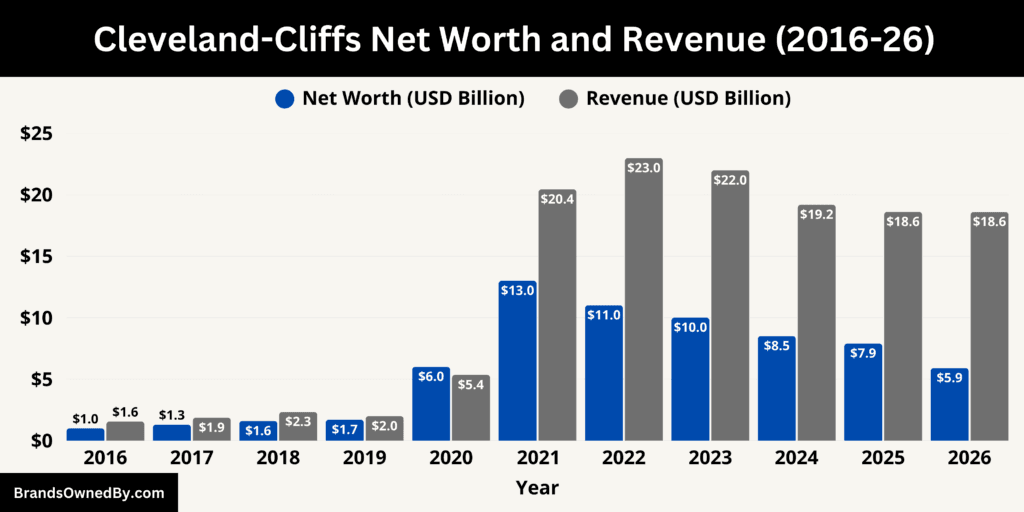
Cleveland-Cliffs has grown into one of the largest steel producers in North America. As of March 2026, the company generates approximately $18.6 billion in annual revenue and has an estimated market capitalization (net worth) of about $5.9 billion, depending on stock price fluctuations.
The company’s revenue primarily comes from steel production and sales, particularly flat-rolled steel supplied to automotive manufacturers, infrastructure projects, and industrial customers. Its market value reflects investor expectations about steel demand, production volumes, and the overall performance of the North American manufacturing sector.
Cleveland-Cliffs Revenue in 2026
The most recent financial results show that Cleveland-Cliffs generated $18.6 billion in consolidated revenue for 2025, which forms the baseline for its 2026 financial performance.
Quarterly data indicates that the company produced $4.3 billion in revenue during the fourth quarter of 2025, with similar levels expected to continue through 2026 depending on steel demand and production volumes.
A large portion of Cleveland-Cliffs’ revenue comes from its steelmaking segment. The company shipped approximately 16.2 million net tons of steel products in 2025, serving markets such as automotive manufacturing, construction, infrastructure, and heavy industry.
The automotive sector remains one of the company’s largest revenue sources. Cleveland-Cliffs supplies high-strength steel and specialty steel products used in vehicle manufacturing across North America. Other revenue streams include sales to distributors, converters, energy companies, and industrial equipment manufacturers.
Revenue Breakdown by Business Segments
Cleveland-Cliffs operates as a vertically integrated steel producer. Most of its revenue comes from the production and sale of flat-rolled steel products, while smaller portions come from iron ore mining and other steel-related products. The company generated $18.6 billion in total revenue in 2025, which serves as the baseline financial performance entering 2026.
The revenue structure is heavily tied to steel product shipments. In 2025, Cleveland-Cliffs shipped 16.2 million net tons of steel products, supplying major industries such as automotive manufacturing, infrastructure, energy, and heavy industrial production.
Steel Products Segment
Steel production represents the largest portion of Cleveland-Cliffs’ revenue. The company sells several types of flat-rolled steel products used in vehicles, appliances, infrastructure, and industrial equipment.
Based on shipment data for 2025, the company’s steel product mix consisted of:
- Hot-rolled steel: about 40% of total steel shipments
- Coated steel: about 28% of shipments
- Cold-rolled steel: about 15% of shipments
- Plate steel: about 5% of shipments
- Stainless and electrical steel: about 3% of shipments
- Other steel products including slabs: about 9% of shipments.
Hot-rolled steel is the company’s largest product category. It is widely used in automotive frames, construction equipment, and pipelines. Coated steel and cold-rolled steel are particularly important for automotive manufacturing, where corrosion resistance and precision shaping are critical.
Revenue by Customer Market
Cleveland-Cliffs generates revenue from several major industrial sectors that purchase its steel products.
Financial reporting from 2025 shows the following distribution of steel sales across end markets:
- Automotive industry: approximately 30% of revenue
- Infrastructure and manufacturing sectors: about 29% of revenue
- Distributors and steel converters: roughly 28% of revenue
- Other steel producers and miscellaneous markets: about 13% of revenue.
The automotive industry remains the company’s largest single customer base. Cleveland-Cliffs supplies specialized high-strength steel and electrical steel used in vehicle bodies, engines, and electric vehicle components.
Infrastructure and manufacturing customers include construction companies, equipment manufacturers, and industrial machinery producers. Steel distributors and converters purchase large volumes of steel for further processing before selling to smaller manufacturers.
Iron Ore and Raw Materials
Cleveland-Cliffs also generates revenue from iron ore mining and pellet production. The company operates iron ore mines in Minnesota and Michigan that supply pellets used in blast furnace steelmaking.
Unlike many steel companies that purchase raw materials from external suppliers, Cleveland-Cliffs produces much of its own iron ore. This vertical integration helps stabilize production costs and ensures supply security.
Although iron ore operations contribute a smaller portion of revenue compared with steel manufacturing, they play a crucial role in supporting the company’s steel production network.
Cleveland-Cliffs Net Worth in 2026
The net worth of Cleveland-Cliffs is typically measured using its market capitalization, which reflects the total market value of its outstanding shares.
As of March 2026, Cleveland-Cliffs has a market capitalization of approximately $5.9 billion, depending on the company’s stock price at a given time.
The company’s balance sheet also shows significant industrial assets. Cleveland-Cliffs holds about $20 billion in total assets, including steel mills, iron ore mines, processing plants, transportation infrastructure, and manufacturing equipment.
These assets support the company’s large-scale production network, which includes multiple integrated steel mills and mining operations across the United States.
However, net worth fluctuates significantly with steel prices, manufacturing demand, and macroeconomic conditions. Because the steel industry is cyclical, market value can change quickly depending on economic growth, construction activity, and automotive production levels.
Future Revenue Forecast (2026–2030)
Cleveland-Cliffs’ revenue outlook is closely tied to steel demand, automotive production levels, infrastructure spending, and global commodity prices. The company expects moderate growth over the next several years as U.S. manufacturing activity stabilizes.
Key projections for the period through 2030 include:
- 2026: Steel shipments expected to reach 16.5–17 million tons, up about 3% from 2025 levels, which could support revenue close to $19–$20 billion depending on steel prices.
- 2027: Continued recovery in automotive production and infrastructure investment could push shipments above 17 million tons, supporting revenue around $20–$21 billion.
- 2028: Expansion of domestic manufacturing and energy infrastructure projects may increase steel demand, potentially driving revenue toward $21–$22 billion.
- 2029: Efficiency improvements and capacity optimization across steel mills could stabilize margins and maintain revenue near $22 billion.
- 2030: Long-term revenue could reach $23–$24 billion if North American steel demand continues to grow alongside industrial and infrastructure development.
Industry forecasts suggest steel demand in North America will remain relatively stable through 2030, with moderate fluctuations depending on construction activity and manufacturing output.
For Cleveland-Cliffs, maintaining strong automotive contracts and increasing infrastructure demand will likely be the most important factors supporting long-term revenue growth.
Companies Owned by Cleveland-Cliffs
Cleveland-Cliffs owns and operates several steel companies, subsidiaries, and specialty steel businesses across the United States. Many of these entities became part of the company after major acquisitions completed in 2020 and subsequent corporate restructuring. These businesses allow Cleveland-Cliffs to operate as a vertically integrated steel producer, controlling iron ore mining, steelmaking, and specialized steel manufacturing.
Below are the major companies, brands, and entities owned or operated by Cleveland-Cliffs as of 2026:
| Company / Entity | Type of Business | Year Acquired / Established | Key Activities | Strategic Role |
|---|---|---|---|---|
| AK Steel Holding Corporation | Specialty steel manufacturing company | 2020 (acquired) | Produces flat-rolled carbon steel, stainless steel, and electrical steel used in automotive and industrial applications | Provides advanced high-strength steel and electrical steel for automotive, energy, and appliance industries |
| ArcelorMittal USA | Integrated steel manufacturing company | 2020 (acquired) | Operates large integrated steel mills producing hot-rolled, cold-rolled, and coated steel | Significantly expanded Cleveland-Cliffs’ steel production capacity and market share in North America |
| AK Coal Resources | Metallurgical coal mining subsidiary | 2020 (acquired with AK Steel) | Mines metallurgical coal used in blast furnace steelmaking | Supplies key raw material used for coke production in steel manufacturing |
| AK Tube LLC | Steel tubing manufacturing company | Acquired through AK Steel (2020) | Produces welded steel tubing used in automotive frames, construction, and industrial machinery | Expands Cleveland-Cliffs’ product portfolio beyond flat-rolled steel |
| Tilden Mining Company | Iron ore mining company | Long-standing Cliffs mining subsidiary | Operates the Tilden iron ore mine in Michigan producing iron ore concentrate and pellets | Provides raw material for Cleveland-Cliffs’ steelmaking operations |
| Empire Iron Mining Partnership | Iron ore mining entity | Legacy Cliffs mining operation | Historically operated the Empire Mine in Michigan before closure in 2016 | Represents historical mining assets within the company’s iron ore portfolio |
| United Taconite LLC | Iron ore mining and pellet production company | Acquired in 2003 | Produces iron ore pellets used in blast furnace steel production | Major supplier of iron ore pellets to Cleveland-Cliffs steel facilities |
| Northshore Mining Company | Iron ore mining and processing company | Acquired in 1994 | Mines iron ore and produces pellets at facilities in Minnesota | Supplies raw materials for steel production and supports vertical integration |
| Cliffs Mining Company | Iron ore mining management entity | Legacy mining division | Oversees mining operations, extraction processes, and logistics | Manages Cleveland-Cliffs’ mining assets and ore supply chain |
| Cleveland-Cliffs Steel LLC | Steel production operating entity | Formed after 2020 acquisitions | Operates steel mills, finishing lines, and flat-rolled steel production facilities | Core steel manufacturing arm of Cleveland-Cliffs |
AK Steel Holding Corporation
AK Steel Holding Corporation is one of the most significant companies owned by Cleveland-Cliffs. Cleveland-Cliffs acquired AK Steel in March 2020 in a transaction valued at about $3 billion.
AK Steel was originally founded in 1899 and grew into one of the most important specialty steel manufacturers in the United States. The company specialized in flat-rolled carbon steel, stainless steel, and electrical steel products.
After the acquisition, AK Steel became a wholly owned subsidiary of Cleveland-Cliffs. Its operations were integrated into Cleveland-Cliffs’ steelmaking network, but the AK Steel brand remains widely recognized in the steel industry.
AK Steel’s business includes the production of advanced high-strength steel used in automotive manufacturing. Many major automakers in North America rely on these steel products for vehicle frames and structural components.
The company also produces electrical steel used in electric motors, transformers, and electric vehicle power systems.
ArcelorMittal USA
ArcelorMittal USA is another major steel business owned by Cleveland-Cliffs. The company acquired these U.S. operations from global steel giant ArcelorMittal in December 2020 for about $1.4 billion.
The acquisition included several integrated steel mills and finishing facilities located across the United States. These operations significantly increased Cleveland-Cliffs’ steel production capacity.
ArcelorMittal USA historically supplied steel to industries such as automotive manufacturing, construction, energy, and heavy equipment manufacturing. After the acquisition, these facilities became part of Cleveland-Cliffs’ core steel production network.
This acquisition was one of the most transformative deals in Cleveland-Cliffs’ history because it expanded the company from a mining-focused business into a major steel manufacturer.
AK Coal Resources
AK Coal Resources is a coal mining subsidiary that came with the acquisition of AK Steel. The company operates metallurgical coal mines used to supply raw materials for steel production.
Metallurgical coal is an essential input in blast furnace steelmaking because it is used to produce coke, which acts as both a fuel and reducing agent in the steelmaking process.
By owning AK Coal Resources, Cleveland-Cliffs gained better control over another critical raw material in its steel production supply chain.
AK Tube LLC
AK Tube LLC is a manufacturing subsidiary originally developed under AK Steel. The company produces welded steel tubing used in automotive, construction, and industrial equipment manufacturing.
Steel tubes produced by AK Tube are used in vehicle frames, structural supports, mechanical components, and industrial machinery.
After Cleveland-Cliffs acquired AK Steel, AK Tube became part of the company’s broader steel product portfolio. It continues to serve major industrial and automotive customers across North America.
Tilden Mining Company
Tilden Mining Company is one of the key iron ore mining subsidiaries owned by Cleveland-Cliffs. The company operates the Tilden Mine in Michigan’s Upper Peninsula.
The Tilden Mine produces iron ore concentrate that is processed into pellets used in steelmaking. These pellets are supplied to Cleveland-Cliffs’ blast furnace operations.
Tilden Mining Company plays an important role in the company’s vertically integrated supply chain by providing a stable source of iron ore for steel production.
Empire Iron Mining Partnership
Empire Iron Mining Partnership is another mining entity associated with Cleveland-Cliffs’ iron ore operations. The partnership historically operated the Empire Mine in Michigan.
Although the mine ceased operations in 2016 due to market conditions, the entity remains part of Cleveland-Cliffs’ corporate structure and represents part of its legacy mining business.
The Empire Mine was once one of the largest iron ore mines in the United States and played an important role in supplying iron ore to the American steel industry.
United Taconite LLC
United Taconite LLC is a mining company owned by Cleveland-Cliffs that operates iron ore mining and processing facilities in Minnesota.
The company produces iron ore pellets used in blast furnace steelmaking. These pellets are shipped to steel mills across the Great Lakes region.
United Taconite is one of the largest iron ore mining operations in Minnesota and plays a critical role in supplying raw materials for Cleveland-Cliffs’ steel production network.
Northshore Mining Company
Northshore Mining Company is another important mining subsidiary owned by Cleveland-Cliffs. The company operates mining and pelletizing facilities in Minnesota.
Northshore Mining produces iron ore pellets used in steel manufacturing. These pellets are transported to steel mills via rail and shipping networks across the Great Lakes.
This mining operation supports Cleveland-Cliffs’ integrated steel production system by supplying high-quality iron ore pellets.
Cliffs Mining Company
Cliffs Mining Company is part of Cleveland-Cliffs’ broader mining division and manages several iron ore mining assets.
The company oversees operations related to iron ore extraction, processing, and logistics. These activities are essential for maintaining Cleveland-Cliffs’ vertically integrated business model.
The mining division provides the raw materials needed for steel production, allowing Cleveland-Cliffs to control costs and maintain supply stability.
Cleveland-Cliffs Steel LLC
Cleveland-Cliffs Steel LLC is a core operating entity within the company that manages many of the steel production facilities acquired through AK Steel and ArcelorMittal USA.
This entity oversees blast furnace operations, steel finishing facilities, and flat-rolled steel production lines across the United States.
Through Cleveland-Cliffs Steel LLC, the company produces hot-rolled steel, cold-rolled steel, coated steel, and specialty steel products supplied to major industrial customers.
This entity represents the central steel manufacturing arm of Cleveland-Cliffs.
Conclusion
Cleveland-Cliffs operates as a publicly traded company with a widely distributed shareholder base. Major institutional investors such as Vanguard, BlackRock, and State Street hold the largest stakes, while other investment firms and retail investors also own shares. Because ownership is spread across many shareholders, no single entity has controlling ownership.
The company’s strategic direction is guided by CEO Lourenco Goncalves and the board of directors, who oversee operations, acquisitions, and long-term planning. Cleveland-Cliffs has grown into a major steel producer through vertical integration and expansion in the North American steel market. Its ownership structure reflects the typical governance model of large publicly listed industrial companies.
FAQs
Who is the owner of Cleveland-Cliffs?
Cleveland-Cliffs does not have a single owner. It is a publicly traded company listed on the New York Stock Exchange under the ticker symbol CLF. Ownership is divided among institutional investors, hedge funds, and individual shareholders. The largest shareholders include The Vanguard Group, BlackRock, and State Street Corporation.
Who owns Cleveland-Cliffs Inc. now?
As of 2026, Cleveland-Cliffs Inc. is owned by a combination of institutional investors and public shareholders. Major investors include The Vanguard Group, BlackRock Advisors, State Street Corporation, Slate Path Capital, and Dimensional Fund Advisors. Because its shares are publicly traded, thousands of investors collectively own the company.
Who owns most of Cleveland-Cliffs stock?
The largest shareholder of Cleveland-Cliffs is The Vanguard Group, which holds about 9.55% of the company’s outstanding shares. Other major shareholders include BlackRock with roughly 8% ownership and State Street Corporation with about 4.5%. These large asset managers hold shares mainly through mutual funds and exchange-traded funds.
Who owns ArcelorMittal now?
ArcelorMittal is primarily owned by the Mittal family. The family, led by Lakshmi Mittal, holds the largest stake in the company and controls a significant portion of voting rights through their investment holding companies. Although ArcelorMittal is publicly traded, the Mittal family remains its dominant shareholder.
Is Lourenco Goncalves a US citizen?
Yes, Lourenco Goncalves is a U.S. citizen. He was born in Brazil but later became a naturalized American citizen. Goncalves has served as the Chairman, President, and CEO of Cleveland-Cliffs since 2014 and has played a major role in transforming the company into a vertically integrated steel producer.