

- The New York Post is wholly owned by News Corp, a global media conglomerate controlled by the Murdoch Family Trust, giving the Murdoch family effective voting control and strategic oversight.
- News Corp acquired the New York Post in 1976, briefly divested it in 1988, and reacquired it in 1993, securing full ownership at an estimated price of $30 million.
- The ownership structure places the Post as a subsidiary of News Corp, meaning its operations and financial decisions are overseen by the parent company, while maintaining editorial and commercial independence under its own leadership team.
- The Murdoch family, through News Corp dual-class shares, holds significant voting power (approximately 39%), ensuring they can influence major corporate and operational decisions across the Post and other News Corp media assets.
The New York Post is one of the longest-published newspapers in the United States. It began as a political paper and transformed into a major tabloid with global recognition. Its evolution reflects more than two centuries of media history. The paper is widely known for its tabloid format, bold headlines, and opinion-driven coverage.
Originally launched as a political newspaper, the publication evolved with changing reader habits and media trends. Today, it operates as both a print and digital news platform. While it is rooted in New York City, its readership extends nationally and internationally through online distribution.
New York Post Founders
The New York Post was founded in 1801 by Alexander Hamilton, one of the most influential figures in early American history. Hamilton was a Founding Father of the United States, the first U.S. Secretary of the Treasury, and a leading advocate of a strong federal government.
He established the newspaper under the original name New-York Evening Post. The publication was created to support Federalist political ideals and to serve as a platform for policy debate during a period when newspapers were closely tied to political movements. Hamilton viewed the press as a critical tool for shaping public opinion and defending the Constitution.
The paper was launched with financial backing from a group of Federalist supporters and merchants who shared Hamilton’s vision. Although Hamilton did not manage day-to-day operations for long, his influence defined the paper’s early editorial mission.
His assassination in 1804 ended his direct involvement, but the newspaper continued to operate and expand, making it one of the few media institutions directly founded by a U.S. Founding Father.
Major Milestones
- 1801: Founded by Alexander Hamilton as the New-York Evening Post. The paper launched as a Federalist publication aimed at influencing political debate in the early United States.
- 1804: Alexander Hamilton’s death ended his direct involvement, but the newspaper continued operating under his original editorial principles.
- 1829: William Cullen Bryant became editor, ushering in a long period of stability and intellectual influence.
- 1830s–1840s: The paper gained prominence for its opposition to slavery and its role in shaping reformist political thought.
- 1865: The Post emerged as a significant voice during the Civil War and Reconstruction eras, expanding its national political relevance.
- 1878: Ownership transitioned following Bryant’s death, reflecting broader shifts in the American newspaper industry.
- Early 1900s: The newspaper began moving away from elite political commentary toward broader news coverage aimed at mass audiences.
- 1910s–1920s: The Post adapted to modern newspaper practices, including more frequent editions and expanded city reporting.
- 1934: Officially rebranded as the New York Post, solidifying its modern identity.
- 1940s: Increased focus on crime, human-interest stories, and visual storytelling during and after World War II.
- 1958: Purchased by J. David Stern, who accelerated the shift toward tabloid journalism.
- 1960s: Introduced bold layouts and expanded gossip coverage, setting the stage for its modern tabloid style.
- 1976: Acquired by Rupert Murdoch, marking a dramatic transformation in tone, headlines, and competitive positioning.
- 1977: Converted fully to a tabloid format, differentiating it from traditional New York newspapers.
- 1988: Murdoch was forced to sell the paper due to U.S. media ownership regulations.
- 1989: The paper temporarily ceased print operations amid ownership and financial instability.
- 1993: Rupert Murdoch regained control, stabilizing the publication and securing its long-term survival.
- 1996: Integrated more closely with Murdoch’s broader U.S. media strategy following the formation of News Corp’s modern structure.
- 2000s: Expanded digital publishing and online readership, reaching audiences beyond New York City.
- 2010s: Strengthened its presence on social media and mobile platforms, adapting to changing news consumption habits.
- 2020: Increased national visibility through aggressive digital distribution and viral headline strategies.
- 2023: Continued digital-first expansion while maintaining print circulation in key metropolitan markets.
- 2025: Operates as a flagship tabloid brand within News Corp, balancing traditional print publishing with a growing digital and regional footprint.
Who Owns New York Post?
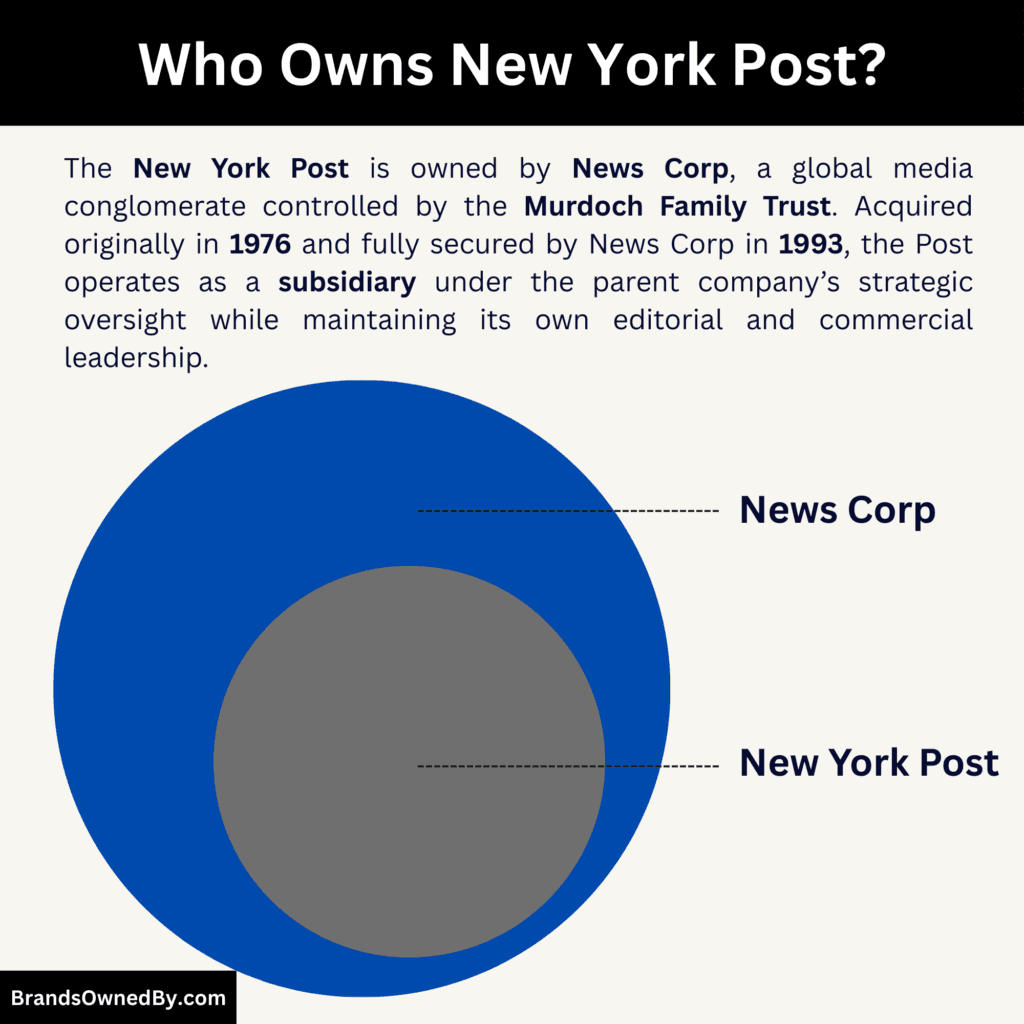
The New York Post is owned by News Corp, a global media and information services company. News Corp acquired full control of the paper through Rupert Murdoch’s media holdings.
News Corp is a publicly traded company. However, control is not evenly distributed among shareholders. The Murdoch family retains effective control through a dual-class share structure.
As of December 2025, the largest and controlling shareholder of News Corp is the Murdoch Family Trust. This trust holds significant voting power, even though it does not own a majority of total shares.
- Company name: New York Post
- Founded: 1801
- Original founder: Alexander Hamilton
- Current owner: News Corp
- Ownership type: Wholly owned subsidiary
- Parent company ownership stake: 100% owned by News Corp
- Controlling entity: Murdoch Family Trust
- Voting control at parent level: Approximately 39% of News Corp voting power
- Economic ownership by controlling trust: Roughly 14% to 15% of total News Corp shares
- Ownership structure: Dual-class share system at News Corp level
- First acquisition by Rupert Murdoch: 1976
- Initial acquisition price: Approximately $30 million
- Forced divestment: 1988 due to U.S. media ownership regulations
- Temporary owner after divestment: Peter S. Kalikow
- Reacquisition by Murdoch: 1993
- Reacquisition price: Approximately $30 million
- Current ownership status: Stable with no announced sale or spin-off plans as of 2025.
Parent Company: News Corp
News Corp is a publicly traded global media company listed on the NASDAQ. It was formed in 2013 after the former News Corporation split into two separate companies, one focused on entertainment assets and the other on publishing and news media.
Within News Corp, the New York Post sits under the News Media segment. This segment includes newspapers, digital news platforms, and related publishing operations. News Corp owns 100% of the New York Post, giving it full economic and legal ownership.
Although News Corp is publicly traded, it does not operate under a one-share-one-vote system. Instead, it uses a dual-class share structure that concentrates voting power in a small group of shareholders, regardless of overall economic ownership.
Murdoch Family Trust Ownership and Control
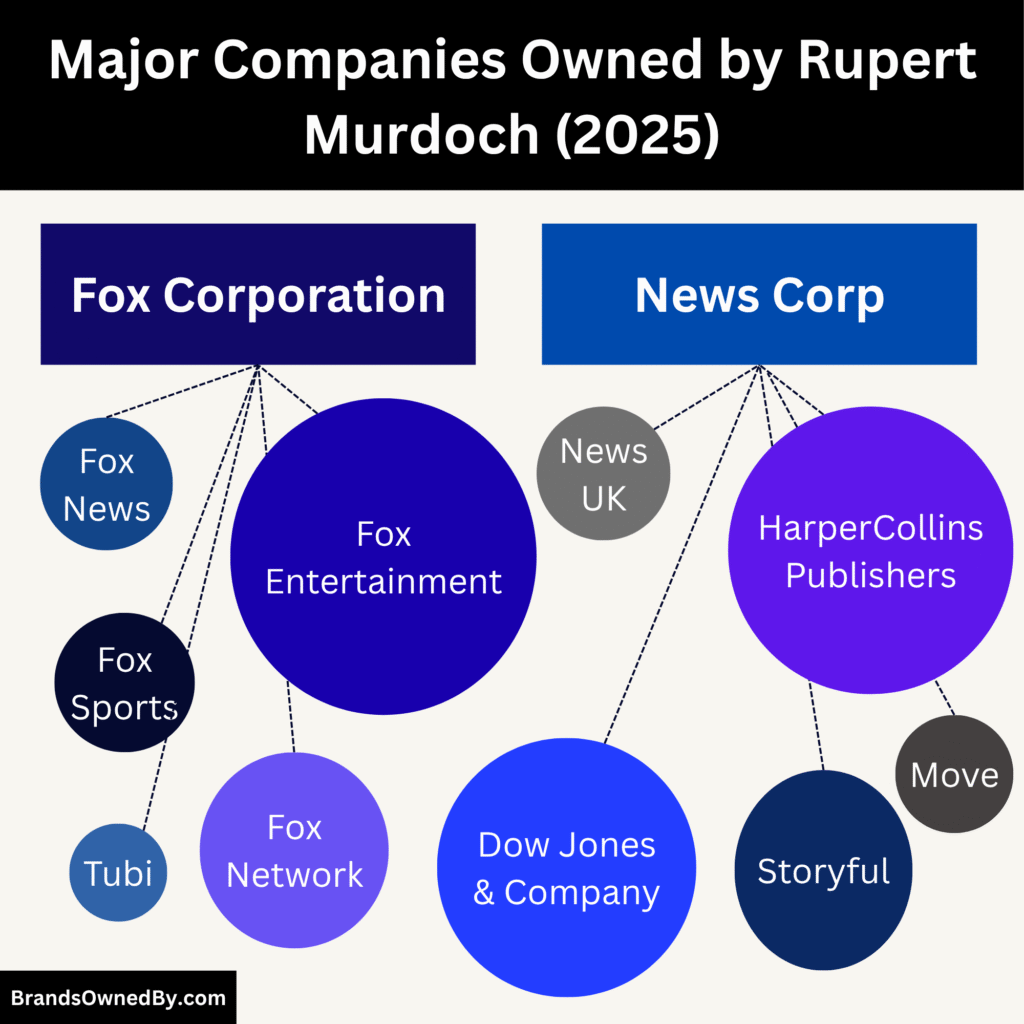
The Murdoch Family Trust is the single most important ownership entity connected to the New York Post. As of 2025, the trust controls approximately 39% of News Corp’s total voting power through its holdings of Class B shares.
In terms of economic ownership, the trust holds roughly 14% to 15% of News Corp’s total outstanding shares. Despite this lower economic stake, the enhanced voting rights attached to Class B shares allow the trust to exert effective control over the company.
This voting dominance enables the Murdoch Family Trust to appoint board members, approve executive leadership, and influence major corporate decisions. As a result, the New York Post remains firmly under Murdoch family control, even though most of News Corp’s shares are owned by outside investors.
Institutional and Public Shareholder Ownership
Institutional investors collectively own the largest portion of News Corp’s economic value. As of 2025, institutional shareholders account for approximately 55% to 60% of total outstanding shares. These include asset managers, index funds, and long-term investment firms.
However, these shares are primarily Class A shares, which carry limited voting rights. This means institutional investors have financial exposure but very limited influence over governance or editorial strategy.
Public and retail investors hold an estimated 25% to 30% of News Corp’s shares. Like institutional investors, their ownership is economic rather than controlling. Neither group has any direct role in decisions affecting the New York Post.
Rupert Murdoch’s Initial Acquisition in 1976
Rupert Murdoch first acquired the New York Post in 1976 for approximately $30 million. At the time, the newspaper was struggling to compete against larger New York dailies and lacked a clear market identity.
Murdoch viewed the Post as an opportunity to introduce a British-style tabloid model to the U.S. market. After the acquisition, the paper underwent major changes in layout, tone, and editorial approach. Headlines became more aggressive, visual presentation was emphasized, and the newspaper targeted a broader, mass-market readership.
This acquisition fundamentally reshaped the New York Post and laid the foundation for its modern identity.
Forced Sale and Ownership Disruption in 1988
In 1988, Murdoch was required to divest the New York Post due to U.S. media ownership regulations that restricted cross-ownership between newspapers and broadcast stations in the same market.
The paper was sold to real estate developer Peter S. Kalikow for approximately $37.6 million. Under Kalikow’s ownership, the New York Post struggled financially and operationally. Advertising declined, costs rose, and the paper faced increasing competition.
Bankruptcy and Operational Crisis
Between 1989 and 1992, the New York Post entered a period of severe instability. The newspaper filed for bankruptcy protection and briefly stopped publishing print editions. Multiple rescue efforts were attempted, including temporary government waivers that allowed Murdoch to operate the paper during negotiations.
This period underscored the difficulty of sustaining the newspaper without a strong corporate parent and long-term strategic backing.
Murdoch Reacquisition in 1993
In 1993, Rupert Murdoch reacquired the New York Post after regulatory conditions were eased.
The reacquisition price was approximately $30 million, and ownership was restored through Murdoch-controlled entities that later became part of News Corp. This transaction permanently returned the paper to Murdoch control and stabilized its operations.
Since that reacquisition, the New York Post has not changed owners and has remained continuously held within Murdoch’s media structure.
Who is the CEO of the New York Post?
Sean Giancola is the current CEO and Publisher of the New York Post as of December 2025. He leads the newspaper’s operational, commercial, and strategic efforts. His appointment in 2019 marked a shift toward revenue growth and digital expansion. Giancola reports to News Corp leadership and works closely with editorial and business executives to navigate the evolving media landscape.
CEO and Publisher of the New York Post
The New York Post has its own CEO distinct from the parent company’s CEO. As of 2025, the Publisher and Chief Executive Officer of the New York Post is Sean Giancola. He runs the day‑to‑day operations of the newspaper and oversees its strategic direction, editorial coordination with leadership, and commercial performance.
Giancola’s title is CEO and Publisher, reflecting responsibility for both business operations and overall leadership of the brand. This differs from the Chief Executive Officer of the parent company (News Corp), whose role is broader and spans multiple media assets.
Appointment and Leadership Context
Sean Giancola was appointed CEO and Publisher of the New York Post in January 2019, succeeding long‑time publisher and CEO Jesse Angelo. Before his appointment, Giancola served as the Post’s Chief Revenue Officer. The transition was part of News Corp’s leadership strategy to emphasize revenue growth and digital expansion for the paper.
Giancola brought extensive experience in advertising and publishing to the role, having previously worked in revenue leadership at AOL Travel and AOL Advertising, as well as digital and print media. His background positioned him to focus on both audience growth and monetization amid shifting consumer habits.
Under his leadership, operational priorities include strengthening digital audience engagement, diversifying advertising streams, and integrating the newspaper’s print and digital products into a cohesive strategic business model.
Executive Responsibilities
As CEO of the New York Post, Sean Giancola’s responsibilities include:
- Overseeing all commercial activities, including advertising sales and revenue strategy
- Coordinating with editorial leadership on content strategy and newsroom priorities
- Managing business operations for print, digital, and ancillary products
- Liaising with News Corp leadership on corporate planning and resource allocation
- Driving regional expansion and audience diversification initiatives.
This role requires balancing the newspaper’s historic brand identity with its digital growth objectives. Giancola works regularly with senior editors, digital product teams, and corporate stakeholders to align the Post’s operational execution with broader market trends.
Relationship to Parent Company Leadership
While Giancola is the CEO of the Post itself, the parent company News Corp has its own CEO at the corporate level. As of 2025, Robert Thomson is the CEO of News Corp, overseeing all News Corp media assets and guiding high‑level strategy.
Thomson’s role includes decisions that indirectly affect the Post, such as capital allocation, major technology partnerships, and global strategic initiatives. However, the daily operational control of the newspaper resides with Giancola.
New York Post Annual Revenue and Net Worth
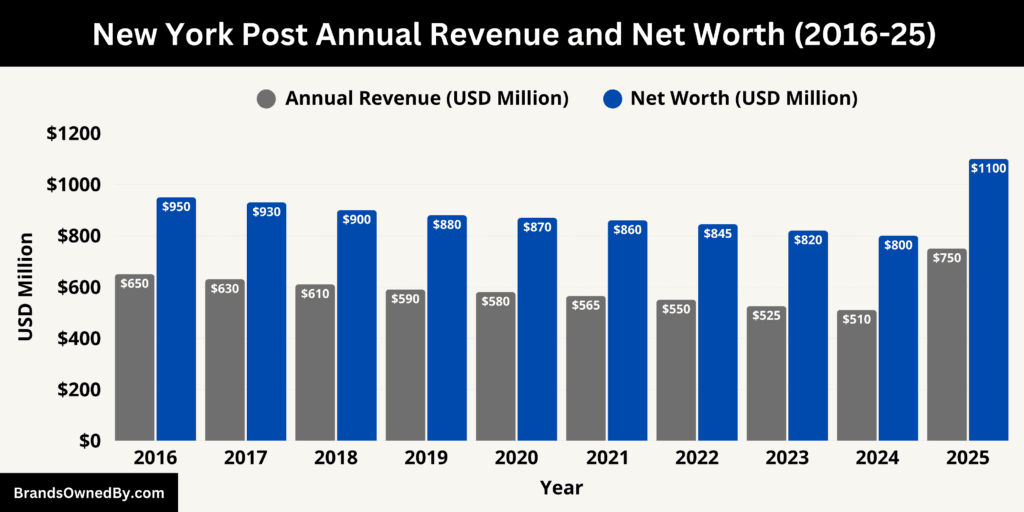
As of December 2025, the New York Post is estimated to generate annual revenue of $750 million and has an estimated net worth of $1.1 billion.
These figures reflect the newspaper’s performance as a major metropolitan publication with both print and digital revenue streams. The revenue encompasses print circulation, subscription sales, advertising—both traditional and digital—and ancillary digital services.
Revenue Composition
The New York Post’s revenue in 2025 is diversified across multiple streams:
- Print Circulation and Subscriptions: Print circulation continues to contribute substantially to overall revenue. With weekday circulation in the range of 499,000 copies and Sunday circulation exceeding 550,000, subscription and single-copy sales generate a reliable revenue base. Home delivery subscriptions, bundled digital access, and premium subscription packages have allowed the Post to maintain revenue even as print readership declines.
- Advertising Revenue: Advertising remains the largest single revenue contributor. While traditional print advertising has contracted, the Post has expanded its digital advertising portfolio, including programmatic ads, native sponsored content, and targeted online campaigns. Industry estimates suggest that digital advertising now accounts for roughly 40% of total advertising revenue, up from around 25% five years ago, reflecting the newspaper’s investment in audience analytics and online engagement platforms.
- Digital Products and Ancillary Services: The Post has leveraged its website, mobile app, and social media presence to generate subscription-based revenue and partnerships. Digital subscriptions have grown by over 15% year-over-year, contributing an estimated $80–$100 million to the total annual revenue. Ancillary services, such as branded content partnerships, event promotions, and content licensing, also contribute to revenue diversification.
Audience Reach and Market Position
The New York Post remains a dominant media presence in the New York metropolitan area. Its print readership, while smaller than in its peak years, still exceeds half a million daily readers, and its digital platforms attract over 30 million monthly unique users. This broad audience reach strengthens both its subscription base and advertising revenue potential.
The newspaper’s readership is demographically diverse, with strong engagement among urban commuters, younger digital-native readers, and long-term metropolitan subscribers. The Post’s strategic digital initiatives, including mobile push notifications, social media campaigns, and video content, have expanded audience engagement and contributed significantly to its revenue stability.
Net Worth and Brand Value
The estimated $1.1 billion net worth, as of December 2025, of the New York Post reflects both tangible and intangible assets.
Tangible assets include printing facilities, office infrastructure, distribution logistics, and newsroom operations. Intangible assets—arguably more significant—include brand equity, historical influence, journalistic reputation, and audience loyalty. The Post’s ability to convert readership into subscriptions and advertising revenue is a key factor in this valuation.
Industry valuation approaches suggest that newspapers of the Post’s scale are typically valued at 1.4–1.5 times annual revenue, consistent with the estimated $1.1 billion net worth for a $750 million revenue figure. This valuation is supported by the newspaper’s strong digital presence, stable print operations, and ongoing profitability.
Profitability and Operational Outlook
While exact profitability figures for the New York Post are not publicly disclosed, financial modeling indicates operating margins in the range of 12–15%, typical for large metropolitan newspapers with diversified revenue streams. Cost optimization, especially in printing, distribution, and digital content production, has helped maintain these margins.
The Post continues to invest in technology, newsroom resources, and digital platforms to sustain growth. This includes AI-driven content personalization, enhanced analytics for advertisers, and expanded digital subscription offerings. These investments have positioned the newspaper to maintain revenue and brand value while navigating ongoing industry challenges, including print decline and competitive digital news markets.
Brands Owned by New York Post
The New York Post is more than just a daily newspaper—it operates a diverse portfolio of media brands, digital platforms, and specialized content entities. Over the years, the Post has expanded beyond print to build a robust digital ecosystem, entertainment outlets, lifestyle publications, and multimedia production divisions.
Below is a list of the major brands and divisions owned by the New York Post as of December 2025:
| Brand / Entity | Focus / Type | Operational Details | Primary Function |
|---|---|---|---|
| NYPost.com | Digital news platform | Flagship website for the newspaper, covering breaking news, politics, sports, business, and opinion; tens of millions of monthly users | Main digital hub, drives online traffic and advertising revenue |
| Page Six | Entertainment and celebrity news | Originated as the Post’s gossip column; now a standalone brand with online, print, and radio presence | Celebrity news, entertainment coverage, lifestyle content |
| Decider | Digital entertainment and streaming news | Covers TV, movies, and streaming content; dedicated editorial team | Provides recommendations, reviews, and streaming guides for audiences |
| PageSix.com | Online portal for Page Six | Publishes real-time celebrity and pop culture content; complements print column | Digital entertainment news, cross-platform audience engagement |
| The California Post | Regional expansion project | Upcoming California-based newspaper; set to launch in 2026 | Local and regional news, print and digital editions tailored to California audiences |
| NY Post Digital Network | Digital ecosystem | Integrates NYPost.com, PageSix.com, Decider, and sub-brands; cross-platform traffic and ad network | Unifies digital operations, maximizes audience reach and monetization |
| Alexa | Lifestyle magazine | Focuses on luxury lifestyle, fashion, travel, real estate, and culture | Premium content for niche audiences, attracts specialized advertisers |
| Post Studios | Multimedia production division | Produces podcasts, video series, and audio content; supports Post’s core brands | Expands Post’s presence in audio and video content, supports cross-platform engagement |
| Internal Media Sub-Brands | Specialized content verticals | Includes sports, opinion, and lifestyle sections on digital platforms | Audience segmentation and targeted advertising within niche categories |
NYPost.com
NYPost.com is the flagship digital news platform of the New York Post. It publishes the same core news coverage found in the print edition but is optimized for online audiences.
It covers breaking news, politics, local and national reporting, business, sports, culture, and opinion pieces. It functions as the central hub for the Post’s digital distribution, attracting tens of millions of monthly unique visitors. The platform integrates multimedia content—including video, photo galleries, live updates, and interactive features—and serves as the primary driver of digital advertising and programmatic revenue for the newspaper.
Page Six
Page Six began as the New York Post’s gossip and entertainment column and has evolved into a major standalone brand within the Post’s portfolio. It specializes in celebrity news, entertainment scoops, fashion coverage, and pop culture reporting.
Over time, it has expanded beyond print to its own dedicated website and social media presence. Page Six’s influence has grown into live events, partnerships, and cross‑platform content.
In 2025, Page Six also has expanded into radio with Page Six Radio on SiriusXM, bringing celebrity news and commentary to broadcast audio for the first time. Page Six continues to diversify into video production and studio activities aimed at producing daily video segments and multimedia content, marking it as one of the most influential entertainment news brands under the Post’s umbrella.
Decider
Decider is a digital entertainment discovery and review site launched by the New York Post to serve the growing audience for streaming video content. It focuses on television, movies, and streaming services, offering curated recommendations, reviews, editorial analysis, and guides to help consumers decide what to watch across platforms like Netflix, Hulu, Amazon Prime, Disney+, and others.
Decider operates as a distinct brand with its own editorial team and content strategy, generating revenue through affiliate partnerships, display advertising, and audience engagement metrics that funnel readers back to the broader Post digital network. Decider’s editorial voice targets younger, streaming‑savvy audiences and has become a key contributor to the Post’s diversified digital footprint.
PageSix.com
PageSix.com is the online home of the Page Six brand, offering real‑time celebrity gossip, exclusive entertainment stories, interviews, red carpet coverage, and behind‑the‑scenes insights.
It extends the Page Six experience beyond the print column and complements the entertainment coverage on Page Six‑branded social media channels. PageSix.com has become a destination site for pop culture enthusiasts and works alongside NYPost.com to cross‑promote content and maximize audience engagement.
The California Post
Although not yet launched as of 2025, The California Post is an announced expansion project set to begin publishing in early 2026.
It is structured as its own entity under the New York Post Media Group umbrella. The California Post will be a daily print and digital newspaper headquartered in Los Angeles, covering local and statewide news with the same editorial tone the Post is known for, but tailored to California audiences. It will cover politics, culture, entertainment, sports, and regional issues unique to the West Coast, with dedicated editorial leadership and staff.
This move reflects the Post’s strategy to extend its geographic reach and create a region‑specific masthead that operates parallel to the traditional New York edition.
NY Post Digital Network
The Post Digital Network refers collectively to the digital ecosystem that the New York Post operates. It includes NYPost.com, PageSix.com, the Decider platform, and associated digital sub‑brands.
This network is designed to unify the newspaper’s online identity and drive cross‑platform traffic, enabling stronger monetization through programmatic advertising, subscription options, and data analytics. The digital network’s scale—measured in tens of millions of monthly unique visitors—positions it as a critical engine of the Post’s revenue and brand exposure in the digital era.
Alexa (Lifestyle Magazine)
Alexa is a lifestyle magazine edition published by the New York Post that targets readers interested in luxury fashion, travel, real estate, entertainment, and high‑end culture. While associated with the main newspaper, Alexa functions as a branded publication with its own editorial direction. It appeals to niche audiences and premium advertisers and contributes to the Post’s diversified revenue streams beyond hard news coverage.
Post Studios
Post Studios is the multimedia production division of the New York Post that focuses on audio, video, and podcast content. It produces original media series, collaborations with broadcasters, and special content formats tied to the Post’s core brands, including Page Six. The division supports ventures such as podcasts, exclusive video series, and partnerships with audio platforms to expand the newspaper’s presence beyond print and traditional web pages.
Internal Media Properties and Sub‑Brands
The New York Post has also developed sub‑brands tied to specific verticals within its reporting, such as its sports coverage, opinion sections, and lifestyle features. These sub‑brands often have dedicated content categories on NYPost.com and related distribution channels. By segmenting content into targeted sub‑brands, the Post enhances monetization opportunities and audience segmentation for advertisers.
Final Thoughts
Understanding who owns New York Post requires looking beyond the newspaper itself. Ownership rests firmly with News Corp, under the effective control of the Murdoch Family Trust.
This structure shapes the paper’s editorial stance, business strategy, and long-term resilience. While public shareholders have economic exposure, real control remains concentrated. That concentration has defined the New York Post’s identity for decades and continues to do so as of 2025.
FAQs
Who owns NY Post newspaper?
The New York Post is owned by News Corp, a global media conglomerate. The Murdoch family, through the Murdoch Family Trust, exercises significant control over News Corp, making them the ultimate decision-makers for the newspaper.
Who is New York Post affiliated with?
The New York Post is affiliated with News Corp, which owns a range of media properties including newspapers, digital news platforms, and publishing companies. As part of this network, the Post operates under the corporate and strategic oversight of News Corp while maintaining editorial independence.
Who is Rupert Murdoch?
Rupert Murdoch is an Australian-born media mogul and the founder of News Corp. He has been a prominent figure in global media for decades, known for building a vast portfolio of newspapers, television networks, and publishing companies. Murdoch is influential in shaping editorial and business strategies for his media holdings.
Who owns News Corp?
News Corp is publicly traded, but the Murdoch family holds substantial voting power through the Murdoch Family Trust, giving them effective control. Robert Thomson is the current CEO, but the Murdoch family remains the dominant shareholder group.
Is New York Post Republican or Democrat?
The New York Post is widely regarded as conservative, generally supporting Republican perspectives in its editorial and opinion sections. Its political stance tends to favor right-leaning policies and candidates.
Does Rupert Murdoch still own the New York Post?
Yes, Rupert Murdoch still owns the New York Post indirectly through his control of News Corp and the Murdoch Family Trust, which exerts significant influence over the company’s strategic decisions.
What newspapers are owned by Murdoch?
Murdoch owns several major newspapers, including the New York Post, The Wall Street Journal, The Times (UK), The Sun (UK), The Sunday Times (UK), and the Herald Sun (Australia), among others. His holdings span multiple countries and include both print and digital platforms.
Is NYT left or right?
The New York Times (NYT) is generally considered left-leaning or liberal, often supporting Democratic perspectives in its editorials and opinion content.
Is the New York Post liberal or conservative?
The New York Post is conservative, frequently endorsing Republican candidates and policies, with editorial content and opinion pieces reflecting right-leaning political viewpoints.