

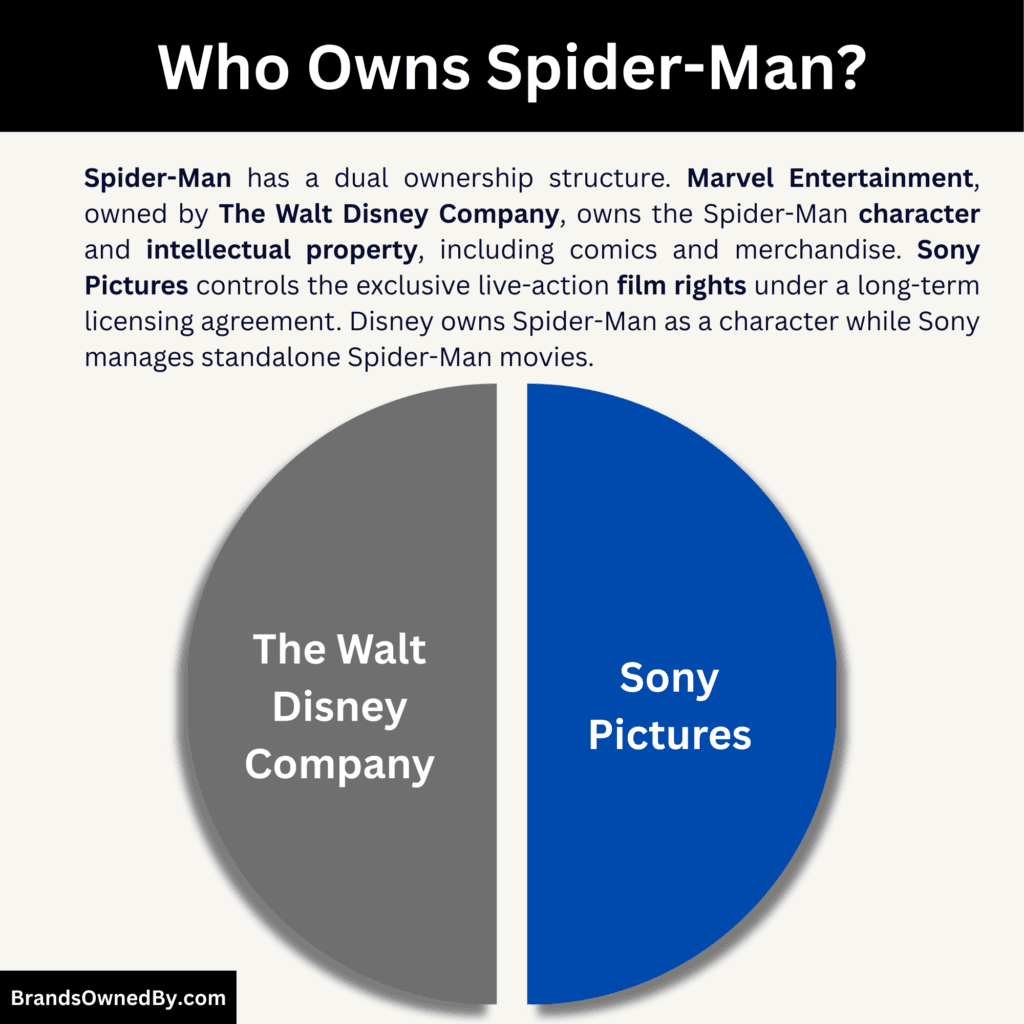
- Spider-Man is owned by Marvel Entertainment, which is fully controlled by The Walt Disney Company. Disney holds the core intellectual property, including comics, licensing, merchandise, and character rights.
- Sony Pictures does not own Spider-Man but controls exclusive live-action film rights through a long-term licensing agreement signed in the 1990s. Sony produces and distributes Spider-Man movies.
- Ultimate ownership traces back to Disney shareholders, primarily major institutional investors such as Vanguard, BlackRock, and State Street, along with global retail and insider shareholders.
- Spider-Man operates under a unique dual-rights structure where Marvel (Disney) owns the character and brand, while Sony controls theatrical film exploitation, making it one of the few major franchises split between two global corporations.
Spider-Man is one of the most influential and recognizable superheroes in global pop culture. The character represents responsibility, resilience, and ordinary human struggles combined with extraordinary powers. Spider-Man’s real identity is Peter Parker, a young man who gains spider-like abilities after being bitten by a radioactive spider. His powers include wall-crawling, super strength, agility, enhanced reflexes, and a “spider-sense” that warns him of danger.
Unlike many superheroes, Spider-Man focuses on everyday problems such as work, education, and personal loss. This human element made the character deeply relatable and helped him become Marvel’s most iconic figure.
Spider-Man operates primarily in New York City. He protects citizens from street crime and powerful villains. Over time, the character evolved into multiple versions across comics, films, animation, and games, including Miles Morales and Spider-Verse variations. The Spider-Man brand now spans publishing, film, streaming, gaming, and global consumer products.
Spider-Man is owned and managed by Marvel Entertainment, which operates under The Walt Disney Company. Marvel is responsible for publishing, character development, and licensing. Disney oversees global brand management, strategic expansion, and franchise integration across entertainment platforms. Sony Pictures plays a major role in Spider-Man films due to its ownership of movie rights, making Spider-Man one of the few characters jointly managed by two major entertainment companies.
Marvel’s role includes comic publishing, animated content, and creative direction of the character. Disney manages brand positioning, partnerships, and cross-franchise storytelling. Sony focuses on live-action Spider-Man films and related cinematic projects. This shared structure allows Spider-Man to exist across multiple entertainment ecosystems simultaneously.
Founders of Spider-Man
Spider-Man was created by Stan Lee and Steve Ditko in 1962. Stan Lee served as the writer and conceptual creator. He wanted a teenage superhero who faced real-life struggles. This was unusual at the time because most superheroes were adults with perfect lives. Lee introduced the idea that “with great power comes great responsibility,” which became Spider-Man’s core philosophy.
Steve Ditko was the co-creator and original artist. He designed Spider-Man’s visual identity, including the red-and-blue suit, web shooters, and unique body posture. Ditko also shaped the character’s darker and more grounded tone. His art style made Spider-Man appear agile, flexible, and human rather than invincible.
Together, Stan Lee and Steve Ditko created a new kind of superhero. Their creation changed comic storytelling forever. Spider-Man became Marvel’s breakthrough character and helped transform Marvel into a global entertainment powerhouse.
Ownership History
Spider-Man’s ownership history is one of the most complex structures in modern entertainment law. The character did not simply move from one company to another. Instead, different rights were separated over time. Comic rights, licensing rights, and film rights were treated differently in contracts. To fully understand who owns Spider-Man today, it is essential to examine how these rights evolved through bankruptcy, acquisitions, and negotiated partnerships.
Creation and Original Marvel Ownership (1962–Early 1990s)
Spider-Man debuted in 1962 under Marvel Comics. At that time, Marvel was an independent comic book publisher. The company retained full intellectual property ownership of the character. This included publishing rights, licensing rights, adaptation rights, and derivative works.
Under U.S. copyright law, characters created by employees under work-for-hire agreements belong to the company. Stan Lee and Steve Ditko created Spider-Man as Marvel employees. Therefore, Marvel legally owned the character from inception. During this period, Marvel controlled comics, animated adaptations, merchandise licensing, and early television appearances.
Spider-Man quickly became Marvel’s flagship property. The character drove comic sales and licensing growth. By the 1980s, Spider-Man was Marvel’s most recognized global asset.
Marvel Bankruptcy and Film Rights Sale to Sony (1990s)
The 1990s comic market crash severely damaged Marvel’s finances. Sales declined sharply after a speculative bubble burst. Marvel filed for Chapter 11 bankruptcy protection in 1996. To generate liquidity and stabilize operations, Marvel sold film adaptation rights for several characters.
Spider-Man’s live-action film rights were sold to Sony Pictures through Columbia Pictures. The deal granted Sony long-term theatrical film production and distribution rights. Importantly, Marvel did not sell character ownership. Instead, it licensed film rights under specific contractual terms.
This agreement gave Sony control over:
- Production of live-action Spider-Man movies
- Theatrical distribution rights
- Creative authority over standalone Spider-Man film projects.
Marvel retained:
- Comic publishing rights
- Animation rights (subject to specific carve-outs)
- Merchandise and consumer product licensing
- Overall character intellectual property ownership.
This rights separation created the dual-ownership confusion that continues today.
Sony’s Exclusive Film Control Era (2002–2014)
Sony launched its Spider-Man film franchise in 2002. The success of the early films reinforced Sony’s strong contractual position. Under the licensing structure, Sony maintained exclusive live-action film rights as long as it continued producing Spider-Man movies within defined time intervals. This “use-it-or-lose-it” clause prevented rights from reverting back to Marvel.
During this period, Marvel had no involvement in Sony’s Spider-Man film creative decisions. Sony independently developed sequels and reboots. Marvel, however, continued expanding Spider-Man in comics and merchandise.
This era demonstrated the separation between film rights and character ownership. Marvel owned Spider-Man as intellectual property. Sony controlled cinematic execution.
Disney Acquires Marvel (2009)
In 2009, The Walt Disney Company acquired Marvel Entertainment. This transaction transferred Marvel’s entire intellectual property portfolio to Disney. Spider-Man became part of Disney’s broader franchise ecosystem.
However, the acquisition did not alter Sony’s contractual film rights. Those rights remained legally binding. Disney gained full control over:
- Publishing operations
- Consumer products and merchandise
- Animation development
- Brand management strategy.
But Disney could not produce standalone live-action Spider-Man films without Sony’s participation.
This created a rare situation in Hollywood where the character owner did not control theatrical film production.
The Marvel–Sony Strategic Partnership (2015 Agreement)
In 2015, Disney’s Marvel Studios and Sony Pictures negotiated a landmark collaboration. Instead of attempting to recover film rights through litigation or buyback, Disney and Sony structured a co-production model.
Under this agreement:
- Spider-Man could appear in the Marvel Cinematic Universe
- Marvel Studios would provide creative oversight
- Sony would finance and distribute standalone Spider-Man films
- Profits would be shared under negotiated terms.
This partnership allowed Spider-Man to integrate into a larger shared universe. It also preserved Sony’s film rights while leveraging Marvel’s storytelling infrastructure.
This arrangement significantly strengthened the Spider-Man brand globally.
Modern Ownership Structure and Rights Allocation
As of 2026, Spider-Man’s ownership structure operates under a layered rights model:
Marvel (owned by Disney) controls:
- Core intellectual property
- Comic publishing
- Licensing and merchandise
- Animated projects (subject to agreements)
- Video game licensing.
Sony Pictures controls:
- Live-action theatrical film rights
- Distribution of standalone Spider-Man films
- Spin-off films based on Spider-Man-related characters (under specific rights scopes).
This shared framework is uncommon in the entertainment industry. Most major superhero characters are fully controlled by one parent company. Spider-Man remains an exception due to historical financial decisions made during Marvel’s bankruptcy period.
The ownership history shows that Spider-Man was never fully sold. Only certain rights were licensed. That distinction is critical when answering who owns Spider-Man today. Marvel owns the character. Sony owns specific exploitation rights within cinema.
Who Owns Spider-Man in 2026?
Spider-Man operates under a dual-rights ownership structure.
The character itself is owned by Marvel Entertainment, which is a subsidiary of The Walt Disney Company.
At the same time, Sony Pictures controls the live-action theatrical film rights through a long-standing licensing agreement. This means Spider-Man is not fully controlled by one company. Instead, two major entertainment corporations share different layers of rights, each playing a distinct role in the character’s global presence.
Marvel and Disney: Legal Owner of Spider-Man
Spider-Man is legally owned by Marvel Entertainment. Marvel created the character in 1962 and has retained the core intellectual property ever since. This includes the character, supporting universe, stories, symbols, and long-term franchise rights. Marvel is a wholly owned subsidiary of The Walt Disney Company. Therefore, Disney is the ultimate legal owner of Spider-Man.
Disney controls publishing, merchandise, licensing, animation, and long-term brand strategy. All Spider-Man comics, toys, games, and non-film commercial rights flow through Marvel under Disney. Disney also oversees character continuity, cross-franchise integration, and global brand positioning. Spider-Man is one of Disney’s most valuable intellectual properties and a central pillar of Marvel’s ecosystem.
Disney itself is publicly traded. Its largest shareholders include major institutional investors such as Vanguard, BlackRock, and State Street, along with global retail investors and company insiders. These shareholders collectively own Disney, and indirectly, Marvel and Spider-Man.
Sony Pictures: Owner of Live-Action Film Rights
Sony Pictures does not own Spider-Man as a character. However, it owns exclusive live-action theatrical film rights. These rights were acquired in the 1990s when Marvel sold film licensing rights during financial distress. The contract gave Sony long-term control over producing and distributing Spider-Man movies.
Sony finances, produces, and distributes standalone Spider-Man films. It also controls certain spin-off films connected to the Spider-Man cinematic universe. These rights remain with Sony as long as it continues producing qualifying films under contractual timelines.
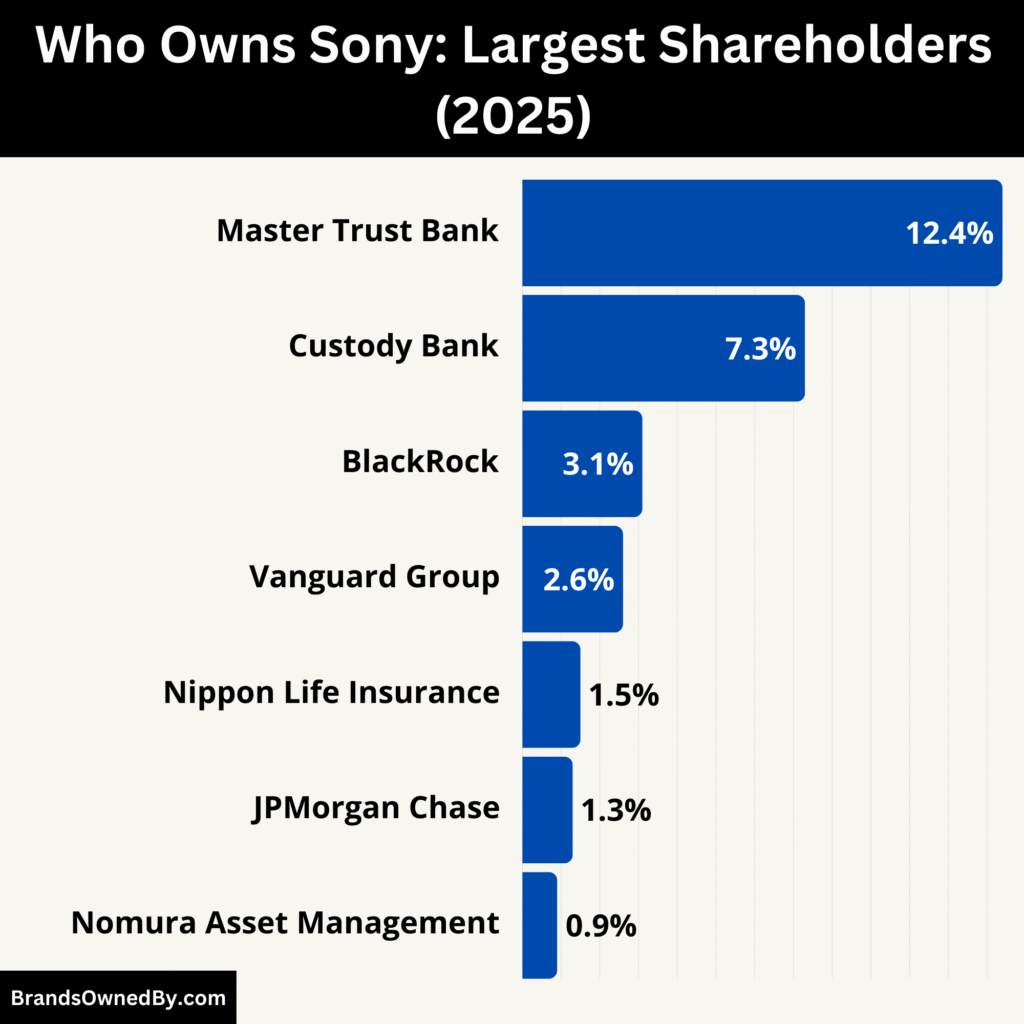
Sony Pictures is owned by Sony Group Corporation, a publicly traded Japanese multinational. Sony’s major shareholders include institutional investors, banks, and global investment funds. While Sony controls Spider-Man films, it has no ownership over the character’s intellectual property outside cinema.
How the Rights Are Split Between Marvel and Sony
The ownership structure is divided by type of rights, not by character percentage.
Marvel and Disney control:
- Character intellectual property
- Comic publishing and storytelling
- Merchandise and global licensing
- Animation and non-live-action media
- Video game licensing and brand expansion.
Sony controls:
- Live-action Spider-Man films
- Theatrical distribution rights
- Film-related spin-off projects tied to the Spider-Man film universe.
This division explains why Spider-Man can appear in Marvel-controlled media while Sony independently releases Spider-Man movies.
Creative Control and Collaboration
Creative control is divided by project type and contract terms. Marvel leads character consistency. Sony leads film execution. Each company operates within clearly defined rights.
In shared-universe projects, Marvel Studios controls story, character arc, and continuity. This ensures Spider-Man aligns with Marvel’s broader narrative structure. Marvel supervises script direction, character portrayal, and long-term planning.
In standalone Spider-Man films, Sony controls financing, production, casting, marketing, and global theatrical distribution. Sony makes final operational decisions for films produced under its licensed rights.
Both companies must approve major uses of Spider-Man when rights overlap. Contracts define revenue sharing, character usage limits, and creative approval authority. Marvel protects character identity. Sony manages cinematic delivery. This rights-based control system allows Spider-Man to operate across both ecosystems without changing legal ownership.
Competitor Ownership Comparison
Spider-Man’s ownership model is unusual. Most major superheroes are controlled by one parent company. Spider-Man is split between Marvel (Disney) and Sony. Comparing this structure with key competitors reveals how ownership affects control, revenue, and long-term franchise strategy.
| Character | Character Owner | Film Rights Controller | Ownership Structure | Strategic Impact |
|---|---|---|---|---|
| Spider-Man | Marvel Entertainment (Disney) | Sony Pictures | Split rights between two corporations | Requires coordination between Marvel and Sony. Shared investment. Complex control but strong global expansion. |
| Batman | DC Comics (Warner Bros. Discovery) | Warner Bros. Discovery | Fully unified ownership | Complete control over films, licensing, and storytelling. Faster decisions. All revenue retained internally. |
| Superman | DC Comics (Warner Bros. Discovery) | Warner Bros. Discovery | Fully unified ownership | Centralized franchise management. Consistent character strategy. No external approvals required. |
| X-Men (current) | Marvel Entertainment (Disney) | Marvel Studios (Disney) | Fully unified ownership after Disney–Fox merger | Full creative and commercial control. Easier integration into broader franchise ecosystem. |
| X-Men (historical) | Marvel Entertainment | 20th Century Fox | Previously split rights (similar to Spider-Man) | Divided control limited integration. Resolved after Disney acquired Fox and regained film rights. |
Batman: Centralized Ownership
Batman is fully owned by DC Comics, which sits inside Warner Bros. Discovery. All rights remain under one corporate umbrella. This includes character intellectual property, publishing, live-action films, streaming, animation, games, and global licensing. No external studio holds partial rights.
This centralized structure gives Warner Bros. complete operational control. The company can reboot Batman, change actors, alter tone, or expand into new media without negotiating with another rights holder. Strategic decisions such as cinematic universe planning, streaming releases, and merchandising are executed internally. Revenue from films, licensing, and consumer products flows to a single parent company. This maximizes profit retention and simplifies brand management.
Batman’s unified ownership also reduces legal risk. There are no reversion deadlines, licensing conflicts, or approval dependencies. This allows faster execution and tighter franchise coordination compared to Spider-Man’s shared system.
Superman: Unified Intellectual Property Control
Superman follows the same ownership model as Batman. DC Comics and Warner Bros. Discovery control the entire franchise. Publishing, film, television, animation, and licensing are managed internally. This provides long-term strategic stability.
Because no external studio controls film rights, Warner Bros. can align Superman with its broader DC Universe strategy. Casting, story direction, and reboot timing are decided without outside negotiation. Crossovers, streaming expansion, and global licensing operate under a single command structure.
This unified ownership allows Warner Bros. to maintain consistent character portrayal and brand positioning. Unlike Spider-Man, there is no separation between the character owner and the film producer. This eliminates conflicts between creative direction and distribution control.
X-Men: Full Disney Control
X-Men previously had a structure similar to Spider-Man. Marvel owned the characters. 20th Century Fox controlled live-action film rights for decades. This created divided control over storytelling and franchise expansion.
Disney changed this structure after acquiring 21st Century Fox. The acquisition returned X-Men film rights to Marvel. Today, Disney controls X-Men across all major media. Publishing, films, streaming, licensing, and games now operate under one corporate system.
This reunification gave Disney full creative and commercial control. X-Men can now be integrated into larger franchise planning without external approval. Compared to Spider-Man, X-Men demonstrates how unified ownership strengthens long-term franchise scalability and reduces contractual complexity.
Spider-Man: Permanently Split Exploitation Rights
Spider-Man remains structurally different from competitors. Marvel (Disney) owns the character and core intellectual property. Sony controls exclusive live-action theatrical film rights. This division is contractual and long-term.
Marvel controls publishing, merchandise, animation, gaming licenses, and character canon. Sony controls film production, financing, and global theatrical distribution. Neither company has full authority alone when projects overlap.
This structure creates both limitations and advantages. Decision-making can require negotiation. Film strategy and character continuity must be coordinated. However, the partnership also spreads financial risk and allows dual investment into the franchise. Sony focuses on cinematic expansion. Marvel protects character identity and global licensing value.
Strategic Impact of Ownership Differences
Ownership structure directly affects franchise power. Unified ownership (Batman, Superman, X-Men today) enables full control, faster execution, and consolidated revenue. Split ownership (Spider-Man) introduces coordination complexity but enables shared investment and multi-studio expansion.
Spider-Man’s model is the only major case where film rights and character ownership remain permanently separated between two global media giants. This makes Spider-Man not only a leading superhero brand but also one of the most strategically unique intellectual properties in the entertainment industry.
Who Controls Spider-Man?
Control and ownership are not the same. Marvel owns Spider-Man as intellectual property. Sony owns live-action film rights. But control depends on the medium. Creative direction, financial authority, and operational decision-making are divided based on contract scope.
Control of Spider-Man is rights-based and medium-specific:
- Disney controls corporate strategy and brand governance.
- Marvel controls character canon, publishing, and licensing.
- Sony controls live-action theatrical film production and distribution.
- Shared projects require coordinated approval between Marvel and Sony.
Corporate Control: The Walt Disney Company
Ultimate corporate control of Spider-Man sits with The Walt Disney Company because Disney owns Marvel Entertainment. This gives Disney authority over strategic decisions involving the character’s long-term brand positioning, licensing expansion, and cross-franchise integration.
Disney’s executive leadership and board of directors oversee Marvel’s operations. Major strategic decisions, such as global partnerships, media platform distribution, and intellectual property monetization, require Disney-level approval. While Disney does not manage day-to-day comic storytelling, it controls high-level brand governance and commercial direction.
Character and Publishing Control: Marvel Entertainment
Marvel directly controls Spider-Man’s character canon. This includes comic publishing, storyline evolution, character redesigns, new versions, and the introduction of alternate universes. Editorial teams within Marvel determine character arcs, supporting characters, and long-term narrative continuity.
Marvel also controls:
- Animated projects (subject to contractual carve-outs)
- Video game licensing approvals
- Merchandise branding rules
- Character usage guidelines across media.
Any company seeking to use Spider-Man outside Sony’s live-action film scope must obtain Marvel’s authorization.
Film Production Control: Sony Pictures
Sony controls live-action theatrical film production. This authority comes from the 1990s licensing agreement. Sony finances films, manages production schedules, approves casting, oversees marketing campaigns, and controls global theatrical distribution.
Sony retains final decision-making authority over standalone Spider-Man films produced under its licensed rights. It also controls film-related spin-offs connected to its Spider-Man cinematic universe.
However, when Spider-Man appears in collaborative projects involving Marvel Studios, certain creative decisions are jointly coordinated.
Creative Oversight in Shared Projects
In collaborative films, Marvel Studios typically leads creative consistency. Marvel ensures Spider-Man aligns with broader character continuity and long-term narrative planning. Sony manages financing and distribution logistics.
This shared model means neither side has unilateral creative dominance in crossover projects. Approval processes are defined contractually. Script development, character portrayal, and major storyline changes require coordination between both companies.
Executive Leadership Influence
Control ultimately flows through executive leadership at both corporations.
At Disney, the CEO and executive board oversee Marvel’s strategic priorities. At Sony Group Corporation, executive leadership supervises Sony Pictures’ film strategy and investment decisions. These executives do not write stories or direct films, but they influence budget approvals, partnership renewals, and franchise expansion decisions.
This executive-level influence determines whether agreements are extended, renegotiated, or restructured.
Financial Control and Revenue Allocation
Control is also shaped by financial structure. Sony finances and distributes live-action films, giving it operational control in cinema. Marvel and Disney generate substantial revenue from merchandise and licensing, reinforcing their long-term influence over brand direction.
Revenue-sharing agreements define how profits are split in collaborative projects. These agreements shape negotiation leverage between the two companies.
Spider-Man Annual Revenue and Net Worth
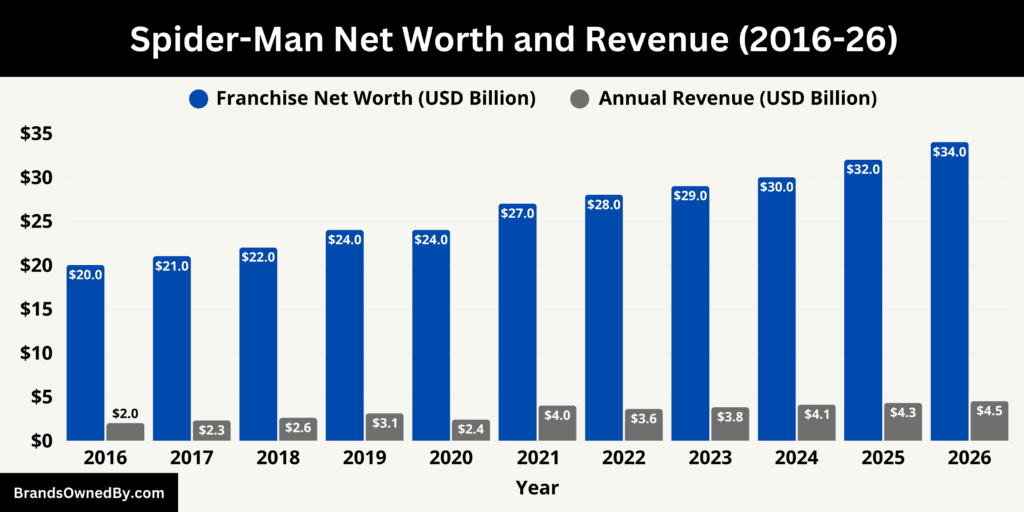
As of February 2026, the Spider-Man franchise generates an estimated $4.5 billion in annual revenue and holds an estimated brand net worth of about $34 billion. This valuation reflects long-term intellectual property strength, global licensing dominance, and sustained monetization across films, merchandise, gaming, and publishing.
2026 Revenue Structure and Segment Contribution
In 2026, Spider-Man’s total estimated franchise revenue of $4.5 billion comes from multiple monetization channels. Merchandise and consumer products remain the largest contributor, generating approximately $2.1 billion. Spider-Man consistently ranks among the top-selling character brands globally across toys, apparel, school supplies, and collectibles. This segment provides stable and recurring income regardless of film release cycles.
Film and streaming revenue contribute about $1.2 billion. This includes theatrical box office income, catalog performance from previous films, streaming licensing, and digital distribution. Even without a major blockbuster release every year, Spider-Man films maintain strong global consumption and long-tail earnings through streaming platforms and digital rentals.
Gaming generates roughly $650 million annually. Spider-Man remains one of the most commercially successful superhero gaming franchises. Console titles, downloadable expansions, and licensing agreements drive both direct sales and recurring engagement revenue. The gaming segment continues to grow as interactive entertainment expands globally.
Publishing and comics contribute around $120 million. While smaller compared to other segments, comics remain critical for character evolution, new storyline creation, and intellectual property sustainability. Many major film and game narratives originate from comic arcs, reinforcing long-term franchise strength.
Licensing, partnerships, and brand collaborations generate approximately $430 million annually. This includes theme park integrations, promotional partnerships, co-branded products, and global licensing deals. These partnerships strengthen brand visibility and expand Spider-Man’s commercial reach beyond core media.
2026 Brand Net Worth and Value Drivers
As of February 2026, Spider-Man’s estimated $34 billion brand net worth reflects cumulative franchise value rather than annual profit.
This valuation is driven by global recognition, long-term revenue stability, and cross-platform dominance. Merchandise and licensing contribute the largest share of brand value because they provide predictable and recurring income streams. The film franchise significantly enhances brand perception and global visibility, which in turn boosts merchandise and licensing demand.
Gaming and digital media have become major value drivers in recent years. High engagement in interactive entertainment strengthens long-term franchise relevance and expands younger audience reach. Publishing maintains intellectual property continuity and supports future content development, ensuring Spider-Man remains culturally and commercially relevant.
The brand’s value continues to rise due to multi-generational appeal, international market expansion, and consistent character reinvention across media formats.
Long-Term Financial Growth and Market Position
Spider-Man’s financial trajectory shows steady upward momentum over the past decade. Revenue growth has been supported by diversified monetization rather than reliance on a single segment. Merchandise stability ensures baseline revenue, while films and gaming create periodic growth spikes. The franchise benefits from global brand strength, strong licensing control, and continuous content production across platforms.
Spider-Man remains one of the most monetized fictional characters in history. Its diversified revenue structure reduces financial volatility and supports long-term valuation growth.
Future Revenue Forecast (2026–2030)
- 2027: Projected revenue around $4.7 billion, expected growth from new film releases and expanded streaming distribution.
- 2028: Forecast revenue approximately $4.9 billion, gaming and digital ecosystem expected to become a larger contributor.
- 2029: Projected revenue near $5.0 billion, licensing expansion and global merchandise demand expected to drive growth.
- 2030: Forecast revenue could reach about $5.2 billion with brand net worth potentially exceeding $38 billion, supported by multi-platform expansion, new media formats, and sustained global demand.
The long-term outlook remains strong. Spider-Man’s diversified monetization model, global recognition, and cross-platform expansion position the franchise for continued revenue growth and rising brand value through the end of the decade.
List of Spider-Man Movies
Spider-Man’s film history began long before the modern blockbuster era. The character has appeared in television films, international adaptations, reboots, and animated features.
Below is a complete chronological breakdown of Spider-Man movies, starting from the earliest productions in 1977 to the modern cinematic era:
| Year | Movie Title | Era / Series | Notes |
|---|---|---|---|
| 1977 | Spider-Man | Early Television Films | First live-action Spider-Man film starring Nicholas Hammond. Began as a TV pilot, later released internationally. |
| 1978 | Spider-Man Strikes Back | Early Television Films | Follow-up to the 1977 film. Focused on espionage and criminal conspiracy. |
| 1978 | Spider-Man (Japanese) | Japanese Adaptation (Toei) | Unique version with sci-fi elements and a giant robot. Theatrical compilation of the Japanese TV series. |
| 1981 | Spider-Man: The Dragon’s Challenge | Early Television Films | Final film of the early era. Peter Parker travels internationally to uncover a criminal plot. |
| 2002 | Spider-Man | Sam Raimi Trilogy | Modern blockbuster debut. Introduced Green Goblin and redefined superhero cinema. |
| 2004 | Spider-Man 2 | Sam Raimi Trilogy | Featured Doctor Octopus. Widely considered one of the greatest superhero films. |
| 2007 | Spider-Man 3 | Sam Raimi Trilogy | Concluded the trilogy. Included Venom, Sandman, and Peter’s darker arc. |
| 2012 | The Amazing Spider-Man | Amazing Spider-Man Series | Franchise reboot with a darker tone. Introduced the Lizard. |
| 2014 | The Amazing Spider-Man 2 | Amazing Spider-Man Series | Featured Electro and Green Goblin. Attempted to build a larger universe. |
| 2017 | Spider-Man: Homecoming | Marvel Cinematic Universe | First MCU Spider-Man film. Focused on young Peter Parker. Villain: Vulture. |
| 2019 | Spider-Man: Far From Home | Marvel Cinematic Universe | Expanded Spider-Man globally. Villain: Mysterio. |
| 2021 | Spider-Man: No Way Home | Marvel Cinematic Universe | Multiverse storyline. Brought together past Spider-Man characters. Major global success. |
| 2018 | Spider-Man: Into the Spider-Verse | Animated Spider-Verse | Introduced Miles Morales and the multiverse. Critically acclaimed. |
| 2023 | Spider-Man: Across the Spider-Verse | Animated Spider-Verse | Expanded multiverse narrative and character depth. |
| Upcoming | Spider-Man: Beyond the Spider-Verse | Animated Spider-Verse | Expected to conclude the animated trilogy and continue multiverse storyline. |
Early Television Spider-Man Films (1977–1981)
These were the first live-action Spider-Man screen adaptations. They were produced for television but later released theatrically in some international markets.
Spider-Man (1977) was the first live-action Spider-Man film starring Nicholas Hammond as Peter Parker. It introduced the character’s origin and crime-fighting role. The film was produced as a pilot for the television series The Amazing Spider-Man and later screened internationally as a feature film.
Spider-Man Strikes Back (1978) continued the television storyline. Peter Parker battles a criminal organization involved in espionage and mind-control technology. The film expanded Spider-Man’s early live-action narrative.
Spider-Man: The Dragon’s Challenge (1981) was the final film of this early era. The story follows Peter Parker traveling internationally to clear a man falsely accused of murder while confronting a criminal conspiracy. This film marked the end of the 1970s Spider-Man screen adaptations.
Japanese Spider-Man Film (1978)
Spider-Man (1978, Japanese adaptation) was produced by Toei Company in Japan. This version was very different from the American portrayal. The character had a giant robot and science-fiction themes. The film was a theatrical version of episodes from the Japanese Spider-Man television series. Despite its unique style, it played an important role in expanding Spider-Man globally and influenced future superhero production formats.
Sam Raimi Spider-Man Trilogy (2002–2007)
This trilogy launched Spider-Man into the modern blockbuster era and established the character as a global film icon.
Spider-Man (2002) introduced Peter Parker’s origin and his battle with the Green Goblin. The film became a massive commercial success and helped redefine superhero cinema.
Spider-Man 2 (2004) focused on Peter Parker’s emotional struggles and his fight against Doctor Octopus. It is widely considered one of the greatest superhero films ever made due to its strong character development and storytelling.
Spider-Man 3 (2007) explored Peter’s darker transformation and featured multiple villains including Sandman and Venom. The film concluded the trilogy and achieved major box office success.
The Amazing Spider-Man Reboot Series (2012–2014)
Sony rebooted the franchise with a new cast and modernized tone.
The Amazing Spider-Man (2012) retold Spider-Man’s origin story with a darker and more emotional narrative. The Lizard served as the primary antagonist.
The Amazing Spider-Man 2 (2014) introduced Electro and Green Goblin while expanding the universe. The film aimed to build a larger cinematic universe but led to another reboot after mixed performance.
Marvel Cinematic Universe Spider-Man Films (2017–2021)
Sony partnered with Marvel Studios to integrate Spider-Man into a shared cinematic universe.
Spider-Man: Homecoming (2017) followed a young Peter Parker balancing school life and superhero responsibility. The Vulture was the main villain.
Spider-Man: Far From Home (2019) showed Peter stepping into a more independent hero role while facing Mysterio. The film expanded Spider-Man’s global narrative.
Spider-Man: No Way Home (2021) explored the multiverse and brought together characters from previous Spider-Man film eras. It became one of the highest-grossing Spider-Man films ever.
Animated Spider-Verse Films (2018–Present)
Sony expanded Spider-Man into animated multiverse storytelling, introducing new characters and visual styles.
Spider-Man: Into the Spider-Verse (2018) introduced Miles Morales and the concept of multiple Spider-Man universes. The film received critical acclaim and won major animation awards.
Spider-Man: Across the Spider-Verse (2023) expanded the multiverse storyline and deepened Miles Morales’ journey across dimensions.
Spider-Man: Beyond the Spider-Verse (upcoming) is expected to conclude the animated trilogy and further expand the Spider-Verse narrative.
Conclusion
So, who owns Spider-Man?
The answer is layered but clear.
Marvel, under Disney, owns the Spider-Man character and all core intellectual property rights. Sony controls the live-action film rights through a long-standing licensing agreement. This split structure makes Spider-Man unique among major superheroes.
Despite divided rights, the character remains one of the most powerful franchises in entertainment. The partnership between Marvel and Sony has allowed Spider-Man to thrive across comics, films, animation, and global merchandise. Ownership may be shared in function, but Spider-Man’s cultural and commercial dominance continues to grow across generations.
FAQs
Who owns Spider-Man IP?
Spider-Man’s intellectual property is owned by Marvel Entertainment. Marvel created the character in 1962 and has retained the core IP rights ever since. Marvel is a wholly owned subsidiary of The Walt Disney Company, so Disney ultimately owns the Spider-Man IP, including comics, merchandise, licensing, and character canon.
Who owns Spider-Man rights?
Spider-Man rights are divided. Marvel (under Disney) owns the character and intellectual property rights. Sony Pictures owns the exclusive live-action theatrical film rights under a long-term licensing agreement. This means Disney controls the character, while Sony controls standalone Spider-Man movies.
Why does Sony own Spider-Man?
Sony owns the live-action film rights because Marvel licensed those rights in the 1990s during a financial crisis. Marvel needed capital and sold movie rights for several characters to different studios. Sony acquired Spider-Man’s film rights and retained them under contractual terms that remain in effect today.
Does Sony own Spider-Man?
No, Sony does not own Spider-Man as a character. Sony only owns the live-action theatrical film rights. Marvel, owned by Disney, owns the Spider-Man character, publishing rights, and global licensing rights.
Is Spider-Man Universal or Disney?
Spider-Man is not owned by Universal. The character is owned by Marvel, which is owned by Disney. However, Sony controls the live-action film rights. So Spider-Man belongs to Disney in terms of intellectual property, but Sony manages theatrical movies.
Why did Marvel sell Spider-Man to Sony?
Marvel sold the film rights in the 1990s due to severe financial distress and bankruptcy proceedings. Licensing film rights was a way to generate immediate cash and stabilize the company. Marvel did not sell the character permanently. It licensed specific movie rights while retaining ownership of the intellectual property.
Why is Spider-Man not fully owned by Disney?
Spider-Man is owned by Disney through Marvel. The confusion exists because Sony controls the live-action film rights. Disney does not control those theatrical rights due to the earlier licensing agreement. So while Disney owns the character, it does not have full control over Spider-Man movies.