- Ryobi is owned by Ryobi Limited, a Japanese publicly traded industrial manufacturer headquartered in Hiroshima. The company created the Ryobi brand in 1943 and still owns the trademark while operating global businesses in automotive aluminum die-casting, printing presses, and architectural hardware.
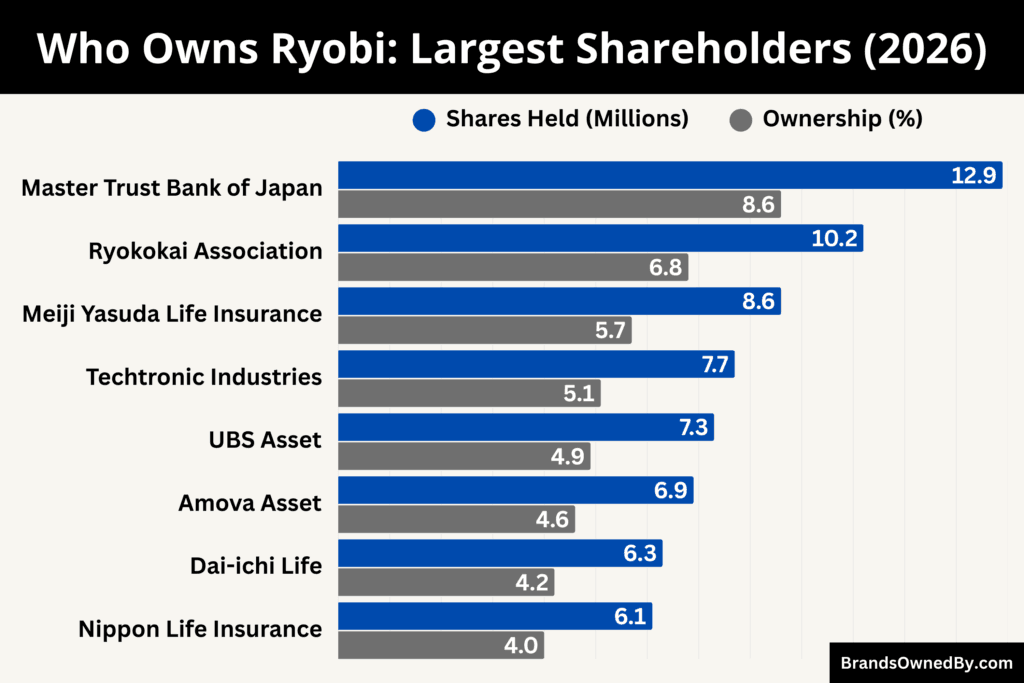
- Ownership of Ryobi Limited is institutional and widely distributed. The largest shareholders include The Master Trust Bank of Japan (about 12.9 million shares), Ryokokai Shareholding Association (about 10.2 million shares), Meiji Yasuda Life Insurance (about 8.6 million shares), and Techtronic Industries (about 7.7 million shares).
- Techtronic Industries plays a dual role in Ryobi’s ecosystem. Besides being a major shareholder with roughly a 5% stake, it holds the global license to manufacture and sell Ryobi power tools in key markets such as the United States, Europe, Australia, and New Zealand.
- Ryobi operates without a controlling shareholder. Institutional investors, insurance companies, and asset managers collectively hold the majority of shares, while public investors own the remaining stock through the Tokyo Stock Exchange.
Ryobi is a global brand associated with power tools, outdoor equipment, and industrial manufacturing technologies. The brand originated in Japan and has become widely recognized among homeowners, DIY enthusiasts, and professionals.
The company began as a die-casting manufacturer before expanding into machinery, printing equipment, and power tools. Over the decades, Ryobi built expertise in aluminum die-casting and mechanical engineering. These capabilities helped the company diversify into multiple industries including automotive components, printing presses, and construction tools.
Today, Ryobi operates as a Japanese industrial manufacturer through Ryobi Limited. The company produces aluminum die-cast components used in automobiles, electronics, and industrial equipment. It also develops printing machinery and builders’ hardware.
The Ryobi name is also widely associated with consumer power tools. In many global markets, including North America and Europe, Ryobi power tools and outdoor equipment are produced and distributed by Techtronic Industries under a licensing agreement.
Because of this structure, the Ryobi brand appears in both industrial manufacturing and consumer power equipment markets. The bright-green cordless tools commonly sold in major home improvement stores are part of the licensed Ryobi tools business operated by Techtronic Industries.
Ryobi Founder
Ryobi was founded by Yutaka Urakami, a Japanese entrepreneur who established the company in December 1943 in Fuchu, Hiroshima, Japan. At the time, he operated a small trading business before deciding to enter the manufacturing sector.
The idea to start the company emerged after a discussion with a manager from Mitsubishi Electric’s Fukuyama Works. The manager suggested producing die-cast metal parts, which were in demand during that period. Although Urakami initially had no experience with die casting, he studied the technology and decided to launch the business.
Urakami established Ryobi Seisakusho Co., Ltd., and began manufacturing die-cast products in a small factory that was originally a converted warehouse. Early production focused on metal components and industrial parts.
Over time, the company expanded into new product categories. In the 1960s it began manufacturing offset printing presses and eventually entered the power tools industry. The company later changed its name to Ryobi Limited in 1973 as the brand gained international recognition.
Urakami’s decision to shift from a small trading operation into manufacturing laid the foundation for what would become a global brand used across multiple industries today.
Ownership History
Ryobi’s ownership history is different from many global tool brands. The company did not follow a typical acquisition path where a larger corporation purchased the brand. Instead, Ryobi evolved from a Japanese manufacturing company and later adopted a licensing model for its power tools business in global markets.
Founding and Early Ownership (1943–1970s)
Ryobi was founded in 1943 in Hiroshima, Japan. The company originally operated under the name Ryobi Seisakusho Co., Ltd. It was established as a manufacturing company focused on aluminum die-casting.
During its early decades, the company remained privately owned and operated by its founders and early shareholders. Its main business involved producing metal components for industrial machinery and manufacturing equipment.
In the 1960s, the company expanded into offset printing presses. This marked the beginning of Ryobi’s transformation into a diversified industrial manufacturer. Around the same time, the company began exploring international markets and exporting equipment to other countries.
As the company grew, it strengthened its manufacturing capabilities and invested heavily in industrial engineering and casting technology.
Public Listing and Corporate Expansion
Ryobi reached a major milestone when it became a publicly traded company. The company listed its shares on the Tokyo Stock Exchange. This move allowed it to raise capital and expand its manufacturing operations.
After becoming public, Ryobi Limited expanded its industrial divisions. The company increased production of aluminum die-cast components used in automotive and industrial applications. This segment eventually became one of the company’s most important businesses.
The company also developed printing press technologies and machine tools. These products were sold globally and helped Ryobi establish itself as a respected engineering manufacturer.
During this period, Ryobi still owned and managed its power tools division directly.
Entry into the Power Tools Market
Ryobi began manufacturing power tools during the late 1960s and early 1970s. The company focused on producing affordable tools for both consumers and professionals.
Its products included drills, saws, and other handheld tools used in construction and woodworking. These tools gained popularity in several international markets due to their competitive pricing and solid performance.
The Ryobi brand gradually became recognized in the global power tool market. However, the company later decided to shift its focus toward industrial manufacturing and automotive die-casting.
This strategic shift would eventually lead to the licensing structure that defines Ryobi today.
Licensing of the Ryobi Tools Brand
A major change in Ryobi’s ownership structure occurred around the late 1990s and early 2000s. The company decided to reduce its direct involvement in the consumer power tools industry.
Instead of operating the tool business directly, Ryobi began licensing the Ryobi brand to other companies. These licensing agreements allowed external manufacturers to produce and sell tools under the Ryobi name.
One of the most important agreements was signed with Techtronic Industries (TTI), a Hong Kong–based power tool manufacturer.
Techtronic Industries acquired the licensing rights to produce and distribute Ryobi power tools in major global markets. These markets include the United States, Canada, Europe, Australia, and New Zealand.
Under this agreement, TTI designs, manufactures, and markets Ryobi tools. However, the Ryobi brand name remains associated with the original Japanese company.
Growth Under Techtronic Industries
After obtaining the Ryobi license, Techtronic Industries invested heavily in expanding the brand. The company focused on cordless power tools, outdoor equipment, and DIY home improvement products.
One of the most important innovations was the Ryobi ONE+ battery system. This platform allows hundreds of tools to operate using the same battery design. The system became extremely popular among homeowners and DIY users.
Techtronic Industries also built strong retail partnerships. Ryobi tools became widely available through large home improvement retailers, especially Home Depot in the United States.
As a result, Ryobi became one of the fastest-growing consumer tool brands in the DIY market.
Ryobi Limited’s Modern Business Structure
While the consumer tools business is licensed to Techtronic Industries, Ryobi Limited continues to operate as an industrial manufacturer.
The company focuses primarily on aluminum die-casting for the automotive industry. It produces engine components, transmission housings, and other precision metal parts used by major automobile manufacturers.
Ryobi Limited also maintains a printing equipment business and continues developing industrial machinery technologies.
This structure means that Ryobi operates under a dual identity.
Ryobi Limited owns the historical brand and operates industrial manufacturing businesses. At the same time, Techtronic Industries manages the global consumer tools brand under licensing agreements.
Current Ownership Structure as of 2026
As of March 2026, Ryobi remains a publicly traded Japanese company listed on the Tokyo Stock Exchange.
The Ryobi brand used on power tools is licensed to Techtronic Industries, which controls product development, marketing, and global distribution of those tools.
This arrangement has allowed the brand to grow rapidly in the consumer tool market while Ryobi Limited focuses on its industrial manufacturing expertise.
The combination of brand ownership and licensing partnerships has made Ryobi one of the most recognizable names in the global power tools industry.
Who Owns Ryobi Limited: Top Shareholders
Ryobi is owned by Ryobi Limited, a Japanese manufacturing company listed on the Tokyo Stock Exchange. The company originally created the Ryobi brand and continues to own it today.
However, the Ryobi power tools widely sold across North America, Europe, and several other global markets are produced and distributed by Techtronic Industries under a licensing agreement.
Ryobi Limited operates as a publicly traded company. As of March 2026, the largest shareholders include Japanese trust banks, insurance companies, asset managers, and strategic partners such as Techtronic Industries. These investors collectively control a substantial portion of the company while public investors hold the remaining shares through stock market trading.
Below are the major shareholders of Ryobi Limited as of March 2026:
The Master Trust Bank of Japan
The Master Trust Bank of Japan is the largest shareholder of Ryobi Limited. The bank holds approximately 12.9 million shares of the company, representing about 8.6% of Ryobi’s outstanding shares.
The Master Trust Bank specializes in asset custody and trust management. The shares it holds are typically managed on behalf of institutional investors such as pension funds, insurance companies, and investment funds.
Because the bank acts as a trustee, the underlying investors are spread across multiple financial institutions. Nevertheless, it remains the largest registered shareholder of Ryobi. Its significant position reflects strong institutional investment in the company’s industrial manufacturing operations.
Ryokokai Shareholding Association
The Ryokokai Shareholding Association owns approximately 10.2 million shares of Ryobi Limited, representing about 6.8% of the company.
This association consists mainly of long-term partner companies, suppliers, and business affiliates that maintain close commercial relationships with Ryobi.
In Japan, these types of shareholding associations help maintain stable ownership structures and strengthen corporate partnerships. The Ryokokai association provides long-term shareholder support and contributes to the stability of Ryobi’s corporate governance.
Meiji Yasuda Life Insurance Company
Meiji Yasuda Life Insurance Company holds approximately 8.6 million shares of Ryobi Limited, which equals about 5.7% of the company’s total shares.
Meiji Yasuda is one of Japan’s largest life insurance providers and a major institutional investor in Japanese industrial companies. Insurance companies often invest in established manufacturing firms because they offer stable long-term returns.
The company’s investment in Ryobi reflects confidence in its industrial capabilities, particularly in aluminum die-casting and automotive component manufacturing.
Techtronic Industries Company Limited
Techtronic Industries holds approximately 7.7 million shares of Ryobi Limited, representing around 5.1% ownership.
This shareholder plays a unique role because Techtronic Industries manufactures and sells Ryobi power tools in many global markets.
Techtronic Industries obtained licensing rights to the Ryobi brand for power tools and outdoor equipment in North America and later expanded into Europe, Australia, and New Zealand. Through this partnership, the company designs, manufactures, and distributes Ryobi consumer tools worldwide.
Its equity stake in Ryobi Limited strengthens the strategic relationship between the brand owner and the company responsible for expanding the Ryobi tools business globally.
UBS Asset Management AG
UBS Asset Management owns approximately 7.3 million shares of Ryobi Limited, representing about 4.9% of the company.
UBS Asset Management is the investment management division of UBS Group, a global financial services company headquartered in Switzerland.
The firm manages investment portfolios for institutional investors, sovereign wealth funds, and pension funds. Its investment in Ryobi highlights international interest in Japanese manufacturing companies and the global automotive supply chain.
Amova Asset Management Co., Ltd.
Amova Asset Management holds roughly 6.9 million shares of Ryobi Limited, equal to about 4.6% ownership.
The company is a Japanese asset management firm that invests in public companies on behalf of institutional clients. Asset managers typically focus on companies with strong industrial capabilities and long-term growth potential.
Ryobi’s expertise in aluminum die-casting, automotive components, and industrial machinery makes it an attractive investment for asset managers seeking stable manufacturing businesses.
Dai-ichi Life Holdings
Dai-ichi Life Holdings owns approximately 6.3 million shares of Ryobi Limited, representing about 4.2% of the company.
Dai-ichi Life is one of Japan’s largest financial services groups. The company operates major life insurance and asset management businesses across Asia, North America, and Europe.
Insurance companies often hold long-term investments in industrial companies. Dai-ichi Life’s stake in Ryobi demonstrates confidence in the company’s stable manufacturing operations and long-term industrial growth.
Nippon Life Insurance Company
Nippon Life Insurance Company holds approximately 6.1 million shares of Ryobi Limited, representing about 4.0% of the company.
Nippon Life is the largest life insurance company in Japan and one of the largest insurers globally. The company manages a vast investment portfolio across various industries.
Its investment in Ryobi reflects strong institutional support from Japan’s financial sector and highlights the company’s credibility within the country’s industrial manufacturing ecosystem.
Other Institutional and Public Shareholders
In addition to the major shareholders listed above, Ryobi Limited is owned by a wide range of smaller institutional investors and public shareholders.
Global investment funds, exchange-traded funds, and Japanese domestic equity funds hold smaller stakes in the company. Individual investors also purchase Ryobi shares through stock market trading.
Together, these investors hold millions of additional shares. The diversified ownership structure ensures that Ryobi remains an independent publicly traded company without a single controlling shareholder.
As of March 2026, Ryobi’s shareholder base continues to be dominated by institutional investors and financial institutions. This stable ownership structure supports the company’s long-term strategy in industrial manufacturing while allowing the Ryobi brand to expand globally through licensing partnerships.
Competitor Ownership Comparison
The global power tools market is dominated by a handful of large corporations that own multiple tool brands and control global manufacturing networks. Comparing Ryobi’s ownership structure with its competitors helps explain how the brand fits within the broader industry.
Ryobi has a unique ownership model. The Ryobi brand is owned by Ryobi Limited, a Japanese industrial manufacturing company. However, the Ryobi power tools widely sold in markets such as the United States, Canada, Europe, and Australia are manufactured and distributed by Techtronic Industries under a licensing agreement.
Most competing tool brands are fully owned and controlled by their parent companies. These corporations manage product development, manufacturing, and brand strategy directly. Ryobi’s licensing structure, therefore, makes it somewhat different from other major brands in the industry.
| Brand | Parent Company / Owner | Ownership Structure | Market Focus | Key Notes |
|---|---|---|---|---|
| Ryobi | Ryobi Limited (brand owner) / Techtronic Industries (tool manufacturer under license) | Brand owned by Ryobi Limited but licensed to Techtronic Industries for power tools | DIY users and homeowners | Unique dual-company structure. TTI designs, manufactures, and distributes Ryobi tools globally. |
| Milwaukee Tool | Techtronic Industries | Fully owned subsidiary | Professional contractors and trades | Flagship professional tool brand of Techtronic Industries competing with DeWalt and Makita. |
| DeWalt | Stanley Black & Decker | Fully owned brand | Professional construction and industrial users | One of the largest professional tool brands globally. Operated directly by Stanley Black & Decker. |
| Makita | Makita Corporation | Independent manufacturer that owns its brand | Professional contractors and construction industry | One of the largest independent power tool manufacturers in the world. |
| Bosch Power Tools | Robert Bosch GmbH | Division of a multinational engineering company | Professional and DIY markets | Integrated with Bosch’s global engineering and manufacturing operations. |
| Craftsman | Stanley Black & Decker | Fully owned brand | DIY users and homeowners | Competes with Ryobi in the consumer tool segment. Distributed through major retailers. |
Ryobi
Ryobi tools are manufactured and distributed by Techtronic Industries, a Hong Kong–based multinational company that specializes in power tools, outdoor equipment, and floor care products.
Techtronic Industries holds the licensing rights to produce and sell Ryobi power tools in major markets including North America, Europe, Australia, and New Zealand. These tools are widely sold through large retailers, particularly Home Depot in the United States.
The Ryobi brand itself is owned by Ryobi Limited, which operates as an industrial manufacturer focusing on aluminum die-casting and automotive components. This creates a dual-company structure where one company owns the brand while another manages the consumer tools business.
Ryobi tools primarily target homeowners and DIY users rather than professional contractors. The brand is known for its affordable cordless tools and the Ryobi ONE+ battery platform, which supports hundreds of tools using the same battery system.
Milwaukee Tool
Milwaukee Tool is one of Ryobi’s biggest competitors and is also owned by Techtronic Industries.
Unlike Ryobi, Milwaukee is fully owned by Techtronic Industries. The company acquired Milwaukee Electric Tool Corporation in 2005 and has since developed it into its flagship professional tool brand.
Milwaukee focuses heavily on professional trades such as construction, electrical work, plumbing, and mechanical services. The brand invests heavily in advanced cordless systems such as the M18 and M12 platforms.
As of 2026, Milwaukee represents one of the fastest-growing brands in the professional power tools market. Techtronic Industries uses Milwaukee to compete directly with other premium brands such as DeWalt and Makita.
DeWalt
DeWalt is owned by Stanley Black & Decker, a major American industrial and tool manufacturing company headquartered in the United States.
Stanley Black & Decker controls a large portfolio of tool brands and manages the DeWalt brand directly. DeWalt tools are manufactured and distributed through the company’s global manufacturing and supply chain network.
The brand focuses on professional contractors and construction companies. DeWalt tools are widely used in construction, woodworking, and heavy industrial applications.
As of 2026, DeWalt remains one of the largest professional power tool brands in the world and competes directly with Milwaukee and Makita in the contractor segment.
Makita
Makita operates under a different structure compared to many other competitors. The Makita brand is owned directly by Makita Corporation, a Japanese power tool manufacturer headquartered in Anjo, Japan.
Makita designs, manufactures, and distributes its own tools globally without relying on licensing agreements or a larger parent company. This allows the company to maintain full control over product development, technology, and brand strategy.
Makita focuses primarily on professional-grade tools used in construction and industrial environments. The company is known for its LXT cordless system and its strong global manufacturing network.
As of 2026, Makita remains one of the largest independent power tool manufacturers in the world.
Bosch Power Tools
Bosch Power Tools is owned by Robert Bosch GmbH, a German multinational engineering and technology company.
Robert Bosch GmbH operates across several industries including automotive technology, industrial equipment, consumer appliances, and power tools. The power tools division is one of its major consumer-facing businesses.
Bosch tools are produced for both professional contractors and DIY consumers. The brand is known for engineering quality, durable tools, and advanced electronic systems.
Because Bosch owns the power tools division directly, the company maintains full control over product development, research, and manufacturing across its global operations.
Craftsman
Craftsman is owned by Stanley Black & Decker, the same company that owns DeWalt.
The brand originally belonged to Sears but was acquired by Stanley Black & Decker in 2017. Since then, the company has expanded the Craftsman product line across multiple categories including hand tools, power tools, and lawn equipment.
Craftsman tools are targeted primarily at homeowners and DIY users. The brand competes more directly with Ryobi in the consumer tool segment rather than the professional contractor market.
Stanley Black & Decker manages Craftsman through its global manufacturing and distribution network, selling products through major retailers including Lowe’s, Amazon, and other hardware chains.
Key Differences in Ownership Structures
Most major power tool brands follow one of two ownership models. The first model involves direct corporate ownership, where a parent company fully owns and manages the brand. Examples include DeWalt and Craftsman under Stanley Black & Decker, Milwaukee under Techtronic Industries, and Bosch under Robert Bosch GmbH.
The second model involves independent manufacturers that own and operate their own brands. Makita is a clear example of this structure.
Ryobi operates under a third and less common model. Ryobi Limited owns the brand, while Techtronic Industries licenses the brand and manages the global consumer power tools business.
This arrangement allows Ryobi Limited to focus on its core industrial manufacturing operations while Techtronic Industries focuses on developing and expanding the Ryobi power tools ecosystem.
As of March 2026, this partnership continues to drive the global growth of the Ryobi brand, especially in the DIY and homeowner tool market.
Who Controls Ryobi?
Control of Ryobi is divided between two companies because of the brand’s unique structure. Ryobi Limited owns the Ryobi brand and operates the core industrial manufacturing business. However, the Ryobi power tools used by millions of consumers globally are designed, manufactured, and distributed by Techtronic Industries under a long-term licensing agreement.
This means that strategic control of the brand and operational control of the tools business are handled by different companies. Ryobi Limited manages the corporate brand and industrial operations, while Techtronic Industries controls the global Ryobi tools ecosystem.
Corporate Leadership of Ryobi Limited
Ryobi Limited is the original company behind the Ryobi brand. The company is headquartered in Hiroshima, Japan and operates as a large industrial manufacturer specializing in aluminum die-casting, automotive components, and printing equipment.
As of March 2026, the company is led by Tatsushi Urakami, who serves as President and Representative Director. He represents the third generation of leadership from the founding Urakami family.
Under Urakami’s leadership, Ryobi Limited focuses primarily on its industrial manufacturing operations rather than consumer tools. The company is one of the world’s leading manufacturers of aluminum die-cast automotive components.
Its products include engine blocks, transmission housings, and structural vehicle parts used by major global automakers. Ryobi operates large manufacturing facilities in Japan, the United States, Mexico, China, and Thailand.
The company’s leadership team and board of directors oversee corporate strategy, technology development, and global manufacturing expansion.
Operational Control of Ryobi Power Tools
While Ryobi Limited owns the brand, the global Ryobi power tools business is controlled operationally by Techtronic Industries.
Techtronic Industries (TTI) is a multinational power tool manufacturer headquartered in Hong Kong. The company holds licensing rights to manufacture and sell Ryobi power tools in key markets including North America, Europe, Australia, and New Zealand.
Through this agreement, Techtronic Industries controls several critical aspects of the Ryobi tools business:
- Product design and engineering
- Manufacturing and supply chain management
- Marketing and brand positioning
- Retail distribution partnerships.
TTI has significantly expanded the Ryobi product ecosystem over the past two decades. One of its most successful innovations is the Ryobi ONE+ battery platform, which allows hundreds of cordless tools to operate on the same battery system.
As of March 2026, the ONE+ ecosystem includes more than 300 compatible tools across categories such as power tools, outdoor equipment, automotive tools, and home maintenance devices.
This ecosystem strategy has helped Ryobi become one of the largest DIY tool brands globally.
CEO Leadership at Techtronic Industries
The operational leadership of the Ryobi power tools business ultimately falls under the executive leadership of Techtronic Industries.
As of March 2026, the Chief Executive Officer of Techtronic Industries is Joseph Galli Jr.
Joseph Galli became CEO in 2018 after joining the company in 2016. He previously held leadership roles at companies such as Stanley Black & Decker and Newell Brands.
Under Galli’s leadership, Techtronic Industries has significantly expanded its cordless power tools business. The company has increased investments in battery technology, product development, and manufacturing capacity.
Techtronic Industries now operates several major tool brands including:
- Milwaukee Tool
- Ryobi
- AEG
- Hart Tools.
Each brand targets a different market segment. Milwaukee focuses on professional contractors, Ryobi targets homeowners and DIY users, while Hart serves entry-level consumers through retail partnerships.
This multi-brand strategy allows Techtronic Industries to compete across nearly every segment of the power tools market.
Role of Retail Partnerships in Brand Control
Retail partnerships also play an important role in how the Ryobi brand is managed in the consumer market.
In the United States, Ryobi tools are sold primarily through Home Depot. The retailer has an exclusive partnership with Techtronic Industries for Ryobi power tools.
This distribution model has helped Ryobi achieve strong market penetration among DIY consumers. The brand is widely available in Home Depot stores and through its online platform.
Because of this close retail relationship, Home Depot plays an important role in shaping product availability, pricing strategies, and promotional campaigns for Ryobi tools.
Governance and Strategic Oversight
Although Ryobi Limited and Techtronic Industries manage different aspects of the brand, both companies maintain strong governance structures.
Ryobi Limited operates under a board of directors and executive management team responsible for corporate oversight. The company’s largest shareholders include Japanese trust banks, insurance companies, and institutional investors.
Techtronic Industries is also publicly listed and governed by its own board and executive leadership team. The company’s major shareholders include institutional investors and members of the founding Pudwill family.
These governance structures ensure that both companies maintain strategic alignment in their partnership while pursuing their own corporate objectives.
Dual Control Structure
The Ryobi brand operates under a dual control structure that separates brand ownership from product manufacturing.
Ryobi Limited owns the Ryobi brand and manages the company’s industrial manufacturing operations, particularly in automotive components and die-casting technology.
Techtronic Industries controls the global consumer tools business under licensing rights. The company designs and manufactures Ryobi tools while managing retail distribution and marketing worldwide.
As of March 2026, this partnership continues to drive Ryobi’s global expansion in the DIY tools market while allowing Ryobi Limited to focus on its core industrial manufacturing business.
Ryobi Annual Revenue and Net Worth
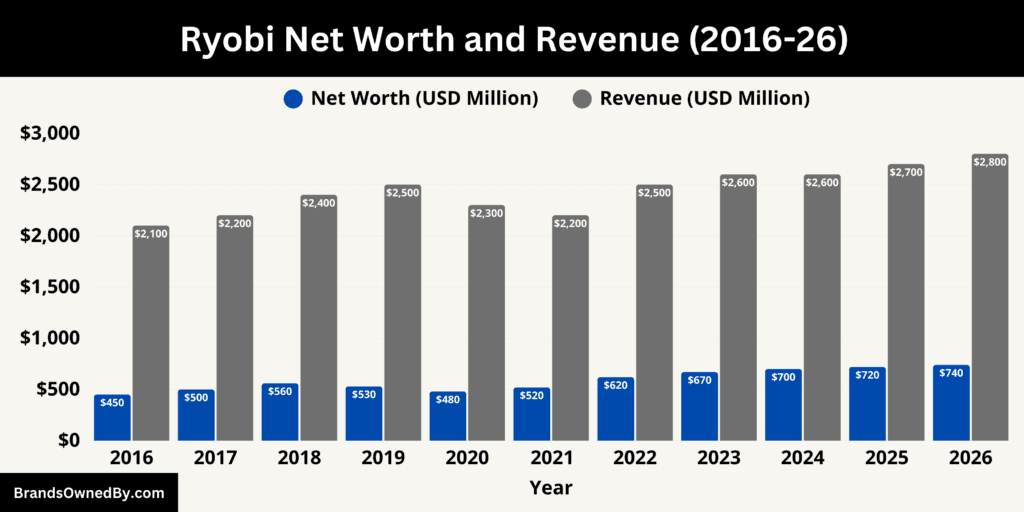
As of March 2026, the company generates more than ¥300 billion in annual revenue, making it a mid-sized industrial manufacturing company within Japan’s automotive supply chain.
For the fiscal year ending December 2025, Ryobi reported ¥309.1 billion in total revenue, which equals roughly $2.0 billion depending on exchange rates. The company expects revenue to increase slightly in fiscal year 2026 to around ¥313 billion, reflecting steady demand for aluminum die-cast automotive components.
Ryobi’s market value, which represents its net worth based on stock market capitalization, is approximately ¥84 billion as of March 2026. This equals roughly $560 million depending on exchange rate fluctuations. Market capitalization reflects investor valuation and changes over time depending on share price movements.
The company’s financial structure is strongly centered around its automotive component manufacturing operations. Ryobi is one of the world’s largest manufacturers of aluminum die-cast automotive parts, supplying components used in engines, transmissions, and structural vehicle systems.
Revenue Breakdown by Business Segment
Ryobi operates through three major business divisions. The die-casting business dominates the company’s financial performance and represents the core of its manufacturing operations.
In fiscal year 2025, the company’s revenue was divided across its segments as follows.
The die-casting segment generated approximately ¥274.3 billion, accounting for nearly 89% of total company revenue. This division produces aluminum components used in engines, transmissions, and electric vehicle structures for major global automakers.
The printing equipment segment generated about ¥23.7 billion, representing roughly 8% of total revenue. Ryobi manufactures offset printing presses and related industrial printing machinery used by commercial printing companies.
The builders’ hardware segment generated around ¥10.9 billion, contributing roughly 3% of company revenue. This division produces architectural hardware such as door closers, hinges, and other construction components.
The dominance of the die-casting segment highlights Ryobi’s strong position in the automotive manufacturing supply chain. Demand for aluminum components has grown as automakers increasingly adopt lightweight materials to improve fuel efficiency and support electric vehicle production.
Net Worth and Corporate Assets
Ryobi’s net worth is typically measured through its market capitalization because the company is publicly traded. As of March 2026, Ryobi Limited’s market value is approximately ¥84 billion.
However, the company’s total corporate assets are significantly larger than its market value. At the end of fiscal year 2025, Ryobi reported total assets exceeding ¥340 billion.
These assets include global manufacturing plants, advanced die-casting machinery, industrial equipment, intellectual property, and research facilities. The company operates production facilities across several countries including Japan, the United States, Mexico, China, and Thailand.
Ryobi also invests consistently in research and development to improve die-casting technology and automotive component design. These investments help the company remain competitive within the global automotive supply chain.
Revenue Forecast Through 2030
Ryobi expects gradual revenue growth through the rest of the decade as demand for aluminum automotive components continues to increase.
- 2026: ¥313 billion projected revenue as automotive demand remains stable.
- 2027: Revenue could reach around ¥330–¥340 billion as new automotive component programs begin production.
- 2028: Sales may approach ¥350 billion with rising demand for lightweight components used in electric vehicles.
- 2029: Revenue could grow to roughly ¥360–¥370 billion as the company expands manufacturing capacity.
- 2030: If current trends continue, annual revenue could reach ¥380–¥400 billion.
Most of this growth is expected to come from the die-casting division, which already contributes nearly ninety percent of total revenue. As automakers increasingly use aluminum parts to reduce vehicle weight and improve battery efficiency in electric vehicles, Ryobi’s manufacturing expertise is expected to remain in high demand.
Overall, Ryobi’s financial performance reflects its role as a specialized automotive component manufacturer rather than a consumer tool company, even though the Ryobi brand is widely recognized in the global power tools market.
Brands Owned by Ryobi
Ryobi Limited operates several companies, subsidiaries, and product brands that support its global manufacturing operations. Unlike consumer conglomerates that manage dozens of retail brands, Ryobi focuses on specialized industrial businesses. Its owned brands and entities are mainly involved in automotive die-casting, industrial machinery, and architectural hardware.
It operates multiple subsidiaries across North America and Asia to support global automotive manufacturing. These subsidiaries manufacture aluminum die-cast components used by major automobile manufacturers and also produce industrial equipment and construction hardware.
Below are the major companies, brands, and operating entities owned and managed directly by Ryobi Limited as of 2026:
| Company / Brand | Type | Headquarters / Location | Key Business Activity |
|---|---|---|---|
| Ryobi Limited | Parent Company | Hiroshima, Japan | Global industrial manufacturer specializing in aluminum die-casting, automotive components, printing presses, and architectural hardware. Oversees global subsidiaries and manufacturing operations. |
| Ryobi Imex Co., Ltd. | Subsidiary | Japan | Trading and logistics company managing procurement, import of raw materials, and global distribution of Ryobi products and industrial components. |
| Ryobi Die Casting (USA) Inc. | Manufacturing Subsidiary | Shelbyville, Indiana, USA | Produces aluminum engine blocks, transmission cases, and structural automotive components for North American automobile manufacturers. |
| Ryobi Aluminium Casting USA Inc. | Manufacturing Subsidiary | United States | Manufactures high-precision aluminum automotive components including drivetrain and engine parts for global automakers operating in North America. |
| Ryobi Die Casting (Mexico) Inc. | Manufacturing Subsidiary | Irapuato, Mexico | Produces aluminum die-cast automotive components and supplies vehicle manufacturers across the North American automotive production network. |
| Ryobi Die Casting (Thailand) Co., Ltd. | Manufacturing Subsidiary | Thailand | Major Southeast Asian production hub manufacturing aluminum automotive parts for regional and global automakers operating in Asia. |
| Ryobi Die Casting (China) Co., Ltd. | Manufacturing Subsidiary | China | Produces die-cast automotive components for both domestic Chinese automakers and international manufacturers operating in China. |
| Ryobi Builders’ Hardware | Product Brand / Division | Japan | Manufactures architectural hardware including door closers, hinges, and mechanical door control systems used in residential and commercial buildings. |
| Ryobi Printing Press | Product Brand / Division | Japan | Develops and manufactures offset printing presses and industrial printing machinery used by commercial printing companies worldwide. |
Ryobi Limited
Ryobi Limited is the parent company that owns the Ryobi brand and oversees all global operations. The company was founded in 1943 in Hiroshima, Japan, and remains headquartered there today.
Ryobi Limited specializes in aluminum die-casting technology, industrial equipment, and architectural hardware. It supplies automotive components such as engine blocks, transmission housings, and structural aluminum parts to global automobile manufacturers.
The company also manufactures offset printing presses and construction hardware used in buildings. Ryobi Limited operates production facilities in several countries and manages its subsidiaries across Asia and North America.
Ryobi Imex Co., Ltd.
Ryobi Imex Co., Ltd. is a trading and logistics subsidiary of Ryobi Limited. The company handles global procurement, export, and distribution of materials and products used in Ryobi’s manufacturing operations.
This subsidiary plays a key role in coordinating international supply chains. It manages the import of raw materials and the export of finished industrial components to global automotive manufacturers.
Ryobi Imex also helps streamline procurement operations by sourcing specialized industrial materials required for die-casting production.
Ryobi Die Casting (USA) Inc.
Ryobi Die Casting (USA) Inc. is one of the company’s largest international subsidiaries. It operates a major automotive component manufacturing facility in Shelbyville, Indiana.
The plant produces aluminum engine blocks, transmission housings, and structural automotive components for automobile manufacturers in the United States.
This facility allows Ryobi to supply parts directly to North American vehicle assembly plants and reduce logistics costs. It also supports just-in-time manufacturing systems used by automotive companies.
Ryobi Aluminium Casting USA Inc.
Ryobi Aluminium Casting USA Inc. is another important U.S. subsidiary specializing in aluminum casting technology.
The company focuses on producing high-precision aluminum automotive components used in engines and drivetrain systems. Its manufacturing capabilities allow Ryobi to support several global automakers operating production facilities in the United States.
The subsidiary plays a critical role in expanding Ryobi’s presence in the North American automotive supply chain.
Ryobi Die Casting (Mexico) Inc.
Ryobi Die Casting (Mexico) Inc. operates a large aluminum die-casting plant in Irapuato, Mexico. The facility produces automotive components for manufacturers operating within Mexico’s growing automotive industry.
Mexico has become a major global automotive manufacturing hub, hosting production plants for numerous international automakers. Ryobi’s Mexican subsidiary supplies aluminum components to these manufacturers and supports the broader North American vehicle production network.
The facility strengthens Ryobi’s manufacturing footprint in North America and enables efficient cross-border supply chains.
Ryobi Die Casting (Thailand) Co., Ltd.
Ryobi Die Casting (Thailand) Co., Ltd. serves as the company’s primary manufacturing hub for Southeast Asia.
The facility manufactures aluminum automotive components for vehicle manufacturers operating in Thailand and neighboring countries. Thailand is one of Asia’s largest automobile production centers, often referred to as the “Detroit of Southeast Asia.”
By operating a plant in Thailand, Ryobi can supply automotive manufacturers throughout Southeast Asia while maintaining close proximity to assembly plants.
Ryobi Die Casting (China) Co., Ltd.
Ryobi Die Casting (China) Co., Ltd. supports the company’s presence in the Chinese automotive manufacturing market.
China produces more automobiles than any other country in the world, making it a critical market for automotive suppliers. Ryobi’s Chinese operations manufacture aluminum die-cast components used in vehicle engines and structural systems.
This subsidiary allows Ryobi to serve both domestic Chinese automakers and international automotive companies operating manufacturing plants in China.
Ryobi Builders’ Hardware Brand
Ryobi Builders’ Hardware is a long-standing product brand operated directly by Ryobi Limited. The brand manufactures architectural hardware used in residential and commercial buildings.
Products include door closers, hinges, and mechanical hardware systems used in offices, schools, hospitals, and industrial buildings. These products help improve building safety and accessibility.
Although this segment contributes a smaller portion of company revenue compared with automotive components, it remains an important legacy brand within Ryobi’s portfolio.
Ryobi Printing Press Brand
Ryobi also operates a printing equipment brand that manufactures offset printing presses and related machinery.
These machines are used in commercial printing operations for producing books, magazines, packaging materials, and promotional print products. Ryobi’s printing presses are known for high precision and reliability.
The printing equipment business has historically been an important part of Ryobi’s industrial manufacturing operations, even though the automotive die-casting business now dominates company revenue.
Ryobi Global Manufacturing Network
In addition to the companies and brands listed above, Ryobi operates a global manufacturing network consisting of production plants, engineering centers, and industrial technology facilities.
These operations support research and development, product design, and advanced manufacturing technologies used in aluminum die-casting and industrial machinery production.
Through its subsidiaries and specialized brands, Ryobi Limited maintains a global presence across multiple manufacturing regions while focusing on automotive components, industrial equipment, and architectural hardware as its core businesses.
Final Words
Understanding who owns Ryobi requires looking beyond the tools themselves. The Ryobi brand is owned by Ryobi Limited, a Japanese industrial manufacturer, while the widely known Ryobi power tools are produced and distributed by Techtronic Industries under a licensing agreement.
This unique structure allows Ryobi Limited to focus on its core strengths in automotive die-casting and industrial manufacturing, while Techtronic Industries expands the Ryobi tools ecosystem globally. As a result, Ryobi remains both a major industrial supplier and one of the most recognizable tool brands among DIY users.
In simple terms, if you are asking who owns Ryobi, the answer lies with Ryobi Limited as the brand owner and Techtronic Industries as the company driving the global Ryobi tools business.
FAQs
Where is Ryobi based?
Ryobi is based in Hiroshima, Japan. The company operates under Ryobi Limited, a Japanese industrial manufacturer founded in 1943. Its headquarters remain in Hiroshima, where the company manages its global manufacturing operations, including automotive die-casting, printing equipment, and builders’ hardware.
Who owns Ryobi tools?
Ryobi tools are manufactured and distributed by Techtronic Industries under a licensing agreement. Techtronic Industries designs, produces, and markets Ryobi power tools in major markets such as the United States, Canada, Europe, Australia, and New Zealand.
Who owns the Ryobi brand?
The Ryobi brand is owned by Ryobi Limited, a Japanese publicly traded manufacturing company. While the brand belongs to Ryobi Limited, the consumer power tools business is licensed to Techtronic Industries, which handles the development and global distribution of Ryobi tools.
Where are Ryobi tools made?
Ryobi tools are manufactured in multiple countries through facilities operated by Techtronic Industries. Most Ryobi tools are produced in China and Vietnam, although some components and specialized products may also be manufactured in other global facilities.
Who makes Ryobi tools?
Techtronic Industries manufactures Ryobi tools. The company designs, engineers, and produces Ryobi power tools and outdoor equipment under a licensing agreement with Ryobi Limited.
Who owns Ryobi power tools?
Ryobi power tools are owned as a brand by Ryobi Limited but are produced and managed commercially by Techtronic Industries. This partnership allows Ryobi Limited to retain brand ownership while Techtronic Industries runs the global tools business.
Are Milwaukee and Ryobi owned by the same company?
Milwaukee and Ryobi tools are both manufactured by Techtronic Industries. However, Milwaukee is fully owned by Techtronic Industries, while Ryobi tools are produced under a licensing agreement from Ryobi Limited.
Is Ryobi owned by DeWalt?
No, Ryobi is not owned by DeWalt. DeWalt is owned by Stanley Black & Decker, a different tool manufacturer. Ryobi is owned by Ryobi Limited and its tools are produced by Techtronic Industries.
Is Ryobi a Japanese or Chinese company?
Ryobi is a Japanese company. The brand and original company, Ryobi Limited, are headquartered in Hiroshima, Japan. Although many Ryobi tools are manufactured in China and other countries, the company itself is Japanese.
Is Ryobi made in Germany?
No, Ryobi tools are not manufactured in Germany. Most Ryobi tools are produced in Asia, primarily in China and Vietnam, through factories operated by Techtronic Industries.
Is Ryobi US-made?
Most Ryobi tools are not manufactured in the United States. They are primarily produced in Asian manufacturing facilities. However, Ryobi products are widely sold in the United States through major retailers such as Home Depot.