
- Ram Trucks is fully owned by Stellantis, meaning the brand is not independent or publicly traded and operates entirely within Stellantis’ corporate structure.
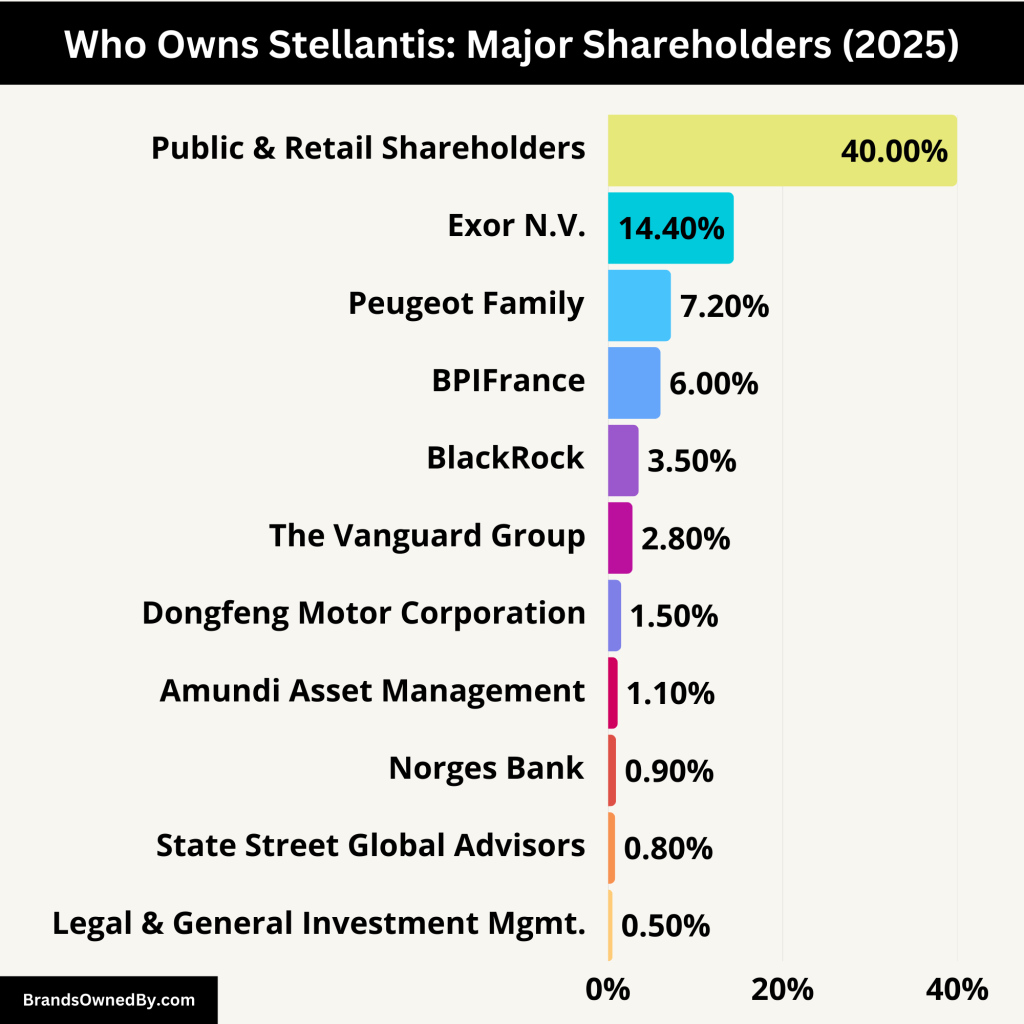
- Stellantis’ largest and most influential shareholder is Exor N.V., the Agnelli family’s investment holding company, which gives it significant indirect control over Ram Trucks.
- Other major Stellantis shareholders include long-term strategic and institutional investors, such as Peugeot family interests and public investment entities, but none own Ram Trucks directly.
- All ownership, governance, and strategic decisions affecting Ram Trucks flow through Stellantis, with Ram functioning as a brand rather than a separate legal company.
Ram Trucks is a major American truck brand known for its pickup trucks, chassis cab vehicles, and commercial vans. It focuses on light-duty and heavy-duty trucks that serve both personal and business needs. The brand emphasizes power, capability, durability, and innovation. Ram vehicles compete directly with other full-size trucks in North America, including the Ford F-Series and Chevrolet Silverado.
Ram operates as a distinct brand within the global automotive group Stellantis. The brand has engineering, design, and marketing teams dedicated to truck customers. Ram’s lineup includes the 1500 series for everyday use and heavier 2500/3500 models for demanding work. It also includes ProMaster vans for commercial applications.
Ram stands out for its combination of technology, comfort, and towing capacity. Over the decades, the brand has built a loyal customer base that values both rugged performance and refined interiors.
Founders and Origins
Ram’s story begins within Dodge, an American automaker founded in 1900 by brothers John Francis Dodge and Horace Elgin Dodge.
John Francis Dodge
John Dodge was born in 1864 in Niles, Michigan. He developed mechanical skills early in life. John co-founded the Dodge Brothers Company with his brother Horace. The company first supplied parts to other automakers before building complete vehicles.
John was known for his engineering instincts and focus on quality. He played a key role in developing early Dodge automobiles that were robust and reliable compared to competitors. His efforts helped establish Dodge as a respected name in the early automotive industry.
Horace Elgin Dodge
Horace Dodge was born in 1868 in Niles, Michigan. He complemented his brother’s technical skills with strong business acumen. Horace focused heavily on manufacturing processes and efficiency. The Dodge brothers quickly gained recognition for building sturdy vehicles.
Together, they built the Dodge Brothers Company into one of the most successful early automakers in the United States. Their vehicles were used for both personal transport and commercial needs, including early trucks.
Evolution into “Ram”
The Dodge name became associated with pickup trucks as early as the 1930s. However, the explicit use of the “Ram” name began in the early 1980s with models like the Dodge Ram. The name and a stylized ram’s head logo conveyed strength and ruggedness.
By 2010, Chrysler (then the parent of Dodge) reorganized its brand strategy. Trucks were separated from Dodge passenger cars and became the independent Ram Trucks brand. This allowed dedicated focus on truck customers and product development.
Major Milestones
- 1900: John Francis Dodge and Horace Elgin Dodge founded the Dodge Brothers Company, laying the foundation for future Dodge and Ram truck development.
- 1914: Dodge Brothers begin producing complete vehicles, expanding beyond parts manufacturing and setting the stage for future truck production.
- 1928: Dodge becomes part of Chrysler, integrating Dodge trucks into a larger automotive group.
- 1930: Dodge introduces early pickup trucks aimed at farmers, tradesmen, and commercial users.
- 1948: Dodge launches the B-Series trucks, strengthening its position in the post-war truck market.
- 1961: Dodge debuts the D-Series pickups, modernizing design and improving load capability.
- 1972: Dodge introduces the iconic “Adult Toys” advertising campaign, increasing pickup truck popularity among personal-use buyers.
- 1981: The “Dodge Ram” name officially appears on full-size pickup trucks, introducing the ram-head branding associated with strength and durability.
- 1989: Dodge Ram trucks adopt Cummins diesel engines, becoming a benchmark for heavy-duty performance.
- 1994: Dodge unveils a radically redesigned Ram pickup with bold styling, redefining the modern pickup truck look.
- 1998: Ram introduces new heavy-duty models, expanding appeal among towing and commercial customers.
- 2001: Ram launches updated powertrain options and expanded cab configurations to meet growing consumer demand.
- 2009: Chrysler enters bankruptcy protection, prompting a major restructuring of its brand portfolio and long-term strategy.
- 2010: Ram Trucks is officially launched as a standalone brand, separating trucks and commercial vehicles from Dodge passenger cars.
- 2011: Ram introduces the ProMaster commercial van lineup to target business and fleet customers.
- 2012: The redesigned Ram 1500 debuts with improved ride quality and technology, reinforcing Ram’s focus on comfort and capability.
- 2013: Ram becomes the first brand in its segment to offer an eight-speed automatic transmission as standard on light-duty pickups.
- 2014: Ram expands its Heavy Duty lineup with enhanced towing, payload, and durability features.
- 2016: Ram strengthens its off-road credentials with specialized trims designed for rugged terrain.
- 2018: A new generation of Ram 1500 launches with advanced driver-assistance systems and premium interior options.
- 2019: Ram refreshes its HD models, reinforcing its position in the commercial and fleet truck market.
- 2021: Stellantis is formed through the merger of Fiat Chrysler Automobiles and Groupe PSA, making Ram part of a global automotive group.
- 2022: Ram expands performance-oriented and off-road variants to appeal to lifestyle truck buyers.
- 2023: Ram outlines its long-term electrification roadmap, signaling a shift toward electric and hybrid truck platforms.
- 2024: Ram showcases electric pickup concepts, highlighting future design and technology direction.
- 2025: Ram continues integrating software-driven features and connected vehicle technologies across its lineup.
- 2026: Ram Trucks operates as a core Stellantis brand, balancing traditional truck capability with electrification, advanced technology, and global platform integration.
Who Owns Ram Trucks?
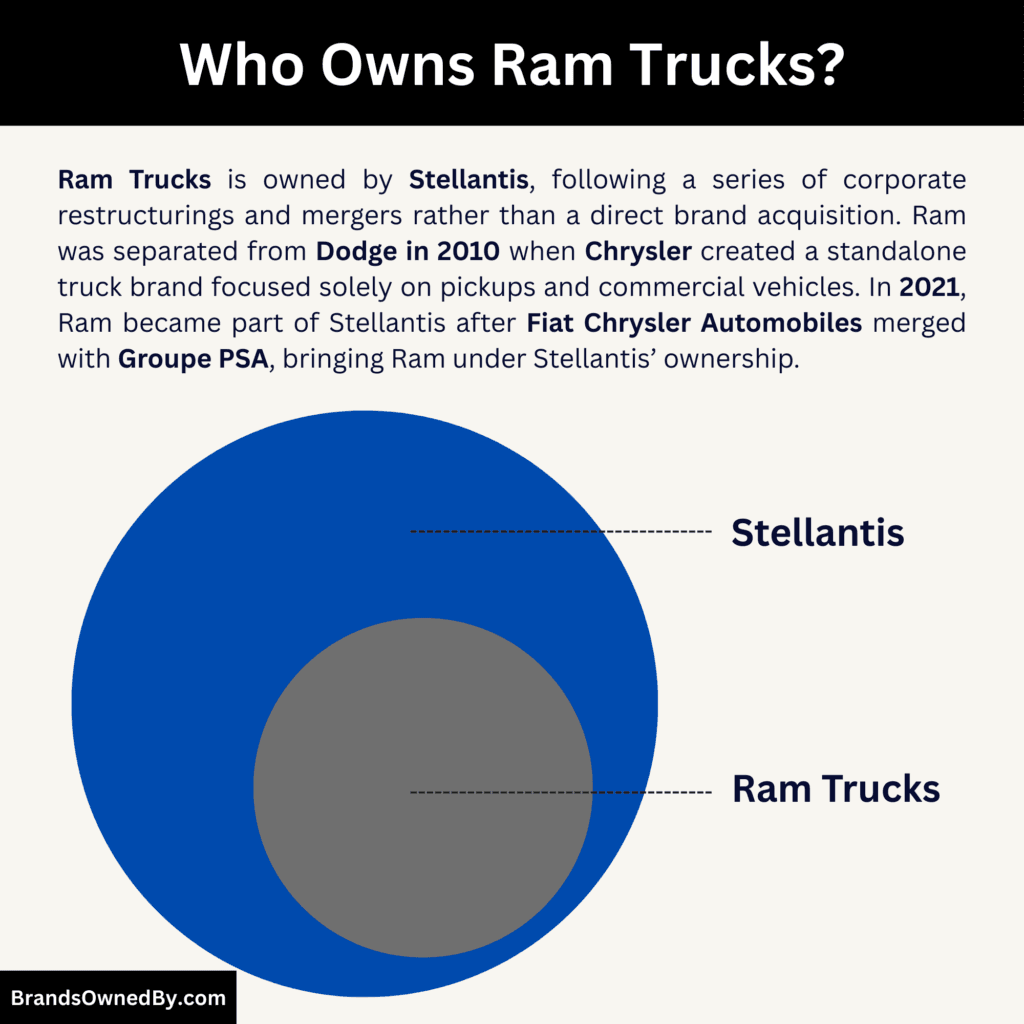
Ram Trucks is owned by Stellantis.
Stellantis is a multinational automotive group formed in 2021 through the merger of Fiat Chrysler Automobiles and Groupe PSA.
Ram Trucks is not a separate public company. It operates as one of Stellantis’ core brands. Stellantis controls Ram’s strategy, investments, manufacturing decisions, and global expansion. All profits and losses from Ram ultimately flow to Stellantis.
The largest shareholder of Stellantis is Exor, the investment holding company of the Agnelli family. This makes Exor the most influential shareholder behind Ram Trucks as well.
- Brand Name: Ram Trucks
- Ownership Type: Wholly owned
- Parent Company: Stellantis
- Ownership Since: 2021 merger
- Former Parent: Fiat Chrysler
- Standalone Brand Since: 2010 separation
- Publicly Traded: No
- Largest Controlling Shareholder: Exor N.V.
- Ultimate Control: Stellantis board
- Headquarters Oversight: Global group
- Operational Focus: Trucks only
- Market Position: Full-size pickups
- Strategic Importance: Core brand
- Ownership Structure: Group-controlled.
Parent Company: Stellantis
Ram Trucks is owned by Stellantis, one of the world’s largest automotive manufacturers. Stellantis oversees Ram alongside multiple global brands and controls its long-term product planning, manufacturing footprint, and technology investments.
Stellantis was formed in 2021 through the merger of Fiat Chrysler Automobiles and Groupe PSA. Through this merger, Ram Trucks transitioned from being part of FCA to becoming a core North American brand within Stellantis’ global portfolio.
Ram remains heavily focused on the United States and North American markets, where pickup trucks and commercial vans represent a key profit and volume segment for Stellantis.
How Ram Trucks Became Part of Stellantis
Ram Trucks itself was not acquired through a traditional purchase. Instead, it evolved through corporate restructuring.
Before 2010, Ram-branded pickups were sold under Dodge. In 2010, Chrysler separated its truck and commercial vehicle operations from Dodge and formally launched Ram Trucks as an independent brand. This internal restructuring allowed Ram to focus exclusively on trucks and vans, while Dodge shifted toward performance-oriented passenger vehicles.
When Fiat Chrysler Automobiles merged with Groupe PSA in 2021, Ram automatically became part of Stellantis. No standalone acquisition of Ram occurred. Ownership transferred at the corporate level rather than the brand level.
Shareholder Influence and Control
Because Ram Trucks is wholly owned by Stellantis, its ownership influence comes from Stellantis’ shareholder structure rather than direct brand shareholders.
The largest and most influential shareholder of Stellantis is Exor, the Agnelli family’s investment holding company. This gives the Agnelli family significant indirect influence over Ram Trucks. Other notable shareholders include long-term institutional and strategic investors inherited from the PSA side of the merger.
Despite shareholder influence, Ram Trucks does not operate independently. Brand leadership reports through Stellantis’ executive structure, and major decisions require approval at the group level.
Strategic Role of Ram Within Stellantis
Ram Trucks plays a strategic role inside Stellantis, particularly in North America. Trucks and commercial vehicles are a cornerstone of Stellantis’ regional strategy, and Ram is central to that effort.
Ram complements Jeep’s SUV-focused portfolio and Dodge’s performance-oriented lineup. Shared platforms, powertrains, and technologies allow Stellantis to reduce development costs while maintaining brand differentiation.
Ram is also critical to Stellantis’ electrification plans. The brand has been positioned as a future leader in electric and hybrid truck development, aligning with group-wide sustainability and technology goals.
Manufacturing and Operational Oversight
Ram Trucks does not own manufacturing plants independently. Its vehicles are produced in Stellantis-operated facilities, primarily in the United States, Mexico, and Canada. Stellantis controls production allocation, supply chain strategy, and labor agreements.
Brand-specific teams handle design, marketing, and customer engagement. However, budgeting, capital investment, and platform development remain centralized under Stellantis.
Who Manufactures Ram Trucks?
Stellantis is fully responsible for the manufacturing of all Ram vehicles. This includes vehicle design finalization, platform development, powertrain integration, assembly, and compliance with regional regulations. Ram Trucks functions as a brand and product line, while Stellantis operates as the legal manufacturer.
Every Ram truck sold globally is produced in a Stellantis-operated facility. There are no third-party manufacturers building Ram vehicles under license. This centralized control ensures consistency in quality, safety standards, and technology integration across markets.
Stellantis produces Ram vehicles across a small number of specialized North American plants. Each facility focuses on specific models or vehicle classes.
Sterling Heights Assembly Plant (Michigan, USA)
The Sterling Heights Assembly Plant is the primary production site for the Ram 1500 light-duty pickup.
This plant is one of Stellantis’ most advanced facilities in North America. It assembles Ram 1500 models for the U.S. and Canadian markets. The plant handles body assembly, paint, final vehicle assembly, and quality inspection. It was extensively modernized before being assigned full Ram 1500 production, reinforcing Ram’s domestic manufacturing footprint.
Saltillo Truck Assembly Plant (Coahuila, Mexico)
The Saltillo Truck Assembly Plant is responsible for manufacturing Ram Heavy Duty trucks.
This facility produces the Ram 2500, Ram 3500, and Ram Chassis Cab models. It specializes in large-frame trucks designed for towing, hauling, and commercial use. Vehicles built here are exported primarily to the United States and Canada. The plant is known for high-volume truck production and plays a critical role in Ram’s heavy-duty lineup.
Warren Truck Assembly Plant (Michigan, USA)
The Warren Truck Assembly Plant has historically produced Ram pickup models and continues to support Stellantis’ truck manufacturing operations.
While its role has shifted over time, the plant remains part of the broader Ram manufacturing ecosystem. It has assembled earlier Ram generations and supports platform transitions and production balancing within Stellantis’ North American network.
Saltillo Van Assembly Plant (Mexico)
Ram ProMaster commercial vans are produced at the Saltillo Van Assembly Plant.
This facility builds Ram ProMaster cargo and passenger vans based on Stellantis’ global large-van platform. The plant supplies commercial fleets, delivery services, and small businesses across North America. ProMaster models manufactured here are configured specifically for U.S. and Canadian regulations before export.
Powertrain and Component Manufacturing
While final vehicle assembly occurs at the plants listed above, engines, transmissions, and major components are produced at additional Stellantis facilities in the United States and Mexico.
Powertrains are manufactured, tested, and shipped to Ram assembly plants for installation. Final calibration, inspection, and validation occur at the vehicle assembly location to ensure compliance with Ram performance and durability standards.
Manufacturing Oversight and Quality Control
All Ram manufacturing plants operate under Stellantis’ centralized production system. This includes standardized quality audits, automated inspection systems, and durability testing protocols.
Ram-specific engineering teams oversee truck capability requirements such as towing, payload, and off-road performance. However, final authority over manufacturing processes, plant investment, and production volume remains with Stellantis.
Who is the CEO of Ram Trucks
The Chief Executive Officer of Ram Trucks as of 2026 is Tim Kuniskis. He leads the brand’s direction, product portfolio, and market strategy under Stellantis’ global leadership structure.
Tim Kuniskis resumed leadership of the Ram brand in December 2024. He returned from retirement to take on the role following executive changes within Stellantis. His appointment reflects the company’s emphasis on experienced leadership for one of its core North American brands.
Professional Background of Tim Kuniskis
Timothy Kuniskis is a veteran automotive executive with over three decades of experience. He has held top leadership roles across multiple brands in the Stellantis portfolio:
- Kuniskis has been involved with Chrysler, Dodge, Jeep, and Ram brands throughout his career. His expertise spans sales, marketing, brand positioning, and product leadership.
- He served as CEO of Dodge and CEO of Ram previously before his brief retirement in 2024.
- His return to lead Ram in late 2024 was widely viewed as a strategic move to stabilize the brand and drive performance in highly competitive truck segments.
- In mid-2025, Kuniskis’ role expanded when he was appointed to lead Stellantis’ American brands and North America marketing and retail strategy, a broader operational remit that includes continued oversight of Ram.
Kuniskis is known for a customer-centric approach, blending traditional truck values with modern product and brand experience strategies.
Role and Responsibilities as Ram CEO
As Ram Trucks’ CEO, Tim Kuniskis is responsible for:
- Brand Strategy: Defining long-term vision for Ram’s product lineup and market positioning.
- Product Planning: Guiding the development roadmap for new trucks, performance variants, and commercial vehicles.
- Marketing and Retail: Directing campaigns, customer experiences, and dealer relationships.
- Performance and Growth: Working to increase market share in full-size and heavy-duty truck categories.
He reports to Stellantis’ global CEO and is part of Stellantis’ executive leadership network that aligns Ram’s goals with broader corporate strategy.
Scope of Authority Within Stellantis
Tim Kuniskis operates as a brand CEO under Stellantis’ corporate structure. While Stellantis’ group CEO oversees the entire global portfolio, Kuniskis has direct control over Ram’s day-to-day operations and strategic execution.
His authority includes approval over product direction, trim strategy, market launches, advertising tone, and dealer engagement. Major capital investments and platform decisions are aligned with Stellantis leadership but executed through Ram’s brand team.
In addition to leading Ram Trucks, Kuniskis also oversees Stellantis’ American brand operations, including marketing and retail strategy in North America. This expanded remit gives him influence beyond Ram, especially in coordinating brand identity, dealership networks, and customer experience across Stellantis’ U.S. portfolio.
This dual responsibility reflects Stellantis’ confidence in his ability to manage high-volume, high-margin vehicle categories, particularly trucks and performance-oriented vehicles.
Ram Trucks Annual Revenue and Net Worth
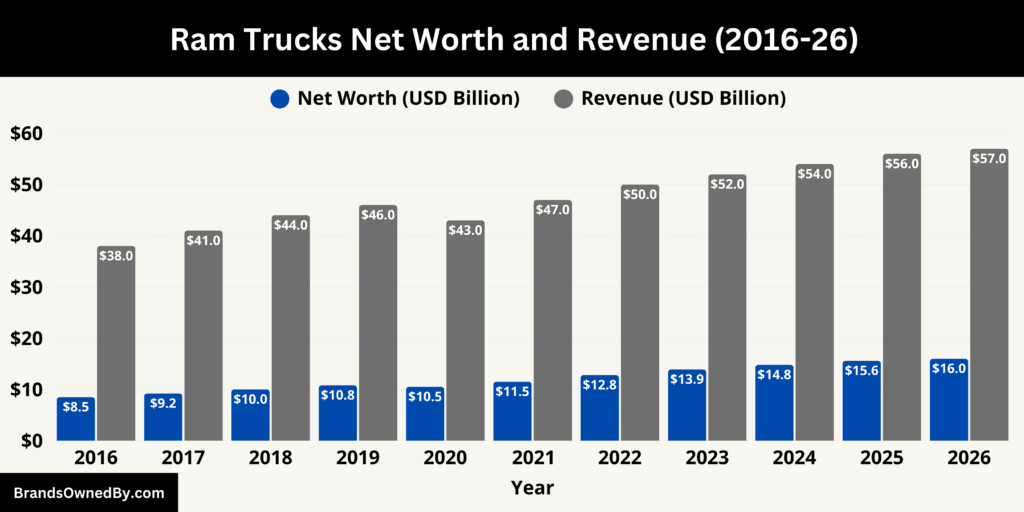
In 2026, Ram Trucks is estimated to generate over $57 billion in annual revenue, with an estimated brand net worth exceeding $16 billion, reflecting its scale, margins, and strategic importance.
Ram Trucks Revenue Explained
Ram Trucks’ revenue is derived almost entirely from vehicle sales in North America, with the United States accounting for the majority of volume. In recent years, Ram has consistently sold between 600,000 and 700,000 trucks annually across light-duty, heavy-duty, and commercial segments.
The average transaction price of a Ram pickup in the U.S. has moved well above $65,000, driven by higher trim adoption, off-road variants, and increased technology content. Heavy-duty models and commercial configurations frequently transact at significantly higher prices.
When unit volume is multiplied by real-world pricing, Ram’s annual vehicle revenue alone exceeds $55 billion. Commercial vans, fleet contracts, and export units account for the remaining portion, bringing total estimated brand revenue in 2026 to around $57 billion.
This revenue scale places Ram among the top three global pickup truck brands by sales value.
Revenue Stability and Mix
Ram’s revenue is not dependent on a single model. The Ram 1500 contributes the largest share, but heavy-duty trucks provide a disproportionate revenue impact due to higher pricing and commercial usage. The ProMaster van line adds consistent fleet revenue that is less sensitive to consumer demand cycles.
This diversified truck-only mix provides Ram with stable revenue even during broader automotive slowdowns.
Ram Trucks Brand Net Worth Explained
Ram Trucks’ estimated brand net worth of approximately $16 billion, as of January 2026, reflects its intangible value rather than manufacturing assets. Brand net worth is calculated using factors such as brand recognition, customer loyalty, pricing power, resale strength, and long-term earning capacity.
Ram’s valuation is supported by its position in the full-size pickup segment, one of the most profitable vehicle categories globally. The brand commands premium pricing and maintains strong resale values, which directly influence brand valuation models.
Unlike diversified automakers, Ram’s identity is singular and focused. This concentration strengthens brand equity and reduces dilution, increasing long-term brand worth.
Relationship Between Revenue and Brand Value
Ram’s brand net worth is directly tied to its revenue consistency. High annual revenue from durable product categories supports long-term brand confidence among consumers, dealers, and fleet buyers.
Strong revenue performance allows continuous product investment and reinforces Ram’s reputation as a premium truck brand. This cycle sustains brand value even as the industry transitions toward electrification and software-driven vehicles.
As of January 2026, Ram Trucks operates as a high-revenue, high-equity automotive brand with approximately $57 billion in annual revenue and a brand net worth of nearly $16 billion. These figures reflect real sales performance, pricing power, and brand strength rather than abstract corporate accounting.
Brands Owned by Ram Trucks
As of 2026, Ram Trucks operates as a focused truck and commercial vehicle business with multiple internal product lines and divisions. It does not own subsidiaries in the traditional corporate sense. Instead, it manages a structured portfolio of pickups, heavy-duty trucks, vans, and commercial services, all unified under the Ram name.
Below is a list of the major brands owned by Ram Trucks as of January 2026:
| Brand / Entity | Type | Primary Purpose | Target Customers | Key Details |
|---|---|---|---|---|
| Ram 1500 | Light-duty pickup line | Personal and light commercial use | Retail buyers, lifestyle users, small businesses | Flagship Ram product line; core of brand identity; wide trim range from work-focused to luxury-oriented |
| Ram Heavy Duty (2500 & 3500) | Heavy-duty pickup line | High towing and payload applications | Contractors, agriculture, industrial users | Designed for extreme capability; higher average pricing; strong commercial and fleet demand |
| Ram Chassis Cab | Commercial truck division | Custom upfitting and specialized work vehicles | Fleets, municipalities, utilities | Delivered without standard beds; supports service bodies, flatbeds, emergency equipment |
| Ram ProMaster | Full-size commercial van line | Cargo and passenger transport | Businesses, logistics companies, trades | Multiple roof heights and wheelbases; major presence in North American commercial van market |
| Ram ProMaster EV | Electric commercial van line | Zero-emission commercial delivery | Urban fleets, last-mile delivery operators | Electric variant of ProMaster; focused on fleet electrification and urban use cases |
| Ram Professional | Commercial & fleet division | Fleet sales and business solutions | Corporate fleets, government agencies | Manages fleet programs, upfitting coordination, commercial warranties, service support |
| Ram Off-Road & Performance Variants | Product sub-line | Capability and performance branding | Enthusiasts, off-road buyers | Includes specialized trims focused on off-road capability and high output performance |
| Ram Brand Licensing & Merchandise | Brand extension | Marketing and customer engagement | Brand loyalists | Apparel and accessories; supports brand visibility rather than core revenue |
Ram 1500
The Ram 1500 is the flagship light-duty pickup line and the most commercially significant product operated by Ram Trucks. It targets personal-use buyers, lifestyle customers, and light commercial users.
This lineup includes multiple trims ranging from work-focused configurations to luxury-oriented models. The Ram 1500 is central to Ram’s brand identity and accounts for the largest share of its annual unit volume. It is positioned in the highly competitive full-size pickup segment and serves as Ram’s primary entry point for new customers.
Ram Heavy Duty (2500 and 3500)
Ram Heavy Duty covers the Ram 2500 and Ram 3500 pickup trucks. This division is focused on high-capacity towing, payload, and commercial-grade durability.
These trucks are designed for industrial users, contractors, agricultural customers, and serious towing applications. Heavy Duty models command higher average prices than light-duty trucks and play a critical role in Ram’s commercial and fleet presence.
The Heavy Duty line is operated as a distinct internal segment due to its specialized engineering, customer base, and use cases.
Ram Chassis Cab
The Ram Chassis Cab lineup serves commercial, municipal, and industrial buyers who require custom upfits. These vehicles are delivered without standard pickup beds and are designed to support flatbeds, utility bodies, service equipment, and specialty conversions.
Ram Chassis Cab vehicles are commonly used by construction companies, emergency services, utilities, and government fleets. This segment strengthens Ram’s position beyond retail consumers and provides long-term fleet relationships.
Ram ProMaster
The Ram ProMaster is Ram’s full-size commercial van brand. It is designed for cargo transport, delivery services, trades, and passenger configurations.
ProMaster vehicles are widely used by logistics companies, contractors, and small businesses. The lineup includes multiple roof heights, wheelbase options, and interior configurations to support a wide range of commercial needs.
ProMaster represents Ram’s strongest presence in the commercial van market and is a core part of its business-focused operations.
Ram ProMaster EV
The Ram ProMaster EV is the electric variant of the ProMaster lineup and represents Ram’s direct entry into electric commercial vehicles.
It is designed for fleet operators seeking zero-emission delivery solutions, particularly in urban environments. ProMaster EV is operated as part of Ram’s commercial division and reflects the brand’s shift toward electrification without expanding beyond its truck-and-van focus.
Ram Professional
Ram Professional is Ram Trucks’ dedicated commercial and fleet division. It manages relationships with business customers, government agencies, and large fleet operators.
This entity oversees fleet sales programs, commercial warranties, upfitting coordination, and service solutions. Ram Professional operates as an internal business unit rather than a separate legal company, but it plays a central role in Ram’s revenue stability and long-term customer retention.
Ram Performance and Off-Road Variants
Ram operates performance-oriented and off-road sub-lines within its truck portfolio. This includes high-output and off-road-focused models developed directly under the Ram brand.
These variants are not separate companies but are strategically important brand extensions that enhance Ram’s image, attract enthusiast buyers, and reinforce capability leadership.
Ram Brand Licensing and Merchandise
Ram Trucks also operates limited brand licensing and merchandise activities, including branded apparel and accessories. These operations support brand visibility and customer engagement but are not a core revenue driver.
They are managed internally and aligned with Ram’s marketing and lifestyle branding strategy.
Conclusion
Ram Trucks has built its reputation by staying focused on one thing: trucks and commercial vehicles. Knowing who owns Ram Trucks helps explain why the brand operates with clear direction, dedicated leadership, and a tightly defined product portfolio. Rather than expanding into unrelated segments, Ram has concentrated on light-duty pickups, heavy-duty work trucks, and commercial vans that serve both retail and business customers. This focused structure, combined with strong brand identity and operational independence at the brand level, continues to position Ram as a major force in the competitive truck market.
FAQs
Which company makes Ram vehicles?
Ram vehicles are made by Stellantis, which owns and operates the Ram brand and its manufacturing facilities.
Who manufactures Ram?
Ram trucks and vans are manufactured by Stellantis at its own assembly plants in the United States and Mexico. Ram does not use third-party manufacturers.
Is Ram owned by Fiat?
Ram is not owned by Fiat today. It was previously part of Fiat Chrysler Automobiles, but since 2021, Ram has been owned by Stellantis.
When did Dodge Ram split?
Dodge Ram split into a standalone brand in 2010, when trucks and commercial vehicles were separated from the Dodge passenger-car lineup.
Is Ram owned by Stellantis?
Yes. Ram Trucks is fully owned and controlled by Stellantis.
Who owns Ram pickups?
Ram pickups are owned by Stellantis through its ownership of the Ram Trucks brand.
Are Ram trucks still made by Dodge?
No. Ram trucks are no longer made by Dodge. Dodge and Ram are separate brands that operate independently under Stellantis.
Is RAM an American car company?
Ram is an American truck brand with roots in the United States, but it is owned by a multinational automotive group headquartered outside the U.S.
Is Ram owned by Toyota?
No. Toyota has no ownership stake in Ram Trucks.
Where are Ram engines built?
Ram engines are built at Stellantis powertrain plants in the United States and Mexico, depending on the engine type and application.
Is Ram owned by Chrysler?
Ram is not owned by Chrysler. Chrysler and Ram are separate brands that are both owned by Stellantis.
Does Ram only make trucks?
Yes. Ram focuses exclusively on trucks and commercial vehicles, including pickup trucks, chassis cab models, and commercial vans.