

- Palantir Technologies is publicly traded, with institutional investors owning over 55% of shares, led by Vanguard Group (9.2%), BlackRock (6.5%), and State Street Corporation (4.2%)
- Founders and insiders hold around 8%–10% equity but control nearly 45%–50% of voting power, led by Peter Thiel (3.3%) and Alex Karp (2.2%)
- Retail investors own approximately 36% of total shares, making them a significant part of the shareholder base, but without meaningful governance control
- Palantir’s structure separates economic ownership from voting control, ensuring long-term strategic decisions remain with insiders
Palantir Technologies is a software company that specializes in data analytics and artificial intelligence platforms. It was founded in 2003 with a mission to help organizations make sense of complex data. The company focuses on solving real-world problems using advanced software systems.
Palantir primarily serves government agencies and large enterprises. Its platforms are used in defense, intelligence, healthcare, and manufacturing. The company is known for handling highly sensitive data and delivering actionable insights.
Its core products include Gotham, Foundry, and Apollo. These platforms help users integrate, analyze, and operationalize data. Palantir’s technology is designed to work across different environments, including cloud and on-premise systems.
The company operates with a strong emphasis on privacy, security, and data governance. It has built a reputation for working on critical and high-stakes projects.
Founders of Palantir
Palantir Technologies was founded in 2003 by Peter Thiel, Alex Karp, Joe Lonsdale, Stephen Cohen, and Nathan Gettings. These founders came from diverse backgrounds, including fintech, academia, and engineering. Their combined expertise shaped the company’s early vision.
The idea behind Palantir was heavily influenced by PayPal’s fraud detection systems. Peter Thiel and his network believed similar data-driven approaches could be used for national security and intelligence. Alex Karp was brought in to lead the company and build its long-term strategy. Meanwhile, the rest of the founding team focused on engineering, product development, and scaling the technology.
Each founder had a clearly defined role. Some led strategy and funding. Others built the technical infrastructure. This combination allowed Palantir to develop both a strong business foundation and highly advanced software systems.
Peter Thiel
Peter Thiel was the driving force behind Palantir’s creation. As a co-founder of PayPal, he had already developed systems to detect fraud using data analysis. He saw an opportunity to extend these techniques beyond payments into intelligence and defense.
Thiel provided early funding and strategic direction. He helped position Palantir as a company that could work with government agencies on sensitive missions. His connections and credibility played a key role in securing early partnerships, including backing from In-Q-Tel.
Even after stepping back from daily operations, Thiel has remained one of the most influential figures in Palantir. His long-term vision continues to shape the company’s focus on security, sovereignty, and data-driven decision-making.
Alex Karp
Alex Karp is a co-founder and has served as CEO since the company’s inception. Unlike many tech CEOs, Karp comes from an academic background, holding a PhD in philosophy. This has influenced Palantir’s emphasis on ethics and responsible data use.
Karp oversees the company’s strategy and operations. He has been instrumental in expanding Palantir from a government-focused firm into a broader enterprise software provider. Under his leadership, the company has built long-term relationships with both public and private sector clients.
He is known for his unconventional leadership style. He often emphasizes long-term value over short-term market expectations. His consistent leadership has provided stability and continuity for the company.
Joe Lonsdale
Joe Lonsdale played a key role in Palantir’s early business development and product strategy. He worked closely with the founding team to shape how the company’s software could be applied across industries.
Lonsdale helped translate Palantir’s technical capabilities into real-world use cases. His contributions were important in the company’s early growth phase. He later left Palantir to start other ventures, including firms in technology and investment.
Although he is no longer involved in daily operations, his influence remains part of Palantir’s early foundation and expansion strategy.
Stephen Cohen
Stephen Cohen was one of the key technical architects of Palantir. He focused on building the core software infrastructure that powers the company’s platforms.
Cohen played a major role in developing systems capable of handling complex and large-scale datasets. His work helped ensure that Palantir’s products could operate in high-stakes environments, such as intelligence and defense.
He later took on leadership roles within the company, including responsibilities related to product development and innovation. His technical contributions remain central to Palantir’s technology.
Nathan Gettings
Nathan Gettings was part of the original engineering team. He contributed to the early design and development of Palantir’s systems.
Gettings focused on building scalable and secure data architectures. His work supported the company’s ability to process and analyze large volumes of information efficiently.
Although less publicly visible than some of the other founders, his role was critical during the early stages. He helped establish the technical groundwork that allowed Palantir to grow into a major data analytics company.
Ownership History
The ownership history of Palantir Technologies reflects a deliberate strategy. The company moved from tightly held founder ownership to a widely held public structure, while still preserving insider control. As of 2026, Palantir remains a rare example where economic ownership is distributed, but voting power is concentrated.
Founding Phase and Initial Capital (2003–2008)
At launch in 2003, ownership was almost entirely held by its founders: Peter Thiel, Alex Karp, Joe Lonsdale, Stephen Cohen, and Nathan Gettings.
Peter Thiel provided the initial funding and strategic backing. Ownership at this stage was highly concentrated. Founders controlled both equity and decision-making.
A key early milestone was investment from In-Q-Tel. This was not just capital. It gave Palantir credibility in the intelligence and defense sectors. It also marked the beginning of external ownership entering the cap table.
Private Market Expansion and Institutional Entry (2008–2019)
As Palantir scaled, it raised multiple funding rounds from venture capital firms and institutional investors. Ownership gradually expanded to include private equity funds, strategic investors, and employees.
Despite this expansion, the company maintained tight control over equity distribution. Founders ensured that no external investor gained dominant influence. This was done through structured share classes and controlled dilution.
During this phase, Palantir built long-term relationships with government agencies and large enterprises. Its ownership base became more sophisticated, but still relatively closed compared to typical tech startups.
Pre-Listing Structure and Governance Design
Before going public, Palantir formalized its dual-class share structure. This was a critical decision in its ownership evolution.
The company introduced multiple share classes with different voting rights. Founders and insiders were granted high-voting shares. Public investors would later receive standard voting shares.
This ensured that even if founders reduced their economic stake over time, they would retain control of the company. This governance model was designed to protect the long-term strategy and avoid short-term market pressure.
Direct Listing and Market Entry (2020)
In 2020, Palantir Technologies went public through a direct listing instead of a traditional IPO. This decision had a major impact on ownership.
A direct listing allowed existing shareholders to sell shares directly to the public. No new shares were issued. This meant there was no immediate dilution of ownership.
As a result, founders, early employees, and private investors retained their stakes. At the same time, ownership opened up to institutional and retail investors globally.
Post-Listing Ownership Shifts (2021–2026)
After listing, ownership became increasingly institutional. Large asset managers such as Vanguard Group, BlackRock, and State Street Corporation accumulated significant positions through index funds and ETFs.
Retail investor participation also increased. Palantir became popular among individual investors due to its positioning in AI, defense technology, and big data.
As of April 2026, institutional investors collectively hold a large percentage of total shares. However, no single institution controls the company. Ownership is fragmented on an economic basis.
Founder Control vs Economic Ownership (Current Structure)
The most defining feature of Palantir’s ownership today is the separation between ownership and control.
Founders such as Peter Thiel and Alex Karp hold a smaller percentage of total shares compared to institutions. However, they retain outsized voting power due to high-vote shares.
This means they can influence major corporate decisions, board composition, and long-term strategy. Even large institutional investors have limited ability to challenge this control.
Present Ownership Landscape (April 2026)
As of April 2026, the ownership of Palantir Technologies can be summarized in three layers.
Institutional investors dominate shareholding volume. They include global asset managers and index funds.
Founders and insiders hold a smaller economic stake but control voting power. This group effectively governs the company.
Retail investors make up a meaningful portion of the remaining shares. They contribute to market liquidity and stock price movements but have minimal influence on governance.
This structure allows Palantir to balance access to public capital with strong internal control. It is a model designed for long-term execution rather than short-term market expectations.
Who Owns Palantir Technologies: Top Shareholders
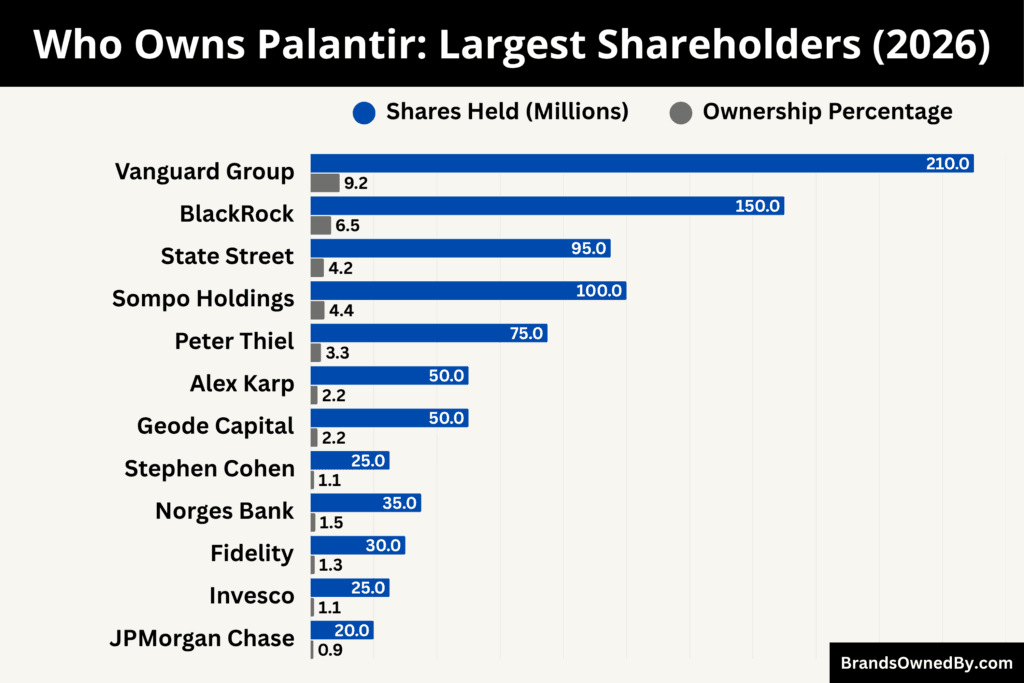
Palantir Technologies is a publicly traded company listed on the NYSE. As of April 2026, it is primarily owned by institutional investors, which collectively hold the largest share of equity. However, control is retained by insiders and founders through a multi-class share structure and special voting rights.
In total, Palantir has roughly 2.2–2.3 billion outstanding shares as of 2026. Institutional investors own over 55% of total shares, retail investors hold around 35%–40%, and insiders own a smaller portion of equity but dominate voting power.
Below is a list of the largest shareholders of Palantir as of April 2026:
The Vanguard Group
Vanguard Group holds approximately 205–215 million shares, representing about 9.0%–9.3% of Palantir.
Vanguard’s ownership comes almost entirely through passive investment vehicles such as index funds and ETFs. Its largest exposure is through funds that track the broader U.S. stock market and major indices where Palantir is included. This means Vanguard increases or decreases its position mainly due to index rebalancing rather than active decision-making.
Although Vanguard is the largest shareholder, it does not actively manage Palantir. It typically votes on governance matters but does not interfere with daily operations or long-term strategy. Its influence is therefore indirect and limited to shareholder voting policies, which are constrained by Palantir’s dual-class structure.
From a market perspective, Vanguard’s large holding adds stability to Palantir’s stock. Its long-term investment approach reduces volatility compared to more active institutional investors.
BlackRock
BlackRock owns roughly 140–155 million shares, equal to about 6.0%–6.8% of Palantir.
BlackRock’s stake is distributed across its iShares ETFs, actively managed funds, and institutional mandates. It is one of the most influential asset managers globally, and its investment decisions often reflect broader market trends.
BlackRock plays a significant role in providing liquidity and maintaining consistent demand for Palantir shares. However, like Vanguard, it is primarily a passive or semi-passive investor in this context.
Despite its size, BlackRock does not have operational control. Its voting influence is diluted due to Palantir’s governance model, which prioritizes founder control. However, BlackRock can still influence corporate governance standards through proxy voting and engagement.
State Street Corporation
State Street Corporation holds approximately 90–100 million shares, representing about 4.0%–4.4% of the company.
State Street’s position is largely tied to its SPDR ETF products, particularly those tracking major U.S. indices. Like Vanguard and BlackRock, it is a passive investor with a long-term horizon.
State Street is known for its focus on governance and stewardship. It often engages with companies on environmental, social, and governance (ESG) issues. However, its ability to influence Palantir is limited due to the company’s voting structure.
Together with Vanguard and BlackRock, State Street forms the “Big Three,” which collectively hold a significant portion of Palantir’s shares. Despite this, they do not control the company.
Sompo Holdings
Sompo Holdings owns around 95–105 million shares, or roughly 4.2%–4.6% of Palantir.
Sompo is a unique shareholder because its relationship with Palantir goes beyond financial investment. The company has partnered with Palantir to integrate advanced data analytics into its insurance operations. This includes risk modeling, claims processing, and operational efficiency improvements.
Its stake reflects a strategic alignment rather than purely financial interest. Sompo benefits directly from Palantir’s technology, making it one of the few shareholders with a business integration component.
This dual role strengthens the relationship between the two companies. However, Sompo still does not have control over Palantir’s governance.
Peter Thiel
Peter Thiel holds approximately 70–80 million shares, representing about 3.0%–3.5% of Palantir.
As a co-founder and chairman, Thiel remains one of the most influential figures in the company. His ownership stake has gradually declined over time due to share sales and dilution. However, his influence has not diminished proportionally.
Thiel’s importance lies in both his equity stake and his role in shaping Palantir’s long-term vision. He continues to influence strategic decisions, partnerships, and overall direction.
Through the company’s special voting structure, Thiel retains significant control. His voting power exceeds his economic ownership, allowing him to remain a central decision-maker.
Alex Karp
Alex Karp owns roughly 45–55 million shares, equal to about 2.0%–2.4% of the company.
As CEO, Karp is deeply involved in the company’s operations and strategic direction. His ownership stake aligns his interests with long-term shareholder value.
Karp is known for prioritizing long-term growth over short-term financial performance. His leadership has been consistent since the company’s founding, which is rare among large public tech companies.
Like other insiders, his voting power is significantly enhanced through special share classes. This ensures he remains a key decision-maker despite holding a relatively small percentage of total shares.
Stephen Cohen
Stephen Cohen holds approximately 20–30 million shares, representing around 1.0%–1.3% of Palantir.
Cohen has played a critical role in building Palantir’s core technology. His background in engineering and data systems helped shape the company’s platforms.
Although he is less publicly visible than Thiel or Karp, Cohen remains an important insider shareholder. His continued stake reflects his long-term involvement and belief in the company’s technology.
His influence is more technical than strategic. However, as a founder, he still benefits from enhanced voting rights.
Geode Capital Management
Geode Capital Management owns about 45–55 million shares, or roughly 2.0%–2.3% of Palantir.
Geode primarily manages index-linked portfolios and institutional mandates. Its investment approach is highly systematic and data-driven.
The firm’s stake represents passive exposure to Palantir as part of broader market indices. It does not engage actively in governance or strategic decisions.
Geode’s presence adds to the overall institutional ownership base, contributing to liquidity and market efficiency.
Norges Bank Investment Management
Norges Bank Investment Management holds approximately 30–40 million shares, representing about 1.3%–1.7% of the company.
This entity manages Norway’s sovereign wealth fund, one of the largest investment funds in the world. Its investment strategy focuses on long-term value creation across global markets.
Norges Bank is known for its strong governance standards. It actively votes on shareholder matters and engages with companies on transparency and sustainability.
However, due to Palantir’s voting structure, its influence remains limited despite its large capital base.
Fidelity Investments
Fidelity Investments owns around 25–35 million shares, equal to roughly 1.1%–1.5% of Palantir.
Fidelity differs slightly from purely passive investors. It manages both active and passive funds, meaning its investment decisions can reflect analyst-driven insights.
Its stake in Palantir indicates confidence in the company’s long-term growth potential, especially in AI and data analytics.
Fidelity may engage more actively with management compared to index funds. However, it still does not have controlling power.
Invesco (QQQ Trust)
Invesco holds approximately 20–30 million shares, or about 0.9%–1.3% of Palantir.
This ownership is largely tied to the Nasdaq-100 ETF (QQQ), where Palantir is included. As a result, Invesco’s stake fluctuates with index adjustments and fund inflows or outflows.
Invesco’s role is primarily to provide exposure to technology-focused investors. It does not actively influence Palantir’s business decisions.
However, its presence reflects Palantir’s growing importance within major tech indices.
JPMorgan Chase
JPMorgan Chase owns roughly 15–25 million shares, representing about 0.7%–1.1% of the company.
JPMorgan’s holdings are spread across asset management divisions, institutional portfolios, and trading activities.
Unlike purely passive investors, JPMorgan may adjust its position based on market conditions and research insights.
It also plays a role in capital markets and advisory services. However, its ownership stake does not translate into governance control.
Retail Investors
Retail investors collectively hold approximately 750–850 million shares, accounting for about 35%–40% of Palantir.
This is a significant portion compared to most large-cap technology companies. Palantir has built a strong following among individual investors due to its positioning in AI, defense, and government technology.
Retail ownership is highly fragmented. Millions of individual shareholders own small amounts of stock. This means they have virtually no coordinated influence over company decisions.
However, retail investors play a major role in stock price movements, volatility, and market sentiment.
Competitor Ownership Comparison
The ownership structure of Palantir Technologies stands out clearly when compared to its competitors. As of April 2026, Palantir combines broad institutional ownership with tightly concentrated voting control in the hands of its founders.
Most competing companies in data analytics, cloud, and enterprise software follow a one-share-one-vote structure, where ownership and control are aligned. In contrast, Palantir separates economic ownership from decision-making power through its dual-class shares and Founder Voting Trust.
| Company | Institutional Ownership | Founder Ownership / Influence | Voting Structure | Control Type | Key Decision Makers |
|---|---|---|---|---|---|
| Palantir Technologies | 55%+ | Peter Thiel (3.3%), Alex Karp (2.2%) | Dual-class + Founder Voting Trust | Founder-controlled | Founders and insiders dominate decisions |
| Snowflake | 75%+ | Minimal founder control | One-share-one-vote | Institutionally controlled | Board and institutional investors |
| Microsoft | 70%+ | Bill Gates (minor stake, no control) | One-share-one-vote | Fully institutional | CEO and board (Satya Nadella-led) |
| IBM | 65%–70% | No founder involvement | One-share-one-vote | Institutional / Board controlled | CEO and board (Arvind Krishna-led) |
| Oracle Corporation | 45%–50% | Larry Ellison (significant stake) | One-share-one-vote | Founder-influenced | Founder + board |
| Amazon | 60%+ | Jeff Bezos (large but non-controlling) | One-share-one-vote | Balanced institutional | CEO and board (Andy Jassy-led) |
Snowflake
Snowflake has a highly institutional ownership structure as of 2026. Institutional investors collectively own over 75% of the company, with major stakes held by Vanguard Group, BlackRock, and other global funds.
Founder influence has significantly declined. Early leaders such as Frank Slootman and initial venture investors no longer dominate control.
Snowflake operates under a standard governance model. Its board of directors and institutional shareholders drive decision-making. This makes it more responsive to shareholder expectations and market performance compared to Palantir.
Microsoft
Microsoft represents a fully mature ownership structure in 2026. Institutional investors own over 70% of total shares, with the largest stakes held by Vanguard Group, BlackRock, and State Street Corporation.
No founder controls Microsoft today. Bill Gates holds a much smaller stake compared to earlier years, and operational control lies entirely with executive leadership under CEO Satya Nadella.
Microsoft follows a pure one-share-one-vote system, where voting power directly matches ownership. This ensures strong institutional influence and accountability to shareholders.
IBM
IBM has one of the most traditional ownership structures in the industry. As of 2026, institutional investors hold around 65%–70% of shares, with no dominant individual shareholder.
The company has no founder control and no dual-class share structure. Governance is handled by its board and executive team, led by CEO Arvind Krishna.
IBM’s ownership model is fully aligned with shareholder voting. This creates a system where large institutional investors can influence corporate strategy more directly than in Palantir.
Oracle
Oracle Corporation represents a hybrid ownership model as of 2026. Institutional investors own over 45%–50% of shares, but founder Larry Ellison remains one of the largest individual shareholders with a significant stake.
Ellison’s influence comes from his large economic ownership, not from enhanced voting rights. Oracle does not use a dual-class structure like Palantir.
This creates a balance between founder influence and institutional oversight. However, control is still more aligned with ownership compared to Palantir’s structure.
Amazon
Amazon has a widely distributed ownership base. Institutional investors hold over 60% of shares as of 2026.
Founder Jeff Bezos remains a major shareholder, but his stake is well below a controlling level. Amazon does not use a dual-class voting system.
The company is governed by its board and executive leadership, currently led by CEO Andy Jassy.
Amazon’s structure ensures that no single shareholder dominates control, making it more balanced compared to Palantir.
Key Structural Differences
The comparison highlights a clear pattern across the industry.
Most competitors operate under standard governance models, where voting power equals ownership. Institutional investors dominate both economically and strategically.
In contrast, Palantir Technologies separates these two elements. Institutional investors own over 55% of shares, yet founders retain nearly half of the total voting power.
This creates a system where:
- Economic ownership is widely distributed
- Voting control is concentrated among insiders
- Institutional influence is structurally limited.
Why Palantir’s Model Is Different in 2026
As of April 2026, Palantir’s ownership model remains one of the most founder-controlled among major public tech companies.
Its multi-class share structure and Founder Voting Trust ensure that key figures like Peter Thiel and Alex Karp retain long-term control.
This allows the company to focus on long-term contracts, government partnerships, and AI development without short-term market pressure.
In contrast, competitors such as Snowflake, Microsoft, and IBM must remain closely aligned with shareholder expectations. Their leadership teams are more accountable to institutional investors and market performance.
Overall, Palantir’s ownership structure is a strategic choice. It prioritizes control and long-term vision over traditional shareholder governance.
Who Controls Palantir?
Control of Palantir Technologies is not determined by who owns the most shares. Instead, it is defined by a multi-layered governance structure that concentrates decision-making power in the hands of founders and key insiders.
As of April 2026, Palantir operates with a system where economic ownership is widely distributed, but voting control remains centralized. This structure ensures that long-term strategic decisions are driven by leadership rather than external shareholders.
Control of Palantir Technologies is concentrated in three layers:
- Alex Karp (CEO) leads operations and strategy
- Founders and insiders control voting power through special shares
- Founder Voting Trust ensures unified decision-making.
Even though institutional investors own the majority of shares, they do not control the company.
CEO Leadership: Alex Karp
Alex Karp is the CEO and the most visible leader of Palantir. He has held this position since the company was founded in 2003.
Karp is responsible for the company’s overall strategy, operations, and execution. He plays a central role in shaping Palantir’s direction, including its expansion into commercial markets and its continued focus on government contracts.
Unlike many public company CEOs, Karp operates with significant independence. This is due to the company’s governance structure, which protects leadership from short-term shareholder pressure.
His influence extends beyond management. As a co-founder with enhanced voting rights, he is also part of the core control group that determines major corporate decisions.
Founder Influence and Voting Power
The most important factor in controlling Palantir Technologies is its founder-led voting structure.
Key founders, including Peter Thiel, Alex Karp, and Stephen Cohen, hold special classes of shares with significantly higher voting power.
Even though these founders collectively own a relatively small percentage of total shares, they control a large portion of voting rights. As of 2026, insiders control close to 45%–50% of total voting power.
This allows founders to influence:
- Board appointments
- Major corporate decisions
- Strategic direction
- Long-term investments.
This structure ensures that control remains stable and concentrated, regardless of changes in public ownership.
Founder Voting Trust
A unique element of Palantir’s control system is its Founder Voting Trust.
This trust consolidates the voting power of key insiders into a single coordinated block. It ensures that founders act together when voting on critical issues.
The trust structure prevents fragmentation of control. Even if individual founders reduce their shareholdings, their combined voting power remains significant.
This mechanism is rare among public companies. It is one of the main reasons Palantir maintains strong insider control despite being publicly listed.
Board of Directors and Governance
The board of directors plays a formal role in governance. However, its composition and decisions are heavily influenced by insiders.
Because founders control a large portion of voting rights, they have significant influence over board appointments. This means the board is generally aligned with management’s long-term vision.
While independent directors are present, their ability to override founder decisions is limited. This creates a governance model where board oversight exists but does not dominate control.
Role of Institutional Investors
Institutional investors such as Vanguard Group and BlackRock collectively own a large percentage of Palantir’s shares.
However, their influence over control is limited. This is because they hold standard voting shares with lower voting power compared to insider shares.
These investors can vote on shareholder proposals and governance matters. But they cannot override the founder voting block.
As a result, institutional ownership does not translate into control. Their role is primarily financial rather than strategic.
Executive Team and Operational Control
Beyond founders, Palantir’s executive team plays a key role in day-to-day control. This includes senior leaders responsible for product development, engineering, and commercial operations.
However, all major decisions ultimately align with the direction set by the CEO and founders. The executive team operates within this framework.
This creates a centralized decision-making structure. It allows Palantir to move quickly and maintain consistency in strategy.
Centralized vs Traditional Control Model
Palantir’s control model differs significantly from traditional public companies.
In most companies, control is influenced by:
- Institutional investors
- Board independence
- Shareholder voting.
In Palantir’s case, control is driven by:
- Founder voting power
- Dual-class share structure
- Centralized leadership.
This results in a founder-controlled public company, which is relatively rare at its scale.
Why Control Remains with Insiders
As of April 2026, the control of Palantir Technologies remains firmly with insiders because of deliberate design choices.
The company structured its shares and governance to ensure that leadership could focus on long-term goals. This is especially important given Palantir’s involvement in complex government and AI-driven projects.
By limiting external influence, Palantir avoids short-term pressure from markets and activist investors.
At the same time, this structure reduces accountability to public shareholders compared to traditional models.
Palantir Annual Revenue and Net Worth
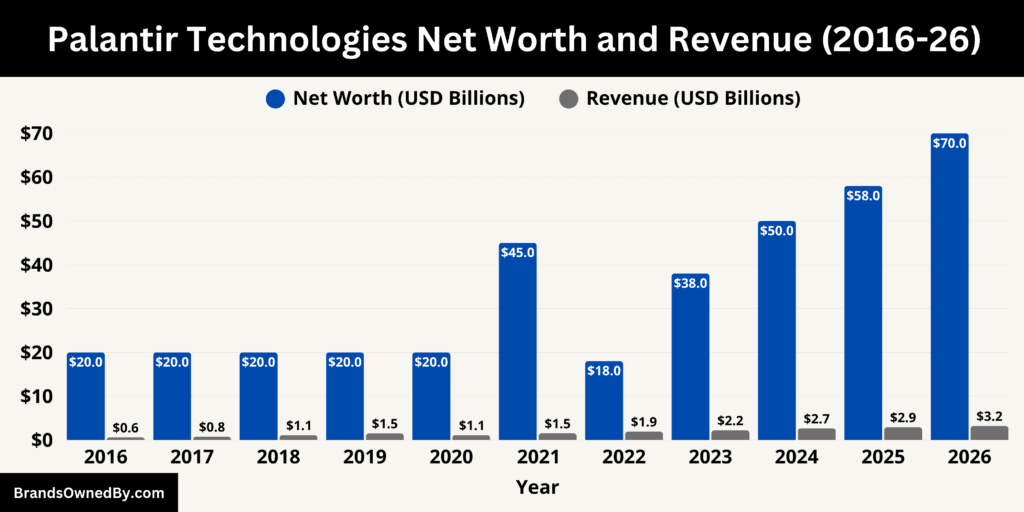
As of April 2026, Palantir Technologies has reached approximately $3.20 billion in annual revenue and a market capitalization of around $70 billion. This reflects strong growth driven by artificial intelligence platforms, enterprise adoption, and continued government contracts. The company has transitioned from a niche defense-focused firm into a mainstream AI and data infrastructure provider.
2026 Revenue Breakdown and Growth Drivers
In 2026, Palantir’s estimated revenue of $3.20 billion is driven by two primary segments: government and commercial.
The government segment continues to contribute a significant portion, generating roughly $1.70 billion. This includes contracts with defense, intelligence, and public sector agencies. These contracts are typically long-term and high-value, providing stable recurring revenue.
The commercial segment contributes approximately $1.50 billion. This segment has grown rapidly in recent years due to increasing demand for AI-powered analytics platforms like Foundry and AIP (Artificial Intelligence Platform). Industries such as healthcare, manufacturing, and energy are major contributors.
Geographically, the United States remains the largest market, accounting for more than 60% of total revenue. International markets, especially in Europe and Asia, are expanding steadily as governments and enterprises adopt Palantir’s software.
This balanced revenue mix has reduced the company’s reliance on government contracts and improved scalability.
2026 Net Worth and Market Position
As of April 2026, Palantir’s market capitalization stands at approximately $70 billion. This valuation reflects strong investor confidence in its long-term AI strategy.
The company’s valuation is influenced by several key factors. First, its positioning as a core infrastructure provider for AI gives it a competitive advantage. Second, its profitability since 2023 has improved investor sentiment. Third, long-term contracts provide predictable revenue streams, which support higher valuation multiples.
Palantir is now considered one of the leading players in the AI and data analytics sector. It competes with major technology firms but maintains a unique niche in high-security and mission-critical applications.
Revenue and Valuation Evolution
Palantir’s growth trajectory from 2016 to 2026 shows a steady increase in both revenue and valuation.
Before going public, the company maintained a relatively stable valuation of around $20 billion, despite increasing revenue. This was due to its private market status and limited liquidity.
After its direct listing in 2020, the company experienced significant volatility. Its valuation surged in 2021 due to strong investor interest in data and AI companies. It then declined in 2022 due to broader market corrections.
From 2023 onward, Palantir entered a new phase of growth. The launch and adoption of AI platforms accelerated revenue growth and improved profitability. This led to a steady increase in market capitalization, reaching $70 billion in 2026.
This evolution highlights the company’s shift from a government contractor to a scalable AI platform provider.
Profitability and Margins
A major inflection point for Palantir Technologies came between 2023 and 2026, when the company transitioned from inconsistent profitability to sustained, high-margin operations. By April 2026, Palantir is firmly positioned as one of the most profitable high-growth software companies in the AI sector.
At a core level, Palantir now operates with an operating margin exceeding 30% on a trailing basis, with some quarters reaching 40%+. This is a significant improvement from earlier years when margins were in single digits. The company’s net profit margin has also crossed 30%, reflecting strong cost discipline and high-value contract structures.
On an adjusted basis, which excludes certain accounting items, profitability is even stronger. Palantir has reported adjusted operating margins above 50%, with some quarters reaching 57%+, indicating exceptional operating leverage.
One of the most important drivers of this margin expansion is operating leverage. Revenue has scaled rapidly, while headcount and operating costs have grown at a much slower pace. For example, in 2025, revenue growth exceeded 60% year-over-year, while employee growth remained close to 10%, showing high efficiency in scaling operations.
Another key factor is the shift toward commercial AI software, which carries significantly higher margins than traditional government contracts. The commercial segment, particularly in the United States, has been growing at over 100% year-over-year, driven by adoption of the Artificial Intelligence Platform (AIP).
Palantir also generates strong cash flow. The company produced over $2.2 billion in free cash flow in 2025, representing a margin of approximately 50% of revenue. This level of cash generation is rare for a company still growing at a high rate.
Overall, Palantir’s profitability profile in 2026 is defined by three key characteristics:
- High operating margins above 30%
- Strong adjusted margins exceeding 50%
- Exceptional cash flow generation.
This combination places Palantir among the most efficient large-scale AI software companies globally.
Future Revenue Forecast (2027–2030)
Looking ahead, Palantir Technologies is expected to maintain strong revenue growth through 2030, driven by AI adoption, enterprise expansion, and increasing demand for data-driven decision systems.
The company has already issued aggressive growth signals. For 2026 alone, management projected over 60% year-over-year revenue growth, significantly above market expectations. This indicates that Palantir is entering a phase of accelerated scaling rather than slowing down.
A major growth engine is the Artificial Intelligence Platform (AIP). This platform allows enterprises to integrate large language models directly into their operations. Adoption has surged across industries such as healthcare, manufacturing, defense, and energy.
Another important driver is the commercial segment overtaking government revenue. As of 2026, commercial revenue is growing faster and is expected to become the dominant contributor within the next few years. This shift is critical because commercial contracts are more scalable and repeatable.
International expansion is also a key factor. While the United States remains the largest market, adoption in Europe and Asia is increasing steadily, providing additional growth runway.
Based on current growth trends, AI adoption rates, and enterprise demand, the following forward revenue trajectory is expected:
- 2027: $3.80 billion
- 2028: $4.60 billion
- 2029: $5.50 billion
- 2030: $6.50 billion.
These projections assume continued high demand for AI infrastructure, expansion of enterprise clients, and deeper integration of Palantir’s platforms into critical operations.
In addition, long-term contract structures provide strong revenue visibility. Many government and enterprise agreements span multiple years, ensuring recurring income and reducing volatility.
Overall, Palantir’s future growth outlook is supported by:
- Rapid adoption of AI across industries
- Expansion of high-margin commercial business
- Strong backlog of long-term contracts
- Increasing global demand for data-driven systems.
This positions the company for sustained revenue expansion through the end of the decade.
Brands Owned by Palantir
As of 2026, Palantir Technologies does not follow a traditional acquisition-heavy model like many large tech companies. Instead of owning dozens of independent subsidiaries, Palantir operates through integrated platforms, internal product ecosystems, and strategic entities that function as core business units.
| Platform / Entity | Type | Primary Use | Key Customers / Industries | Role in Business |
|---|---|---|---|---|
| Palantir Gotham | Government Platform | Data integration, intelligence analysis, threat detection | Defense, intelligence agencies, law enforcement | Core government revenue driver with long-term contracts |
| Palantir Foundry | Commercial Platform | Data analytics, workflow automation, enterprise decision-making | Healthcare, manufacturing, finance, energy | Fastest-growing commercial platform and major revenue contributor |
| Palantir Apollo | Infrastructure Platform | Software deployment, updates, and system management | Government and enterprise clients | Enables scalability and continuous delivery across environments |
| Palantir AIP (Artificial Intelligence Platform) | AI Platform | AI integration, LLM deployment, automation | Enterprises, government, industrial sectors | Key growth engine driving AI adoption and commercial expansion |
| Palantir Metropolis | Financial Platform | Data analytics for financial markets and risk analysis | Hedge funds, financial institutions | Niche platform supporting financial sector clients |
| Palantir Skywise | Joint Platform (with Airbus) | Aviation data integration and operational analytics | Airlines, aviation industry | Industry-specific solution with strong strategic partnership |
| Palantir Foundry for Builders | Program / Platform Extension | Startup data infrastructure and analytics support | Startups, early-stage companies | Growth channel and future client acquisition strategy |
| Palantir Government Solutions | Internal Business Unit | Government software deployment and support | Defense and public sector agencies | Manages public sector contracts and operations |
| Palantir Commercial Solutions | Internal Business Unit | Enterprise software deployment and scaling | Private sector enterprises globally | Drives commercial growth and AI adoption |
Palantir Gotham
Palantir Gotham is the company’s flagship platform designed for government and defense agencies. It is widely used by intelligence organizations, military units, and law enforcement agencies.
Gotham enables users to integrate vast amounts of structured and unstructured data. It allows analysts to identify patterns, track threats, and make real-time decisions. The platform is known for its role in counterterrorism, battlefield intelligence, and national security operations.
As of 2026, Gotham remains a core pillar of Palantir’s government business. It generates a large portion of revenue through long-term contracts with defense and intelligence agencies. Its high-security architecture and advanced analytics capabilities make it difficult to replace, giving Palantir a strong competitive advantage in this segment.
Palantir Foundry
Palantir Foundry is the company’s primary platform for commercial clients. It is designed to help organizations manage, analyze, and operationalize data across their entire business.
Foundry allows companies to integrate data from multiple sources into a single platform. It provides tools for data modeling, workflow automation, and decision-making. Industries such as healthcare, manufacturing, finance, and energy rely heavily on Foundry.
By 2026, Foundry has become one of Palantir’s fastest-growing products. It plays a key role in expanding the company’s commercial segment. Its flexibility and scalability allow it to be customized for different industries, making it a central part of Palantir’s growth strategy.
Palantir Apollo
Palantir Apollo is a continuous delivery and infrastructure management platform. It enables Palantir to deploy, update, and manage its software across various environments, including cloud, on-premise, and hybrid systems.
Apollo is critical for maintaining the performance and reliability of Palantir’s platforms. It allows seamless updates without disrupting operations, which is especially important for mission-critical applications.
As of 2026, Apollo is a key enabler of Palantir’s scalability. It supports both government and commercial deployments, ensuring consistent performance across different environments.
Palantir AIP
Palantir AIP is the company’s newest and most advanced platform, focused on artificial intelligence. It allows organizations to integrate large language models and AI systems into their operations.
AIP connects AI models with real-world data and workflows. This enables businesses and governments to automate processes, generate insights, and improve decision-making.
By 2026, AIP has become a major growth driver for Palantir. It is widely adopted across industries and is central to the company’s positioning as an AI infrastructure provider. The platform has significantly accelerated commercial revenue growth.
Palantir Metropolis
Palantir Metropolis is a platform designed for financial institutions and hedge funds. It focuses on data integration and analytics for financial markets.
The platform helps users analyze large datasets, identify trends, and make investment decisions. It is used by financial firms to manage risk and optimize strategies.
Although not as prominent as Gotham or Foundry, Metropolis remains an important part of Palantir’s early product ecosystem and continues to support financial sector clients.
Palantir Skywise
Skywise is a specialized data platform developed in partnership with Airbus. While it is a collaborative platform, Palantir plays a central role in its technology and operations.
Skywise is used in the aviation industry to improve aircraft performance, maintenance, and operational efficiency. It integrates data from airlines, manufacturers, and suppliers into a unified system.
As of 2026, Skywise remains one of the most successful industry-specific implementations of Palantir’s technology. It demonstrates the company’s ability to adapt its platforms to specialized sectors.
Palantir Foundry for Builders
Foundry for Builders is a program and platform extension aimed at startups and early-stage companies. It provides access to Palantir’s Foundry platform along with technical support and resources.
This initiative helps startups build data-driven operations from the ground up. It also allows Palantir to establish early relationships with emerging companies.
By 2026, this program has expanded significantly. It serves as both a growth channel and a strategic investment in future clients.
Palantir Government Solutions
Palantir Government Solutions is not a separate company but an internal operational entity. It focuses on delivering software solutions to government clients.
This segment handles contracts, deployments, and ongoing support for defense and intelligence agencies. It plays a critical role in maintaining long-term relationships with public sector clients.
As of 2026, this segment continues to generate stable and recurring revenue for the company.
Palantir Commercial Solutions
Palantir Commercial Solutions is another internal business unit. It focuses on enterprise clients across various industries.
This segment is responsible for deploying Foundry and AIP solutions in commercial environments. It also drives sales, partnerships, and customer expansion in the private sector.
By 2026, this unit has become the fastest-growing part of Palantir’s business. It reflects the company’s shift toward commercial and AI-driven growth.
Final Words
The answer to who owns Palantir is not as straightforward as a single name or entity. Its shares are widely distributed among institutional investors, retail shareholders, and insiders.
However, control remains firmly in the hands of its founders and leadership due to a specialized voting structure. This allows the company to operate with a clear long-term vision while limiting outside influence.
Palantir Technologies stands out for combining public ownership with centralized control, making it one of the few major tech companies where founders still shape the direction despite holding a smaller economic stake.
FAQs
Who is the largest shareholder of Palantir?
The largest shareholder of Palantir Technologies is Vanguard Group, holding around 9.2% of total shares. It is followed by BlackRock and State Street Corporation.
Who founded Palantir?
Palantir was founded in 2003 by Peter Thiel, Alex Karp, Joe Lonsdale, Stephen Cohen, and Nathan Gettings.
Who is the CEO of Palantir?
The CEO of Palantir Technologies is Alex Karp, who has led the company since its founding.
What does Palantir do?
Palantir Technologies builds data analytics and artificial intelligence software platforms. Its tools help governments and businesses analyze large datasets, improve decision-making, and automate operations across sectors like defense, healthcare, and finance.
Is Elon Musk involved in Palantir?
No, Elon Musk is not involved in Palantir. He is not a founder, shareholder, or executive in the company.
Does Warren Buffett own Palantir?
No, Warren Buffett does not own Palantir. His company, Berkshire Hathaway, has not reported any significant stake in Palantir.
Who is the biggest client of Palantir?
The U.S. government, particularly the U.S. Army, is Palantir’s biggest client. The company has secured contracts worth up to $10 billion with the U.S. Army, making it its largest customer.
Is Palantir a Chinese company?
No, Palantir Technologies is an American company headquartered in Denver, Colorado. It primarily works with U.S. and allied government agencies.
Does the US military use Palantir?
Yes, the U.S. military extensively uses Palantir’s software for intelligence, battlefield operations, and data analysis. Its platforms are deployed across multiple branches, including the Army, and are integrated into core systems like Project Maven.