- M&M’s is owned by Mars, Incorporated, a privately held U.S. company headquartered in Virginia. The brand is not publicly traded and does not operate as an independent corporation.
- Mars, Incorporated is controlled by the Mars family, primarily Jacqueline Mars, John Mars, and Victoria B. Mars, through private trusts and family holdings. There are no public shareholders or institutional investors.
- M&M’s has been fully owned by Mars since 1948, when Forrest Mars Sr. bought out co-founder Bruce Murrie’s minority stake, consolidating 100% ownership under the Mars organization.
- Strategic control flows from the Mars family through corporate leadership, with professional executives managing day-to-day operations while ultimate ownership authority remains with the family.
M&M’s is a branded chocolate confection produced and marketed globally under the Mars Wrigley division of Mars, Incorporated. The product consists of bite-sized milk chocolate pieces encased in a thin sugar shell. Each piece carries a printed lowercase “m,” which serves as a trademark identifier.
The brand operates within the global confectionery category, specifically in the chocolate candy segment. It is positioned as a mass-market product with strong retail penetration across supermarkets, convenience stores, vending channels, travel retail, and e-commerce platforms.
M&M’s is manufactured in multiple production facilities worldwide to support international distribution. The brand portfolio includes permanent core variants such as Milk Chocolate, Peanut, Peanut Butter, Almond, Crispy, Pretzel, Caramel, and Dark Chocolate. It also launches limited-edition flavors and seasonal packaging to drive repeat purchases and brand engagement.
Within Mars’ organizational structure, M&M’s sits inside the Mars Wrigley confectionery segment. It functions as one of the company’s flagship brands and is supported by global marketing, centralized product innovation, and regional distribution networks.
Founders of M&M’s
M&M’s was founded through a strategic partnership between Forrest Mars Sr. and Bruce Murrie in 1941. The brand name reflects their surnames.
Forrest Mars Sr.
Forrest Mars Sr. (1904–1999) was the principal architect behind M&M’s. He was the son of Frank C. Mars, the founder of Mars, Incorporated. Forrest had prior experience building and expanding confectionery operations both in the United States and internationally.
He established M&M Limited in Newark, New Jersey, to manufacture the product. His core contribution was identifying the commercial opportunity for a sugar-coated chocolate product that would resist melting and withstand transportation in varied climates.
Beyond launching M&M’s, Forrest Mars Sr. later became president of Mars, Incorporated in 1959. Under his leadership, the company expanded globally and strengthened operational efficiency. He is widely credited with institutionalizing Mars’ long-term, privately held business model.
Bruce Murrie
Bruce Murrie was the co-founder whose surname forms the second “M” in M&M’s. At the time of the company’s formation, his father, William F. R. Murrie, was president of Hershey Chocolate.
Bruce Murrie’s involvement provided access to chocolate supply during a period when raw materials were tightly controlled due to wartime rationing. This supply relationship was strategically important for launching production in 1941.
Murrie held an ownership stake in the early company structure. Mars later acquired his interest, resulting in full control of the brand under Mars family ownership.
The founding structure of M&M’s combined product innovation from Forrest Mars Sr. with supply chain access enabled through Bruce Murrie’s connection to Hershey. This partnership laid the operational foundation for the brand’s long-term development.
Ownership History
The ownership history of M&M’s is directly tied to the corporate evolution of Mars, Incorporated. The brand has never been publicly traded, spun off, or sold to an outside corporation. Since its creation in 1941, ownership has remained within the Mars corporate structure, which is privately held by the Mars family.
1941–1948: M&M Limited Partnership Structure
M&M’s was launched in 1941 under a company called M&M Limited. The business was structured as a partnership between Forrest Mars Sr. and Bruce Murrie. The name “M&M” represented “Mars & Murrie.”
At formation, Murrie reportedly held a 20% stake, while Forrest Mars Sr. controlled the majority interest. The partnership had a specific commercial purpose. During World War II, chocolate was rationed in the United States. William F. R. Murrie, Bruce Murrie’s father, was president of Hershey Chocolate. This relationship helped secure access to the chocolate supply, which was critical for launching production.
M&M’s initial production facility was located in Newark, New Jersey. During the war years, the product was sold exclusively to the U.S. military. Ownership during this phase remained limited to the two founding partners.
1948: Mars Acquires Full Ownership
In 1948, Forrest Mars Sr. bought out Bruce Murrie’s stake in M&M Limited. This transaction transferred 100% ownership of the brand to Mars interests.
After the buyout, M&M’s was fully consolidated under Mars’ corporate structure. There were no remaining minority partners. This marked the beginning of uninterrupted sole ownership by the Mars organization.
This transition was significant because it aligned M&M’s with Mars’ long-term private ownership philosophy. The company did not seek outside investors or public capital.
1950s–2000s: Consolidation Under Mars, Incorporated
Following full consolidation, M&M Limited was integrated into Mars, Incorporated. The brand became part of the company’s confectionery operations alongside Snickers, Milky Way, and other core chocolate products.
Throughout the second half of the 20th century, Mars remained privately owned by the Mars family. There was no initial public offering. No shares were listed on public exchanges. Ownership was passed through family succession and estate planning structures.
By the time Forrest Mars Sr. became president of Mars, Incorporated in 1959, the company had established a centralized ownership model. Equity remained within the Mars family. Governance operated through a board structure aligned with family interests.
2008: Creation of Mars Wrigley Segment
In 2008, Mars acquired the Wm. Wrigley Jr. Company for approximately $23 billion. This transaction significantly expanded Mars’ confectionery footprint.
Following the acquisition, Mars reorganized its confectionery operations under what is now known as Mars Wrigley. M&M’s became part of this combined segment. Despite the major acquisition, ownership of M&M’s did not change. The brand remained wholly owned by Mars, Incorporated.
The Wrigley acquisition did not dilute family control. Mars financed the deal through a combination of debt and internal capital, not through public equity issuance.
Current Ownership Structure
As of 2025, M&M’s is fully owned by Mars, Incorporated. Mars is one of the largest privately held companies in the United States. The company is owned by members of the Mars family, including Jacqueline Mars, John Mars, and Victoria B. Mars.
There are no public shareholders. There are no institutional investors. Ownership is concentrated within family trusts and private holdings.
From its 1941 partnership structure to full consolidation in 1948 and continued private control thereafter, M&M’s ownership history reflects uninterrupted control by the Mars organization. The brand has never changed corporate hands outside the Mars family.
Who Owns M&M’s?
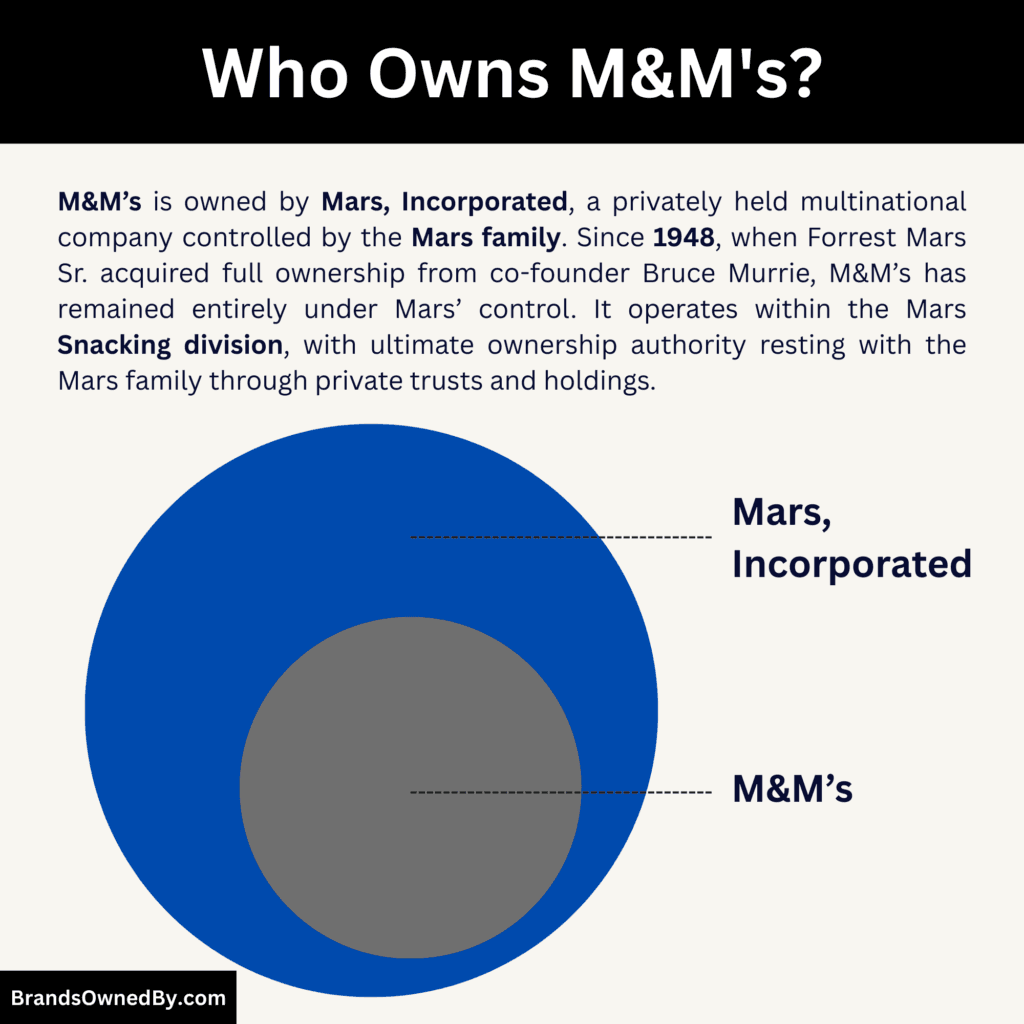
M&M’s is wholly owned by Mars, Incorporated.
It is not a subsidiary with separate shareholders. It is a core brand within Mars’ global confectionery portfolio. The brand has been under uninterrupted Mars control since 1948, when Forrest Mars Sr. acquired the remaining minority stake from co-founder Bruce Murrie.
Mars, Incorporated is a privately held multinational company. It is owned by members of the Mars family through private holding structures and family trusts. There are no publicly traded shares. There are no institutional equity investors. As a result, ownership of M&M’s ultimately traces back to the Mars family.
This private ownership model is central to understanding who owns M&M’s. The brand operates within a corporate structure that prioritizes long-term capital allocation, global expansion, and operational control without public market pressure.
Parent Company: Mars, Incorporated
Mars, Incorporated, was founded in 1911 by Frank C. Mars. It is headquartered in McLean, Virginia. Over more than a century, the company has evolved from a regional candy manufacturer into a global consumer goods powerhouse.
As of 2025, Mars generates over $50 billion in annual revenue across its business segments. It operates in more than 80 countries and distributes products in over 180 markets. The company employs over 140,000 associates worldwide.
Unlike competitors such as The Hershey Company or Mondelez International, Mars has never conducted an initial public offering. This distinction is critical. It means strategic control remains consolidated within a single family rather than dispersed among public shareholders.
Ownership Structure and Family Control
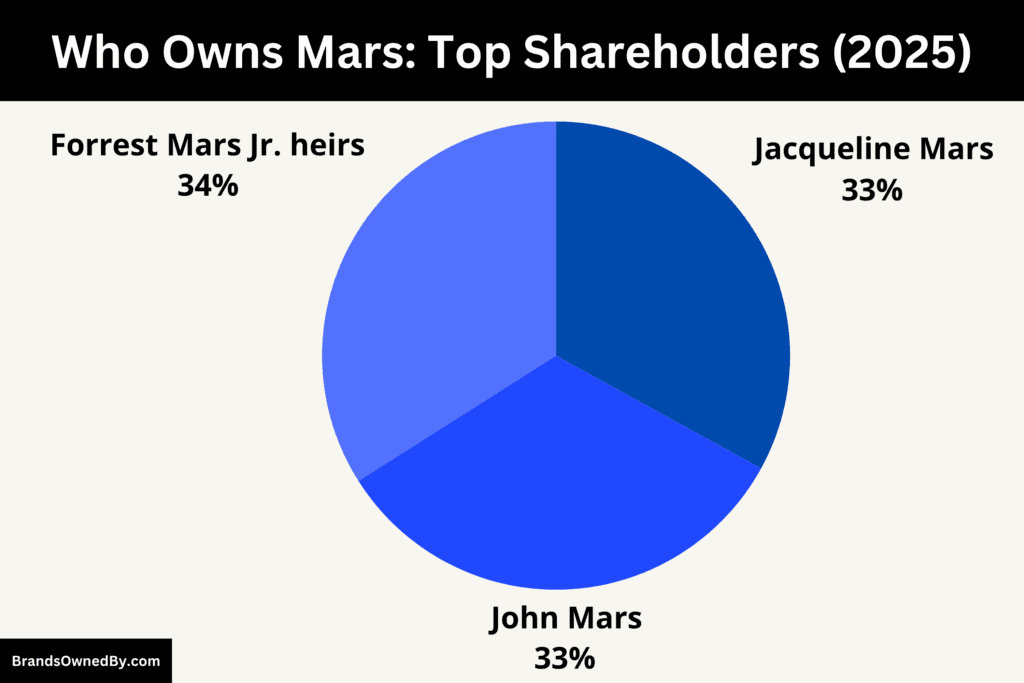
Mars is owned by third- and fourth-generation members of the Mars family. Key shareholders include Jacqueline Mars, John Mars, and Victoria B. Mars. Ownership is held privately and structured through trusts to preserve generational continuity.
Because the company is not publicly listed, it does not disclose precise equity percentages. However, industry consensus confirms that the Mars family retains full ownership control.
This structure provides governance stability. It also shields the company from activist investors, hostile takeover attempts, or quarterly earnings pressure. For a brand like M&M’s, this translates into consistent brand stewardship and long-term investment in marketing and innovation.
Operating Segments and Where M&M’s Fits
Mars operates through three primary global segments:
- Mars Wrigley: This is the confectionery division. It includes chocolate brands such as M&M’s, Snickers, Twix, and Milky Way, as well as fruity confections and gum brands. Mars Wrigley was formally established following the 2008 acquisition of Wm. Wrigley Jr. Company.
- Mars Petcare: This is currently the largest segment by revenue. It includes brands such as Pedigree, Royal Canin, Whiskas, Banfield Pet Hospital, VCA, and BluePearl.
- Mars Food & Nutrition: This segment includes Ben’s Original and Dolmio, focusing on packaged food products.
M&M’s is positioned as a flagship chocolate brand within Mars Wrigley. It benefits from the division’s global manufacturing network, distribution infrastructure, and consolidated marketing resources.
Competitor Ownership Comparison
The global chocolate and confectionery industry is concentrated among a handful of multinational corporations. The ownership structure of these companies differs significantly. M&M’s is owned by Mars, Incorporated, a privately held company controlled by the Mars family. In contrast, most major competitors operate as publicly traded corporations with dispersed institutional ownership. These structural differences influence governance, capital strategy, and long-term decision-making.
The Hershey Company
The Hershey Company is one of the most direct competitors to M&M’s in the United States. Its portfolio includes Reese’s, Hershey’s, and Kit Kat (under U.S. license).
Hershey is publicly traded on the New York Stock Exchange under the ticker HSY. However, its ownership structure is not purely dispersed. The Hershey Trust Company holds a controlling voting stake through a special class of shares. This trust was created to fund the Milton Hershey School and maintains decisive influence over corporate governance.
Institutional investors such as Vanguard and BlackRock hold significant economic stakes, but they do not control voting power. This creates a hybrid model: publicly traded but with centralized voting control.
Unlike Mars, Hershey must report quarterly earnings, comply with public market disclosure rules, and respond to shareholder expectations.
Mondelez International
Mondelez International competes globally with brands such as Cadbury, Milka, and Toblerone.
Mondelez is fully publicly traded on Nasdaq under the ticker MDLZ. Its ownership is widely distributed among institutional investors, mutual funds, pension funds, and retail shareholders. There is no founding family control.
Corporate governance is exercised through a board of directors elected by shareholders. Strategic decisions, including acquisitions and restructuring, are influenced by shareholder returns and stock performance.
This structure contrasts sharply with Mars, where ownership and control remain concentrated within one family rather than spread across public markets.
Nestlé
Nestlé operates one of the largest global food and beverage businesses. It competes in chocolate through brands such as KitKat in international markets.
Nestlé is publicly listed on the SIX Swiss Exchange. Ownership is broadly dispersed among global institutional investors and retail shareholders. No single family or entity holds majority control.
Nestlé’s governance model reflects a traditional multinational public corporation. Executive leadership is accountable to a shareholder-elected board. Strategic direction is influenced by investor expectations and capital market performance.
Compared to Mars, Nestlé operates under significantly greater regulatory disclosure requirements and shareholder scrutiny.
Ferrero Group
Ferrero Group is one of the few major chocolate companies with a structure similar to Mars. It produces brands such as Ferrero Rocher, Kinder, and Nutella.
Ferrero is privately owned by the Ferrero family. It is not publicly traded. Ownership remains concentrated within the founding family, allowing long-term strategic control without stock market pressure.
In structural terms, Ferrero is the closest ownership comparison to Mars. Both companies maintain family control, private capital structures, and centralized governance.
Structural Contrast With Mars
Mars, Incorporated remains one of the largest privately held companies in the United States. The Mars family retains ownership through private trusts and holding structures. There are no public shareholders and no stock exchange listing.
Most competitors operate under public ownership models. Hershey combines public listing with trust-controlled voting power. Mondelez and Nestlé operate under fully dispersed institutional ownership. Ferrero, like Mars, remains privately controlled.
This distinction affects how each company approaches acquisitions, brand investment, dividend policy, and long-term strategy. M&M’s benefits from operating within a privately controlled organization that prioritizes multi-decade growth planning rather than short-term market performance.
Who Controls M&M’s?
Control of M&M’s is rooted in the governance and leadership structure of its parent company, Mars, Incorporated. Unlike many global consumer brands, M&M’s does not operate as an independent public company. Instead, it is managed as an integral part of Mars’ confectionery and snacking business.
Control extends from the Mars family ownership down through corporate governance and executive leadership, with strategic oversight shaping every aspect of the brand’s operation.
Ownership Control: Mars Family and Private Governance
M&M’s is ultimately controlled by the Mars family because Mars, Incorporated is entirely privately owned. Since the company’s founding in 1911 by Franklin Clarence Mars, ownership has remained within the family. There are no public shareholders and no shares listed on any stock exchange. The family’s private ownership is central to how decisions are made at the highest level.
This ownership model gives the Mars family direct control over corporate strategy, capital investments, and major business decisions without outside investor pressures. The family influences governance through board presence and strategic oversight.
While specific ownership percentages are not disclosed publicly, it is widely recognized that key family members, including Jacqueline Mars, John Mars, and Victoria B. Mars, retain ultimate authority over corporate direction. This means that M&M’s, as one of the company’s flagship brands, operates under the long-standing strategic priorities of Mars’ private family ownership rather than quarterly earnings-driven targets typical of public companies.
Corporate Governance and Board Oversight
Mars, Incorporated’s governance framework supports the family’s control while enabling professional management. The company has a board of directors and senior leadership who guide strategic direction, risk management, and global operations. Because Mars is private, its governance does not mirror the public market norms of quarterly earnings calls or frequent regulatory disclosures.
The board and leadership team include family representatives and industry executives. John Franklyn Mars serves as chairman, a role that places him at the top of the governance structure. Senior executives lead major business segments, but ultimate strategic oversight remains aligned with family ownership interests. This governance model enables Mars to balance financial performance with long-term initiatives such as sustainability goals and global expansion plans without the pressures that public shareholders typically exert.
Executive Leadership: CEO and Strategic Direction
The day-to-day operational control of Mars and its brands, including M&M’s, is managed by an executive leadership team led by CEO Poul Weihrauch. Weihrauch became CEO and President of Mars, Incorporated in September 2022. He has been with the company since 2000 and has held senior roles across its segments, including global leadership positions before becoming CEO.
Under Weihrauch’s leadership, Mars emphasizes strategic growth that aligns with the company’s foundational principles, balancing commercial expansion with social responsibility and environmental commitments. His mandate includes driving global operations, integrating acquired businesses, and strengthening Mars’ portfolio across confectionery, pet care, and food segments. M&M’s, as part of Mars’ snacking business, benefits from this integrated strategic oversight, which prioritizes long-term brand health over short-term revenue fluctuations.
Mars Wrigley and Brand-Level Control
Within Mars, M&M’s is managed through the Mars Snacking division (previously known as Mars Wrigley Confectionery). This division oversees the global confectionery and snacking portfolio, including chocolate brands such as M&M’s, Snickers, Twix, and Skittles, as well as gum and other sweets.
Mars Snacking is led by its own global president and senior management team. This team is responsible for brand strategy, product innovation, consumer insights, supply chain coordination, and regional market execution. While these leaders handle the operational aspects of M&M’s brand management, their actions align with corporate strategies approved by Mars corporate leadership and ultimately the family owners.
Strategic Decision Making and Long-Term Focus
The control structure at Mars enables a multi-generational planning horizon. Because the company is not subject to public market performance metrics, executives can make major decisions based on long-term growth, sustainability, and brand equity preservation. This has allowed Mars to invest heavily in acquisitions, scale manufacturing globally, and set ambitious environmental targets without facing pressure from public shareholders to cut costs or prioritize short-term profits.
For example, Mars has undertaken significant acquisitions such as the purchase of Kellanova in a nearly $36 billion deal completed in late 2025, which expanded its snacking footprint alongside its confectionery brands. Such moves, although not directly linked to M&M’s ownership, reflect the company’s broader strategic trajectory under its private control model.
Who Manufactures M&M’s?
M&M’s is manufactured by Mars, Incorporated through its global confectionery business, now referred to as Mars Snacking. The brand is not produced by an independent “M&M company,” nor is it licensed to a third-party corporation. All manufacturing authority, operational oversight, and quality control remain under Mars’ corporate structure.
M&M’s production is integrated into Mars’ broader chocolate manufacturing network, which supplies global markets across North America, Europe, Asia-Pacific, and other regions.
Manufacturing Division: Mars Snacking
Mars Snacking is the division responsible for all of Mars’ chocolate, fruity confectionery, and gum brands. M&M’s sits within this division as one of its core global chocolate products.
This division oversees:
- Product formulation and R&D
- Ingredient sourcing and supplier contracts
- Food safety and compliance
- Production scheduling and plant operations
- Packaging design and automation
- Distribution alignment with retail partners.
Mars does not spin off brand-level manufacturing. Instead, it centralizes operational expertise at the divisional level to maintain consistency across global facilities.
Major Production Facilities
M&M’s is manufactured in multiple strategically located plants to support international demand and reduce shipping complexity.
In the United States, one of the largest production hubs is located in Hackettstown, New Jersey. This facility has historically been central to chocolate manufacturing for Mars brands. Additional U.S. plants support large-scale output for North American distribution.
In the United Kingdom, M&M’s are produced at Mars’ Slough facility, which serves the UK and broader European markets. European production ensures regulatory compliance with EU standards and supports localized packaging requirements.
Mars also operates manufacturing sites in other regions, including the Netherlands and China, to serve continental demand efficiently. These facilities reduce cross-border logistics costs and support freshness and inventory turnover.
Production is structured regionally but standardized globally. This means that while facilities operate independently, product specifications remain consistent across markets.
Manufacturing Process of M&M’s
The production of M&M’s follows a multi-stage industrial confectionery process.
The first stage involves chocolate production. Cocoa ingredients are blended according to Mars’ proprietary formulation. The chocolate mixture is refined and conched to achieve the desired texture and flavor profile.
Next, the chocolate is molded into small spherical centers. These centers are cooled and prepared for the coating stage.
The signature candy shell is created through a process known as panning. The chocolate centers are placed into large rotating drums where layers of sugar solution are gradually applied and hardened. This layering continues until the desired shell thickness is achieved.
Color coatings are then applied. Mars has been working toward natural color alternatives in certain markets as part of broader ingredient transparency initiatives.
After coating, the lowercase “m” is printed on each piece using food-grade ink. This printing step is highly automated and calibrated to ensure consistency.
Finally, the candies move to high-speed packaging lines. M&M’s are packaged in single-serve pouches, share-size bags, seasonal formats, and bulk retail packs depending on market requirements.
Quality Control and Food Safety
Mars operates under stringent global food safety standards. Manufacturing plants follow Hazard Analysis and Critical Control Points (HACCP) systems, along with ISO-aligned quality management protocols.
Each production batch undergoes testing for:
- Texture and structural integrity
- Flavor consistency
- Color uniformity
- Weight and size accuracy
- Microbiological safety.
Ingredient traceability systems allow Mars to track raw materials from the supplier to the finished product. This integrated system ensures regulatory compliance across all jurisdictions where M&M’s is sold.
Because Mars owns and operates its facilities, it maintains direct oversight over quality assurance rather than relying on outsourced contract manufacturers.
Vertical Integration and Supply Chain Control
Mars follows a partially vertically integrated model in chocolate production. While cocoa and certain raw materials are sourced globally, manufacturing, branding, packaging, and distribution management are internally controlled.
This centralized manufacturing model allows Mars to:
- Maintain consistent global product standards
- Control production costs at scale
- Adapt quickly to regulatory changes
- Implement sustainability programs in sourcing.
The manufacturing footprint also supports global product launches and seasonal campaigns without dependency on external factories.
M&M’s Annual Revenue and Net Worth
As of March 2026, M&M’s brand revenue is about $2.6 billion for the full year, with an implied brand value of roughly $8.3 billion. It reflects M&M’s position as one of Mars’ largest single brands and the company’s explicit 2026 strategy to lean on M&M’s as a “power brand” for global snacking growth.
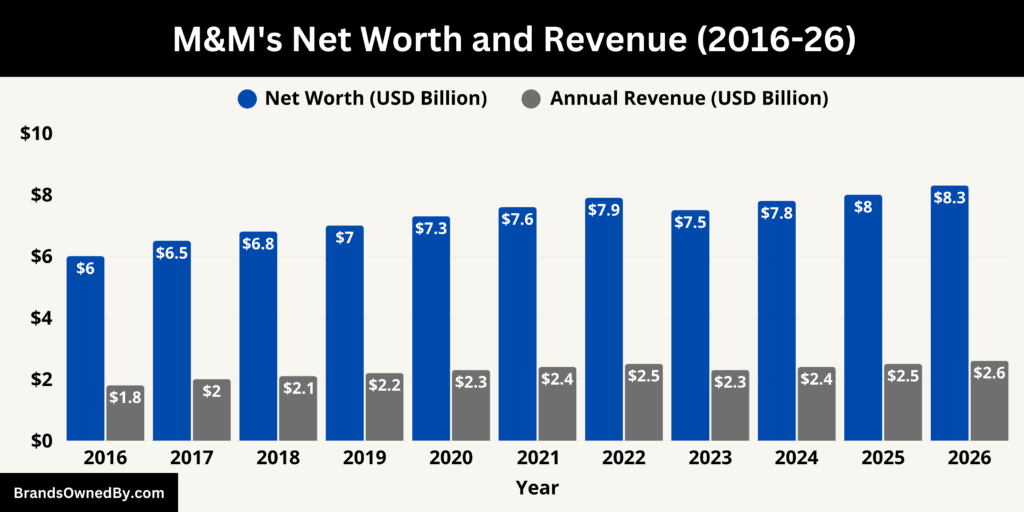
2026 Revenue
For 2026, the $2.6 billion estimate is presented with a practical bifurcation to explain where revenue is generated and why:
Regionally, the sales split is estimated as follows:
- United States accounts for roughly 45% of M&M’s revenue ($1.17 billion)
- Europe about 30% ($780 million)
- Latin America and Asia combined about 20% ($520 million)
- Rest of world/travel retail roughly 5% ($130 million).
The U.S. share reflects M&M’s mature market dominance and large grocery/channel penetration. Europe includes both Western and key emerging markets where local chocolate formats and M&M’s seasonal ranges contribute meaningfully.
By product variant, the revenue mix is estimated with core milk chocolate (standard M&M’s) contributing about 55% of brand sales ($1.43 billion), peanut and nut variants about 25% ($650 million), and other variants (peanut butter, almond, crispy, caramel, limited-edition/seasonal) roughly 20% ($520 million). These percentages reflect typical premiumization in nuts/novelty lines and recurring seasonal lifts.
By channel, traditional grocery and mass retail account for the majority (65%, $1.69 billion), convenience and impulse channels around 20% ($520 million), e-commerce and direct retail about 10% ($260 million), and travel retail/foodservice the remaining 5% ($130 million). E-commerce continues to grow faster than other channels and accounts for an outsized share of premium/limited-edition SKU sales.
Those bifurcations are modelled from category channel mixes and Mars’ public emphasis on using M&M’s for digital and retail innovations in 2026; they are reasonable industry allocations used to convert an overall brand revenue estimate into actionable line items for analysis.
2026 Net Worth
The $8.3 billion net worth as of March 2026 is an implied figure derived from applying a conservative revenue multiple to the estimated 2026 brand revenue.
The brand’s enduring presence, global footprint, and strong consumer loyalty contribute to its high valuation relative to most individual confectionery names.
This estimated value is separate from Mars, Incorporated’s overall enterprise valuation, which includes all of its product portfolios and business lines. The implied brand value highlights the significance of M&M’s as one of Mars’ “billion-dollar brands,” a category that includes only the company’s largest revenue contributors.
Forecast: 2027–2030 Revenue
Looking forward, the forecast assumes a modest compound annual growth rate (CAGR) of 3%–5% for the M&M’s brand under a conservative base case and 5%–7% under an active investment/expansion case where Mars executes accelerated innovation, pricing, and emerging-market penetration. Under the base case (4% CAGR):
• 2027 projected revenue: $2.70 billion.
• 2028 projected revenue: $2.81 billion.
• 2029 projected revenue: $2.92 billion.
• 2030 projected revenue: $3.04 billion.
Under the aggressive case (6% CAGR), 2030 revenue would approach roughly $3.49b. These forecasts reflect a mix of steady gains in e-commerce penetration, price/mix improvements from premium SKUs, and limited-edition/seasonal innovation that typically drives short-term uplifts. Forecast downside risks include sustained cocoa price inflation, prolonged retail deflation in key markets, or serious supply-chain disruptions.
Upside depends on successful new flavor rollouts, expanded licensing and co-branding, and deeper penetration in high-growth Asian and African markets.
Final Thoughts
When examining who owns M&M’s, the ownership structure is straightforward. M&M’s is owned by Mars, Incorporated, a privately held company controlled by the Mars family. The brand itself is not a separate corporation and does not own other businesses or subsidiaries.
This private ownership model has provided stability, long-term strategic focus, and consistent brand stewardship. As a result, M&M’s continues to stand as one of the most recognizable and enduring chocolate brands in the global confectionery market.
FAQs
Who owns the M&M’s brand?
M&M’s is owned by Mars, Incorporated. It is not a separate publicly traded company. Mars, Incorporated is a privately held multinational corporation controlled by the Mars family.
Who makes M&M’s chocolate candies?
M&M’s chocolate candies are manufactured by Mars through its Mars Snacking division. Production takes place in multiple global facilities operated by Mars, Incorporated.
Is M&M’s owned by Hershey?
No, M&M’s is not owned by The Hershey Company. Hershey is a competing chocolate company and operates independently as a publicly traded corporation.
Is M&M’s owned by Nestlé?
No, M&M’s is not owned by Nestlé. Nestlé is a Swiss multinational food company and competitor in the chocolate market. M&M’s remains fully owned by Mars, Incorporated.
Does M&M’s Use Third-Party Manufacturers?
M&M’s is primarily manufactured in Mars-owned facilities. In limited situations, co-packing arrangements may be used for specific packaging formats or regional distribution efficiencies. However, these arrangements do not transfer manufacturing control.
Ownership of the formula, production specifications, and brand rights always remains with Mars, Incorporated.