

- MINI is 100% owned by BMW Group, which fully controls the brand’s operations, strategic decisions, and global product development.
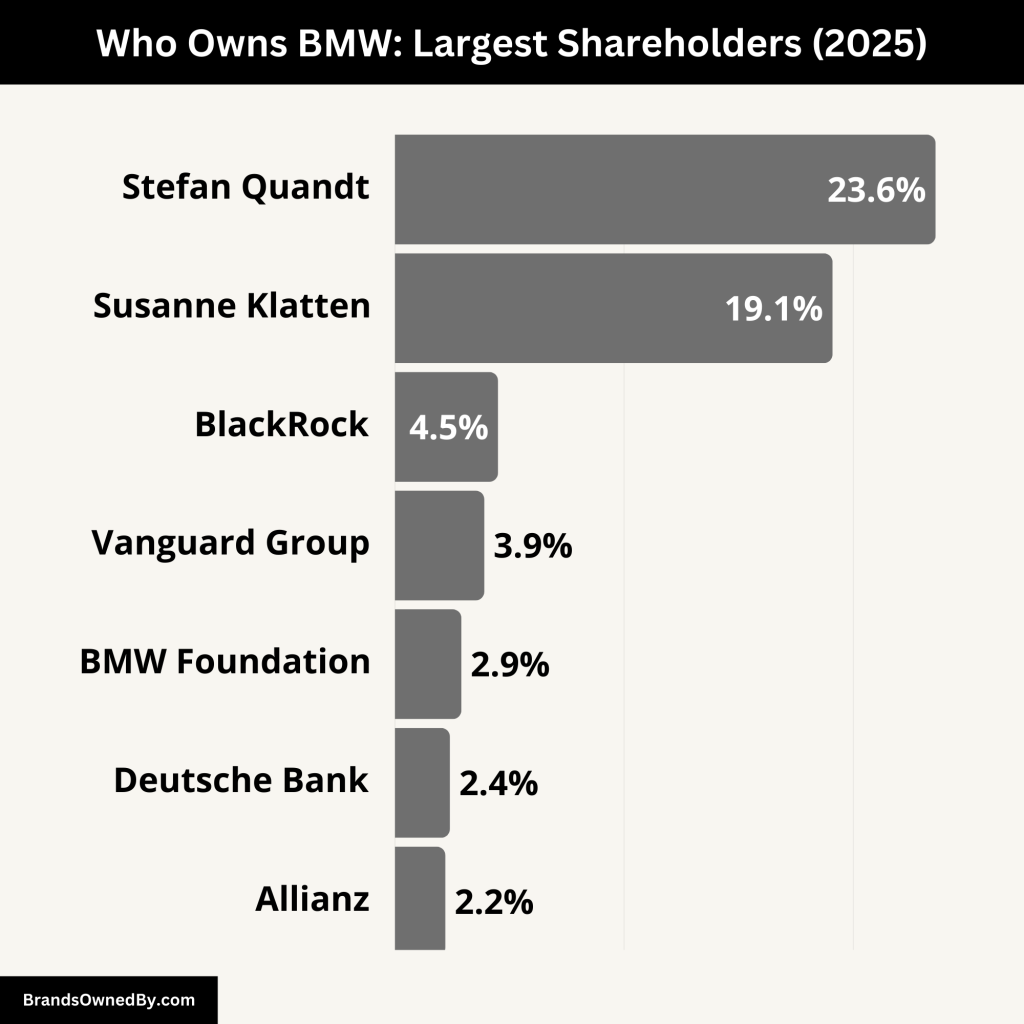
- MINI does not operate as an independent company; its ownership structure follows BMW Group’s shareholders, led by the Quandt family, major institutional investors, and global public shareholders.
MINI is a British automotive brand known for compact cars, agile driving, and distinctive styling. The original Mini was launched in 1959 by the British Motor Corporation. It became an icon of British culture due to its affordability and unique engineering.
The brand later passed through several reorganizations as BMC merged into British Leyland and then the Rover Group. The modern MINI was reborn in 2001 after its acquisition and redevelopment.
MINI operates as part of BMW Group, one of the world’s leading premium car manufacturers. The MINI brand is headquartered in Oxford, England. The company designs, engineers, and markets a range of small automobiles. These include hatchbacks, crossovers, convertibles, and electric models. Production is centred in Oxford and other facilities in Europe and Asia. Under BMW’s ownership, the brand is positioned as premium and innovative.
Founders
The roots of MINI trace back to an original project at the British Motor Corporation (BMC). The first Mini car was designed in the late 1950s by British engineer Sir Alec Issigonis. His goal was to create a small, efficient vehicle with practical space usage. The classic Mini became a hit for its ingenious design and front-wheel-drive layout.
In 1969, the name “Mini” became a standalone marque, replacing model names like Austin Mini and Morris Mini.
The modern MINI brand, however, was reimagined by BMW, which acquired the rights to the Mini name in the mid-1990s. BMW’s new vision retained the essence of Issigonis’ design while updating the cars for contemporary needs.
Major Milestones
- 1959: British Motor Corporation (BMC) launches the first Mini, designed by Sir Alec Issigonis. It becomes a breakthrough in compact engineering.
- 1960: Production ramps up as demand grows across the UK and Europe.
- 1961: The first Mini Cooper is released through a collaboration with John Cooper, bringing racing performance to the small-car segment.
- 1963: Mini Cooper S debuts and becomes a motorsport favourite for its agility and power-to-weight balance.
- 1964–1967: Mini wins the Monte Carlo Rally three times, strengthening its global motorsport reputation.
- 1969: “Mini” becomes a standalone marque under British Leyland, replacing Austin Mini and Morris Mini names.
- 1970s: New variants launch, including the Mini Clubman, as the brand shifts toward a more modern design language.
- 1980: Production continues under Austin Rover Group with improved safety and comfort updates.
- 1994: BMW acquires the Rover Group and obtains rights to the Mini brand.
- 1997: BMW confirms its plan to reinvent Mini as a premium small-car brand.
- 2000: Production of the classic Mini ends after 41 years.
- 2001: BMW launches the first modern MINI Hatch, marking the official rebirth of the brand.
- 2004: MINI Convertible enters production and expands global appeal.
- 2007: The MINI Clubman returns with updated engineering and a new body style.
- 2010: MINI Countryman debuts as the brand’s first crossover and first four-door model.
- 2013: Third-generation MINI Hatch launches with advanced technology and efficiency improvements.
- 2014: MINI’s modern design language is formalized under BMW’s global brand strategy.
- 2017: MINI introduces its first plug-in hybrid, the MINI Countryman PHEV.
- 2019: MINI Electric (Cooper SE) launches, marking the brand’s major entry into electric mobility.
- 2021: MINI announces its roadmap toward an all-electric future.
- 2023: New-generation MINI Electric and MINI Countryman debut with updated designs and digital interiors.
- 2024: MINI expands EV manufacturing partnerships and releases new JCW performance models.
- 2025: MINI strengthens its EV lineup, introduces new special editions, and deepens its role in BMW’s electrification strategy.
Who Owns MINI in 2025?
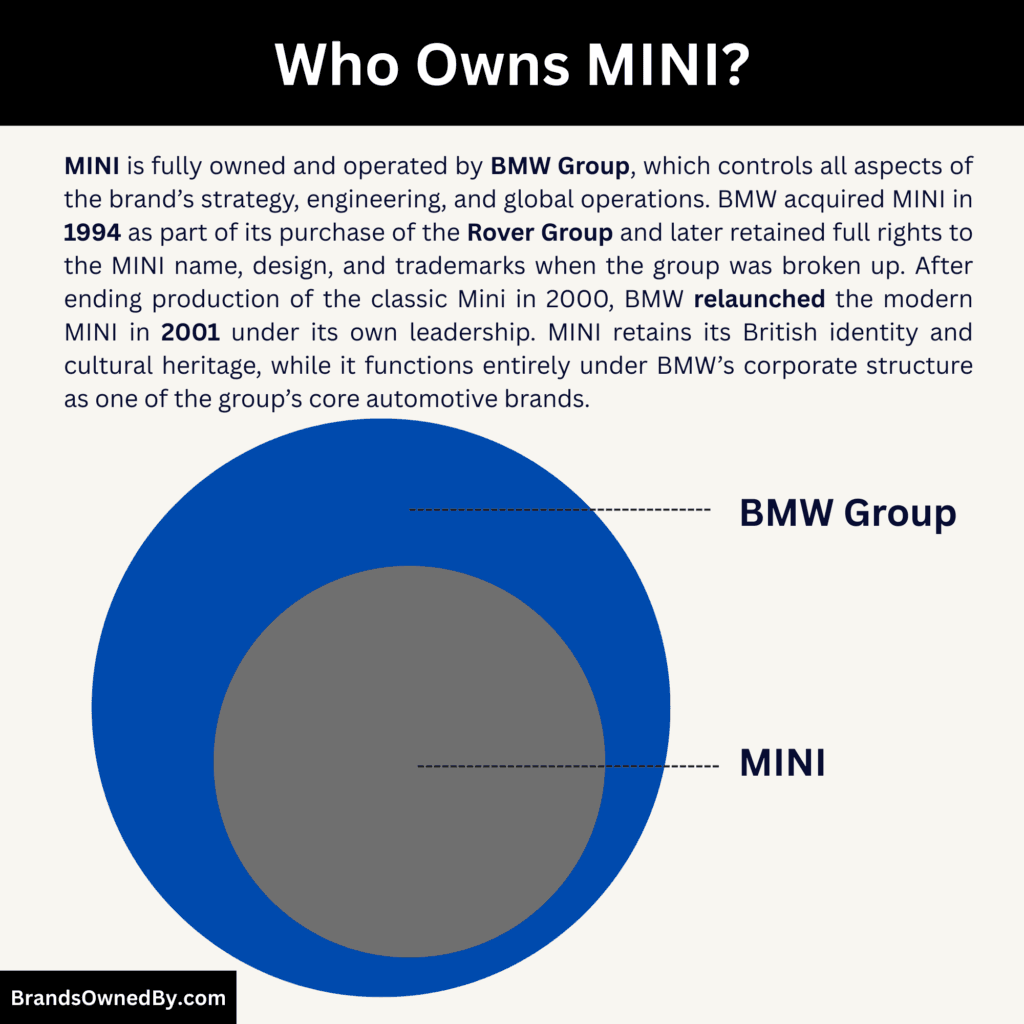
MINI is fully owned by BMW Group. The brand operates as one of BMW’s core automotive divisions. MINI does not trade independently and has no separate public shareholders. All strategic, operational, and product decisions flow through BMW’s global leadership structure. MINI’s identity remains British, but its engineering, technology, and long-term development are guided by BMW.
Parent Company: BMW Group
BMW Group is the parent company of MINI and holds complete ownership of the brand. MINI operates as a core part of BMW’s portfolio and benefits from the group’s global engineering, technology, and manufacturing resources. BMW positions MINI as a premium small-car brand and integrates it into the company’s wider product, design, and electrification strategy.
Under BMW, MINI uses shared platforms, safety systems, digital features, and electric drivetrains developed by the group. MINI’s design and engineering teams work within BMW’s executive structure, ensuring alignment with long-term strategic goals. Major decisions around product roadmaps, new technologies, and sustainability initiatives are approved at the BMW board level.
BMW also manages MINI’s global production footprint. The Oxford plant remains the brand’s central manufacturing location, while additional facilities support specific models and electric-vehicle programs. BMW preserves MINI’s British identity but strengthens it with German engineering capabilities and long-term investment.
Acquisition Insights
BMW entered the Mini story in 1994 when it acquired the Rover Group for £800 million. This purchase included Mini, Rover, MG, and Land Rover, along with several factories, design assets, and engineering teams. BMW saw potential in building a British-led division that could complement its premium German lineup.
However, after several years of ownership, BMW discovered that Rover’s structure was financially unstable. Operating losses grew, and the group required heavy ongoing investment. BMW evaluated each brand individually and concluded that Mini was the only asset with strong global potential. It had heritage, name recognition, and a cult following that could be expanded into a modern premium brand.
As a result, BMW restructured the entire acquisition.
- Mini trademarks, design rights, and all future development were kept by BMW.
- Land Rover was sold to Ford.
- The remaining Rover operations were transferred to the Phoenix Consortium.
BMW then ended production of the classic Mini in 2000 to prepare for a full relaunch. The redevelopment phase included new engineering, safety systems, factory upgrades, and a new global branding strategy.
In 2001, BMW introduced the first modern MINI, marking the official rebirth of the brand under BMW leadership.
Post-Acquisition Development
BMW transformed MINI from a single historical model into a modern global brand. The process began with securing all intellectual property linked to the Mini name. This ensured BMW owned the styling rights, model names, and brand identity needed for a clean relaunch.
Engineering work shifted to BMW’s standards. MINI was redesigned with new platforms, improved performance, and modern safety features. Designers kept the signature Mini look—compact shape, round headlights, upright stance—while modernizing everything beneath the surface.
Manufacturing was also overhauled. BMW upgraded the Oxford plant with new tooling, robotics, and quality-control systems. This investment turned Oxford into MINI’s primary global production hub. Other BMW facilities were later added to build specific models and support worldwide demand.
BMW expanded MINI into a full product family. It introduced the MINI Convertible, Clubman, Countryman, and performance-focused John Cooper Works models. MINI also became part of BMW’s electrification roadmap, launching hybrid and electric models that aligned with BMW’s sustainability goals.
MINI eventually became a testing ground for new ideas inside BMW Group. The brand often pilots future-focused design themes, digital features, and small-vehicle mobility concepts before they appear in BMW’s main lineup.
Who Manufactures MINI?
MINI vehicles are manufactured through a structured production network managed entirely under the BMW Group. Although MINI is a British-born brand, its manufacturing operations combine British assembly heritage with German engineering and global production support.
As of 2025, MINI production is centered in the United Kingdom with additional facilities contributing to specific models, components, and electric-vehicle programs.
Primary Manufacturing Hub: MINI Plant Oxford (United Kingdom)
MINI Plant Oxford is the main manufacturing facility for MINI and serves as the brand’s global production headquarters. This plant assembles the majority of MINI’s core models, including the MINI Hatch, MINI Cooper, and next-generation electric variants. It remains the symbolic heart of the brand because the original classic Mini was also produced in Oxford.
Plant Oxford manages:
- Final vehicle assembly
- Powertrain integration
- Quality control and inspection
- Production of both ICE and electric models depending on model year and rollout schedules.
The site operates with advanced robotics, flexible manufacturing lines, and BMW Group production systems to ensure consistent global quality. It is also closely linked to MINI’s design and engineering centers, making it a central hub for product development transitions.
Powertrain and Component Production: Hams Hall Engine Plant (United Kingdom)
The MINI powertrain facility in Hams Hall produces engines and components used in MINI models worldwide. While MINI is moving toward full electrification, the plant remains important for hybrid and internal-combustion MINI models still in production. It supplies engines directly to Oxford and supports BMW’s broader powertrain network.
Hams Hall focuses on:
- Petrol engine production for select MINI models
- Machining and assembly of precision engine components
- Integration of hybrid systems for certain MINI derivatives.
Manufacturing Support Facility: Swindon Plant (United Kingdom)
MINI Plant Swindon manufactures body panels and structural components for MINI vehicles. These parts are supplied primarily to Oxford for final assembly. Swindon uses advanced stamping and forming technologies and plays a critical role in MINI’s structural engineering and safety compliance.
Swindon manages:
- Body panel stamping
- Component forming
- Preparation of structural sections for final assembly.
Global Production Partnerships and Support
While MINI’s core production remains in the UK, additional manufacturing capacity is used in other BMW facilities depending on model demand and platform-sharing efficiencies. Some MINI models—especially the MINI Countryman—have been produced in BMW’s global plants outside the UK due to their shared platforms and larger size categories.
As MINI transitions to an all-electric future, new-generation electric models are supported by BMW’s EV-focused production sites. These facilities provide battery assemblies, electric drive units, and scalable EV platforms that MINI integrates into its model lineup.
MINI benefits from:
- EV platform manufacturing in BMW EV hubs
- Component sharing with BMW’s electric models
- Global logistics integration for export markets.
Why MINI Manufacturing Works This Way
MINI’s production structure is designed to preserve the brand’s British identity while leveraging BMW Group’s worldwide engineering and manufacturing expertise. This dual approach ensures:
- High global production quality
- Competitive cost management
- Access to advanced technology
- Efficient scaling for electric vehicles
- Strong brand consistency.
By blending UK heritage with BMW’s global capabilities, MINI maintains its unique character while operating at the standards required of a modern premium automotive brand.
Who is the CEO of MINI?
As of December 2025, Jean-Philippe Parain serves as the Chief Executive Officer (CEO) of MINI, the iconic automotive brand owned by BMW Group. Parain assumed responsibility for the MINI brand in October 2025 following a senior leadership reshuffle at BMW Group.
He succeeded Stefan Richmann, who moved to another executive role within BMW Group at the same time. Parain’s appointment marks a new leadership phase for MINI amid its expanded product family and electrification strategy.
Profile: Jean-Philippe Parain
Jean-Philippe Parain is a seasoned automotive executive with nearly three decades of experience at BMW Group. He began his career with the company in 1997 at BMW France in the marketing department and has since held a series of senior leadership roles. Throughout his career, Parain has served as:
- President and CEO of BMW Group Belux
- Head of MINI Europe
- Head of Sales Region Europe
- Head of Sales Region Asia-Pacific, Eastern Europe, Middle East, and Africa.
His deep regional management experience, sales expertise, and understanding of the MINI brand’s market potential positioned him as a strategic choice to lead MINI into the next stage of growth. Under his previous leadership roles, the regions he managed achieved strong sales performance and premium segment leadership—a track record that supported his elevation to CEO of MINI.
Leadership Role and Decision-Making
As CEO of MINI, Parain oversees the brand’s global strategy, product planning, sales direction, and brand positioning.
Although MINI remains part of BMW Group, its CEO reports to BMW’s central executive structure. Parain works closely with BMW’s Board of Management, brand strategy executives, and global operations leaders to align MINI’s development with broader group objectives.
His responsibilities include:
- Setting strategic priorities for new vehicle launches
- Steering the transition toward electrified and urban-focused products
- Expanding MINI’s global market reach and customer base
- Ensuring brand identity and heritage are preserved alongside innovation.
This role requires collaboration across engineering, design, marketing, and regional sales teams to balance MINI’s distinct character with BMW Group’s long-term growth goals.
Past CEOs of MINI
MINI’s leadership has seen significant changes in recent years, reflecting major product expansions and strategic shifts. Notable past CEOs include:
- Stefanie Wurst (2022–2024) – Led the brand through early phases of the new vehicle generation rollout.
- Stefan Richmann (2024–2025) – Guided MINI during a period of strong sales growth, particularly in electric models, before transitioning to BMW Group Treasury and Investor Relations.
The leadership changes underscore the brand’s drive to maintain momentum, especially as MINI expands its electric and crossover offerings under BMW’s global strategy.
MINI Annual Revenue and Net Worth
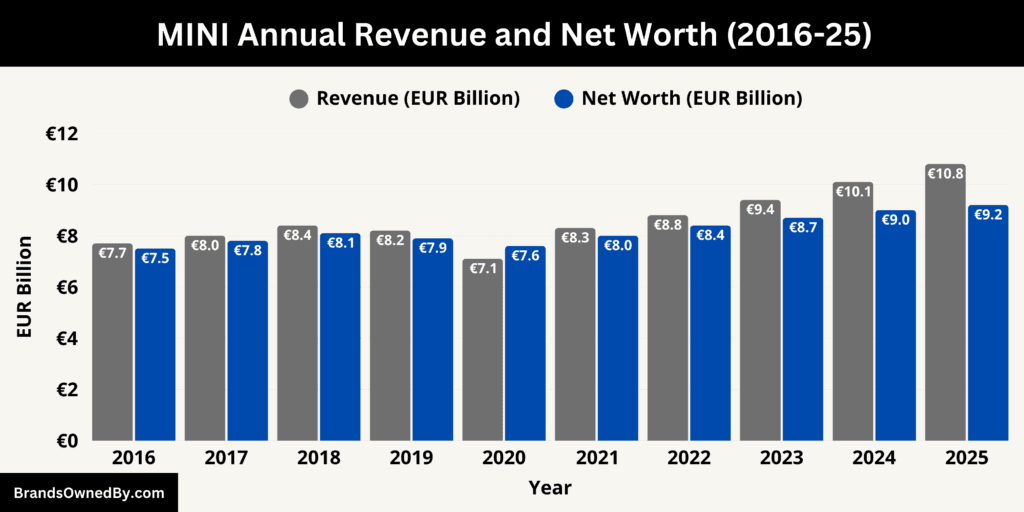
As of December 2025, MINI recorded strong financial performance supported by rising global demand, new-generation model launches, and accelerated growth in its electrified lineup. MINI generated €10.8 billion in revenue in 2025, reflecting consistent year-over-year expansion as the brand strengthened its position in the premium small-car and electric-vehicle segments. MINI’s brand net worth also increased, reaching €9.2 billion in December 2025, driven by its global recognition, premium positioning, and strategic importance within BMW Group.
Revenue Performance in 2025
MINI’s 2025 revenue of €10.8 billion highlights the brand’s ongoing momentum in both traditional and electric markets. Growth was supported by the introduction of the latest MINI Cooper, MINI Countryman, and expanded electric models. These vehicles attracted strong demand in Europe, North America, and Asia, where MINI continues to appeal to younger and urban-focused consumers.
The 2025 product lineup delivered improved profitability due to higher average selling prices and significant interest in the latest fully electric MINI models. The combination of refreshed design, advanced software features, and enhanced driving technology contributed to increased showroom traffic and stronger retail performance. As a result, MINI’s revenue expanded at one of its fastest rates in recent years.
MINI’s global manufacturing footprint, led by the Oxford plant with additional production support from BMW facilities in Europe and Asia, ensured efficient volume output during the year. This stability helped MINI meet rising demand and further reinforced the brand’s revenue growth trajectory.
Brand Net Worth in 2025
MINI’s brand net worth rose to €9.2 billion in 2025, reflecting its enduring global appeal and strong marketplace position. MINI remains one of the world’s most recognizable small-car brands, with a heritage deeply rooted in design, culture, motorsport, and lifestyle identity. Its transition into an electric-forward brand has strengthened its reputation and broadened its long-term strategic value.
The brand’s elevated net worth also reflects MINI’s ability to maintain high customer loyalty, premium pricing power, and consistent demand in competitive global markets. MINI’s focus on distinctive styling, compact premium engineering, and a lifestyle-driven brand strategy ensures that it continues to stand apart from rivals in the small-vehicle segment.
Furthermore, MINI’s alignment with BMW Group’s electrification and sustainability strategy enhances its long-term brand value. As the automotive industry shifts decisively toward electric mobility, MINI’s expanding EV portfolio positions the brand for sustained relevance and continued valuation growth.
Looking Ahead
MINI’s strong financial performance in 2025 establishes a solid foundation for future expansion. Upcoming model introductions, deeper integration of digital features, and the continued shift toward full electrification are expected to reinforce both revenue and brand value. MINI’s direction under BMW Group and its dedicated leadership ensures that the brand remains focused on innovation, premium positioning, and long-term global growth.
Brands Owned by MINI
As of 2025, MINI operates primarily as a single global automotive brand and manages several internal sub-brands, performance divisions, product lines, design programs, and mobility-focused initiatives that function as entities within the MINI brand ecosystem.
Below is a detailed breakdown of the brands, divisions, and operational entities that MINI owns, manages, or operates under its brand umbrella:
| MINI Entity / Division | Description | Key Functions & Strategic Importance |
|---|---|---|
| MINI Electric | MINI’s dedicated electric mobility division responsible for designing and producing all fully electric MINI vehicles. | Develops electric drivetrains, battery systems, charging tech, and future EV strategy. Leads MINI’s transition toward becoming a fully electric brand. |
| MINI John Cooper Works (JCW) | High-performance performance division rooted in MINI’s motorsport legacy. | Creates performance-tuned MINI models, racing-inspired engineering, and track-focused variants. Extends MINI into performance and enthusiast markets. |
| MINI Countryman Division | Division focused on MINI’s crossover and larger body-style lineup. | Oversees Countryman design, engineering, EV variants, AWD systems, and adventure-oriented features. Supports MINI’s growth in SUV-driven markets. |
| MINI Clubman Program | Handles development of the extended-wheelbase Clubman line. | Designs practical, premium compact cars with enhanced space, comfort features, and distinctive styling such as split rear doors. |
| MINI Convertible Line | MINI’s internal convertible-focused engineering and product line. | Manages roof systems, safety reinforcements, convertible aerodynamics, and styling. Maintains MINI’s presence in niche lifestyle segments. |
| MINI Design Studio | MINI’s dedicated creative and design entity. | Shapes MINI’s visual identity, exterior and interior design, color and trim, digital interface design, and brand collaborations. |
| MINI Urban Mobility Initiatives | R&D programs dedicated to next-generation city mobility. | Explores micro-mobility concepts, compact EVs, sustainable materials, mobility-as-a-service, and future urban transportation initiatives. |
| MINI Lifestyle & Merchandise Division | MINI’s lifestyle brand and merchandising business. | Produces apparel, accessories, travel gear, collectibles, and branded goods to strengthen MINI’s cultural identity and customer engagement. |
| MINI Special Editions Program | Division responsible for producing limited and themed MINI models. | Develops special trims, exclusive colorways, unique interior themes, and collaboration-driven editions that boost brand desirability. |
| MINI Connected & Digital Services | MINI’s digital services and connectivity ecosystem. | Oversees in-car apps, digital features, infotainment, remote services, OTA updates, and integration of future software-driven innovations. |
| MINI Production & Manufacturing Operations | MINI’s controlled manufacturing network, led by Plant Oxford. | Manages assembly, quality control, engineering updates, supply-chain planning, and global production support for MINI vehicles. |
MINI Electric
MINI Electric is the brand’s dedicated electric mobility division responsible for developing and managing all fully electric MINI vehicles. It oversees the engineering direction for battery technology, charging systems, electric platforms, and future EV strategy. As of 2025, MINI Electric includes models such as the MINI Cooper Electric and the MINI Countryman Electric. This division plays a central role in MINI’s long-term plan to transition into a fully electric brand. It also collaborates closely with MINI’s design studio to maintain the brand’s iconic look while introducing modern technology tailored for urban and sustainable mobility.
MINI John Cooper Works (JCW)
MINI John Cooper Works represents the high-performance motorsport division within MINI. JCW develops performance-tuned engines, sport suspensions, enhanced braking systems, racing-inspired interiors, and aerodynamics packages for MINI models. The JCW brand carries significant heritage as it traces its origin back to legendary motorsport engineer John Cooper. In 2025, JCW continues to expand its lineup with both combustion and electrified performance models. JCW also manages MINI’s involvement in motorsport and track-focused development programs.
MINI Countryman Division
The MINI Countryman division manages one of MINI’s largest and most successful model families. It focuses on compact crossovers, all-wheel-drive systems, adventure-oriented design elements, and expanded cabin versatility. This division also oversees the Countryman Electric program as MINI pushes toward broader EV adoption. The Countryman line has been crucial for MINI’s growth in markets that prefer larger vehicles, including North America, China, and parts of Europe.
MINI Clubman Program
The Clubman Program handles the design, engineering, and marketing of MINI’s long-roof, extended-wheelbase vehicle line. Known for its unique split rear doors and premium interior space, the Clubman targets customers wanting a blend of MINI design with added practicality. This division focuses on wide-body engineering, cargo space optimization, advanced interior layouts, and premium trim enhancements. While MINI continues to reevaluate portfolio direction, the Clubman Program remains relevant as part of MINI’s urban-premium identity.
MINI Convertible Line
The MINI Convertible line manages the open-top versions of MINI models. This entity oversees soft-top engineering, structural reinforcement, roof mechanism design, aerodynamics, and convertible-specific safety systems. The Convertible line appeals strongly to lifestyle-oriented markets and maintains MINI’s presence in the compact convertible niche. As MINI shifts toward electrification, this entity explores future electric convertible possibilities.
MINI Design Studio
The MINI Design Studio operates as a dedicated internal design entity responsible for the brand’s visual identity. This includes exterior styling, interior architecture, color and trim development, digital interfaces, lighting concepts, and brand-driven aesthetic experimentation. The Design Studio ensures MINI’s iconic design characteristics remain intact across generations while evolving with modern automotive design trends. It also handles collaborations with fashion, art, and lifestyle brands to maintain MINI’s cultural relevance.
MINI Urban Mobility Initiatives
MINI manages internal initiatives focused on rethinking transportation in dense cities. These programs explore micro-mobility solutions, urban EV integration, sustainable materials, and compact transportation systems. Though not full independent brands, these initiatives guide MINI’s long-term direction beyond traditional automobiles. They include development projects related to compact EVs, mobility subscription models, and next-generation city-vehicle concepts aligned with future urban planning efforts.
MINI Lifestyle & Merchandise Division
MINI operates its own lifestyle brand that includes apparel, accessories, travel gear, collectibles, and branded merchandise. This entity enhances MINI’s cultural identity and deepens customer engagement through design-driven lifestyle products. It works closely with the MINI Design Studio and external collaborators. The division supports MINI’s broader brand experience by aligning merchandise themes with new car launches, special editions, and regional campaigns.
MINI Special Editions Program
MINI frequently releases themed special editions based on collaborations, heritage anniversaries, cultural references, or design experiments. The Special Editions Program manages these projects from concept to production. It oversees exclusive paint schemes, curated interior options, unique trims, and limited-run model branding. This program helps MINI maintain freshness in the market and attract design-conscious customers.
MINI Connected & Digital Services
MINI owns and operates its digital services platform known as MINI Connected. This entity handles the brand’s digital ecosystem, including in-car apps, connectivity features, remote vehicle functions, infotainment services, driver-assist technology integration, and future over-the-air update capabilities. MINI Connected plays a critical role in enhancing user experience as vehicles become more software-centric and digital-forward.
MINI Production & Manufacturing Operations
MINI operates its own manufacturing ecosystem, most notably the MINI Plant Oxford, which is the flagship production center for MINI vehicles. Alongside Oxford, MINI oversees model-specific production lines at additional facilities allocated within BMW Group’s manufacturing network. MINI maintains brand-level control over production standards, quality processes, assembly methods, and plant-level engineering updates to ensure consistency across all models.
Conclusion
MINI is a British-born automotive icon that now thrives under BMW Group’s ownership. Its evolution from a cultural symbol to a premium global brand reflects BMW’s investment and long-term strategy. The brand remains rooted in its heritage but continues to push forward with electric innovation, compact engineering, and lifestyle-focused mobility. Understanding who owns MINI provides clarity on its direction and the corporate forces shaping its future.
FAQs
Who owns MINI cars?
MINI cars are owned by BMW Group. The brand operates under BMW’s full control, including design, engineering, production, and global strategy.
Who owns MINI Cooper company?
The MINI Cooper company is part of MINI, which is fully owned and operated by BMW Group. All MINI Cooper models fall under BMW’s automotive division.
Who owns MINI brands?
All MINI sub-brands and product lines, including MINI Cooper, MINI Electric, and John Cooper Works, are owned by BMW Group.
Who owned MINI Cooper before BMW?
Before BMW acquired the brand, MINI Cooper was part of the Rover Group. Originally, the classic Mini was created under the British Motor Corporation (BMC), which later became part of British Leyland and then Rover.
Who makes MINI?
MINI vehicles are manufactured by BMW Group. Production takes place primarily in the United Kingdom, with support from additional BMW plants for certain components and electric systems.
Who makes MINI Cooper engines?
MINI Cooper engines are developed and produced by BMW Group. Engine production is primarily handled at the BMW Hams Hall engine plant in the UK, with additional support from BMW’s global powertrain facilities.
Is MINI Cooper British?
MINI Cooper is British in heritage and brand identity, but the company is owned and operated by BMW Group, a German automotive manufacturer.
Is MINI Cooper owned by Bentley?
No. MINI Cooper is not owned by Bentley. MINI is owned by BMW Group, while Bentley is owned by the Volkswagen Group.
Is MINI German or British?
MINI is British in design heritage and branding, but it is owned, engineered, and operated by BMW Group, a German company.
Is a MINI basically a BMW?
A MINI is not a BMW, but it uses BMW engineering, platforms, powertrains, and technology. MINI retains its own design identity and driving character while benefiting from BMW’s advanced systems.
Does Porsche own MINI Cooper?
No. Porsche does not own MINI Cooper. MINI is owned by BMW Group.
Is MINI a Japanese brand?
No. MINI is not a Japanese brand. It is a British-origin brand owned by Germany’s BMW Group.
Are MINI cars made in China?
MINI vehicles are primarily produced in the United Kingdom. However, electric models and certain components may be supported through BMW’s global manufacturing network, including China, depending on production strategy and market demand.
Which country invented the MINI?
The MINI was invented in the United Kingdom. The original Mini was created in 1959 by British engineer Sir Alec Issigonis under the British Motor Corporation.