
- Frito-Lay is fully owned by PepsiCo and is not an independent company. It operates as a core division, meaning it has no separate stock, no private owners, and no standalone shareholder base. Ownership is exercised entirely through PepsiCo.
- Shareholders of PepsiCo indirectly own Frito-Lay. The largest influence comes from major institutional investors such as Vanguard, BlackRock, and State Street, which together control a significant portion of PepsiCo’s voting power.
- All major decisions (leadership, expansion, and acquisitions) are made at the PepsiCo level. Frito-Lay’s management runs daily operations, but corporate control, long-term strategy, and ownership structure.
Frito-Lay is not just a snack company. It is a global food icon. From supermarket shelves to movie nights and sports events, its brands are woven into everyday life. What began as two small snack businesses in the 1930s grew into the largest snack division in the world.
Today, Frito-Lay operates as part of PepsiCo and leads the global savory snacks category. Its success comes from powerful branding, constant product innovation, and one of the strongest distribution systems in consumer goods history.
Founders and Origin
The roots of Frito-Lay go back to two separate companies in the early 1930s.
On one side was the company started by Charles Elmer Doolin.
In 1932, Doolin purchased a corn-chip recipe and basic equipment — for just $100 borrowed from his mother — to begin producing corn chips. He established his business as the Frito Company, operating initially from his family’s kitchen in San Antonio. The chips were sold in small bags, often for a nickel. What began as a small kitchen operation slowly expanded as Doolin built a larger production and distribution infrastructure.
Over time, the Frito Company opened plants in cities like Dallas, Tulsa, Los Angeles, and Denver, and built its own network of corn farms to secure raw materials for production.
On the other side of what would become Frito-Lay was Herman W. Lay. He started selling potato chips in the southern United States in the early 1930s — often from the trunk of his car.
Later, he formalized his snack business as H.W. Lay & Company. Over time, Lay expanded the reach of his potato-chip business by acquiring manufacturing plants and growing into one of the major potato chip producers in the U.S. by the late 1930s.
In 1961, these two companies merged to form Frito-Lay, Inc. This combination brought together The Frito Company’s corn-chip products with H.W. Lay & Company’s potato-chip strengths. The merger unified their manufacturing and distribution networks and created a powerhouse in snack foods.
At formation, Frito-Lay already had a broad product base including Fritos, Lay’s, Ruffles, Cheetos and other snack lines.
Major Milestones
- 1932: Charles Elmer Doolin buys a corn-chip recipe in San Antonio and begins selling Fritos from his family kitchen, marking the birth of The Frito Company.
- 1939: Herman W. Lay incorporates H.W. Lay & Company after building a fast-growing potato-chip distribution business across the southern United States.
- 1945: The Frito Company becomes America’s first snack company to distribute products nationwide using its own controlled manufacturing and delivery system.
- 1958: The “Frito Bandito” advertising character is introduced, making Fritos one of the earliest snack foods to use national cartoon branding.
- 1961: The Frito Company and H.W. Lay & Company officially merge to form Frito-Lay, Inc., creating a single dominant snack manufacturer.
- 1963: Frito-Lay enters international markets for the first time, beginning long-term global expansion.
- 1965: Frito-Lay merges with Pepsi-Cola to form PepsiCo, transforming the business into part of a global food and beverage giant.
- 1966: Doritos launches nationwide in the United States, helping create an entirely new flavored tortilla-chip category.
- 1974: Flavored versions of Doritos go mainstream, reshaping consumer taste expectations in the snack market.
- 1980s: Frito-Lay builds one of North America’s largest private distribution networks for consumer goods.
- 1991: Global expansion accelerates as PepsiCo pushes Frito-Lay deeper into Europe, Latin America, and Asia.
- 2000: Major investments in automation and mega-manufacturing facilities modernize operations across the United States.
- 2006: PepsiCo adopts a long-term strategy focused on healthier products, reformulation, and industry leadership in nutrition awareness.
- 2011: Frito-Lay expands its baked, reduced-fat, and portion-controlled snack lines to meet rising health-conscious demand.
- 2018: Ramon Laguarta becomes CEO of PepsiCo and strengthens digital transformation and sustainability initiatives across divisions.
- 2020: Frito-Lay introduces electric delivery trucks and renewable-energy manufacturing plants as part of corporate environmental goals.
- 2023: Smart manufacturing systems powered by artificial intelligence are expanded across key facilities.
- 2025: Frito-Lay remains PepsiCo’s largest and most influential business unit, leading global snack innovation and market dominance.
Who Owns Frito-Lay in 2025?
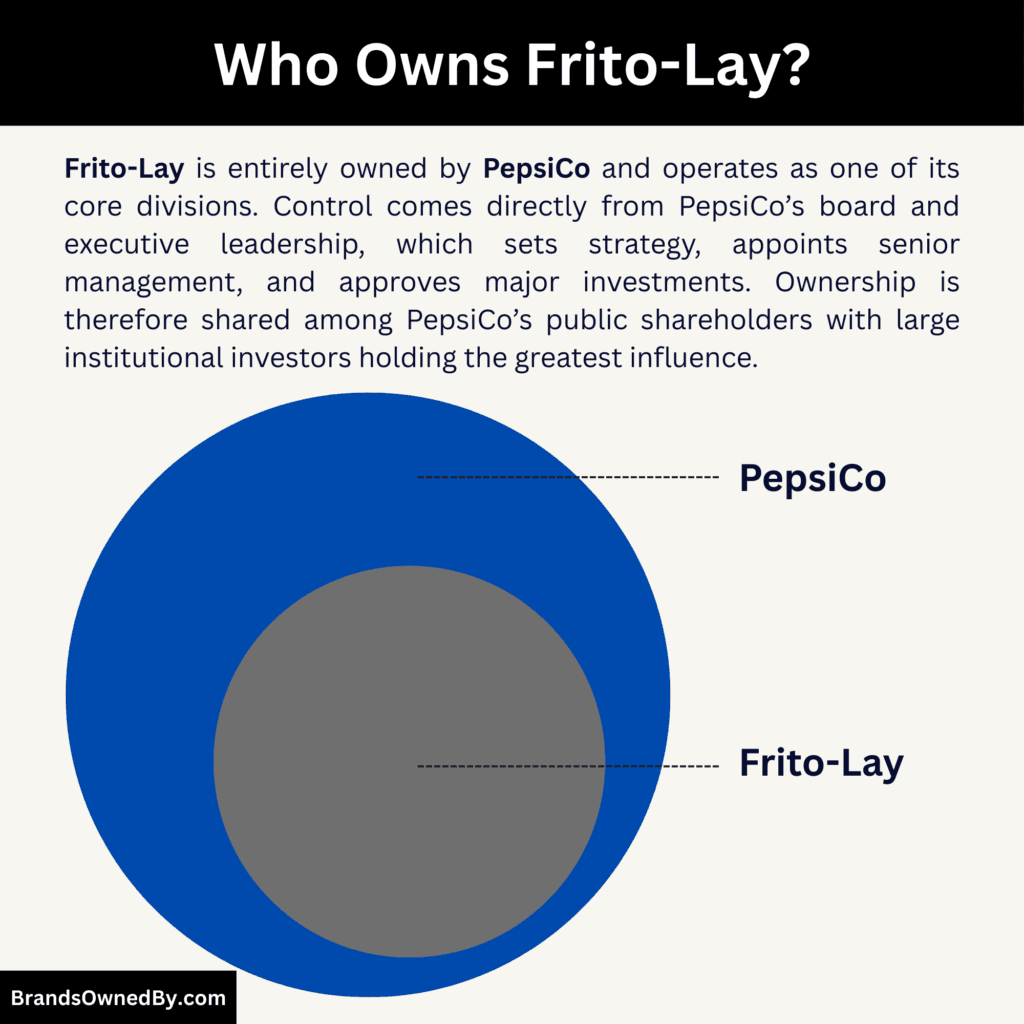
Frito-Lay is not an independent company. It is a fully owned operating division of PepsiCo, one of the world’s largest food and beverage corporations. PepsiCo owns 100% of Frito-Lay’s business operations, brands, production facilities, and distribution infrastructure. There are no outside investors, private owners, or partner companies involved in Frito-Lay’s ownership. All strategic authority ultimately flows from PepsiCo’s corporate leadership and board of directors.
Parent Company: PepsiCo
PepsiCo is the sole parent company of Frito-Lay. The relationship is not contractual or partial. It is full corporate ownership.
Frito-Lay functions as PepsiCo’s global snacks engine. It operates alongside PepsiCo’s beverage and international food divisions, sharing corporate services such as finance, legal, logistics planning, and research and development.
PepsiCo determines Frito-Lay’s operating structure, leadership appointments, international expansion, and manufacturing investment. Regional Frito-Lay executives report directly into PepsiCo’s corporate leadership framework. This centralized structure ensures a unified strategy across all brands and countries.
PepsiCo also controls intellectual property, trademarks, and product patents. All Frito-Lay brands, packaging designs, and product innovations legally belong to PepsiCo.
How Frito-Lay Became Part of PepsiCo
Frito-Lay did not become part of PepsiCo through a conventional acquisition.
In 1965, Frito-Lay and Pepsi-Cola merged to form PepsiCo. This was a merger of equals rather than a purchase or takeover. A new company was created. Both businesses became operating divisions inside PepsiCo.
The motivation behind this combination was strategic alignment. Frito-Lay already dominated snacks in the U.S. Pepsi-Cola had a global beverage reach. Together, they built one of the strongest distribution networks in consumer goods.
After the merger, Frito-Lay continued operating under its existing brand identity but under newly formed corporate ownership. It was never sold afterward. It was never spun off. It has remained fully integrated into PepsiCo for six decades.
Ownership Structure Explained
Frito-Lay itself is not publicly traded. PepsiCo is.
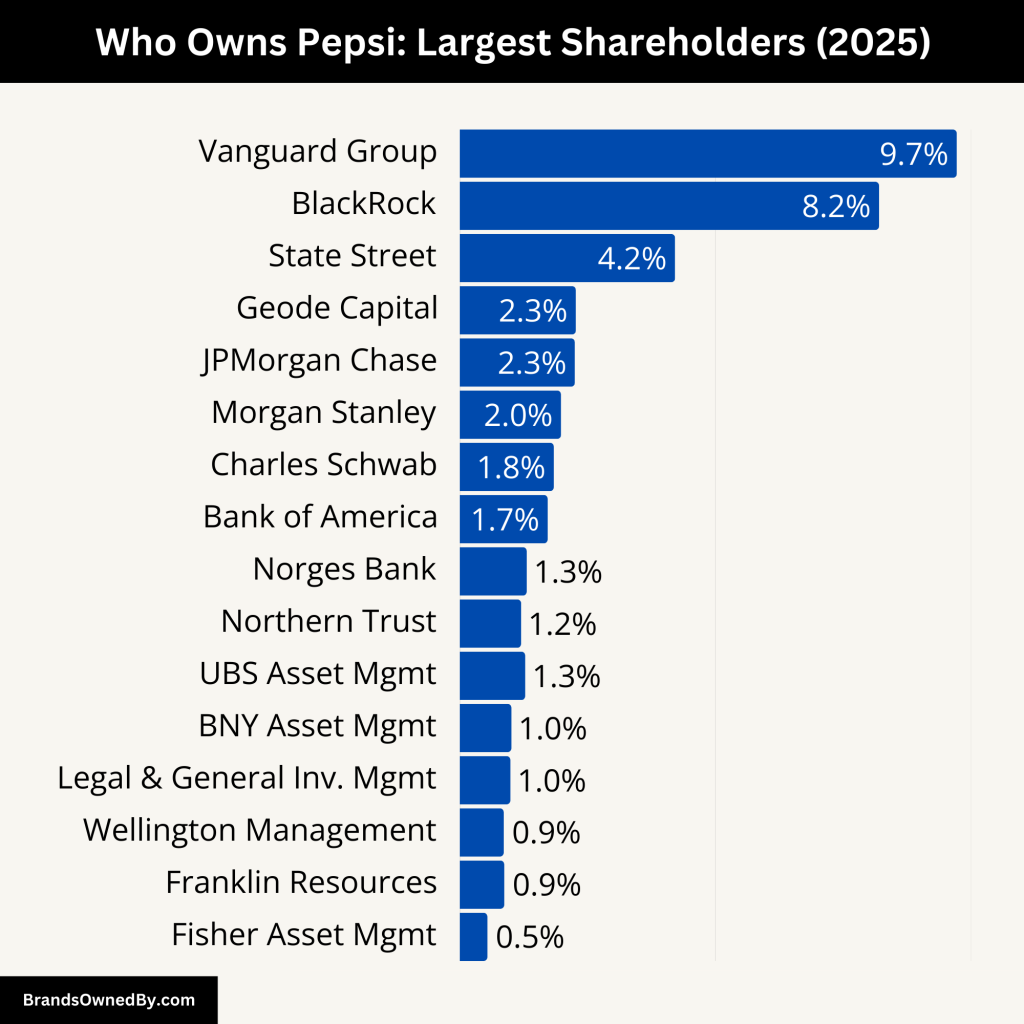
Ownership, therefore, functions through PepsiCo’s shareholder structure. The company is majority-owned by institutional investment firms such as Vanguard Group, BlackRock, and State Street. These firms manage large pools of retirement funds, index funds, and long-term investment vehicles.
No individual shareholder controls PepsiCo outright. Ownership is widely distributed among thousands of institutions and millions of individual investors. This creates a governance model where control flows through the board of directors rather than a founder or family group.
PepsiCo’s board is responsible for approving key actions affecting Frito-Lay such as executive appointments, major investments, plant expansions, and global strategy changes.
Who Makes Everyday Decisions at Frito-Lay
While ownership and strategy come from PepsiCo, daily operations are run by Frito-Lay’s management team.
The business is organized by geographic divisions. North America has its own executive leadership. International markets operate under PepsiCo’s global foods structure.
Local leadership oversees factory operations, marketing campaigns, transportation systems, and retail partnerships. However, all major business decisions are still approved and governed by PepsiCo’s executive council.
Frito-Lay cannot independently sell itself, change ownership, or restructure its capital model. All corporate authority sits at the PepsiCo level.
Can PepsiCo Sell Frito-Lay?
Technically yes. Practically no.
Because Frito-Lay is not a subsidiary with separate shares, selling it would require a full corporate separation. PepsiCo has never indicated that such a move is being considered.
Industry experts widely view Frito-Lay as PepsiCo’s most strategically important business unit. It anchors the company’s snack leadership and is deeply integrated with its logistics, supply chain, and marketing structure.
Removing Frito-Lay would dismantle PepsiCo’s identity as a combined snack-and-beverage giant. For this reason, it is considered a permanent part of the company.
Who is the CEO of Frito-Lay?
Steven Williams is the senior executive directly responsible for Frito-Lay operations in North America. Specifically, he serves as Chief Executive Officer of PepsiCo North America. Within that remit, he oversees the food and snack business that includes Frito-Lay North America (FLNA) along with other food divisions.
Because Frito-Lay is a division of PepsiCo, Inc. — not a standalone public company — the CEO of PepsiCo North America effectively acts as the top leader for Frito-Lay’s regional operations.
Background and Career of Steven Williams
Steven Williams has a long history with PepsiCo and related companies. He originally joined what became PepsiCo in 2001, when the company acquired Quaker Oats Company — where Williams had worked since 1997.
Over the years, he has held many leadership roles across sales, general management, and customer and retail operations.
Before becoming CEO, he served as Senior Vice President and Chief Commercial Officer for Frito-Lay U.S., overseeing sales and commercial activities.
On March 29, 2019, he was promoted to CEO of the food division — at that time called PepsiCo Foods North America — which manages Frito-Lay North America and other snack/food brands.
In 2025, after PepsiCo restructured its North America operations, his role expanded to CEO of PepsiCo North America, consolidating food and beverage leadership under a single executive.
What His Role Means for Frito-Lay
As CEO of PepsiCo North America, Steven Williams oversees a large business encompassing both PepsiCo’s foods (snacks, convenient foods) and beverage operations across the U.S. and Canada. That includes every aspect of Frito-Lay North America — manufacturing, marketing, distribution, strategic planning, and expansion.
He is responsible for guiding product innovation, supply-chain decisions, sustainability initiatives, and brand growth strategies. Under his leadership, Frito-Lay and related divisions have pushed for innovation in snack products and have navigated changing consumer preferences.
Leadership Timeline & Key Career Milestones for Williams
- Before 2001: Worked at Quaker Oats (starting 1997).
- 2001: Became part of PepsiCo when it acquired Quaker Oats.
- Various roles in sales, general management, and retail-customer operations over years.
- Pre-2019: Senior Vice President and Chief Commercial Officer for Frito-Lay U.S.
- March 29, 2019: Promoted to CEO of PepsiCo Foods North America, overseeing Frito-Lay North America and Quaker Foods North America.
- 2025: Elevated to CEO of PepsiCo North America, broadening scope to include both food and beverage operations in North America.
Why This Leadership Structure Matters for Frito-Lay
Having Steven Williams as CEO of PepsiCo North America — with full responsibility for Frito-Lay’s core operations — gives the snack business strong, focused leadership. Because he rose through the ranks at Frito-Lay and related divisions, he brings deep institutional knowledge of the snack business, retail channels, supply chain, and consumer behavior.
At the same time, because his role is tied to PepsiCo’s larger corporate infrastructure, he can leverage broad resources: global logistics, R&D, financial backing, and strategic coordination with beverages and international operations.
This means Frito-Lay benefits from both specialized leadership and corporate muscle. The structure supports product innovation, long-term growth, and stability — especially in times of shifting consumer preferences or global market challenges.
Frito-Lay Annual Revenue
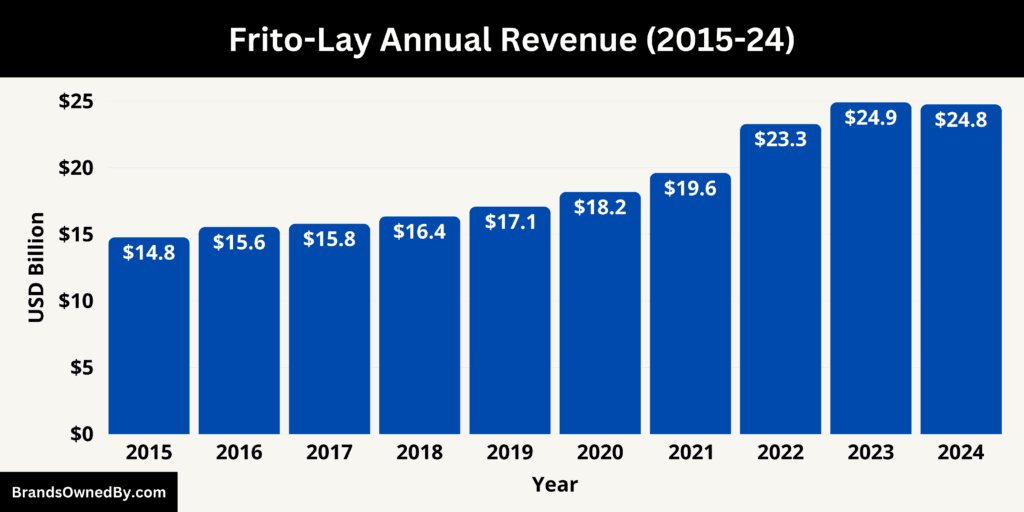
Frito-Lay (operating under Frito-Lay North America — FLNA) remains the leading savory-snack business unit within its parent company. In 2024, FLNA reported net revenue of about $24.75 billion.
That revenue level makes FLNA a major contributor to overall corporate sales. As of the latest full-year data, this revenue represents roughly 27% of total net revenue for the parent.
Frito-Lay’s snacks — including its top global brands — continue generating substantial sales across many product lines and markets.
In recent quarters (for example, a quarter ending March 25), revenue growth for the division was strong: snack brands like Lay’s, Doritos, Cheetos, and Ruffles saw double-digit increases; smaller and newer brands such as PopCorners, SunChips, and others also contributed to overall gains.
However, 2025 has been challenging: in some recent reporting periods, FLNA’s volume has softened. For example, snack volumes in North America reportedly fell by about 2% during a quarter in 2025.
Even so, Frito-Lay remains a major revenue engine in snacks, with diversified brands and product lines, adjusting strategies (such as value-pack offerings and smaller pack sizes) to adapt to changing consumer behavior.
Profitability and Operating Performance
In recent years, it has been reported that FLNA contributed about 43% of the parent company’s adjusted operating profit in a recent year, reflecting both high margins and relative efficiency compared to many other segments.
That means that of every dollar of core profit generated, a substantial portion comes from Frito-Lay operations. This high profitability underscores why Frito-Lay is often viewed as the most valuable business unit in the snacks/food side.
Brands Owned by Frito-Lay
Below are the major brands and entities owned by Frito-Lay as of 2025:
| Brand / Entity | Category | Founded / Acquired | What It Is Known For | Strategic Role Inside Frito-Lay |
|---|---|---|---|---|
| Lay’s | Potato chips | Founded 1932 | World’s most recognized potato chip brand | Flagship revenue engine and shelf-space driver |
| Doritos | Tortilla chips | Launched 1964 | Bold flavors and youth-focused marketing | Category leader in tortilla chips |
| Cheetos | Cheese snacks | Launched 1948 | Crunchy and puffed cheese snacks | Flavor innovation platform |
| Tostitos | Tortilla chips & dips | Acquired 1979 | “Party snack” positioning | Controls entertaining and snacking occasions |
| Fritos | Corn chips | Founded 1932 | Original corn chip product | Heritage brand with loyal customers |
| Ruffles | Ridged potato chips | Launched 1958 | Thick, ridged chips | Premium texture and bold flavors |
| SunChips | Multigrain snacks | Launched 1991 | Whole-grain and baked products | Health-oriented snack option |
| Rold Gold | Pretzels | Acquired 1961 | Classic pretzels | Expands beyond chips to baked snacks |
| Cracker Jack | Popcorn & peanuts | Acquired 1997 | Sweet-and-salty snack | Entry into popcorn and sweet snacks |
| Smartfood | Ready-to-eat popcorn | Acquired early 2000s | White cheddar popcorn | Popcorn category leadership |
| Stacy’s | Pita chips | Acquired 2005 | Artisan-style pita snacks | Premium and natural snack segment |
| PopCorners | Popped corn snacks | Acquired 2020 | Air-popped chip alternative | Light-snack and modern health appeal |
| Miss Vickie’s | Kettle-cooked chips | Acquired 1993 | Thick, kettle-style chips | Premium potato chip market |
| Funyuns | Onion-flavored snacks | Launched 1969 | Onion-ring style snacks | Flavor-based niche leadership |
| TrueNorth | Nut snacks | Launched 2011 | Almond and peanut clusters | Protein snacking category |
| Walkers | Potato crisps (UK) | Acquired via local buyout | British crisp brand | Dominates UK snack market |
| Smith’s | Chips (Australia) | Acquired via local buyout | Australian snack icon | Regional market control |
| Gamesa Snacks | Savory snacks | Acquired 1990 | Latin American snack foods | Regional brand authority |
| Sabritas | Chips & corn snacks | Acquired 1966 | Mexico’s leading snack company | Latin America distribution hub |
| Matutano | European snacks | Acquired 1998 | Mediterranean snacks | Southern Europe expansion |
| Bluebird Foods | Snack chips (NZ) | Acquired 2006 | New Zealand snack leader | Geographic footprint |
Lay’s
Lay’s is Frito-Lay’s flagship potato chip brand and one of the most recognized snack brands in the world. It covers classic salted chips, kettle-cooked variants, wavy cuts, baked lines, and a huge range of flavors that change by market. In many countries, Lay’s is the lead brand that anchors supermarket shelf space and drives promotions. It is also the platform for constant innovation, such as limited-time flavors, local cuisine inspired recipes, and “better for you” baked or reduced-fat lines.
The Lay’s brand is central to Frito-Lay’s identity. It gives the company mass appeal, strong retail visibility, and the scale needed to negotiate with major retailers across North America and many international markets.
Doritos
Doritos is Frito-Lay’s powerhouse tortilla chip brand. It began as a simple tortilla chip, but flavored variants such as Nacho Cheese and Cool Ranch turned it into a cultural icon. Doritos is positioned as bold, edgy, and youth focused. It often leads major sponsorships, gaming tie-ins, and high-profile advertising campaigns, including Super Bowl commercials.
The brand has expanded into different shapes, textures, and seasoning intensities. Doritos also acts as a seasoning platform that Frito-Lay can extend into other snacks, joint flavors, and mashups, including collaborations with pretzels or other base snacks.
Cheetos
Cheetos is the cheese-flavored snack arm of Frito-Lay. It includes crunchy curls, puffs, popcorn-style pieces, and numerous local shapes and flavors. The mascot, Chester Cheetah, keeps the brand playful and mischievous. Cheetos has gone far beyond the original formula, adding spicy variants like Flamin’ Hot, and region-specific flavors tailored to local tastes.
Under Frito-Lay, Cheetos has become a platform brand. Its iconic orange cheese or spicy red seasoning is used across multiple product forms and even outside snacks in some markets via licensing.
Tostitos
Tostitos is the tortilla chip and dip brand designed around sharing, parties, and game days. Frito-Lay uses Tostitos to own the “chips and salsa” or “chips and queso” occasion. The brand includes classic triangle chips, scoops designed to hold dips, flavored chips, and a full line of branded salsa, queso, and dips.
Tostitos gives Frito-Lay a strong presence in the party and entertaining category. It pairs neatly with events such as sports broadcasts and holidays, and is a major driver of seasonal displays in supermarkets.
Fritos
Fritos is the original corn chip brand that traces back to one of the founding companies. Today, Fritos is still a core corn-based snack line under Frito-Lay. It includes classic corn chips, scoops, and flavored variants. Fritos often appears in recipes, walking tacos, and snack mixes.
While newer brands get more marketing attention, Fritos remains important because of its heritage, unique taste, and loyal consumer base. It also plays a role in multi-brand displays and variety packs.
Ruffles
Ruffles is Frito-Lay’s ridged potato chip brand. Its signature ridges give it a heavier crunch and make it ideal for thicker dips. Ruffles often leans into bold flavors, collaborations with restaurants, and sports tie-ins.
Ruffles allows Frito-Lay to segment the potato chip market. Lay’s covers mainstream thin chips, while Ruffles owns the thicker, more indulgent, and heavily flavored end of the category.
SunChips
SunChips is the multigrain snack brand within Frito-Lay. It was developed to appeal to consumers seeking a more wholesome image than traditional fried chips. The snacks are made from whole grains and come in flavors like Harvest Cheddar and Garden Salsa.
Frito-Lay has used SunChips as a test bed for packaging and sustainability experiments, including earlier compostable bag trials. The brand helps Frito-Lay serve the “better-for-you” snack segment without losing the crunch and taste people expect from chips.
Rold Gold
Rold Gold is Frito-Lay’s pretzel brand. Frito-Lay acquired the Rold Gold pretzel company in the early 1960s and has owned it ever since. The line includes classic pretzel twists, rods, thins, and newer premium variants such as flavored twists and specialty shapes.
Rold Gold gives Frito-Lay a strong foothold in the pretzel category, allowing it to complement its chip and corn snack offerings with baked, lower-fat options. In recent years, Rold Gold has also become a platform for flavor mashups using seasonings associated with other Frito-Lay brands.
Cracker Jack
Cracker Jack is the caramel popcorn and peanut snack brand that Frito-Lay brought into its portfolio through acquisition in the late 1990s. Famous for its long association with baseball and its “prize in every box” tradition, Cracker Jack adds a sweet-and-salty dimension to Frito-Lay’s primarily savory lineup.
Under Frito-Lay, Cracker Jack has seen updates in packaging, prize formats, and occasional line extensions, while still leveraging its nostalgic brand story. It allows Frito-Lay to participate in the sweet snack and popcorn segment in a way that complements its salty portfolio.
Funyuns
Funyuns is an onion-flavored ring snack that Frito-Lay developed and operates. It mimics the taste of onion rings but in a crunchy, shelf-stable form. The brand has grown a cult following, especially among younger consumers and fans of intense savory flavors.
Funyuns plays in a niche but distinctive space. It helps Frito-Lay cover another texture and flavor profile and is often used in flavor crossovers and limited-edition spicy or cheesy variants.
Smartfood
Smartfood is the popcorn brand Frito-Lay operates in the ready-to-eat popcorn category. Best known for its white cheddar popcorn, Smartfood has expanded into various flavors and limited editions. The brand positions itself as a somewhat lighter alternative to heavy chips, while still feeling indulgent.
By operating Smartfood, Frito-Lay competes directly in the growing ready-to-eat popcorn market. The brand broadens the company’s reach to consumers who may want a different snacking format than chips or pretzels.
Stacy’s Pita Chips
Stacy’s Pita Chips began as an independent company and was later acquired and placed under the Frito-Lay division. The brand focuses on pita-based chips and related snacks such as pita thins and bagel chips. It highlights simple ingredients, artisanal-style baking, and a more upscale, deli-style image.
Under Frito-Lay, Stacy’s retained its identity but gained access to national distribution, stronger marketing support, and broader flavor innovation. For Frito-Lay, Stacy’s is a key asset in premium and “better-for-you” snacking, particularly among urban and health-conscious shoppers.
PopCorners
PopCorners is a popped corn snack brand integrated into Frito-Lay’s portfolio after the acquisition of its former owner. The snacks are made by popping corn into crisp triangular pieces, offering a different texture than both popcorn and traditional chips.
Frito-Lay uses PopCorners to address consumers looking for snacks that feel lighter and less greasy, but still crunchy and flavorful. The brand also fits squarely into the “better-for-you” and “air-popped” trend, giving Frito-Lay relevance with shoppers who read labels closely and look for alternatives to fried snacks.
Miss Vickie’s
Miss Vickie’s is the kettle-cooked potato chip brand that Frito-Lay operates in North America and some other markets. Known for thicker, crunchier chips and a more handcrafted image, Miss Vickie’s competes in the premium kettle segment.
For Frito-Lay, Miss Vickie’s fills an important niche. Lay’s can offer kettle-cooked variants, but Miss Vickie’s carries its own story, recipes, and loyal fan base. It allows the company to segment price tiers and retail positioning within the kettle-chip space.
TrueNorth and Nut-Based Snacks
TrueNorth is a nut- and nut-cluster snack brand under Frito-Lay’s umbrella. It focuses on nut crisps and clusters that mix almonds, pecans, or peanuts with sweet or savory seasonings. The goal is to offer a more natural, protein-oriented snack while staying within the convenient packaged format.
By operating TrueNorth and similar nut-based lines, Frito-Lay broadens its reach beyond traditional grain-based snacks. These products help address consumers who see nuts as a more nutritious snacking option and want portion-controlled packs.
Regional Crisp Brands
Outside North America, Frito-Lay operates potato crisp brands under local names. In the United Kingdom and Ireland, the main brand is Walkers, which offers classic crisps and a large range of localized flavors. In other countries, similar products may be sold under brands that align with local history or acquired companies.
These regional crisp brands are important because they respect established local identities while using Frito-Lay’s technology, flavors, and global expertise. They show how Frito-Lay adapts its model to different markets instead of forcing one global name everywhere.
Integrated Acquisitions and Merged Entities
Over time, Frito-Lay has absorbed several companies directly into its operating structure. The Rold Gold pretzel company, Cracker Jack business, Stacy’s Pita Chip Company, and the maker of PopCorners all started as independent entities. Each was acquired and then integrated into Frito-Lay’s manufacturing, marketing, and distribution systems.
Once integrated, these businesses stopped operating as separate corporate entities and became brands or sub-brands within Frito-Lay. This acquisition and merger strategy allowed Frito-Lay to quickly enter new snack segments, such as pita chips and popped corn snacks, without building from scratch. It also gave the company ready-made products with existing fans, which could then be scaled using Frito-Lay’s national and international reach.
Final Thoughts
So, who owns Frito-Lay?
PepsiCo does.
But ownership does not stop there.
It flows through global investment firms, individual shareholders, and corporate leaders.
Frito-Lay’s success comes from scale, brand power, and distribution muscle. Its parent company provides financial strength and strategic direction. Together, they form one of the most dominant forces in food and beverage history.
FAQs
Who does Frito-Lay own?
Frito-Lay does not function as a holding company that owns outside corporations. Instead, it owns and operates a large internal portfolio of snack brands such as Lay’s, Doritos, Cheetos, Ruffles, Tostitos, Fritos, SunChips, Smartfood, Stacy’s, Miss Vickie’s, PopCorners, and Rold Gold. These brands are not separate companies anymore. They are business units managed directly within Frito-Lay.
Who owns Frito-Lay Canada?
Frito-Lay Canada is owned by PepsiCo through its Frito-Lay division. It is not a separate company with private owners. It operates as the Canadian arm of Frito-Lay and follows the global structure set by the parent company.
Who owns Frito-Lay in the United States?
Frito-Lay in the United States is owned by PepsiCo. The U.S. business is the original and largest part of Frito-Lay and functions as a central operating division inside the parent company.
Who owns the Frito-Lay brand?
The Frito-Lay brand is owned by PepsiCo. PepsiCo controls the trademark, brand strategy, and global operations. Frito-Lay does not operate independently from its owner.
Where was Frito-Lay founded?
Frito-Lay was formed in the United States. The company officially came into existence in 1961 through the merger of The Frito Company based in Texas and H.W. Lay & Company based in Tennessee.
Does Frito-Lay own Ruffles?
Yes, Frito-Lay owns and operates the Ruffles brand. Ruffles is one of the company’s core potato chip brands and is fully controlled within its snack portfolio.
Who made Frito-Lay?
Frito-Lay was created through the merger of two founders’ businesses. Charles Elmer Doolin founded The Frito Company. Herman W. Lay built H.W. Lay & Company. Their companies merged to form Frito-Lay.
Who is the owner of Doritos?
Doritos is owned by PepsiCo and operated by Frito-Lay. It is not owned by an individual or separate business entity.
Who owns Cheetos?
Cheetos is owned by PepsiCo and managed by Frito-Lay. Like all major Frito-Lay brands, it operates entirely under PepsiCo’s corporate ownership.