- Food Lion is owned by Ahold Delhaize USA, the American division of the global grocery retailer Ahold Delhaize, meaning the supermarket chain itself is not an independent or publicly traded company.
- The ultimate owners of Food Lion are the shareholders of Ahold Delhaize, since the parent company is publicly traded on Euronext Amsterdam and controls Food Lion through its U.S. operations.
- Major shareholders of Ahold Delhaize include large institutional investors such as BlackRock, The Vanguard Group, Amundi Asset Management, Norges Bank Investment Management, and State Street Global Advisors.
- Food Lion operates independently at the brand level, with its own headquarters in Salisbury, North Carolina and leadership team, but strategic control and capital investment decisions ultimately come from Ahold Delhaize and its shareholders.
Food Lion is a regional supermarket chain headquartered in Salisbury, North Carolina, United States. The company operates more than 1,100 grocery stores across 10 U.S. states as of March 2026. Its largest presence is in North Carolina, Virginia, and South Carolina, though the chain also operates stores in Maryland, Georgia, Tennessee, Delaware, Pennsylvania, and West Virginia.
The retailer focuses on neighborhood grocery stores that provide affordable food and everyday essentials. Food Lion locations typically offer fresh produce, meat, seafood, dairy products, frozen foods, bakery items, packaged groceries, and household goods. Many stores also provide services such as online grocery pickup, digital coupons, and loyalty programs through the Food Lion MVP rewards system.
Food Lion is one of the most recognized grocery brands in the Southeastern United States. The company serves millions of customers every week and operates several distribution centers that support its large store network. Although the brand operates independently in the U.S. market, it is part of the global grocery group Ahold Delhaize.
Founders of Food Lion
Food Lion was founded in 1957 by Wilson Smith, Ralph W. Ketner, and Brown Ketner. The three entrepreneurs opened the first store under the name Food Town in Salisbury, North Carolina. Their goal was to build a grocery store that focused on efficient operations and consistently lower prices for customers.
The founders combined their retail experience, local market knowledge, and financial support to grow the business. What started as a single grocery store gradually expanded across North Carolina and neighboring states. Their strategy of offering lower grocery prices helped the company scale rapidly and eventually evolve into the Food Lion supermarket chain.
Wilson Smith
Wilson Smith was one of the founding partners who helped establish the first Food Town store in 1957. He brought operational grocery experience that helped shape the early structure of the business.
Smith played an important role in managing store operations during the company’s early years. His experience in grocery retail helped the founders create efficient store processes and maintain consistent product availability for customers.
Ralph Ketner
Ralph W. Ketner was a key strategic leader behind the company’s expansion. He helped develop the pricing philosophy that later became central to the brand’s identity.
Ketner introduced the concept of consistently lower grocery prices compared with competitors. This strategy helped attract a larger customer base and allowed the company to expand quickly throughout the Carolinas and other southeastern states.
He remained closely associated with the company for decades and later became chairman emeritus after retiring from daily operations.
Brown Ketner
Brown Ketner, the brother of Ralph Ketner, was the third co-founder of the company. He helped finance the launch of the original Food Town grocery store in Salisbury.
Brown Ketner supported the early development of the business as the founders worked to establish their grocery model. His financial backing and involvement helped stabilize the company during its early growth phase.
Together, Wilson Smith, Ralph Ketner, and Brown Ketner built the foundation of a grocery business that later expanded into more than 1,100 stores across the Southeastern United States.
Ownership History
Food Lion’s ownership history reflects the transformation of a small local grocery store into part of a global supermarket group. The company started as an independent family-run business in North Carolina. Over time, it attracted international investors and eventually became part of one of the largest grocery retail groups in the world.
1957: Founding of Food Town
Food Lion began in 1957 when Wilson Smith, Ralph W. Ketner, and Brown Ketner opened a grocery store called Food Town in Salisbury, North Carolina. The founders focused on building a neighborhood supermarket that offered competitive prices and a limited but essential range of grocery products.
During its early years, the company expanded slowly within North Carolina. The founders reinvested profits into opening additional locations and improving store operations. This careful expansion helped the company build a stable regional presence.
1960s–1970s: Early Expansion and Public Listing
As the company grew, it adopted an aggressive pricing strategy that helped it compete with larger grocery chains. This strategy allowed Food Town to attract more customers and expand into neighboring states.
During the late 1960s and early 1970s, the company expanded rapidly across the Carolinas. To support this growth, the business eventually went public and began trading shares on the stock market. This move allowed the company to raise capital for store expansion, distribution infrastructure, and supply chain improvements.
The public listing marked an important stage in the company’s ownership structure. Instead of being controlled only by the founders, Food Town now had institutional and individual shareholders.
1974–1990s: Delhaize Group Acquires a Controlling Stake
A major turning point in the ownership history occurred in 1974 when Belgian supermarket operator Delhaize Group began investing in the company.
Delhaize was already expanding internationally and saw strong growth potential in the American grocery market. The company gradually increased its ownership stake in Food Town during the late 1970s and early 1980s.
By the 1980s, Delhaize had acquired a controlling stake in the company. This made Food Lion one of the most important assets in Delhaize’s U.S. expansion strategy.
During this period, the company also changed its name from Food Town to Food Lion. The new brand identity helped differentiate the company from other grocery stores with similar names and supported its nationwide expansion plans.
1990s–2015: Food Lion as a Core Brand of Delhaize America
Throughout the 1990s and early 2000s, Food Lion operated as a major subsidiary of Delhaize Group. The company became the centerpiece of Delhaize’s operations in the United States.
Food Lion expanded its store network across the Southeastern and Mid-Atlantic regions. At its peak, the chain operated well over a thousand stores and served millions of customers every week.
Delhaize also created a U.S. division known as Delhaize America. This division managed several grocery brands, including Food Lion, Hannaford, and Sweetbay Supermarket. Food Lion remained the largest and most recognizable brand within this portfolio.
2016: Formation of Ahold Delhaize
The most significant change in Food Lion’s ownership occurred in 2016. That year, Royal Ahold, a Dutch supermarket operator, merged with Belgium’s Delhaize Group.
The merger created Ahold Delhaize, a multinational grocery retail company headquartered in the Netherlands. This deal combined two major grocery groups that already operated across Europe and the United States.
Because Food Lion was owned by Delhaize before the merger, the supermarket chain automatically became part of the new combined company.
The merger created one of the world’s largest grocery retail groups, with thousands of stores across multiple continents.
2016–Present: Food Lion Under Ahold Delhaize
After the merger, Food Lion became part of Ahold Delhaize’s U.S. supermarket division. The company continued operating under its own brand while benefiting from the parent company’s global supply chain, technology systems, and retail expertise.
Ahold Delhaize reorganized its U.S. operations into a group called Ahold Delhaize USA. This division oversees several major supermarket brands in the United States, including Food Lion, Giant Food, Giant Food Stores, Stop & Shop, and Hannaford.
Food Lion remains one of the largest brands within this portfolio. The chain continues to focus on regional grocery markets in the Southeastern United States while expanding digital grocery services and modernizing store locations.
Today, Food Lion operates entirely under the ownership of Ahold Delhaize, making it part of a global grocery group that serves millions of customers across Europe and the United States.
Who Owns Food Lion: Its Parent Company
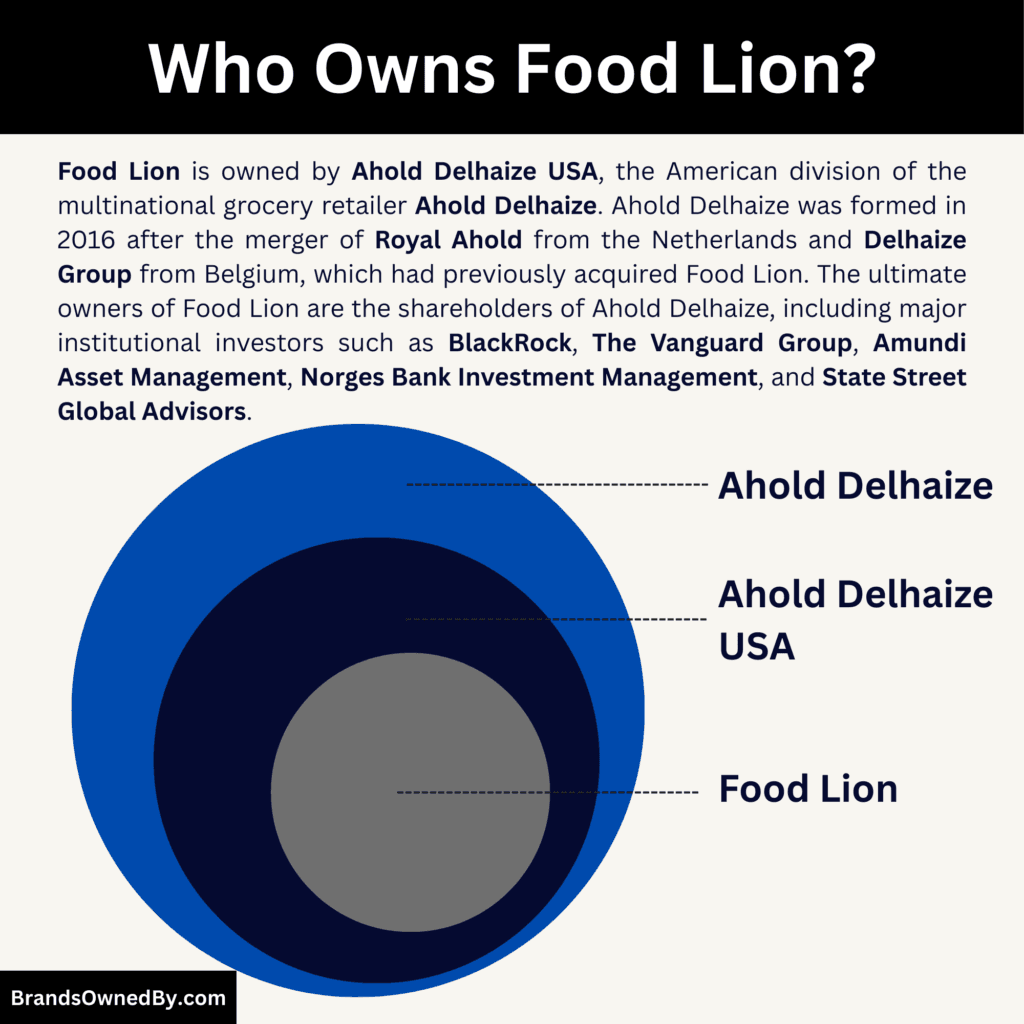
Food Lion is owned by Ahold Delhaize USA, the American subsidiary of the multinational grocery retail group Ahold Delhaize. The supermarket chain does not operate as an independent company and does not have its own stock listed on a public exchange. Instead, it functions as one of the major grocery brands within the Ahold Delhaize portfolio.
This means that Food Lion’s ownership ultimately traces back to the shareholders of Ahold Delhaize. The parent company oversees strategy, capital investments, technology infrastructure, and supply chain systems, while Food Lion operates its own regional store network and management team in the United States.
As of March 2026, Food Lion operates more than 1,100 supermarkets across 10 U.S. states, making it one of the most important brands in Ahold Delhaize’s American business. The chain primarily serves the Southeastern and Mid-Atlantic regions, where it competes with other major grocery retailers such as Walmart, Kroger, Publix, and Aldi.
The ownership structure of Food Lion can therefore be understood in three levels:
- Food Lion operates as a grocery retail brand.
- Ahold Delhaize USA directly owns and manages the brand.
- Ahold Delhaize shareholders ultimately own the parent company.
Ahold Delhaize USA
Food Lion is directly owned and operated by Ahold Delhaize USA, which manages the parent company’s grocery retail operations in the United States.
This division was established after the 2016 merger between Royal Ahold and Delhaize Group. It oversees several major supermarket chains across the country and coordinates operational systems shared by these brands.
Ahold Delhaize USA handles key corporate functions that support Food Lion’s operations, including:
- National supply chain logistics
- Sourcing and procurement
- Distribution infrastructure
- Digital retail technology
- Private-label product development.
Even though Food Lion is owned by this U.S. division, the company maintains a strong regional identity. Its corporate headquarters remain in Salisbury, North Carolina, where the brand was originally founded.
The company also operates multiple distribution centers that supply stores across the Southeast and Mid-Atlantic regions. These logistics facilities allow Food Lion to maintain efficient inventory management and consistent product availability for customers.
Within the Ahold Delhaize USA portfolio, Food Lion is one of the largest supermarket brands in terms of store count. Its strong presence in southeastern states makes it a critical part of the parent company’s U.S. grocery strategy.
Ahold Delhaize
The ultimate parent company of Food Lion is Ahold Delhaize, a multinational grocery retailer headquartered in Zaandam, Netherlands.
The company was formed in July 2016 when Dutch supermarket operator Royal Ahold merged with Belgium-based Delhaize Group. Before this merger, Food Lion had already been owned by Delhaize for several decades.
After the merger, Food Lion became part of a much larger global grocery organization that operates across both Europe and the United States.
As of March 2026, Ahold Delhaize operates more than 7,600 grocery stores worldwide and employs hundreds of thousands of workers. The company runs supermarkets, online grocery platforms, and distribution systems across multiple countries.
The United States represents the company’s largest market. Its American brands include Food Lion along with several other major supermarket chains operating in different regions of the country.
Through this structure, Food Lion benefits from the parent company’s scale in areas such as procurement, supply chain technology, and digital grocery services. At the same time, the brand continues to operate with its own regional management team and store network.
Institutional Shareholders
Since Ahold Delhaize is a publicly traded company, its ownership is largely held by institutional investors. These investors indirectly own Food Lion through their shareholdings in the parent company.
Institutional investors include global asset managers, pension funds, insurance companies, and investment funds that manage large portfolios of public company shares.
As of 2026, several large investment firms hold significant stakes in Ahold Delhaize.
- BlackRock is one of the largest shareholders of the company. The asset management giant holds a stake of roughly about 5% of the company through various index funds and exchange-traded funds.
- The Vanguard Group is another major shareholder with an ownership stake of roughly 4–5%. Vanguard’s holdings are spread across multiple global index funds and mutual funds that track international equity markets.
- Amundi Asset Management, one of Europe’s largest asset managers, also holds a significant stake in the company. The firm manages investment funds for institutional investors and retirement portfolios across Europe.
- Norges Bank Investment Management, which manages Norway’s sovereign wealth fund, is another major shareholder. This fund invests globally in large multinational companies to diversify the Norwegian government’s long-term wealth.
- State Street Global Advisors also holds a substantial stake in the company through its index funds and exchange-traded investment products.
These institutional investors play an important role in corporate governance. They vote on shareholder proposals, board appointments, and major corporate decisions affecting the company.
Public Investors
In addition to large institutional investors, a large portion of Ahold Delhaize shares is owned by individual public investors.
These investors purchase shares through stock exchanges such as Euronext Amsterdam, where the company is listed. Millions of individual investors around the world own shares either directly or through retirement accounts and brokerage portfolios.
Public shareholders collectively represent one of the largest ownership groups of the company. Because the shares are widely distributed, no single investor has complete control over the company.
This diversified ownership structure means Food Lion ultimately belongs to a broad base of global investors rather than a single family or corporate owner.
For the Food Lion brand itself, however, operational decisions remain focused on the American grocery market. The company continues to expand store upgrades, digital grocery services, and supply chain improvements across the Southeastern United States while operating under the ownership of Ahold Delhaize.
Competitor Ownership Comparison
Food Lion competes with several large grocery retailers in the United States. These competitors operate under different ownership structures. Some are publicly traded companies owned by institutional investors. Others are privately owned businesses controlled by families or employees.
| Company | Ownership Type | Major Owners / Control | Key Ownership Details (2026) |
|---|---|---|---|
| Food Lion | Subsidiary brand | Owned by Ahold Delhaize | Food Lion is not publicly traded. It operates as a supermarket brand under Ahold Delhaize USA, the American division of Ahold Delhaize. |
| Walmart | Public company with family control | Walton family, institutional investors | The Walton family owns about 45% of Walmart shares. Major institutional investors include Vanguard, BlackRock, and State Street. |
| Kroger | Publicly traded company | Institutional investors and public shareholders | Institutional investors collectively own around 60% of Kroger shares. Major investors include Berkshire Hathaway, Vanguard, and BlackRock. |
| Publix | Private company | Publix employees and Jenkins family | About 80% of Publix shares are owned by employees through stock ownership plans. The Jenkins family holds most of the remaining shares. |
| Aldi | Private family-owned company | Albrecht family | Aldi operates through two groups, Aldi Nord and Aldi Süd. U.S. operations are controlled by Aldi Süd under the Albrecht family. |
| Costco | Publicly traded company | Institutional investors | Major shareholders include Vanguard, BlackRock, and State Street. Shares are widely distributed among institutional and retail investors. |
| Target | Publicly traded company | Institutional investors | Ownership is widely distributed among institutional investors such as Vanguard, BlackRock, and State Street along with public shareholders. |
Walmart
Walmart is the largest grocery retailer in the United States and a major competitor to Food Lion, particularly through its Walmart Supercenters and Walmart Neighborhood Market stores.
Walmart operates as a publicly traded corporation, but its ownership structure is unusual because a single family still controls a large portion of the company. The Walton family, descendants of founder Sam Walton, collectively owns about 45% of Walmart’s shares as of 2026.
The Walton family holds much of this stake through investment entities such as Walton Enterprises and the Walton Family Holdings Trust. This ownership gives the family significant influence over corporate decisions even though the company is publicly traded.
Alongside the Walton family, large institutional investors such as Vanguard, BlackRock, and State Street hold major stakes through index funds and retirement investment portfolios.
This structure means Walmart combines both family control and public shareholder ownership, making it one of the largest family-influenced corporations in the world.
Kroger
Kroger is another major competitor to Food Lion and operates one of the largest supermarket networks in the United States.
Unlike Food Lion, Kroger functions as a fully independent publicly traded company listed on the New York Stock Exchange. Its ownership is widely distributed among institutional investors, company insiders, and retail shareholders.
As of 2026, institutional investors hold roughly 60% of Kroger’s shares, while public investors and company insiders own the remaining portion.
Because Kroger does not have a controlling family shareholder, corporate governance is largely influenced by institutional investors and the company’s board of directors. This ownership model is typical for large American public corporations.
Publix
Publix is one of the strongest regional competitors to Food Lion in the Southeastern United States.
Unlike most major grocery chains, Publix is privately owned and not listed on any stock exchange. The company follows a unique ownership structure based on employee ownership.
Approximately 80% of Publix shares are owned by current and former employees, while the remaining shares are held by members of the Jenkins family, descendants of founder George W. Jenkins.
This structure makes Publix the largest employee-owned company in the United States. Because the company is privately held, it does not have to disclose the same level of financial or shareholder information as public corporations.
The employee ownership model also encourages long-term stability and strong workplace loyalty, which has become a defining feature of the Publix brand.
Aldi
Aldi is a major competitor to Food Lion in the discount grocery segment.
Unlike Food Lion or Kroger, Aldi is privately owned by the Albrecht family of Germany. The company originally split into two independent businesses in the 1960s: Aldi Nord and Aldi Süd.
The Aldi stores operating in the United States are controlled by Aldi Süd, which remains under family ownership. Because the company is privately held, detailed shareholder information and financial figures are not publicly disclosed.
This ownership structure allows Aldi to operate with a highly centralized management model and focus heavily on efficiency, private-label products, and low operating costs.
Costco
Costco is another important competitor in grocery retail, especially in bulk food purchases and warehouse shopping.
The company operates as a publicly traded corporation listed on the NASDAQ stock exchange. Its ownership is widely distributed among institutional investors and public shareholders.
Major investors include Vanguard Group, BlackRock, and State Street, along with company executives and board members who hold smaller stakes.
Unlike traditional supermarkets like Food Lion, Costco follows a membership warehouse model. Customers pay annual membership fees to shop at its stores, which helps the company maintain lower prices on bulk groceries and household products.
Key Ownership Differences
The comparison highlights several major differences between Food Lion and its competitors.
Food Lion operates as a brand owned by a multinational grocery group, Ahold Delhaize. Its ownership ultimately belongs to the shareholders of the parent company.
Walmart operates as a public company with strong family control, with the Walton family owning roughly 45% of the company.
Kroger is a fully public corporation with ownership spread across institutional investors and public shareholders.
Publix is privately owned with an employee-ownership structure, making it unique among major U.S. grocery chains.
Aldi is privately owned by the Albrecht family, allowing it to operate with centralized management and limited public disclosure.
Costco operates as a publicly traded retail corporation, with institutional investors holding most of the shares.
These different ownership structures shape how each retailer approaches expansion, pricing strategies, and long-term growth in the highly competitive grocery market where Food Lion operates.
Who Controls Food Lion?
Food Lion is owned by Ahold Delhaize, but operational control of the supermarket chain comes from its own executive leadership team and the management structure of Ahold Delhaize USA. The company operates with a decentralized model. This allows Food Lion to manage its stores, pricing strategy, merchandising, and regional operations independently while still benefiting from the scale and resources of its parent organization.
Control of Food Lion, therefore, exists at three levels. The first level is the brand’s own leadership team that manages daily operations. The second level is Ahold Delhaize USA, which coordinates shared services and infrastructure for all U.S. grocery brands. The third level is the global leadership of Ahold Delhaize, which sets the long-term corporate strategy.
This layered structure allows Food Lion to remain a regional grocery brand while being supported by one of the largest food retail groups in the world.
Meg Ham
Meg Ham serves as the President of Food Lion as of March 2026 and is the top executive responsible for the supermarket chain.
She oversees the company’s entire business, including store operations, merchandising strategy, supply chain coordination, workforce management, and customer experience initiatives. Under her leadership, Food Lion operates more than 1,100 supermarkets across 10 U.S. states and employs tens of thousands of workers across its retail and distribution network.
Ham has played a major role in modernizing the Food Lion brand. One of the most important initiatives during her tenure has been the “Easy, Fresh and Affordable” transformation strategy. This initiative focused on upgrading store layouts, expanding fresh food departments, improving customer service, and investing in technology systems across the company’s store network.
She has also overseen investments in digital grocery services, including online ordering, digital coupons through the Food Lion MVP loyalty program, and grocery pickup services that allow customers to order groceries online and collect them at local stores.
Through these initiatives, Ham has helped position Food Lion as a competitive regional supermarket chain in the Southeastern United States.
Ahold Delhaize USA Leadership
Food Lion is part of the Ahold Delhaize USA division, which manages the parent company’s grocery retail operations in the United States.
This division oversees several supermarket brands operating in different regions of the country. It coordinates shared services that support these brands, including supply chain logistics, distribution infrastructure, procurement systems, digital technology platforms, and private-label product development.
For Food Lion, this means the company benefits from large-scale purchasing power and shared logistics systems used across the broader Ahold Delhaize network. These efficiencies help reduce operational costs and allow the brand to maintain competitive grocery pricing.
At the same time, Food Lion maintains its own corporate headquarters in Salisbury, North Carolina, where the brand’s leadership team manages regional strategy, store operations, and customer engagement initiatives.
This hybrid structure allows Food Lion to operate independently in its regional markets while still relying on the corporate infrastructure of Ahold Delhaize USA.
Ahold Delhaize Global Leadership
At the highest level, Food Lion is ultimately controlled by the leadership of Ahold Delhaize, the multinational grocery company headquartered in the Netherlands.
As of March 2026, the company is led by Frans Muller, who serves as President and Chief Executive Officer of Ahold Delhaize. The executive leadership team oversees global operations across Europe and the United States and sets the company’s long-term strategic direction.
The executive board determines major corporate decisions that affect all brands within the group. These decisions include investments in digital grocery technology, supply chain modernization, sustainability initiatives, store expansion strategies, and capital allocation.
Because the United States is the largest market for Ahold Delhaize, Food Lion plays an important role in the company’s global retail strategy.
Corporate Governance and Board Oversight
The final level of control comes from the Supervisory Board of Ahold Delhaize, which represents the interests of shareholders and oversees the company’s executive leadership.
The board is responsible for approving major corporate decisions, monitoring executive performance, and ensuring the company follows governance standards and regulatory requirements.
Although the board does not manage the day-to-day operations of Food Lion stores, its decisions influence the broader strategic direction of the company. This includes approving major investments, acquisitions, and structural changes that could impact Food Lion and the other grocery brands owned by Ahold Delhaize.
Through this governance structure, Food Lion operates as a regional supermarket chain while remaining part of a large multinational retail organization that provides financial stability, operational scale, and strategic direction.
Food Lion Annual Revenue and Net Worth
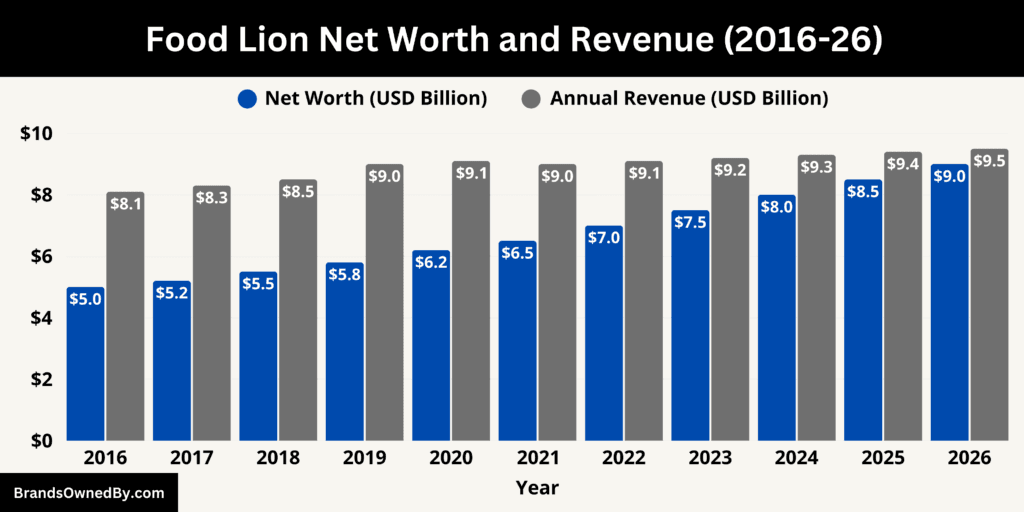
As of March 2026, Food Lion generates approximately $9.5 billion in annual revenue and has an estimated net worth of about $9.0 billion based on its store network, logistics infrastructure, and operational scale.
The company operates over 1,100 supermarkets across 10 U.S. states and employs more than 82,000 associates, making it one of the largest grocery employers in the Southeastern United States.
Food Lion’s revenue growth has been driven by strong regional market share, consistent same-store sales growth, digital grocery expansion, and large-scale store modernization investments. The company has recorded more than 52 consecutive quarters of comparable store sales growth, highlighting steady demand and operational stability.
2026 Revenue Breakdown
Food Lion’s estimated $9.5 billion revenue in 2026 comes from multiple business segments within its grocery retail operations.
The largest share comes from in-store grocery sales, which account for roughly $7.6 billion of total revenue. These sales include packaged food, fresh produce, meat, seafood, dairy, frozen goods, bakery products, and household essentials sold across its more than 1,100 supermarkets.
Another growing revenue stream is private-label grocery products, which contribute approximately $1.1 billion in annual sales. Private-label items typically offer higher profit margins compared with national brands and are increasingly popular among price-sensitive consumers.
Food Lion also generates revenue from digital grocery services, including online ordering and curbside pickup. These services contribute an estimated $0.8 billion annually, supported by the rapid growth of online grocery shopping in the United States.
Together, these segments form the company’s core retail revenue model and allow Food Lion to maintain stable financial performance even during economic fluctuations.
Net Worth and Asset Structure
Food Lion’s estimated $9.0 billion valuation as of March 2026 reflects the total value of the company’s physical assets, brand equity, and operational infrastructure.
A significant portion of this value comes from the company’s retail store network. With over 1,100 supermarket locations, Food Lion controls one of the largest grocery footprints in the Southeastern United States. These stores generate steady daily revenue from millions of weekly customers.
Another major contributor to the company’s net worth is its distribution and logistics infrastructure. Food Lion operates multiple regional distribution centers that support store operations and maintain inventory across thousands of grocery products.
The company has also invested heavily in supply chain modernization. Recent projects include the construction of a new $860 million automated distribution center in North Carolina, designed to improve logistics efficiency and support future growth.
In addition, Food Lion’s brand value contributes significantly to its estimated net worth. After nearly seven decades of operation, the company has built strong brand recognition and customer loyalty across the Southeastern United States.
Capital Investments and Expansion
Food Lion continues to invest heavily in infrastructure and store upgrades to strengthen its financial position.
The company recently completed a $500 million store remodeling initiative covering more than 150 stores in the Charlotte market, introducing new layouts, upgraded refrigeration systems, and expanded fresh food sections.
In 2026, Food Lion also announced plans to open several new supermarkets in North Carolina and South Carolina, further expanding its regional footprint. These new locations feature modern grocery technology, energy-efficient refrigeration systems, and expanded prepared food sections.
These investments aim to improve store productivity, increase customer traffic, and strengthen the company’s competitive position against rivals such as Kroger, Walmart, and Publix.
Revenue Forecast (2027–2030)
Based on historical growth trends, store expansion, and the growth of digital grocery shopping, Food Lion’s revenue is expected to increase steadily through the end of the decade.
Projected Revenue Forecast
- 2027: $9.8 billion
- 2028: $10.1 billion
- 2029: $10.5 billion
- 2030: $11.0 billion.
Several factors support this projected growth.
First, population growth across the Southeastern United States continues to increase demand for neighborhood grocery stores. Second, Food Lion is expanding its store network and modernizing existing locations to improve customer experience. Third, digital grocery services and curbside pickup are expected to contribute a larger share of total revenue.
With a stable regional market, strong brand recognition, and continued investment in technology and logistics, Food Lion is expected to remain one of the most successful regional supermarket chains in the United States through 2030.
Brands Owned by Food Lion
As of 2026, Food Lion manages a large portfolio of private-label grocery brands, retail concepts, and operational entities designed to support its store network of more than 1,100 supermarkets. These brands cover a wide range of product categories, including organic foods, premium grocery products, household goods, and health products. Food Lion stores carry over 7,000 private-label items across various categories, making these brands a major part of the company’s business strategy.
Below are the major companies, brands, and retail entities directly operated or developed by Food Lion:
| Brand / Entity | Type | Year Introduced | Category | Key Details |
|---|---|---|---|---|
| Food Lion | Private-label grocery brand | 1970s | Grocery & food products | Core store brand covering thousands of everyday grocery items including packaged foods, dairy, frozen foods, and fresh produce sold across all Food Lion supermarkets. |
| Nature’s Promise | Natural & organic brand | 1990s | Organic and natural foods | Includes organic produce, meats, dairy, snacks, and pantry staples made without artificial preservatives or synthetic additives. |
| Taste of Inspirations | Premium grocery brand | 2000s | Gourmet and specialty foods | Premium private-label brand offering specialty sauces, prepared meals, desserts, frozen foods, and international-style products. |
| Home 360 | Household goods brand | 2010s | Household and cleaning products | Includes storage bags, cleaning supplies, batteries, charcoal, pet products, and other everyday household items. |
| Healthy Accents | Health and personal care brand | 2000s | Vitamins and health products | Covers vitamins, nutritional supplements, personal hygiene items, and over-the-counter medicines sold in Food Lion stores. |
| Smart Option | Value grocery brand | 2010s | Budget grocery items | Low-cost grocery products designed for price-sensitive shoppers, including canned foods, pasta, frozen items, and pantry staples. |
| Bloom | Former grocery store concept | 2004 | Retail store concept | Experimental supermarket format launched by Food Lion to test modern store layouts and merchandising strategies. Most locations were later converted back to Food Lion stores. |
| Food Lion MVP | Customer loyalty platform | 1997 | Digital rewards program | Loyalty program providing digital coupons, personalized discounts, and rewards through the Food Lion mobile app and website. |
| Food Lion Distribution Centers | Logistics and supply chain network | Various | Distribution infrastructure | Major logistics facilities in Salisbury (NC), Elloree (SC), Greencastle (PA), and Disputanta (VA) that supply groceries and private-label products to over 1,100 stores. |
Food Lion Brand
The Food Lion brand is the company’s core private-label product line and is sold exclusively in its supermarkets. This brand includes thousands of everyday grocery products that compete directly with national brands while offering lower prices.
The product range covers almost every department in the store. Items include packaged foods, canned goods, dairy products, frozen foods, bakery items, fresh produce, snacks, condiments, and household staples. The goal of the Food Lion brand is to provide customers with reliable quality at a lower price than comparable national brands.
Over the years, the company has expanded the Food Lion brand significantly. The brand now includes fresh produce and perishable foods in addition to packaged goods, allowing the retailer to offer store-branded items across most aisles in the supermarket.
Nature’s Promise
Nature’s Promise is Food Lion’s natural and organic grocery brand. The brand focuses on products made without artificial ingredients, preservatives, or synthetic additives.
Nature’s Promise includes a wide range of food products such as organic pasta, canned foods, fresh meats, dairy products, snacks, spices, and produce. Many of the products are certified organic and designed for customers seeking healthier or environmentally friendly food options.
The brand has expanded steadily in recent years as consumer demand for organic and “clean label” foods continues to grow. Nature’s Promise products are typically priced lower than comparable organic brands while still maintaining strict ingredient standards.
The brand also includes specialized sub-lines such as Nature’s Promise Kids, which offers healthier snack and meal options designed for children.
Taste of Inspirations
Taste of Inspirations is Food Lion’s premium private-label brand. It focuses on gourmet-style foods made with higher-quality ingredients and unique recipes.
Products under this brand include specialty pastas, sauces, frozen appetizers, prepared meals, pizzas, marinades, desserts, and salad dressings. These items are positioned as an affordable alternative to premium national brands.
The Taste of Inspirations brand allows Food Lion to compete in the premium grocery category while maintaining competitive pricing. Many products are developed with more sophisticated flavors and packaging to appeal to customers seeking higher-end food products.
Home 360
Home 360 is Food Lion’s private brand for non-food household products. The brand includes a wide range of everyday household items sold in its supermarkets.
Products under this label include batteries, charcoal, fire logs, cleaning supplies, storage bags, pet products, and baby products. The brand provides lower-cost alternatives to well-known household brands while maintaining comparable quality standards.
Home 360 allows Food Lion to compete with big-box retailers that sell general merchandise by offering affordable household goods alongside groceries.
Healthy Accents
Healthy Accents is Food Lion’s private label focused on health and beauty products. The brand includes items such as vitamins, skincare products, personal hygiene items, and over-the-counter health products.
These products are typically priced lower than national health brands but are designed to offer similar quality. The brand targets customers who want affordable personal care products while shopping for groceries.
Healthy Accents products are widely available across Food Lion’s store network and form part of the company’s broader private-label portfolio.
Smart Option
Smart Option is Food Lion’s value-focused private label designed for budget-conscious customers. The brand was created to provide aggressively priced alternatives to national grocery brands.
Products under the Smart Option label include staple grocery items such as canned foods, pasta, baking ingredients, snacks, and frozen meals. The brand is positioned as a low-cost option within the store while still maintaining acceptable quality standards.
Smart Option allows Food Lion to compete directly with discount grocery chains and private-label heavy retailers like Aldi.
Food Lion MVP Loyalty Program
The Food Lion MVP program is the company’s customer loyalty and digital rewards platform. While not a traditional brand or company, it is a major operational entity within Food Lion’s business model.
The program allows customers to access digital coupons, personalized discounts, and promotional offers through the Food Lion mobile app and website. Members can also earn rewards and receive special savings on store products.
The MVP program has become an important tool for customer retention and data analytics. It helps the company understand shopping patterns and tailor promotions to individual customers.
Food Lion Distribution and Supply Chain Network
Food Lion operates an extensive logistics and distribution network that supports its supermarket operations across the Southeastern United States. The company manages several large distribution facilities that supply grocery products, fresh foods, and private-label items to its more than 1,100 stores.
Key Food Lion distribution facilities include:
Food Lion Distribution Center – Salisbury, North Carolina
Located near the company’s headquarters, this facility is one of the primary logistics hubs supporting stores across North Carolina, Virginia, and surrounding markets. It handles grocery inventory, dry goods, and packaged foods.
Food Lion Distribution Center – Elloree, South Carolina
This distribution center supplies stores across South Carolina and nearby states. The facility manages grocery inventory and helps maintain efficient product delivery to supermarkets in the region.
Food Lion Distribution Center – Greencastle, Pennsylvania
The Greencastle distribution center supports stores located in the Mid-Atlantic region, including Pennsylvania, Maryland, and Delaware. It plays a major role in supplying packaged goods and refrigerated products to these markets.
Food Lion Distribution Center – Disputanta, Virginia
This facility focuses on frozen foods and temperature-controlled products. It ensures that frozen goods and perishable items are distributed efficiently to stores across multiple states.
Conclusion
Food Lion remains one of the most recognizable grocery chains in the Southeastern United States. The company started as a small local store in North Carolina and grew into a major supermarket brand.
Today, anyone asking who owns Food Lion will find that the chain belongs to Ahold Delhaize, a global grocery retail giant. The company’s ownership structure allows Food Lion to benefit from international resources while continuing to serve local communities.
With more than a thousand stores and millions of weekly customers, Food Lion continues to play a major role in the American grocery industry.
FAQs
Who owns Food Lion supermarkets?
Food Lion supermarkets are owned by Ahold Delhaize USA, the American subsidiary of the multinational grocery retailer Ahold Delhaize. Food Lion operates as one of the major supermarket brands within this group and is headquartered in Salisbury, North Carolina.
Who bought out Food Lion?
Food Lion was gradually acquired by the Belgian grocery company Delhaize Group starting in the 1970s. Delhaize eventually gained full control of the chain. In 2016, Delhaize Group merged with Dutch retailer Royal Ahold to form Ahold Delhaize, which now owns Food Lion.
Is Food Lion publicly traded?
No, Food Lion is not publicly traded. The supermarket chain operates as a subsidiary brand under Ahold Delhaize USA. However, its parent company, Ahold Delhaize, is publicly traded on the Euronext Amsterdam stock exchange.
Who owns Food Lion stores?
Food Lion stores are owned and operated by Food Lion LLC, which is part of Ahold Delhaize USA. This division manages the company’s American supermarket operations and oversees the Food Lion store network across the Southeastern and Mid-Atlantic United States.
What is the Food Lion parent company’s name?
The parent company of Food Lion is Ahold Delhaize, a multinational grocery retailer headquartered in Zaandam, Netherlands. The company owns several supermarket chains across Europe and the United States.
Is Food Lion owned by a German company?
No, Food Lion is not owned by a German company. It is owned by Ahold Delhaize, a Dutch multinational grocery retailer formed through the merger of Royal Ahold from the Netherlands and Delhaize Group from Belgium.
Is Food Lion owned by Kroger?
No, Food Lion is not owned by Kroger. Kroger is a separate publicly traded grocery company that operates its own supermarket chains across the United States. Food Lion is owned by Ahold Delhaize USA.
What companies are owned by Ahold Delhaize USA?
Ahold Delhaize USA operates several major grocery chains in the United States, including:
- Food Lion
- Stop & Shop
- Giant Food
- Giant Food Stores
- Hannaford.
These brands operate in different regions of the country but share supply chain infrastructure, technology platforms, and corporate services under Ahold Delhaize USA.