- Fashion Nova is a privately owned company with ownership concentrated entirely under its founder, Richard Saghian, giving the brand full independence from public markets and institutional shareholders.
- There are no publicly disclosed minority shareholders, venture capital firms, or private equity investors, which means strategic control and equity remain centralized.
- The founder-led ownership model allows faster decision-making, aggressive trend adoption, and internal brand expansion without shareholder approval or board-level constraints.
Fashion Nova is an American fast fashion retailer based in Beverly Hills, California. The business primarily operates through its online store, although it maintains a small number of physical locations in Southern California. It focuses on trend-driven, affordable clothing for women, men, and inclusive sizing lines that respond quickly to changes in fashion trends.
The brand is recognized for introducing new styles at an exceptionally rapid pace, often launching hundreds of designs weekly. Its strong social media presence, particularly on Instagram, has made Fashion Nova a cultural phenomenon and a reference point in digital-first retail strategy.
The company distinguishes itself with a marketing strategy that leans heavily on influencer partnerships and user-generated content rather than traditional advertisements. This digital-first approach allows the brand to stay at the forefront of internet culture and fashion trends, attracting a deeply engaged global audience.
Founder
Richard Saghian is the founder and CEO of Fashion Nova. He started the company in 2006 after gaining early retail experience by working in his father’s clothing stores in Los Angeles. His understanding of customer preferences and retail operations stemmed from this upbringing in the family business.
Saghian launched Fashion Nova when he was in his early twenties. He opened the first store in the Panorama Mall in Panorama City, California. At the time, the retail fashion landscape was dominated by established mall brands, and social media platforms like Instagram had not yet been launched.
Over time, Saghian shifted the company’s focus from physical retail expansion to e-commerce and digital marketing. He maintained full private ownership of the business, making strategic decisions without external investors or a public listing.
Saghian is known for maintaining a low public profile while steering Fashion Nova’s aggressive growth strategy. Under his leadership, the brand leveraged influencer-driven campaigns to connect with its audience and elevate brand visibility globally.
Ownership Snapshot
Fashion Nova’s ownership structure is straightforward and centralized around its founder and chief executive officer. The company is privately held, meaning it does not issue publicly traded shares. It has no parent corporation and it does not report ownership stakes in public filings like a listed company would. This private ownership model shapes the way decisions are made and how strategy is executed at the company.
Privately Held and Founder-Controlled
Fashion Nova is owned outright by Richard Saghian, who founded the company in 2006 and continues to serve as its CEO and primary decision-maker. Unlike companies that raise capital from external investors or list on stock exchanges, Fashion Nova’s ownership remains concentrated in a single individual. No institutional shareholders or venture capital firms are publicly disclosed as having equity in the company.
This concentrated ownership gives Saghian significant control over the company’s strategic direction. There is no broad base of public shareholders to influence decisions, and no board of directors in the traditional public company sense that must answer to external investors. Instead, all major strategic decisions—from product direction to marketing strategies—are driven at the executive level under Saghian’s leadership.
Operational Impacts of Ownership
The private, founder-owned design influences Fashion Nova’s operations in several ways:
- Decision Agility: With a single owner, Fashion Nova can pivot quickly in response to fashion trends. There is no need for shareholder votes or lengthy approval processes.
- Strategic Autonomy: Saghian can pursue long-term plans or unconventional marketing strategies without needing to justify them to external investors.
- Brand Direction: The company’s identity and brand ethos are closely tied to the founder’s vision. This contributes to the strong and consistent brand presence on social media and in its rapid trend cycles.
Ownership History
Fashion Nova’s ownership has remained remarkably consistent since the company was founded. Control has stayed concentrated with its founder, shaping how the brand expanded, made strategic decisions, and scaled without external influence. This background helps explain the company’s independence, fast execution, and long-term focus on founder-led growth.
Early Foundation and Retail Roots
Fashion Nova’s ownership history begins with its founder, Richard Saghian, who launched the company in 2006. Before creating the brand, Saghian gained real-world retail experience by working in his father’s women’s clothing stores in Los Angeles.
This early exposure taught him how fashion trends evolved and what customers wanted at affordable price points. Saghian used that insight as the foundation for Fashion Nova, directing the company’s strategy and ownership from day one.
The first Fashion Nova store opened in the Panorama Mall in Panorama City, Los Angeles. The store sold inexpensive clubwear and trendy apparel geared toward a younger audience. At this stage, the company was a small retail operation with a handful of physical locations. Saghian retained full control of the business, managing growth without external investors or equity partners.
Transition to E-Commerce and Expansion of Control
By 2013, Fashion Nova’s ownership history took a major turn when Saghian launched the company’s e-commerce platform. This pivot from primarily brick-and-mortar operations to online retail dramatically expanded the brand’s reach and sales potential. Rather than raising venture capital or selling stakes to outside parties, Saghian funded this transition internally, preserving his sole ownership and centralized control.
At this point, Instagram and other social platforms were gaining popularity. Saghian placed them at the center of the company’s marketing strategy. This use of social media was unusual for the time and helped Fashion Nova scale rapidly without relying on traditional advertising. This tactical shift further entrenched Saghian’s hands-on leadership and control over the brand’s direction.
Brand Diversification Under Founder Control
After e-commerce took off, Fashion Nova expanded its product offerings and internal brand structure, all under Saghian’s ownership. In 2016, Fashion Nova introduced the Curve Collection, catering to plus-size customers, broadening its audience without altering its ownership structure.
In 2018, the company launched Fashion Nova Men, entering the menswear segment. These strategic extensions were decisions made by Saghian and his executive team without external equity pressures.
Throughout this period, Fashion Nova continued to rely on a private ownership model. There were no disclosed venture capital rounds, no public listing, and no sale of controlling stakes. The company maintained a tight ownership structure centered on the founder.
Modern Developments and Headquarters Relocation
In recent years, Fashion Nova’s ownership history has included operational expansions that reflect its growth while keeping control tightly held. The company relocated its headquarters to Beverly Hills, California, investing in a prime location that aligns with its global fashion positioning.
This move, reported around 2024–2025, exemplifies how Saghian continues to steer the brand’s long-term strategy and physical footprint as a privately owned entity.
Fashion Nova’s history of ownership shows a consistent pattern: from a mall shop to a global fashion presence, decisions were made and executed under the control of its founder. This continuity has shaped the company’s culture, speed of execution, marketing approach, and product strategy without outside shareholder influence.
Who Owns Fashion Nova?
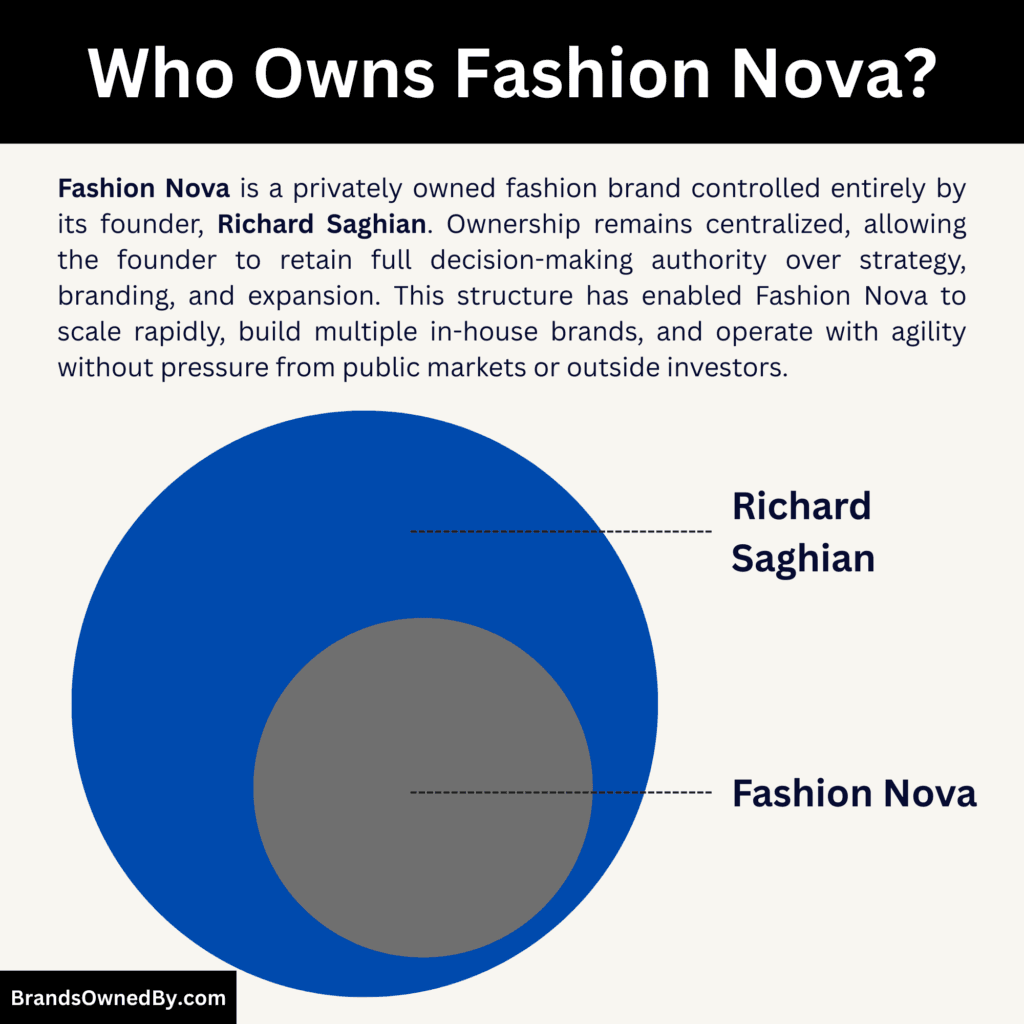
Richard Saghian owns Fashion Nova. He is the founder, sole owner, and ultimate decision-maker.
Fashion Nova is a privately owned company. Ownership information is derived from corporate history and industry reporting.
From its founding in 2006 to 2026, the company has remained privately held and founder-controlled. There are no known institutional investors, private equity partners, or outside shareholders with disclosed stakes. This ownership model gives the founder direct control over strategic decisions without external shareholder approval.
Richard Saghian – Founder and Sole Owner
Richard Saghian is the founder, CEO, and principal owner of Fashion Nova. He launched the brand in Los Angeles in 2006 after gaining early retail experience in his family’s clothing business. From the outset, Saghian retained full ownership rather than bringing in venture capital or selling equity to outside investors. That approach has continued through the company’s evolution into a global fast-fashion brand with a strong e-commerce presence.
Saghian retains 100% ownership or a near-total controlling interest in the company. There are no publicly documented minority shareholders or outside equity partners. This ownership structure enables Saghian to make strategic decisions, set marketing direction, and manage operations without oversight from external investors or public shareholders.
Profile and Role
Richard Saghian serves as the company’s chief executive and leading decision-maker. His vision for rapid trend adoption and influencer-based marketing has shaped Fashion Nova’s brand identity and growth strategy. By maintaining sole or near-sole ownership, Saghian ensures that strategic pivots can occur swiftly, aligning with changing fashion trends and competitive pressures.
Implications of the Ownership Structure
The concentrated ownership under a single founder has several implications:
- Strategic Flexibility: Saghian can pivot quickly in response to trends, often faster than competitors with larger, externally accountable boards.
- Marketing Autonomy: The company can invest heavily in celebrity and influencer campaigns without having to justify such spending to external stakeholders.
- Operational Control: Decisions about product development, brand extensions, and geographic expansion are made internally, maintaining a unified vision.
- Risk and Reward Alignment: All corporate risk and reward remains with the controlling owner, which can lead to bold moves but also means limited diversification of ownership risk.
Competitor Ownership Comparison
Ownership structures across the fast fashion industry differ sharply, and those differences shape how brands grow, make decisions, and respond to market pressure. Comparing Fashion Nova’s founder-controlled model with its major competitors highlights clear contrasts between private ownership, publicly traded groups, and subsidiary-led brands. This context helps explain why Fashion Nova operates with greater speed and autonomy than many rivals that answer to investors, boards, or public shareholders.
Here’s a quick summary of the ownership models of Fashion Nova and its competitors:
- Fashion Nova operates under private founder-led ownership, with Richard Saghian in control.
- Shein is privately held, primarily owned by its founder and private investors.
- Debenhams Group (Boohoo) and Inditex (Zara) are public companies, meaning ownership is spread among market investors and institutional shareholders.
- Brands like PrettyLittleThing operate within larger publicly traded groups rather than as independent entities.
- ASOS and H&M exemplify public ownership with broad shareholder bases.
| Company / Brand | Ownership Type | Primary Owner(s) | Public or Private | Control Structure |
|---|---|---|---|---|
| Fashion Nova | Founder-owned | Richard Saghian | Private | Fully founder-controlled with centralized decision-making |
| Shein | Founder-led with private investors | Chris Xu and private shareholders | Private | Founder-led with influence from private equity stakeholders |
| PrettyLittleThing | Subsidiary brand | Debenhams Group | Public (via parent) | Controlled by parent company board and shareholders |
| Debenhams Group | Public company | Institutional and retail investors | Public | Board-governed with shareholder oversight |
| Zara | Subsidiary brand | Inditex | Public (via parent) | Strategic control held by Inditex management and board |
| Inditex | Public company with founder influence | Institutional investors and Ortega family | Public | Board-led governance with significant founder-family influence |
| ASOS | Public company | Institutional and retail shareholders | Public | Shareholder-driven governance with executive leadership |
Shein – Privately Held and Founder-Led
Shein is one of Fashion Nova’s most formidable competitors. The company was founded by Chris Xu in 2008. Shein remains privately held and is owned through its corporate entity, Roadget Business Pte. Ltd., which is registered outside mainland China.
As a private company, Shein does not trade on public exchanges and does not disclose detailed shareholder information publicly, but Chris Xu is widely recognized as the founder and CEO with a dominant ownership position. Shein has raised significant private funding over multiple rounds, including a major private funding event in 2022 valued at tens of billions, but control remains with its founders and private shareholders. Its private ownership gives Shein flexibility similar to Fashion Nova’s, enabling fast decision-making without public shareholder pressure.
Shein operates at a scale that exceeds many traditional fashion companies. It uses integrated manufacturing networks and data analytics to rapidly design and deliver products globally. Its private ownership contrasts with many established fast fashion rivals that are publicly traded or part of larger groups.
Debenhams Group (formerly Boohoo Group) – Publicly Traded Parent
Debenhams Group, formerly known as Boohoo Group plc, is a publicly traded company on the London Stock Exchange. It owns multiple fast fashion brands, including PrettyLittleThing, boohooMAN, and other acquired labels. As a public company, Debenhams Group’s ownership is shared among institutional investors, retail shareholders, and other market participants who hold its publicly traded shares.
PrettyLittleThing, one of Fashion Nova’s competitive peers in the online fast fashion market, operates as a brand within the Debenhams Group. Its ownership structure falls under the parent group’s shareholder base, meaning strategic decisions and governance are influenced by the publicly traded group’s board and majority shareholders rather than a single founder-owner.
The transition from Boohoo to Debenhams Group included integrating a broader portfolio of brands and adjusting ownership interests among public investors.
Public ownership subjects the Debenhams Group and its subsidiaries to regulatory reporting, quarterly earnings expectations, and shareholder voting on governance matters. This contrasts with Fashion Nova’s private, founder-centric control structure.
Inditex (Zara and Subsidiaries) – Large Public Retail Group
Inditex is the parent company of Zara and several other fashion labels such as Bershka, Pull&Bear, Massimo Dutti, Stradivarius, and more. Inditex is a publicly traded multinational corporation listed on the Spanish stock exchange (IBEX 35).
Most of Inditex’s ownership is held by a combination of institutional investors and individual shareholders worldwide. A significant portion of the shares are still held by Amancio Ortega, the founder of the group, and his family interests, giving them substantial influence over the company’s direction. Inditex’s public status means that governance, financial transparency, and strategic decisions are formalized through a board of directors and subject to regulatory disclosure requirements.
Inditex’s ownership model illustrates how a large fast fashion competitor operates under a diversified shareholder base with both public investors and founding family influence. This differs from the wholly private structures of Fashion Nova and Shein.
Public Fashion Retailers – ASOS and Others
Other competitors like ASOS are also publicly traded companies. ASOS lists its shares on the London Stock Exchange, meaning ownership is dispersed among institutional investors, mutual funds, and retail shareholders. Public ownership exposes ASOS to market sentiment, stock performance pressures, and regulatory compliance. In this model, strategic direction is influenced by a board representing the shareholders rather than a sole founder.
Even global brands like H&M are publicly listed, with institutional investors and public shareholders holding equity. Their scale and diversified ownership models contrast sharply with the tightly held ownership seen at Fashion Nova.
Who Controls Fashion Nova?
Control at Fashion Nova is highly centralized. The company follows a founder-led model where ownership, executive authority, and strategic decision-making are closely aligned. This structure plays a major role in how quickly the brand responds to trends and executes large-scale marketing and operational decisions.
Founder-Led Executive Control
Richard Saghian is the founder and chief executive of Fashion Nova. He has led the company since its inception and continues to hold primary executive authority. As CEO, Saghian oversees the brand’s long-term vision, growth strategy, and positioning in the fast fashion market.
Because Fashion Nova is privately owned, Saghian’s role extends beyond that of a traditional CEO. He acts as the final decision-maker on major initiatives, including brand direction, expansion priorities, and high-profile marketing campaigns. There is no external ownership layer that limits his authority or requires approval for strategic moves.
Decision-Making Structure
Fashion Nova operates with a lean executive structure. Day-to-day functions such as merchandising, supply chain management, logistics, and digital marketing are handled by senior leadership teams. However, these teams operate under centralized oversight.
Strategic decisions are typically made at the top. Product direction, influencer partnerships, and operational scaling initiatives are aligned directly with the founder’s vision. This structure allows the company to move quickly and adapt without delays caused by multi-layered approvals or board voting processes.
Absence of a Public Board of Directors
Unlike publicly traded companies, Fashion Nova does not have a board of directors accountable to shareholders. There is no obligation to hold shareholder meetings or disclose executive votes.
Any advisory roles within the company are internal or informal. Control remains executive-driven rather than board-governed. This gives leadership flexibility but also places responsibility squarely on internal management rather than distributed governance.
CEO Continuity and Leadership Stability
Fashion Nova has not experienced frequent changes in top leadership. Richard Saghian has served as CEO throughout the company’s growth. There are no publicly reported former CEOs or leadership transitions at the executive level.
This continuity has created a consistent leadership approach. Strategic priorities have remained focused on speed, trend relevance, and digital engagement. The absence of leadership turnover reduces disruption and reinforces centralized control.
Operational Control and Brand Direction
Control at Fashion Nova extends deeply into operations. The leadership team closely monitors consumer behavior, social media trends, and sales data. These insights feed directly into product development and marketing decisions.
Marketing direction is also tightly controlled. Influencer collaborations, celebrity partnerships, and campaign timing are aligned with leadership strategy rather than outsourced to external agencies with independent authority. This level of control helps maintain a unified brand voice across platforms.
Fashion Nova Annual Revenue and Net Worth
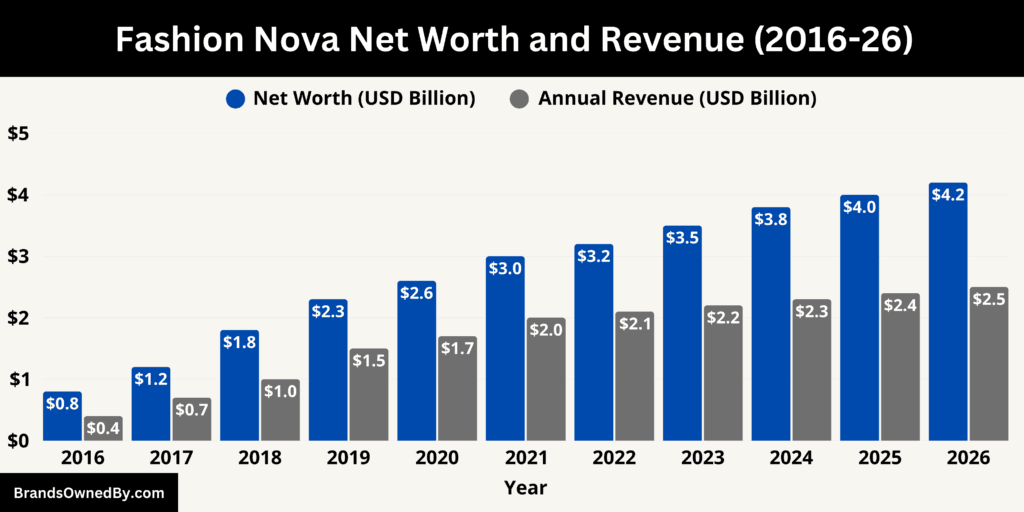
As of 2026, Fashion Nova continues to be one of the most prominent names in fast fashion globally. The company’s estimated annual revenue for 2026 is $2.5 billion, and its estimated net worth stands at approximately $4.2 billion as of January 2026. Its ability to maintain revenue increases and valuation gains over a sustained period highlights how its business model, influencer-driven marketing, and direct-to-consumer focus have anchored its financial performance.
Revenue 2026
As of 2026, Fashion Nova’s estimated annual revenue stands at approximately $2.5 billion. This figure reflects a mature phase of growth following years of rapid expansion driven by social commerce, influencer marketing, and a direct-to-consumer model. Compared with 20the 25 revenue of about $2.4 billion, the 2026 increase of roughly $100 million represents year-over-year growth of around 4.2%.
This slower but steady growth rate indicates stabilization rather than decline. Fashion Nova has already penetrated its core markets deeply. Revenue generation is now supported more by repeat customers, frequent product drops, and brand loyalty than by explosive new customer acquisition. The company’s scale also means that incremental gains translate into large absolute dollar increases even when percentage growth moderates.
Revenue Forecast (2027–2030)
Looking ahead, Fashion Nova’s revenue outlook suggests moderate, sustainable expansion rather than hypergrowth.
If the brand maintains a conservative compound annual growth rate (CAGR) of 4 to 6%, projected revenue could evolve as follows:
- 2027: Approximately $2.6 billion, assuming 4.5% growth
- 2028: Approximately $2.75 billion, reflecting continued low-to-mid single-digit expansion
- 2029: Approximately $2.9 billion, driven by international demand and higher order frequency
- 2030: Approximately $3.1 billion, representing a total increase of about 24% from 2026 levels.
This outlook assumes stable consumer demand, continued dominance in social-media-driven fashion, and no major structural shifts in pricing or product mix. Upside scenarios exist if Fashion Nova significantly expands into new regions or categories, while downside risk is tied to intensifying competition and pricing pressure in fast fashion.
Net Worth 2026
Fashion Nova’s estimated company net worth in January 2026 is approximately $4.2 billion. This valuation reflects not only annual revenue but also brand equity, digital reach, customer data assets, and the company’s fully private ownership structure.
Compared with an estimated net worth of about $4.0 billion in 2025, the 2026 increase of roughly $200 million represents a growth of about 5%. This slightly higher growth rate compared with revenue reflects the strengthening of Fashion Nova’s brand value and its ability to sustain scale without dilution from public shareholders or external investors.
Because the company is privately held, this valuation is best viewed as an enterprise-level estimate rather than a market-tested figure. However, it aligns with valuation multiples typically applied to large, profitable direct-to-consumer fashion brands with strong digital engagement.
Net Worth Forecast (2027–2030)
Fashion Nova’s future net worth is expected to rise in line with revenue growth, margin stability, and long-term brand relevance.
Assuming valuation growth in the range of 4 to 6% annually, projected net worth could develop as follows:
- 2027: Approximately $4.4 billion
- 2028: Approximately $4.6 billion
- 2029: Approximately $4.9 billion
- 2030: Approximately $5.2 billion.
By 2030, this would represent an overall net worth increase of roughly 24% compared with 2026. This trajectory assumes Fashion Nova maintains its current market position and continues to convert brand visibility into sustained cash flow without ownership dilution.
Higher valuation upside could materialize if the company diversifies successfully into adjacent verticals or significantly increases international market share. Conversely, valuation growth would slow if margins compress or if competitive pressure erodes pricing power.
Brands Owned by Fashion Nova
Below is a list of the brands and entities owned and operated by Fashion Nova as of January 2026:
| Brand / Entity | Category | Year Introduced | Core Focus | Strategic Role Within Fashion Nova |
|---|---|---|---|---|
| Fashion Nova | Apparel (Women) | 2006 | Trend-driven women’s fashion, denim, dresses, accessories | Core revenue engine and flagship brand driving global recognition |
| Fashion Nova Curve | Apparel (Plus Size) | 2016 | Inclusive sizing with trend-aligned designs | Expands customer base and increases repeat purchases among underserved segments |
| Fashion Nova Men | Apparel (Men) | 2018 | Streetwear, casualwear, denim, basics | Diversifies audience and balances women-focused revenue |
| Fashion Nova Kids | Apparel (Children) | 2020 | Trend-inspired children’s clothing | Extends brand lifecycle and strengthens family-based customer retention |
| Maven Beauty | Beauty & Skincare | 2020 | Skincare and cosmetics | Category diversification into higher-margin lifestyle products |
| Fashion Nova Beauty | Beauty (Integrated) | 2021 | Curated beauty offerings and collaborations | Cross-selling, higher average order value, lifestyle positioning |
| Fashion Nova E-Commerce Platform | Digital Infrastructure | 2013 | Direct-to-consumer online retail | Central sales channel enabling global reach and data-driven growth |
| Fashion Nova Influencer Network | Marketing Infrastructure | 2015 | Influencer and celebrity partnerships | Core growth engine driving traffic, conversions, and brand visibility |
| Fashion Nova Supply Chain Operations | Operations | Ongoing | Fast-turn manufacturing and logistics | Enables rapid product launches and trend responsiveness |
Fashion Nova (Core Brand)
Fashion Nova is the flagship brand and the foundation of the company. It focuses primarily on women’s fast fashion, offering trend-driven apparel, dresses, denim, activewear, and accessories. The brand is built around rapid product turnover, frequent launches, and social-media-first marketing.
Operations are heavily digital. E-commerce drives the majority of sales, supported by limited physical retail locations in California. Fashion Nova’s internal teams manage design, sourcing, marketing, and merchandising, allowing tight control over speed and brand consistency. The core brand remains the largest revenue contributor within the company.
Fashion Nova Curve
Fashion Nova Curve is a dedicated plus-size brand developed internally to serve extended sizing customers. It was created in response to strong demand for inclusive fashion that mirrors mainstream trends rather than simplified or conservative designs.
Curve is not a separate legal company. It operates as a full-scale brand vertical within Fashion Nova, with its own product drops, influencer partnerships, and targeted marketing. The Curve line plays a strategic role in customer loyalty and repeat purchases, especially among underserved segments in traditional fast fashion.
Fashion Nova Men
Fashion Nova Men represents the company’s expansion into menswear. The brand focuses on streetwear-inspired fashion, casual basics, denim, and seasonal trend items aimed at a younger demographic.
Like other Fashion Nova extensions, Fashion Nova Men is internally operated and fully integrated into the company’s supply chain and marketing infrastructure. The men’s division allows Fashion Nova to diversify its audience while leveraging the same influencer-driven growth model used by the core women’s brand.
Fashion Nova Kids
Fashion Nova Kids is a smaller but growing brand extension focused on children’s apparel. The line emphasizes trendy, miniature versions of adult fashion styles, targeting families already engaged with the Fashion Nova ecosystem.
This brand functions as a complementary category rather than a standalone growth engine. Its primary role is brand expansion and lifetime customer value, encouraging long-term engagement with Fashion Nova across age groups.
Maven Beauty
Maven Beauty is Fashion Nova’s beauty and cosmetics brand. It marks the company’s entry into the beauty and personal care segment. Maven Beauty includes skincare products and cosmetics designed to align with Fashion Nova’s fashion-forward, influencer-centric identity.
The brand is operated entirely in-house. It leverages the same digital marketing channels and influencer network as Fashion Nova apparel. Maven Beauty represents a strategic diversification move, allowing Fashion Nova to participate in a higher-margin category without acquiring an external beauty company.
Fashion Nova Beauty (Platform Integration)
Fashion Nova Beauty operates as an integrated beauty category within the Fashion Nova ecosystem rather than as a fully independent brand. It includes curated beauty products, collaborations, and cross-promotions tied closely to Fashion Nova’s apparel launches.
This entity supports cross-selling strategies and increases average order value. It also strengthens Fashion Nova’s positioning as a lifestyle brand rather than a pure apparel retailer.
Internal Digital and E-Commerce Operations
Fashion Nova owns and operates its e-commerce infrastructure, including proprietary storefronts, marketing systems, and customer data platforms. These are not spun out as separate companies but function as critical internal entities supporting global operations.
The company controls its digital advertising execution, influencer relationship management, and social commerce strategies internally. This vertical control reduces reliance on third-party platforms beyond distribution and advertising channels.
Conclusion
Fashion Nova’s growth story is closely tied to its ownership structure and leadership approach. Knowing who owns Fashion Nova helps explain the brand’s ability to move quickly, stay trend-focused, and expand across multiple categories without relying on acquisitions or external investors. With founder-led control, internally built brands, and a digital-first operating model, the company has maintained consistency while scaling into a multi-billion-dollar fashion business as of 2026. This combination of centralized ownership and operational agility continues to define Fashion Nova’s position in the global fast fashion landscape.
FAQs
Who owns the Fashion Nova company?
Fashion Nova is privately owned by its founder, Richard Saghian. He holds full ownership and control of the company. There are no publicly disclosed institutional investors, private equity firms, or minority shareholders.
Who created Fashion Nova?
Fashion Nova was created by Richard Saghian. He founded the brand after gaining hands-on experience in the Los Angeles apparel retail market and identifying unmet demand for fast, trend-driven fashion at accessible prices.
Who is Richard Saghian’s wife?
Richard Saghian keeps his personal life private. As of 2026, there is no publicly confirmed information regarding his wife or marital status, and he has not shared verified personal details in public interviews.
How did Fashion Nova start?
Fashion Nova began as a small brick-and-mortar clothing store in Los Angeles. The company initially focused on clubwear and trend-forward women’s apparel. Over time, the founder shifted the business toward e-commerce and social-media-driven marketing, which became the foundation of its rapid growth.
When was Fashion Nova founded?
Fashion Nova was founded in 2006. The brand started with physical retail locations before evolving into a digital-first fast fashion retailer.
Who makes Fashion Nova clothing?
Fashion Nova designs its clothing in-house and works with a network of third-party manufacturers. Production is handled through fast-turn suppliers in the United States and overseas, allowing the brand to quickly respond to fashion trends and consumer demand.
Does Cardi B still work with Fashion Nova?
Cardi B previously partnered with Fashion Nova on successful capsule collections. As of 2026, there is no publicly confirmed ongoing exclusive collaboration, though Fashion Nova continues to work with celebrities and influencers in a similar campaign-driven model.
How much is the CEO of Fashion Nova worth?
Richard Saghian, the CEP of Fashion Nova, has an estimated net worth of around $1.5 billion as of January 2026.
Where is the headquarters of Fashion Nova?
Fashion Nova is headquartered in Beverly Hills, California, United States. The headquarters houses executive leadership, design teams, marketing operations, and core business functions.