- DeWalt is 100% owned by Stanley Black & Decker and operates as a core professional tools brand rather than an independent or publicly traded company.
- The DeWalt brand was acquired by Black & Decker in 1960, with the transaction covering the brand name and trademarks; the purchase price was never publicly disclosed, and the brand was later repositioned as the company’s flagship professional tools platform.
- Ownership of Stanley Black & Decker is dominated by institutional investors, including Vanguard Group, BlackRock, and State Street, with no controlling individual or family shareholder, placing governance with the board and executive leadership.
DeWalt is a professional-grade power tools and equipment brand widely used by contractors, builders, and industrial workers. The brand is recognized for durability, job-site performance, and long product life cycles. DeWalt operates globally, with products sold across North America, Europe, Asia, and emerging markets.
Its portfolio includes power tools, hand tools, outdoor equipment, storage systems, and jobsite accessories. DeWalt functions as a core professional brand within its parent company’s tools ecosystem and maintains a strong focus on trade professionals rather than casual DIY users.
Today, DeWalt products are sold in more than 100 countries and are widely used by contractors, builders, mechanics, and industrial workers.
DeWalt Founder
Raymond E. DeWalt was the founder of DeWalt and the driving force behind its early innovation. He was an American inventor with a strong background in industrial machinery and woodworking equipment. His most important contribution was the invention of the radial arm saw, which allowed wood to be cut more accurately, safely, and efficiently than traditional methods at the time.
Raymond E. DeWalt founded the company in 1924 to commercialize this invention. His vision was centered on improving productivity in workshops and factories rather than serving casual users. This professional-first mindset became deeply embedded in the brand’s DNA.
Even after the company changed ownership, DeWalt continued to emphasize rugged construction, precision engineering, and tools designed for heavy daily use. The founder’s focus on innovation and practicality still shapes how DeWalt products are designed and marketed today.
Major Milestones
- 1924: DeWalt is founded by Raymond E. DeWalt following the invention of the radial arm saw.
- 1929: The DeWalt Products Company is formally incorporated to scale production and distribution.
- 1931: DeWalt opens a large manufacturing facility in Lancaster, Pennsylvania, increasing industrial output.
- 1937: The radial arm saw gains widespread adoption in furniture factories and woodworking shops.
- 1941: DeWalt tools and machinery are used extensively in US industrial plants during World War II.
- 1945: Post-war expansion accelerates as demand for industrial and construction equipment rises.
- 1953: The original DeWalt Products Company winds down independent operations amid industry consolidation.
- 1960: Black & Decker acquires the DeWalt brand name and trademarks.
- 1961: DeWalt-branded industrial tools are reintroduced under Black & Decker ownership.
- 1968: The brand gains recognition in heavy-duty commercial and factory environments.
- 1975: DeWalt expands distribution outside the United States under Black & Decker’s global network.
- 1981: The DeWalt name becomes closely associated with professional-grade power tools rather than consumer tools.
- 1989: Stanley Works merges with Black & Decker, setting the stage for future brand realignment.
- 1992: DeWalt is officially repositioned as the flagship professional power tools brand of Stanley Black & Decker.
- 1994: DeWalt launches a comprehensive professional cordless tool system for contractors.
- 1998: Expansion into jobsite accessories and rugged tool storage systems begins.
- 2001: DeWalt introduces contractor-focused hand tools to complement power tools.
- 2004: The brand strengthens its presence in European and Asian construction markets.
- 2008: DeWalt expands lithium-ion battery technology across its cordless platforms.
- 2010: Stanley and Black & Decker complete their formal merger, enhancing DeWalt’s global scale.
- 2012: DeWalt launches high-performance brushless motor technology for cordless tools.
- 2014: Expansion into outdoor power equipment for professional landscaping and construction use.
- 2016: DeWalt increases US-based manufacturing initiatives to support domestic production.
- 2018: Introduction of connected and smart jobsite tool technology within the DeWalt ecosystem.
- 2020: DeWalt broadens battery-powered outdoor equipment and cordless jobsite solutions.
- 2021: Continued focus on safety systems and ergonomics for professional users.
- 2022: Expansion of modular storage and jobsite organization platforms.
- 2023: DeWalt enhances high-voltage cordless platforms for heavy construction applications.
- 2024: Increased integration of sustainability and durability standards in tool design.
- 2025: DeWalt remains one of the most recognized professional power tools brands globally, operating as a cornerstone brand within Stanley Black & Decker’s tools and outdoor segment.
Who Owns DeWalt?

DeWalt is wholly owned by Stanley Black & Decker. It is not a separate legal entity. All ownership and strategic control flow through its parent company.
Stanley Black & Decker is a publicly traded company listed on the New York Stock Exchange. This means the institutional and individual shareholders of Stanley Black & Decker indirectly own DeWalt.
Here is an overview of the DeWalt ownership status as of December 2025:
- Company: DeWalt
- Ownership status: Wholly owned brand; not a separate legal entity and not publicly traded
- Parent company: Stanley Black & Decker
- Year founded: 1924
- Founder: Raymond E. DeWalt
- Brand acquisition: Acquired by Black & Decker in 1960; acquisition covered the brand name and trademarks; purchase price not disclosed
- Current ownership structure: 100% owned by Stanley Black & Decker; no direct shareholders
- Parent company ownership: Publicly traded; primarily owned by institutional investors including Vanguard Group, BlackRock, and State Street Global Advisors
- Control and governance: Managed by Stanley Black & Decker’s board and executive leadership
- Ownership status as of 2025: No spin-off or divestment; DeWalt remains fully owned by Stanley Black & Decker.
Parent Company of DeWalt: Stanley Black & Decker
Stanley Black & Decker is an American industrial manufacturer with roots dating back to the 19th century. It is publicly traded on the New York Stock Exchange and operates through a multi-brand portfolio focused primarily on tools, outdoor equipment, and engineered industrial solutions.
Within its brand architecture, DeWalt is positioned as the flagship professional power tools and jobsite solutions brand. It is distinct from the company’s consumer and DIY-oriented brands and is strategically targeted at contractors, industrial users, and skilled trades. DeWalt plays a central role in the parent company’s tools and outdoor segment, which represents the core of its global operations.
Stanley Black & Decker’s broader portfolio includes well-known brands such as Stanley, Black+Decker, Craftsman, Irwin, Lenox, and Facom. Each brand serves a defined market segment, but DeWalt is the primary growth and innovation engine for professional-grade cordless tools, battery platforms, and jobsite systems.
Ownership of Stanley Black & Decker is dominated by institutional investors. Among the largest shareholders are firms such as Vanguard Group, BlackRock, and State Street Global Advisors.
These institutions hold significant voting power through index funds and long-term asset management vehicles. No single shareholder holds a controlling stake. As a result, governance authority rests with the board of directors and executive leadership rather than with a founder, family, or private equity owner.
Acquisition History and Ownership Transition
DeWalt was founded in 1924 as the DeWalt Products Company, built around Raymond E. DeWalt’s invention of the radial arm saw. The company gained early traction in industrial and woodworking markets but did not evolve into a diversified consumer power tools business during its independent years.
In 1960, Black & Decker acquired the DeWalt name and associated trademarks. This was not a traditional acquisition of a fast-growing competitor. By that time, the original DeWalt Products Company was no longer operating as a large-scale, independent manufacturer. Black & Decker’s acquisition was primarily focused on securing the DeWalt brand, which already carried strong credibility in industrial and professional environments.
Following the acquisition, Black & Decker initially used the DeWalt name selectively. The major strategic shift occurred in the early 1990s, when Black & Decker made a deliberate decision to reposition DeWalt as its primary professional power tools brand. This involved transferring significant product development resources, manufacturing capacity, and marketing investment into the DeWalt platform.
The next major ownership milestone occurred in 2010, when Stanley Works and Black & Decker completed their merger, forming Stanley Black & Decker. This was a full corporate merger rather than an acquisition of DeWalt itself. As part of this transaction, DeWalt became one of the most important brands within the combined company. The merger expanded DeWalt’s access to global supply chains, international distribution networks, and advanced engineering capabilities.
Since that merger, DeWalt’s ownership has remained unchanged. It continues to be fully owned and controlled by Stanley Black & Decker, with no spin-offs, partial sales, or separate equity structures introduced.
Where Are DeWalt Tools Made?
DeWalt tools are manufactured across multiple countries through a global production network. The brand does not rely on a single country or factory. Instead, manufacturing is distributed to balance cost, scale, supply chain efficiency, and proximity to key markets. This structure allows DeWalt to maintain consistent quality standards while producing tools at high volume.
Manufacturing in the United States
DeWalt operates several manufacturing facilities in the United States as part of its domestic production strategy. These plants primarily focus on professional-grade power tools, hand tools, and accessories, with an emphasis on tools marketed as “Made in the USA with Global Materials.”
US manufacturing locations are concentrated in states such as South Carolina, Tennessee, Kentucky, North Carolina, and Connecticut. These facilities often handle final assembly, machining, and quality testing. Domestic production supports faster distribution to North American markets and appeals to professional users who prioritize US-made tools.
Manufacturing in Mexico
Mexico is one of DeWalt’s most important manufacturing hubs. Many power tools, hand tools, and accessories sold in North America are produced or assembled there. Mexican facilities support large-scale production due to lower manufacturing costs and close geographic proximity to the US market.
These plants typically handle high-volume assembly, component integration, and packaging. Tools manufactured in Mexico are widely sold in the United States and Canada and meet the same performance and durability specifications as products made elsewhere.
Manufacturing in China
China remains a major manufacturing base for DeWalt, particularly for cordless tools, components, accessories, and consumer-facing products. Chinese factories support mass production, advanced component sourcing, and cost efficiency.
Many entry-level and mid-range tools are manufactured in China, along with batteries, chargers, and accessories. DeWalt applies centralized design standards and quality controls to ensure consistency across factories, regardless of location.
Manufacturing in Europe
DeWalt also manufactures tools in parts of Europe, including facilities that support regional demand. These plants typically serve European markets and focus on tools designed to meet local regulatory and performance requirements.
European production helps DeWalt reduce shipping times, manage tariffs, and comply with regional standards. These facilities often specialize in specific tool categories rather than full product ranges.
Manufacturing in Other Regions
In addition to its major hubs, DeWalt uses manufacturing partners and facilities in other regions, including parts of Asia outside China. These locations support specific product lines, components, or regional demand.
This diversified footprint reduces supply chain risk and allows DeWalt to shift production when market conditions, tariffs, or logistics costs change.
Who is the CEO of DeWalt?
DeWalt does not have its own chief executive officer because it is not an independent company. The brand operates entirely under its parent company, Stanley Black & Decker. Therefore, the CEO of Stanley Black & Decker is the executive with ultimate authority over DeWalt’s strategy, operations, and long-term direction.
As of 2025, the CEO of Stanley Black & Decker is Christopher J. Nelson. He assumed the role following a planned leadership transition announced earlier by the company. As CEO, he is responsible for overseeing all major brands in the portfolio, including DeWalt, Stanley, Craftsman, and Black+Decker.
Christopher Nelson previously served as Chief Operating Officer. In that role, he was directly responsible for global operations, manufacturing efficiency, supply chain execution, and brand performance. His promotion to CEO reflects continuity in operational leadership rather than a strategic reset.
All major decisions affecting DeWalt, including product investment, manufacturing footprint, pricing strategy, and global expansion, fall under his authority and the board of directors.
Leadership Background of the CEO
Christopher J. Nelson is a long-tenured executive at Stanley Black & Decker and represents a continuity-based leadership transition. He rose through the organization with a strong operations-focused background rather than coming from outside the company.
Before becoming CEO, he served as Chief Operating Officer, where he was responsible for global manufacturing, supply chain management, and operational performance across all major brands, including DeWalt. His role centered on execution, efficiency, and scale rather than brand marketing.
Nelson’s leadership style emphasizes operational discipline, simplified product platforms, and supply chain reliability. For DeWalt, this means continued focus on professional users, stable battery ecosystems, and globally consistent manufacturing standards. Strategic decisions affecting DeWalt remain centralized at the parent company level, reinforcing stability rather than change.
Decision-Making Authority Over DeWalt
All major decisions affecting DeWalt ultimately flow through the CEO and the board of Stanley Black & Decker. This includes approval of new product platforms, battery system roadmaps, manufacturing location decisions, pricing frameworks, and long-term capital investments.
DeWalt maintains brand-level leadership teams responsible for product development and market execution. However, those teams operate within strategic and financial parameters set at the corporate level. The CEO plays a central role in aligning DeWalt’s growth priorities with broader corporate objectives.
Strategic Priorities Under Current Leadership
Under Christopher Nelson’s leadership, the company has emphasized operational discipline, portfolio focus, and simplification. For DeWalt, this translates into fewer but more scalable product platforms, long-term continuity in battery ecosystems, and tighter integration between manufacturing and demand planning.
Rather than repositioning DeWalt or altering its market focus, current leadership reinforces its role as the flagship professional brand. The emphasis remains on durability, backward compatibility, and global consistency rather than rapid brand experimentation.
As CEO, Nelson works closely with the board of directors and senior executive team. Major strategic initiatives, acquisitions, and capital allocation decisions require board approval. DeWalt, as a core brand, receives heightened oversight due to its importance within the company’s tools and outdoor segment.
This governance structure ensures that DeWalt’s direction is shaped by long-term corporate planning rather than short-term brand-level decisions.
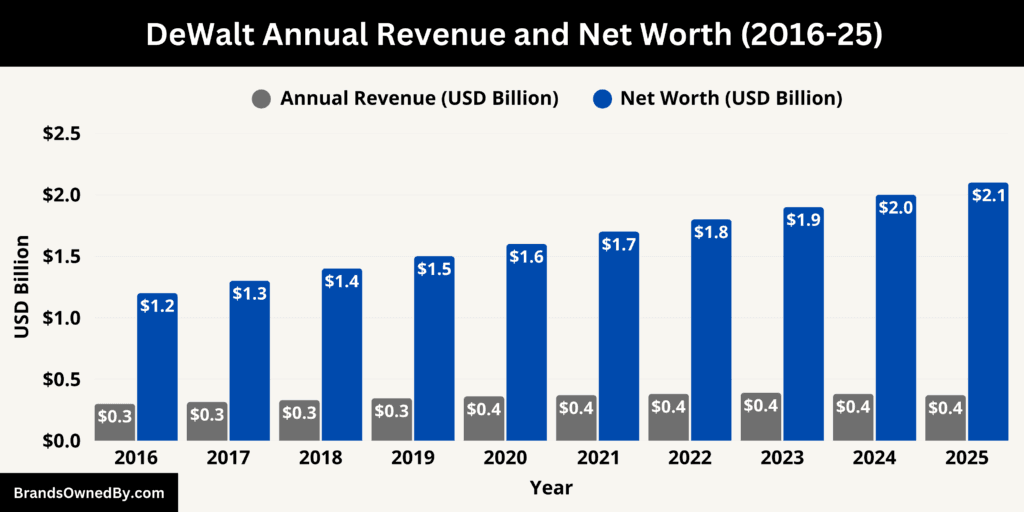
DeWalt Annual Revenue and Net Worth
As of December 2025, DeWalt generates an estimated annual revenue of $370 million and carries an estimated brand net worth of $2.1 billion. These figures reflect DeWalt’s economic value as a global professional tools brand rather than as a standalone legal company. DeWalt does not publish audited financial statements, so its revenue and net worth are assessed at the brand level using industry estimates, market position, and long-term performance indicators.
DeWalt Annual Revenue
DeWalt’s estimated $370 million revenue reflects sales generated directly under the DeWalt brand across power tools, accessories, storage systems, outdoor equipment, and jobsite solutions. The majority of this revenue comes from professional contractors, industrial users, and skilled trades, rather than from casual or entry-level consumers.
A key driver of DeWalt’s revenue is its ecosystem-based model. Cordless platforms, battery systems, and tool compatibility encourage repeat purchases over long periods. Once a professional user commits to a specific DeWalt battery platform, switching costs increase, leading to stable and predictable revenue streams. This creates recurring demand through tool upgrades, replacements, and accessory purchases rather than one-time transactions.
Geographically, DeWalt’s revenue is diversified across North America, Europe, and selected high-growth international markets. North America remains the largest contributor due to strong contractor adoption and brand loyalty. International markets add incremental growth, particularly in commercial construction and infrastructure projects where professional-grade tools are required.
DeWalt’s revenue profile is also shaped by its premium positioning. The brand commands higher average selling prices compared to entry-level tool brands. This allows DeWalt to maintain solid revenue levels even when overall unit volumes fluctuate due to broader economic cycles.
DeWalt Net Worth
DeWalt’s estimated net worth of $2.1 billion represents its brand valuation, not accounting for net worth or shareholder equity. As a brand, DeWalt does not own assets or liabilities independently. Instead, its value is derived from intangible factors that translate into long-term earning power.
This valuation is supported by DeWalt’s brand recognition, professional trust, and pricing power. The brand has been built over decades around durability, reliability, and jobsite performance. For professional users, DeWalt is often a default choice, which significantly enhances brand equity beyond what annual revenue alone would suggest.
Another major contributor to DeWalt’s net worth is its product depth and integration. DeWalt is not dependent on a single product category. Its valuation reflects a broad and interconnected lineup that spans drills, saws, impact tools, storage systems, batteries, chargers, and outdoor equipment. This diversification reduces risk and strengthens long-term brand value.
The gap between DeWalt’s annual revenue and its $2.1 billion valuation highlights the importance of future earning potential. Brand net worth captures expected cash generation over time, not just current-year sales. DeWalt’s entrenched position in professional job sites globally supports this long-term outlook.
Relationship Between Revenue and Net Worth
DeWalt’s financial profile shows how a strong brand can be worth several times its annual revenue. While $370 million represents one year of estimated sales, the $2.1 billion net worth reflects confidence in DeWalt’s ability to sustain those sales, protect margins, and remain relevant to professionals for years to come.
This relationship is reinforced by high customer retention, standardized battery platforms, and consistent demand from trade professionals. These factors reduce volatility and make DeWalt’s revenue stream more durable than that of trend-driven or consumer-focused brands.
Strategic Importance of DeWalt’s Financial Profile
DeWalt’s revenue and net worth make it a strategically valuable asset within its ownership structure. The brand’s strong valuation justifies continued investment in research and development, manufacturing scale, and global distribution. Rather than chasing short-term revenue spikes, DeWalt’s financial strength lies in its ability to support long product lifecycles and long-term professional adoption.
In practical terms, DeWalt’s estimated $370 million in annual revenue and $2.1 billion brand net worth explain why the brand remains tightly controlled, fully owned, and positioned as a cornerstone professional tools platform. Its financial contribution is not only measured in sales but in long-term stability, brand loyalty, and sustained market relevance.
Brands Owned by DeWalt
Below are the brands, platforms, and entities operated directly under the DeWalt brand as of 2025:
| Brand / Entity | Type | Year Introduced (Approx.) | Core Focus | Key Details |
|---|---|---|---|---|
| DeWalt XR | Cordless power tools platform | Early 2000s | Professional cordless tools | Flagship DeWalt platform for contractors; high power, durability, and long runtime; integrated with DeWalt lithium-ion batteries. |
| DeWalt FlexVolt | Battery and high-power tool system | 2016 | High-voltage cordless tools | Auto-switching battery system (20V/60V); enables cordless replacement of corded and gas-powered tools; used in heavy construction equipment. |
| DeWalt PowerStack | Battery technology platform | 2022 | Next-generation batteries | Uses pouch-cell technology; smaller, lighter, higher power density; designed for compact professional tools. |
| DeWalt Atomic | Compact tool line | 2019 | Compact professional tools | Smaller form-factor tools for tight spaces; maintains professional-grade performance within DeWalt ecosystems. |
| DeWalt ToughSystem | Storage and organization system | 2013 | Jobsite storage solutions | Modular, rugged storage platform; designed for transport, stacking, and harsh jobsite environments. |
| DeWalt Hand Tools | Hand tools product line | Expanded 2000s | Professional hand tools | Includes hammers, pliers, tape measures, screwdrivers, sockets; complements power tool offerings. |
| DeWalt Outdoor Power Equipment | Outdoor equipment line | 2010s | Landscaping and maintenance tools | Battery-powered mowers, trimmers, blowers, chainsaws; integrated with 20V and FlexVolt systems. |
| DeWalt Jobsite Systems | Jobsite support equipment | 2000s | Worksite infrastructure | Includes lighting, chargers, power stations, work stands, radios, and safety products. |
| DeWalt Accessories | Consumables and attachments | Ongoing | Tool accessories | Blades, bits, fasteners, abrasives, and consumables; recurring-use products tied to DeWalt tools. |
DeWalt XR
DeWalt XR is the brand’s flagship professional cordless tools platform. The “XR” designation is used for high-performance tools designed for contractors and industrial users. XR tools emphasize power, runtime, and durability, and they form the backbone of DeWalt’s professional cordless ecosystem.
XR is tightly integrated with DeWalt’s lithium-ion battery systems and is used across drills, impact drivers, saws, grinders, and specialty trade tools. The XR line is positioned for daily jobsite use rather than occasional or consumer-level applications.
DeWalt FlexVolt
DeWalt FlexVolt is a proprietary battery and tool platform developed and operated entirely by DeWalt. FlexVolt batteries automatically switch voltage depending on the tool being used, enabling compatibility between 20V and 60V tools.
This platform allows DeWalt to offer cordless tools capable of replacing corded and gas-powered equipment. FlexVolt is heavily used in large saws, outdoor equipment, and heavy-duty construction tools. It represents one of DeWalt’s most significant internal technology investments and is central to its high-power cordless strategy.
DeWalt PowerStack
DeWalt PowerStack is a newer battery platform based on pouch-cell lithium technology rather than traditional cylindrical cells. It is designed to deliver higher power density, reduced size, and improved performance in compact tools.
PowerStack batteries are operated and marketed exclusively under the DeWalt brand. They are positioned as a next-generation power solution for professionals who require smaller tools without sacrificing performance. This platform reflects DeWalt’s ongoing internal innovation rather than external acquisition.
DeWalt Atomic
DeWalt Atomic is a compact tool line developed for professionals working in tight spaces. While smaller and lighter than standard XR tools, Atomic products are still designed for trade-level use.
Atomic tools operate within DeWalt’s cordless ecosystem and are marketed as complementary rather than entry-level products. The line allows DeWalt to address specialized use cases without diluting its professional positioning.
DeWalt ToughSystem
DeWalt ToughSystem is the brand’s modular storage and organization platform. It includes toolboxes, storage units, organizers, and mobile jobsite solutions designed for harsh environments.
ToughSystem is operated as a standalone product ecosystem within DeWalt. It integrates with DeWalt tools and accessories and targets contractors who require durable, transportable storage across multiple job sites.
DeWalt Hand Tools
DeWalt operates a full line of professional hand tools under its own brand. This includes hammers, tape measures, screwdrivers, pliers, sockets, and mechanic tools.
These products are designed to complement DeWalt’s power tools and reinforce its position as a full-spectrum professional tools provider. Hand tools are developed and branded internally rather than through acquisitions.
DeWalt Outdoor Power Equipment
DeWalt operates a growing range of outdoor power equipment under its own name. This includes lawn mowers, trimmers, blowers, chainsaws, and other landscaping tools.
Most of these products are battery-powered and integrated into DeWalt’s cordless platforms, particularly FlexVolt and 20V systems. This category allows DeWalt to compete in professional landscaping and maintenance markets without relying on gas-powered equipment.
DeWalt Jobsite Systems and Accessories
DeWalt also operates jobsite lighting, chargers, power stations, work stands, safety equipment, and accessories as internal product entities. These systems are designed to work together within the DeWalt ecosystem and are branded exclusively under the DeWalt name.
Accessories such as blades, bits, fasteners, and consumables form an important recurring revenue component of the brand’s operations.
Conclusion
Examining who owns DeWalt also explains how the brand has been able to grow without losing its professional edge. Being fully owned allows DeWalt to operate with clear strategic direction, stable funding, and centralized decision-making. This structure supports long product lifecycles, consistent battery platforms, and coordinated innovation across tools, accessories, and jobsite systems. As a result, DeWalt has been able to scale globally while maintaining the reliability, performance standards, and brand trust that professionals expect.
FAQs
Who owns DeWalt tools?
DeWalt tools are owned by Stanley Black & Decker. DeWalt is not an independent company and does not have its own shareholders. It operates as a core professional tools brand fully controlled by its parent company.
Is DeWalt owned by Bosch?
No, DeWalt is not owned by Bosch. Bosch operates its own competing power tools brands and has no ownership stake in DeWalt. DeWalt is entirely owned by Stanley Black & Decker, while Bosch tools are produced under Bosch.
Who owns the DeWalt brand?
The DeWalt brand, including its name, trademarks, and product platforms, is owned outright by Stanley Black & Decker. The brand was originally acquired by Black & Decker in 1960 and later became part of Stanley Black & Decker after the 2010 merger.
Who makes DeWalt wrenches?
DeWalt wrenches are manufactured under the DeWalt brand through a global manufacturing network. Production typically takes place in the United States, Mexico, and Asia, depending on the specific product line. All wrenches are designed, specified, and quality-controlled according to DeWalt’s professional standards, even when manufactured outside the US.
Is DeWalt a German name?
No, DeWalt is not a German name. The brand is named after its founder, Raymond E. DeWalt, who was American. DeWalt originated in the United States and has no historical or ownership connection to Germany.
What is the sister company of DeWalt?
DeWalt’s sister companies are other brands owned by Stanley Black & Decker. These include Stanley, Black+Decker, Craftsman, Irwin, Lenox, and Facom. Each brand serves a different market segment, while DeWalt is positioned specifically for professional and industrial users.