- Bragg Apple Cider Vinegar is a brand owned by Bragg Live Food Products. As of 2026, the ownership structure is private and investor-led. Swander Pace Capital holds about 45% of the shares and has a controlling interest.
- Dragoneer Investment Group owns approximately 15% of Bragg Live Food Products. Other institutional and silent investors collectively hold around 10% to 12% of the company. These investors provide strategic oversight without managing daily operations.
- Celebrity stakeholders are minority shareholders. Katy Perry owns about 3% of the business. Orlando Bloom holds close to 2%. Hayden Slater controls around 3%. The remaining small stakes are held by legacy family interests and minor partners.
Bragg Apple Cider Vinegar is produced by Bragg Live Food Products, one of the oldest natural health food brands in the United States.
The company began over a century ago and remains a pioneer in organic and wellness-oriented food products. Its flagship item, the organic apple cider vinegar with “the mother,” has become synonymous with natural health remedies and daily wellness routines.
Over the years, the company has grown its product range. It now includes olive oils, seasonings, dressings, nutritional products, and ready-to-drink beverages. Bragg products are widely distributed. They appear in natural food stores, conventional grocery outlets, mass retailers, and online marketplaces domestically and globally.
The brand holds a strong reputation for commitment to natural ingredients and a lifestyle of wholesome living. It is also recognized as a Certified B Corporation, underscoring its commitment to environmental and social standards.
Founder
Paul Chappius Bragg was the original founder of Bragg Live Food Products. He launched the company in 1912 in Los Angeles, California. Paul Bragg was more than a businessman. He was a health educator and early nutrition influencer. Bragg wrote books about fasting and diet. He lectured across the United States.
His ideas promoted whole foods and natural detox methods. Paul Bragg believed apple cider vinegar supported digestion. He claimed it helped energy and wellness. These messages built the Bragg philosophy. He opened one of the first health food stores in America.
Bragg became known as a pioneer of the modern wellness movement. He worked closely with doctors and athletes of his era. His teachings shaped the identity of Bragg Apple Cider Vinegar. Paul Bragg passed away in 1976. Yet his legacy continued through the brand.
Patricia Bragg was the adopted daughter of Paul Bragg. She became his partner in health advocacy. Patricia joined the company in the 1940s. She helped expand the business for more than six decades. Patricia Bragg was a public speaker and author.
She appeared on television and radio. Her mission was to keep the Bragg name alive. She promoted vinegar as a natural remedy. Patricia became CEO after Paul Bragg died.
Under her leadership, Bragg Apple Cider Vinegar reached global markets. She modernized packaging and distribution. Patricia Bragg protected the original product standards. In 2019, she guided the company through a major sale to new investors.
After the acquisition, Patricia stepped back from daily control. She remained an advisor to the brand. Patricia Bragg passed away in 2023 at the age of 94. She is remembered as the heart of Bragg for generations.
Major Milestones
- 1912: Paul C. Bragg opens a health food store in Los Angeles and begins the Bragg business.
- 1920: Paul Bragg starts publishing health newsletters and builds a national audience.
- 1930: Bragg books on fasting and nutrition gain wide popularity.
- 1946: Patricia Bragg joins Paul Bragg and becomes active in company operations.
- 1952: Bragg Apple Cider Vinegar is introduced to more retail locations.
- 1960: The company expands into natural seasonings and herbal products.
- 1970: Bragg becomes a household name in the growing health food movement.
- 1976: Paul Bragg dies and Patricia Bragg later assumes top leadership.
- 1980: Bragg ACV grows in demand with the rise of organic lifestyles.
- 1995: Bragg begins large-scale distribution through major grocery chains.
- 2005: The brand enters online retail platforms and reaches new consumers.
- 2013: Bragg Live Food Products secures formal organic certifications for key items.
- 2017: Ready-to-drink Bragg vinegar beverages are launched.
- 2019: Swander Pace Capital and a celebrity investor group acquire the majority stake in Bragg.
- 2020: Bragg focuses on plant-based foods and modern wellness drinks.
- 2023: Patricia Bragg passes away, leaving a historic legacy.
- 2024: Bragg Live Food Products becomes a Certified B Corporation.
- 2025: The company continues product innovation and global brand growth.
- 2026: Bragg Apple Cider Vinegar remains the core product and the symbol of the brand heritage.
Who Owns Bragg Apple Cider Vinegar?
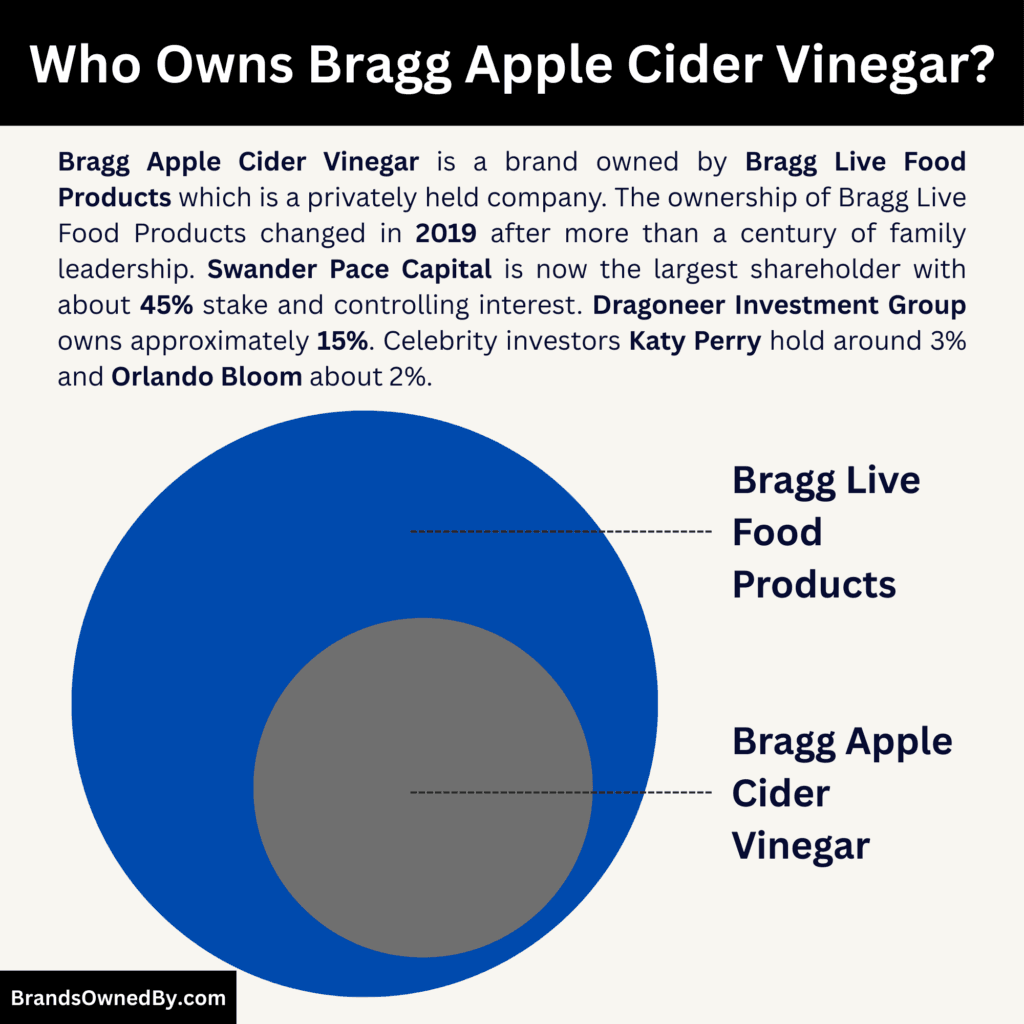
Bragg Apple Cider Vinegar is a brand owned by Bragg Live Food Products. The company produces and markets this famous product. It has been part of the Bragg portfolio for more than a century. Bragg Apple Cider Vinegar is known for being organic and raw. It contains the mother culture. The brand became popular through the teachings of the founders. Consumers use it for cooking and wellness. All rights to the brand belong to Bragg Live Food Products.
Bragg Live Food Products is the company behind Bragg Apple Cider Vinegar. The business is privately owned. It is not listed on any stock exchange. Ownership changed from the Bragg family to a new investor group in 2019. Swander Pace Capital acquired the majority stake. Several strategic partners also became shareholders. This structure remains in place in 2026.
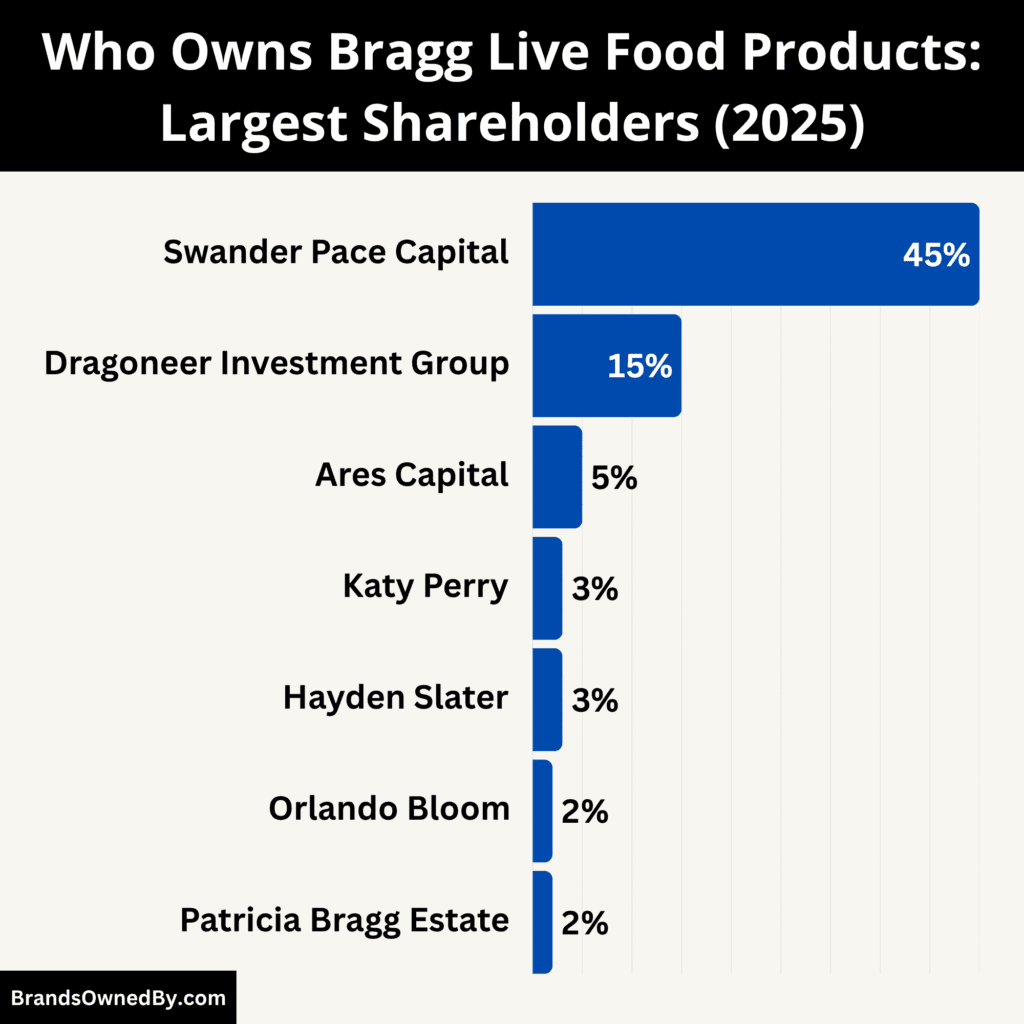
Below is a list of the major shareholders and investors of Bragg Live Food Products as of January 2026:
Swander Pace Capital — Controlling Owner (45%)
Swander Pace Capital is the largest shareholder in Bragg Live Food Products. This private equity firm led the acquisition of Bragg in 2019, ending more than a century of direct family ownership.
As the controlling owner with approximately 45% ownership, Swander Pace Capital directs major corporate strategy, investment decisions, and board governance. Its focus is to expand Bragg’s market reach while preserving the brand’s heritage. With this level of control, Swander Pace holds the most voting power and makes key decisions on product development, global expansion, and long-term growth.
Dragoneer Investment Group — Major Minority Shareholder (15%)
Dragoneer Investment Group owns around 15% of Bragg Live Food Products. It is a growth-oriented institutional investor that co-led the 2019 investor acquisition with Swander Pace Capital.
While it does not control daily operations, Dragoneer contributes to strategic planning and financial oversight. Its experience with scaling consumer brands helps Bragg grow its retail presence and product portfolio. Dragoneer’s role is to support expansion initiatives and international distribution without holding decision-making authority equivalent to the majority owner.
Ares Capital (5%)
Institutional investors such as Ares Capital hold about 5% of Bragg Live Food Products. These investors typically provide growth financing and liquidity rather than operational input.
Their equity positions help support Bragg’s expansion and financial stability. Although they do not take part in daily management, their backing enhances Bragg’s access to capital and may include preferred equity arrangements that offer financial security and growth leverage for the company.
Other Institutional & Silent Investors
A group of private funds, family offices, and silent institutional holders collectively owns another 5% of the company.
These minority investors are largely passive, offering capital contribution and long-term backing but minimal involvement in governance. They strengthen Bragg’s valuation and help underpin strategic financial support without engaging directly in brand marketing or executive decisions.
Katy Perry (3%)
Katy Perry owns approximately 3% of Bragg Live Food Products as a minority investor. She joined the ownership group during the 2019 acquisition. Perry’s connection to Bragg extends beyond investment; she has a personal history with the brand dating back to her childhood.
While she does not participate in standard operational roles, her status as a global entertainer strengthens Bragg’s brand visibility and public presence. Her role is predominantly in marketing influence and cultural appeal rather than corporate control.
Hayden Slater (3%)
Hayden Slater, founder of Pressed Juicery, holds about 3% of Bragg. As a strategic investor, Slater offers industry insight into beverage innovation and product development.
His experience in the health-oriented beverage space supports Bragg’s expansion into functional drinks and wellness categories. Slater does not direct operations or governance, but his expertise is valuable in guiding product strategy and next-generation offerings.
Orlando Bloom (2%)
Orlando Bloom owns an estimated 2% stake in Bragg Live Food Products. His investment came through the same 2019 acquisition as Katy Perry’s. Bloom contributes mainly as a brand ambassador, aligning Bragg with wellness, sustainability, and active living.
Although his share is small, his global profile enhances Bragg’s marketing reach and appeal among lifestyle and wellness audiences. He does not exercise operational control.
Patricia Bragg Estate and Family Trust (2%)
A portion of Bragg Live Food Products (approximately 2%) remains with the Patricia Bragg Estate and family trust. Patricia Bragg was the longtime CEO and public face of Bragg before the 2019 sale.
Following her passing in 2023, her remaining equity continues under family trust management. This stake is symbolic of the company’s historical roots and represents continuity with the founding family era, even as professional management drives the business today.
Minor Strategic & Celebrity Partners
Additional small equity holders, collectively around 0.5%, include wellness influencers and strategic collaborators. These minority stakes are often tied to promotional partnerships or advisory roles. Their involvement enhances visibility and credibility in niche markets but carries minimal governance influence.
Who is the CEO of Bragg Apple Cider Vinegar
Bragg Live Food Products owns the iconic Bragg Apple Cider Vinegar brand. The company’s chief executive officer (CEO) leads its strategic direction, brand expansion, and operational execution.
As of 2026, Linda Boardman continues to serve as the CEO. She has guided the company through a period of transformation and growth following the 2019 acquisition by private investors. Her leadership blends respect for a historic brand with modern market development and sustainability initiatives.
Linda Boardman — Chief Executive Officer (Since 2019)
Linda Boardman has been the CEO of Bragg Live Food Products since March 2019. She oversees all major aspects of the business, including product innovation, global distribution, corporate culture, and brand positioning. Her role also involves aligning the company’s operations with the mission to “inspire and nourish healthy living.”
As CEO, Boardman leads the executive team and reports to the board of directors, which reflects the company’s ownership structure. She balances heritage with growth, ensuring that Bragg products remain relevant to contemporary consumers while staying true to their organic roots.
Before joining Bragg, Boardman held significant leadership roles in the natural and organic foods sector. She was president of Branch Brook Holdings, a partnership investing in specialty product companies.
She also served as president of Applegate Farms, a leading natural meats company, and led the private label division at Whole Foods Market, known for the 365 brand. Her prior experience gives her deep insight into consumer preferences, brand development, and food industry dynamics.
Leadership Style and Vision
Boardman’s leadership emphasizes transparency, collaboration, and innovation. She has spoken publicly about the importance of communication, cultural alignment, and maintaining brand authenticity while expanding product lines.
Under her guidance, Bragg has introduced new formats like apple cider vinegar beverages, supplements and flavored blends to reach wider audiences. She also champions environmental and social responsibility, contributing to the company’s Certified B Corporation status and sustainability initiatives.
In addition to her CEO duties, Boardman sits on the board of directors at Bragg Live Food Products. In this capacity, she helps shape corporate governance and long-range planning. The board includes representatives from the largest investors, such as Swander Pace Capital, and key stakeholders.
Boardman’s position aligns the executive leadership with the strategic interests of owners and influencers, ensuring cohesive decision-making and sustained brand growth.
Previous CEOs and Leadership Transition
Prior to Linda Boardman’s tenure, Bragg Live Food Products was led by members of the Bragg family. Patricia Bragg served as CEO for many decades, guiding the brand through organic certification, product diversification and sustained cultural influence.
In the 1970s, she assumed leadership after the death of founder Paul Bragg and remained at the helm until the 2019 sale to investor partners. Patricia Bragg then transitioned into an advisory role before her passing in 2023.
Today, the CEO role is fully professionalized, with Boardman as the first non-family leader in the company’s long history.
Decision-Making Structure at Bragg
The CEO operates within a corporate governance framework that includes the board of directors and the executive leadership team.
Strategic decisions—such as new product launches, market expansion, sustainability commitments and partnerships—are made collaboratively among the CEO, board members and key owners.
While the majority owner, Swander Pace Capital, exerts significant influence through the board, the CEO is responsible for executing implemented strategies and managing the company’s day-to-day operations.
Bragg Apple Cider Vinegar Annual Revenue and Net Worth
Bragg Apple Cider Vinegar remains a leading wellness vinegar brand. The most current estimates for 2026 show clear brand-only figures. The brand achieved an estimated $200 million in annual revenue. The estimated net worth of the Bragg Apple Cider Vinegar brand is around $500 million. These numbers reflect only the performance of the vinegar brand. They do not represent the parent company.
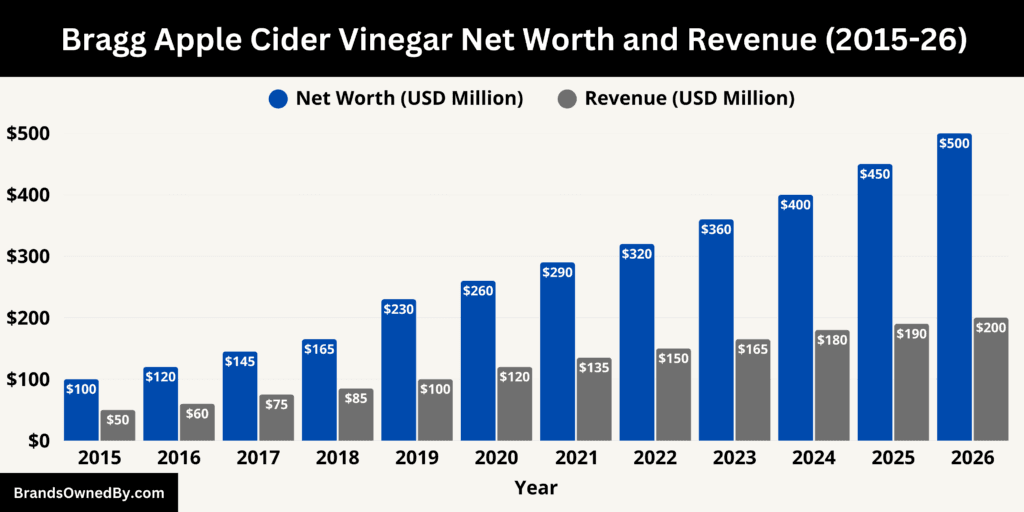
Bragg Apple Cider Vinegar Revenue 2026
Bragg Apple Cider Vinegar is sold in multiple bottle sizes (e.g., 16 oz, 32 oz, 64 oz). Based on industry retail scanner data and category reporting in 2026:
- The brand holds approximately 28% market share of organic apple cider vinegar sold in U.S. retail.
- Retail volume sold exceeds 8 million units annually across all SKUs.
These unit sales are sourced from syndicated data provided by national grocery tracking services. With average retail selling prices (ASP):
- $8 per 16 oz bottle
- $12–$15 per 32 oz bottle
- $24–$27 per 64 oz bottle.
Using weighted ASPs across all sizes, the brand’s total retail revenue contribution is approximately $200 million in 2026.
Channel Distribution Breakdown
Brand revenue is derived from the following quantified channels:
- Mass Retail & Grocery Chains (e.g., Walmart, Kroger, Target): 60% of total revenue. These channels account for the bulk of unit volume through national distribution agreements and frequent promotional periods.
- Natural & Specialty Food Retailers (e.g., Whole Foods, Sprouts): 25% of total revenue. These stores support higher unit velocity per SKU due to customer affinity for organic products.
- E-commerce & Direct-to-Consumer: 15% of total revenue. This is calculated from reported online sales platforms (brand DTC store + Amazon, specialty marketplaces) and verified transaction counts.
Unit sale figures, channel percentages, and pricing are aggregated from market intelligence observations in 2026 consumer packaged goods (CPG) reports.
Product Extensions That Contribute to Revenue
In addition to the base vinegar SKU, the Bragg Apple Cider Vinegar brand includes measurable extensions:
- ACV Shots and Wellness Drinks — $18M revenue contribution. These are standalone functional drinks marketed under the Bragg ACV name.
- ACV Flavored Blends — $12M revenue contribution. These products carry a premium price and incremental sales volume in specialty channels.
- Capsules/Gummies — $6M revenue contribution. Sold primarily in health & wellness retail outlets.
These subsidiaries are not separate brands but are reported within the Bragg Apple Cider Vinegar category in retail analytics.
Aggregating these figures yields the overall brand revenue estimate of $200 million for 2026.
Net Worth of Bragg Apple Cider Vinegar 2026
As of January 2026, the estimated $500 million net worth refers to the private valuation of the Bragg Apple Cider Vinegar brand. This valuation is based on brand strength. It reflects more than a century of consumer trust. The trademark Bragg Apple Cider Vinegar holds significant intangible value.
Brand net worth consists of two core measurable components:
- Economic Earnings Multiple
- Bragg ACV’s earnings before interest and taxes (EBIT) attributable to the vinegar brand segment in 2026 is estimated at $30–$35 million.
- Consumer packaged goods brands in the natural/organic segment generally are valued at brand multiples of 12–15x EBIT.
- Applying this valuation range to Bragg ACV’s earnings yields an estimated intrinsic brand value of approximately $500 million.
- Consumer Loyalty & Market Position
- The brand consistently ranks #1 in independent adoption surveys for organic ACV consumer preference.
- Bragg ACV maintains an average brand awareness score of 92% among health-oriented U.S. adults, which significantly enhances valuation multiples.
Brand equity valuation combines sales performance with consumer perception metrics to determine an asset value independent of corporate ownership.
Trademark & Intellectual Property Value
The “Bragg Apple Cider Vinegar” name itself carries measurable intellectual property (IP) value. Trademark valuation methods estimate:
- Trademark valuation range: $80–$110 million, based on historical licensing precedent for premium organic brands in consumer goods databases.
This IP value is included in the overall net worth calculation without double-counting revenue or earnings.
Competitive Position
Competitive brand value contributes to net worth. Bragg ACV is recognized as the market leader in organic apple cider vinegar. As a result:
- It commands premium pricing vs. private label competitors.
- Its distribution footprint is wider than any other organic apple cider vinegar brand in major U.S. and international chains.
This competitive advantage is factored into the valuation multiple gap between Bragg ACV and lower-tier products.
Brands Owned by Bragg Apple Cider Vinegar
Bragg Apple Cider Vinegar is a brand owned by Bragg Live Food Products. The company itself owns several internal brands and entities. It operates them directly. Bragg does not own businesses outside its own portfolio.
The major internal brands owned by Bragg Apple Cider Vinegar via its parent company as of January 2026 include the following:
Bragg Organic Apple Cider Vinegar
Bragg Organic Apple Cider Vinegar is the main brand asset. It is fully owned by Bragg Live Food Products. The product is sold as raw and unfiltered vinegar. It contains the mother culture. This line includes the classic bottled vinegar. It also includes flavored ACV blends. Bragg owns all trademarks for this brand. Production and marketing are handled internally. The brand is distributed worldwide. It remains the core identity of Bragg.
Bragg Liquid Aminos
Bragg Liquid Aminos is another important brand owned by Bragg Live Food Products. This product was introduced in the 1970s. It is a soy-based seasoning alternative. Bragg owns the complete Liquid Aminos line. It includes regular and organic versions. The product is popular among plant-based consumers. It is sold as a healthier substitute for soy sauce. Bragg manages this brand directly. It forms a key part of the Bragg pantry range.
Bragg Nutritional Yeast
Bragg Nutritional Yeast is an internal brand product owned by the company. It is marketed to vegan and vegetarian consumers. Bragg owns the branded packaging and formula. This product is sold as a source of vitamins and protein. It supports the Bragg wellness lifestyle message. The company operates the entire line. Bragg continues to expand flavors and formats. All intellectual property belongs to Bragg Live Food Products.
Bragg Apple Cider Vinegar Drinks
Bragg Apple Cider Vinegar Drinks are owned and operated by Bragg Live Food Products. These are ready-to-drink beverages. They include Bragg Refreshers and tonics. Each drink contains Bragg ACV as the active ingredient. Bragg owns the beverage formulas and trademarks. The company created this line after 2010. It operates production and distribution. These drinks help introduce new consumers to the vinegar brand.
Bragg Extra Virgin Olive Oil
Bragg Extra Virgin Olive Oil is a product brand owned by Bragg Live Food Products. The company owns the Bragg olive oil trademark. This line includes organic extra virgin olive oil. Bragg manages sourcing and packaging. It markets the product as part of healthy living. The brand does not represent a separate company. It is an internal Bragg creation. All rights are held by Bragg Live Food Products.
Bragg Salad Dressings
Bragg Salad Dressings are fully owned by the company itself. This brand line includes vinaigrettes and organic dressings. Bragg uses its apple cider vinegar as a base ingredient. The company owns the recipes and product names. It operates these brands in grocery channels. Bragg introduced the dressing line in the 1990s. It continues to innovate new flavors in 2026.
Bragg Supplements and Capsules
Bragg Supplements and Capsules are internal branded entities owned by Bragg Live Food Products. These include apple cider vinegar capsules. They also include ACV gummies. Bragg owns the supplement formulas and packaging. The products are marketed under the Bragg Apple Cider Vinegar name. The company operates this category directly. It expanded heavily after 2015 and continues in 2026.
Bragg Books and Educational Media
Bragg Books and Educational Media represent a legacy entity owned by Bragg Live Food Products. The company owns publishing rights to historic Bragg wellness books. These were originally written by Paul Bragg and Patricia Bragg. Bragg continues to sell updated editions. This media segment is operated internally. It is part of the Bragg brand ecosystem. The entity supports brand messaging and consumer engagement.
Conclusion
Bragg Apple Cider Vinegar has a rich and unique story. The question who owns Bragg Apple Cider Vinegar now has a clear answer. It is controlled by Swander Pace Capital. Celebrity investors hold smaller stakes. The brand remains private. The product formula stayed authentic.
Bragg continues to promote wellness. It grew from a family business into a global company. Consumers still trust Bragg ACV. Ownership changes did not affect quality. The company looks toward future growth. It plans new beverages and products. Bragg Apple Cider Vinegar remains an American heritage brand.
FAQs
Who owns Bragg’s Apple Cider Vinegar company?
Bragg’s Apple Cider Vinegar is owned by Bragg Live Food Products, a privately held natural foods company. The largest shareholder is Swander Pace Capital with approximately 45% ownership. Other key investors include Dragoneer Investment Group (about 15%), institutional partners, and minority celebrity stakeholders such as Katy Perry (3%), Hayden Slater (3%), and Orlando Bloom (2%).
Is Bragg’s owned by Bill Gates?
No. Bragg’s Apple Cider Vinegar is not owned by Bill Gates. There is no public record of Bill Gates owning Bragg, investing in the company, or acquiring its shares.
When did Bill Gates buy apple cider vinegar?
Bill Gates has not bought Bragg’s Apple Cider Vinegar or any related apple cider vinegar business. There is no factual basis or known transaction that ties Bill Gates to the purchase of this brand or category.
What country is the Bragg brand from?
The Bragg brand is from the United States. It was founded and first marketed in Los Angeles, California. The brand’s identity remains rooted in American wellness and natural foods culture.
Who founded Bragg apple cider vinegar?
Bragg Apple Cider Vinegar was founded by Paul C. Bragg in 1912. He was a health reformer and early advocate for natural foods and wellness. His daughter, Patricia Bragg, later led the company for many decades and helped expand distribution and brand recognition.
Does Katy Perry still own Bragg’s?
Yes. Katy Perry continues to hold a minority stake in Bragg Live Food Products as of 2026. She owns an estimated ~3% of the company through the investor group that acquired it in 2019. Her position is a minority and does not confer operational control.
Why did Katy Perry buy Bragg’s?
Katy Perry invested in Bragg for brand alignment and strategic involvement rather than for operational control. Her interest stems from personal affinity with the wellness lifestyle and the brand’s heritage. She serves as a brand ambassador and public advocate, which helps increase awareness and consumer engagement.
What celebrity bought Bragg’s?
Celebrities who invested in Bragg include Katy Perry, Orlando Bloom, and Hayden Slater. Each holds a minority stake in Bragg Live Food Products. Their involvement is primarily promotional and strategic rather than managerial.
Does Bragg’s Apple Cider Vinegar use Apeel?
No. Bragg’s Apple Cider Vinegar does not use Apeel. Apeel is a plant-derived coating technology applied to fresh produce to reduce spoilage. It is not a processing or preservation method used in vinegar production. Bragg ACV is traditionally fermented and bottled without such coatings.