

- Apple Inc. owns 100% of Beats Electronics after acquiring the company in 2014, making Beats a private subsidiary with no public shareholders or outside investors.
- Beats has no independent owners or board members; all strategic and operational control comes from Apple’s executive leadership structure.
- Dr. Dre and Jimmy Iovine sold all ownership stakes during the acquisition and do not hold equity or decision-making power today.
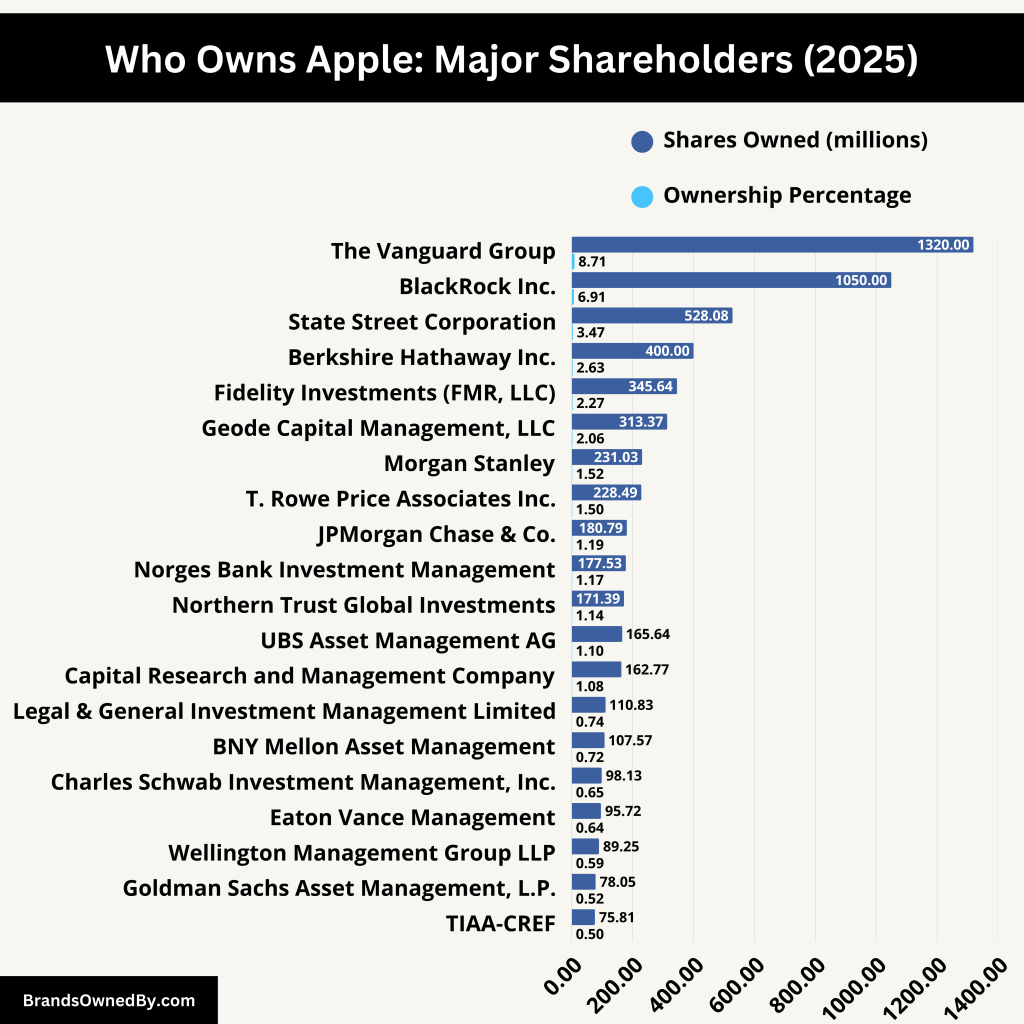
- Apple’s institutional shareholders indirectly own Beats, with firms like Vanguard, BlackRock, and Berkshire Hathaway holding the largest ownership influence through Apple shares.
Beats Electronics is a consumer-audio brand that produces headphones, earbuds, and speakers. The brand is known worldwide for its distinctive style, strong bass sound, and lifestyle appeal. Since its inception, Beats has blurred the line between high-end audio gear and pop-culture fashion. The company’s products remain widely sold globally.
Company Details and Founders
Beats Electronics was founded in 2006 by legendary music producer Dr. Dre (Andre Young) and record executive Jimmy Iovine. Both came from the heart of the music industry and shared the same frustration. They believed most consumer headphones failed to reflect how music actually sounded in professional studios.
Dr. Dre had spent decades producing music and working with artists who cared deeply about sound quality. He felt that everyday listeners were missing the emotional depth of tracks due to low-grade audio equipment. Jimmy Iovine had built an empire in the music business through Interscope Records and later Interscope-Geffen-A&M. He understood both the creative side of sound and the commercial side of branding.
Their goal was not simply to sell headphones. They wanted to reshape how people experienced music. Beats was designed around one idea: listeners should hear music the same way artists hear it in the studio. That vision became the foundation of the brand.
To bring their idea to life, Beats initially partnered with Monster Cable, a company known for high-end audio components. This partnership handled early manufacturing while Beats focused on design, brand identity, and marketing strategy. From the start, Beats was marketed differently. Instead of traditional advertising, the company used musicians, athletes, and celebrities to promote the product by wearing it publicly.
The strategy worked. Beats became a fashion symbol almost overnight. The brand combined music, culture, and design into one identity. That mix turned Beats into more than an electronics company. It became a lifestyle brand.
Major Milestones
- 2006: Beats Electronics was founded by Dr. Dre and Jimmy Iovine with the goal of improving consumer sound quality to match studio-level audio.
- 2008: The first product, Beats by Dr. Dre Studio Headphones, was officially launched and quickly gained attention in music and sports circles.
- 2009: Beats became a pop-culture symbol as athletes and celebrities began wearing the headphones publicly during interviews and events.
- 2010: The company expanded into portable speakers and accessory-style audio products, entering the lifestyle electronics market.
- 2011: Smartphone maker HTC purchased a majority stake in Beats, helping push the brand into mobile audio and smartphone integration.
- 2012: Beats ended its manufacturing partnership with Monster Cable and took direct control over product design and manufacturing.
- 2012: The company launched its first self-designed wireless speakers and introduced enhanced noise-canceling headphones.
- 2013: Private equity firm Carlyle Group invested $500 million in Beats, while HTC exited completely, returning ownership to Beats and Carlyle.
- 2014: Apple acquired Beats Electronics and Beats Music in a landmark deal valued at about $3 billion. Dr. Dre and Jimmy Iovine joined Apple as executives.
- 2015: Beats Music was integrated into Apple’s ecosystem and laid the foundation for Apple Music.
- 2016: Beats shifted its full focus to hardware after Apple absorbed the music-streaming service into Apple Music.
- 2018: Beats began integrating Apple-designed silicon into its products, significantly improving performance and energy efficiency.
- 2020: Beats launched fitness-focused earbuds and performance-driven products targeted at athletes and gym users.
- 2022: Beats strengthened cross-platform support, providing full compatibility with both iOS and Android devices.
- 2023: Beats refreshed its lineup with advanced noise-cancelation, spatial audio features, and improved design materials.
- 2024: Beats reinforced its identity as Apple’s culture-focused audio brand, separate from Apple’s own AirPods line.
- 2025: Beats continues producing performance and lifestyle audio products under Apple’s ownership, focusing on global expansion and innovation.
Who Owns Beats Electronics (Beats by Dre)?
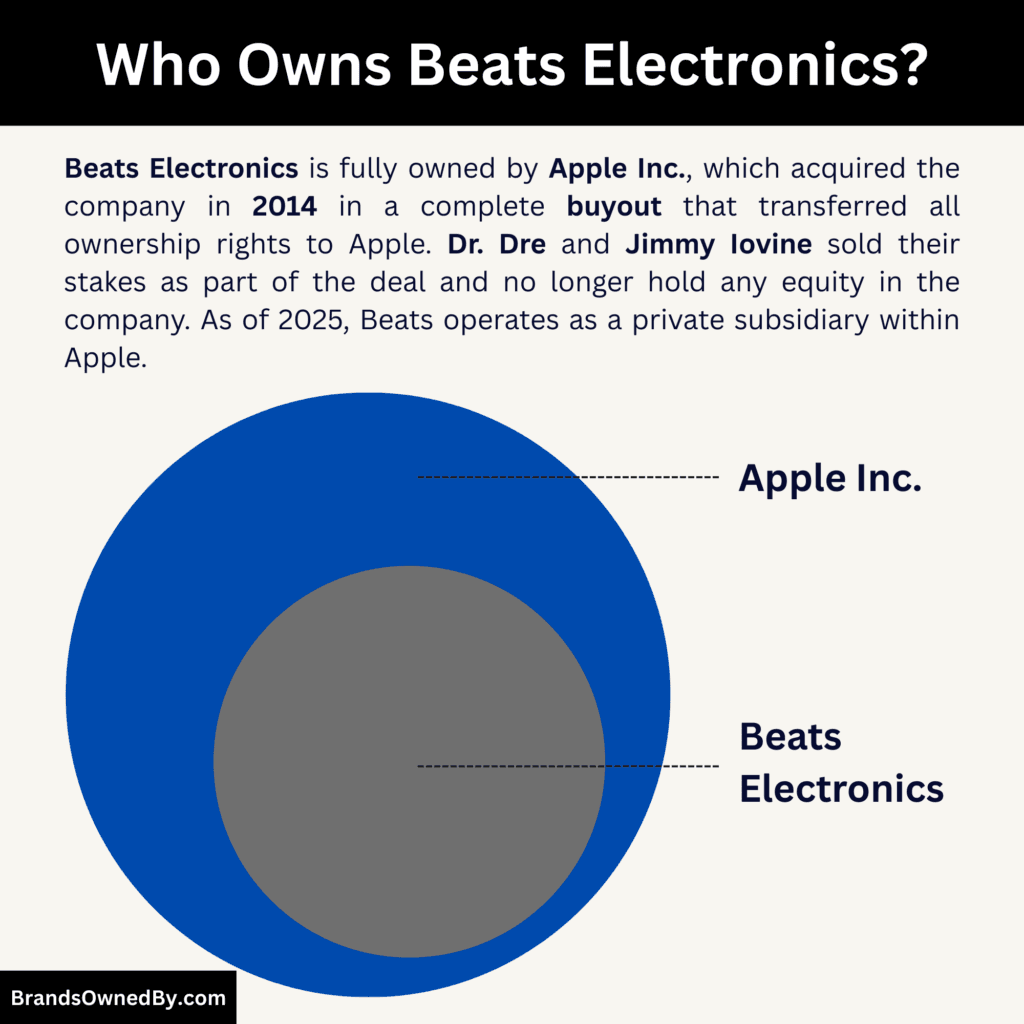
Apple acquired Beats Electronics in May 2014 in a complete acquisition that included both the hardware brand and the streaming service Beats Music. The deal transferred all ownership rights to Apple.
As of December 2025, Beats Electronics operates as a private Apple subsidiary. It manufactures audio products only. It does not operate independently and it has no public shareholders.
Parent Company: Apple Inc.
Apple Inc. is the sole and permanent owner of Beats Electronics. Apple owns the company outright and holds full legal possession of all Beats trademarks, intellectual property, business operations, and product designs. Beats Electronics is not a joint venture, franchise, or partially owned brand. It is a private operating unit inside Apple.
Legally, Beats Electronics exists as a subsidiary under Apple’s corporate structure. Operationally, it does not function as an independent company. It does not have its own board of directors. It does not release financial reports. It does not approve its own product roadmaps or budgets.
All strategic control sits within Apple’s hardware leadership teams.
Product development for Beats is directed through Apple’s internal engineering groups. Chip selection, audio architecture, wireless protocols, and firmware design are chosen by Apple, not by Beats as a separate decision-maker. Current Beats headphones and earbuds use Apple-designed processors for connectivity, power management, and pairing systems.
Manufacturing is fully controlled by Apple’s global operations team. Apple selects suppliers, identifies production partners, negotiates factory contracts, and runs quality assurance for Beats through the same supply chain infrastructure used for iPhone, iPad, and AirPods manufacturing.
Sales and distribution are also controlled by Apple. Beats products are sold via Apple Stores, Apple’s online store, and Apple-authorized retailers. Pricing decisions and sales strategy are managed by Apple’s commercial division, not Beats as a brand.
Branding is the only area where Beats operates with visible autonomy and even here, final approval flows through Apple’s marketing executives. Beats keeps its visual identity and cultural tone, but the messaging strategy is reviewed internally by Apple’s communications leadership.
Acquisition Insights: How Apple Bought Beats by Dre
Apple acquired Beats Electronics in 2014 in a complete takeover. The deal transferred full ownership of Beats to Apple and permanently ended its status as an independent company. This acquisition included both sides of the business: Beats Electronics (the hardware brand) and Beats Music (the streaming platform).
The transaction marked a turning point for Beats. It went from a celebrity-founded electronics company into an internal brand within one of the largest technology companies in the world.
When and How the Acquisition Happened
Apple publicly announced the acquisition on May 28, 2014. The agreement was structured as a full buyout rather than a partnership or investment.
The transaction value was approximately $3 billion. Payment consisted of both cash and Apple stock. Once the transaction closed, Apple held 100% ownership of Beats Electronics. No shares, voting rights, or board authority were left outside Apple.
The deal was completed later in 2014 after regulatory approval. From that point forward, Beats was legally an Apple-controlled entity.
What Apple Acquired in the Deal
Apple did not only buy a brand name. It acquired the entire business.
The acquisition included:
- All intellectual property
- Manufacturing contracts
- Distribution agreements
- The Beats Music platform
- Brand trademarks and licensing rights
- Hardware technology and patents.
Beats Music was not purchased as a standalone product. It was acquired as part of the same transaction and absorbed into Apple’s services business.
Why Apple Bought Beats
The acquisition had two strategic objectives.
First, Apple acquired a recognized audio brand with cultural relevance. Beats had deep roots in basketball, hip-hop, and youth culture. Apple gained instant credibility in the premium headphone market.
Second, Apple acquired streaming infrastructure and industry relationships. Beats Music gave Apple a foundation to accelerate its own music service development. Apple Music launched shortly after and replaced Beats Music fully.
This acquisition allowed Apple to enter streaming at scale without starting from zero and to immediately secure licensing relationships with music labels and artists.
What Changed After the Deal
After Apple completed the acquisition, major changes followed.
- Beats Music was shut down and merged into Apple Music.
- Beats Electronics stopped operating as a startup-like company.
- Product design moved into Apple’s internal processes.
- All engineering became integrated with Apple hardware teams.
- Brand marketing became Apple-supervised.
Dr. Dre and Jimmy Iovine joined Apple as executives. They did not retain ownership. Their roles were advisory and creative, not executive control. Over time, both stepped back from active leadership roles.
Beats became a product line. Not a company with autonomy.
What Happened to Previous Investors
Before Apple’s purchase, Beats had several outside investors.
- HTC had once held a majority stake in Beats but sold off all holdings before Apple finalized the deal.
- The Carlyle Group invested heavily in 2013 but fully exited as part of Apple’s acquisition.
- The founders sold their remaining shares to Apple.
After the transaction, no outside investor retained equity. All shares were consolidated into Apple alone.
Where Beats Stands Today (As of December 2025)
As of December 2025:
- Beats Electronics is fully owned by Apple.
- The company has no external investors.
- Beats Music does not exist as a platform.
- Beats functions as a hardware-only brand.
- All authority comes from Apple management.
The acquisition permanently ended Beats as a standalone company and redefined it as a brand within Apple’s product ecosystem.
Beats Electronics Leadership
Beats Electronics does not operate like an independent company. It does not have a standalone executive team, public officers, or its own corporate governance structure. Leadership of Beats is handled internally by Apple Inc. and distributed across Apple’s executive leadership, hardware teams, and operations management.
No Independent CEO or Board at Beats
Beats Electronics does not have its own CEO.
It also does not have:
- A separate board of directors
- Independent financial leadership
- Public executive officers
- Independent corporate governance.
Beats is not treated as a subsidiary with autonomy. It functions as a branded product division inside Apple’s hardware business.
Final authority does not exist at the Beats level. It exists inside Apple’s corporate leadership structure.
Ultimate Leader: Apple CEO
Because Apple fully owns and controls Beats, Apple’s CEO is the highest authority over the brand.
As of 2025, Apple’s CEO is Tim Cook.
All strategic decisions affecting Beats require executive-level approval within Apple. This includes:
- New product lines
- Pricing strategy
- Manufacturing strategy
- Geographic expansion
- Brand positioning
- Product discontinuation
- Engineering budgets.
Tim Cook does not manage Beats day-to-day. However, every major decision is approved within his leadership structure. Beats cannot operate outside Apple’s strategy framework.
Founders’ Roles After the Acquisition
Dr. Dre
After Apple acquired Beats in 2014, Dr. Dre entered Apple as a senior advisor.
He did not lead day-to-day operations.
He had influence in:
- Brand culture
- Creative partnerships
- Artist relationships.
He exited operational involvement over time and no longer holds any executive role or ownership position as of 2025.
Jimmy Iovine
Jimmy Iovine took on a more formal role than Dr. Dre.
He worked inside Apple as a senior executive focused on:
- Music industry negotiations
- Artist partnerships
- Apple Music development
- Cultural strategy.
Jimmy Iovine formally left Apple in 2022.
He holds no leadership or ownership position in Beats or Apple today.
Who Really Runs Beats in 2025
Beats is run through Apple’s internal command structure.
Leadership flows downward like this:
- Apple Board of Directors
- Apple CEO
- Apple Hardware Leadership
- Apple Operations & Marketing Units
- Beats Product Teams.
Beats managers report to Apple executives, not to a Beats leadership office.
Beats Electronics Annual Revenue and Net Worth
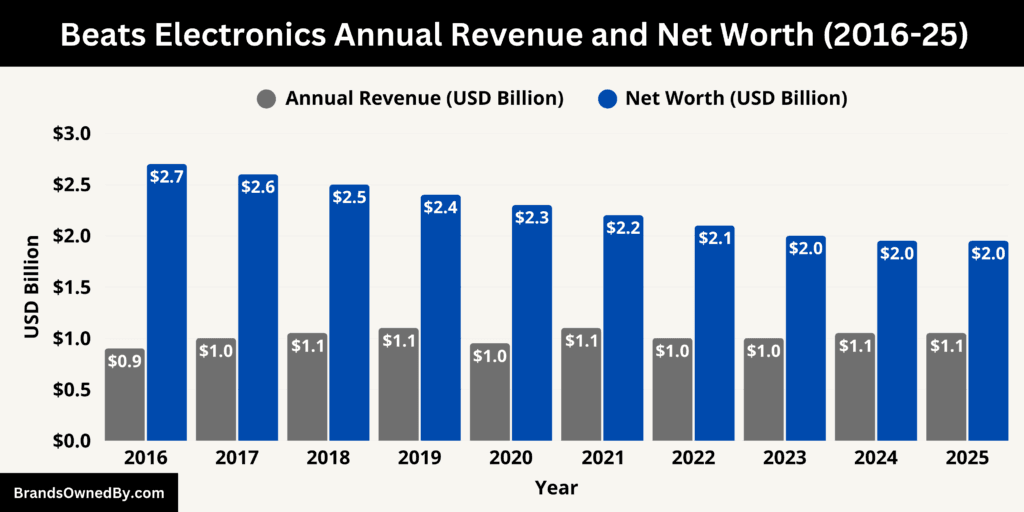
As of December 2025, Beats Electronics generated an estimated $1.05 billion in annual revenue and holds an estimated brand and business value of $1.95 billion. These figures reflect Beats as a hardware-only brand operating under Apple’s ownership and measured as a business asset rather than an independent company.
Beats Electronics Revenue in 2025
Beats Electronics’ estimated revenue for 2025 is approximately $1.05 billion. This revenue is primarily generated through the sale of premium headphones, wireless earbuds, and compact Bluetooth speakers. The company no longer operates a streaming service or any subscription-based model, which means all revenue is tied directly to physical product sales.
Most sales occur through Apple’s retail network, including Apple Stores, Apple’s online store, and authorized electronics retailers worldwide. The strong retail backing allows Beats to maintain steady volume despite intense competition from consumer electronics brands. Beats products are also sold alongside Apple devices, which boosts visibility and recurring consumer exposure.
Because Beats does not publish standalone financial statements, its revenue is estimated based on industry modeling, historical performance, and market intelligence. The estimate assumes stable global demand, continued presence in North America, Europe, and Asia, and consistent sales in Apple’s accessories category.
Beats Electronics Net Worth
Beats Electronics’ estimated business value in December 2025 stands at $1.95 billion. This valuation represents the brand’s intellectual property, product designs, trademarks, retail influence, and revenue-generating capability. It does not represent market capitalization because Beats is not public. It reflects what the brand itself is worth as a controlled asset inside Apple.
The brand’s current valuation is lower than its 2014 acquisition price, when Apple purchased Beats for about $3 billion. That reduction does not imply failure. It reflects the change in how the brand operates.
When Beats was acquired, it included a software division, a streaming platform, and growth-stage valuation multiples. Today, Beats exists purely as a hardware brand, which carries lower valuation multipliers than multi-revenue tech companies.
Despite this, the brand remains valuable. It still commands premium pricing. It still enjoys global recognition. It also benefits from Apple’s manufacturing scale and distribution infrastructure. This keeps costs lower and profit margins stable, which preserves long-term brand value.
Revenue Trend and Business Performance (2016–2025)
Over the last decade, Beats’ revenue has shown moderate stability with slight fluctuation. The initial years following the Apple acquisition saw strong momentum. The pandemic period caused a temporary slowing in physical retail, but product demand recovered as e-commerce and remote work increased headphone usage.
By 2023, sales had leveled into a predictable cycle driven by product refreshes rather than explosive growth. In 2024 and 2025, Beats maintained sales above the $1 billion mark due to continued demand for lifestyle audio products and steady brand loyalty.
Unlike technology startups, Beats does not chase rapid expansion. Its business model focuses on brand longevity, predictable upgrades, and limited, curated product releases. This results in slower growth but more reliable income over time.
How Apple’s Ownership Affects Beats’ Financials
Because Beats is fully owned by Apple, its revenue is consolidated into Apple’s overall reporting. Beats does not issue independent earnings or disclose margins. This also means Beats does not operate under pressure from public investors. It receives funding through Apple’s internal budgeting systems.
This structure gives Beats financial stability. It does not rely on external capital. It does not need to pursue aggressive expansion. It is funded and maintained as a strategic brand inside a much bigger ecosystem.
For Apple, Beats is less about revenue scale and more about market positioning. It serves a different customer mindset from AirPods and adds diversity to Apple’s hardware portfolio.
Brands Owned by Beats Electronics
Below are the brands and entities that operate under Beats Electronics as of December 2025:
| Name | Type | Year Introduced | Current Status | Description |
|---|---|---|---|---|
| Beats by Dre | Master Brand | 2008 | Active | Core commercial brand under which all Beats products are sold. Represents the identity of the company and remains the official trademark. |
| Beats Studio Series | Product Line | 2008 | Active | Premium over-ear and on-ear headphones focused on noise cancellation and immersive sound quality. |
| Beats Solo | Product Line | 2009 | Active | Lightweight on-ear headphone lineup focused on style, everyday listening, and youth audience appeal. |
| Beats Fit Pro | Product Line | 2021 | Active | Sports-focused wireless earbuds designed for workouts, movement, and durability. |
| Beats Studio Buds | Product Line | 2021 | Active | Entry-to-mid-tier wireless earbuds targeting casual listeners and cross-platform users. |
| Beats Pill | Product Line | 2012 | Active | Portable Bluetooth speaker family known for bass-heavy sound and compact design. |
| Beats Accessories | Product Line | 2009 | Active | Includes cables, cases, ear pads, adapters, and retail add-ons sold under Beats branding. |
| Beats Music | Former Business Unit | 2012 | Discontinued | Streaming platform formerly operated by Beats; absorbed during Apple acquisition and shut down. |
| Beats Creative & Marketing Unit | Internal Division | 2008 | Active | Handles branding, product design language, and cultural partnerships. |
| Beats Product Engineering Team | Internal Division | 2008 | Active | Internal group responsible for product design, acoustics, and audio development direction. |
Beats by Dre
Beats by Dre is the core brand and the name most consumers associate with the company. It is not a separate company. It is the commercial identity under which Beats Electronics sells all audio products.
The “by Dre” branding refers to co-founder Dr. Dre’s personal identity as a producer and audio engineer. The name continues to exist as a trademark even though Dr. Dre no longer owns the company.
Beats by Dre is used across all product categories including headphones, earbuds, accessories, and speakers. The brand is licensed only internally and is not sold, franchised, or sublicensed to other manufacturers.
Beats Studio Series
The Beats Studio line is one of the company’s most important product families. It includes over-ear and on-ear premium headphones with active noise cancellation.
This lineup represents Beats’ premium consumer tier. It focuses on comfort, battery performance, and processing technology rather than just audio tuning.
Beats owns the Beats Studio trademark as a product identity. It is not a separate company and does not operate independently.
Beats Solo
Beats Solo is a standalone branding line within Beats Electronics. It represents the fashion-forward, lightweight on-ear headphone category.
Solo products target music fans and lifestyle buyers rather than audio engineers. Color variations, limited releases, and collaborations typically launch under this brand family.
Beats Solo is treated as its own product label but remains part of the main company.
Beats Fit Pro
Beats Fit Pro is Beats’ fitness-focused product identity. It focuses on sports users, gym training, and sweat-resistant design.
Fit Pro is marketed differently from fashion or studio products. It emphasizes stability, comfort during movement, and active use.
The branding is owned solely by Beats Electronics and is not licensed or separated into its own business unit.
Beats Studio Buds
Beats Studio Buds represent Beats’ true wireless earbud lineup.
The Studio Buds product family exists to compete in the mid-range wireless audio market. These products are tuned differently from AirPods and follow Beats’ own design strategy.
Although they integrate with Apple devices, the Beats Studio Buds are sold under Beats branding and product identity.
Beats Pill
Beats Pill is the speaker brand under Beats Electronics.
It includes portable Bluetooth speakers focused on bass output and design rather than smart-home functionality.
The Beats Pill name is trademarked and owned by Beats Electronics. It is considered one of the company’s earliest non-headphone product families.
Beats Accessories
Beats owns a range of accessory brands attached to its main product identity. These include:
- Carrying cases
- Charging cables
- Replacement ear cushions
- Adapters
- Travel pouches.
Although not always marketed as independent product families, these items are developed and sold internally under the Beats branding.
Beats Music
Beats Music was once owned and operated by Beats Electronics as a streaming platform.
This entity no longer exists as part of Beats.
When Apple acquired the company, Beats Music was absorbed into Apple’s streaming services and shut down as a branded product. Beats Music is considered a historical business unit, not an active asset.
Beats does not operate any digital streaming platforms today.
Creative and Marketing Divisions
Beats runs internal units across design, brand promotion, and product marketing.
These are not incorporated subsidiaries but internal operational entities that manage:
- Product design language
- Global advertising
- Athlete sponsorship programs
- Music artist partnerships
- Retail presentation concepts.
These teams function inside Beats’ business structure and do not operate independently.
Final Thoughts
Beats Electronics has transitioned from a founder-led startup into a brand fully controlled by a global technology giant. Anyone searching who owns Beats Electronics will find that Apple is now responsible for its direction, production, and market strategy. The brand no longer operates independently and does not make corporate decisions outside Apple’s structure. Despite this, Beats has retained its identity as a lifestyle-focused audio brand, known for bold design and bass-driven sound. Today, it functions as a long-term asset inside Apple’s product ecosystem rather than a standalone company, with its future tied directly to Apple’s vision and leadership.
FAQs
Who Owns Beats Now?
Beats Electronics is owned 100% by Apple Inc. Apple acquired the entire company and remains the sole owner.
Is Beats Still Owned by Dr. Dre?
No. Dr. Dre does not own Beats anymore. He sold his ownership stake when Apple acquired the company.
Who Owned Beats Before Apple?
Before Apple acquired it, Beats was owned by Dr. Dre, Jimmy Iovine, and private-equity firm Carlyle Group. HTC was also a former investor but exited before Apple completed the deal.
When Did Apple Acquire Beats?
Apple announced the acquisition in May 2014, and the deal was completed later that year after regulatory approvals.
Is Beats Owned by Apple?
Yes. Beats is fully owned by Apple and operates as a private subsidiary.
Who Made Beats?
Beats was created by Dr. Dre and Jimmy Iovine. They founded Beats Electronics in 2006.
Does Apple Still Own Beats?
Yes. As of now, Apple continues to own Beats completely and controls all operations.
Who Created Beats by Dre?
Beats by Dre was created by Dr. Dre and Jimmy Iovine as part of the Beats Electronics company.
Who Bought Beats by Dre?
Apple Inc. bought Beats by Dre as part of the full acquisition of Beats Electronics in 2014.
How Much Did Dr. Dre Sell Beats For?
Apple purchased Beats for about $3 billion. Dr. Dre reportedly earned roughly $700–$750 million from the deal before taxes through his ownership stake.
Is Dr. Dre the CEO of Beats?
No. Dr. Dre is not the CEO of Beats. Beats does not have an independent CEO and is managed under Apple’s leadership.
Are Beats and JBL the Same?
No. Beats and JBL are completely different brands owned by different companies and operate independently of each other.
How Much Did LeBron Make From Beats by Dre?
LeBron James reportedly earned over $30 million from his early investment in Beats when Apple acquired the company.
Was Dr. Dre Ever a Billionaire?
Yes. In 2014, after Apple acquired Beats, Dr. Dre became the first hip-hop artist to be widely recognized as a billionaire.
Does LeBron Own Beats by Dre?
No. LeBron James does not own Beats today. He sold his stake during the Apple acquisition.
What Companies Does Dr. Dre Own?
Dr. Dre owns several businesses including Aftermath Entertainment (his record label) and production ventures under his name. He does not own Beats Electronics.