

- Ancestry is a privately held company controlled primarily by Blackstone, which owns approximately 75% of the company and holds majority voting and board authority.
- GIC, Singapore’s sovereign wealth fund, is the largest minority shareholder with an estimated 25% stake, providing financial stability without controlling influence.
- All former institutional investors, including Silver Lake and other early private equity partners, exited during the Blackstone acquisition, consolidating ownership under the current structure.
- The concentrated ownership allows Ancestry to operate independently, invest in long-term technology and global expansion, and maintain strategic control over its genealogy and DNA platforms.
Ancestry is a leading genealogy and consumer genomics company. It provides one of the world’s largest online collections of family history and historical records. The platform helps people discover information about their ancestors, connect with distant relatives, and build family trees using millions of digitized records. Ancestry also operates a major consumer DNA testing business under the AncestryDNA brand, which matches users with relatives and provides ethnicity estimates.
The company is known for its extensive historical data partnerships with archives and public record holders around the world. Ancestry’s services span web, mobile, and DNA platforms that are used by millions for personal research and family exploration.
Ancestry is headquartered in Lehi, Utah, and employs thousands globally. While it operates tools for individual users, it also offers localized sites and databases in many countries to expand its global reach.
It’s data resources now encompass tens of billions of historical records from more than 80 countries. Ancestry’s platform integrates records, user-generated content (like family trees), and genetic information to create connections across generations.
Founders of Ancestry
Ancestry was founded in 1983 by Paul Brent Allen and Dan Taggart, two entrepreneurs with a shared interest in genealogy, publishing, and data organization.
Paul Brent Allen played a key role in shaping the company’s early editorial and content strategy. He had a strong background in genealogical research and publishing. His focus was on making complex family records easier for everyday users to understand and access.
Dan Taggart brought operational and business leadership to the company. He helped establish Ancestry as a structured publishing business during its early years. Taggart was instrumental in scaling distribution and building the company’s initial customer base before the internet era.
The founders originally launched the business as Ancestry Publishing. Their goal was to organize family history records that were traditionally scattered across libraries, churches, and government offices. At the time, genealogy research required physical access to records and expert-level knowledge.
Their long-term vision went beyond print. As digital technology evolved, the founders supported the shift toward online databases. This strategic pivot laid the foundation for Ancestry’s transformation into a global digital genealogy platform.
Major Milestones
- 1983: Ancestry Publishing is founded by Paul Brent Allen and Dan Taggart. The company focuses on printed genealogy materials and family history publications.
- 1987: Genealogical magazines and reference guides are launched, helping Ancestry build early credibility among professional and amateur researchers.
- 1990: The company begins using early digital databases to store genealogical records, signaling a future shift toward technology-driven research.
- 1996: Ancestry.com is officially launched, marking the transition from print publishing to online genealogy services.
- 1999: Subscription-based access is introduced, allowing users to search census and public records through a centralized digital platform.
- 2003: Major expansion of U.S. census, immigration, and vital records significantly increases database depth and usability.
- 2006: International growth begins with the addition of the UK, Irish, and European historical record collections.
- 2009: Ancestry becomes a publicly traded company after listing on NASDAQ, increasing operational scale and visibility.
- 2010: Strategic partnerships with national archives and government agencies accelerate large-scale record digitization.
- 2012: AncestryDNA is launched, transforming the company into a leading consumer genetics platform.
- 2013: Find a Grave is acquired, expanding Ancestry’s cemetery and memorial data ecosystem.
- 2015: Mobile applications are released, enabling on-the-go family tree building and record searches.
- 2016: The company returns to private ownership, allowing management to focus on long-term product and data strategy.
- 2018: Machine learning tools are introduced to improve handwriting recognition and record-matching accuracy.
- 2020: Blackstone acquires Ancestry, strengthening its global expansion and technology investment strategy.
- 2021: Deb Liu is appointed CEO, bringing a renewed focus on privacy, inclusivity, and ethical data use.
- 2023: AI-driven family tree hints and smarter record-linking features are rolled out across the platform.
- 2024: International DNA matching capabilities are expanded, improving global ancestry connections.
- 2025: Ancestry continues advancing artificial intelligence to automate record transcription and enrich historical context.
Who Owns Ancestry: Major Shareholders
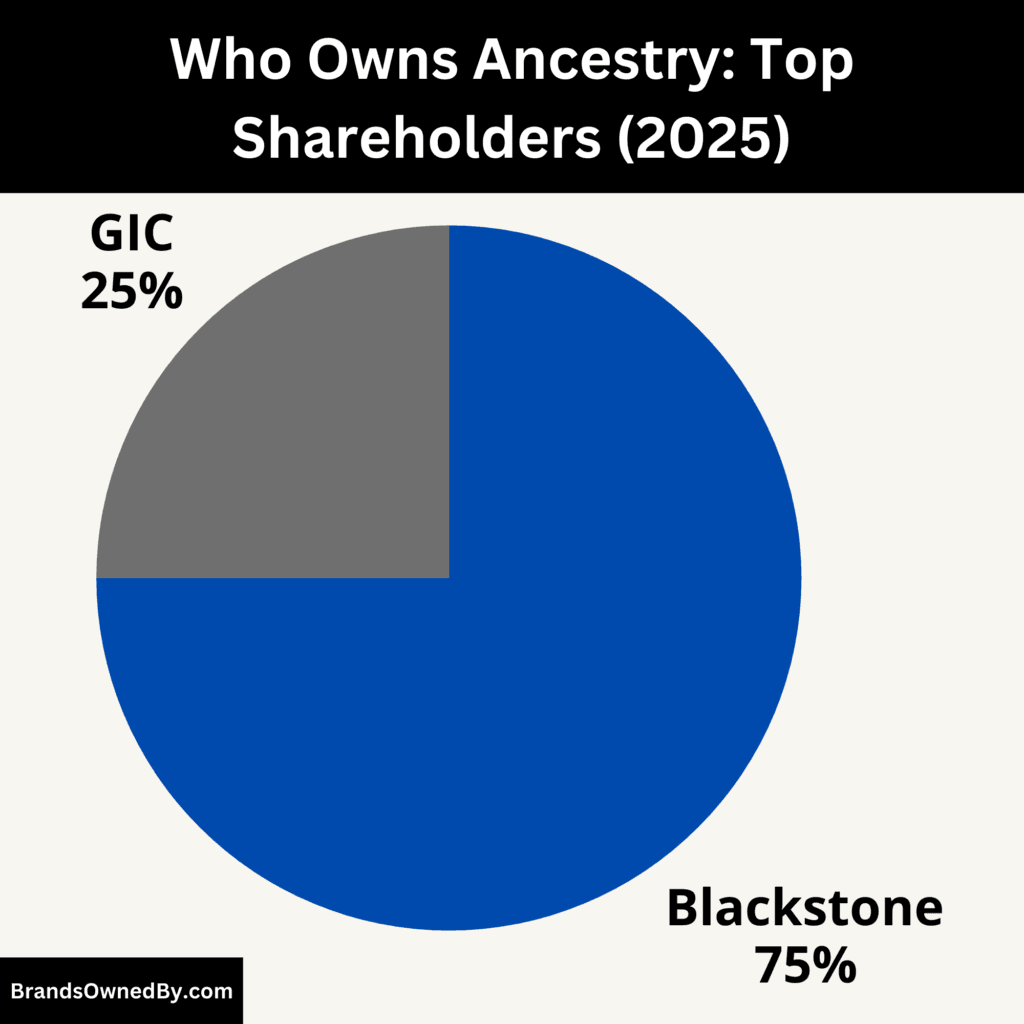
Ancestry is owned by Blackstone. The global private equity firm acquired the company in a major buyout in 2020. The deal valued Ancestry at approximately $4.7 billion.
Blackstone is the largest shareholder and controlling owner. It holds decision-making authority over long-term strategy, capital allocation, and executive leadership. Ancestry operates independently on a day-to-day basis. However, Blackstone plays a central role at the board level.
The ownership structure reflects private equity control rather than public shareholders. This allows Ancestry to invest heavily without quarterly market pressure.
Parent Company: Blackstone Group (75%)
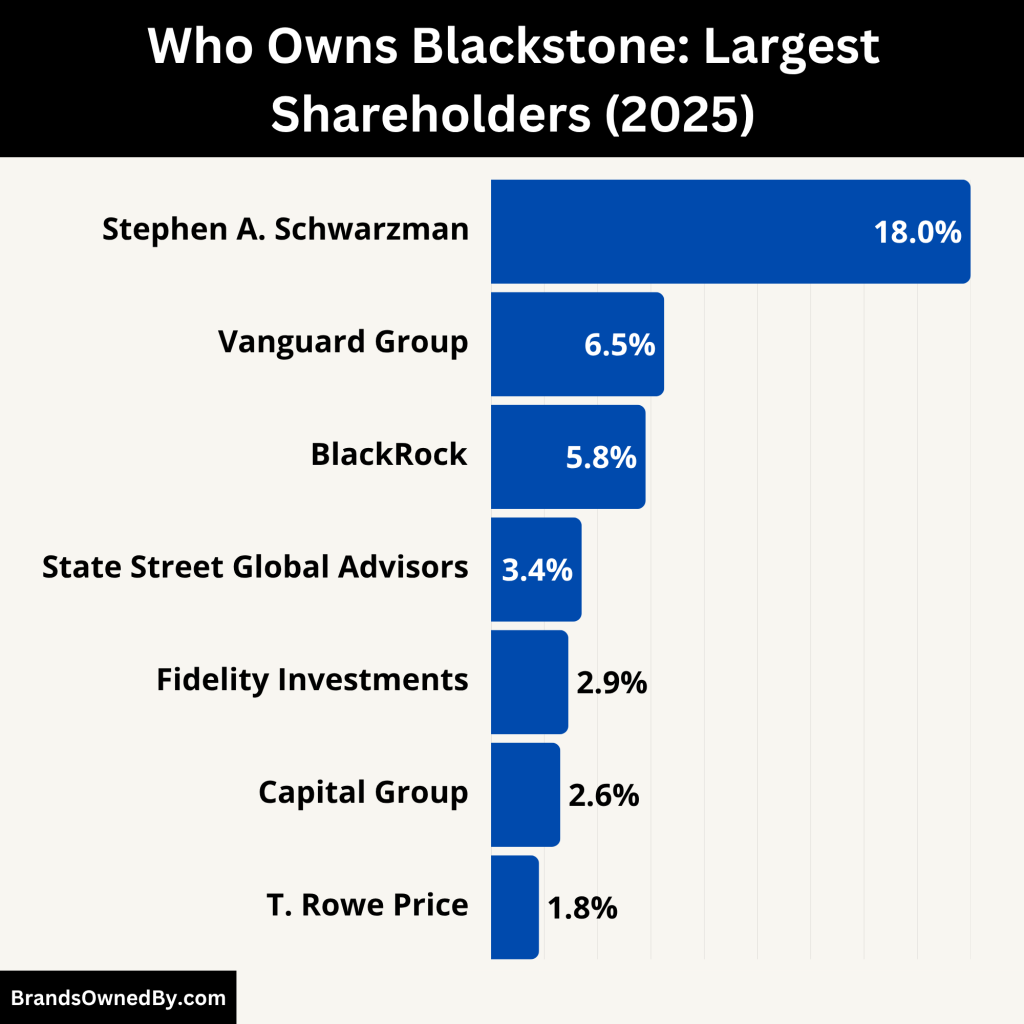
Blackstone holds approximately three-quarters of Ancestry’s equity through its private equity vehicles. This ownership level grants Blackstone full control over shareholder voting outcomes and board-level resolutions.
Its role is primarily strategic rather than operational. Blackstone focuses on scaling the business, strengthening data assets, and supporting global expansion. The firm also plays a critical role in risk management, especially in areas related to genetic data protection and regulatory compliance.
Because Ancestry is privately held, Blackstone does not face public shareholder pressure, allowing it to support longer investment cycles and large-scale technology initiatives.
GIC (25%)
GIC, Singapore’s sovereign wealth fund, is the largest minority shareholder in Ancestry. It holds an estimated 25% stake in the company.
GIC is a passive, long-term investor. It does not manage daily operations and does not exercise controlling power. However, it typically participates in governance through board representation or observer rights.
GIC’s investment reflects confidence in Ancestry’s global relevance, stable user demand, and long-term data value. Its presence adds financial stability and institutional credibility to Ancestry’s ownership structure.
Acquisition of Ancestry by Blackstone
Blackstone acquired Ancestry in December 2020 in a definitive all-cash transaction. The deal valued Ancestry at approximately $4.7 billion. This acquisition resulted in a full change of control, with Ancestry becoming a privately held company under Blackstone’s ownership.
The transaction closed after regulatory approvals and shareholder consent. Upon completion, Ancestry was delisted and ceased to operate as a public or widely held private entity.
Seller and Pre-Acquisition Ownership
Before the acquisition, Ancestry was owned by a group of institutional investors led by Silver Lake, with additional stakes held by GIC and other minority partners.
Silver Lake had taken Ancestry private earlier and was the primary selling shareholder in the Blackstone transaction. Its exit marked the end of its investment cycle in the company.
At the time of sale:
- Silver Lake held the controlling stake
- GIC already held a minority interest
- Public shareholders had exited years earlier.
Buyer and Capital Structure
Blackstone acquired Ancestry through its private equity funds, taking a controlling ownership position of approximately 75%.
GIC reinvested alongside Blackstone and retained an estimated 25% minority stake post-transaction. This was not a secondary purchase. It was a rollover investment, meaning GIC continued as an owner rather than exiting.
There were no retail or public investors after the deal closed.
Transaction Mechanics
The acquisition was structured as:
- A leveraged buyout backed by Blackstone equity
- Minority co-investment by GIC
- Full cash exit for selling shareholders.
No merger occurred. Ancestry remained a standalone operating company. Its legal entity and brand name were unchanged.
All voting control shifted to Blackstone upon closing.
After the acquisition:
- Blackstone gained majority board control
- Silver Lake representatives exited the board
- Governance authority consolidated under Blackstone-aligned directors.
Executive management remained in place. There was no founder return or leadership replacement at closing. Operational continuity was prioritized.
Who is the CEO of Ancestry?
Howard Hochhauser became President and Chief Executive Officer of Ancestry effective February 1, 2025.
He succeeded Deborah (Deb) Liu after a planned transition by the Board of Directors. Hochhauser has been with Ancestry since 2009, having previously served as Chief Financial Officer (CFO) and Chief Operating Officer (COO) before being appointed CEO. His familiarity with the company’s finances, strategy, and operations positions him to lead Ancestry through its next growth phase.
Hochhauser’s career at Ancestry spans more than 16 years. He played a central role in key corporate milestones, including the company’s initial public offering, multiple acquisitions, and strategic financing activities.
Prior to joining Ancestry, he served as CFO of Martha Stewart Living Omnimedia and worked in equity research and accounting earlier in his career. He holds a Bachelor of Science from Boston University and an MBA from Columbia Business School.
Salary and Net Worth
As a privately held company, detailed executive compensation disclosures for Ancestry’s CEO are not publicly mandated in the same way as for public companies.
However, employment and compensation records indicate that Howard Hochhauser’s base salary is approximately $275,000 per year. This figure comes from an employment offer agreement and reflects base salary terms as part of his executive compensation structure.
In addition to salary, he is eligible for an annual performance bonus targeted at 75% of base salary, based on company performance and individual goals.
This compensation structure — base salary plus performance bonus — is typical for senior executives at large private technology firms. Other elements of his total compensation likely include benefits, retirement benefits, and potential long-term incentives or equity-based awards, although specific equity figures are not publicly disclosed.
Howard Hochhauser’s estimated net worth is approximately $5.31 million according to compensation estimation and executive wealth tracking as of late 2024.
This figure reflects a combination of salary earnings, prior executive compensation, and any personal equity stakes or investments attributed in publicly available databases.
It is important to note that net worth estimates for private company executives can vary and may not fully capture non-public equity awards, deferred compensation, private investments, or unreported assets. Therefore, the $5.31 million estimate should be understood as an approximate figure rather than an exact valuation.
Role in Corporate Governance
As CEO, Hochhauser leads Ancestry’s executive team and is accountable to the Board of Directors, which includes representatives from the majority shareholder (Blackstone) and the minority shareholder (GIC). His responsibilities include:
- Setting and executing strategic priorities
- Overseeing product, technology, and data operations
- Managing global teams and operational execution
- Aligning company performance with shareholder expectations.
This governance framework balances operational autonomy with oversight from major shareholders, ensuring that strategic decisions support long-term growth and data stewardship.
Ancestry Annual Revenue and Net Worth

As of December 2025, Ancestry continues to be a leading global genealogy and consumer genomics platform. The company generates an estimated annual revenue of $1.3 billion, driven by subscriptions, DNA testing products, and related services. Its estimated net worth is approximately $5 billion, reflecting enterprise value under private ownership by Blackstone and minority shareholder GIC, as well as growth in data assets, subscriber base, and brand equity.
2025 Revenue Details
Ancestry’s 2025 revenue primarily comes from two segments: subscription services and DNA testing. Subscription services, which give users access to billions of historical records and family tree tools, account for roughly 60% of total revenue.
DNA services, including AncestryDNA kits and health reports, contribute the remaining 40%. Growth in 2025 has been driven by expanding international markets, recurring subscription renewals, and increased adoption of DNA testing for ancestry and health insights.
Investments in technology, including artificial intelligence for record transcription and DNA matching, have enhanced user experience and improved record search accuracy. Mobile applications and cloud-based platforms further support revenue growth by allowing users to access and manage family trees on the go.
Net Worth
Ancestry’s net worth, estimated at $5 billion as of December 2025, represents the company’s enterprise valuation rather than annual income.
This valuation reflects the combined worth of its subscription base, proprietary DNA datasets, historical records, technology infrastructure, intellectual property, and global brand presence.
Private ownership by Blackstone provides long-term stability, enabling Ancestry to focus on platform expansion, technology investment, and global market penetration without public market pressures.
The net worth also considers the company’s potential in future strategic moves, including international expansion and monetization of data-driven services. Blackstone’s majority stake, alongside GIC’s minority ownership, ensures that corporate governance, investment, and operational strategies align with long-term value creation.
Strategic Implications
Strong revenue and high enterprise net worth position Ancestry as a leader in the genealogy and consumer genomics market. The company’s predictable subscription revenue and growing DNA business support sustainable growth, while its valuation underscores investor confidence in Ancestry’s strategic assets.
These factors allow Ancestry to continue investing in AI-driven improvements, international record digitization, and new DNA products, while maintaining a competitive edge in a rapidly evolving global market.
Companies and Brands Owned by Ancestry
Ancestry owns and operates several well-known genealogy and historical research platforms. These brands support its core ecosystem and expand its data coverage.
Below is a list of the major brands and companies owned by Ancestry as of December 2025:
| Brand / Company | Year Acquired / Founded | Primary Services / Focus | Key Features / Details | Role in Ancestry Portfolio |
|---|---|---|---|---|
| Ancestry.com | Founded 1983 | Genealogy and historical records | Subscription-based access to billions of records, family tree building, AI-powered record hints, mobile accessibility | Flagship platform; primary revenue driver |
| AncestryDNA | Launched 2012 | Consumer genetic testing | DNA kits, ancestry and ethnicity insights, genetic relative matching, AI-driven ancestry predictions | Major growth driver; expands global user base and engagement |
| Find a Grave | Acquired 2013 | Cemetery and grave records | Global grave site database, memorial submissions, user-contributed photos and biographies | Complements historical records; integrates physical and digital genealogy |
| Newspapers.com | Acquired 2012 | Historical newspaper archives | Millions of newspaper pages, search tools, family tree integration | Enhances research capabilities with historical news content |
| Fold3 | Acquired 2010 | Military records | US military service records, draft cards, pension files | Supports military genealogy research; integrates with main records platform |
| Genealogy.com | Acquired 2003 | Genealogy resources and community | Forums, educational content, family tree guidance | Community-driven platform; connects enthusiasts to professional databases |
| Archives.com | Acquired 2008 | Genealogical records and family trees | Census records, vital records, subscription-based historical databases | Supplements Ancestry.com with region-specific and US-focused records |
| ProGenealogists | Founded 1999 | Professional genealogical research | Connects users with certified genealogists, custom research reports | Offers professional services beyond self-directed research |
| AncestryHealth | Founded 2016 | Health-related genetic insights | DNA-based hereditary health risk information, research-based wellness insights | Expands offerings into health and wellness genomics |
| MyFamily.com | Acquired 2007 | Family networking and digital memory sharing | Collaborative family trees, digital albums, interactive family networking | Adds social and collaborative dimension to family history |
Ancestry.com
Ancestry.com is the flagship online platform of the company. It offers subscription-based access to billions of historical records, including census data, immigration documents, birth and death records, and military records. The platform allows users to build family trees, connect with relatives, and explore historical documents in an interactive way. Ancestry.com remains the core driver of the company’s revenue, contributing a significant portion of its subscription income. The platform has also integrated AI-powered record hints, improved search functionality, and mobile accessibility to enhance user experience.
AncestryDNA
AncestryDNA is the company’s consumer genomics division, providing DNA testing kits that allow users to explore their ancestry, ethnicity estimates, and potential genetic relatives. Launched in 2012, AncestryDNA has become a major growth driver, expanding into international markets and providing additional insights such as migration patterns and regional ancestry breakdowns. The service supports personalized recommendations for historical research and matches users with potential living relatives. In 2025, AncestryDNA continues to innovate with AI-driven ancestry predictions and improved database connectivity.
Find a Grave
Find a Grave is a website and database that catalogs cemetery records and grave sites worldwide. Acquired by Ancestry in 2013, it allows users to search for burial locations, submit memorials, and document family history through photographs and biographical information. Find a Grave complements Ancestry’s historical records and DNA platforms, giving users a comprehensive view of family history both digitally and physically through gravesites. The platform remains active with contributions from volunteers globally.
Newspapers.com
Newspapers.com is a subscription-based digital archive of historical newspapers. It provides access to millions of pages of newspapers from the 18th century to the present, helping users trace family history, historical events, and regional developments. Ancestry acquired the platform to integrate historical news content into its research ecosystem. By 2025, Newspapers.com has enhanced search capabilities and improved integration with Ancestry’s family tree tools, enabling users to link news articles directly to ancestors in their records.
Fold3
Fold3 is Ancestry’s military records database, focusing on US military history. It includes service records, draft cards, pension records, and other documents related to armed forces personnel. Fold3 enables users to trace military service and explore historical conflicts through primary source documents. Acquired and operated by Ancestry, Fold3 complements the broader historical record collection, especially for users interested in military genealogy.
Genealogy.com
Genealogy.com is a platform providing family history resources, including forums, educational content, and research tools. It serves as a community hub for genealogy enthusiasts, offering guidance on building family trees and accessing historical records. Ancestry owns and operates Genealogy.com as part of its efforts to consolidate genealogy resources under its brand umbrella, connecting community-driven research with professional-grade databases.
Archives.com
Archives.com provides access to genealogical records and family tree tools, similar to Ancestry.com but often with more region-specific databases. It offers subscription-based access to census records, vital records, and historical documents. Acquired by Ancestry, Archives.com complements the primary Ancestry platform by targeting users seeking streamlined access to US-centric historical data.
ProGenealogists
ProGenealogists is a professional research service operated by Ancestry that connects customers with certified genealogists. Users can hire experts to conduct complex family history research, verify records, or create professionally compiled family histories. The service expands Ancestry’s offerings beyond self-directed research into professional-grade genealogical services, leveraging the company’s extensive databases and historical expertise.
AncestryHealth
AncestryHealth is a division focused on health-related genetic insights, linking DNA analysis with potential hereditary health risks. While distinct from the core ancestry testing services, AncestryHealth allows users to explore genetic predispositions and provides research-based insights for wellness and prevention. The division has grown as DNA and genomics interest expands, maintaining privacy and ethical data use standards under Ancestry’s governance.
MyFamily.com
MyFamily.com is a platform offering family networking, photo sharing, and historical record integration. Acquired and operated by Ancestry, it allows users to create digital family albums, share memories, and maintain collaborative family trees online. The platform complements Ancestry’s subscription and DNA services by providing a social and interactive dimension to family history research.
Final Thoughts
So, who owns Ancestry in practical terms?
Blackstone controls the company through majority ownership, supported by institutional partners like GIC. This private ownership structure gives Ancestry flexibility, scale, and long-term focus.
Ancestry’s leadership, data depth, and financial backing position it as the dominant force in genealogy and consumer DNA testing. Its ownership model continues to shape how it grows, innovates, and protects its vast historical datasets.
FAQs
Who owns Ancestry.com?
Ancestry.com is privately owned by Blackstone, which holds approximately 75% of the company. Singapore’s GIC is the largest minority shareholder with around 25%, giving it influence without controlling authority.
Who owns Ancestry UK?
Ancestry UK is operated by Ancestry itself, under the same ownership as Ancestry.com. The UK branch is fully controlled by Blackstone and GIC through Ancestry’s parent company structure.
Why did Blackstone buy Ancestry?
Blackstone acquired Ancestry to gain control over its extensive historical and DNA databases, recurring subscription revenue, and growing global footprint. The acquisition allows long-term investment in technology, international expansion, and data-driven services without the pressure of public markets.
When was Ancestry founded?
Ancestry was founded in 1983, initially focusing on genealogical records and family history research. Over time, it evolved into a leading global platform for both historical records and consumer DNA services.
When did AncestryDNA start?
AncestryDNA, the company’s consumer genetic testing service, was launched in 2012. It allows users to explore ancestry, ethnicity, and genetic connections to relatives worldwide.