- Ownership is concentrated in specific industries, not the entire economy. Chinese ownership in the US is focused on select companies in food production (Smithfield Foods), consumer appliances (GE Appliances), technology and gaming (Riot Games, minority stakes like Epic Games), and industrial or aerospace manufacturing, rather than broad control of US financial or consumer sectors.
- Most major acquisitions happened before 2018. High-profile purchases such as Smithfield Foods, GE Appliances, and Motorola Mobility were completed during the 2010–2017 period. Since then, stricter US regulations and CFIUS enforcement have sharply reduced new Chinese takeovers of American companies.
- Control varies widely by company. Some US brands are fully owned and controlled by Chinese parents (for example, Smithfield Foods and GE Appliances), while others involve minority stakes that provide influence but not operational control, especially in technology and gaming.
- New Chinese ownership growth in the US has largely stalled. As of January 2026, Chinese ownership of US companies is largely a legacy of past deals, with current investment activity limited to small, cautious, and non-controlling positions rather than large-scale acquisitions.
Understanding US companies owned by China has become increasingly important as globalization, technology transfer, and geopolitical tensions reshape global business.
Chinese firms—both private and state-backed—have invested billions into American companies across technology, entertainment, automotive, food, real estate, and manufacturing. Some deals involve full acquisitions. Others involve minority stakes that still provide strategic influence.
This article provides a clear, detailed, and factual breakdown of US companies owned by China, how these ownership structures work, and why they matter.
What Does US Companies Owned by China Mean?
The phrase US companies owned by China refers to American businesses in which Chinese entities hold ownership, control, or meaningful financial influence. This ownership is not limited to outright takeovers. It spans a spectrum that includes full acquisitions, majority control, minority stakes with strategic rights, and indirect ownership through layered corporate structures.
To make this clearer, it helps to break Chinese ownership into distinct and practical categories, each with real-world examples.
Full Ownership and Complete Acquisitions
In some cases, a Chinese company acquires 100% of a US business.
The US company continues operating under its existing name, workforce, and branding. However, ultimate ownership, capital decisions, and long-term strategy are controlled by the Chinese parent.
A well-known example is Smithfield Foods, which is fully owned by WH Group. Smithfield remains an American brand in daily operations, but ownership and financial control sit with its Chinese parent.
Full acquisitions like this receive intense regulatory scrutiny, especially in sectors such as food production, energy, infrastructure, and technology.
Majority Ownership and Controlling Stakes
Not all Chinese-owned US companies are fully acquired.
In many cases, a Chinese firm holds more than 50% of voting shares, giving it effective control while allowing the company to remain publicly listed or operationally independent.
This structure allows the Chinese owner to appoint board members, influence executive leadership, and direct corporate strategy without fully absorbing the company.
A historical example includes Wanda Group, which held a controlling stake in AMC Entertainment for several years. AMC continued operating as a US-based public company, but Wanda exercised significant influence through ownership and governance rights.
Majority ownership structures are common in manufacturing, logistics, and industrial businesses.
Minority Ownership With Strategic Influence
Many Chinese investments in US companies involve minority stakes below 50%.
While these investments do not provide formal control, they often come with strategic advantages. These can include board representation, preferred shares, veto rights on key decisions, or exclusive commercial agreements.
A clear example is Tencent, which holds minority stakes in multiple US gaming and software companies. Tencent typically does not manage daily operations, but its investments provide access to global intellectual property, technology insight, and long-term partnerships.
This model is especially common in technology startups, gaming studios, electric vehicle firms, and data-driven platforms.
Ownership Through Subsidiaries and Holding Companies
Chinese ownership of US companies is often indirect rather than straightforward.
A Chinese parent company may use offshore holding entities, regional subsidiaries, or investment vehicles to acquire US assets. These layers are frequently registered in jurisdictions such as Hong Kong or the Cayman Islands.
For example, Chinese automotive groups like Geely operate through complex global structures. Some US-facing investments are held through intermediate subsidiaries rather than directly under the Chinese parent name.
This layered approach can make Chinese ownership less visible in public records and more difficult for casual observers to trace.
Private Chinese Companies vs State-Owned Enterprises
Chinese owners are not all the same.
Private Chinese companies operate as commercial entities focused on profit and growth. However, they still function within China’s regulatory environment, where government policy and financing channels can influence strategy.
State-owned enterprises are directly owned or controlled by the Chinese government. Their overseas investments often align with national economic or strategic priorities, such as food security, energy, or advanced manufacturing.
Deals involving state-owned firms typically face higher levels of scrutiny from US regulators due to political and national security concerns.
Ownership Does Not Always Mean Operational Control
A common misconception is that Chinese ownership automatically leads to hands-on control of US operations.
In reality, many US companies with Chinese investors remain operationally independent. Management teams, data systems, and day-to-day decision-making often stay entirely US-based, particularly in cases of minority ownership.
However, even passive ownership can still influence major decisions such as mergers, funding rounds, asset sales, and long-term strategic direction.
Why Chinese Companies Invest in US Businesses?
Chinese investment in US businesses is rarely accidental or short-term. It is driven by clearly defined strategic goals. These motivations become easier to understand when viewed alongside real-world examples of Chinese firms and the US companies they have targeted.
Access to Advanced Technology and Intellectual Property
Technology acquisition is one of the most important reasons Chinese companies invest in US firms.
The United States leads globally in areas such as semiconductors, artificial intelligence, gaming engines, biotech, and advanced manufacturing. Rather than building these capabilities internally over decades, Chinese firms often invest directly in US innovators.
For example, Tencent has invested in multiple US-based gaming and software companies. These investments provide exposure to game engines, cloud infrastructure, and interactive entertainment technologies that can be scaled globally.
Similarly, Chinese investors have backed US semiconductor startups and AI firms through minority stakes, gaining insight into cutting-edge research without triggering full acquisition scrutiny.
Direct Entry Into the US Consumer Market
Owning or investing in a US company provides immediate access to American consumers.
This approach reduces reliance on exports from China and avoids tariffs, trade restrictions, and political barriers. It also allows Chinese firms to operate under trusted US brands rather than unfamiliar foreign names.
A clear example is WH Group, which owns Smithfield Foods. Through this acquisition, WH Group gained a major foothold in the US food market while maintaining Smithfield’s American identity.
This strategy is common in food, consumer goods, and entertainment, where local brand trust directly impacts sales.
Acquisition of Established and Trusted Global Brands
Many US companies possess decades of brand equity that cannot be replicated quickly.
By acquiring these brands, Chinese firms gain instant credibility not only in the US but also in Europe, Asia, and emerging markets.
Smithfield Foods is again a strong example. While ownership sits with WH Group, the Smithfield brand continues to operate as a familiar American food company with global reach.
In entertainment, Wanda Group previously acquired AMC Entertainment, instantly becoming one of the largest cinema operators in the world through a single transaction.
Expansion of Global Footprint and Competitive Position
Chinese companies increasingly compete with US and European multinationals.
Owning US businesses strengthens their global footprint and allows them to operate closer to innovation hubs, financial markets, and strategic partners.
Geely illustrates this approach. Through investments and acquisitions across global automotive brands and technology firms, Geely has positioned itself as a major international player, with US-facing operations tied to electric vehicles and mobility technology.
These investments help Chinese firms scale internationally while reducing dependence on the domestic Chinese market.
Supply Chain Security and Vertical Integration
Supply chain stability is a critical motivation, particularly in sensitive sectors.
By owning or investing in US agriculture, food processing, logistics, or industrial firms, Chinese companies gain long-term access to essential inputs.
WH Group’s ownership of Smithfield Foods again reflects this strategy. Control over US pork production provides supply stability while reducing exposure to global market volatility.
Similar motivations drive Chinese investment in US logistics technology firms and energy-related assets.
Financial Diversification and Capital Allocation
Chinese conglomerates often manage large pools of capital.
Investing in US businesses allows them to diversify geographically and reduce exposure to domestic economic cycles. The US market also offers strong legal protections, predictable regulation, and long-term growth potential.
Real estate investments by Chinese firms in US hotels and commercial properties during the 2010s were driven largely by this diversification strategy, even though many firms have since reduced exposure.
Strategic Minority Investments Instead of Full Control
In today’s regulatory environment, many Chinese firms avoid full acquisitions.
Instead, they take minority stakes that still provide strategic benefits. These investments often include board representation, long-term partnerships, or technology-sharing agreements.
Tencent’s minority investments in US gaming studios are a prime example. While Tencent does not control day-to-day operations, it gains exposure to innovation, global IP, and recurring digital revenue.
This model reduces political and regulatory risk while preserving strategic value.
Alignment With National Economic Priorities
Some investments align closely with broader Chinese economic goals.
Sectors such as electric vehicles, renewable energy, food security, and advanced manufacturing are long-term priorities. When Chinese state-owned or state-backed firms invest in US companies operating in these areas, the motivation often extends beyond pure profit.
These deals typically face higher scrutiny due to their strategic implications.
List of Major US Companies Owned or Part-Owned by China
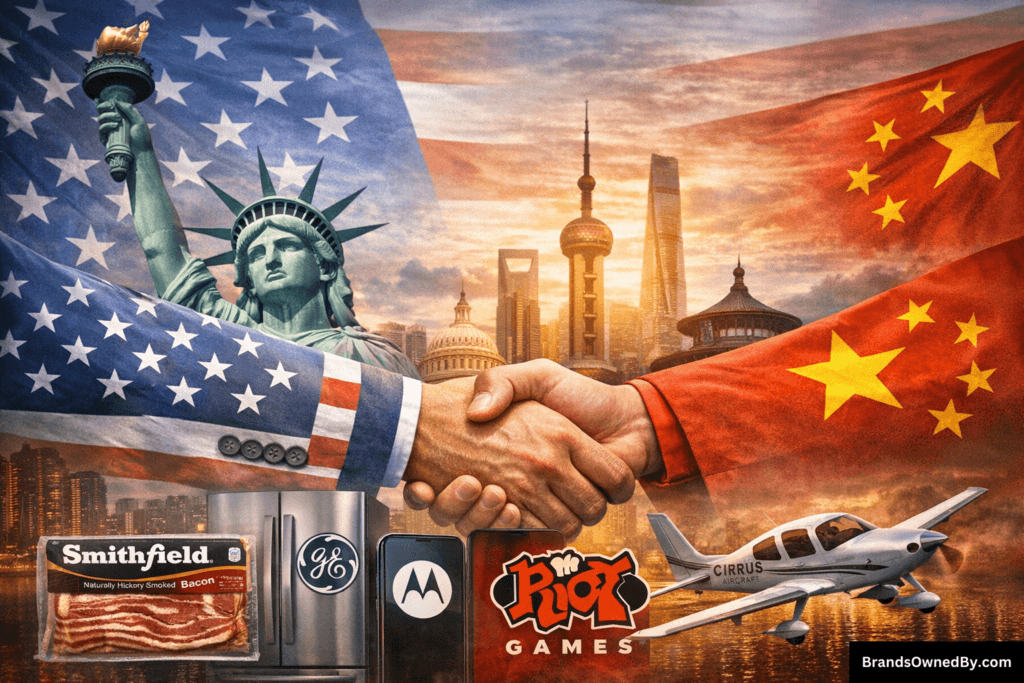
US companies owned by China are not limited to one industry or ownership model. Some are fully owned subsidiaries. Others involve majority control or strategically important minority stakes. What they share is verified Chinese ownership that meaningfully affects governance, capital decisions, or long-term strategy.
Below is a list of the major US companies owned by China as of January 2026:
| US Company / Brand | Chinese Owner | Ownership Stake | Ownership Type | Impact on Control & Governance |
|---|---|---|---|---|
| Smithfield Foods | WH Group | 100% | Full ownership | WH Group has complete financial and strategic control. Smithfield operates as a wholly owned subsidiary while retaining US management and branding. |
| GE Appliances | Haier | 100% | Full ownership | Haier controls capital allocation, product strategy, and long-term direction. US manufacturing continues under Chinese parent ownership. |
| Motorola Mobility | Lenovo | 100% | Full ownership | Lenovo owns the Motorola brand and IP, controlling product roadmap and global strategy while US teams handle engineering and design. |
| Riot Games | Tencent | Majority → near full | Controlling ownership | Tencent exercises decisive governance control over Riot’s monetization, IP expansion, and global publishing strategy. |
| Epic Games | Tencent | 40% | Strategic minority | Tencent does not run daily operations but holds significant financial influence and long-term strategic alignment. |
| Nexteer Automotive | China-backed Beijing-linked entities | Majority | Controlling ownership | Chinese owners appoint the board and direct long-term strategy while Nexteer supplies US automakers. |
| Cirrus Aircraft | CAIGA | 100% | Full ownership | Chinese parent controls capital and strategic direction; US manufacturing and operations remain in place. |
| Henniges Automotive | AVIC Auto | 51% | Majority ownership | AVIC Auto holds board control and strategic authority despite continued US-based operations. |
| Karma Automotive | Wanxiang Group | 80% | Controlling ownership | Wanxiang controls funding, EV development, and manufacturing strategy after acquiring Fisker assets. |
| Waldorf Astoria New York | Dajia Insurance Group | 100% (property) | Asset ownership | Chinese owner controls the property asset; hotel operations continue under management agreements. |
| TikTok US | ByteDance | 19.9% | Minority stake | ByteDance retains economic exposure and limited influence following US restructuring and partial divestment. |
| Lexmark International | Apex Technology | Majority | Full acquisition (private) | Apex-led Chinese consortium took Lexmark private, gaining full control over governance and enterprise printer strategy. |
| Complete Genomics | BGI Group | 100% | Full ownership | BGI controls IP, sequencing technology, and commercialization while US operations continue. |
| Segway (US brand & ops) | Ninebot | 100% | Full ownership | Ninebot controls product development, manufacturing, and global commercialization under the Segway brand. |
| Continental Motors | AVIC International | 100% | Full ownership | Chinese state-owned entity controls a key US aircraft engine manufacturer. |
| Sany America | Sany Group | 100% (subsidiary) | Direct subsidiary | Strategic, financial, and operational control flows to Sany Group in China. |
| Zoomlion US Operations | Zoomlion | 100% (subsidiary) | Direct subsidiary | US entities operate under full Chinese ownership supplying heavy equipment to US projects. |
| US Hog Farming & Feed Subsidiaries | WH Group | Controlling | Indirect ownership | Chinese control extends beyond Smithfield into lesser-known agricultural and feed operations. |
| US Aviation Leasing Assets (historic) | HNA Group | Majority (at peak) | Asset/platform ownership | HNA controlled US aviation leasing and services before later divestments, influencing airline financing. |
| US Enterprise IT & Cloud Investments | Unisplendour | Minority | Strategic minority | Provides exposure to US enterprise tech ecosystems without direct operational control. |
| Strategic Hotels & Resorts (portfolio) | Anbang Insurance Group | 100% (at acquisition) | Portfolio ownership | One of the largest but quiet Chinese ownership footprints in US luxury hospitality assets. |
Smithfield Foods
Smithfield Foods is fully owned by WH Group, following a complete acquisition that made Smithfield a wholly owned subsidiary. While Smithfield continues to operate as a US-based company with American management and facilities, WH Group holds ultimate authority over capital allocation, long-term strategy, and financial reporting.
This ownership structure gives the Chinese parent full economic and governance control, making Smithfield the most cited example in discussions about Chinese ownership of US food companies.
GE Appliances
GE Appliances is 100% owned by Haier through its subsidiary Qingdao Haier. The acquisition transferred full ownership from General Electric to Haier, giving the Chinese group complete control over investment decisions, product strategy, and global expansion. GE Appliances continues to manufacture and operate in the US, but it is legally and financially controlled by its Chinese parent.
Motorola Mobility
Motorola Mobility is wholly owned by Lenovo, following Lenovo’s acquisition from Google. Lenovo controls the Motorola brand, product roadmap, and intellectual property strategy, while Motorola’s US teams continue to handle design, engineering, and product development. Ownership is complete, making Motorola Mobility a core Lenovo business unit rather than an independent US company.
Riot Games
Riot Games operates as a Chinese-owned US video game developer under Tencent. Tencent initially acquired a majority stake and later moved to near-total ownership, giving it decisive influence over Riot’s corporate governance, monetization strategy, and global expansion. Riot remains headquartered in the US, but Tencent ultimately controls the company through ownership.
Epic Games
Epic Games is partially owned by Tencent, which holds an estimated 40% minority stake. This does not give Tencent operational control, as founder Tim Sweeney retains majority voting power.
However, Tencent’s ownership provides significant financial influence and long-term strategic alignment, including access to global distribution and partnerships.
This structure reflects Tencent’s preference for influential minority investments in US tech and gaming firms rather than full takeovers.
Nexteer Automotive
Nexteer Automotive, a major US auto-parts supplier, is controlled by Chinese state-linked investors following its sale by General Motors. The acquiring group includes Chinese government-backed entities that hold majority ownership, enabling control over board appointments and corporate strategy. Nexteer continues to supply US automakers, but ownership and high-level decision-making rest with its Chinese parent structure.
Cirrus Aircraft
Cirrus Aircraft became Chinese-owned after its acquisition by CAIGA, an affiliate of China’s state-owned aviation industry. The Chinese parent holds full ownership, while Cirrus maintains US manufacturing and operations. Strategic direction, capital investment, and long-term planning are controlled by the Chinese owner, making this a high-profile example of Chinese ownership in US aerospace manufacturing.
Henniges Automotive
Henniges Automotive was acquired through a joint transaction led by AVIC Auto, which holds a majority stake, alongside BHR Partners as a minority owner. AVIC’s majority ownership gives it controlling governance rights, including board control and strategic oversight. Henniges continues to operate in the US but is ultimately directed by its Chinese majority owner.
Karma Automotive
Karma Automotive is controlled by Wanxiang Group, which acquired the assets of Fisker Automotive out of bankruptcy. Wanxiang holds an estimated controlling stake of around 80%, allowing it to determine funding, product development, and manufacturing strategy. Karma positions itself as a US-based electric vehicle company, but ownership and financial control are Chinese.
Waldorf Astoria New York
The Waldorf Astoria New York was acquired by Anbang Insurance Group and later transferred to Dajia Insurance Group after Anbang’s restructuring. Ownership of the landmark property remains Chinese, while hotel operations continue under a management agreement. Control lies at the ownership level rather than in daily hospitality operations.
Strategic Hotels & Resorts
Strategic Hotels & Resorts was acquired by Anbang Insurance Group in a multibillion-dollar transaction, giving the Chinese insurer ownership of a large portfolio of luxury US hotels.
Although many assets were later sold or restructured, the acquisition remains one of the largest examples of Chinese capital taking ownership of high-end US hospitality assets.
TikTok US
TikTok’s US operations remain partially owned by ByteDance, which retained a reported minority stake following US-led restructuring efforts. While US investors now hold majority economic and governance control, ByteDance’s retained ownership preserves financial exposure and limited influence, particularly through intellectual property and licensing arrangements. This structure illustrates how Chinese ownership can persist even after regulatory intervention.
Lexmark International
Lexmark, a US printer and enterprise imaging company, is owned by a Chinese-led consortium including Apex Technology and PAG, with Apex as the primary Chinese buyer.
The acquisition resulted in Lexmark being taken private, giving the Chinese owner effective control over strategy, capital decisions, and long-term product direction. Lexmark continues to serve US government and enterprise clients despite Chinese ownership, which has drawn regulatory and cybersecurity attention.
Complete Genomics
Complete Genomics, a US-based DNA sequencing company, is owned by BGI Group. The acquisition gave BGI full ownership and access to advanced US genetic sequencing technology.
Although Complete Genomics operates in the US, ownership allows BGI to control intellectual property development and commercialization strategy, making it a sensitive example of Chinese ownership in biotech and genomics.
Sany America
Sany America is the US manufacturing and sales arm of Sany Group. While often overlooked because it operates as a US subsidiary, Sany America is fully controlled by its Chinese parent. The company manufactures heavy construction equipment in the US, but strategic, financial, and operational control ultimately resides with Sany Group in China.
Zoomlion Heavy Industry US Operations
Zoomlion operates US-based subsidiaries and distribution businesses under the control of Zoomlion. These US entities are not household names, yet they play a role in supplying cranes and heavy equipment to American infrastructure projects. Ownership remains fully Chinese, with US operations functioning as execution arms rather than independent companies.
Gibson Brands
Less widely known is that CEC Capital acquired a minority stake in Gibson Brands during its restructuring phase. While Gibson later exited bankruptcy with new ownership, the Chinese investment provided financing influence at a critical moment. This case illustrates how Chinese capital can shape outcomes even without long-term ownership.
HNA Group
HNA Group quietly acquired multiple US aviation leasing, logistics, and service businesses during its expansion phase. While HNA later divested many assets under financial pressure, its former ownership included US-based aircraft leasing entities that supported major American airlines.
These companies were rarely known to consumers but strategically important within aviation finance.
CFHI (US Hog Farming Assets)
Beyond Smithfield, Chinese-backed entities linked to WH Group and related investors have controlled smaller, lesser-known US hog farming and feed operations through subsidiary structures. These businesses rarely appear in media coverage but represent deeper Chinese ownership penetration into US agricultural supply chains.
Segway US Operations
Segway’s US brand and operations are controlled by Ninebot, which acquired Segway outright. While the Segway brand is well known, its Chinese ownership is often missed in ownership-focused articles. Ninebot controls product development, manufacturing strategy, and global commercialization while maintaining a US-facing brand identity.
Unisplendour
Unisplendour, affiliated with Tsinghua Unigroup, has made minority investments in US-based enterprise IT and cloud-related firms. Although these stakes are often non-controlling, they provide strategic exposure to US enterprise technology ecosystems and are rarely highlighted outside regulatory discussions.
Continental Motors (Aviation Engines)
Continental Motors, a US aircraft engine manufacturer, was acquired by AVIC International. While less famous than Cirrus, Continental plays a critical role in general aviation. Chinese ownership gives AVIC influence over engine technology, certification strategy, and global distribution, while US manufacturing and operations remain intact.
Chinese State-Owned vs Private Company Ownership
Not all Chinese-owned US companies are backed by the Chinese state. A critical distinction exists between state-owned enterprises (SOEs) and private Chinese companies, and this difference directly affects governance, regulatory scrutiny, and perceived risk in the United States. Understanding this split is essential when evaluating US companies owned by China.
What Are Chinese State-Owned Enterprises (SOEs)?
Chinese state-owned enterprises are companies in which the Chinese government holds direct or controlling ownership, usually through central or provincial agencies.
These firms often operate in sectors considered strategically important to China, such as aviation, energy, telecommunications, transportation, and advanced manufacturing. Their overseas investments are frequently aligned with national policy objectives rather than purely commercial goals.
When a Chinese SOE acquires or controls a US company, US regulators tend to apply heightened scrutiny. This is because strategic decision-making may be influenced by state priorities rather than market forces.
Examples include AVIC, which controls US aviation-related businesses through subsidiaries, and CAIGA, an AVIC affiliate that owns Cirrus Aircraft. In these cases, ownership directly links a US manufacturer to China’s state industrial framework.
How SOE Ownership Impacts Control and Governance
SOE ownership often brings centralized oversight.
Board appointments, executive decisions, and long-term investment strategies are influenced by government-linked stakeholders. Access to state financing can support aggressive expansion, but it also raises concerns around competitive neutrality and national security.
For US companies owned by Chinese SOEs, this means that ultimate authority may sit outside normal commercial governance models, even if day-to-day operations remain US-based.
What Are Private Chinese Companies?
Private Chinese companies are owned by founders, families, or private investors rather than the state. These firms operate primarily for profit and often compete globally like Western multinationals.
However, “private” in China does not mean completely independent from the government. Many private firms maintain close relationships with regulators, state banks, or local authorities. Party committees may also exist within large private corporations.
Examples of private Chinese companies with US ownership include Tencent, Lenovo, and Haier, all of which own or invest in US companies without being classified as SOEs.
How Private Ownership Affects US Companies
Private Chinese ownership tends to resemble traditional foreign investment.
Control depends on ownership percentage rather than political mandate. Minority investments often aim at financial returns, partnerships, or technology exposure rather than operational control.
That said, large private Chinese firms still face regulatory attention in the US, particularly when investments involve sensitive data, technology, or infrastructure.
Why US Regulators Treat SOEs and Private Firms Differently
US regulators, especially the Committee on Foreign Investment in the United States (CFIUS), differentiate between SOEs and private firms when assessing risk.
SOE-backed acquisitions are more likely to be reviewed, delayed, or blocked due to concerns over state influence, data access, and strategic assets. Private company investments are evaluated more on commercial merit, though scrutiny increases in sensitive sectors.
This distinction explains why some Chinese deals are approved quickly while others face prolonged reviews or outright rejection.
Grey Areas and Hybrid Ownership Structures
In practice, the line between state-owned and private is not always clear.
Some private firms receive state funding, hold strategic mandates, or include government-affiliated investors. Others operate through joint ventures with SOEs or state-backed funds.
For example, investment vehicles such as BHR Partners combine private capital with state-linked investors, creating hybrid structures that complicate regulatory assessment.
Role of CFIUS in Chinese Ownership of US Companies
The role of CFIUS in Chinese ownership of US companies is not theoretical. It is measurable, data-driven, and outcome-oriented. Over the last decade, CFIUS has directly reduced Chinese acquisitions, forced divestments, and reshaped deal structures.
What CFIUS Actually Reviews
CFIUS reviews foreign transactions that could give a non-US person control or sensitive access to a US business.
Between 2016 and 2023, Chinese-linked transactions became the single most scrutinized category:
- In 2016, China accounted for 30% of all CFIUS notices filed
- By 2018, Chinese transactions represented nearly 40% of CFIUS investigations
- By 2022, Chinese filings dropped below 5%, not because interest disappeared, but because deals were abandoned before filing.
This collapse aligns directly with expanded CFIUS authority and enforcement.
FIRRMA’s Measurable Impact on Chinese Deals
The Foreign Investment Risk Review Modernization Act (FIRRMA) took effect in 2018 and dramatically expanded CFIUS powers.
Before FIRRMA:
- Only controlling acquisitions were routinely reviewed
- Minority investments often escaped scrutiny.
After FIRRMA:
- Minority stakes as low as 10–15% can trigger a review if they involve:
- Board access
- Non-public technical data
- Critical technology or personal data.
- Real estate near military bases became reviewable
- Mandatory filings were introduced for certain Chinese-linked deals.
Result:
- Chinese outbound M&A into the US fell from ~$46 billion in 2016 to under $5 billion by 2020
- Technology acquisitions declined by over 90%.
Deals Explicitly Blocked or Unwound by CFIUS (Chinese Buyers)
CFIUS does not just discourage deals. It kills them outright.
Ant Financial – MoneyGram (2018)
Ant Financial (Alibaba affiliate) attempted to acquire MoneyGram for $1.2 billion. CFIUS blocked the deal due to concerns over US financial data access. This was a decisive signal that consumer data alone could justify rejection.
Beijing Kunlun – Grindr (2019–2020)
Kunlun was ordered to fully divest Grindr after CFIUS determined that ownership created unacceptable risks involving location data, personal profiles, and national security exposure. This was a rare example of forced divestment after a completed acquisition.
China Oceanwide – Genworth Financial (blocked 2021)
Despite years of negotiation, regulatory approval collapsed under CFIUS scrutiny due to concerns over insurance data and financial infrastructure. The deal was ultimately abandoned.
Mitigation Agreements: When CFIUS Allows Partial Ownership
CFIUS sometimes allows Chinese ownership—but only with strict, enforceable conditions.
Common mitigation requirements include:
- No Chinese access to US customer data
- Independent US-based boards
- Government-approved security officers
- Data localization inside the US
- Limits on voting rights.
TikTok US (ByteDance)
Under pressure from CFIUS and Congress:
- US investors now hold the majority economic interest
- ByteDance retains <20% ownership
- US user data is stored domestically
- Algorithm access is contractually restricted.
This structure exists solely because CFIUS would not permit full Chinese ownership.
How CFIUS Changed Chinese Investment Strategy
Before 2017:
- Average Chinese acquisition size: $600–800 million
- Common structure: full takeovers.
After 2019:
- Average Chinese investment size: <$100 million
- Dominant structure:
- Minority stakes
- Passive VC funding
- Offshore holding layers
- Joint ventures outside the US jurisdiction.
This explains why Chinese firms like Tencent shifted almost entirely to sub-50% investments in US companies rather than acquisitions.
Sectors Where CFIUS is Most Aggressive (Ranked)
Based on blocked deals and mitigation frequency, CFIUS scrutiny is highest in:
- Semiconductors & advanced computing
- Consumer data platforms (apps, fintech, health data)
- Aerospace & aviation
- Defense-adjacent manufacturing
- Energy infrastructure
- Telecommunications
- Genomics & biotech.
Chinese deals in these sectors now face near-automatic extended review.
Retroactive Power: Why Old Deals Are Not “Safe”
CFIUS can review transactions years after closing.
Example:
- Grindr acquisition completed in 2016
- Forced divestment ordered in 2019
This retroactive authority creates ongoing risk for any US company with Chinese ownership, even if the deal was previously approved or unreviewed.
Why CFIUS is the Decisive Gatekeeper?
CFIUS has not eliminated Chinese ownership of US companies—but it has redefined its limits.
- Full acquisitions are now rare
- Minority stakes are tightly constrained
- Data access is aggressively policed
- Ownership structures are engineered around CFIUS, not business logic.
In practical terms, CFIUS—not the market—decides how Chinese ownership in US companies can exist. For readers evaluating US companies owned by China, understanding CFIUS outcomes is more important than understanding deal headlines.
National Security and Data Privacy Concerns
National security and data privacy concerns around Chinese ownership of US companies are driven by documented cases, measurable data exposure, and regulatory outcomes, not abstract fears. US regulators focus on what data is collected, who can access it, and how ownership changes the risk profile.
Personal Data Exposure at Scale
The primary risk factor is the scale of sensitive US user data.
When Chinese-owned or Chinese-linked companies control platforms with tens of millions of American users, regulators assess the volume, sensitivity, and exploitability of the data involved.
A clear example is Grindr. When Beijing Kunlun Tech acquired Grindr, the app had over 27 million users globally, with a large US base. Grindr collected:
- Precise GPS location data
- Sexual orientation and health-related metadata
- Private messages and behavioral patterns.
CFIUS determined that Chinese ownership created an unacceptable risk because such data could be used to identify US military or intelligence personnel. In 2019, Kunlun was ordered to divest 100% of its stake, making this one of the few cases of forced divestment after acquisition.
Financial and Transaction Data Risks
Financial platforms are treated as critical national infrastructure because of transaction visibility and identity linkage.
In 2018, Ant Financial attempted to acquire MoneyGram for $1.2 billion. MoneyGram processed hundreds of millions of cross-border transactions annually, including US remittances tied to verified identities and banking data.
CFIUS blocked the acquisition outright, citing risks that:
- US consumer financial data could be accessed offshore
- Transaction flows could be monitored or profiled
- Compliance data could be subject to foreign legal demands.
No mitigation structure was deemed sufficient, demonstrating that ownership + financial data = near-zero tolerance.
Social Media, Algorithms, and Behavioral Influence
Concerns extend beyond stored data to algorithmic control.
Social platforms shape information exposure, trends, and behavior through recommendation systems. Regulators worry less about individual posts and more about who controls the algorithmic levers.
This is central to the TikTok case. ByteDance owned TikTok outright at its peak, while TikTok had:
- 170+ million US users
- Detailed engagement, location, and device data
- A proprietary recommendation algorithm controlled by ByteDance.
Under regulatory pressure, ByteDance reduced its stake to below 20%, while US investors gained majority economic and governance control. Despite this, concerns persist because ByteDance reportedly retains algorithm licensing rights, showing that control over algorithms can matter as much as equity percentage.
Genomics and Irreversible Data Sensitivity
Biotech and genomics present a different category of risk.
Unlike financial or social data, genetic data cannot be changed or anonymized once exposed. This has made Chinese ownership in genomics especially sensitive.
Complete Genomics, owned 100% by BGI Group, operates advanced DNA sequencing technology originally developed in the US. US lawmakers have raised concerns that:
- Genetic datasets could be aggregated at the population scale
- Research insights could be transferred offshore
- Health data could be used for non-commercial purposes.
These risks are magnified because ownership is full, not minority, giving the Chinese parent ultimate control over IP and research direction.
Defense, Aerospace, and Dual-Use Technology
Chinese ownership in aerospace and industrial manufacturing raises dual-use technology concerns.
Dual-use technologies are civilian products that can be adapted for military use. Regulators assess whether ownership could allow access to:
- Engine designs
- Materials science breakthroughs
- Manufacturing processes.
For example, Continental Motors, owned by AVIC International, produces engines used in general aviation. While civilian, engine technology overlaps with military applications, prompting ongoing scrutiny due to AVIC’s state ownership and defense ties.
Infrastructure Proximity and Physical Access
Not all risks are digital.
Chinese ownership of physical assets near sensitive sites has triggered regulatory intervention even without data exposure.
CFIUS has reviewed or blocked deals involving:
- Real estate near US military bases
- Energy transmission assets
- Port-adjacent infrastructure.
The concern is physical access, surveillance potential, and disruption risk during geopolitical crises. Ownership alone can create leverage in these contexts.
Supply Chain Control and Economic Security
Food, logistics, and manufacturing ownership raise economic security concerns.
Smithfield Foods’ ownership by WH Group gave Chinese interests control over roughly 25% of US pork production capacity at the time of acquisition. While day-to-day operations remained American, regulators and lawmakers questioned long-term supply resilience and dependency during trade or political disputes.
This shows that market share and production concentration, not just data, factor into national security assessments.
Ownership Percentage vs Actual Control
A key misconception is that low ownership percentages equal low risk.
CFIUS repeatedly demonstrated that:
- 10–20% ownership can trigger a review if it includes board seats or data access
- Minority stakes can still influence strategy, partnerships, and technology direction
- Control over IP, algorithms, or data pipelines can outweigh equity size.
This is why Tencent’s minority stakes in US gaming and tech firms are still reviewed, even when Tencent holds less than 50%.
Why These Cases Matter
These examples show that national security and data privacy concerns are transaction-specific and evidence-driven.
Regulators assess:
- Data volume and sensitivity
- Ownership percentage and governance rights
- Legal obligations of the parent company
- Sector relevance to defense, infrastructure, or public influence.
In the context of US companies owned by China, the risk calculation is not theoretical. It is based on who owns what, how much they own, and what that ownership enables in practice.
Are US Companies Owned by China Still Increasing?
The short answer is no.
Chinese ownership of US companies is not increasing in any meaningful way as of January 2026.
While Chinese outbound investment has stabilized globally after years of decline, the United States has not benefited from this rebound.
In fact, the US remains one of the least favored destinations for new Chinese investment among developed economies.
The Big Picture: Global Recovery, US Exception
Chinese companies resumed overseas investment activity in 2024 after several weak years.
Completed Chinese outbound foreign direct investment globally reached approximately $58 billion in 2024, marking the first year-over-year increase since 2017. This shows that Chinese firms are once again deploying capital abroad.
However, this recovery did not extend to the United States.
Chinese investment into US companies in 2024 totaled less than €2 billion (roughly $2.2 billion). That figure represents only a small single-digit percentage of China’s total outbound investment and is dramatically lower than levels seen during the mid-2010s.
At its peak between 2014 and 2017, Chinese acquisitions of US companies regularly reached tens of billions of dollars per year. That era has not returned.
Deal Volume and Value Remain Depressed
The decline is visible not only in dollar value, but also in deal count and structure.
Large Chinese acquisitions of US companies have become rare. Most transactions that do occur involve:
- Minority stakes below 50%
- Passive venture capital investments
- Non-controlling financial exposure.
Full takeovers of US companies by Chinese buyers are now exceptional rather than common.
This shift is structural, not cyclical.
Sector Shift Away From the United States
Chinese capital is flowing again, but it is flowing elsewhere.
In 2024:
- Chinese outbound investment in electric vehicles, batteries, and critical materials exceeded $16 billion
- The majority of this capital went to Europe, Southeast Asia, Latin America, and Mexico
- US-based targets received only a marginal share.
Sensitive US sectors such as semiconductors, consumer technology, fintech, biotech, and data-driven platforms have seen a continued decline in Chinese deal activity compared with the pre-2018 period.
Structural Impact of CFIUS and Regulation
US regulatory pressure is the single biggest reason Chinese ownership is not increasing.
Following the expansion of CFIUS authority under FIRRMA:
- Minority stakes as low as 10–15% can trigger a review
- Deals involving data, technology, or infrastructure face extended scrutiny
- Chinese investors face higher compliance costs, longer timelines, and a real risk of forced divestment.
CFIUS filing volumes peaked around 2021–2022 and cooled slightly in 2023–2024, but enforcement expectations remain strict. For Chinese investors, the risk-reward profile of US acquisitions is no longer attractive.
As a result, many Chinese deals are abandoned before filing.
Geographic Reallocation of Chinese Capital
Instead of the United States, Chinese companies are prioritizing:
- Europe (selected countries)
- Southeast Asia
- Latin America
- Mexico (nearshoring and manufacturing hubs).
In 2024, Chinese investment into Europe rebounded to around €10 billion, while the US share continued to fall. This reflects a deliberate reallocation rather than a lack of capital.
Existing Ownership vs New Growth
It is important to distinguish between existing Chinese ownership and new expansion.
China still owns or part-owns a meaningful number of US companies acquired during earlier investment waves. Those assets remain in place.
What has stopped is the new large-scale expansion.
As of January 2026:
- The stock of Chinese-owned US companies is largely stable
- New acquisitions are limited, smaller, and more cautious
- Ownership structures are engineered to minimize visibility and regulatory exposure.
What This Means Going Forward
Chinese ownership of US companies is not growing, and there is no evidence of a near-term reversal.
Future Chinese investment activity is likely to focus on:
- Greenfield projects outside the US
- Supply-chain investments in third countries
- Minority financial stakes with limited governance rights.
How to Check If a US Company is Owned by China?
Determining whether a US company is owned or part-owned by Chinese entities requires more than a quick Google search. Ownership is often layered through subsidiaries, private equity vehicles, or offshore holding companies.
Below is a practical, step-by-step framework used by analysts, journalists, and regulators to identify Chinese ownership accurately.
Start With SEC Filings (Public Companies)
For publicly listed US companies, regulatory filings are the most reliable source.
Check:
- Form 10-K (annual report)
- Form DEF 14A (proxy statement)
- Form 13D / 13G (beneficial ownership filings).
Look for:
- Shareholders owning 5% or more
- References to foreign parent companies
- Voting rights, board seats, or special control provisions.
Chinese ownership may appear under a holding company name, not a well-known Chinese brand. Always trace the shareholder’s ultimate parent.
Review Merger, Acquisition, and Take-Private Announcements
Ownership changes often occur through acquisitions rather than open-market purchases.
Search for:
- Press releases announcing acquisitions or “strategic investments”
- SEC Form 8-K filings (material events)
- Court filings for bankruptcy asset sales.
Pay attention to:
- Whether the deal took the company private
- Whether the buyer is a consortium led by a Chinese firm
- Post-transaction governance changes.
Many US companies owned by China no longer appear in stock market databases because they were taken private.
Trace Ownership Through Parent and Subsidiary Structures
Chinese ownership is frequently indirect.
A US company may be owned by:
- A Hong Kong–registered holding company
- A Cayman Islands entity
- A Singapore or Luxembourg investment vehicle.
To verify true ownership:
- Identify the immediate parent
- Trace that parent to the ultimate beneficial owner
- Check whether that owner is headquartered in China or controlled by Chinese nationals, firms, or state entities.
This step is critical, as surface-level ownership often hides Chinese control.
Use Business and Ownership Databases
Professional databases provide structured ownership data.
Useful tools include:
- Crunchbase (for venture and minority investments)
- PitchBook (private equity and M&A ownership)
- Bloomberg (beneficial ownership and control)
- OpenCorporates (corporate registries and parent entities).
Cross-check information across multiple sources. No single database is complete.
Examine Board Composition and Governance Rights
Ownership is not just about percentages.
Review:
- Board member nationality and affiliations
- Investor rights agreements
- Veto rights or preferred shares
- Strategic committees or reserved matters.
A Chinese investor holding 10–20% with board representation may exert more influence than a passive 30% shareholder without governance rights.
Check CFIUS Filings and Government Disclosures
When Chinese ownership is sensitive, regulatory involvement often leaves a paper trail.
Look for:
- CFIUS mitigation agreements
- Forced divestment announcements
- Congressional hearings or inquiries
- Treasury or Commerce Department disclosures.
Even if a deal was approved, the existence of mitigation terms often confirms Chinese ownership and its perceived risk.
Review Bankruptcy and Restructuring Records
Some Chinese ownership enters through distressed asset purchases.
Check:
- Bankruptcy court filings
- Asset sale approvals
- Restructuring announcements.
Chinese firms have acquired US companies quietly through bankruptcy auctions, where ownership changes receive less media attention.
Identify State vs Private Chinese Ownership
After confirming Chinese ownership, determine who the owner actually is.
Ask:
- Is the owner a private Chinese company?
- Is it state-owned or state-controlled?
- Does it receive funding from government-backed entities?
This distinction matters for regulatory risk and long-term control implications.
Watch for Red Flags That Signal Hidden Chinese Ownership
Certain patterns often indicate undisclosed or indirect Chinese ownership:
- Sudden take-private transactions
- Complex offshore ownership chains
- Frequent references to “strategic investors” without names
- Board members with ties to Chinese state firms or universities
- Financing from Chinese policy banks or state funds.
These signals warrant deeper investigation.
Conclusion
Chinese ownership of US companies reflects deeper trends in globalization, technology competition, and capital flows.
While regulatory scrutiny has increased, Chinese firms continue to hold meaningful stakes across multiple US industries. Understanding ownership structures, regulatory oversight, and strategic intent is essential for investors, policymakers, and consumers seeking clarity on US companies owned by China.
FAQs
How many companies does China own in the US?
There is no single official number for how many US companies China owns. Chinese ownership exists across a spectrum, ranging from full ownership and majority control to minority stakes and indirect holdings through offshore entities.
As of January 2026, data from investment research groups and policy institutions indicate that hundreds of US companies have some level of Chinese ownership or investment exposure. However, only a relatively small number are fully or majority owned. Most Chinese involvement today comes from legacy acquisitions completed before 2018 and minority investments that do not involve full control.
What is the list of American companies owned by China?
There is no complete or official public list, but several American companies are confirmed to be fully or majority owned by Chinese entities. Well-documented examples include Smithfield Foods (owned by WH Group), GE Appliances (owned by Haier), Motorola Mobility (owned by Lenovo), Riot Games (controlled by Tencent), and Cirrus Aircraft (owned by CAIGA).
In addition to these, many US companies have partial Chinese ownership, particularly in gaming, technology, automotive, manufacturing, and industrial supply chains.
What are major American businesses bought by China?
Some of the largest and most significant American businesses acquired by Chinese companies include Smithfield Foods (acquired by WH Group), GE Appliances (acquired by Haier from General Electric), Motorola Mobility (acquired by Lenovo from Google), Cirrus Aircraft (acquired by CAIGA), and Lexmark International (acquired by a Chinese-led consortium led by Apex Technology).
Most of these high-profile acquisitions took place between 2010 and 2017, before tighter US regulatory scrutiny sharply reduced Chinese takeovers of American companies.
China owns what American companies?
China owns specific individual American companies, not entire US industries or major financial institutions. Ownership is typically limited to standalone companies, operating subsidiaries, or minority equity positions. Chinese ownership does not extend to systemic control of the US economy, banks, or critical financial institutions.
What American companies are sold to China?
American companies are sold to Chinese buyers primarily through regulator-approved acquisitions, private transactions, or bankruptcy asset sales. Examples include Smithfield Foods, GE Appliances, Motorola Mobility, Lexmark International, and Cirrus Aircraft.
Since 2018, very few large American companies have been sold to Chinese buyers due to stricter CFIUS enforcement, data security concerns, and political risk.
Does China own JP Morgan?
No. China does not own JPMorgan Chase.
JPMorgan Chase is a publicly traded American financial institution owned by a broad base of global shareholders, primarily US-based institutional investors. Chinese entities do not hold controlling or strategic ownership in the company.
Is Oscar Mayer owned by China?
No. Oscar Mayer is not owned by China.
Oscar Mayer is a brand owned by Kraft Heinz, an American multinational corporation. Kraft Heinz is publicly traded and is not controlled by Chinese investors.
Does China own the Bank of America?
No. China does not own Bank of America.
Bank of America is a US-based financial institution with a diversified shareholder base dominated by American institutional investors. Chinese banks or government entities do not have controlling ownership.
Is Tyson Foods a Chinese company?
No. Tyson Foods is not a Chinese company.
Tyson Foods is an American multinational food corporation headquartered in the United States. While it exports products to China and operates internationally, ownership and control remain American.