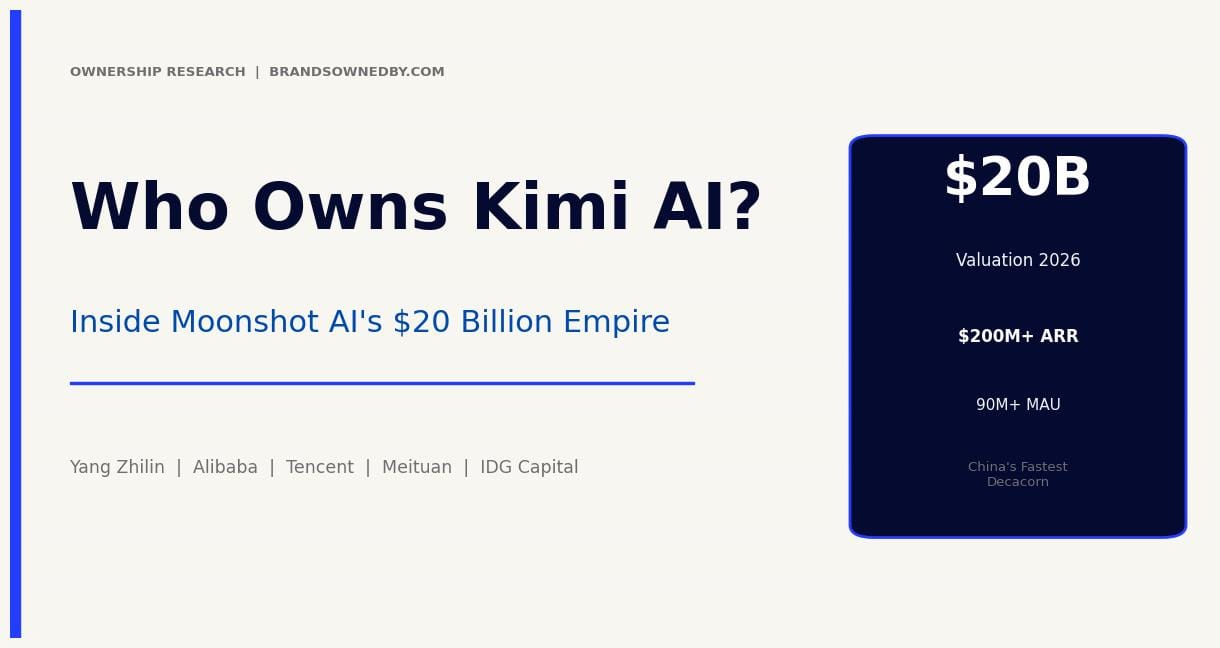

Quick Answer: Kimi AI is a product of Moonshot AI (Beijing Moonshot Technology Co., Ltd.), a Chinese artificial intelligence startup founded in March 2023. Moonshot AI is primarily controlled by its founder and CEO, Yang Zhilin, who holds more than 50% of voting rights through a dual-class share structure. The company’s largest equity investor is Alibaba Group, which holds approximately 36% of equity after investing $1.18 billion across multiple rounds. Other major investors include Meituan’s Long-Z Investments, IDG Capital, HongShan Capital, Tencent, and Gaorong Capital. As of May 2026, Moonshot AI carries a $20 billion valuation, making Kimi the flagship product of China’s fastest-ever decacorn startup.
Kimi is the AI assistant that broke China’s internet in 2024. When Moonshot AI announced it had pushed Kimi’s context window to 2 million Chinese characters, the equivalent of roughly 1,500 novels read in a single conversation, the product crashed under the weight of users trying to access it.
That was February 2024. By May 2026, the company behind Kimi was worth $20 billion, had passed $200 million in annual recurring revenue, and had open-sourced a trillion-parameter AI model that became the most-downloaded model on Hugging Face on the day it launched.
Kimi is not a subsidiary of a tech giant. It is not a side project. It is the defining product of one of the most ambitious AI startups in the world, a company that its founder has explicitly said is targeting Anthropic’s position in the global AI landscape.
The story of who owns Kimi is really the story of who built it, who bet on it, and who controls what it does next.
This article covers all of it: the ownership structure, the investor table, the governance mechanics, the revenue model, the competitive position, and the full picture of what sits under the Kimi brand today.
![who owns kimi [infographic]](https://brandsownedby.com/wp-content/uploads/2026/07/who-owns-kimi-infographic-803x1024.jpg)
What is Kimi AI?
Kimi is a large language model-based AI assistant developed and operated by Moonshot AI, a Beijing-based startup formally incorporated as Beijing Moonshot Technology Co., Ltd. Kimi launched in October 2023 as a Chinese-language chatbot with a context window of 200,000 characters, at the time, the longest context window of any consumer AI product in the world.
That single technical advantage defined the early product: where other AI assistants could only read short documents, Kimi could read entire books, research dossiers, and lengthy contracts in a single prompt.
The chatbot takes its name from the English nickname of its creator, Yang Zhilin. Yang chose the name “Moonshot” because of his love of Pink Floyd’s album The Dark Side of the Moon, and the company was launched on the album’s 50th anniversary. These are not the hallmarks of a corporation managing a portfolio, they are the hallmarks of a founder building something personal.
What began as a long-context chatbot has evolved into a full model family. Kimi K2, released in July 2025, is a one-trillion-parameter mixture-of-experts model released as open weights. Kimi K2.5, released in January 2026, added native vision capabilities through a 400-million-parameter visual encoder called MoonViT.
Kimi Work, launched globally in 2026, is a desktop AI agent that can autonomously browse the web, manage files, and orchestrate multi-step tasks. Across all of these products, the Kimi brand represents Moonshot AI’s consumer and developer-facing presence, the interface between the company’s research and the rest of the world.
Kimi AI at a Glance
- Developer: Moonshot AI (Beijing Moonshot Technology Co., Ltd.)
- Launched: October 2023
- Context window: 200K characters at launch; 2M characters (Mar 2024); up to 256K tokens (K2.5)
- Monthly Active Users: 90 million+ (early 2026)
- Current models: Kimi K2 (1T params, open weights), Kimi K2.5 (multimodal), Kimi K2.6 (agent)
- Platforms: Web (kimi.com), iOS, Android, API, Desktop (Kimi Work)
- Company valuation: $20 billion (May 2026)
- Annual Recurring Revenue: $200M+ (April 2026)
- Parent company CEO: Yang Zhilin (CMU PhD, ex-Google Brain, ex-Meta AI).
The Ownership History of Kimi and Moonshot AI
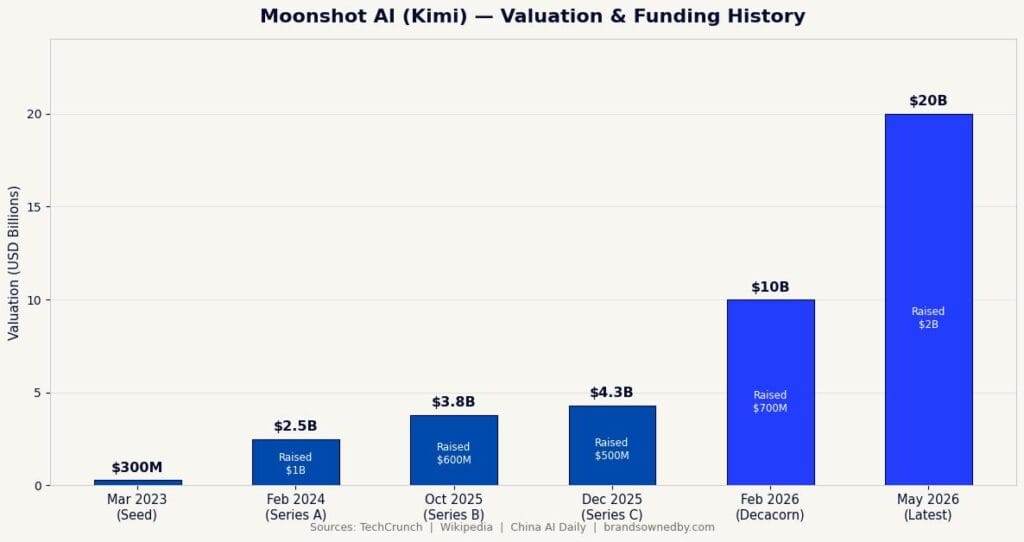
Kimi’s ownership history is inseparable from Moonshot AI’s funding story. The company was built fast, founded in March 2023, it reached a $20 billion valuation by May 2026. Each major funding round brought new investors onto the cap table while Yang Zhilin maintained governance control throughout.
- Mar 2023: Moonshot AI founded by Yang Zhilin, Zhou Xinyu, and Wu Yuxin. Raises a $300 million seed round — one of the largest in Chinese AI history. HongShan Capital and Gaorong Capital are among the early backers.
- Oct 2023: Kimi chatbot launches with a 200,000-character context window — the world’s longest for a consumer AI product. Positions as the go-to tool for professionals processing long documents, legal filings, and research reports.
- Feb 2024: Alibaba Group leads a $1 billion Series A, acquiring approximately 36% of Moonshot AI’s equity. Valuation: $2.5 billion. Kimi’s context window expands to 2 million characters; servers go down under the demand spike.
- Jul 2025: Kimi K2 launches: a 1-trillion-parameter mixture-of-experts open-weight model. Becomes the most-downloaded model on Hugging Face on day one. Overseas API revenue begins accelerating sharply.
- Oct 2025: IDG Capital leads a $600 million funding round. Pre-money valuation: $3.8 billion. Tencent joins the cap table. Paying users growing 170%+ month-over-month.
- Jan 2026: Kimi K2.5 launches January 27. Adds native multimodal capabilities via MoonViT. Within 20 days of launch, cumulative K2.5 revenue exceeds all of Moonshot AI’s 2025 revenue.
- Feb 2026: A $700M+ round pushes valuation above $10 billion — China’s fastest-ever decacorn. ARR crosses $100 million.
- Apr 2026: Annual recurring revenue crosses $200 million. Overseas API revenue surpasses domestic revenue for the first time.
- May 2026: Meituan’s Long-Z Investments leads a $2 billion round at a $20 billion valuation. Total fundraising over prior six months: $3.9 billion. IPO on Hong Kong Stock Exchange reportedly under consideration.
Who Owns Kimi AI: Largest Shareholders
As of mid-2026, Kimi is owned by Moonshot AI, which is in turn owned by a combination of its founding team and a set of major institutional investors. The ownership structure has three layers: Yang Zhilin’s controlling equity, the investor cap table, and the legal holding arrangement that wraps everything together.
Yang Zhilin: Founder and Controlling Shareholder
Yang Zhilin is Kimi’s creator, Moonshot AI’s CEO, and the person who holds the most effective ownership over what the product does and where it goes. He completed his undergraduate degree at Tsinghua University in 2015, then earned his doctorate at Carnegie Mellon University. At CMU and afterward at Google Brain and Meta AI, Yang published research alongside Yoshua Bengio and Yann LeCun, both Turing Award winners.
His two most influential papers, Transformer-XL and XLNet, addressed how language models handle very long text sequences, the specific research problem on which Kimi was built.
Yang holds over 50% of Moonshot AI’s voting rights through a dual-class share structure, which means his decision-making authority is not diluted by the $3.9 billion the company has raised. His equity stake is estimated at roughly 42% of total shares, making him the largest single shareholder as well as the controlling voter.
Alibaba Group: Largest Equity Investor (36%)
Alibaba Group entered the Moonshot AI cap table in February 2024 with a $1 billion investment — its largest single bet on an external AI startup at the time. Over subsequent rounds, Alibaba’s total investment has reached approximately $1.18 billion, making it the biggest financial backer of Kimi by dollar amount. In exchange, Alibaba received roughly 36% of Moonshot AI’s equity.
Alibaba’s interest in Moonshot AI is strategic on two fronts. First, Kimi models are compatible with Alibaba Cloud infrastructure, meaning the commercial success of Kimi directly benefits Alibaba Cloud’s enterprise AI services. Second, Alibaba is in direct competition with ByteDance and Baidu in the Chinese AI market, and having a stake in one of the leading independent model labs gives it an advantage even if its own Qwen models do not dominate. Critically, Alibaba’s 36% equity stake does not translate to 36% voting power — Yang Zhilin’s dual-class share structure caps the effective governance influence of any single investor.
Meituan / Long-Z Investments
Meituan, the Chinese company best known for food delivery and local services, made its largest single external investment ever in May 2026 when its Long-Z Investments vehicle led Moonshot AI’s $2 billion round at a $20 billion valuation. Kimi’s agentic capabilities — particularly through Kimi Work — make it a natural fit for Meituan’s strategy of integrating AI into next-generation local commerce.
IDG Capital
IDG Capital — one of the earliest institutional investors in Baidu, Tencent, and Xiaomi — led the October 2025 funding round worth approximately $600 million at a $3.8 billion pre-money valuation. IDG typically leads rounds in companies it expects to IPO, and its position in Moonshot aligns with the company’s reported plans to list on the Hong Kong Stock Exchange.
HongShan Capital
HongShan Capital, formerly Sequoia Capital China, was one of Moonshot’s original seed investors in 2023 and has continued participating through subsequent rounds. Its Moonshot position, taken when the company had just launched and had no revenue, represents its highest-conviction AI model bet in China.
Tencent
Tencent joined the cap table in the October 2025 IDG-led round. For Tencent, a Moonshot stake hedges against the risk that the Chinese AI market consolidates around a model family it doesn’t control, and gives Kimi’s capabilities potential access to WeChat’s 1.3 billion-user distribution network.
Gaorong Capital
Gaorong Capital participated in the founding seed round in 2023 and has maintained its position through the company’s growth. One of the few institutional investors willing to bet on a pre-product AI lab in early 2023, Gaorong’s early conviction has produced one of the more significant returns in Chinese venture capital in recent years.
Who Controls Kimi AI?
Ownership and control are fundamentally different questions at Moonshot AI, and in Kimi’s case that difference is enormous. Alibaba owns more of the company by equity than Yang Zhilin does, but Yang controls the company in every meaningful governance sense. Understanding how that works requires looking at three distinct mechanisms that together make his authority over Kimi nearly absolute.
The Dual-Class Share Structure
Moonshot AI operates with multiple share classes carrying different voting weights. Yang Zhilin’s founder shares carry significantly more votes per share than the ordinary shares distributed to investors through funding rounds. This structure, common in founder-led technology companies from Meta to Alphabet, ensures that equity dilution through fundraising does not translate into governance dilution.
When Alibaba invested $1 billion in February 2024 and received 36% of Moonshot’s equity, it received ordinary shares with limited voting power. Yang’s super-voting shares kept his voting bloc above 50%.
The practical consequences of this structure are visible in the company’s most consequential decisions. In July 2025, Moonshot released Kimi K2 as open weights, a model that cost tens of millions of dollars to train. Open-sourcing it meant giving the model away to every developer, startup, and competitor in the world who wanted to download it.
That decision was made by Yang Zhilin unilaterally. Had Alibaba, Meituan, or any investor coalition wanted to prevent it, they had no formal mechanism to do so. Similarly, Moonshot’s 2026 strategic plan, which explicitly sets surpassing Anthropic as the company’s primary goal, is a founder directive that no investor can override.
The VIE Structure and Contractual Control
Moonshot AI operates through a VIE (variable interest entity) arrangement. At the top sits a Cayman Islands holding company, this is the entity in which investors like Alibaba, Meituan, and IDG Capital hold their equity stakes. Below it sits the actual Beijing operating company, Beijing Moonshot Technology Co., Ltd., which owns the Kimi models, the intellectual property, the servers, and the engineering team.
The Cayman Islands entity does not own Beijing Moonshot directly. Instead, it controls the Beijing company through a series of contractual agreements, service agreements, licensing agreements, and equity pledge arrangements, executed by Chinese citizens on behalf of the holding company. Those Chinese citizens are Yang Zhilin and his co-founders.
This structure is mandated by Chinese law, which restricts foreign ownership in sectors classified as strategic, a category that increasingly includes AI. Yang’s ability to influence the contractual arrangements with the Beijing entity gives him additional practical control beyond what the share structure alone provides.
Board Composition and Founder Protections
As CEO and co-founder, Yang controls the board through his voting majority. The company’s governance documents give founder shares the ability to elect a majority of board directors, meaning that even as new investors join the cap table and receive observer or minority board seats, the strategic direction of the company is set by a board that Yang can always control.
This is the same architecture that ByteDance’s Zhang Yiming used to maintain operational authority even as SoftBank and other large investors accumulated significant equity in ByteDance’s Cayman holding company. Yang has cited ByteDance explicitly as a structural model.
Kimi AI vs. Competitors
Kimi competes in a Chinese AI market that has, by mid-2026, consolidated around roughly ten serious players but is effectively dominated by three or four. Understanding where Kimi sits requires looking at each major competitor with specificity.
Doubao
ByteDance’s Doubao is the market leader by monthly active users, with over 260 million MAU as of early 2026. Doubao benefits from a distribution advantage that no standalone AI startup can easily replicate: it is embedded inside the ByteDance ecosystem, which includes Douyin (the Chinese version of TikTok, with over 700 million daily active users), Toutiao, and Feishu. Doubao is effectively free for most users, subsidized by ByteDance’s advertising revenue.
That makes it nearly impossible for a subscription-dependent startup like Moonshot to compete on price or reach in the mass market. What Kimi does instead is target users who need more: longer documents, more sophisticated reasoning, agentic workflows, and access to state-of-the-art open-weight models.
ERNIE Bot
Baidu’s ERNIE Bot, with approximately 220 million MAU, benefits from a different structural advantage: search. Baidu holds roughly 60% of China’s search market, and ERNIE Bot is integrated directly into Baidu’s search results page.
This gives ERNIE Bot passive distribution, users encounter it when they search for anything, without deliberately choosing an AI assistant. However, Baidu’s model capability has fallen behind Kimi K2 and K2.5 on standard benchmarks, and ERNIE is not available as open weights, limiting its global developer adoption.
Qwen
Alibaba’s Qwen model family is arguably Kimi’s most technically similar competitor. Qwen models have been downloaded billions of times from Hugging Face and compete directly with Kimi K2 in the open-source developer market. Alibaba’s consumer chatbot, Quark, has approximately 180 million MAU.
But Alibaba is simultaneously a Moonshot AI investor, which creates an unusual dynamic: the company that owns 36% of Kimi is also running a competing product. In practice, the two operate independently.
DeepSeek
DeepSeek, backed by the Chinese quantitative hedge fund High-Flyer, is the competitor that most directly challenged Kimi’s technical positioning. DeepSeek’s R1 reasoning model, released in January 2025, achieved benchmark performance comparable to OpenAI’s o1 at a training cost of approximately $5.5 million.
Moonshot responded with Kimi K2 Thinking in November 2025, a reasoning-focused model trained for approximately $4.6 million, matching DeepSeek’s efficiency claim. Unlike DeepSeek, which operates primarily through API access with no major consumer product, Kimi has a full consumer chatbot, a mobile app, and an enterprise agent.
Key Comparison
Globally, Kimi’s primary competition comes from OpenAI’s ChatGPT and Anthropic’s Claude. ChatGPT has over 500 million global MAU and a multi-year brand recognition lead. Claude is widely considered the closest technical peer to Kimi K2.5 in terms of reasoning and long-context capability. Moonshot’s stated 2026 goal is to surpass Anthropic, meaning not just to match Claude’s benchmark scores but to exceed its revenue scale and model capability.
Kimi AI Revenue and Net Worth
Kimi’s financial story is one of the most compressed revenue arcs in the global AI industry. In the space of roughly four months, from January to April 2026, annual recurring revenue more than quintupled, from an estimated $40 million to over $200 million. That growth was driven almost entirely by two factors: the launch of Kimi K2.5 and the explosion of overseas API demand.
How Kimi Makes Money
Kimi generates revenue through three distinct channels. The first is consumer subscriptions. Kimi offers a paid tier comparable to ChatGPT Plus or Claude Pro, giving subscribers higher usage limits, priority access to the latest models, and advanced features including extended context processing and agentic browsing.
Subscription pricing in China is typically lower than Western equivalents, monthly plans in the range of 59 to 99 yuan, or roughly $8 to $14, but the volume of subscribers across 90 million monthly active users means this channel generates meaningful recurring revenue.
The second and now dominant channel is the Moonshot API platform. Developers and enterprises access Kimi’s models directly through an API, paying per token consumed, the same billing model used by OpenAI’s API.
The API includes native tools: real-time web search, persistent memory storage and retrieval, code execution, file analysis, and spreadsheet processing. Enterprise contracts carry higher per-token rates and fixed-commitment pricing. From September to November 2025, overseas API revenue grew fourfold, and by April 2026 overseas API revenue had overtaken domestic API revenue, making Kimi a genuinely global API business.
The third channel is Kimi Work, the desktop agent launched globally in 2026. Kimi Work targets knowledge workers who need an AI system that can autonomously manage multi-step tasks: browsing the web, reading and modifying files, drafting communications, and orchestrating workflows across applications. Enterprise Kimi Work licenses are priced significantly above consumer subscriptions and represent the company’s highest-value customer segment.
Revenue Milestones
The most striking revenue data point is the K2.5 effect. In the 20 days following Kimi K2.5’s January 27, 2026 launch, cumulative revenue exceeded Moonshot AI’s entire calendar year 2025 revenue. K2.5 was released as open weights, immediately creating a global developer install base that converted into API usage; and K2.5’s multimodal capabilities unlocked new enterprise use cases that the text-only K2 could not serve.
Net Worth and Valuation
Moonshot AI is a private company, which means it does not publish audited financial statements. Its implied valuation is $20 billion as of the May 2026 funding round.
At $200 million in ARR, that valuation implies a revenue multiple of approximately 100x, aggressive but consistent with how investors are pricing frontier AI companies globally. OpenAI’s $157 billion valuation at roughly $3.4 billion in ARR implies a 46x multiple; Anthropic’s $61.5 billion valuation at approximately $1 billion in ARR implies a 60x multiple. Moonshot’s 100x multiple reflects the faster growth rate and the expectation that current ARR will compound rapidly as Kimi Work enterprise contracts accumulate.
On a personal basis, Yang Zhilin’s approximate 42% equity stake in a $20 billion company implies a paper net worth of roughly $8.4 billion, making him one of the wealthiest AI founders in China outside of the established tech giants. That figure is illiquid and will fluctuate with the company’s valuation, but it reflects the economic scale of what Kimi has become since its October 2023 launch.
Brands Owned By Kimi
Kimi is both the name of a chatbot and the brand umbrella for an expanding portfolio of AI products. Moonshot AI has organized its consumer and developer-facing presence around the Kimi name, creating a family of products that collectively represent the company’s commercial footprint.
Kimi App
The flagship consumer product, available at kimi.com and through dedicated iOS and Android apps. Launched October 2023 with a 200,000-character context window, the world’s longest at the time. Expanded to 2 million characters in March 2024, causing a traffic-driven outage from the volume of users trying to access the upgraded product.
By early 2026, the Kimi app had 90 million monthly active users, making it one of the five most-used AI assistants in China. The app supports document upload, image analysis (since K2.5), web search, and code execution as native features.
Kimi K2
Released July 2025. A 1-trillion-parameter mixture-of-experts model. Of those one trillion parameters, 32 billion are active during any given inference pass, a design choice that makes the model computationally efficient relative to its total size.
Released with fully open weights on Hugging Face, K2 became the most-downloaded model on the platform on its launch day. The K2 Thinking variant, released November 2025, was trained for approximately $4.6 million, a data point Moonshot has used to demonstrate training efficiency relative to Western frontier labs.
Kimi K2.5
Released January 27, 2026. K2.5 adds native multimodal capability through MoonViT, a 400-million-parameter vision encoder that allows the model to process images and video natively. K2.5 supports contexts up to 256,000 tokens. Like K2, it was released as open weights.
Within 20 days of launch, K2.5 had generated more revenue than Moonshot AI had earned in all of 2025. Overseas revenue from K2.5’s API access surpassed domestic revenue, marking the first time Kimi became a net overseas revenue generator.
Kimi Work
Launched globally in 2026, powered by the K2.6 model. A native desktop application for Windows and Apple Silicon Macs that acts as a local AI agent. It can mount and navigate file systems, execute multi-step browser workflows autonomously, draft and send communications, and coordinate tasks across multiple applications without user intervention.
Kimi Work targets knowledge workers and enterprise users who need AI assistance for sustained, multi-hour tasks. Its global launch signals that Moonshot is explicitly building Kimi as an international brand.
Moonshot API Platform
The developer and enterprise API platform providing programmatic access to all Kimi models using token-based billing. The API includes native tools: real-time web search, persistent memory storage and retrieval, code execution, file processing including Excel analysis, and date and unit conversion.
Enterprise contracts give organizations committed token volumes at discounted rates. By April 2026, overseas API revenue became the company’s single largest revenue category.
Mooncake
The internal infrastructure platform that processes all Kimi inference requests. It handles 100 billion tokens per day as of early 2026, making it one of the largest AI serving deployments in China. Mooncake is not sold to third parties, but it represents a significant proprietary infrastructure investment that gives Moonshot direct control over serving latency, cost per token, and infrastructure scaling.
Conclusion
Kimi AI is owned by Moonshot AI, and Moonshot AI is controlled by Yang Zhilin. Those two facts are the load-bearing pillars of the ownership structure. Alibaba holds the largest equity stake at 36%, but equity and control are legally separated through a dual-class share structure that keeps Yang’s voting authority intact regardless of what the cap table looks like. Meituan, IDG Capital, HongShan, Tencent, and Gaorong Capital are meaningful financial stakeholders, but none of them can override a founder’s decision.
What Yang Zhilin has built around the Kimi name, in just over two years, is a product family that spans consumer AI, open-weight foundation models, enterprise API services, and a desktop productivity agent. The company went from $300 million in seed funding to $3.9 billion raised, from a chatbot launch to 90 million monthly users, and from zero revenue to $200 million in annual recurring revenue. That it did all of this while open-sourcing its most powerful models speaks to the kind of long-term thinking that founder control enables, and that a more investor-constrained governance structure might not.
As Moonshot AI moves toward a potential Hong Kong IPO and continues to pursue its stated goal of surpassing Anthropic, the ownership question will grow in relevance. Who owns Kimi is ultimately a question about who decides what Kimi becomes, and right now, that answer is Yang Zhilin.
FAQs
Who is the CEO of Kimi AI?
Yang Zhilin is the CEO and co-founder of Moonshot AI, the company behind Kimi. He holds a bachelor’s degree from Tsinghua University and a doctorate from Carnegie Mellon University, and previously worked at Google Brain and Meta AI. He is the original author of the Transformer-XL and XLNet papers, which are foundational to how modern large language models handle long text sequences.
Is Kimi AI owned by Alibaba?
No. Alibaba is Moonshot AI’s largest equity investor, holding approximately 36% of shares after investing $1.18 billion in total. But it does not own or control Kimi. Founder Yang Zhilin holds over 50% of voting rights through a dual-class share structure, meaning Alibaba cannot override his decisions even though it holds more equity than he does.
What is the valuation of Kimi / Moonshot AI?
As of May 2026, Moonshot AI was valued at $20 billion after a $2 billion funding round led by Meituan’s Long-Z Investments. This makes it the fastest Chinese startup in history to reach decacorn status — a valuation exceeding $10 billion.
How many users does Kimi AI have?
Kimi AI has more than 90 million monthly active users as of early 2026. Internationally, Kimi’s open-weight models have been downloaded by developers in over 100 countries.
Is Moonshot AI publicly traded?
No. As of mid-2026, Moonshot AI remains a private company. Reports from March 2026 indicated the company is considering an IPO on the Hong Kong Stock Exchange, but no formal prospectus had been filed.
How does Kimi AI make money?
Kimi generates revenue through three channels: consumer subscriptions to the Kimi app (monthly plans priced at approximately $8–$14), a token-based API platform for enterprise and developer use, and Kimi Work enterprise licenses. The API business became the largest revenue contributor after the launch of Kimi K2.5 in January 2026, with overseas API revenue surpassing domestic revenue by April 2026.
What is the difference between Kimi AI and Moonshot AI?
Moonshot AI is the company — formally Beijing Moonshot Technology Co., Ltd. Kimi is the brand name for Moonshot AI’s consumer-facing products and model family, including the Kimi chatbot, Kimi K2, Kimi K2.5, and Kimi Work. The Kimi brand takes its name from founder Yang Zhilin’s personal English nickname.
Who are Kimi’s main competitors?
In China: ByteDance Doubao (260M+ MAU), Baidu ERNIE Bot (220M+ MAU), Alibaba Quark (180M+ MAU), Tencent Yuanbao (150M+ MAU), and DeepSeek (API-focused, cost-efficient open models). Globally: OpenAI ChatGPT (500M+ MAU), Google Gemini, and Anthropic Claude — with Claude being the company that Moonshot has explicitly named as its 2026 benchmark target.
What is Yang Zhilin’s net worth?
Yang Zhilin’s equity stake of approximately 42% in Moonshot AI implies a paper net worth of roughly $8.4 billion based on the company’s $20 billion May 2026 valuation. This is an illiquid figure representing the estimated value of his shares, not cash he has received.
How much has Moonshot AI raised in total?
As of May 2026, Moonshot AI had raised approximately $3.9 billion: $300M seed (March 2023), $1B Series A (February 2024), $600M round (October 2025), $500M round (December 2025), $700M+ round (February 2026), and $2B round (May 2026).