
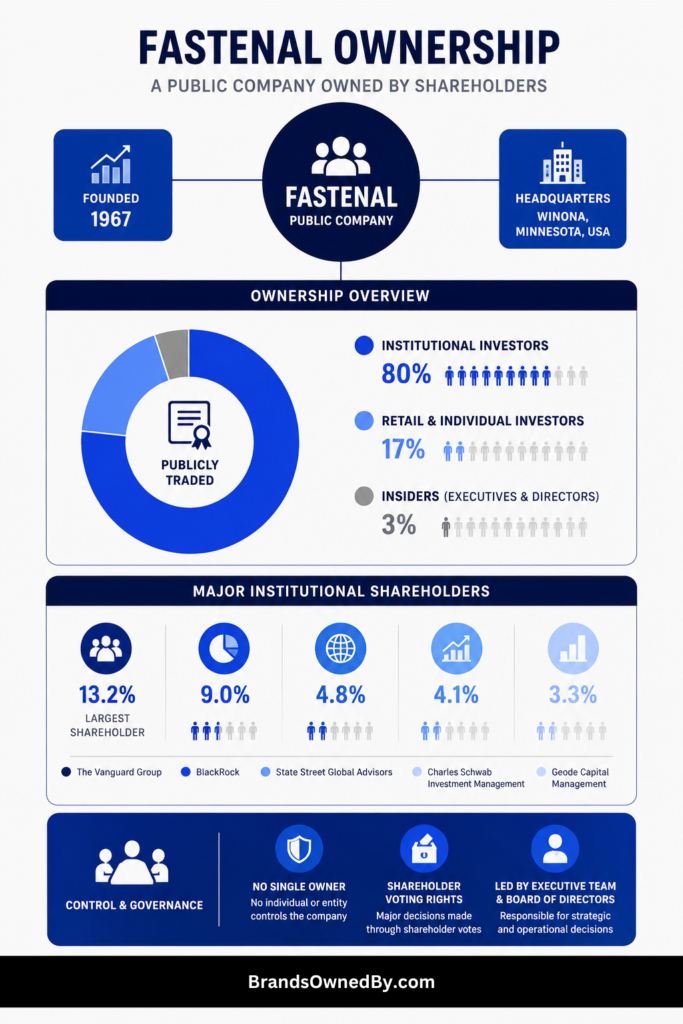
- Fastenal is a publicly traded company listed on Nasdaq under the ticker symbol FAST. The company has no controlling shareholder, meaning no individual, family, institution, or parent company has enough ownership to control corporate decisions.
- Institutional investors collectively own approximately 80% of Fastenal’s outstanding shares, making them the dominant ownership group. The largest shareholders are The Vanguard Group (13.2%), BlackRock (9.0%), State Street Global Advisors (4.8%), Charles Schwab Investment Management (4.1%), and Geode Capital Management (3.3%).
- Retail investors and individual shareholders own roughly 17% of the company, while insiders, including executives and directors, own approximately 3%. This creates a widely distributed ownership structure with no single investor exercising majority control.
- Fastenal was founded by Bob Kierlin in 1967, but the company is no longer founder-controlled. As of 2026, strategic and operational control rests with the executive leadership team and board of directors, while major shareholders influence governance through voting rights rather than direct management authority.
Fastenal is an American industrial distribution company that supplies products used in manufacturing, construction, transportation, energy, government, and maintenance operations. The company is best known for distributing fasteners, which include bolts, nuts, screws, washers, anchors, and other industrial components.
Over the years, Fastenal expanded beyond fasteners and became a full-service industrial supplier. Today, it provides safety equipment, tools, electrical products, hydraulic components, material handling equipment, janitorial supplies, welding products, and inventory management solutions.
The company operates through a large network of branches, on-site customer locations, distribution centers, and automated inventory systems. Its customers range from small local businesses to some of the largest manufacturers in North America.
Fastenal differentiates itself through its service-driven business model. Instead of simply selling products, the company works closely with customers to improve inventory management, reduce downtime, and streamline procurement processes. This approach has helped Fastenal build long-term relationships with industrial customers across multiple sectors.
What Does Fastenal Do?
Fastenal specializes in industrial supply distribution. The company helps businesses source and manage thousands of products required for daily operations.
Its major product categories include:
- Fasteners and industrial hardware.
- Personal protective equipment (PPE).
- Cutting tools.
- Power tools.
- Electrical supplies.
- Hydraulics and pneumatics.
- Welding products.
- Material handling equipment.
- Facility maintenance supplies.
For example, a manufacturing plant may use Fastenal’s vending machines to automatically distribute gloves, safety glasses, drill bits, and other frequently used items. This reduces waste and helps managers track inventory consumption in real time.
Fastenal’s Business Model
Fastenal generates revenue by supplying industrial products and providing inventory management solutions to businesses.
One of its most successful offerings is Fastenal Managed Inventory (FMI). Under this system, Fastenal places inventory management technology directly inside customer facilities. The company monitors stock levels and automatically replenishes products when needed.
This creates a recurring business relationship and makes Fastenal an important part of its customers’ supply chains.
Another key component is its industrial vending program. These vending systems allow employees to access tools and safety equipment while giving employers better control over inventory usage.
Global Presence
Although Fastenal is primarily known for its North American operations, the company also serves customers internationally. It maintains sourcing, distribution, and support operations in multiple countries.
Its global supply chain network helps customers secure products efficiently while maintaining quality standards and inventory availability.
Fastenal Founder: Bob Kierlin
Fastenal was founded by Robert A. “Bob” Kierlin in 1967.
Kierlin was a student at Winona State University when he developed the idea for a specialized fastener distribution company. At the time, many businesses struggled to obtain small quantities of industrial fasteners quickly and efficiently. Kierlin saw an opportunity to create a business that focused exclusively on meeting that demand.
He launched Fastenal in Winona, Minnesota, with the goal of building a local fastener distribution network. The company initially faced challenges because customers were unfamiliar with the concept of a dedicated fastener supplier. However, demand gradually increased as businesses recognized the convenience of having a specialized distributor.
Under Kierlin’s leadership, Fastenal expanded steadily across the United States. The company opened new branches, broadened its product offerings, and developed a reputation for customer service and operational efficiency.
Kierlin remained actively involved in the company for decades and played a major role in shaping its culture. His focus on employee ownership, customer relationships, and disciplined expansion helped transform Fastenal from a small regional distributor into one of North America’s leading industrial supply companies.
Why Bob Kierlin’s Leadership Matters
Many industrial distributors focus primarily on product sales. Kierlin took a different approach.
He believed that customer service, local branch support, and inventory availability would create a competitive advantage. This philosophy continues to influence Fastenal’s operations today.
Many of the company’s modern initiatives, including managed inventory programs and customer-focused supply chain solutions, reflect the service-oriented culture established by its founder.
This long-term approach helped Fastenal develop strong customer loyalty and maintain its position as one of the most recognized names in industrial distribution.
Ownership History
Fastenal’s ownership history reflects its transformation from a small founder-led business into one of the largest publicly traded industrial distributors in North America. The company started with concentrated ownership under its founder and early investors. Over time, ownership became increasingly diversified as institutional investors, mutual funds, pension funds, and retail shareholders acquired shares.
Fastenal Ownership Evolution
From founder-owned business to institutionally owned public company.
Founder Ownership
Bob Kierlin founded Fastenal and held primary ownership.
Private Expansion
Ownership expanded gradually among insiders and early investors.
IPO
Fastenal became a publicly traded company and opened ownership to public investors.
Institutional Entry
Mutual funds and pension funds began accumulating shares.
Index Fund Growth
Vanguard, BlackRock, and State Street became major shareholders.
Diversified Ownership
No controlling shareholder. Ownership spread across institutions, insiders, and retail investors.
Ownership Shift Over Time
Founding and Early Ownership (1967–1987)
Fastenal was founded in 1967 by Bob Kierlin in Winona, Minnesota. During the company’s early years, ownership remained concentrated among Kierlin, company executives, and a small group of private investors.
At the time, Fastenal operated as a privately held company. Most strategic decisions were made directly by the founder and senior management team. Because the business was relatively small, ownership and control were closely connected.
Bob Kierlin played a hands-on role in every aspect of the company. His ownership stake gave him significant influence over expansion plans, hiring decisions, operational strategy, and corporate culture.
As the company expanded across the United States during the 1970s and early 1980s, additional investors joined the business. However, ownership remained heavily concentrated among insiders.
Initial Public Offering and Public Ownership (1987)
A major shift occurred in 1987 when Fastenal completed its Initial Public Offering (IPO).
The public listing allowed investors to purchase shares in the company through the stock market. This move provided Fastenal with greater access to capital while also creating liquidity for existing shareholders.
Following the IPO, ownership began transitioning from a founder-dominated structure to a broader shareholder base. Thousands of individual investors became part owners of the company.
Although Bob Kierlin remained one of the largest shareholders after the IPO, his ownership percentage gradually declined as additional shares entered the public market and new investors accumulated positions.
Expansion of Institutional Ownership (1990s)
During the 1990s, Fastenal experienced significant business growth. As revenue, profitability, and market capitalization increased, institutional investors started taking larger positions in the company.
Large investment firms viewed Fastenal as an attractive long-term investment because of its consistent expansion, disciplined management, and growing industrial customer base.
Mutual funds, pension funds, insurance companies, and investment managers began acquiring Fastenal shares in increasing numbers. This period marked the beginning of institutional ownership becoming a dominant force within the shareholder base.
Despite growing institutional participation, company insiders still maintained meaningful ownership and influence.
Rise of Index Funds and Asset Managers (2000s)
The 2000s brought another significant change in Fastenal’s ownership structure.
The popularity of index investing increased dramatically during this period. Large asset management companies such as Vanguard, BlackRock, and State Street began accumulating substantial positions in Fastenal through index funds and exchange-traded funds (ETFs).
Because Fastenal became a component of major stock market indexes, many passive investment funds automatically purchased and held its shares.
This trend reduced ownership concentration even further. Instead of a small number of individual investors holding large stakes, ownership became distributed across millions of investors through institutional investment vehicles.
The company’s shareholder base became increasingly diversified, reducing the influence of any single individual investor.
Reduction of Founder Influence
As Fastenal matured, founder ownership gradually declined.
This reduction did not occur because Bob Kierlin sold control of the company to another organization. Instead, it happened naturally as public ownership expanded and institutional investors acquired larger positions over time.
Although Kierlin remained an important shareholder and influential figure within the company for many years, the business eventually evolved into a professionally managed public corporation with broad shareholder participation.
This transition is common among successful publicly traded companies. Founder influence often decreases as market capitalization grows and ownership becomes more widely distributed.
Modern Ownership Structure
Today, Fastenal operates with a highly diversified ownership structure.
No single shareholder owns a controlling stake in the company. Instead, ownership is spread among institutional investors, mutual funds, pension funds, ETFs, company insiders, and retail shareholders.
Institutional investors collectively own the majority of Fastenal’s outstanding shares. These investors include some of the world’s largest asset management firms.
The largest individual shareholder group consists of index fund providers and investment management companies that hold shares on behalf of millions of investors.
This structure creates a balance between professional investment oversight and broad public ownership.
Role of Employee and Insider Ownership
Fastenal has historically encouraged employee ownership.
Many executives, directors, and employees have owned company stock through compensation programs and investment plans. This ownership culture helps align employee interests with shareholder interests.
When employees own shares, they directly benefit from the company’s long-term success. This creates incentives to improve customer service, operational efficiency, and overall business performance.
Insider ownership also gives management a personal stake in the company’s future growth and profitability.
Key Ownership Milestones
Several important events shaped Fastenal’s ownership history:
- 1967: Bob Kierlin founded Fastenal and held primary ownership.
- 1970s–1980s: Ownership expanded gradually among private investors and company insiders.
- 1987: Fastenal completed its IPO and became a publicly traded company.
- 1990s: Institutional investors began acquiring significant ownership positions.
- 2000s: Index funds and ETFs increased institutional ownership substantially.
- 2010s–Present: Ownership became broadly distributed among major asset managers, institutional investors, insiders, and retail shareholders.
How Fastenal’s Ownership Has Evolved
Fastenal’s ownership journey illustrates the evolution of a successful public company.
The business began with founder-led ownership and direct management control. Following its stock market listing, ownership gradually expanded to include thousands of shareholders. Over time, institutional investors became the dominant owners due to the growth of index investing and passive investment strategies.
Today, Fastenal remains independently operated and publicly owned. No family, founder, corporation, or investment group controls the company outright. Instead, ownership is shared among a diverse group of investors who collectively influence the company’s governance through shareholder voting and board elections.
Who Owns Fastenal Company: Major Shareholders
Fastenal is a publicly traded company listed on the Nasdaq stock exchange under the ticker symbol FAST. Unlike founder-controlled businesses or companies owned by a parent corporation, Fastenal is owned by thousands of shareholders around the world.
The company’s ownership is dominated by institutional investors. These include asset managers, pension funds, mutual funds, insurance companies, and exchange-traded funds. Collectively, institutional investors own the majority of Fastenal’s outstanding shares. Individual investors, company executives, directors, and employees own the remaining shares.
One of the most notable aspects of Fastenal’s ownership structure is that no single shareholder controls the company. Even the largest investor owns only a minority stake. This creates a balanced governance structure where major decisions require board oversight and shareholder approval.
The largest shareholders are primarily investment management firms that hold Fastenal shares on behalf of millions of clients through mutual funds, retirement accounts, and ETFs. These investors influence the company through voting rights but do not participate in day-to-day management.
Based on the latest available ownership data, Fastenal’s shareholder base can be broadly divided into the following categories:
Institutional ownership has steadily increased over the past two decades due to the growth of index funds and passive investing strategies. Today, the majority of Fastenal shares are held by large investment firms.
The Vanguard Group
The Vanguard Group is the largest shareholder of Fastenal.
According to recent ownership filings, Vanguard controls approximately 13.2% of Fastenal’s outstanding shares, representing more than 151 million shares. This makes Vanguard the company’s most influential shareholder from a voting perspective.
Vanguard does not actively manage Fastenal’s operations. Instead, it holds shares through its index funds and ETFs, including funds that track the S&P 500 and other major market indexes.
Because millions of investors own Vanguard funds, Vanguard effectively votes on their behalf during board elections, executive compensation proposals, and corporate governance matters.
Its large ownership stake gives it significant influence over long-term governance decisions.
BlackRock
BlackRock is the second-largest shareholder of Fastenal.
The investment management giant owns approximately 9.0% of Fastenal’s outstanding shares, representing more than 103 million shares.
BlackRock’s ownership comes primarily through its iShares ETFs, mutual funds, institutional portfolios, and retirement investment products.
As one of the world’s largest asset managers, BlackRock has substantial influence over corporate governance practices across publicly traded companies.
Although BlackRock does not directly manage Fastenal, its voting power can affect important shareholder resolutions and board appointments.
State Street Global Advisors
State Street Global Advisors ranks among Fastenal’s largest shareholders.
The firm owns approximately 4.8% of the company’s outstanding shares, equivalent to nearly 55 million shares.
State Street is best known for managing SPDR ETFs and institutional investment portfolios.
Like Vanguard and BlackRock, State Street is considered a passive investor. However, its large ownership position provides considerable voting influence.
State Street frequently advocates for strong corporate governance, board accountability, and long-term shareholder value creation.
Charles Schwab Investment Management
Charles Schwab Investment Management has become one of Fastenal’s largest institutional shareholders.
The firm controls approximately 4.1% of Fastenal shares through various mutual funds and index-tracking investment products.
Schwab’s ownership reflects the continued growth of passive investing and low-cost index fund strategies. Its funds hold Fastenal because the company is included in major stock market indexes.
Although Schwab rarely takes an activist role, it participates in shareholder voting and governance decisions.
Geode Capital Management
Geode Capital Management is another major institutional owner of Fastenal.
The firm owns roughly 3.3% of the company’s outstanding shares.
Geode primarily manages index-based investment strategies and institutional portfolios. Its holdings are spread across a wide range of publicly traded companies, including Fastenal.
While Geode typically maintains a passive investment approach, its ownership position contributes to the institutional influence over Fastenal’s governance.
UBS Asset Management
UBS Asset Management holds approximately 1.7% of Fastenal shares.
The company’s ownership comes through global equity funds, pension portfolios, and institutional investment products.
UBS is one of the largest international asset managers investing in Fastenal. Its position demonstrates the company’s appeal among global institutional investors.
Norges Bank Investment Management
Norges Bank Investment Management manages Norway’s sovereign wealth fund and is among Fastenal’s notable shareholders.
The fund owns approximately 1.4% of the company.
As one of the world’s largest sovereign wealth investors, Norges Bank focuses on long-term investments in high-quality businesses. Its investment in Fastenal reflects confidence in the company’s long-term business model and governance practices.
Walter Scott & Partners
Walter Scott & Partners owns approximately 1.5% of Fastenal.
The investment firm specializes in long-term ownership of high-quality global companies with strong competitive advantages.
Fastenal’s consistent operating performance, strong market position, and disciplined management have made it an attractive holding for the firm.
Invesco Capital Management
Invesco Capital Management is another significant institutional shareholder.
The company owns approximately 1.2% of Fastenal’s outstanding shares through various mutual funds and ETF products.
Invesco’s ownership further highlights the broad institutional support behind Fastenal’s stock.
Insider Ownership
Although institutional investors dominate Fastenal’s shareholder base, company insiders also own shares.
Insiders include directors, executive officers, and senior management. CEO Daniel Florness is among the largest individual insider shareholders. Other directors and executives also maintain ownership positions through compensation programs and personal investments.
Insider ownership is relatively small compared with institutional ownership. However, it remains important because it aligns management interests with shareholder interests.
When executives own company stock, they directly benefit from long-term increases in shareholder value.
Retail Shareholders
Retail investors collectively own a meaningful portion of Fastenal.
These shareholders include individual investors who hold shares directly through brokerage accounts, retirement plans, and dividend reinvestment programs.
Although retail investors do not individually hold enough shares to influence company policy, they collectively represent an important ownership group.
Many retail shareholders are attracted to Fastenal because of its long history of dividend growth, strong market position, and consistent profitability.
Competitor Ownership Comparison
Ownership structure can significantly influence how a company operates. Companies with concentrated ownership often have long-term stability and clear strategic direction, but decision-making can become concentrated among a small group of shareholders. In contrast, companies with dispersed ownership tend to be more accountable to a broader shareholder base but may face greater pressure from institutional investors.
Fastenal falls into the second category. The company has no controlling shareholder, no dual-class share structure, and no founding family that controls voting rights. This makes Fastenal one of the most widely held industrial distribution companies in North America.
Competitor Ownership Comparison
Ownership Structure Across Major Industrial Distributors
Fastenal vs. W.W. Grainger
W.W. Grainger is one of Fastenal’s closest competitors in the industrial and maintenance, repair, and operations (MRO) distribution market.
Like Fastenal, Grainger is publicly traded and primarily owned by institutional investors. Large asset managers such as Vanguard, BlackRock, and State Street are among the largest shareholders of both companies.
The key difference is historical family influence. While institutional investors dominate Grainger’s shareholder base today, members of the Grainger family have maintained ownership interests for decades and continue to have a stronger historical connection to the business than Fastenal’s founder does today.
As a result, Grainger’s ownership structure reflects a combination of institutional ownership and legacy family influence, whereas Fastenal’s ownership is almost entirely market-driven.
Fastenal vs. MSC Industrial Direct
MSC Industrial Direct has one of the most distinctive ownership structures among Fastenal’s competitors.
The company remains heavily influenced by the Jacobson family, descendants of the founders. Through Class B shares, the family controls a majority of the company’s voting power despite owning a smaller percentage of the economic interest.
This creates a significant difference from Fastenal.
At Fastenal, institutional investors collectively influence governance through shareholder voting. At MSC Industrial Direct, the Jacobson family maintains substantial control over board elections, executive appointments, and major strategic decisions.
From a governance perspective, MSC Industrial Direct operates more like a founder-controlled company, while Fastenal operates as a broadly held public corporation.
Fastenal vs. Wesco International
Wesco International has an ownership structure that closely resembles Fastenal’s.
The company is publicly traded and does not have a controlling shareholder. Ownership is concentrated among institutional investors, including many of the same investment firms that own Fastenal shares.
Neither company has a founder, family, or parent corporation exercising control.
Instead, management teams operate under the oversight of independent boards and large institutional shareholders.
This structure generally promotes strong governance standards and accountability to investors.
Fastenal vs. Applied Industrial Technologies
Applied Industrial Technologies also operates with a dispersed ownership model.
The company has no controlling family and no dominant shareholder. Institutional investors hold most outstanding shares, making its governance structure very similar to Fastenal’s.
The similarity extends beyond ownership. Both companies have historically focused on disciplined growth, conservative balance sheet management, and long-term shareholder returns.
Because ownership is broadly distributed, neither company is particularly vulnerable to the influence of a single shareholder group.
Fastenal vs. Ferguson Enterprises
Ferguson Enterprises is one of the largest industrial and construction products distributors in North America.
Like Fastenal, Ferguson is publicly traded and primarily owned by institutional investors. No single shareholder controls the company.
However, Ferguson’s shareholder base is more internationally diversified due to its global investor following and larger exposure to construction and infrastructure markets.
Both companies operate under similar governance structures where management decisions are subject to board oversight and shareholder accountability.
Fastenal vs. Global Industrial Company
Global Industrial Company differs from Fastenal in several ways.
While institutional investors own a significant portion of the company, ownership is more concentrated among a smaller group of major shareholders and insiders.
This concentration gives certain investor groups greater influence over corporate decisions than would typically be possible at Fastenal.
Fastenal’s shareholder base is considerably more diversified, reducing the ability of any individual investor or shareholder group to exert outsized influence.
Fastenal vs. HD Supply
HD Supply presents a completely different ownership model because it is not independently owned.
The company operates as a subsidiary of The Home Depot. As a result, all major strategic decisions ultimately fall under Home Depot’s corporate structure.
Fastenal remains independent.
Its management team answers directly to shareholders and the board of directors rather than a parent company. This gives Fastenal greater operational autonomy and strategic flexibility compared with a subsidiary-owned competitor.
Which Competitor Has the Most Similar Ownership Structure?
Among Fastenal’s major competitors, Wesco International and Applied Industrial Technologies have ownership structures most similar to Fastenal. All three companies are publicly traded, institutionally owned, and operate without a controlling shareholder.
MSC Industrial Direct represents the biggest contrast because the Jacobson family maintains significant voting control. HD Supply differs even more because it is wholly owned by a parent company.
Fastenal’s ownership structure sits in the middle of the industrial distribution sector. It combines broad institutional ownership, limited insider control, and independent governance. This structure provides stability while ensuring that no single investor, family, or corporation can dominate the company’s strategic direction.
Who Controls Fastenal?
Fastenal is not controlled by a founder, family, or majority shareholder. Instead, control is shared between the company’s executive leadership team, board of directors, and major institutional shareholders.
Because no investor owns a controlling stake, corporate authority is distributed across several layers of leadership. This structure is designed to balance management execution with board oversight and shareholder accountability.
In practice, Fastenal’s strategic direction is determined by senior management and the board, while shareholders influence governance through voting rights.
Daniel Florness: Current Chief Executive Officer
As of June 2026, Daniel L. Florness serves as Chief Executive Officer of Fastenal. He has held the CEO position since 2016 and is one of the most influential leaders in the company’s modern history. Before becoming CEO, Florness served as Chief Financial Officer and Executive Vice President, giving him extensive experience across Fastenal’s operations, finance, procurement, manufacturing, and national accounts businesses.
During his tenure, Fastenal expanded its focus on inventory management technology, industrial vending solutions, digital supply chain services, and large national accounts. Many of the company’s most significant strategic initiatives over the past decade have been implemented under his leadership.
Although Florness remains CEO in June 2026, he has already announced his intention to step down on July 16, 2026.
Jeffery Watts: Incoming Chief Executive Officer
The Fastenal board has appointed Jeffery M. Watts as the company’s next CEO, effective July 16, 2026. Watts currently serves as President and Chief Sales Officer and has worked at Fastenal since 1996.
Watts is widely viewed as the architect of Fastenal’s sales organization and customer engagement strategy. He has spent nearly three decades in operational and sales leadership roles throughout the company.
His appointment was part of a structured succession plan that began in 2024 when he was promoted to President. The board publicly stated that the transition was designed to ensure leadership continuity and preserve Fastenal’s long-term strategy.
As incoming CEO, Watts will become the executive primarily responsible for:
- Corporate strategy.
- Sales performance.
- Operational execution.
- Supply chain initiatives.
- Capital allocation.
- Long-term growth planning.
Scott Satterlee: Chairman of the Board
While the CEO manages day-to-day operations, ultimate oversight of Fastenal rests with its board of directors.
The board is chaired by Scott Satterlee, who serves as Chairman of the Board. As chairman, Satterlee leads the board’s oversight responsibilities, including CEO succession planning, executive compensation, governance standards, and long-term strategic review.
The chairman does not manage daily operations. However, the role carries significant influence because the board approves major corporate decisions and evaluates executive performance.
The board also played the central role in selecting Jeffery Watts as the company’s next CEO.
The Board of Directors
Fastenal’s board represents shareholders and acts as the company’s highest governance authority.
The board includes experienced executives from manufacturing, technology, logistics, finance, and industrial sectors. In June 2026, Fastenal expanded its board by electing Vishal Talwar, the Chief Digital and Information Officer of FedEx Corporation, as an independent director. This addition reflects Fastenal’s growing emphasis on technology, data analytics, cybersecurity, and digital supply chain capabilities.
The board is responsible for:
- Appointing the CEO.
- Approving executive succession plans.
- Reviewing acquisitions and major investments.
- Authorizing significant capital expenditures.
- Approving dividend policies.
- Monitoring corporate governance.
- Evaluating long-term strategy.
Management can propose initiatives, but major corporate decisions ultimately require board approval.
Do Institutional Investors Control Fastenal?
Institutional investors own most of Fastenal’s outstanding shares, but they do not directly control the business.
The largest shareholders include Vanguard, BlackRock, State Street, Charles Schwab Investment Management, and Geode Capital Management. Together, these firms control a substantial percentage of voting rights through their investment funds.
Their influence comes primarily through:
- Director elections.
- Executive compensation votes.
- Governance proposals.
- Shareholder resolutions.
However, none of these investors owns enough shares to independently control the company.
Unlike founder-controlled businesses or dual-class share structures, Fastenal operates under a one-share, one-vote system where influence is distributed across a broad shareholder base.
Does Founder Bob Kierlin Still Control Fastenal?
No.
Bob Kierlin founded Fastenal in 1967 and played a critical role in building the company into North America’s largest fastener distributor. However, Fastenal’s ownership structure has changed significantly since its public listing.
Today, the company is no longer founder-controlled. Decision-making authority rests with management and the board rather than with the founder or his family.
Nevertheless, many aspects of Fastenal’s corporate culture, customer-focused philosophy, and decentralized operating model still reflect principles established during Kierlin’s leadership.
Who Has the Final Say at Fastenal?
Control of Fastenal is shared rather than concentrated.
Operational decisions are led by CEO Daniel Florness and the executive team. Strategic oversight is provided by Chairman Scott Satterlee and the board of directors. Shareholders influence governance through voting rights but do not directly manage the company.
As of June 2026, Daniel Florness remains the most influential executive at Fastenal. Following the planned leadership transition on July 16, 2026, that role will shift to Jeffery Watts. The board of directors will continue to serve as the company’s ultimate governing authority on behalf of shareholders.
This structure makes Fastenal a professionally managed public company rather than a founder-controlled, family-controlled, or shareholder-controlled business.
Fastenal Annual Revenue and Net Worth
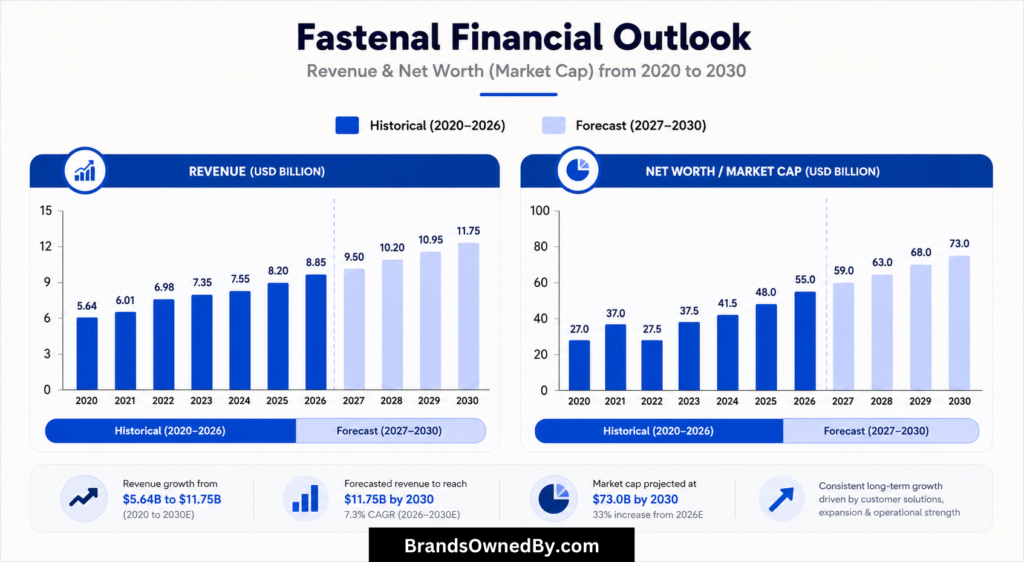
As of June 2026, Fastenal generates approximately $8.85 billion in annual revenue and has a market capitalization of roughly $55 billion. The company’s valuation is more than six times its annual sales, reflecting investor confidence in its profitability, cash generation, and long-term growth prospects.
Unlike many industrial distributors that rely heavily on cyclical demand, Fastenal has gradually transformed its business toward recurring customer relationships through onsite locations, managed inventory programs, and industrial vending solutions. This shift has helped the company grow revenue consistently while supporting a premium market valuation.
June 2026 Revenue Analysis
Fastenal’s estimated revenue of $8.85 billion in 2026 represents an increase of approximately $3.21 billion compared with 2020 revenue of $5.64 billion.
Over the six-year period, revenue has expanded by nearly 57%, significantly outpacing growth in many traditional industrial distribution businesses.
The company’s growth profile can be divided into three distinct phases.
The first phase occurred between 2020 and 2022, when revenue increased from $5.64 billion to $6.98 billion. This represented cumulative growth of approximately 23.8%. Much of this increase came from strong industrial demand, pricing actions, supply chain disruptions that favored larger distributors, and increased safety-product sales.
The second phase occurred during 2023 and 2024. Revenue growth slowed as manufacturing activity weakened across parts of North America. Revenue increased from $6.98 billion to $7.55 billion, representing cumulative growth of approximately 8.2% over the two-year period.
The third phase began in 2025 and continued into 2026. Revenue increased from $7.55 billion in 2024 to approximately $8.85 billion in 2026. This represents growth of more than 17% in only two years, indicating a return to stronger business momentum.
Where Fastenal’s Revenue Comes From
One of the biggest misconceptions about Fastenal is that it primarily sells nuts, bolts, and fasteners.
While fasteners remain a core category, the company’s revenue mix has become significantly more diversified.
Fastenal now generates billions of dollars from industrial supplies, safety equipment, tools, cutting products, inventory management services, vending solutions, and onsite customer programs.
The largest customer group is the manufacturing sector, which typically accounts for approximately 70% to 75% of total sales. These customers include machinery manufacturers, transportation companies, heavy equipment producers, aerospace suppliers, metal fabricators, and industrial contractors.
The remaining 25% to 30% of revenue comes primarily from construction, government, warehousing, utilities, and other non-manufacturing customers.
This diversification helps reduce dependence on any single industry.
The Real Driver of Growth: Managed Inventory
The most important revenue driver is no longer product sales alone.
Fastenal’s Fastenal Managed Inventory (FMI) program has become a major competitive advantage.
Under FMI agreements, Fastenal manages inventory directly for customers through onsite locations, vending machines, automated replenishment systems, and integrated supply-chain solutions.
These programs create recurring revenue streams and increase customer retention.
Once inventory systems are integrated into a customer’s operations, switching suppliers becomes more difficult and costly.
This creates a higher-quality revenue base than traditional transactional distribution businesses.
As a result, a growing percentage of Fastenal’s revenue is tied to long-term customer relationships rather than one-time product purchases.
2026 Net Worth Analysis
Fastenal’s market capitalization of approximately $55 billion is particularly significant when compared with its revenue base.
With annual revenue of approximately $8.85 billion, investors are valuing the company at roughly 6.2 times annual sales.
This multiple is substantially higher than many traditional industrial distributors.
The premium valuation reflects several factors.
First, Fastenal consistently generates strong operating margins compared with many competitors.
Second, the company has maintained a strong balance sheet with relatively conservative financial management.
Third, investors view Fastenal as a technology-enabled industrial distributor rather than a traditional product reseller.
The company’s inventory management systems, onsite programs, data analytics capabilities, and industrial vending network create barriers to entry that support long-term profitability.
Revenue Growth vs. Net Worth Growth
One of the most interesting trends is the difference between revenue growth and valuation growth.
Between 2020 and June 2026, revenue increased by approximately 57%.
During the same period, market capitalization increased from approximately $27 billion to $55 billion, representing growth of more than 103%.
In other words, Fastenal’s valuation grew nearly twice as fast as its revenue.
This indicates that investors are not simply paying for current revenue levels. They are assigning a higher value to each dollar of revenue because they expect future earnings, cash flow, and market share gains to continue increasing.
Revenue Forecast Through 2030
Fastenal Revenue & Net Worth (2020–2030)
Historical Performance and Forecast
Based on historical growth trends, customer expansion initiatives, and increasing adoption of managed inventory programs, Fastenal’s revenue could continue growing at a mid-single-digit to high-single-digit rate through the end of the decade.
Projected revenue figures include:
- 2027: $9.50 billion.
- 2028: $10.20 billion.
- 2029: $10.95 billion.
- 2030: $11.75 billion.
If these projections are achieved, Fastenal would add approximately $2.9 billion in additional annual revenue between 2026 and 2030.
That would represent growth of approximately 33% over four years.
Assuming valuation multiples remain relatively stable, market capitalization could increase from approximately $55 billion in June 2026 to roughly $73 billion by 2030.
What Investors Are Watching
The biggest factors likely to influence Fastenal’s future revenue and valuation are manufacturing activity, industrial capital spending, and growth in managed inventory programs.
Investors are also closely monitoring the expansion of onsite locations. These facilities typically generate deeper customer relationships, higher retention rates, and larger average account sizes than traditional branch sales.
The upcoming CEO transition to Jeffery Watts is another important factor. Investors will be watching whether Fastenal can maintain its historical growth trajectory while continuing to expand technology-driven services and supply-chain solutions.
The company’s ability to convert industrial customers into long-term managed inventory clients will likely determine whether revenue approaches the projected $11.75 billion level by 2030 and whether its market value continues to outpace revenue growth.
Brands Owned by Fastenal
As of 2026, most of Fastenal’s value is concentrated within the Fastenal operating platform itself. However, the company owns several important business units, proprietary service platforms, private-label brands, and operational entities that play a critical role in its growth.
Fastenal Companies, Brands & Business Units
Core Businesses Operated by Fastenal
FMI
Managed Inventory
Onsite
1,900+ Locations
FASTBin
Inventory Automation
FASTVend
Industrial Vending
eBusiness
Digital Procurement
Safety
PPE & Compliance
Holo-Krome
Premium Fasteners
Blue Lane
Private Label Brand
Manufacturing
Industrial Components
Logistics
Distribution Network
Fastenal Company
Fastenal Company is the primary operating entity and the core business owned by shareholders.
Founded in 1967 in Winona, Minnesota, Fastenal has grown into one of North America’s largest industrial supply distributors. The company operates thousands of customer service locations and serves manufacturing, construction, transportation, aerospace, energy, government, and maintenance customers.
Fastenal distributes millions of products across categories such as fasteners, safety supplies, tools, cutting products, abrasives, hydraulics, electrical supplies, material handling equipment, and industrial maintenance products.
Unlike many competitors that rely heavily on acquisitions, nearly all of Fastenal’s revenue is generated through this core operating business.
Fastenal Managed Inventory (FMI)
Fastenal Managed Inventory is one of the company’s most valuable operating platforms.
FMI is not a separate corporation but functions as a specialized business division focused on supply chain management and inventory optimization.
Under FMI agreements, Fastenal manages customer inventory directly through software, automated replenishment systems, onsite personnel, vending machines, and integrated procurement solutions.
This business has become one of Fastenal’s most important competitive advantages because it creates recurring customer relationships and increases switching costs.
By 2026, FMI represents a significant portion of the company’s customer engagements and is widely considered one of the primary drivers of future growth.
Fastenal Onsite Locations
The Fastenal Onsite program operates as another major business unit within the company.
Through this model, Fastenal establishes dedicated inventory and service facilities directly inside customer manufacturing plants, warehouses, and industrial facilities.
Unlike traditional branches, onsite locations are designed exclusively for a specific customer.
These facilities allow Fastenal to manage inventory, procurement, and logistics while becoming deeply integrated into customer operations.
By 2026, the company operates well over 1,900 onsite locations globally, making this one of Fastenal’s largest and fastest-growing service platforms.
FASTVend
FASTVend is Fastenal’s industrial vending business.
The platform includes automated vending machines, inventory lockers, smart cabinets, and dispensing systems that allow customers to control and monitor inventory usage in real time.
FASTVend helps manufacturers reduce waste, improve accountability, and maintain production efficiency.
The system tracks product consumption, generates usage reports, and automatically initiates replenishment orders when inventory reaches predefined levels.
This platform has become a major differentiator for Fastenal and continues to expand throughout manufacturing and industrial facilities.
FASTBin
FASTBin is an automated inventory replenishment solution developed by Fastenal.
The system uses RFID technology, barcode scanning, and smart inventory tracking to monitor stock levels automatically.
When inventory falls below predetermined thresholds, replenishment orders are triggered without requiring manual intervention.
FASTBin reduces inventory shortages and improves supply chain efficiency for customers operating large manufacturing facilities.
The technology plays a central role in Fastenal’s strategy of becoming a supply chain partner rather than simply a product distributor.
Fastenal eBusiness Platform
Fastenal’s eBusiness platform serves as the company’s digital commerce and procurement infrastructure.
The platform allows customers to place orders, monitor inventory levels, track deliveries, manage purchasing approvals, and integrate Fastenal’s systems with enterprise resource planning (ERP) software.
Large industrial customers increasingly use the platform to automate procurement activities and reduce administrative costs.
The growth of digital ordering and integrated supply chain management has made the eBusiness platform an increasingly important component of Fastenal’s operations.
Fastenal Manufacturing Operations
Although Fastenal is primarily known as a distributor, the company also operates manufacturing facilities.
These operations produce selected fasteners, industrial products, and specialized components sold through Fastenal’s distribution network.
Manufacturing allows the company to maintain greater control over product quality, supply availability, and customer service levels.
While manufacturing contributes a relatively small percentage of total revenue, it supports the company’s broader supply chain strategy.
Blue Lane
Blue Lane is Fastenal’s proprietary private-label brand.
The brand was developed to provide customers with high-quality industrial products at competitive prices.
Blue Lane products are available across multiple categories, including tools, safety equipment, maintenance supplies, abrasives, cutting products, and industrial consumables.
Because private-label products typically generate higher margins than third-party brands, Blue Lane contributes positively to Fastenal’s profitability.
The brand has expanded significantly as customers seek cost-effective alternatives to premium national brands.
Holo-Krome
Holo-Krome is one of the most recognized industrial fastener brands distributed and controlled through Fastenal’s product portfolio.
The brand specializes in high-strength socket-head cap screws, fasteners, and precision-engineered industrial fastening solutions.
Holo-Krome products are widely used in aerospace, manufacturing, defense, and heavy equipment applications where reliability and performance are critical.
The brand enhances Fastenal’s presence in specialized fastening solutions and premium industrial markets.
Fastenal Safety Solutions
Fastenal Safety Solutions operates as a specialized business unit focused on workplace safety products and services.
The division provides personal protective equipment (PPE), fall protection systems, respiratory equipment, first-aid products, and safety training solutions.
Safety products have become one of Fastenal’s fastest-growing categories over the past decade.
The business benefits from regulatory compliance requirements and increasing workplace safety standards across industrial sectors.
Distribution Centers and Supply Chain Network
Fastenal owns and operates an extensive logistics network that functions as a strategic asset.
The company maintains multiple regional distribution centers, hub facilities, transportation operations, and inventory management systems throughout North America and international markets.
These facilities enable rapid product availability and efficient fulfillment for customers.
The supply chain network is one of Fastenal’s most important competitive advantages and supports its ability to provide next-day and same-day service in many markets.
Final Thoughts
Fastenal is a publicly traded company owned primarily by institutional investors, with The Vanguard Group serving as the largest shareholder. Other major owners include BlackRock, State Street, company insiders, and retail investors.
While ownership is distributed across thousands of shareholders, operational control remains with CEO Daniel Florness and the board of directors.
Fastenal’s strong market position, consistent profitability, growing revenue base, and extensive industrial supply network have made it one of North America’s most successful industrial distribution companies. Its diversified ownership structure and disciplined management approach continue to support long-term growth.
FAQs
When was Fastenal founded?
Fastenal was founded in 1967 by Bob Kierlin in Winona, Minnesota. The company started as a small fastener distributor focused on supplying nuts, bolts, screws, and other industrial fastening products to local businesses. Over the following decades, Fastenal expanded into a full-service industrial distribution company serving customers across North America and international markets.
Where is Fastenal headquarters?
Fastenal’s headquarters is located in Winona, Minnesota, United States.
The company has maintained its headquarters in Winona since its founding. The location serves as the center of Fastenal’s corporate leadership, strategic planning, technology development, supply chain management, and administrative operations. Despite its global expansion, Fastenal has continued to operate from its original hometown.
Is Fastenal a public company?
Yes, Fastenal is a publicly traded company.
The company is listed on the Nasdaq Stock Market under the ticker symbol FAST. Fastenal completed its Initial Public Offering (IPO) in 1987, allowing public investors to purchase shares of the company.
Today, Fastenal is owned by a combination of institutional investors, retail shareholders, mutual funds, pension funds, and company insiders. No single shareholder controls the business.
What does Fastenal Company do?
Fastenal is an industrial supply distribution company that provides products and supply-chain solutions to businesses.
The company distributes millions of products across categories such as:
- Fasteners.
- Safety equipment.
- Industrial tools.
- Cutting tools.
- Abrasives.
- Electrical supplies.
- Hydraulics.
- Material handling products.
- Maintenance and repair supplies.
Beyond product distribution, Fastenal operates inventory management programs, industrial vending systems, onsite customer facilities, and procurement solutions that help businesses manage inventory more efficiently.
Its primary customers include manufacturers, construction companies, transportation firms, government agencies, utilities, and industrial contractors.
Is Fastenal a Fortune 500 company?
No, Fastenal is not currently included in the Fortune 500 ranking.
The Fortune 500 list is based on annual revenue, and while Fastenal generates more than $8 billion in annual sales, its revenue remains below the threshold typically required for inclusion in the Fortune 500.
However, Fastenal is one of the largest industrial distribution companies in North America and is frequently included in rankings of America’s most successful industrial and manufacturing-related businesses.
Who are the major shareholders of Fastenal?
Fastenal’s largest shareholders are primarily institutional investors.
As of 2026, the major shareholders include:
- The Vanguard Group.
- BlackRock.
- State Street Global Advisors.
- Charles Schwab Investment Management.
- Geode Capital Management.
Together, institutional investors own more than 80% of Fastenal’s outstanding shares. The Vanguard Group is generally recognized as the company’s largest shareholder, holding the biggest individual ownership stake among investment firms.
How much does the CEO of Fastenal make?
Daniel L. Florness served as Fastenal’s Chief Executive Officer through July 2026 before the planned leadership transition to Jeffery Watts.
CEO compensation varies from year to year and typically includes:
- Base salary.
- Annual cash incentives.
- Stock awards.
- Performance-based compensation.
- Other executive benefits.
In recent years, Fastenal’s CEO compensation package has generally been valued in the range of $8 million to $12 million annually, depending on company performance, stock-based awards, and incentive payments approved by the board of directors.
Who is Fastenal’s biggest competitor?
W.W. Grainger is widely considered Fastenal’s biggest competitor.
Both companies operate in the industrial distribution and maintenance, repair, and operations (MRO) supply market. They compete across product categories including industrial supplies, safety equipment, tools, inventory management solutions, and supply-chain services.
Other significant competitors include:
- MSC Industrial Direct.
- Wesco International.
- Applied Industrial Technologies.
- Ferguson Enterprises.
- Global Industrial Company.
Among these competitors, Grainger is generally viewed as Fastenal’s closest rival due to its size, market presence, broad product portfolio, and extensive customer base across North America.