
- Sega is owned by Sega Sammy Holdings Inc., a Japanese entertainment conglomerate formed after the 2004 merger between Sega and Sammy Corporation.
- The Satomi family is the most influential shareholder group in Sega Sammy Holdings, controlling roughly 19% of shares through direct ownership and affiliated entities such as HS Company.
- Major institutional shareholders of Sega Sammy Holdings as of 2026 include The Master Trust Bank of Japan, BlackRock, State Street Bank and Trust Company, Vanguard Group, and Nomura Asset Management.
- Sega’s business is controlled through Sega Sammy Holdings leadership, with Haruki Satomi serving as Group CEO and Shuji Utsumi leading Sega Corporation’s gaming operations as President and COO.
Sega is a Japanese video game and entertainment company headquartered in Tokyo, Japan. The company develops video games, arcade products, animation projects, and digital entertainment content for global markets.
As of May 2026, Sega mainly focuses on software publishing rather than gaming hardware. The company publishes games for PlayStation, Xbox, Nintendo Switch, PC, and mobile platforms. Sega also operates in licensing, esports, merchandising, and multimedia entertainment.
The company is best known for creating some of the gaming industry’s most recognizable franchises. These include Sonic the Hedgehog, Persona, Like a Dragon, Total War, Football Manager, and Phantasy Star.
Sega operates under Sega Sammy Holdings, which serves as its parent company. The business manages several internal studios and subsidiaries across Japan, Europe, and North America.
Unlike many gaming companies that focus on a single category, Sega operates through multiple entertainment segments. These include:
- Console and PC game publishing.
- Mobile gaming.
- Arcade systems.
- Animation and media projects.
- Licensing and merchandising.
- Amusement machine operations.
One major example of Sega’s diversification is Sonic the Hedgehog. The franchise expanded beyond gaming into movies, streaming content, toys, apparel, and brand collaborations. The success of the Sonic films helped Sega strengthen its mainstream entertainment presence globally.
Sega also expanded aggressively in mobile gaming after acquiring Rovio Entertainment, the creator of Angry Birds. This acquisition improved Sega’s mobile publishing infrastructure and advertising capabilities.
Today, Sega is considered one of Japan’s largest gaming publishers and one of the most recognizable entertainment brands in the global gaming industry.
Sega Founders
Sega’s origins are more complex than many modern gaming companies because the business evolved through mergers, acquisitions, and restructuring over several decades.
The company’s early foundation traces back to Martin Bromley, Irving Bromberg, and James Humpert. These American businessmen were involved in amusement machine operations connected to military entertainment services after World War II.
The original business operated under Service Games. The company supplied coin-operated entertainment machines to U.S. military bases in Japan and other regions.
The name “Sega” later emerged from the phrase “Service Games.”
During the 1960s, the business expanded deeper into amusement and arcade operations in Japan. Over time, Sega shifted from importing machines to developing original entertainment products.
David Rosen also became one of the most important figures in Sega’s history. He founded Rosen Enterprises, a company specializing in photo booths and amusement machines in Japan.
Rosen Enterprises later merged with Service Games operations. This merger helped shape the modern Sega organization.
David Rosen played a major role in Sega’s international expansion and early arcade success. Under his leadership, Sega became heavily involved in arcade innovation during the 1970s and 1980s.
Later executives such as Hayao Nakayama transformed Sega into a global gaming giant during the console era. Although Nakayama was not a founder, he became one of the company’s most influential leaders through the Sega Genesis and arcade expansion period.
Because of Sega’s long corporate history, the company is often associated with multiple founding figures rather than one single founder. The most commonly recognized early founders and builders include:
- Martin Bromley.
- Irving Bromberg.
- James Humpert.
- David Rosen.
These individuals helped establish the foundation that later evolved into modern Sega Corporation.
Ownership History
Sega’s ownership history is closely tied to the evolution of the global gaming industry. The company changed significantly over the decades through mergers, restructurings, financial crises, and acquisitions. Its journey from an arcade machine business to a subsidiary of Sega Sammy Holdings is one of the most important corporate transformations in gaming history.
Early Formation of Service Games
Sega’s roots trace back to the post-World War II period.
The original business began as Service Games, a company founded by Martin Bromley, Irving Bromberg, and James Humpert. The business focused on supplying coin-operated amusement machines to U.S. military bases in Japan and nearby regions.
The name “Sega” was later derived from the phrase “Service Games.”
At this stage, the company mainly operated in the amusement and entertainment machine industry rather than video gaming.
David Rosen and the Expansion Era
A major shift happened when David Rosen entered the business.
Rosen founded Rosen Enterprises in Japan during the 1950s. His company specialized in amusement machines, jukeboxes, and photo booths. Rosen recognized the growing entertainment demand in Japan and expanded aggressively.
Eventually, Rosen Enterprises merged with Service Games operations. This merger played a critical role in shaping the modern Sega business.
David Rosen later became one of Sega’s most influential early leaders. Under his leadership, Sega invested heavily in arcade technology and entertainment products.
The company gained popularity in Japan’s growing arcade industry during the 1960s and 1970s.
Gulf and Western Ownership
Another major ownership change occurred in 1969.
American conglomerate Gulf and Western Industries acquired Sega Enterprises. This acquisition gave Sega access to larger financial resources and international business support.
Under Gulf and Western ownership, Sega continued expanding its arcade business and amusement operations. The company became increasingly involved in developing original arcade titles rather than simply distributing imported machines.
This period helped Sega build its technical expertise in entertainment hardware and software.
Management Buyout and Independence
In the early 1980s, Gulf and Western began restructuring several businesses.
As part of this process, Sega’s management team and investors purchased parts of the company’s operations. David Rosen and Hayao Nakayama became especially important during this transition.
Nakayama later emerged as one of the most influential figures in Sega’s history.
After regaining greater independence, Sega accelerated its gaming expansion strategy. The company entered the home console market more aggressively and challenged competitors such as Nintendo.
The Console Wars and Rapid Expansion
During the late 1980s and 1990s, Sega experienced massive international growth.
The Sega Genesis, known as the Mega Drive in several markets, became one of the company’s most successful products. Sega positioned itself as a more aggressive and edgy alternative to Nintendo.
This period transformed Sega into a globally recognized gaming brand.
The company invested heavily in:
- Home consoles.
- Arcade systems.
- Game development studios.
- International publishing.
- Marketing campaigns.
Hayao Nakayama played a central role in Sega’s expansion strategy during this era.
However, rapid expansion also created financial pressure. Several hardware decisions later weakened the company’s market position.
Sega Saturn and Dreamcast Challenges
The Sega Saturn struggled against Sony’s PlayStation in many global markets.
Development complexity, high production costs, and marketing problems affected the console’s commercial performance.
Sega later launched the Dreamcast in 1998. The console received strong reviews and introduced innovative online gaming features ahead of competitors.
Despite its technical strengths, the Dreamcast failed to compete long-term against Sony’s PlayStation 2.
The failure of the Dreamcast created severe financial pressure for Sega.
Exit From the Console Hardware Business
In 2001, Sega officially exited the home console manufacturing business.
This decision marked one of the biggest turning points in the company’s ownership and operational history.
Instead of producing hardware, Sega shifted toward third-party software publishing. The company began developing games for rival platforms including PlayStation, Nintendo, Xbox, and PC.
This strategy helped reduce manufacturing risks and stabilized operations.
The transition was difficult initially. However, it eventually allowed Sega to focus more heavily on intellectual property development and publishing.
Isao Okawa’s Financial Support
During Sega’s financial struggles, Isao Okawa became a crucial figure in the company’s survival.
Okawa served as chairman of Sega and personally supported the business during its restructuring period.
Before his death, Okawa reportedly forgave large debts owed by Sega and transferred valuable assets to help stabilize the company financially.
Many industry analysts consider this support one of the key reasons Sega survived the post-Dreamcast crisis.
Without that intervention, Sega’s future could have been far more uncertain.
Merger With Sammy Corporation
The most important ownership transformation happened in 2004.
Sega merged with Sammy Corporation to form Sega Sammy Holdings.
Sammy was a Japanese company specializing in pachinko machines and amusement products. The company had strong financial performance and stable cash flow.
The merger created a broader entertainment group combining:
- Video games.
- Arcade operations.
- Pachinko businesses.
- Amusement systems.
- Digital entertainment.
Under this structure, Sega became a subsidiary of Sega Sammy Holdings.
Hajime Satomi, founder of Sammy Corporation, became one of the most influential figures in the combined organization.
This merger gave Sega stronger financial backing and greater operational stability.
Expansion Under Sega Sammy Holdings
After the merger, Sega expanded internationally through acquisitions and studio investments.
The company strengthened its publishing business and invested more heavily in digital gaming.
Several major acquisitions reshaped Sega’s portfolio during this period.
Key acquisitions included:
- Atlus.
- Creative Assembly.
- Sports Interactive.
- Amplitude Studios.
- Rovio Entertainment.
These acquisitions helped Sega expand into role-playing games, strategy gaming, football simulations, and mobile gaming.
The Rovio acquisition became especially important because it added the Angry Birds franchise and strengthened Sega’s mobile gaming infrastructure.
Sega’s Ownership Structure As of May 2026
As of May 2026, Sega operates as a wholly controlled subsidiary of Sega Sammy Holdings Inc.
The parent company is publicly traded on the Tokyo Stock Exchange. Ownership is distributed among institutional investors, financial organizations, investment funds, and retail shareholders.
The Satomi family remains one of the most influential shareholder groups connected to the company.
Although Sega Sammy Holdings has public shareholders, operational control mainly flows through executive leadership, board governance, and long-term institutional ownership relationships.
Today, Sega functions as a global gaming and entertainment business rather than simply a console manufacturer. Its ownership history reflects decades of restructuring, adaptation, and expansion across changing entertainment markets.
Who Owns Sega: Largest Shareholders
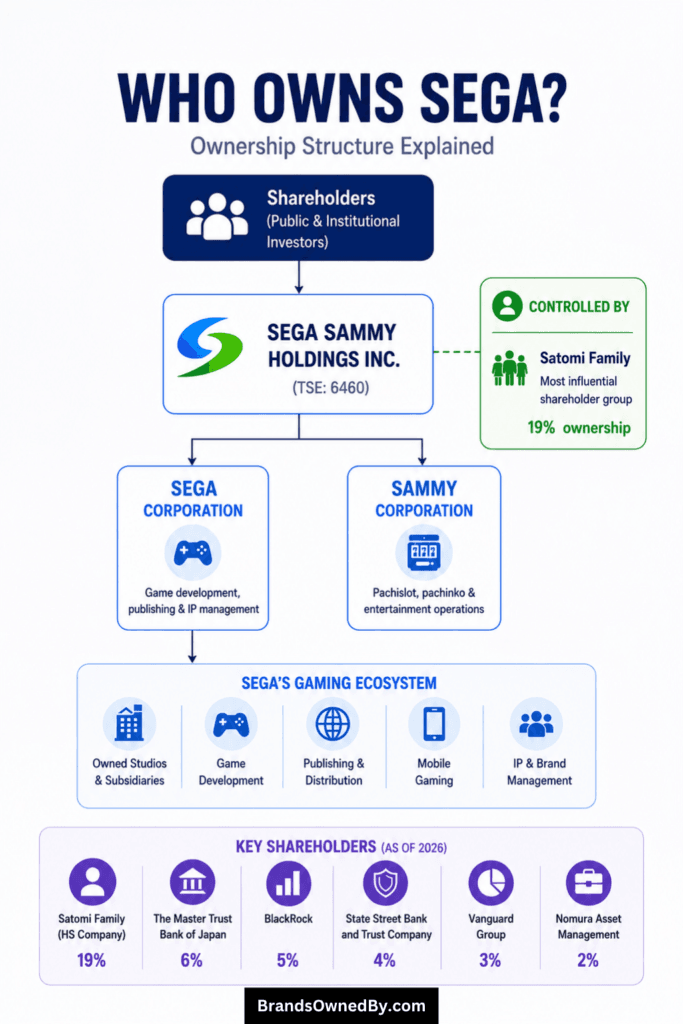
Sega is owned by Sega Sammy Holdings Inc., a Japanese entertainment conglomerate listed on the Tokyo Stock Exchange. Sega operates as one of the group’s primary subsidiaries alongside pachinko, amusement, and resort businesses.
As of May 2026, ownership of Sega Sammy Holdings is divided among the Satomi family, Japanese trust banks, global institutional investors, asset management firms, and public shareholders.
Although the company is publicly traded, effective control largely remains connected to the Satomi family through direct ownership, affiliated investment companies, executive leadership positions, and long-term governance influence.
The ownership structure is important because Sega Sammy is not controlled by a single corporation like Xbox or PlayStation. Instead, it uses a mixed ownership model that combines founder influence with institutional investment.
The company’s largest shareholders collectively shape:
- Corporate strategy.
- Acquisitions.
- Gaming investments.
- Leadership appointments.
- Capital allocation.
- Share buyback programs.
As of 2026, the majority of Sega Sammy Holdings shares are held by long-term investors rather than short-term traders. This gives Sega relatively stable corporate governance compared to many Western gaming companies.
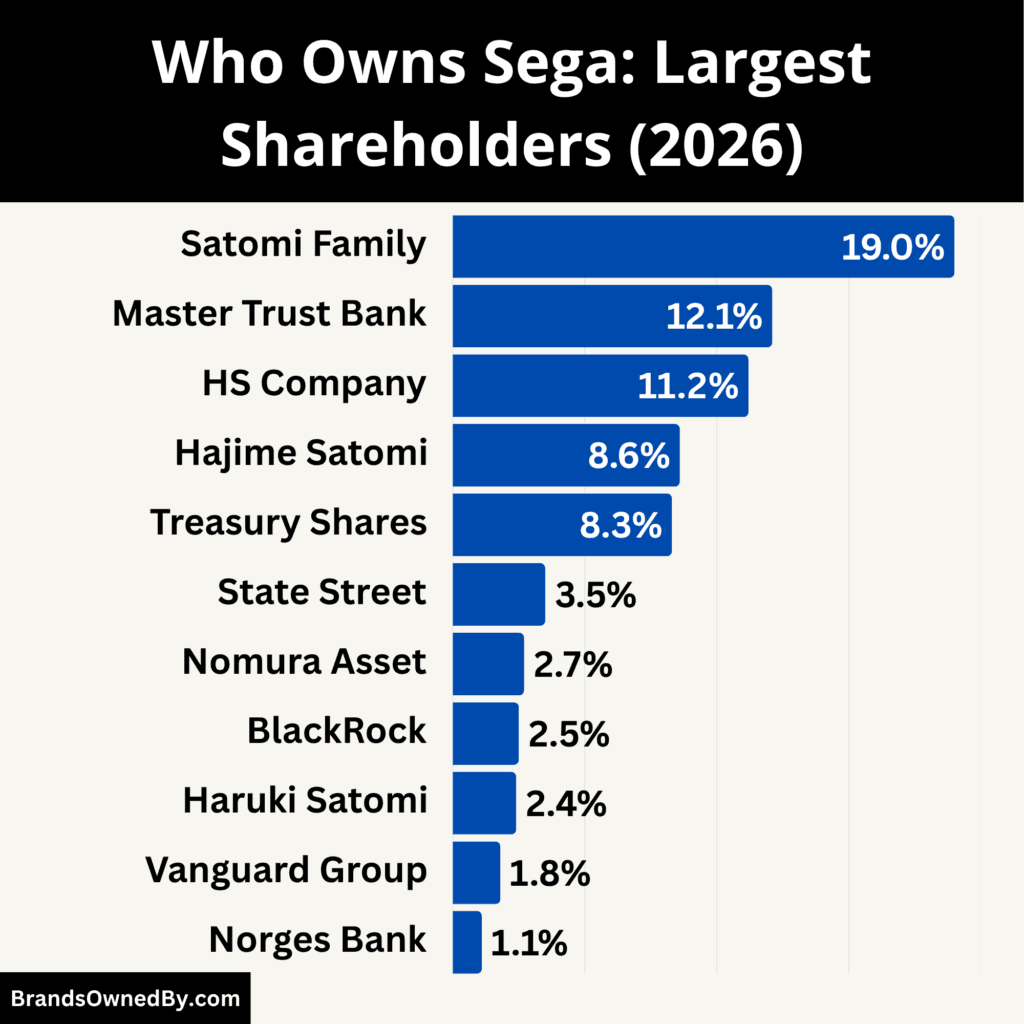
Below is a list of the key shareholders of Sega Sammy Holdings as of May 2026 (the company that ultimately owns Sega):
| Shareholder Group | Estimated Ownership |
|---|---|
| Satomi family and affiliates | 19% |
| Japanese institutional investors | 20%+ |
| International asset managers | 10%+ |
| Public retail investors | Significant minority |
| Treasury shares | 8% |
Satomi Family
The Satomi family remains the most influential ownership group connected to Sega.
As of May 2026, the broader family network controls an estimated 18% to 20% of Sega Sammy Holdings through direct share ownership, affiliated holding companies, and private investment entities.
This ownership level gives the family substantial influence over voting decisions and long-term strategy.
The Satomi family became dominant after the 2004 merger between Sega and Sammy Corporation. Since Sammy was financially stronger at the time, the Satomi side gained significant influence inside the newly formed Sega Sammy Holdings structure.
The family’s influence extends beyond ownership percentages because several members also hold executive and board-level positions.
Their control affects decisions involving:
- Gaming acquisitions.
- Franchise investments.
- International expansion.
- Shareholder policies.
- Executive appointments.
The Satomi group effectively functions as Sega’s controlling ownership bloc.
Hajime Satomi
Hajime Satomi is one of Sega Sammy Holdings’ largest individual shareholders.
As of May 2026, he directly owns roughly 8% to 9% of the company’s shares. His actual influence is larger because of family-related entities and affiliated investment companies connected to his holdings.
Satomi founded Sammy Corporation before the merger with Sega. He later became the architect behind Sega Sammy Holdings.
His ownership position gives him major influence over:
- Corporate governance.
- Strategic planning.
- Board decisions.
- Major investments.
- Long-term restructuring.
Even after transitioning into more senior advisory and chairman-focused roles, Hajime Satomi remains one of the company’s most powerful figures.
His continued involvement provides continuity between the original Sammy business and Sega’s modern gaming operations.
Haruki Satomi
Haruki Satomi, the current Group CEO and President of Sega Sammy Holdings as of May 2026, also owns a meaningful portion of company shares.
His estimated direct ownership is around 2% to 3%, though his influence extends beyond that because of broader family ownership alignment.
Haruki became increasingly important during Sega’s transition toward:
- Digital publishing.
- Mobile gaming.
- Global acquisitions.
- Cross-media entertainment.
- Live-service gaming.
He oversaw several modern expansion initiatives, including the acquisition of Rovio Entertainment.
His ownership stake aligns management incentives closely with shareholder performance because he directly benefits from the company’s long-term growth.
HS Company
HS Company is one of the most important entities in Sega’s ownership structure.
The private company is closely tied to Hajime Satomi and functions as a family-controlled investment vehicle.
As of 2026, HS Company reportedly controls around 10% to 12% of Sega Sammy Holdings shares.
This makes it one of the single largest shareholder entities connected to Sega.
The company exists primarily to maintain stable family influence over Sega Sammy Holdings. Rather than relying entirely on personal ownership, the Satomi family uses HS Company to centralize long-term voting power.
This structure is common among large Japanese corporate groups because it protects strategic continuity and reduces hostile takeover risks.
The Master Trust Bank of Japan
The Master Trust Bank of Japan is one of the largest institutional shareholders in Sega Sammy Holdings.
As of May 2026, the bank controls roughly 11% to 13% of shares through trust accounts and institutional custody services.
Importantly, the bank does not personally own these shares for itself. Instead, it manages holdings on behalf of:
- Pension funds.
- Institutional investors.
- Asset management firms.
- Insurance companies.
- Retirement portfolios.
Its large stake reflects strong institutional confidence in Sega Sammy’s entertainment and gaming businesses.
The bank’s holdings also demonstrate how Japanese corporations rely heavily on long-term institutional ownership rather than speculative trading.
State Street Bank and Trust Company
State Street Bank and Trust Company is another major shareholder connected to Sega Sammy Holdings.
As of 2026, the company controls an estimated 3% to 4% stake through ETF holdings, index funds, and institutional investment products.
State Street is one of the world’s largest custodial and asset servicing firms. Its ownership reflects international investor exposure to Sega through global investment portfolios.
Most of these holdings are passive investments rather than active controlling positions.
Still, a 3% to 4% stake gives State Street notable influence during shareholder voting and governance matters.
Nomura Asset Management
Nomura Asset Management is one of Japan’s largest institutional investment firms.
The company holds an estimated 2% to 3% stake in Sega Sammy Holdings through mutual funds, pension products, and institutional investment portfolios.
Nomura’s investment position reflects confidence in Sega’s intellectual property portfolio and long-term entertainment strategy.
Japanese asset managers often maintain stable long-term positions in domestic companies with strong global branding.
Sega’s ownership of franchises such as Sonic the Hedgehog, Persona, and Like a Dragon makes the company attractive for long-term institutional investment.
BlackRock
BlackRock holds an estimated 2% to 3% stake in Sega Sammy Holdings as of May 2026.
The investment primarily comes through index funds, ETFs, and institutional portfolio products managed by BlackRock.
The company’s involvement highlights Sega’s growing relevance within global entertainment and technology investment markets.
BlackRock typically maintains passive ownership positions. However, because of its scale, even a relatively small percentage gives the firm substantial voting influence.
Its investment also signals international investor confidence in gaming as a long-term digital entertainment sector.
Vanguard Group
The Vanguard Group also holds shares in Sega Sammy Holdings through global index funds and mutual fund products.
As of 2026, Vanguard’s estimated ownership stake is around 1% to 2%.
Although Vanguard does not play an active operational role, its investment is important because it reflects Sega’s inclusion in major international indexes and institutional portfolios.
Passive investment firms like Vanguard provide stability because they typically maintain long-term holdings.
Norges Bank Investment Management
Norges Bank Investment Management, which manages Norway’s sovereign wealth fund, owns roughly 1% of Sega Sammy Holdings shares.
The fund invests globally across technology, gaming, and entertainment sectors.
Its investment in Sega reflects institutional confidence in:
- Global gaming growth.
- Digital entertainment demand.
- Franchise licensing opportunities.
- Mobile gaming expansion.
Sovereign wealth fund ownership also adds credibility to Sega Sammy’s long-term investment profile.
Treasury Shares Held by Sega Sammy Holdings
Sega Sammy Holdings also owns treasury shares representing roughly 7% to 9% of total shares outstanding as of May 2026.
Treasury shares are stock repurchased and held internally by the company.
These shares generally do not carry voting rights. However, they remain strategically important for:
- Share buyback programs.
- Executive compensation.
- Capital management.
- Earnings-per-share optimization.
- Future acquisitions.
Sega Sammy increased treasury share activity in recent years as part of broader shareholder return and capital allocation strategies.
Competitor Ownership Comparison
Sega’s ownership structure differs significantly from many of its gaming competitors. Some gaming companies operate as independent public corporations, while others function as subsidiaries inside larger technology or entertainment groups.
As of May 2026, Sega operates under Sega Sammy Holdings, a diversified entertainment conglomerate. This structure gives Sega financial support from multiple business segments including gaming, pachinko, resorts, and digital entertainment.
By comparison, competitors such as Nintendo, Sony, Microsoft, and Ubisoft use different ownership and governance models that shape how they operate, invest, and grow.
The biggest ownership differences between Sega and its competitors involve:
| Company | Ownership Model | Key Control Structure |
|---|---|---|
| Sega | Subsidiary under entertainment holding company | Satomi family influence through Sega Sammy Holdings |
| Nintendo | Independent public company | Institutionally balanced ownership |
| PlayStation | Division of Sony Group | Controlled by Sony conglomerate |
| Xbox | Division of Microsoft | Controlled by Microsoft corporation |
| Ubisoft | Independent public company | Guillemot family influence |
| Electronic Arts | Independent public company | Institutional investor dominated |
| Bandai Namco | Entertainment holding company | Diversified institutional structure |
Sega vs Nintendo Ownership Structure
Nintendo operates very differently from Sega.
Unlike Sega, Nintendo is not owned by a parent company. It functions as an independent publicly traded corporation listed on the Tokyo Stock Exchange.
As of May 2026, Nintendo’s ownership is heavily institutional but does not have a single controlling family like Sega’s Satomi family structure.
Nintendo’s largest shareholders include:
- The Master Trust Bank of Japan.
- Custody Bank of Japan.
- JPMorgan Chase Bank.
- Bank of Kyoto.
- International institutional investors.
Nintendo historically maintained strong internal independence and resisted mergers or outside corporate control.
This ownership model gives Nintendo more autonomy over:
- Hardware development.
- Platform strategy.
- Intellectual property management.
- Long-term product launches.
For example, Nintendo independently controls the Switch 2 ecosystem, including hardware, software, online services, and licensing.
Sega, in contrast, no longer controls gaming hardware platforms and instead focuses on software publishing across competing ecosystems.
Another key difference is governance influence.
Nintendo does not rely on a founder-family-controlled structure like Sega Sammy Holdings. Its governance is more institutionally balanced, while Sega’s ownership still reflects strong founder-family influence through the Satomi group.
Sega vs PlayStation Ownership Structure
PlayStation operates under Sony Group Corporation.
Sony Interactive Entertainment, the company behind PlayStation, is a wholly owned subsidiary of Sony Group. This means PlayStation itself is not independently traded.
As of May 2026, Sony Group remains one of the world’s largest entertainment and technology companies with operations across:
- Gaming.
- Electronics.
- Music.
- Film.
- Image sensors.
- Financial services.
This gives PlayStation access to significantly larger financial and technological resources than Sega.
Sony’s ownership structure allows integration between multiple entertainment divisions. For example:
- PlayStation games can be adapted into films and television through Sony Pictures.
- Sony Music supports gaming soundtracks and artist partnerships.
- Sony semiconductor divisions contribute to gaming hardware technologies.
Sega does not have this level of internal technology integration.
Instead, Sega focuses more heavily on intellectual property publishing and software development.
Another major difference involves corporate dependency.
PlayStation is strategically important to Sony Group, but remains one division within a much larger corporation. Sega, meanwhile, represents one of the core pillars of Sega Sammy Holdings.
This means Sega often receives greater direct strategic focus from its parent company than PlayStation does within Sony’s broader portfolio.
Sega vs Xbox Ownership Structure
Xbox operates under Microsoft Corporation.
Microsoft completed its acquisition of Activision Blizzard in 2023, significantly expanding its gaming ownership structure. As of May 2026, Xbox Game Studios controls a massive portfolio including:
- Bethesda.
- Activision.
- Blizzard.
- Mojang.
- Obsidian.
- Ninja Theory.
- Rare.
Unlike Sega, Xbox benefits from Microsoft’s massive enterprise and cloud infrastructure business.
Gaming represents only a portion of Microsoft’s overall operations. The company also generates major revenue from:
- Cloud computing.
- Enterprise software.
- AI services.
- Productivity tools.
- Data infrastructure.
This ownership structure gives Xbox enormous financial flexibility for acquisitions and long-term investments.
For example, Microsoft can fund expensive gaming acquisitions using cash generated outside gaming.
Sega cannot compete at that scale financially because Sega Sammy Holdings is much smaller overall.
However, Sega has one strategic advantage.
Sega operates platform-neutral publishing. Its games launch across PlayStation, Xbox, Nintendo, and PC ecosystems. Microsoft still prioritizes expanding the Xbox ecosystem, Game Pass subscriptions, and cloud gaming infrastructure.
As a result, Sega faces less hardware ecosystem pressure than Xbox.
Sega vs Ubisoft Ownership Structure
Ubisoft operates as an independent publicly traded company headquartered in France.
Unlike Sega, Ubisoft does not belong to a larger entertainment conglomerate.
As of May 2026, Ubisoft’s ownership structure still centers around the Guillemot family, which co-founded the company.
The Guillemot family maintains significant voting influence through direct ownership and holding structures, similar in some ways to Sega’s Satomi family influence.
However, Ubisoft has faced stronger pressure from activist investors and market volatility in recent years.
Sega Sammy’s diversified structure gives Sega more financial stability during weaker gaming cycles.
Ubisoft depends much more heavily on the performance of its gaming division alone.
For example, delays involving Assassin’s Creed, Star Wars Outlaws, or live-service projects directly impact Ubisoft’s financial performance more aggressively than game delays impact Sega Sammy Holdings.
Sega benefits from diversified entertainment operations beyond traditional gaming.
Sega vs Electronic Arts Ownership Structure
Electronic Arts operates as a standalone American public company.
Unlike Sega, EA has no controlling family ownership group and no parent conglomerate.
Ownership is dominated by:
- Institutional investors.
- Asset management firms.
- Pension funds.
- Public shareholders.
Major investors include BlackRock, Vanguard, and State Street.
EA’s governance model is much more shareholder-driven compared to Sega’s founder-influenced structure.
EA focuses heavily on:
- Sports gaming.
- Live-service monetization.
- Subscription services.
- Digital distribution.
Franchises such as EA Sports FC, Madden NFL, Apex Legends, and The Sims generate recurring revenue through online ecosystems.
Sega’s portfolio is more diversified across role-playing games, strategy titles, arcade properties, and multimedia entertainment.
EA also operates with a stronger North American business orientation, while Sega maintains deeper roots in Japanese gaming culture and Asian entertainment markets.
Sega vs Bandai Namco Ownership Structure
Bandai Namco’s ownership structure is one of the closest comparisons to Sega.
Like Sega Sammy Holdings, Bandai Namco operates as a diversified Japanese entertainment conglomerate.
Bandai Namco Holdings oversees:
- Video games.
- Toys.
- Anime.
- Licensing.
- Arcades.
- Theme attractions.
This model closely resembles Sega Sammy’s multi-segment entertainment strategy.
Both companies rely heavily on intellectual property monetization across multiple industries.
For example:
- Sega uses Sonic the Hedgehog across games, films, and merchandise.
- Bandai Namco uses franchises such as Gundam, Dragon Ball, and Pac-Man across similar entertainment channels.
However, Bandai Namco’s ownership structure is less concentrated around a single founder family compared to Sega Sammy’s Satomi-centered influence.
Bandai Namco’s governance is more institutionally diversified.
Who Controls Sega?
Sega is ultimately controlled by Sega Sammy Holdings Inc., the Japanese entertainment conglomerate formed after the merger between Sega and Sammy Corporation in 2004. As of May 2026, control over Sega is concentrated among the Satomi family, Sega Sammy Holdings executives, and the company’s board of directors.
Unlike Nintendo, which operates independently, or Xbox, which is directly controlled by Microsoft, Sega functions as a subsidiary inside a larger entertainment holding structure. This means the company’s most important strategic decisions are approved at the Sega Sammy Holdings level rather than by Sega alone.
The control structure is heavily influenced by:
- Founder-family ownership.
- Executive leadership.
- Board governance.
- Institutional shareholders.
- Subsidiary management teams.
However, the strongest long-term influence still comes from the Satomi family and Sega Sammy Holdings leadership.
Sega Sammy Holdings Controls Sega
Sega operates under Sega Sammy Holdings, which serves as the company’s parent organization.
As of May 2026, Sega Sammy Holdings oversees several major business segments:
- Sega gaming operations.
- Sammy pachinko and pachislot businesses.
- Animation and media operations.
- Resort and entertainment investments.
- Mobile gaming and digital publishing.
The holding company structure allows Sega Sammy to coordinate financial planning, acquisitions, investments, and executive management across multiple divisions.
This means Sega itself does not independently control major corporate decisions involving:
- Large acquisitions.
- Share repurchase programs.
- Executive restructuring.
- Capital allocation.
- Long-term investment strategy.
For example, Sega’s acquisition of Rovio Entertainment was executed through Sega Sammy Holdings’ broader strategic expansion plan rather than through Sega operating independently.
The parent company also controls Sega’s annual budget priorities, international expansion direction, and group-wide intellectual property strategy.
Hajime Satomi Remains the Most Powerful Figure Behind Sega
Hajime Satomi remains the single most influential individual connected to Sega as of May 2026.
He founded Sammy Corporation in 1975 after leaving Aoyama Gakuin University and built the business into one of Japan’s largest pachinko and pachislot companies.
In 2004, Satomi orchestrated the merger between Sammy and Sega, creating Sega Sammy Holdings. Although the merger was publicly presented as a partnership, Sammy effectively became the financially dominant side of the deal.
At the time of the merger:
- Sega had reportedly been unprofitable for nearly a decade.
- Sammy had significantly stronger cash flow and financial stability.
- Sammy already owned 22.4% of Sega before the final merger agreement.
Satomi used this position to reshape Sega’s corporate structure and leadership.
As of May 2026:
- Hajime Satomi serves as Chairman of Sega Sammy Holdings.
- He directly owns approximately 8.6% of company shares.
- His affiliated entity HS Company controls an additional 11.2%.
- Combined family influence connected to the Satomi group remains around 19% of total ownership.
This makes the Satomi network the company’s dominant control bloc.
Satomi’s influence goes beyond ownership percentages because he also shaped Sega Sammy’s governance model, executive appointments, and acquisition strategy over the past two decades.
Several major strategic shifts were executed under his leadership, including:
- Sega’s transition toward digital publishing.
- Expansion into mobile gaming.
- Increased focus on transmedia franchises.
- International acquisitions.
- Cost restructuring across gaming divisions.
Even though day-to-day operations are handled by newer executives, Hajime Satomi still holds major influence over long-term strategic direction.
Haruki Satomi Runs Sega Sammy’s Modern Operations
Haruki Satomi currently serves as President and Group CEO of Sega Sammy Holdings as of May 2026.
He is Hajime Satomi’s son and represents the next generation of leadership inside the Sega Sammy group.
Haruki became increasingly influential during Sega’s push into:
- Global publishing.
- Mobile gaming.
- Live-service infrastructure.
- Multimedia entertainment.
- International acquisitions.
One of his most important strategic moves was overseeing Sega’s acquisition of Rovio Entertainment, the creator of Angry Birds.
Under Haruki Satomi’s leadership, Sega accelerated its strategy of turning gaming franchises into broader entertainment brands.
This included expansion involving:
- Sonic the Hedgehog films.
- Streaming projects.
- Licensing partnerships.
- Merchandise growth.
- Cross-media collaborations.
Haruki also pushed Sega toward a stronger international business structure rather than relying primarily on the Japanese domestic gaming market.
As of May 2026, Haruki controls Sega operationally through:
- Group-wide executive authority.
- Board-level leadership.
- Ownership stakes.
- Corporate restructuring power.
His leadership style is considered more globally focused compared to earlier Sega executives.
Shuji Utsumi Controls Sega’s Gaming Strategy
Shuji Utsumi became one of Sega’s most important executives after being appointed President and COO of Sega in April 2024. He also serves as CEO of Sega of America and Sega Europe.
Utsumi has extensive gaming industry experience.
Before joining Sega leadership, he worked at:
- Sony Computer Entertainment America.
- Disney Interactive.
- Warner Music Japan.
- Cybird.
- Q Entertainment.
At Sony, he helped support third-party relations during the original PlayStation launch era.
Inside Sega, Utsumi now controls much of the company’s gaming business strategy, including:
- Global publishing operations.
- Franchise expansion.
- Western market growth.
- Platform partnerships.
- Transmedia initiatives.
- Revivals of dormant IP.
As of 2026, Sega has actively revived several legacy franchises under Utsumi’s strategy, including projects connected to:
- Crazy Taxi.
- Jet Set Radio.
- Shinobi.
- Golden Axe.
Utsumi strongly advocates positioning Sega as an “IP powerhouse” rather than only a traditional game publisher.
This strategy focuses on turning Sega franchises into broader entertainment ecosystems involving games, films, streaming, licensing, and merchandise.
Sega’s Internal Studio Structure
Although Sega Sammy Holdings controls overall strategy, Sega’s individual studios maintain partial operational independence.
As of May 2026, Sega’s major internal studios include:
- Sonic Team.
- Ryu Ga Gotoku Studio.
- Atlus.
- Creative Assembly.
- Sports Interactive.
- Amplitude Studios.
- Sega Sapporo Studio.
Each studio has its own management structure and creative leadership. However, major financial and publishing decisions still flow upward through Sega Corporation and Sega Sammy Holdings.
For example:
Sonic Team
Sonic Team controls Sonic the Hedgehog game development and franchise management.
The studio coordinates closely with Sega’s licensing and film divisions because Sonic now functions as a multimedia brand rather than only a gaming property.
Ryu Ga Gotoku Studio
This studio develops the Like a Dragon franchise.
Its leadership maintains substantial creative influence because the franchise became one of Sega’s most valuable adult-oriented gaming properties internationally.
Atlus
Atlus operates semi-independently inside Sega’s structure.
The studio maintains its own publishing identity and controls franchises such as:
- Persona.
- Shin Megami Tensei.
- Metaphor: ReFantazio.
Atlus leadership retains significant creative control because of the brand’s strong commercial performance globally.
Sega’s Board of Directors Influences Final Decisions
The Sega Sammy Holdings board of directors plays a major role in controlling Sega.
The board oversees:
- Financial governance.
- Executive accountability.
- Risk management.
- Mergers and acquisitions.
- Long-term investment planning.
As of May 2026, the board includes:
- Internal executives.
- Independent outside directors.
- Senior financial advisors.
- Entertainment industry leaders.
Japanese governance reforms over the past decade increased the role of independent directors in major corporations, including Sega Sammy Holdings.
However, unlike many Western gaming companies, Sega’s governance structure still remains heavily influenced by founder-family leadership.
Institutional Investors Influence Sega Indirectly
Several large institutional investors also influence Sega through ownership stakes in Sega Sammy Holdings.
Major institutional shareholders include:
- The Master Trust Bank of Japan.
- BlackRock.
- Vanguard Group.
- State Street Bank and Trust Company.
- Nomura Asset Management.
The Master Trust Bank of Japan alone controls approximately 12.1% of shares through institutional trust accounts.
These investors influence Sega through:
- Shareholder voting.
- Governance pressure.
- Executive compensation reviews.
- Capital allocation expectations.
However, institutional investors do not directly manage Sega’s daily operations.
The Satomi family and Sega Sammy executives still maintain the strongest operational control over the company.
Why Sega’s Control Structure Matters
Sega’s control structure directly affects how the company operates in the gaming industry.
Because Sega is controlled through a stable founder-family-influenced holding company, it can make longer-term investments without facing the same short-term market pressure as some Western publishers.
This stability helped Sega survive several major industry transitions, including:
- Exiting the console business.
- Moving into digital publishing.
- Expanding into mobile gaming.
- Acquiring international studios.
- Building multimedia entertainment franchises.
At the same time, Sega’s structure limits the company’s ability to compete financially with giants such as Microsoft and Sony.
Instead of competing through hardware ecosystems, Sega focuses on:
- Intellectual property ownership.
- Cross-platform publishing.
- Multimedia franchise expansion.
- Strategic acquisitions.
- International licensing growth.
Sega Annual Revenue and Net Worth
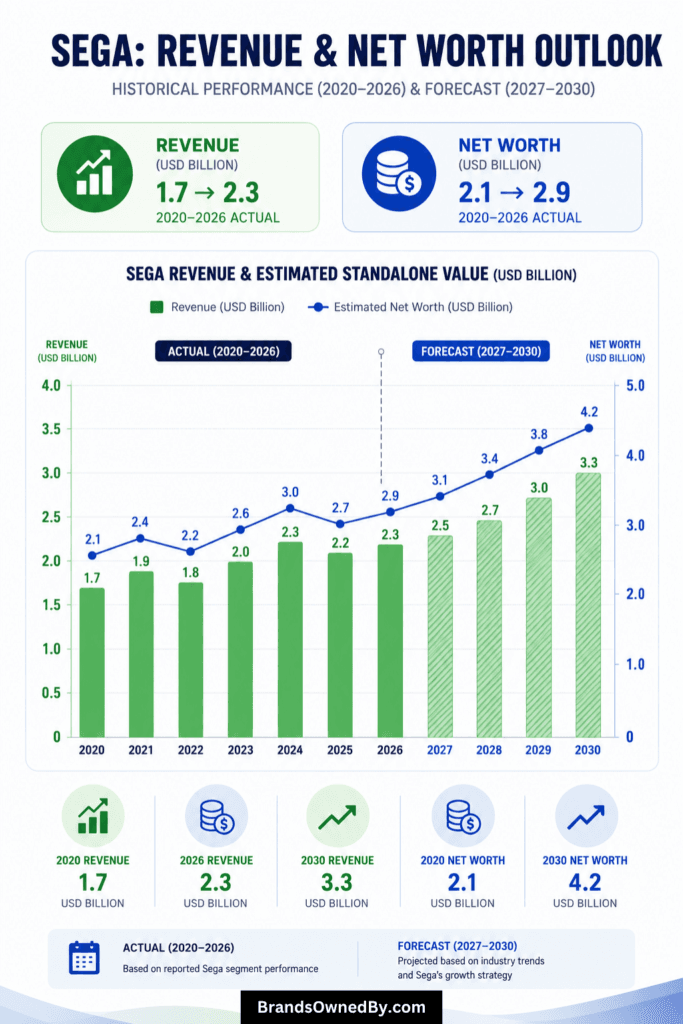
As of May 2026, Sega’s standalone gaming and entertainment operations are estimated to generate approximately $2.3 billion in annual revenue. Sega’s estimated standalone enterprise value and net worth is approximately $2.9 billion as of May 2026, based on segment profitability, intellectual property assets, studio ownership, licensing strength, and comparable gaming industry valuation multiples.
The company’s strongest financial assets include Sonic the Hedgehog, Persona, Like a Dragon, Total War, Football Manager, Angry Birds, and Shin Megami Tensei.
Sega Revenue Breakdown in 2026
Sega’s estimated $2.3 billion revenue base in 2026 is divided across multiple gaming and entertainment categories.
| Revenue Segment | Estimated 2026 Revenue | Contribution Share |
|---|---|---|
| Console and PC games | $1.08 billion | 47% |
| Mobile gaming | $420 million | 18% |
| Licensing and merchandise | $310 million | 13% |
| Animation and media | $185 million | 8% |
| Arcade and amusement content | $160 million | 7% |
| Digital services and others | $145 million | 7% |
Console and PC publishing remains Sega’s largest revenue driver. However, mobile gaming and licensing became increasingly important after the Rovio acquisition and Sonic media expansion.
Console and PC Gaming Revenue
Console and PC gaming generated an estimated $1.08 billion for Sega in 2026.
This segment includes revenue from:
- Steam sales.
- PlayStation digital downloads.
- Xbox publishing.
- Nintendo Switch releases.
- DLC and expansion content.
- Physical game distribution.
The strongest-performing Sega gaming franchises in FY2026 include:
| Franchise | Estimated 2026 Revenue Contribution |
|---|---|
| Sonic the Hedgehog | $390 million |
| Persona | $280 million |
| Like a Dragon | $190 million |
| Total War | $120 million |
| Football Manager | $70 million |
| Other Sega IP | $30 million |
Persona became one of Sega’s most profitable premium franchises after Persona 3 Reload and continued Persona 5 catalog sales across PC and console ecosystems.
Like a Dragon also continued strong international growth. The franchise performed especially well in North America and Europe compared to earlier years when it relied heavily on Japan.
Sonic the Hedgehog Revenue and Brand Value
Sonic is Sega’s single most valuable intellectual property as of May 2026.
The franchise generates revenue from multiple business categories simultaneously.
Estimated Sonic-related revenue in 2026:
| Sonic Revenue Stream | Estimated Revenue |
|---|---|
| Video games | $185 million |
| Licensing and merchandise | $95 million |
| Film and streaming rights | $60 million |
| Mobile gaming | $30 million |
| Retail and promotional partnerships | $20 million |
Total estimated Sonic franchise revenue in 2026 is approximately $390 million.
Sonic’s entertainment value increased significantly after the success of Paramount’s Sonic movie franchise. Sega transformed Sonic from a gaming mascot into a mainstream entertainment brand competing with franchises such as Mario and Pokémon in cross-media visibility.
Sonic licensing now includes:
- Apparel collaborations.
- Toys and collectibles.
- Fast-food promotions.
- Streaming partnerships.
- Publishing agreements.
- Theme park collaborations.
This diversification reduced Sega’s dependence on new game launches alone.
Atlus and Persona Financial Performance
Atlus became one of Sega’s most strategically important subsidiaries.
As of 2026, Persona is among Sega’s highest-margin franchises because of:
- Premium pricing.
- Strong digital sales.
- Long-tail catalog performance.
- DLC monetization.
- Merchandise sales.
Estimated Atlus-related revenue in 2026:
| Atlus Revenue Area | Estimated Revenue |
|---|---|
| Persona franchise | $280 million |
| Shin Megami Tensei | $45 million |
| Metaphor: ReFantazio | $55 million |
| Merchandise and licensing | $35 million |
Total estimated Atlus contribution in FY2026 is approximately $415 million.
Persona alone now contributes roughly 12%–13% of Sega’s total gaming revenue.
This represents a major shift because Persona was once considered a niche RPG franchise primarily focused on Japan.
Rovio and Mobile Gaming Revenue
The acquisition of Rovio Entertainment significantly expanded Sega’s mobile gaming business.
As of 2026, mobile gaming generates approximately $420 million annually for Sega.
The largest contributors include:
| Mobile Property | Estimated 2026 Revenue |
|---|---|
| Angry Birds | $210 million |
| Sonic mobile games | $85 million |
| Sega live-service titles | $70 million |
| Mobile advertising revenue | $55 million |
Rovio added several important capabilities to Sega:
- Advertising technology.
- User acquisition systems.
- Mobile monetization expertise.
- Live-service infrastructure.
- Global mobile publishing reach.
However, Sega also faced challenges in FY2026 because several live-service projects underperformed expectations. The company later reduced investment in weaker free-to-play projects and shifted resources toward established intellectual properties.
Regional Revenue Distribution
Sega’s revenue is geographically diversified across Japan, North America, Europe, and Asia.
Estimated regional revenue split for 2026:
| Region | Estimated Revenue Share |
|---|---|
| Japan | 39% |
| North America | 31% |
| Europe | 24% |
| Asia and others | 6% |
Japan remains Sega’s largest single market because of strong domestic brand recognition and arcade-related business operations.
North America became increasingly important after:
- Sonic movie expansion.
- Persona growth.
- PC publishing success.
- Mobile gaming expansion.
Europe remains strong primarily because of:
- Creative Assembly.
- Sports Interactive.
- Football Manager.
- Total War.
Sega Net Worth and Enterprise Value in 2026
As of May 2026, Sega’s estimated standalone enterprise value is approximately $2.9 billion.
This valuation reflects:
- Intellectual property assets.
- Studio ownership.
- Publishing infrastructure.
- Licensing businesses.
- Mobile gaming operations.
- Entertainment media expansion.
The valuation can be roughly divided into major business categories.
| Asset Category | Estimated Value |
|---|---|
| Intellectual property portfolio | $1.15 billion |
| Game development studios | $650 million |
| Mobile gaming assets | $380 million |
| Licensing and media operations | $320 million |
| Publishing infrastructure | $250 million |
| Arcade and entertainment assets | $150 million |
Sega’s intellectual property portfolio alone represents nearly 40% of its estimated total value.
This highlights how modern gaming companies derive significant value from franchise ownership rather than physical hardware businesses.
Most Valuable Sega Franchises in 2026
Sega’s valuation is heavily concentrated around a few major franchises.
Estimated franchise values in 2026:
| Franchise | Estimated Brand Value |
|---|---|
| Sonic the Hedgehog | $950 million |
| Persona | $420 million |
| Like a Dragon | $260 million |
| Angry Birds | $240 million |
| Total War | $210 million |
| Football Manager | $120 million |
| Shin Megami Tensei | $95 million |
Sonic alone represents nearly one-third of Sega’s estimated intellectual property value.
Sega Revenue Forecast Through 2030
As of May 2026, Sega’s future revenue strategy is centered around four major areas: premium game publishing, mobile gaming expansion, intellectual property licensing, and multimedia entertainment. Unlike the company’s console-focused business model from the 1990s, modern Sega operates as a diversified content publisher with recurring digital revenue streams.
The company’s long-term forecast is heavily tied to the commercial performance of Sonic the Hedgehog, Persona, Like a Dragon, Total War, Football Manager, and Angry Birds. Sega is also investing aggressively in reviving dormant intellectual properties that were inactive for years.
During The Game Awards 2023, Sega officially confirmed the return of several classic franchises including Crazy Taxi, Jet Set Radio, Golden Axe, Shinobi, and Streets of Rage. Those projects remain part of Sega’s medium-term growth pipeline entering 2027–2030.
Another major factor influencing Sega’s forecast is the continued expansion of Atlus. Persona evolved from a niche Japanese RPG series into one of Sega’s highest-margin global gaming properties. Persona 3 Reload became one of Atlus’ fastest-selling titles after launch, while anticipation surrounding Persona 6 continues driving long-term investor expectations for Sega’s premium publishing business.
Mobile gaming also became strategically important after Sega acquired Rovio Entertainment in 2023 for approximately $776 million. The acquisition added Angry Birds, Rovio’s advertising technology platform, mobile user acquisition systems, and live-service publishing expertise.
As of FY2026, Sega’s mobile business contributes roughly 18% of total standalone revenue. However, Sega is restructuring parts of its free-to-play division after weaker-than-expected performance from several live-service initiatives. The company shifted development resources toward stronger legacy intellectual properties and higher-performing core franchises.
Sega’s future forecast is also influenced by the rapid expansion of multimedia licensing. Sonic the Hedgehog is no longer only a gaming franchise. It now operates as a global entertainment brand generating revenue through:
- Films.
- Streaming content.
- Retail licensing.
- Apparel partnerships.
- Merchandise.
- Publishing rights.
- Promotional collaborations.
The Sonic movie franchise significantly increased Sega’s brand value in North America and Europe. Licensing revenue now represents one of the company’s fastest-growing non-gaming business segments.
PC gaming remains another major growth area for Sega through subsidiaries such as Creative Assembly and Sports Interactive. Total War and Football Manager maintain strong recurring sales performance on Steam and digital storefronts.
2027 Forecast
Sega’s estimated 2027 revenue is projected to reach approximately $2.55 billion, while its estimated standalone valuation could rise to around $3.15 billion.
Growth during 2027 is expected to come primarily from:
| 2027 Growth Driver | Expected Impact |
|---|---|
| Sonic franchise expansion | Increased licensing and multimedia revenue |
| Persona franchise growth | Higher premium RPG sales globally |
| Rovio mobile monetization | Improved mobile advertising and live-service revenue |
| Legacy IP revivals | New AAA releases from dormant Sega franchises |
| PC gaming growth | Stronger Total War and Football Manager sales |
Sega is expected to increase digital revenue share further during 2027. Physical game sales continue declining across the industry, while recurring digital monetization becomes more important for profitability.
2028 Forecast
By 2028, Sega’s estimated annual revenue is projected to approach $2.82 billion, with estimated standalone valuation rising toward $3.45 billion.
The company’s 2028 growth is expected to rely heavily on franchise diversification and international publishing expansion.
Several factors are expected to support this growth:
Persona 6 is widely expected to become one of Sega’s largest premium launches of the decade. Analysts expect the title to outperform previous Atlus releases internationally because of Persona’s rapid mainstream expansion after Persona 5 and Persona 3 Reload.
Sega’s mobile segment is also forecasted to improve operational efficiency after the integration of Rovio’s advertising and monetization systems across broader Sega properties.
Licensing growth is expected to accelerate as Sega expands Sonic-related retail partnerships and entertainment media projects globally.
2029 Forecast
Sega’s projected 2029 revenue is estimated at approximately $3.08 billion, while standalone valuation could rise to around $3.82 billion.
By this stage, Sega’s revenue structure is expected to become more balanced across premium publishing, mobile gaming, and licensing operations.
The company’s long-term strategy increasingly resembles broader entertainment businesses rather than traditional gaming publishers alone.
A major driver behind 2029 projections is Sega’s push toward “transmedia” intellectual property development. This strategy involves turning franchises into cross-platform entertainment ecosystems rather than standalone games.
For example:
| Franchise | Expected Expansion Area by 2029 |
|---|---|
| Sonic the Hedgehog | Films, streaming, merchandise, mobile |
| Persona | Anime, music, merchandise, live events |
| Like a Dragon | Streaming adaptation potential |
| Angry Birds | Licensing and mobile expansion |
| Total War | Live-service and DLC ecosystem growth |
Recurring monetization from DLC, subscriptions, and live-service mechanics is expected to contribute a larger percentage of Sega’s profits by 2029 compared to earlier years.
2030 Forecast
As of current projections in May 2026, Sega’s estimated 2030 revenue could exceed $3.4 billion, while its standalone valuation may approach $4.25 billion.
The company’s long-term financial growth depends heavily on intellectual property management rather than hardware production. Sega no longer faces the manufacturing risks associated with the console business during the Saturn and Dreamcast eras.
Instead, Sega’s future business model is expected to focus on:
| Core 2030 Strategy | Revenue Importance |
|---|---|
| Digital publishing | Very high |
| Mobile gaming | High |
| Licensing and merchandising | High |
| Multimedia entertainment | High |
| Physical game sales | Moderate |
| Arcade operations | Lower than historical levels |
By 2030, analysts expect Sonic to remain Sega’s single most valuable intellectual property, potentially approaching a standalone franchise value of over $1 billion if multimedia licensing and entertainment expansion continue growing at current rates.
Atlus is also expected to become increasingly important to Sega’s long-term profitability because premium RPG franchises typically generate higher margins than many live-service models.
The company’s overall growth outlook remains dependent on Sega’s ability to successfully modernize legacy franchises while maintaining strong publishing performance in North America, Europe, and Japan simultaneously.
Brands Owned by Sega
As of 2026, Sega owns and operates a large portfolio of gaming studios, entertainment brands, publishing divisions, mobile gaming assets, and intellectual properties. The company expanded far beyond its original arcade and console business and now controls major franchises across console gaming, PC gaming, mobile gaming, esports, licensing, and multimedia entertainment.
Sega’s modern business structure focuses heavily on intellectual property ownership. Many of its subsidiaries operate semi-independently while still publishing under the broader Sega ecosystem.
| Company / Studio / Brand | Type | Acquired / Founded | Main Franchises or Operations | Strategic Importance to Sega |
|---|---|---|---|---|
| Atlus | Game developer and publisher | Acquired in 2013 | Persona, Shin Megami Tensei, Metaphor: ReFantazio, Etrian Odyssey | One of Sega’s most profitable RPG divisions. Expanded Sega’s premium JRPG business globally. |
| Creative Assembly | Game development studio | Acquired in 2005 | Total War series, Alien: Isolation | Strengthened Sega’s PC strategy gaming business in Europe and North America. |
| Sports Interactive | Sports simulation developer | Acquired in 2006 | Football Manager | Controls the world’s leading football management simulation franchise with strong recurring annual revenue. |
| Rovio Entertainment | Mobile gaming company | Acquired in 2023 | Angry Birds | Expanded Sega’s mobile gaming, advertising technology, and live-service infrastructure. |
| Amplitude Studios | Strategy game developer | Acquired in 2016 | Endless Space, Endless Legend, Humankind | Strengthened Sega’s 4X and strategy gaming portfolio on PC platforms. |
| Two Point Studios | Simulation game developer | Acquired in 2019 | Two Point Hospital, Two Point Campus, Two Point Museum | Expanded Sega’s casual simulation and management gaming segment. |
| Sonic Team | Internal Sega development studio | Founded internally | Sonic the Hedgehog games | Sega’s flagship studio responsible for Sonic franchise development and multimedia coordination. |
| Ryu Ga Gotoku Studio | Internal Sega development studio | Founded internally | Like a Dragon / Yakuza series | One of Sega’s fastest-growing global console gaming divisions focused on mature audiences. |
| Sega Sapporo Studio | Internal development studio | Founded in 2021 | AAA game development support and technical production | Strengthens Sega’s internal Japanese development capacity and production infrastructure. |
| Sega AM2 | Internal arcade and gaming division | Founded internally | Virtua Fighter, Shenmue, OutRun, Daytona USA | Historically one of Sega’s most important arcade and 3D gaming divisions. |
| Sega Europe | Regional publishing and operations division | Operated by Sega | European publishing, localization, marketing | Manages Sega’s European gaming business and PC publishing ecosystem. |
| Sega Toys | Consumer products and toy division | Operated by Sega | Toys, entertainment products, family gaming items | Supports Sega’s merchandising and licensing business globally. |
| Sonic the Hedgehog | Gaming and entertainment franchise | Created in 1991 | Games, movies, merchandise, licensing | Sega’s most valuable intellectual property and largest multimedia entertainment brand. |
| Persona | RPG franchise | Atlus property under Sega | Persona 3 Reload, Persona 5 | One of Sega’s highest-margin premium gaming franchises globally. |
| Like a Dragon | Action RPG franchise | Sega property | Like a Dragon / Yakuza series | Major international franchise driving Sega’s mature-audience gaming growth. |
| Total War | Strategy gaming franchise | Creative Assembly property | Total War: Warhammer, Rome, Shogun | One of Sega’s strongest PC gaming revenue generators. |
| Football Manager | Sports simulation franchise | Sports Interactive property | Football Manager series | Dominates the football management simulation market globally. |
| Angry Birds | Mobile gaming franchise | Rovio property | Angry Birds mobile ecosystem | Strengthened Sega’s global mobile gaming and advertising business. |
| Shin Megami Tensei | RPG franchise | Atlus property | Mainline Shin Megami Tensei series | Important long-running RPG property supporting Atlus’ core identity. |
| Phantasy Star | Online RPG franchise | Sega property | Phantasy Star Online 2, New Genesis | Supports Sega’s online gaming ecosystem in Japan and Asia. |
| Virtua Fighter | Fighting game franchise | Sega AM2 property | Virtua Fighter series | One of Sega’s most historically important esports and arcade fighting franchises. |
| Crazy Taxi | Arcade racing franchise | Sega property | Crazy Taxi series | Part of Sega’s major legacy IP revival strategy as of 2026. |
| Jet Set Radio | Action and skating franchise | Sega property | Jet Set Radio series | Cult classic franchise being revived for modern platforms. |
| Golden Axe | Fantasy action franchise | Sega property | Golden Axe series | Legacy arcade franchise included in Sega’s revival initiatives. |
| Shinobi | Action platform franchise | Sega property | Shinobi series | One of Sega’s classic ninja-themed gaming properties being rebooted. |
| Streets of Rage | Beat ‘em up franchise | Sega property | Streets of Rage series | Important retro franchise with continued global fan demand. |
| House of the Dead | Arcade shooter franchise | Sega property | House of the Dead series | Long-running arcade horror franchise with remasters and adaptations. |
| Shenmue | Open-world action franchise | Sega AM2 property | Shenmue series | Historically important cinematic open-world gaming franchise. |
| OutRun | Racing franchise | Sega AM2 property | OutRun series | One of Sega’s classic arcade racing properties. |
| Space Channel 5 | Rhythm game franchise | Sega property | Space Channel 5 series | Cult classic music and rhythm franchise with strong nostalgic value. |
Gaming Studios Owned by Sega
Below are the major gaming studios owned by Sega:
Atlus
Atlus is one of Sega’s most valuable subsidiaries and one of the most important RPG developers in the gaming industry.
Sega acquired Atlus through the purchase of Index Corporation assets in 2013. The acquisition became one of Sega’s most successful long-term investments because Persona evolved into a globally recognized franchise.
Atlus develops and publishes:
- Persona.
- Shin Megami Tensei.
- Metaphor: ReFantazio.
- Etrian Odyssey.
- Soul Hackers.
As of 2026, Persona represents one of Sega’s highest-margin premium gaming properties. Persona 3 Reload and continued Persona 5 catalog sales significantly expanded Atlus’ international revenue.
Atlus also operates publishing and localization divisions that support Sega’s Japanese RPG business globally.
Creative Assembly
Creative Assembly is a British game developer owned by Sega since 2005.
The studio specializes in strategy and large-scale tactical games. Its flagship franchise, Total War, remains one of the most successful strategy gaming series globally.
Creative Assembly developed:
- Total War: Warhammer.
- Total War: Rome.
- Total War: Shogun.
- Alien: Isolation.
The studio became strategically important because it strengthened Sega’s PC gaming business in Europe and North America.
As of 2026, Total War remains one of Sega’s largest recurring PC revenue generators through DLC, expansions, and long-tail digital sales.
Sports Interactive
Sports Interactive develops the Football Manager franchise.
Sega acquired the company in 2006 to strengthen its sports simulation business.
Football Manager dominates the football management simulation genre globally. The franchise maintains a strong recurring revenue structure because of annual releases and loyal long-term players.
The series performs especially well in:
- Europe.
- South America.
- Southeast Asia.
Sports Interactive also became strategically important for Sega’s digital subscription and PC publishing ecosystem.
Rovio Entertainment
Sega completed its acquisition of Rovio Entertainment in 2023 for approximately $776 million.
The acquisition added:
- Angry Birds.
- Rovio’s advertising platform.
- Mobile monetization systems.
- User acquisition technology.
- Live-service infrastructure.
Rovio significantly expanded Sega’s mobile gaming business.
As of 2026, Angry Birds remains one of the world’s most recognizable mobile gaming franchises with revenue generated through:
- In-app purchases.
- Advertising.
- Licensing.
- Merchandise.
- Mobile publishing partnerships.
The acquisition also gave Sega stronger mobile distribution capabilities globally.
Amplitude Studios
Amplitude Studios is a French strategy game developer acquired by Sega in 2016.
The studio is known for:
- Endless Space.
- Endless Legend.
- Humankind.
Amplitude strengthened Sega’s presence in the 4X strategy gaming market.
The studio’s games are particularly popular on PC platforms such as Steam.
Two Point Studios
Two Point Studios develops simulation and management games.
Sega acquired the studio in 2019.
The company created:
- Two Point Hospital.
- Two Point Campus.
- Two Point Museum.
The studio became important for Sega’s casual management simulation portfolio and broader PC gaming expansion.
Relic Entertainment (Publishing Relationship)
Relic Entertainment historically worked closely with Sega through publishing partnerships involving Company of Heroes and strategy-focused PC titles.
Although Sega does not fully own Relic as of 2026, the relationship became commercially important within Sega’s PC publishing ecosystem.
Internal Sega Development Studios
Here’s a list of the development studios owned by Sega as of May 2026:
Sonic Team
Sonic Team is Sega’s flagship internal development studio.
The studio controls Sonic the Hedgehog game development and franchise management.
As of 2026, Sonic Team oversees:
- Mainline Sonic games.
- Sonic Frontiers expansions.
- Sonic licensing coordination.
- Multimedia franchise integration.
Sonic Team became increasingly important after Sonic expanded into films, streaming, merchandise, and entertainment partnerships.
Ryu Ga Gotoku Studio
Ryu Ga Gotoku Studio develops the Like a Dragon franchise, formerly known internationally as Yakuza.
The series evolved from a niche Japanese property into one of Sega’s largest global franchises.
The studio is known for:
- Narrative-driven gameplay.
- Urban open-world design.
- Mature storytelling.
- Fast production cycles.
As of 2026, Like a Dragon became one of Sega’s strongest-performing console franchises internationally.
Sega Sapporo Studio
Sega established Sega Sapporo Studio in 2021 to strengthen development capabilities in Japan.
The studio supports:
- AAA game development.
- Technical production.
- Programming support.
- Online infrastructure projects.
Its creation reflects Sega’s effort to expand internal Japanese development capacity.
Sega AM2
Sega AM2 remains one of Sega’s most historically important arcade and gaming divisions.
The studio was originally led by Yu Suzuki and became famous for pioneering 3D arcade gaming.
AM2 developed:
- Virtua Fighter.
- Daytona USA.
- Shenmue.
- OutRun.
Although its role changed significantly compared to the arcade era, the AM2 legacy still remains central to Sega’s brand identity.
Major Franchises and Brands Owned by Sega
Below is an overview of the core franchises and brands owned by Sega as of 2026:
Sonic the Hedgehog
Sonic is Sega’s most valuable intellectual property.
The franchise includes:
- Console games.
- Mobile games.
- Movies.
- Merchandise.
- Licensing partnerships.
- Streaming content.
- Publishing rights.
As of 2026, Sonic functions as a multimedia entertainment brand rather than only a gaming property.
The Sonic films significantly increased the franchise’s commercial value globally.
Persona
Persona became one of Sega’s fastest-growing premium franchises after Atlus joined Sega.
The brand expanded into:
- Anime adaptations.
- Music releases.
- Merchandise.
- Live concerts.
- Mobile games.
Persona’s international growth transformed Atlus from a niche Japanese developer into a major global RPG publisher.
Like a Dragon
Like a Dragon became one of Sega’s strongest mature-audience franchises.
The series built a loyal international fan base because of its storytelling, character development, and cinematic presentation.
Sega expanded the franchise through:
- Mainline games.
- Spin-offs.
- Mobile projects.
- Merchandise.
- Potential streaming adaptations.
Total War
Total War remains one of Sega’s most valuable PC gaming franchises.
The series generates recurring revenue through:
- DLC expansions.
- Long-tail Steam sales.
- Multiplayer ecosystems.
- Franchise partnerships.
The Warhammer collaboration became especially profitable for Sega and Creative Assembly.
Football Manager
Football Manager remains the dominant football management simulation franchise globally.
The franchise generates stable annual revenue because of yearly releases and deep player retention.
Sports Interactive continuously expanded the series into cloud gaming and subscription platforms.
Angry Birds
Angry Birds became part of Sega after the Rovio acquisition.
The franchise remains commercially valuable because of:
- Brand recognition.
- Mobile monetization.
- Merchandise.
- Licensing partnerships.
- Entertainment media expansion.
Sega uses Angry Birds to strengthen its mobile gaming strategy globally.
Virtua Fighter
Virtua Fighter remains one of Sega’s most historically important fighting game franchises.
Although inactive for several years previously, Sega revived the franchise through remasters and esports-focused initiatives.
Shin Megami Tensei
Shin Megami Tensei remains a core Atlus franchise under Sega ownership.
The series maintains strong commercial performance in the RPG market and serves as the foundation for several Persona-related mechanics and themes.
Phantasy Star
Phantasy Star remains one of Sega’s longest-running RPG franchises.
Phantasy Star Online 2 and New Genesis continued supporting Sega’s online gaming ecosystem in Japan and Asia.
Arcade and Entertainment Businesses Operated by Sega
Here’s a list of the businesses owned by Sega:
Sega Arcade Operations
Sega historically operated one of Japan’s largest arcade businesses.
Although the company reduced direct arcade ownership during the restructuring years, Sega still remains heavily associated with arcade gaming through legacy operations and amusement technologies.
Sega Toys
Sega Toys develops entertainment products, toys, and family-oriented gaming items.
The division supports Sega’s licensing and consumer products strategy.
Sega Europe
Sega Europe manages Sega’s European publishing and operational activities.
The division oversees:
- European publishing.
- Localization.
- Marketing.
- PC gaming operations.
- Studio coordination.
It became increasingly important after Sega expanded its PC gaming business globally.
Major Acquisitions by Sega
Below are the major brands and companies acquired by Sega as of May 2026:
Atlus
The acquisition of Atlus in 2013 transformed Sega’s RPG publishing business and added one of the gaming industry’s most respected Japanese developers.
Rovio
The $776 million Rovio acquisition in 2023 became Sega’s largest modern acquisition and significantly expanded the company’s mobile gaming capabilities.
Creative Assembly
Creative Assembly strengthened Sega’s PC gaming presence and gave the company one of the strategy genre’s most successful franchises.
Sports Interactive
The Sports Interactive deal gave Sega control over Football Manager and established a stable recurring sports simulation business.
Amplitude Studios
Amplitude expanded Sega’s strategy gaming portfolio and strengthened its European development ecosystem.
Legacy Brands and Historical Entities Owned by Sega
Sega also owns several historically important gaming brands and dormant franchises including:
- Crazy Taxi.
- Jet Set Radio.
- Shinobi.
- Golden Axe.
- Streets of Rage.
- Space Channel 5.
- Panzer Dragoon.
- House of the Dead.
- OutRun.
- Shenmue.
- Virtua Cop.
As of 2026, Sega actively began reviving several of these legacy franchises as part of its long-term intellectual property expansion strategy.
Final Thoughts
Sega is owned by Sega Sammy Holdings, a Japanese entertainment holding company formed through the merger between Sega and Sammy Corporation.
Although public investors own shares in the parent company, strategic control largely remains with executive leadership and influential shareholder groups connected to the Satomi family.
Sega transformed itself from a console manufacturer into a global gaming and entertainment company. The business now focuses on software publishing, mobile gaming, licensing, multimedia expansion, and digital entertainment.
The company controls some of gaming’s most valuable franchises, including Sonic the Hedgehog, Persona, Total War, Football Manager, Angry Birds, and Like a Dragon.
Its ability to adapt after leaving the hardware market remains one of the most important corporate turnarounds in gaming history.
FAQs
Who owns Sega Group Corporation?
Sega Group Corporation operates under Sega Sammy Holdings Inc., the Japanese entertainment conglomerate formed after the merger between Sega and Sammy Corporation in 2004. Sega Sammy Holdings is publicly traded, with the Satomi family remaining the most influential ownership group as of 2026.
Who owns Sega Games?
Sega Games is owned by Sega Corporation, which itself operates as a subsidiary of Sega Sammy Holdings. The parent company oversees Sega’s gaming, publishing, mobile, and entertainment operations globally.
Who owns Sega Sammy Holdings?
Sega Sammy Holdings is publicly owned through the Tokyo Stock Exchange. However, the Satomi family and affiliated entities remain the company’s dominant shareholder group. Major institutional investors such as The Master Trust Bank of Japan, BlackRock, and Nomura Asset Management also hold significant stakes.
Is Sega owned by Nintendo?
No. Sega is not owned by Nintendo. Sega operates independently under Sega Sammy Holdings. Although Sega publishes games on Nintendo platforms such as the Nintendo Switch and Switch 2, the two companies remain separate businesses.
When was Sega founded?
Sega’s origins date back to 1960 when the company was officially established in Japan through the merger of Service Games and Rosen Enterprises operations. Its roots trace even earlier to amusement machine businesses operating during the 1940s and 1950s.
Has Sega been bought by Nintendo?
No. Nintendo has never purchased Sega. During the early 2000s, rumors about a possible Nintendo acquisition circulated after Sega exited the console hardware market, but no acquisition ever happened.
Who Is the CEO of Sega?
As of May 2026, Shuji Utsumi serves as President and COO of Sega Corporation. Haruki Satomi serves as President and Group CEO of Sega Sammy Holdings, the parent company controlling Sega.
Is Sega owned by Sony?
No. Sega is not owned by Sony. Sony owns the PlayStation brand through Sony Interactive Entertainment, while Sega operates separately under Sega Sammy Holdings.
Is Sega American or Japanese?
Sega is a Japanese company headquartered in Tokyo, Japan. However, the company has historical American roots because some of its early founders, including David Rosen and Martin Bromley, were American businessmen involved in amusement machine operations in Japan.