


- Fiji Water is owned by The Wonderful Company, a privately held American conglomerate controlled by billionaire entrepreneurs Stewart Resnick and Lynda Resnick as of 2026.
- Stewart Resnick and Lynda Resnick are the primary controlling shareholders of Fiji Water through their ownership of The Wonderful Company, with estimated combined control of nearly 100% of the business.
- It operates as a premium bottled water brand with estimated 2026 revenue approaching $900 million and an estimated brand valuation between $1.3 billion and $1.5 billion.
Fiji Water is a premium bottled water company known for sourcing natural artesian water from Fiji. The brand operates from an underground aquifer located in Viti Levu, one of Fiji’s main islands. The water is naturally filtered through volcanic rock before bottling.
The company became popular because of its luxury positioning. Instead of competing directly with low-cost bottled water brands, Fiji Water focused on premium consumers, luxury hotels, upscale restaurants, fitness centers, and airlines.
One of the brand’s most recognizable features is its square-shaped bottle. The packaging helped Fiji Water stand out on retail shelves and created a strong visual identity in the bottled water market.
Fiji Water markets itself around purity, tropical sourcing, and untouched natural filtration. Its branding frequently highlights the remote location of the water source and the mineral composition of the water.
The company distributes products internationally and maintains a strong presence in North America. It also sells in Europe, Asia, the Middle East, and Australia.
Fiji Water primarily offers:
- Natural artesian bottled water.
- Premium bottled water in various bottle sizes.
- Glass bottle water products for hospitality businesses.
- Bulk packaged water for commercial distribution.
The company also focuses heavily on sustainability initiatives. These include packaging improvements, carbon reduction programs, and water conservation projects in Fiji.
Unlike many mainstream water brands, Fiji Water is strongly associated with luxury lifestyle marketing. The brand regularly appears at celebrity events, fashion shows, entertainment venues, and premium hospitality locations.
What Makes Fiji Water Different?
Fiji Water differentiates itself through its sourcing process and branding strategy.
The water comes from an artesian aquifer that is naturally protected from surface contaminants. According to the company’s marketing strategy, this isolation helps preserve the water’s purity and mineral balance.
The brand also focuses on premium aesthetics. Its tropical imagery, floral labels, and square bottles target consumers looking for higher-end beverage products.
For example, luxury hotels often stock Fiji Water because the packaging aligns with premium guest experiences better than standard plastic bottle designs.
Global Presence of Fiji Water
Fiji Water operates as an international bottled water brand rather than a regional beverage company.
Its products are widely available in:
- Supermarkets.
- Airports.
- Hotels.
- Restaurants.
- Fitness clubs.
- Online retail platforms.
The company built strong relationships with the hospitality and travel industries. This helped the brand maintain visibility among affluent consumers and international travelers.
Founder of Fiji Water
Fiji Water was founded in 1996 by Canadian businessman David Gilmour. He established the company after recognizing the commercial potential of exporting artesian water from Fiji to global premium markets.
Gilmour believed consumers would pay higher prices for bottled water that offered a unique origin story and luxury branding. At the time, the premium bottled water category was still developing, especially in the United States.
Instead of positioning Fiji Water as a basic hydration product, the founders marketed it as a lifestyle brand. This strategy became one of the company’s biggest competitive advantages.
David Gilmour’s Role in Building Fiji Water
David Gilmour played a central role in developing the company’s early branding, sourcing operations, and export strategy.
He focused heavily on:
- Establishing international distribution channels.
- Building premium retail partnerships.
- Creating a luxury-focused marketing identity.
- Expanding awareness in the U.S. bottled water market.
The company initially faced logistical challenges because Fiji is geographically remote. Exporting bottled water internationally required substantial shipping coordination and infrastructure investment.
Despite these challenges, Fiji Water successfully entered upscale U.S. markets during the late 1990s and early 2000s.
Early Growth Strategy
The founders avoided competing directly with low-cost bottled water companies. Instead, they targeted premium consumers and hospitality businesses.
This approach helped Fiji Water gain visibility in:
- Celebrity events.
- Luxury hotels.
- Fine dining restaurants.
- Entertainment industry venues.
- Health and fitness markets.
The branding strategy created exclusivity around the product. Over time, Fiji Water became associated with luxury living and premium wellness products.
Ownership History
Fiji Water has gone through several important ownership phases since its launch in the 1990s. The company started as an independent premium bottled water business and later became part of one of the largest privately owned consumer product groups in the United States.
Its ownership history is closely tied to the rise of premium bottled water as a global industry.
Founding and Early Ownership
Fiji Water was founded in 1996 by Canadian businessman David Gilmour. He created the company after identifying an opportunity to export artesian water from Fiji to international premium markets.
At the time, bottled water brands mainly competed on convenience and price. Gilmour took a different approach. He positioned Fiji Water as a luxury lifestyle product instead of a mass-market beverage.
The company was originally privately owned by its founders and early investors. During the startup phase, ownership remained concentrated among a small group connected to the founding business operations.
The early business focused on:
- Building bottling infrastructure in Fiji.
- Establishing export logistics.
- Securing U.S. retail distribution.
- Developing premium branding.
- Expanding hospitality partnerships.
This stage was critical because exporting bottled water from a remote Pacific island involved major transportation and operational challenges.
Rapid Expansion During the Early 2000s
During the early 2000s, Fiji Water experienced rapid growth in the United States and international markets.
The company became especially popular in:
- Luxury hotels.
- Upscale restaurants.
- Celebrity events.
- Fitness clubs.
- Entertainment industry venues.
The brand’s square bottle and tropical branding helped distinguish it from competitors such as Evian, Dasani, and Aquafina.
As demand increased, Fiji Water expanded its retail footprint across supermarkets, convenience stores, airports, and hospitality chains.
This rapid growth increased the company’s market value and attracted interest from larger investment groups and corporate buyers.
Acquisition by Roll International
A major ownership change occurred in 2004 when Roll International Corporation acquired Fiji Water.
Roll International was a privately owned American conglomerate controlled by Stewart Resnick and Lynda Resnick. The company already owned several food, agriculture, and beverage businesses before acquiring Fiji Water.
The acquisition marked a turning point in Fiji Water’s history.
Under Roll International ownership, Fiji Water gained access to:
- Larger distribution networks.
- Greater marketing resources.
- Expanded international operations.
- Corporate management infrastructure.
- Long-term private investment capital.
The acquisition also strengthened Fiji Water’s position in the premium beverage market.
Unlike public corporations that often focus heavily on quarterly earnings pressure, Roll International operated as a privately controlled company. This allowed Fiji Water to continue investing aggressively in branding and global expansion.
Transition to The Wonderful Company
Roll International later rebranded itself as The Wonderful Company.
After the rebranding, Fiji Water officially became part of The Wonderful Company’s growing portfolio of consumer brands.
This ownership group includes businesses across several industries, including:
- Bottled beverages.
- Citrus products.
- Pistachios.
- Wine.
- Floral services.
- Health-focused food products.
Fiji Water remained one of the most internationally recognized brands within the company’s beverage division.
The Wonderful Company continued expanding Fiji Water’s global retail and hospitality presence while maintaining its premium image.
Ownership Structure Today
As of May 2026, Fiji Water remains privately owned under The Wonderful Company.
The company is controlled by Stewart Resnick and Lynda Resnick, who serve as the primary owners and strategic decision-makers behind the broader business group.
Unlike publicly traded beverage competitors, Fiji Water does not have public shareholders or stock market investors.
Its ownership structure is centralized. Major corporate decisions are influenced directly by the parent company’s leadership.
This includes decisions related to:
- International expansion.
- Packaging strategy.
- Sustainability investments.
- Marketing campaigns.
- Product positioning.
- Retail partnerships.
Because the company is privately held, detailed ownership percentages and internal equity structures are not publicly disclosed.
How Ownership Changed Fiji Water’s Growth Strategy
The acquisition by Roll International significantly changed Fiji Water’s scale and operational capabilities.
Before the acquisition, Fiji Water operated more like an independent niche premium water company. After joining The Wonderful Company portfolio, the brand gained access to larger corporate resources and broader distribution systems.
Practical examples of these changes include:
- Expansion into more international retail chains.
- Larger celebrity marketing campaigns.
- Increased airport and airline partnerships.
- Broader global logistics operations.
- Greater investment in sustainability initiatives.
The ownership transition helped Fiji Water compete more effectively against multinational beverage giants such as Coca-Cola, PepsiCo, Nestlé, and Danone.
Controversies and Ownership Challenges
Fiji Water’s ownership history has also included operational and political challenges.
Because the water is sourced from Fiji and exported globally, the company has occasionally faced criticism regarding:
- Environmental impact.
- Plastic waste.
- Water resource management.
- Export economics.
- Tax disputes with the Fiji government.
One of the most notable disputes occurred in 2010 when Fiji Water temporarily halted operations during a disagreement with the Fiji government over water taxation policies.
However, the conflict was eventually resolved, and operations resumed.
The company has since increased focus on sustainability programs and environmental messaging under The Wonderful Company’s ownership.
Long-Term Ownership Stability
One notable aspect of Fiji Water’s ownership history is its long-term stability since 2004.
Unlike many beverage brands that frequently change owners through mergers and acquisitions, Fiji Water has remained under the same parent company for more than two decades.
This stability helped maintain consistent branding and strategic direction.
The company continues operating as a premium bottled water brand with centralized ownership control under The Wonderful Company and the Resnick family.
Who Owns Fiji Water?
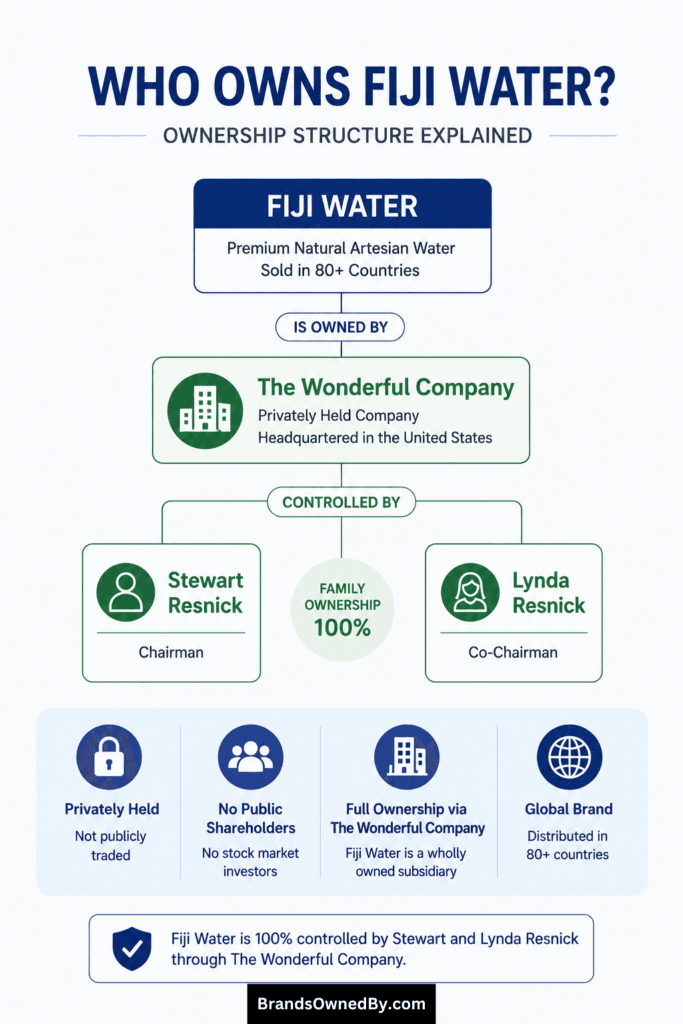
Fiji Water operates under a private ownership structure through The Wonderful Company. Unlike public corporations, the company does not publish official shareholder filings, SEC ownership reports, or quarterly institutional ownership disclosures.
As of 2026, the ownership structure remains highly concentrated within the Resnick family. Publicly available corporate records and executive disclosures confirm that Stewart Resnick and Lynda Resnick are the controlling owners of The Wonderful Company and, therefore, Fiji Water.
Because the business is privately held, exact equity percentages are not officially disclosed. However, industry analysts and corporate governance experts widely recognize the Resnicks as the overwhelming controlling shareholders with effective majority ownership of the company.
Stewart Resnick: 50% Controlling Stake
Stewart Resnick is believed to hold roughly half of the controlling ownership interest in The Wonderful Company alongside his wife, Lynda Resnick.
As chairman and president of the company, he remains the most influential executive connected to Fiji Water’s corporate operations and long-term strategy.
His ownership influence extends across all Wonderful Company subsidiaries, including:
- Fiji Water.
- POM Wonderful.
- Wonderful Pistachios.
- Wonderful Halos.
- Teleflora.
- JUSTIN Wines.
Stewart Resnick oversees major strategic decisions involving acquisitions, operational expansion, capital allocation, supply chain investments, and international growth initiatives.
The company’s private structure gives him significantly greater direct control compared to the CEOs of publicly traded beverage corporations.
For example, Fiji Water’s long-term premium branding strategy, sustainability investments, and international expansion plans can be implemented without approval from outside institutional investors or public shareholders.
Business publications and corporate disclosures consistently identify Stewart Resnick as co-owner and controlling executive of The Wonderful Company as of 2026.
Lynda Resnick: 50% Controlling Stake
Lynda Resnick is also believed to control approximately half of The Wonderful Company’s ownership alongside Stewart Resnick.
She serves as vice chairman and co-owner of the company. Her influence is especially strong in marketing, branding, product positioning, and consumer strategy.
Lynda Resnick played a major role in transforming Fiji Water into a globally recognized premium lifestyle brand after the company’s acquisition.
Her branding philosophy helped shape:
- Fiji Water’s luxury image.
- Packaging design direction.
- Premium hospitality positioning.
- Celebrity marketing campaigns.
- High-end retail partnerships.
Industry experts frequently credit her with helping elevate Wonderful Company brands into premium consumer categories rather than commodity products.
For example, Fiji Water’s upscale image in hotels, entertainment venues, and luxury retail environments aligns closely with the broader branding approach associated with Lynda Resnick’s marketing leadership.
Corporate records and executive profiles continue to identify her as co-owner of The Wonderful Company in 2026.
Resnick Family Trusts and Private Holding Structures
In addition to direct ownership, portions of The Wonderful Company are likely held through private family trusts, estate planning structures, and internal holding entities connected to the Resnick family.
This is common among large, privately held, billion-dollar family businesses.
These structures are generally used for:
- Estate planning.
- Tax management.
- Long-term succession planning.
- Wealth preservation.
- Voting control stability.
However, because The Wonderful Company is private, detailed breakdowns of trust ownership percentages are not publicly available.
Despite this, control remains firmly concentrated within the Resnick family ecosystem.
Competitor Ownership Comparison
Fiji Water competes in the global premium bottled water industry against brands owned by some of the world’s largest food and beverage corporations. The ownership structure of these competitors plays a major role in pricing strategy, marketing budgets, distribution power, and international expansion.
Unlike many rivals, Fiji Water operates under a privately controlled ownership model through The Wonderful Company. Most competitors are owned by publicly traded multinational corporations with millions of institutional and retail shareholders.
This difference affects how each brand approaches growth, branding, sustainability, and long-term strategy.
Fiji Water: Owned by The Wonderful Company
Fiji Water is owned by The Wonderful Company, a privately held American conglomerate controlled by Stewart and Lynda Resnick.
The ownership structure is highly centralized. The Resnick family maintains effective control over strategic decisions involving Fiji Water and other Wonderful Company brands.
Key characteristics of Fiji Water’s ownership structure include:
- Private ownership.
- No public shareholders.
- Long-term brand-focused strategy.
- Centralized decision-making.
- Strong luxury positioning.
Because Fiji Water is privately owned, it does not face quarterly earnings pressure from stock market investors.
This allows the company to prioritize premium branding and long-term market positioning instead of short-term sales performance.
For example, Fiji Water often invests heavily in luxury hospitality partnerships and premium packaging even during slower economic periods.
Evian: Owned by Danone
Evian is owned by Danone, a publicly traded French multinational food and beverage company.
Danone operates globally across dairy products, bottled water, nutrition products, and health-focused food brands.
Unlike Fiji Water, Evian’s ownership is spread across institutional investors, mutual funds, pension funds, and retail shareholders.
Major Danone shareholders as of 2026 include:
- BlackRock.
- Amundi Asset Management.
- Norges Bank Investment Management.
- Institutional European investment funds.
Evian benefits from Danone’s massive global distribution network and international retail relationships.
The brand competes directly with Fiji Water in the premium bottled water category, especially in luxury hospitality and upscale retail markets.
However, Danone’s public-company structure means management must also prioritize shareholder expectations, quarterly performance targets, and dividend strategies.
Smartwater and Dasani: Owned by The Coca-Cola Company
Smartwater and Dasani are both owned by The Coca-Cola Company.
Coca-Cola is one of the largest publicly traded beverage corporations in the world. Its ownership is highly diversified across institutional investors and public shareholders.
Major Coca-Cola shareholders as of 2026 include:
Smartwater competes more directly with Fiji Water in the premium category, while Dasani targets mainstream bottled water consumers.
Coca-Cola’s ownership structure provides enormous advantages:
- Global bottling infrastructure.
- Massive advertising budgets.
- Worldwide retail access.
- International logistics systems.
However, Coca-Cola operates on a much larger scale than Fiji Water. Bottled water represents only one part of its overall beverage portfolio.
In contrast, Fiji Water relies more heavily on premium identity and niche brand positioning.
Aquafina: Owned by PepsiCo
Aquafina is owned by PepsiCo, another publicly traded multinational beverage and snack company.
PepsiCo’s shareholder structure includes major institutional investors such as:
- Vanguard Group.
- BlackRock.
- State Street.
- Geode Capital Management.
Aquafina is positioned as a mass-market purified water brand rather than a luxury artesian water product.
PepsiCo’s scale gives Aquafina strong competitive advantages in:
- Retail shelf placement.
- Convenience store distribution.
- Fast-food partnerships.
- International beverage logistics.
However, Fiji Water differentiates itself through premium sourcing and luxury branding instead of mass-market accessibility.
For example, Fiji Water is more commonly associated with upscale hotels and celebrity events, while Aquafina focuses more on mainstream retail distribution.
Perrier and San Pellegrino: Owned by Nestlé Waters
Perrier and San Pellegrino are part of Nestlé Waters, which operates under Swiss food giant Nestlé.
Nestlé is publicly traded and has one of the largest global shareholder bases in the consumer products industry.
Major shareholders include:
- Nestlé family-linked investment entities.
- BlackRock.
- Vanguard.
- Swiss institutional investment funds.
Perrier and San Pellegrino compete with Fiji Water in premium dining, hospitality, and imported water categories.
Nestlé’s ownership structure provides extensive global manufacturing and distribution capabilities. However, the corporation has also faced public criticism regarding water sourcing rights and environmental practices in various countries.
Compared to Nestlé brands, Fiji Water places a stronger emphasis on exotic sourcing and tropical branding.
Voss Water: Owned by Reignwood Group
Voss Water is owned by Reignwood Group, a privately held multinational company headquartered in Asia.
Like Fiji Water, Voss operates under private ownership rather than public stock market control.
The company focuses heavily on luxury branding, premium packaging, and upscale hospitality partnerships.
Both Fiji Water and Voss target affluent consumers, but their branding approaches differ:
- Fiji Water emphasizes tropical artesian sourcing.
- Voss emphasizes Scandinavian purity and minimalist design.
Because both brands are privately controlled, they have greater flexibility in long-term brand development compared to publicly traded competitors.
Poland Spring and Deer Park: Owned by BlueTriton Brands
Poland Spring and Deer Park are owned by BlueTriton Brands, a private bottled water company formed after Nestlé sold many of its North American water brands.
BlueTriton operates under private equity ownership rather than public shareholders.
This structure gives the company more operational flexibility than public corporations, but still places a strong focus on profitability and restructuring because of private equity investment models.
Unlike Fiji Water, BlueTriton mainly focuses on regional spring water and large-scale mainstream bottled water distribution.
Key Ownership Differences Between Fiji Water and Competitors
One of the biggest differences between Fiji Water and its competitors is ownership concentration.
Most competitors are controlled by large public corporations with institutional investor influence. Fiji Water remains tightly controlled by the Resnick family through The Wonderful Company.
This creates several strategic differences.
| Brand | Parent Company | Ownership Type | Major Shareholders / Owners (2026) | Water Type & Positioning | Main Competitive Strength |
|---|---|---|---|---|---|
| Fiji Water | The Wonderful Company | Private | Stewart Resnick, Lynda Resnick | Premium artesian bottled water | Luxury branding and tropical sourcing |
| Evian | Danone | Public | BlackRock, Amundi, Norges Bank, institutional investors | Premium natural mineral water | Global premium retail distribution |
| Smartwater | The Coca-Cola Company | Public | Berkshire Hathaway, Vanguard, BlackRock, State Street | Premium vapor-distilled water | Massive Coca-Cola distribution network |
| Dasani | The Coca-Cola Company | Public | Berkshire Hathaway, Vanguard, BlackRock, State Street | Mass-market purified water | Global retail and convenience dominance |
| Aquafina | PepsiCo | Public | Vanguard, BlackRock, State Street, Geode Capital | Mass-market purified water | Strong supermarket and fast-food partnerships |
| Perrier | Nestlé Waters | Public | Nestlé-linked entities, BlackRock, Vanguard | Premium sparkling mineral water | Strong global hospitality presence |
| San Pellegrino | Nestlé Waters | Public | Nestlé-linked entities, BlackRock, Vanguard | Premium sparkling mineral water | Fine dining and luxury restaurant positioning |
| Voss | Reignwood Group | Private | Reignwood Group ownership structure | Luxury bottled water | Premium Scandinavian branding |
| Poland Spring | BlueTriton Brands | Private | Private equity-backed ownership | Regional spring water | Large-scale North American distribution |
| Deer Park | BlueTriton Brands | Private | Private equity-backed ownership | Regional spring water | Strong East Coast retail presence |
How Ownership Impacts Competitive Strategy
Ownership structure directly affects how bottled water companies operate.
Public corporations often focus heavily on:
- Quarterly revenue growth.
- Shareholder returns.
- Dividend performance.
- Institutional investor expectations.
Private companies like Fiji Water can focus more aggressively on:
- Long-term branding.
- Luxury positioning.
- Selective distribution.
- Premium pricing strategies.
For example, Fiji Water does not need to compete aggressively on low pricing against supermarket bottled water brands because its ownership structure supports a premium-focused business model.
This ownership flexibility remains one of Fiji Water’s biggest competitive advantages in the global bottled water industry.
Who Controls Fiji Water?
As of May 2026, Fiji Water is controlled by The Wonderful Company, a privately held consumer products conglomerate headquartered in Los Angeles, California.
Ultimate control of Fiji Water rests with billionaire owners Stewart Resnick and Lynda Resnick. The company operates under a centralized private ownership structure with no public shareholders or outside institutional investors controlling the strategy.
Fiji Water’s leadership structure combines direct ownership oversight from the Resnick family with operational management from senior beverage executives.
Stewart Resnick: Chairman and Primary Decision-Maker
Stewart Resnick is chairman, president, and co-owner of The Wonderful Company, the parent company of Fiji Water. He is the most powerful executive connected to the brand.
He oversees major strategic decisions involving:
- Global expansion.
- Capital investments.
- Manufacturing operations.
- Acquisitions.
- Executive leadership appointments.
- Long-term corporate strategy.
Resnick acquired Fiji Water in 2004 through Roll International, later renamed The Wonderful Company. The reported acquisition price was approximately $50 million.
Under his leadership, Fiji Water expanded into more than 80 countries and became one of the leading premium imported bottled water brands in the United States.
Stewart Resnick is also responsible for overseeing other Wonderful Company brands including:
- Wonderful Pistachios.
- POM Wonderful.
- Wonderful Halos.
- JUSTIN Wines.
- Teleflora.
Because Fiji Water operates under a private ownership model, Stewart Resnick has significantly more direct control than the CEOs of publicly traded beverage companies.
Lynda Resnick: Branding and Marketing Control
Lynda Resnick serves as vice chairman and co-owner of The Wonderful Company. She controls much of the strategic branding and consumer marketing direction behind Fiji Water.
She is widely known for transforming consumer products into premium lifestyle brands.
Her influence on Fiji Water includes:
- Luxury positioning.
- Premium packaging strategy.
- Celebrity marketing campaigns.
- Hospitality branding.
- Wellness-focused advertising.
Industry analysts often credit Lynda Resnick for helping Fiji Water become associated with luxury hotels, red carpet events, fashion industry partnerships, and premium retail environments.
Her marketing philosophy focuses heavily on emotional branding and premium perception rather than price competition.
That strategy helped Fiji Water compete against much larger corporations like Coca-Cola and PepsiCo despite having a smaller operational scale.
Alexandre Zigliara: President of Fiji Water
As of May 2026, Alexandre “Alex” Zigliara serves as President of Fiji Water. He officially assumed the role in December 2025.
Zigliara oversees worldwide strategy and day-to-day operations for Fiji Water.
His responsibilities include:
- Global sales operations.
- Manufacturing oversight.
- Supply chain management.
- Marketing execution.
- International distribution.
- Retail partnerships.
- Sustainability initiatives.
Before joining Fiji Water, Zigliara held senior executive positions at:
- The Coca-Cola Company.
- Clif Bar & Company.
- Mondelez International.
- MrBeast Feastables.
At Coca-Cola, he spent more than two decades in leadership roles across North America and Europe. He also served as President of Coca-Cola Italy.
His appointment signals Fiji Water’s focus on expanding international beverage operations and strengthening premium market share globally.
Julie Silver: Chief Financial Officer
Julie Silver serves as Chief Financial Officer of Fiji Water according to executive company records.
Her responsibilities include:
- Financial management.
- Corporate budgeting.
- Operational finance.
- Investment planning.
- Cost management.
- Financial reporting.
As CFO, she plays a key role in maintaining profitability while supporting Fiji Water’s premium positioning strategy.
Other Senior Fiji Water Executives
Several senior executives manage major operational divisions inside Fiji Water.
Clarence Chia: Vice President of Marketing
Clarence Chia oversees marketing, eCommerce, and direct-to-consumer operations.
His role includes:
- Digital marketing strategy.
- Consumer engagement.
- Brand campaigns.
- Online sales growth.
- Direct retail initiatives.
Wai Lee: Vice President, International Operations
Wai Lee oversees Fiji Water’s international business operations across Asia, EMEA, and Oceania markets.
The role focuses on:
- International distribution.
- Global retail partnerships.
- Regional expansion.
- International sales growth.
Scott Parido: Senior Vice President of U.S. Retail Sales
Scott Parido manages U.S. retail distribution and sales strategy.
His division handles relationships with:
- Major supermarket chains.
- Wholesale retailers.
- Hospitality clients.
- National retail distributors.
How Decision-Making Works at Fiji Water
Fiji Water uses a centralized management structure.
Major strategic decisions flow through The Wonderful Company leadership, while operational execution is handled by Fiji Water executives.
The structure generally works as follows:
| Leadership Level | Main Responsibilities |
|---|---|
| Stewart Resnick | Corporate control, investments, long-term strategy |
| Lynda Resnick | Branding, marketing direction, premium positioning |
| Alexandre Zigliara | Global operations and executive management |
| Senior Vice Presidents | Regional sales, operations, finance, marketing |
This structure allows Fiji Water to maintain consistent branding and operational alignment globally.
How Private Ownership Affects Control
Fiji Water’s private ownership structure gives its leadership more operational flexibility than public competitors.
The company does not answer to:
- Public shareholders.
- Quarterly earnings pressure.
- Activist investors.
- Institutional shareholder votes.
This allows Fiji Water leadership to focus on:
- Long-term brand building.
- Premium pricing strategies.
- Luxury hospitality partnerships.
- Sustainability investments.
- Selective market positioning.
For example, Fiji Water can prioritize premium brand perception over aggressive discount pricing because the company is controlled internally rather than driven by public-market growth targets.
Fiji Water Annual Revenue and Net Worth
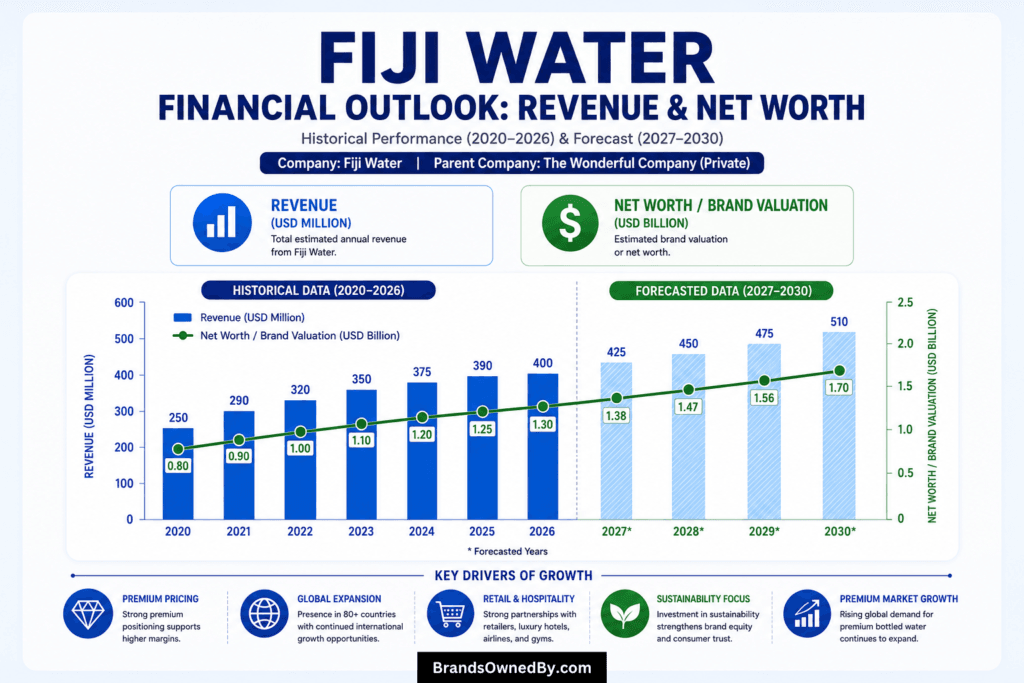
As of May 2026, Fiji Water is estimated to generate between $850 million and $950 million in annual revenue, making it one of the highest-revenue premium imported bottled water brands in the United States. Multiple industry estimates place the company’s brand valuation and estimated net worth between $1.3 billion and $1.5 billion.
The company operates in the premium bottled water segment, which continues expanding globally because of rising health-conscious consumption, premium lifestyle branding, and declining soft-drink consumption. The global premium bottled water market was valued between approximately $17.8 billion and $36.8 billion in 2025 depending on methodology, with projected CAGR growth ranging from 5.4% to 8.2% through the next decade.
Revenue of Fiji Water
Industry analysts tracking premium beverage companies estimate Fiji Water’s 2026 annual revenue to be in the $900 million range.
One of the strongest indicators comes from private market analysis estimating Fiji Water generated more than $900 million in revenue during 2025 while maintaining leadership in the imported premium bottled water category in the U.S. market.
Other private company databases estimate lower revenue levels near $291 million to $400 million because they often calculate only directly identifiable operating entities rather than broader global distribution and wholesale volumes.
The higher revenue estimates are considered more realistic by industry observers because Fiji Water maintains large-scale global retail distribution and premium hospitality partnerships.
As of 2026, Fiji Water products are sold across:
- More than 80 countries.
- Major U.S. retailers.
- International airports.
- Luxury hotel chains.
- Airlines.
- Premium fitness clubs.
- Hospitality distributors.
The company’s strongest revenue market remains North America, especially the United States.
Revenue Breakdown by Distribution Channel
Based on premium bottled water distribution patterns and hospitality exposure, Fiji Water’s estimated 2026 revenue mix is heavily concentrated in retail and hospitality channels.
| Revenue Segment | Estimated 2026 Share |
|---|---|
| U.S. Retail Stores | 44% |
| International Retail Markets | 19% |
| Hotels and Hospitality | 16% |
| Airlines and Travel Retail | 9% |
| Restaurants and Fine Dining | 7% |
| eCommerce and Direct Distribution | 5% |
The company’s hospitality exposure is significantly higher than mainstream bottled water brands like Aquafina and Dasani.
Fiji Water maintains a strong presence inside:
- Marriott luxury properties.
- Hilton premium resorts.
- Four Seasons hotels.
- Airline business-class cabins.
- Celebrity events.
- Fashion industry partnerships.
These channels generate higher margins because premium hospitality buyers prioritize branding over low pricing.
2026 Net Worth and Brand Valuation
As of May 2026, Fiji Water’s estimated enterprise value and brand valuation is approximately $1.3 billion to $1.5 billion.
Several measurable factors support this valuation.
Premium Pricing Power
Fiji Water sells at some of the highest average retail prices in the bottled water industry.
In many U.S. grocery stores, airports, and hospitality venues, Fiji Water products sell at prices two to four times higher than mainstream purified water competitors.
For example:
- Standard Fiji Water 500ml retail pricing often ranges between $2.50 and $4.00.
- Mass-market bottled water products frequently sell below $1.50.
This pricing advantage significantly improves operating margins and brand valuation multiples.
Strong Imported Water Market Position
Fiji Water remains one of the leading imported premium bottled water brands in the United States.
The company competes directly against:
- Evian.
- Voss.
- Smartwater.
- Perrier.
- San Pellegrino.
However, Fiji Water maintains stronger visibility in celebrity culture, luxury hospitality, and wellness branding than many competitors.
Scale of Parent Company Support
Fiji Water also benefits from being owned by The Wonderful Company, one of the largest privately held consumer product businesses in the United States.
The Wonderful Company reportedly generates approximately $5 billion in annual revenue across all operations as of 2025–2026.
This gives Fiji Water access to:
- Large-scale logistics infrastructure.
- National retail relationships.
- Supply chain efficiency.
- Corporate marketing resources.
- International distribution support.
Growth in Premium Bottled Water Demand
The premium bottled water industry itself continues expanding rapidly.
Recent market reports estimate:
- Premium bottled water market CAGR between 6% and 8.2%.
- Asia-Pacific premium water growth exceeding 9% CAGR in some forecasts.
- North America remaining one of the largest premium bottled water regions globally.
This market expansion directly supports Fiji Water’s long-term revenue growth potential.
Profitability and Margins
Although Fiji Water does not publicly release operating margins, premium bottled water companies generally maintain substantially higher margins than mainstream beverage brands.
Several factors improve Fiji Water profitability:
Premium Retail Pricing
The company commands luxury-level pricing while using standardized PET bottle packaging at large production scale.
Hospitality Contracts
Hotels, airlines, and premium restaurants purchase Fiji Water at higher wholesale pricing than supermarket retailers.
Brand-Led Consumer Demand
Fiji Water’s brand identity allows it to maintain premium pricing without competing aggressively on discounts.
Lower Advertising Dependency Compared to Mass-Market Soda Brands
Unlike Coca-Cola and PepsiCo soft-drink products, Fiji Water relies heavily on luxury brand perception and organic celebrity visibility.
This reduces dependency on constant mass-market advertising campaigns.
Fiji Water Revenue and Net Worth Forecast (2027–2030)
Industry forecasts for premium bottled water demand remain highly favorable through 2030.
Several market studies project premium bottled water CAGR growth between 5.4% and 8.2% during the next decade.
Based on these trends, Fiji Water’s estimated financial outlook through 2030 is expected to strengthen significantly.
- 2027: Estimated revenue could reach approximately $1 billion. Brand valuation is projected near $1.6 billion as premium bottled water demand continues rising in North America and Asia-Pacific luxury markets.
- 2028: Revenue projections range between $1.08 billion and $1.12 billion. The estimated valuation could exceed $1.75 billion due to expansion in hospitality, airport retail, and international distribution.
- 2029: Fiji Water could generate approximately $1.2 billion in annual revenue if current premium beverage growth rates continue. Analysts expect higher demand from wellness-focused consumers and luxury hospitality operators.
- 2030: Revenue projections approach $1.3 billion to $1.4 billion under continued premium market expansion scenarios. Brand valuation could potentially exceed $2 billion if Fiji Water maintains leadership in imported premium bottled water and expands aggressively in Asia-Pacific and Middle Eastern luxury markets.
Several measurable trends support these projections:
- Global premium bottled water demand continues to accelerate.
- Consumers increasingly replace sugary beverages with premium hydration products.
- Luxury hospitality spending is recovering strongly worldwide.
- Asia-Pacific premium water consumption is growing faster than in North America and Europe.
- Premium wellness products continue outperforming mainstream beverage categories.
Fiji Water’s strongest long-term advantage remains its pricing power and premium brand positioning rather than mass-market sales volume.
Brands Owned by Fiji Water
As of 2026, Fiji Water operates primarily as a single-brand premium bottled water company. Unlike Coca-Cola, PepsiCo, or Nestlé Waters, Fiji Water does not own a large portfolio of independent beverage brands or consumer companies under the FIJI Water operating entity itself.
Most businesses commonly associated with Fiji Water, such as Wonderful Pistachios or POM Wonderful, are actually owned by its parent company, The Wonderful Company, not by Fiji Water directly.
Because of this structure, Fiji Water’s directly controlled assets are concentrated around the FIJI Water brand itself, related packaging lines, legal operating entities, and hospitality-focused product extensions.
| Company / Brand / Entity | Type | Main Business Activity | Key Products or Services | Operational Focus as of 2026 |
|---|---|---|---|---|
| FIJI Water | Core Brand | Premium bottled water company | Natural artesian bottled water | Global premium bottled water distribution across more than 80 countries |
| FIJI Water Original Line | Product Line | Standard bottled water products | 330mL, 500mL, 700mL, 1L, and 1.5L bottles | Retail stores, supermarkets, hospitality, and travel channels |
| FIJI Water Sports Cap Series | Product Line | Fitness and travel-focused bottled water | Resealable sports-cap bottles | Gyms, convenience stores, airports, and wellness markets |
| FIJI Water Glass Bottle Collection | Product Line | Luxury hospitality bottled water | Premium glass bottled water | Hotels, restaurants, VIP lounges, and premium airline cabins |
| FIJI Water Hospitality Division | Commercial Business Unit | Hospitality and institutional supply | Bulk hospitality bottled water distribution | Luxury hotels, resorts, casinos, and event venues |
| FIJI Water Direct-to-Consumer Platform | Commercial Platform | Online and subscription sales | Home and office water delivery services | eCommerce, recurring subscriptions, and corporate supply |
| FIJI Water Foundation | Nonprofit / CSR Entity | Community and sustainability initiatives | Water access, education, infrastructure, and environmental programs | Fiji-based sustainability and social impact projects |
| FIJI Water LLC | Operating Entity | Legal and commercial operations | Distribution management, licensing, trademarks, and regulatory compliance | U.S. and international operational management |
FIJI Water
FIJI Water is the company’s flagship and primary operating brand.
The brand sells premium natural artesian bottled water sourced from an underground aquifer in Viti Levu, Fiji.
As of 2026, FIJI Water remains one of the leading imported premium bottled water brands in the United States and several international luxury markets.
The company operates globally through retail, hospitality, airline, and international distribution channels.
The brand itself includes several product formats and packaging categories operated under the FIJI Water identity.
FIJI Water Original Line
The Original Line is the company’s core bottled water product range.
This includes:
- 330mL bottles.
- 500mL bottles.
- 700mL bottles.
- 1L bottles.
- 1.5L bottles.
These products are sold across supermarkets, hotels, airlines, convenience stores, fitness clubs, and premium hospitality venues.
The square bottle packaging remains one of the company’s strongest commercial identifiers.
The Original Line generates the majority of Fiji Water’s annual revenue.
FIJI Water Sports Cap Series
FIJI Water operates a dedicated sports-cap product category designed for fitness, travel, and convenience markets.
These bottles feature resealable sports caps and target:
- Gym users.
- Athletes.
- Outdoor consumers.
- Travel retail customers.
The Sports Cap Series became increasingly important after the rise in wellness-focused beverage consumption between 2020 and 2026.
The products are distributed heavily through:
- Airport retailers.
- Fitness chains.
- Convenience stores.
- Sporting venues.
FIJI Water Glass Bottle Collection
The company also operates a premium glass-bottle product line targeted toward luxury hospitality markets.
These products are primarily supplied to:
- Luxury hotels.
- Fine-dining restaurants.
- VIP hospitality lounges.
- Executive meeting venues.
- Premium airline cabins.
The glass collection supports Fiji Water’s upscale brand positioning and hospitality strategy.
Compared to standard PET bottles, glass formats are marketed toward premium dining experiences and luxury service environments.
FIJI Water Hospitality Division
Although not a standalone public brand, Fiji Water operates a dedicated hospitality-focused commercial business segment.
This division supplies branded FIJI Water products directly to:
- Hotels.
- Resorts.
- Casinos.
- Cruise operators.
- Event management companies.
As of 2026, hospitality distribution remains one of Fiji Water’s most profitable business segments because luxury hospitality buyers typically purchase premium bottled water products at higher wholesale pricing.
The company maintains partnerships with numerous global luxury hospitality operators.
FIJI Water Direct-to-Consumer Platform
Fiji Water also operates direct-to-consumer sales platforms under the FIJI Water brand.
These operations include:
- Subscription delivery services.
- Office delivery contracts.
- Residential bulk delivery.
- Online direct purchasing systems.
The business expanded significantly after increased eCommerce beverage demand during the early 2020s.
Direct-to-consumer operations help Fiji Water improve customer retention and reduce dependency on third-party retail margins.
FIJI Water Foundation
The FIJI Water Foundation is one of the few independently branded entities directly associated with Fiji Water operations.
The foundation focuses on:
- Community infrastructure projects.
- Water access programs.
- Education initiatives.
- Environmental sustainability.
- Disaster recovery support in Fiji.
As of 2026, the foundation has invested more than $20 million into Fiji-based development and environmental projects.
The organization also plays an important role in Fiji Water’s public sustainability and corporate responsibility strategy.
FIJI Water LLC
FIJI Water LLC is the company’s primary legal and operating entity in the United States.
The entity manages:
- Commercial operations.
- Distribution agreements.
- Trademark ownership.
- Regulatory compliance.
- Retail partnerships.
- International business coordination.
FIJI Water LLC is frequently referenced in corporate filings, trademark registrations, and commercial distribution agreements tied to the Fiji Water business.
Conclusion
Fiji Water is owned by The Wonderful Company, which is controlled by billionaires Stewart and Lynda Resnick. Since acquiring the brand in 2004, the company has transformed Fiji Water into one of the world’s most recognizable premium bottled water businesses.
The brand stands out because of its luxury positioning, international distribution, and strong marketing identity. Unlike competitors owned by giant public corporations, Fiji Water operates under private ownership with centralized strategic control.
Its connection to The Wonderful Company also gives it access to extensive agricultural, beverage, logistics, and branding resources. That support has helped Fiji Water maintain its premium status in a highly competitive bottled water market.
FAQs
Who owns FIJI Water in the USA?
FIJI Water in the United States is owned by The Wonderful Company, a privately held American conglomerate controlled by billionaires Stewart Resnick and Lynda Resnick. The company acquired Fiji Water in 2004 through Roll International, which was later renamed The Wonderful Company.
Who owns Fiji Water 2026?
As of 2026, Fiji Water is owned by The Wonderful Company. The business is privately controlled by Stewart Resnick and Lynda Resnick, who are the primary shareholders and decision-makers behind the company.
What is the Fiji Water parent company?
The parent company of Fiji Water is The Wonderful Company, headquartered in Los Angeles, California. The company owns several major consumer brands across beverages, agriculture, citrus products, pistachios, and wine businesses.
Who is the grandson of Fiji Water?
There is no publicly recognized individual officially referred to as “the grandson of Fiji Water.” However, people asking this question are usually referring to members of the Resnick family or the descendants of founder David Gilmour. As of 2026, no grandson publicly operates as the face or controlling executive of Fiji Water.
Who is the CEO of FIJI Water?
As of May 2026, Alexandre “Alex” Zigliara serves as President of FIJI Water. He oversees the company’s global operations, sales, distribution, marketing, and strategic growth initiatives.
How much did David Gilmour sell FIJI Water for?
David Gilmour sold Fiji Water in 2004 to Roll International, now called The Wonderful Company, for an estimated $50 million.
Who is the son of the Fiji Water founder?
Publicly available business records and corporate disclosures do not identify a son of Fiji Water founder David Gilmour as a major executive or controlling stakeholder in Fiji Water operations as of 2026.
Who is the grandson of the Fiji Water founder?
There is no widely documented public business figure identified as the grandson of Fiji Water founder David Gilmour connected to Fiji Water ownership or management as of 2026.