
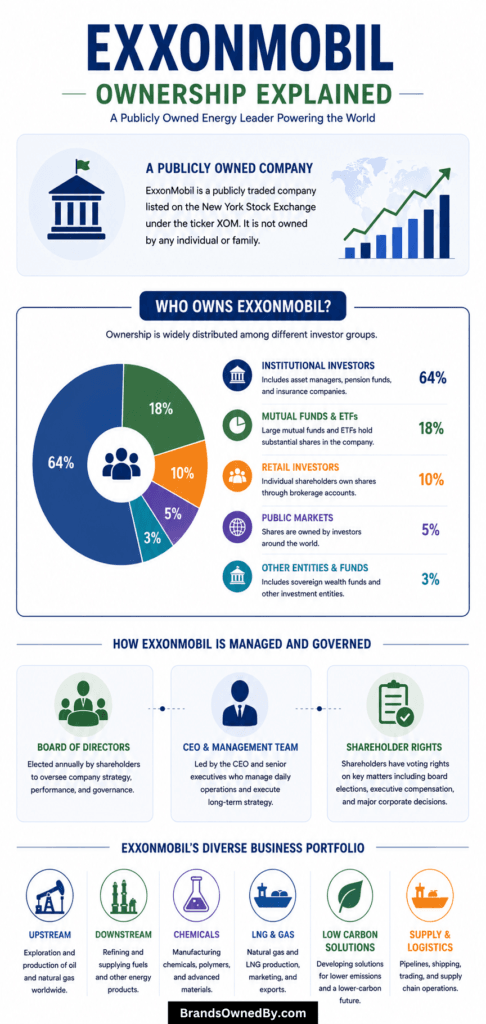
- ExxonMobil is a publicly traded energy company listed on the New York Stock Exchange under the ticker symbol XOM. No single person or family owns the company outright. Ownership is primarily divided among institutional investors, mutual funds, pension funds, ETFs, and retail shareholders worldwide.
- The Vanguard Group is the largest shareholder of ExxonMobil as of 2026, owning more than 10% of the company. Other major shareholders include BlackRock, State Street Global Advisors, Fidelity Investments, and Geode Capital Management, giving institutional investors significant influence over board elections and corporate governance.
- ExxonMobil is controlled operationally by Chairman and CEO Darren Woods along with the company’s Management Committee and board of directors. Major shareholders influence strategic decisions through proxy voting, shareholder resolutions, executive compensation approvals, and governance pressure.
- ExxonMobil owns and operates a massive portfolio of brands and businesses including Exxon, Mobil, Mobil 1, Esso, XTO Energy, Pioneer Natural Resources, Imperial Oil, ExxonMobil Chemical Company, Low Carbon Solutions, and multiple LNG, petrochemical, pipeline, and carbon capture entities across global energy markets.
ExxonMobil is an American multinational oil and gas corporation headquartered in Spring, Texas. The company operates across the entire energy value chain. Its operations include crude oil exploration, natural gas production, refining, fuel distribution, petrochemicals, lubricants, and industrial energy solutions.
ExxonMobil is considered one of the most influential energy companies in the world. The company supplies fuel, chemicals, and energy products to businesses, governments, airlines, shipping companies, factories, and consumers across multiple continents.
Its business is divided into several major segments:
Upstream Operations
The upstream division focuses on oil and natural gas exploration and production.
ExxonMobil operates offshore drilling projects, shale assets, deepwater fields, and conventional oil reserves in various countries. Major production regions include the United States, Guyana, Canada, and parts of Asia and Africa.
The company is especially known for large-scale offshore projects. Guyana has become one of ExxonMobil’s most important production areas in recent years due to massive oil discoveries.
Downstream Operations
The downstream business handles refining, transportation, and fuel distribution.
ExxonMobil owns and operates refineries that convert crude oil into gasoline, diesel, jet fuel, marine fuel, and other petroleum products.
Its fuel products are sold through brands such as Exxon, Mobil, and Esso.
For example, airlines use ExxonMobil aviation fuel, while industrial fleets and consumers use its gasoline and diesel products daily.
Chemical Business
ExxonMobil operates one of the largest chemical manufacturing businesses globally.
The company produces plastics, synthetic rubber, packaging materials, industrial chemicals, and specialty products used in multiple industries.
Its chemical products are commonly used in:
- Automotive manufacturing.
- Construction materials.
- Medical packaging.
- Consumer electronics.
- Food packaging.
This segment helps ExxonMobil generate diversified income beyond oil production alone.
Lubricants and Industrial Products
Mobil 1 is one of ExxonMobil’s best-known lubricant brands.
The company supplies engine oils, industrial lubricants, hydraulic fluids, and specialty products for vehicles and heavy machinery.
Its lubricants are widely used in:
- Passenger vehicles.
- Commercial trucking.
- Motorsports.
- Aviation.
- Industrial factories.
Low Carbon and Energy Transition Projects
ExxonMobil has expanded investments in lower-emission technologies.
The company is developing projects related to:
- Carbon capture and storage.
- Hydrogen production.
- Emissions reduction systems.
- Low-carbon industrial solutions.
Unlike some competitors, ExxonMobil still focuses heavily on oil and gas production while gradually building low-carbon businesses alongside its traditional operations.
Founders of ExxonMobil
ExxonMobil does not have a single modern founder because it was created through the merger of Exxon and Mobil in 1999. However, its historical roots trace back to Standard Oil and several influential business leaders.
John D. Rockefeller
John D. Rockefeller is considered the original founder behind the corporate lineage that eventually led to ExxonMobil.
He founded Standard Oil in 1870. The company rapidly became the dominant force in the American oil industry.
Standard Oil controlled major parts of:
- Oil refining.
- Transportation.
- Pipelines.
- Fuel distribution.
Rockefeller’s business model focused on efficiency, scale, and aggressive expansion. His company transformed the oil business into a modern industrial system.
After the breakup of Standard Oil in 1911, several independent companies emerged. Two of them later evolved into Exxon and Mobil.
Founders Behind Exxon
Exxon traces its roots to Standard Oil of New Jersey, one of the largest companies created after the breakup of John D. Rockefeller’s Standard Oil empire in 1911.
Standard Oil of New Jersey quickly became a dominant force in the global petroleum industry. The company expanded aggressively into oil refining, transportation, international exploration, and fuel exports. Over time, it developed large refinery networks and overseas production assets that helped it become one of the most influential oil corporations in the world.
During the mid-20th century, the company operated under the “Esso” brand in many international markets. The name came from the initials “S.O.” for Standard Oil. However, trademark disputes in certain U.S. states limited the company’s ability to use the Esso name nationwide.
To create a unified global identity, the company introduced the Exxon brand in 1972. The new name was designed to be unique, recognizable, and legally protectable worldwide. Exxon soon became the primary consumer-facing brand for fuel stations, petroleum products, and energy operations in the United States.
The company gained a reputation for large-scale engineering projects, offshore drilling expertise, and advanced refining technology. Before merging with Mobil, Exxon had already become one of the largest publicly traded oil companies globally.
Exxon also played a major role in expanding international energy infrastructure. Its operations stretched across North America, Europe, the Middle East, Asia, and Africa.
Founders Behind Mobil
Mobil originated from Standard Oil of New York, commonly known as Socony. The company was another major successor created after the Standard Oil breakup.
Socony initially focused on fuel distribution and kerosene sales in the northeastern United States. As automobile ownership increased during the early 20th century, the company rapidly expanded into gasoline production and retail fuel stations.
In 1931, Socony merged with Vacuum Oil Company, a respected lubricant producer known for its advanced oil technology. The merger formed Socony-Vacuum, which later became Mobil.
This merger significantly strengthened the company’s position in both fuel and lubricants. Mobil became especially known for innovation in motor oils and industrial lubricants. The Pegasus logo became one of the most recognizable symbols in the global energy industry.
Mobil expanded heavily into international oil exploration, refining, petrochemicals, and aviation fuel supply. The company built strong operations across Europe, Asia, and Latin America.
One of Mobil’s biggest strengths was its lubricant business. Mobil 1 motor oil became a premium global brand used in passenger vehicles, racing teams, industrial machinery, and aviation applications.
Before the Exxon merger, Mobil had developed a strong reputation for technological innovation and high-performance petroleum products. Its expertise complemented Exxon’s large-scale production and refining operations, making the 1999 merger strategically important for both companies.
Exxon and Mobil Merger
ExxonMobil was officially formed in 1999 when Exxon and Mobil merged.
The merger combined two of the largest oil companies in American history into a single energy giant.
The deal created a stronger operational scale in:
- Oil production.
- Refining capacity.
- Global logistics.
- Chemical manufacturing.
- International energy trading.
Former Exxon CEO Lee Raymond played a major role in leading the merger process and shaping the combined company’s early strategy.
Ownership History
ExxonMobil’s ownership history is closely connected to the evolution of the modern oil industry in the United States. The company did not begin as ExxonMobil. It evolved through decades of restructuring, antitrust actions, mergers, and public stock ownership changes.
Its history can be divided into several major phases.
The Standard Oil Era
ExxonMobil’s roots trace back to Standard Oil, founded by John D. Rockefeller in 1870.
At the time, the oil industry was highly fragmented. Rockefeller built Standard Oil into the dominant oil company in the United States through acquisitions, refinery expansion, transportation control, and operational efficiency.
Standard Oil eventually controlled a massive share of the American petroleum industry. The company managed nearly every part of the oil supply chain, including:
- Oil refining.
- Pipelines.
- Storage facilities.
- Rail transportation.
- Fuel distribution.
Because of its dominance, Standard Oil became one of the most powerful corporations in American history.
Ownership during this period was concentrated among Rockefeller, business partners, and wealthy investors connected to Standard Oil.
The Breakup of Standard Oil in 1911
In 1911, the U.S. Supreme Court ruled that Standard Oil violated antitrust laws.
The government ordered the company to be broken into 34 separate entities to reduce monopoly power in the energy market.
Several major oil companies emerged from this breakup, including:
- Standard Oil of New Jersey.
- Standard Oil of New York.
- Chevron.
- Amoco.
- Conoco.
- Sohio.
Standard Oil of New Jersey later evolved into Exxon, while Standard Oil of New York eventually became Mobil.
After the breakup, ownership became decentralized. Shares of the newly independent companies were distributed among existing Standard Oil shareholders.
Interestingly, Rockefeller’s personal wealth increased after the breakup because the individual companies grew rapidly in value.
Growth of Standard Oil of New Jersey
Standard Oil of New Jersey became one of the largest successor companies after the breakup.
The company expanded internationally through oil exploration, refining projects, and fuel exports. It developed operations in Europe, Asia, South America, and the Middle East.
Over time, ownership shifted from founding investors toward public shareholders.
As stock markets expanded during the 20th century, large financial institutions, pension funds, and retail investors began purchasing shares.
The company eventually adopted the Exxon name in 1972 to create a unified corporate identity.
Growth of Mobil
Standard Oil of New York followed a different growth path.
The company expanded aggressively in fuel marketing and lubricants. It later merged with Vacuum Oil Company in 1931, creating Socony-Vacuum.
The business eventually became Mobil Oil Corporation.
Mobil developed strong positions in:
- Motor oil products.
- International fuel stations.
- Aviation fuels.
- Offshore exploration.
- Petrochemicals.
Like Exxon, Mobil’s ownership became widely distributed among public investors over time.
Institutional ownership increased significantly during the late 20th century as pension funds and mutual funds expanded their holdings in large American corporations.
The Exxon and Mobil Merger
One of the biggest moments in ExxonMobil ownership history occurred in 1999.
Exxon and Mobil merged in a deal valued at approximately $81 billion. The transaction created ExxonMobil Corporation.
The merger was designed to improve:
- Operational efficiency.
- Refining scale.
- International competitiveness.
- Exploration capabilities.
- Chemical production capacity.
Ownership of the new company was divided among former Exxon and Mobil shareholders.
Exxon shareholders received the larger ownership share because Exxon was the bigger company at the time of the merger.
The deal also created one of the largest publicly traded energy companies in the world.
Rise of Institutional Ownership
During the 2000s and 2010s, institutional investors became the dominant owners of ExxonMobil stock.
Large asset management firms accumulated major stakes through:
- Index funds.
- Mutual funds.
- Pension funds.
- Exchange-traded funds (ETFs).
This shifted practical ownership influence away from individual investors and toward financial institutions.
The largest shareholders eventually included:
These firms manage investments on behalf of millions of ordinary investors worldwide.
For example, when someone invests in an S&P 500 index fund, part of their money is indirectly invested in ExxonMobil shares.
Shareholder Activism and Governance Changes
ExxonMobil’s ownership history also includes periods of shareholder activism.
Environmental groups, pension funds, and activist investors have increasingly pressured the company regarding:
- Climate strategy.
- Carbon emissions.
- Energy transition planning.
- Executive compensation.
- Capital spending decisions.
One of the most notable events occurred when activist hedge fund Engine No. 1 successfully pushed for board changes at ExxonMobil.
The campaign argued that ExxonMobil needed stronger financial discipline and better long-term energy transition planning.
This showed how institutional investors could influence company leadership without owning a majority stake.
Modern Ownership Structure
As of 2026, ExxonMobil remains a publicly traded corporation with highly distributed ownership.
No single shareholder controls the company outright.
Instead, ownership is divided among:
- Institutional investors.
- Pension funds.
- ETFs.
- Mutual funds.
- Retail investors.
- Corporate insiders.
The company’s ownership structure reflects the broader modern American corporate system where financial institutions hold large voting power through pooled investment funds.
Although millions of investors technically own ExxonMobil shares, major strategic decisions are heavily influenced by the board of directors, executive leadership team, and large institutional shareholders.
Who Owns ExxonMobil: Major Shareholders
ExxonMobil is a publicly traded American oil and gas company listed on the New York Stock Exchange (NYSE) under the ticker symbol XOM. The company is headquartered in Spring, Texas, and operates as one of the world’s largest integrated energy corporations.
As of 2026, ExxonMobil is primarily owned by institutional investors rather than a single individual or family. The company’s largest shareholders are The Vanguard Group, BlackRock, and State Street Global Advisors. These investment firms collectively own a major portion of ExxonMobil shares through index funds, ETFs, pension funds, retirement portfolios, and mutual funds.
The Vanguard Group is currently the largest shareholder of ExxonMobil with ownership exceeding 10% of the company’s outstanding stock. BlackRock is the second-largest shareholder with roughly 7% to 8% ownership, while State Street holds close to 5%.
As of May 2026, ExxonMobil remains one of the largest publicly traded energy companies in the world by market value, production scale, and global operations.
The Vanguard Group
The Vanguard Group is the largest shareholder of ExxonMobil as of 2026.
Vanguard owns more than 429 million ExxonMobil shares, representing slightly over 10% of the company’s outstanding stock.
The firm holds ExxonMobil shares through its massive network of index funds and ETFs. These include:
- Vanguard 500 Index Fund.
- Vanguard Total Stock Market Index Fund.
- Vanguard Energy ETF.
- Retirement and pension-focused funds.
Vanguard’s ownership is considered passive because the company usually invests to track stock market indexes rather than actively control operations.
However, Vanguard still has enormous influence because it votes on:
- Board elections.
- Executive compensation.
- Shareholder resolutions.
- Governance proposals.
- Climate-related policies.
For example, if ExxonMobil shareholders vote on emissions targets or executive pay packages, Vanguard’s voting power can heavily influence the outcome.
The company’s ownership stake has steadily increased over the years because more investors continue moving retirement savings into passive index funds.
BlackRock
BlackRock is the second-largest shareholder of ExxonMobil.
As of recent 2026 shareholder filings, BlackRock owns more than 310 million ExxonMobil shares, representing roughly 7.4% to 7.5% ownership.
BlackRock manages trillions of dollars in assets globally and is one of the most powerful investment firms in the world.
Its ExxonMobil holdings are spread across:
- iShares ETFs.
- Institutional portfolios.
- Pension investments.
- Energy-focused funds.
- Passive index products.
BlackRock plays a highly visible role in energy-sector governance discussions.
The company has previously supported some shareholder proposals related to:
- Climate risk disclosure.
- Emissions reporting.
- Long-term sustainability planning.
- Corporate governance reforms.
At the same time, BlackRock also remains heavily invested in traditional energy companies because oil and gas stocks continue to generate strong cash flows and dividend income.
This creates a balancing act between sustainability goals and shareholder return expectations.
State Street Global Advisors
State Street Global Advisors is another major ExxonMobil shareholder.
The company owns approximately 205 million ExxonMobil shares, giving it close to 5% ownership in the corporation.
State Street is one of the world’s largest asset managers and operates major ETF products such as SPDR funds.
Like Vanguard and BlackRock, State Street mainly owns ExxonMobil shares through passive investment vehicles tied to stock indexes.
Although State Street is not usually as publicly aggressive as activist investors, it still influences ExxonMobil through:
- Shareholder voting.
- Governance recommendations.
- Board oversight discussions.
- ESG-related engagement.
Together, Vanguard, BlackRock, and State Street often control more than 20% of ExxonMobil’s total shares combined.
This gives the three firms enormous collective influence over company governance.
FMR LLC
FMR LLC, the parent company of Fidelity Investments, is another significant ExxonMobil shareholder.
Fidelity owns nearly 99 million ExxonMobil shares as of recent filings, representing more than 2% ownership.
Unlike purely passive asset managers, Fidelity combines both active and passive investment strategies.
Its ExxonMobil holdings appear across:
- Fidelity mutual funds.
- Retirement portfolios.
- Energy-sector investment products.
- Institutional advisory accounts.
Fidelity’s portfolio managers may increase or reduce ExxonMobil exposure depending on oil prices, energy demand, geopolitical conditions, and expected profitability.
Geode Capital Management
Geode Capital Management is also among ExxonMobil’s top shareholders.
The firm owns roughly 95 million ExxonMobil shares, equal to slightly more than 2% ownership.
Geode primarily manages index-based investment products and institutional portfolios.
Although less publicly known than Vanguard or BlackRock, Geode controls billions of dollars in energy-sector investments.
Its ownership demonstrates how large portions of ExxonMobil stock are concentrated among firms connected to passive investing strategies.
Norges Bank Investment Management
Norges Bank, which manages Norway’s sovereign wealth fund, is another notable ExxonMobil investor.
The fund has historically maintained major positions in global oil and energy companies because of its long-term investment strategy.
Norges Bank periodically adjusts holdings based on market conditions, energy outlooks, and sustainability considerations.
Because the fund represents one of the world’s largest sovereign wealth portfolios, even relatively small percentage stakes in ExxonMobil represent billions of dollars in value.
Retail Investors
Retail investors collectively own a meaningful portion of ExxonMobil shares.
These include:
- Individual brokerage account holders.
- Retirees.
- Dividend investors.
- Long-term stock market investors.
- Employees with stock ownership plans.
Many retail shareholders invest in ExxonMobil for dividend income and long-term energy exposure.
For example, ExxonMobil has historically attracted income-focused investors because of its long track record of dividend payments.
However, retail ownership is fragmented. Individual investors usually do not have enough shares to directly influence corporate strategy on their own.
Insider Ownership
ExxonMobil executives and board members own relatively small percentages of the company compared to institutional investors.
Key insiders include:
- Darren Woods.
- Senior executives.
- Board directors.
Insider ownership is common in public corporations because executives often receive stock awards and performance-based compensation.
However, insider holdings represent less than 1% of ExxonMobil’s total shares.
This means company leadership controls ExxonMobil mainly through management authority and board governance rather than ownership dominance.
How ExxonMobil Shareholders Influence the Company
Large shareholders influence ExxonMobil through proxy voting and governance pressure.
Major investors can vote on:
- Board appointments.
- Executive compensation.
- Shareholder resolutions.
- Climate policies.
- Mergers and acquisitions.
- Capital allocation decisions.
One major example was the activist campaign led by Engine No. 1, which successfully gained board seats despite owning only a small stake in ExxonMobil.
The campaign succeeded because large institutional shareholders supported governance changes aimed at improving long-term performance and energy transition planning.
This demonstrated that shareholder influence at ExxonMobil depends more on coalition-building and institutional voting power than on outright ownership control.
Competitor Ownership Comparison
ExxonMobil’s ownership structure is heavily institutional and shareholder-driven. As of 2026, more than 70% of ExxonMobil shares are owned by institutional investors, with Vanguard, BlackRock, and State Street controlling the largest stakes.
This structure is similar to some Western energy companies but very different from state-controlled oil giants such as Saudi Aramco and Petrobras.
Ownership structure matters because it directly affects:
- Corporate strategy.
- Capital allocation.
- Dividend priorities.
- Climate policies.
- Government influence.
- Long-term investment planning.
Some energy companies answer mainly to shareholders. Others operate under national government priorities.
Chevron
Chevron has one of the closest ownership structures to ExxonMobil.
Like ExxonMobil, Chevron is a publicly traded American oil company listed on the New York Stock Exchange. Institutional investors dominate ownership.
As of 2026, Chevron’s largest shareholders include:
- Vanguard Group.
- State Street Corporation.
- BlackRock.
- Berkshire Hathaway.
Institutional investors collectively control more than 73% of Chevron shares.
This makes Chevron highly shareholder-focused, similar to ExxonMobil.
Both companies prioritize:
- Shareholder returns.
- Dividend growth.
- Stock buybacks.
- Production efficiency.
- Large-scale oil and gas expansion.
However, Chevron has a more concentrated strategic investor presence because Berkshire Hathaway holds a very large stake compared to ExxonMobil, where ownership is more diversified across asset managers.
Another key similarity is governance independence. Neither ExxonMobil nor Chevron has direct government ownership or state control.
Shell
Shell operates under a more globally diversified shareholder base.
The company is publicly traded, but its investor mix includes large European pension funds, sovereign wealth funds, institutional investors, and retail shareholders from multiple continents.
Unlike ExxonMobil, Shell faces stronger pressure from European investors focused on:
- Net-zero targets.
- Carbon reduction.
- Renewable energy expansion.
- ESG compliance.
- Climate disclosure.
Because of this investor pressure, Shell accelerated investments in:
- Offshore wind.
- EV charging infrastructure.
- Hydrogen projects.
- Renewable power generation.
ExxonMobil investors, particularly major U.S. institutional shareholders, have historically prioritized profitability and cash flow over aggressive renewable expansion.
This difference in shareholder priorities has significantly shaped how both companies approach the energy transition.
BP
BP also has broad institutional ownership, but its governance environment differs from ExxonMobil.
Major BP shareholders include global investment firms, pension funds, and sovereign wealth investors. European institutional investors hold substantial influence over company strategy.
Following the Deepwater Horizon disaster, BP experienced major governance restructuring and increased shareholder scrutiny.
Since then, shareholders have pushed BP more aggressively toward:
- Emissions reduction.
- Renewable energy development.
- Lower hydrocarbon dependence.
- ESG-linked executive compensation.
Compared to ExxonMobil, BP investors have generally supported faster transformation into a diversified energy company rather than remaining heavily oil-focused.
This reflects broader differences between American and European shareholder expectations in the energy sector.
Saudi Aramco
Saudi Aramco has one of the most different ownership structures compared to ExxonMobil.
Saudi Aramco is majority-owned by the Saudi Arabian government. Although a minority of shares trade publicly on the Saudi stock exchange, the Saudi state maintains overwhelming control.
This means Saudi Aramco operates primarily under national strategic objectives rather than institutional shareholder priorities.
Its decisions are heavily influenced by:
- Saudi government policy.
- National budget requirements.
- OPEC production strategy.
- Geopolitical goals.
- Domestic economic diversification plans.
Unlike ExxonMobil, Saudi Aramco does not face strong activist investor pressure from firms like Vanguard or BlackRock.
The company can therefore prioritize long-term national energy influence over short-term shareholder expectations.
This state-controlled structure gives Saudi Aramco extraordinary production flexibility but also ties corporate decisions closely to political priorities.
Petrobras
Petrobras operates under a hybrid ownership model.
The company is publicly traded, but the Brazilian government remains the controlling shareholder through voting power.
This government influence has historically shaped Petrobras decisions involving:
- Domestic fuel pricing.
- Infrastructure spending.
- Employment policies.
- National energy development.
- Capital investment priorities.
Compared to ExxonMobil, Petrobras faces significantly higher political intervention risk.
For example, Brazilian governments have occasionally pressured Petrobras to keep fuel prices artificially low to reduce inflation and political backlash.
ExxonMobil does not face this type of direct government operational control because its ownership is fully market-driven.
TotalEnergies
TotalEnergies has a publicly traded ownership structure similar to ExxonMobil, but shareholder priorities differ substantially.
European institutional investors play a larger role in TotalEnergies ownership and governance.
These investors have strongly supported the company’s transition into renewable energy and lower-carbon businesses.
As a result, TotalEnergies expanded investments into:
- Solar energy.
- Wind power.
- Green hydrogen.
- Battery storage.
- Electric mobility infrastructure.
ExxonMobil has also invested in low-carbon technologies, but its shareholders have generally supported maintaining a stronger focus on oil and gas production.
This difference reflects contrasting investor expectations between U.S. and European capital markets.
Key Ownership Differences Between ExxonMobil and Competitors
| Company | Stock Symbol | Ownership Structure | Largest/Key Shareholders | Government Ownership | Main Shareholder Priorities | Ownership Impact on Strategy |
|---|---|---|---|---|---|---|
| ExxonMobil | NYSE: XOM | Publicly traded corporation | Vanguard, BlackRock, State Street | No direct government ownership | Profitability, dividends, production growth, shareholder returns | Strong focus on oil and gas expansion, operational efficiency, stock buybacks, and long-term cash flow generation. |
| Chevron | NYSE: CVX | Publicly traded corporation | Vanguard, BlackRock, State Street, Berkshire Hathaway | No direct government ownership | Investor returns, dividend stability, capital discipline | Similar to ExxonMobil with strong emphasis on shareholder value and large-scale energy production. |
| Shell | LSE: SHEL | Publicly traded multinational company | Global institutional investors, pension funds, sovereign funds | No controlling government stake | ESG goals, emissions reduction, renewable expansion | Greater pressure to accelerate clean energy investments and reduce carbon intensity. |
| BP | LSE: BP | Publicly traded multinational company | BlackRock, Vanguard, Norges Bank, pension funds | No controlling government ownership | Sustainability targets, governance reforms, lower emissions | Investors have pushed BP toward renewable energy and reduced hydrocarbon dependence. |
| Saudi Aramco | Tadawul: 2222 | Majority state-owned oil company | Saudi Arabian government | Yes, majority controlled by Saudi government | National revenue generation, OPEC strategy, geopolitical influence | Corporate decisions are closely aligned with Saudi national policy and economic planning. |
| Petrobras | NYSE: PBR | Government-controlled public company | Brazilian government, institutional investors | Yes, controlling voting power held by Brazil | Domestic fuel pricing, national energy policy, political priorities | Political influence often impacts fuel pricing, investment decisions, and operational strategy. |
| TotalEnergies | NYSE: TTE | Publicly traded multinational company | European institutional investors, pension funds | No controlling government ownership | Energy transition, renewable investments, ESG compliance | Faster expansion into solar, wind, hydrogen, and clean energy infrastructure compared to ExxonMobil. |
The biggest difference between ExxonMobil and many global competitors is the absence of government ownership.
ExxonMobil operates almost entirely under institutional investor influence.
Its largest shareholders are financial asset managers rather than governments or sovereign entities.
Another major difference is activist shareholder influence.
ExxonMobil has faced campaigns from activist investors such as Engine No. 1, which successfully won board seats with support from institutional shareholders.
This demonstrated how even relatively small investors can influence ExxonMobil if they gain backing from major institutional shareholders like BlackRock or Vanguard.
State-controlled companies such as Saudi Aramco do not face the same level of activist shareholder pressure because governments maintain decisive control.
Who Controls ExxonMobil?
ExxonMobil is controlled through a layered corporate governance structure that includes the board of directors, the management committee, senior executives, and large institutional shareholders. Although millions of investors own ExxonMobil shares, operational control is concentrated within a relatively small leadership group based at the company’s headquarters in Spring, Texas.
As of May 2026, ExxonMobil’s leadership structure is centered around Chairman and CEO Darren Woods and a powerful internal management committee responsible for overseeing the company’s global energy operations, refining business, chemical division, financial strategy, and low-carbon investments.
The control structure works like this:
- Shareholders elect the board of directors.
- The board oversees governance and appoints top executives.
- Darren Woods and the Management Committee control operations and strategy.
- Senior executives manage individual business divisions.
- Institutional investors influence governance through voting power.
Darren Woods: Chairman and Chief Executive Officer
Darren Woods is the top decision-maker at ExxonMobil.
He serves as both Chairman of the Board and Chief Executive Officer. Holding both positions gives Woods substantial authority over corporate strategy, executive leadership appointments, capital allocation, and long-term operational planning.
Woods became CEO in January 2017 after previously serving as President of ExxonMobil and a member of the board.
As CEO, Woods oversees:
- Global upstream oil and gas operations.
- Refining and fuels business.
- Chemical manufacturing.
- Low Carbon Solutions division.
- Major acquisitions and investments.
- Shareholder strategy.
- Long-term production growth targets.
Under Woods, ExxonMobil aggressively expanded production in Guyana and the Permian Basin while also increasing investments in carbon capture and hydrogen projects.
He also led ExxonMobil’s $60 billion acquisition of Pioneer Natural Resources, which significantly strengthened the company’s position in U.S. shale production.
Because Woods also serves as board chairman, he holds more centralized authority compared to companies that separate the chairman and CEO roles.
ExxonMobil Management Committee
The Management Committee is ExxonMobil’s most powerful internal leadership group.
As of May 2026, the committee consists of four senior executives:
| Executive | Position | Main Responsibilities |
|---|---|---|
| Darren Woods | Chairman and CEO | Overall corporate strategy, leadership, acquisitions, investor relations, and global operations oversight. |
| Neil Chapman | Senior Vice President | Oversees major operational businesses and corporate strategy execution across global energy operations. |
| Neil Hansen | Senior Vice President and CFO | Controls financial strategy, investor relations, capital allocation, financial reporting, and corporate finance. |
| Jack Williams | Senior Vice President | Oversees major upstream and production-related operational functions and strategic development activities. |
This committee effectively acts as ExxonMobil’s central command structure.
Major operational and financial decisions typically move through this group before reaching the board of directors.
The committee supervises:
- Multi-billion-dollar investment decisions.
- Global production targets.
- Refining operations.
- Cost reduction programs.
- Mergers and acquisitions.
- Shareholder return strategy.
- Climate and emissions planning.
Neil Chapman: Senior Vice President
Neil Chapman is one of the most influential executives inside ExxonMobil.
Chapman joined ExxonMobil’s Management Committee in 2018 and has spent decades inside the company across chemicals, refining, fuels, and international operations.
He plays a major role in operational execution and strategic planning.
Chapman previously led ExxonMobil Chemical Company and managed several international business divisions before becoming Senior Vice President.
His influence is especially important in:
- Chemicals strategy.
- International operations.
- Refining integration.
- Commercial fuel operations.
- Corporate planning.
Because ExxonMobil operates across the full energy value chain, executives like Chapman help coordinate operations between upstream production, refining, chemicals, and global distribution.
Neil Hansen: Chief Financial Officer
Neil Hansen became ExxonMobil’s Senior Vice President and Chief Financial Officer effective February 1, 2026, replacing Kathryn Mikells after her retirement announcement.
Hansen controls ExxonMobil’s financial systems and capital allocation strategy.
His responsibilities include:
- Corporate finance.
- Investor relations.
- Financial reporting.
- Budget planning.
- Shareholder return programs.
- Debt management.
- Cash flow oversight.
The CFO position is extremely important at ExxonMobil because the company manages massive global capital expenditures tied to oil fields, refineries, pipelines, LNG projects, and petrochemical plants.
Hansen previously held several major internal leadership positions including:
- Vice President of Investor Relations.
- Senior Vice President for Energy Products.
- President of Global Business Solutions.
His appointment reflected ExxonMobil’s preference for experienced internal operators with deep knowledge of the company’s financial and operational systems.
Jack Williams: Senior Vice President
Jack Williams is another key member of ExxonMobil’s Management Committee.
Williams has been Senior Vice President since 2014 and previously led ExxonMobil Production Company and XTO Energy operations.
His influence is strongest in:
- Upstream production.
- Shale operations.
- Engineering projects.
- Oil and gas development.
- Production efficiency.
Williams also played a major role in integrating XTO Energy after ExxonMobil acquired the shale producer.
Because upstream production generates a major portion of ExxonMobil’s profits, executives overseeing drilling and production operations hold enormous influence inside the company.
Business Unit Leaders Also Hold Significant Control
Beyond the Management Committee, several business-unit presidents control major operating divisions.
One major leadership change occurred in 2025 when ExxonMobil appointed Dan Ammann to lead its upstream oil and gas business.
Ammann previously served as President of General Motors and later led ExxonMobil’s Low Carbon Solutions division.
As head of upstream operations, Ammann oversees ExxonMobil’s most profitable segment, including:
- Offshore oil production.
- Shale drilling.
- International exploration.
- Production growth strategy.
ExxonMobil also appointed Barry Engle to lead Low Carbon Solutions, signaling the company’s increasing focus on carbon capture and emissions-reduction businesses.
These appointments showed ExxonMobil expanding its leadership structure beyond traditional internal promotions by bringing in outside executives with industrial and manufacturing experience.
ExxonMobil Board of Directors
The board of directors oversees management and represents shareholder interests.
As of 2026, ExxonMobil’s board includes executives and business leaders from industries such as:
- Finance.
- Aerospace.
- Investment management.
- Technology.
- Manufacturing.
- Energy.
Key board members include:
- Darren Woods.
- Joseph Hooley.
- Michael Angelakis.
- Angela Braly.
- Dina Powell McCormick.
- Jeffrey Ubben.
- Kaisa Hietala.
The board approves major corporate actions such as:
- Executive compensation.
- Large acquisitions.
- Governance policies.
- Risk management systems.
- Long-term strategic planning.
The board can also pressure management or replace executives if shareholder concerns intensify.
Institutional Investors Influence ExxonMobil Indirectly
Although executives manage ExxonMobil directly, institutional investors influence the company through proxy voting power.
The largest shareholders include:
- Vanguard.
- BlackRock.
- State Street.
Together, these firms control more than 20% of ExxonMobil shares.
These investors vote on:
- Board elections.
- Executive pay.
- Climate resolutions.
- Governance reforms.
- Shareholder proposals.
For example, activist hedge fund Engine No. 1 successfully gained board seats at ExxonMobil after winning support from major institutional investors.
That campaign demonstrated how shareholder coalitions can pressure ExxonMobil leadership even without owning a controlling stake.
ExxonMobil Annual Revenue and Net Worth
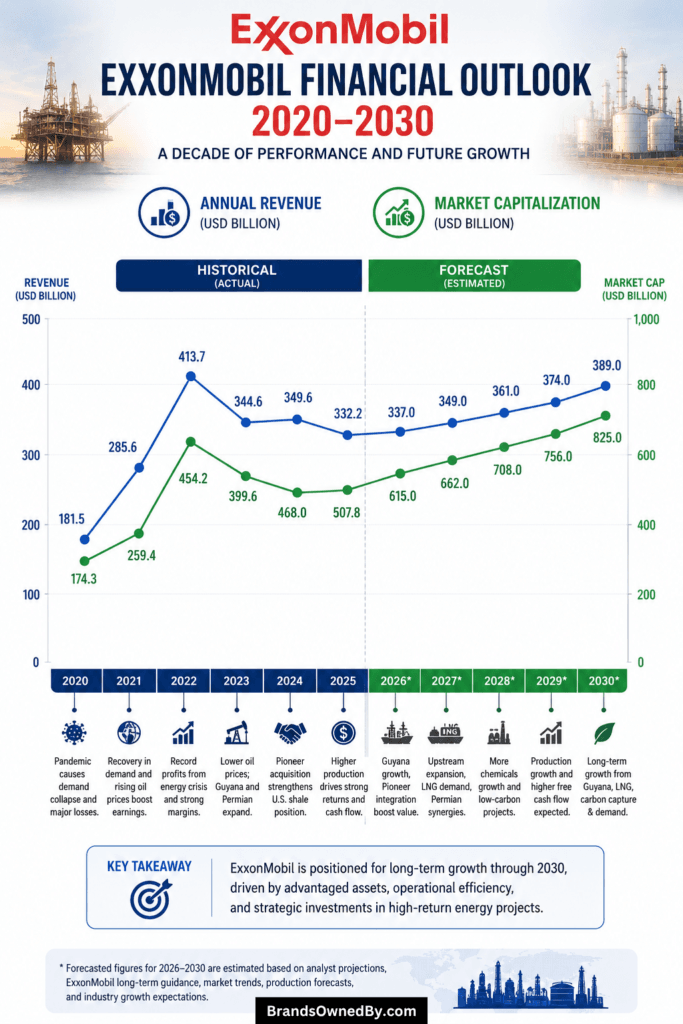
As of May 2026, ExxonMobil remains one of the world’s largest publicly traded energy companies based on revenue, market capitalization, production scale, and cash flow generation. The company generated annual revenue of more than $330 billion in 2025, while its market capitalization crossed $600 billion in May 2026 due to rising investor confidence, higher oil prices, strong Guyana production growth, and successful integration of Pioneer Natural Resources.
ExxonMobil’s financial performance is driven by multiple business segments including upstream oil and gas production, refining, petrochemicals, LNG exports, and low-carbon solutions. Unlike smaller oil companies that depend mainly on crude prices, ExxonMobil benefits from diversified global operations across the entire energy value chain.
The company’s financial growth between 2021 and 2026 was heavily supported by:
- Rising global oil demand.
- Higher refining margins.
- Record Guyana production.
- Permian Basin expansion.
- LNG export growth.
- Operational cost reductions.
- Large-scale share repurchases.
ExxonMobil 2026 Revenue
ExxonMobil’s estimated annualized revenue for 2026 is approximately $337 billion.
The company reported first-quarter 2026 revenue exceeding $83 billion despite disruptions linked to Middle East tensions and temporary downstream trading impacts. ExxonMobil also reported stronger-than-expected earnings during the quarter.
One of the biggest contributors to ExxonMobil’s 2026 revenue growth is upstream production.
The company achieved record production levels in Guyana and continued expanding output in the Permian Basin after completing the Pioneer Natural Resources acquisition. ExxonMobil also increased LNG export capacity through the Golden Pass LNG project.
The upstream business remained the company’s strongest earnings driver in 2026. According to company disclosures, upstream earnings reached approximately $5.7 billion during the first quarter alone despite geopolitical disruptions.
ExxonMobil’s major 2026 revenue sources include:
| Business Segment | Estimated 2026 Revenue Contribution | Estimated Share of Total Revenue | Key Revenue Drivers | Major Operational Regions |
|---|---|---|---|---|
| Upstream Oil & Gas | $148 billion | Approximately 44% | Crude oil production, natural gas sales, offshore drilling, shale production, LNG-linked output | Guyana, Permian Basin, Gulf of Mexico, Canada, Middle East |
| Energy Products & Refining | $121 billion | Approximately 36% | Gasoline, diesel, jet fuel, marine fuels, refining margins, fuel exports | United States, Europe, Singapore, Asia-Pacific |
| Chemical Products | $46 billion | Approximately 14% | Petrochemicals, plastics, industrial chemicals, packaging materials, specialty products | United States, China, Singapore, Belgium |
| LNG & Natural Gas Solutions | $14 billion | Approximately 4% | LNG exports, natural gas trading, long-term LNG supply contracts | Qatar, Papua New Guinea, United States |
| Low Carbon Solutions | $8 billion | Approximately 2% | Carbon capture projects, hydrogen initiatives, emissions-reduction services, low-carbon technologies | United States, Europe, industrial carbon hubs |
| Total Estimated 2026 Revenue | $337 billion | 100% | Combined contribution from all ExxonMobil business segments | Global operations across more than 60 countries |
The company also benefited from stronger oil market conditions during early 2026 as geopolitical tensions in the Middle East pushed crude prices higher. Brent crude temporarily crossed $100 per barrel during the Iran-related supply disruptions.
ExxonMobil 2026 Net Worth and Market Value
As of May 2026, ExxonMobil’s market capitalization is estimated at approximately $615 billion.
This makes ExxonMobil one of the most valuable energy companies in the world alongside Saudi Aramco.
Investor confidence increased significantly after:
- Strong Guyana production growth.
- Successful Pioneer integration.
- Higher expected cash flows.
- Expanding Permian production.
- Record operational efficiency.
- Aggressive share buybacks.
ExxonMobil stock traded above $150 per share during May 2026 after gaining roughly 55% over the previous year. Analysts cited low-cost production growth in Guyana and the Permian Basin as major reasons behind the company’s higher valuation.
The company’s financial strength is also supported by strong operating cash flow.
ExxonMobil generated approximately $13.8 billion in adjusted operating cash flow during the first quarter of 2026 alone, excluding certain accounting impacts tied to derivative contracts.
The company returned billions of dollars to shareholders through:
- Quarterly dividends.
- Stock repurchases.
- Capital return programs.
ExxonMobil distributed more than $9 billion to shareholders during the first quarter of 2026 through dividends and share buybacks combined.
Revenue Recovery After 2020
ExxonMobil’s revenue collapsed during 2020 when the COVID-19 pandemic sharply reduced fuel demand worldwide.
Global lockdowns caused major declines in:
- Airline fuel consumption.
- Industrial activity.
- Vehicle fuel demand.
- Global shipping activity.
This pushed ExxonMobil revenue down to approximately $181.5 billion in 2020.
However, the company recovered rapidly between 2021 and 2023 as oil prices rebounded and global energy demand returned.
The 2022 global energy crisis became a major turning point for ExxonMobil’s profitability. Higher oil prices and refining margins helped the company generate record earnings and more than $413 billion in annual revenue.
Impact of Guyana and Permian Basin Growth
Guyana has become ExxonMobil’s most profitable long-term growth project.
The company continues expanding offshore production in the region through multiple floating production storage and offloading vessels (FPSOs). Guyana operations are considered highly profitable because production costs remain among the lowest in the global oil industry.
The Permian Basin is another major growth engine.
Following the Pioneer acquisition, ExxonMobil significantly increased its shale drilling inventory and production capacity. The company aims to produce approximately 2.5 million barrels of oil equivalent per day from the Permian Basin by 2030.
These two regions are expected to drive much of ExxonMobil’s future revenue growth through the end of the decade.
ExxonMobil Revenue and Net Worth Forecast Through 2030
ExxonMobil expects continued growth in revenue, earnings, and cash flow through 2030 due to expanding upstream production, LNG exports, and operational efficiency improvements.
Future growth is expected to come from:
- Guyana offshore expansion.
- Permian Basin drilling.
- LNG export growth.
- Chemical manufacturing.
- Carbon capture operations.
- AI-driven operational efficiency.
The company also continues reducing production costs using automation, advanced drilling systems, and artificial intelligence technologies across major oil fields.
ExxonMobil Forecasted Revenue and Net Worth (2027–2030)
- 2027: Expected revenue of approximately $349 billion with estimated market capitalization near $662 billion driven by higher Permian and Guyana output.
- 2028: Forecasted revenue of around $361 billion with market value approaching $708 billion supported by LNG expansion and chemical business growth.
- 2029: Projected revenue of approximately $374 billion with estimated market capitalization near $756 billion as operational synergies and cash flow improve further.
- 2030: ExxonMobil is projected to generate nearly $389 billion in annual revenue with estimated market value approaching $825 billion due to long-term upstream expansion, LNG demand, and low-carbon business growth.
These forecasts are based on current production guidance, analyst expectations, long-term oil demand projections, and ExxonMobil’s public growth targets through 2030.
Companies Owned by ExxonMobil
As of May 2026, ExxonMobil owns and operates one of the largest energy portfolios in the world. The company controls subsidiaries, joint ventures, chemical businesses, LNG operations, fuel brands, shale producers, pipeline assets, shipping entities, and low-carbon infrastructure across multiple continents.
ExxonMobil’s portfolio extends far beyond traditional gasoline stations. Its businesses operate across:
- Oil exploration and production.
- LNG exports.
- Petrochemicals.
- Carbon capture.
- Lubricants.
- Pipeline transportation.
- Marine logistics.
- Refining and fuel retail.
- Hydrogen and low-carbon projects.
- Lithium development.
It has expanded aggressively through acquisitions and strategic partnerships, especially in shale production, LNG infrastructure, and carbon capture operations.
| Company / Brand / Entity | Type | Ownership Status | Main Business Area | Key Operations and Strategic Importance |
|---|---|---|---|---|
| Exxon | Fuel and Retail Brand | Fully owned | Fuel retail and downstream operations | Major gasoline and diesel retail brand in the United States. Supports ExxonMobil’s refining and fuel distribution network. |
| Mobil | Fuel and Lubricant Brand | Fully owned | Lubricants and fuel retail | Global lubricant and fuel brand used across automotive, industrial, aviation, and commercial markets. |
| Mobil 1 | Synthetic Motor Oil Brand | Fully owned | Premium lubricants | One of the world’s leading synthetic motor oil brands used in passenger vehicles, motorsports, and industrial machinery. |
| Esso | International Fuel Brand | Fully owned | International fuel retail | ExxonMobil’s international fuel station and lubricant brand operating across Europe, Asia, Canada, and Latin America. |
| On the Run | Convenience Retail Brand | Fully owned | Retail convenience stores | Convenience retail chain attached to fuel stations in multiple international markets. |
| XTO Energy | Subsidiary | Fully owned | Shale oil and gas production | Major unconventional oil and gas producer operating in the Permian, Bakken, Haynesville, and Marcellus regions. |
| Pioneer Natural Resources | Acquired Company | Fully acquired in 2024 | Permian Basin shale production | Expanded ExxonMobil’s shale drilling inventory and Permian Basin production capacity significantly. |
| Imperial Oil | Public Affiliate | Majority owned | Canadian integrated energy operations | Operates oil sands, refining, petrochemicals, pipelines, and fuel retail operations across Canada. |
| ExxonMobil Chemical Company | Subsidiary Division | Fully owned | Petrochemicals and specialty chemicals | Produces polyethylene, polypropylene, elastomers, synthetic rubber, and industrial chemicals globally. |
| ExxonMobil Product Solutions | Integrated Business Division | Fully owned | Refining, chemicals, and fuels | Combines downstream refining, lubricants, fuels, and chemicals into a unified operating structure. |
| ExxonMobil Low Carbon Solutions | Energy Transition Division | Fully owned | Carbon capture and hydrogen | Focuses on carbon capture, hydrogen, ammonia, emissions reduction, and low-carbon infrastructure projects. |
| Denbury Inc. Assets | Acquired Company | Fully acquired in 2023 | Carbon capture and CO2 pipelines | Added extensive carbon dioxide pipeline infrastructure and carbon storage assets across the Gulf Coast. |
| InterOil Assets | Acquired Assets | Fully acquired | LNG and natural gas | Strengthened ExxonMobil’s Papua New Guinea LNG operations and Asia-Pacific gas position. |
| SeaRiver Maritime | Shipping Subsidiary | Fully owned | Marine logistics and shipping | Manages petroleum transportation, marine logistics, and tanker operations globally. |
| ExxonMobil Pipeline Company | Midstream Subsidiary | Fully owned | Pipeline transportation | Operates crude oil, refined product, and midstream pipeline infrastructure in the United States. |
| Golden Pass LNG | LNG Export Venture | Majority controlled stake | LNG exports | Major LNG export project in Texas supplying natural gas to international markets. |
| ExxonMobil Guyana Ltd. | Regional Subsidiary | Fully owned operating entity | Offshore oil production | Manages ExxonMobil’s massive Guyana offshore operations and Stabroek Block developments. |
| Gulf Coast Growth Ventures | Joint Venture | Joint venture with SABIC | Petrochemical manufacturing | Operates large petrochemical manufacturing facilities in Texas producing ethylene and polyethylene products. |
| Infineum | Joint Venture | 50% ownership with Shell | Lubricant additives | Produces fuel additives, lubricant additives, and transmission fluid technologies globally. |
| Saudi Aramco Mobil Refinery Company (SAMREF) | Joint Venture | Joint venture with Saudi Aramco | Refining operations | Operates refinery operations in Saudi Arabia processing crude oil into petroleum products. |
| Saudi Yanbu Petrochemical Company (YANPET) | Joint Venture | Joint venture with SABIC | Petrochemicals | Produces polyethylene, ethylene glycol, and industrial polymers in Saudi Arabia. |
| Qatar LNG Interests | Strategic LNG Partnerships | Partial ownership stakes | LNG production and exports | Includes major LNG partnerships and export operations in Qatar. |
| RasGas Interests | LNG Venture Interests | Partial ownership stakes | Natural gas and LNG | Supports international LNG production and long-term gas export contracts. |
| ExxonMobil Lithium | Emerging Business Unit | Fully owned | Lithium production and battery materials | Developing lithium extraction operations in Arkansas to support electric vehicle battery supply chains. |
| Celtic Exploration Assets | Acquired Assets | Acquired in 2012 | Natural gas production | Expanded ExxonMobil’s unconventional gas exposure in Canada. |
| Jurong Aromatics Assets | Acquired Assets | Acquired in 2017 | Petrochemicals and aromatics | Strengthened ExxonMobil’s petrochemical manufacturing capacity in Asia. |
| Global Trading Operations | Internal Operating Division | Fully owned | Commodity trading and logistics | Handles crude trading, LNG trading, refined product exports, and global energy supply optimization. |
XTO Energy
XTO Energy is one of ExxonMobil’s most important subsidiaries and remains central to the company’s North American shale operations as of 2026.
ExxonMobil acquired XTO Energy in a $41 billion transaction completed in 2010. The acquisition transformed ExxonMobil into a dominant player in unconventional oil and natural gas production.
XTO operates across major shale regions including:
- Permian Basin.
- Marcellus Shale.
- Bakken Formation.
- Haynesville Shale.
- Eagle Ford.
- Western Canada.
The subsidiary manages approximately 40,000 active oil and natural gas sites across North America.
XTO specializes in:
- Hydraulic fracturing.
- Horizontal drilling.
- Tight oil production.
- Shale gas extraction.
- Midstream energy operations.
The acquisition became strategically important because it gave ExxonMobil massive exposure to the U.S. shale revolution and natural gas growth.
Pioneer Natural Resources
Pioneer Natural Resources became part of ExxonMobil after the company completed its nearly $60 billion acquisition in May 2024.
The deal was one of the largest oil-sector acquisitions in decades.
Pioneer significantly expanded ExxonMobil’s position in the Permian Basin. The combined company now controls more than 1.4 million net acres in the Delaware and Midland basins with an estimated 16 billion barrels of oil equivalent resources.
The acquisition more than doubled ExxonMobil’s Permian production capacity and positioned the company as one of the largest shale producers in the United States.
Pioneer’s assets strengthened ExxonMobil in:
- High-return shale drilling.
- Horizontal well inventory.
- Low-cost oil production.
- Water infrastructure.
- Permian logistics.
The acquisition is expected to remain one of ExxonMobil’s most important growth drivers through 2030.
Imperial Oil
Imperial Oil is ExxonMobil’s largest Canadian affiliate.
ExxonMobil owns approximately 69.6% of Imperial Oil as of 2026.
The company operates across:
- Oil sands production.
- Upstream oil operations.
- Refining.
- Fuel retail.
- Petrochemicals.
- Pipelines.
Imperial controls major Canadian assets including the Kearl oil sands project and several refining facilities.
The company also markets fuel products under the Esso and Mobil brands across Canada.
Imperial Oil plays a major role in ExxonMobil’s heavy oil and oil sands strategy.
ExxonMobil Chemical Company
ExxonMobil Chemical Company is one of the world’s largest petrochemical manufacturers.
The division produces:
- Polyethylene.
- Polypropylene.
- Synthetic rubber.
- Elastomers.
- Packaging materials.
- Industrial chemicals.
- Specialty polymers.
Its products are used in:
- Automotive manufacturing.
- Consumer electronics.
- Medical equipment.
- Food packaging.
- Construction materials.
ExxonMobil Chemical operates major facilities in:
- United States.
- Singapore.
- Belgium.
- China.
- Saudi Arabia.
The chemical division provides significant diversification beyond crude oil production.
ExxonMobil Product Solutions
ExxonMobil Product Solutions is a major integrated business segment formed after ExxonMobil reorganized its downstream and chemical businesses.
The division combines:
- Refining.
- Fuels.
- Lubricants.
- Chemicals.
- Commercial product operations.
This restructuring improved operational coordination across ExxonMobil’s downstream activities.
The division oversees fuel manufacturing and product distribution across global markets.
ExxonMobil Low Carbon Solutions
Low Carbon Solutions is ExxonMobil’s dedicated lower-emissions business.
The division focuses on:
- Carbon capture and storage.
- Hydrogen production.
- Ammonia projects.
- Biofuels.
- Industrial decarbonization.
- Direct air capture.
ExxonMobil significantly expanded this division after acquiring Denbury in 2023.
The business is developing large carbon capture hubs along the U.S. Gulf Coast and other industrial regions.
Low Carbon Solutions has become increasingly important as ExxonMobil expands into energy-transition infrastructure.
Denbury Inc.
ExxonMobil completed its acquisition of Denbury in November 2023 in a deal valued at approximately $4.9 billion.
Denbury was strategically important because it owned one of the largest carbon dioxide pipeline systems in the United States.
The acquisition added:
- CO2 transportation pipelines.
- Carbon storage infrastructure.
- Gulf Coast industrial connections.
- Enhanced oil recovery expertise.
- Carbon capture capabilities.
Denbury accelerated ExxonMobil’s carbon capture strategy and strengthened its Low Carbon Solutions business.
The acquisition also positioned ExxonMobil as one of the leading carbon capture operators in North America.
InterOil Corporation Assets
ExxonMobil completed its acquisition of InterOil in 2017.
The deal expanded ExxonMobil’s LNG and natural gas operations in Papua New Guinea and Asia-Pacific markets.
InterOil’s assets included the major Elk-Antelope gas field, considered one of Asia-Pacific’s largest undeveloped gas resources at the time.
The acquisition strengthened ExxonMobil’s position in:
- LNG exports.
- Asia-Pacific gas markets.
- Papua New Guinea operations.
- Long-term natural gas supply.
SeaRiver Maritime
SeaRiver Maritime is ExxonMobil’s marine transportation subsidiary.
The company manages:
- Oil tankers.
- Marine logistics.
- International petroleum transportation.
- Shipping operations.
SeaRiver helps ExxonMobil transport crude oil, LNG, and refined products globally.
The subsidiary plays an important role in maintaining ExxonMobil’s integrated supply chain.
ExxonMobil Pipeline Company
ExxonMobil Pipeline Company operates pipeline transportation infrastructure across the United States.
The business manages:
- Crude oil pipelines.
- Refined product pipelines.
- Midstream transportation assets.
- Storage infrastructure.
The company also owns interests in major pipeline partnerships tied to Permian Basin production and Gulf Coast exports.
Golden Pass LNG
Golden Pass LNG is one of ExxonMobil’s most important LNG projects.
ExxonMobil owns a major stake in the Golden Pass LNG export terminal located in Texas.
The facility is expected to become a major LNG export hub supplying natural gas to global markets including Europe and Asia.
Golden Pass LNG supports ExxonMobil’s growing focus on international LNG demand growth.
ExxonMobil Guyana Ltd.
ExxonMobil Guyana Ltd. manages ExxonMobil’s offshore operations in Guyana.
The business oversees the highly valuable Stabroek Block discoveries, which became some of ExxonMobil’s most profitable oil assets globally.
The Guyana operation includes multiple floating production storage and offloading vessels (FPSOs) and billions of barrels in recoverable resources.
By 2027, ExxonMobil expects Guyana production to reach approximately 1.3 million barrels of oil per day.
Mobil
Mobil is one of ExxonMobil’s primary fuel and lubricant brands.
The brand operates globally across:
- Retail fuel stations.
- Lubricants.
- Industrial oils.
- Aviation products.
- Commercial fleet solutions.
Mobil remains especially important in the lubricant business.
Mobil 1
Mobil 1 is ExxonMobil’s flagship synthetic motor oil brand.
The brand is widely used in:
- Passenger vehicles.
- Luxury cars.
- Commercial fleets.
- Motorsports.
- Aviation applications.
Mobil 1 maintains partnerships with major automotive manufacturers and racing organizations including Formula One teams.
The brand remains one of ExxonMobil’s strongest global consumer products.
Exxon
Exxon remains one of the company’s primary fuel retail brands in the United States.
Exxon-branded stations sell:
- Gasoline.
- Diesel.
- Motor oils.
- Retail convenience products.
The brand also supports ExxonMobil’s refining and downstream fuel distribution operations.
Esso
Esso is ExxonMobil’s primary international retail fuel brand in many countries.
The brand operates across:
- Europe.
- Asia.
- Canada.
- Latin America.
Esso-branded stations sell fuels, lubricants, and commercial petroleum products.
On the Run
On the Run is ExxonMobil’s convenience retail brand attached to many fuel stations internationally.
The business combines:
- Fuel retail.
- Convenience stores.
- Food services.
- Travel retail.
The brand is especially visible in Canada and several international fuel markets.
Infineum
Infineum is a major lubricant additives joint venture owned equally by ExxonMobil and Shell.
The company manufactures:
- Fuel additives.
- Lubricant additives.
- Transmission fluids.
- Industrial oil technologies.
Infineum products are used across automotive and industrial lubrication markets worldwide.
Gulf Coast Growth Ventures
Gulf Coast Growth Ventures is a major petrochemical joint venture between ExxonMobil and SABIC.
The project operates a large petrochemical manufacturing complex in Texas.
The venture produces:
- Ethylene.
- Polyethylene plastics.
- Chemical feedstocks.
The facility became one of the largest petrochemical investments in North America.
Saudi Aramco Mobil Refinery Company (SAMREF)
SAMREF is a refining joint venture between ExxonMobil and Saudi Aramco.
The refinery operates in Saudi Arabia and processes crude oil into refined petroleum products for international markets.
The partnership strengthened ExxonMobil’s presence in Middle Eastern refining operations.
Saudi Yanbu Petrochemical Company (YANPET)
YANPET is a joint venture between ExxonMobil and SABIC in Saudi Arabia.
The company manufactures petrochemical products including:
- Polyethylene.
- Ethylene glycol.
- Industrial polymers.
YANPET supports ExxonMobil’s global petrochemical business.
Qatar LNG and RasGas Interests
ExxonMobil owns significant stakes in multiple Qatar LNG and RasGas-related ventures.
These projects support:
- LNG production.
- International gas exports.
- Long-term natural gas contracts.
Qatar remains one of ExxonMobil’s most strategically important LNG partnerships globally.
ExxonMobil Lithium Operations
ExxonMobil entered the lithium sector in 2023 and expanded development activities through 2026.
The company began lithium drilling operations in Arkansas and signed preliminary lithium supply agreements tied to electric vehicle battery manufacturing.
The lithium business supports ExxonMobil’s broader strategy to expand into energy-transition materials.
Major Acquisitions and Mergers
ExxonMobil has completed several major acquisitions and mergers that shaped its global operations.
| Acquisition or Merger | Year | Strategic Impact |
|---|---|---|
| Exxon and Mobil merger | 1999 | Created ExxonMobil and combined two major Standard Oil descendants into one energy giant. |
| XTO Energy | 2010 | Expanded shale gas and unconventional oil production capabilities. |
| Celtic Exploration assets | 2012 | Increased Canadian unconventional gas exposure. |
| Jurong Aromatics assets | 2017 | Expanded petrochemical and aromatics manufacturing capacity in Asia. |
| InterOil Corporation | 2017 | Strengthened LNG operations and Papua New Guinea gas assets. |
| Denbury Inc. | 2023 | Expanded carbon capture infrastructure and CO2 pipeline assets. |
| Pioneer Natural Resources | 2024 | Significantly expanded Permian Basin shale production and drilling inventory. |
These businesses, acquisitions, brands, and subsidiaries collectively form ExxonMobil’s global energy and industrial portfolio as of May 2026.
Final Thoughts
ExxonMobil is owned primarily by institutional investors rather than a single individual or family. Vanguard, BlackRock, and State Street hold the largest stakes because their index funds and ETFs own millions of shares on behalf of investors worldwide.
Control of the company rests with the board of directors and the executive leadership team led by CEO Darren Woods. ExxonMobil continues to dominate the global energy industry through massive oil production, refining operations, chemical manufacturing, and expanding low-carbon investments.
Despite growing competition from renewable energy and changing environmental regulations, ExxonMobil remains one of the most influential energy corporations in the world as of 2026.
FAQs
Is Exxon an American owned company?
Yes, Exxon is an American-owned company. ExxonMobil is headquartered in Spring, Texas, United States, and is publicly traded on the New York Stock Exchange under the ticker symbol XOM. Ownership is primarily held by American and global institutional investors such as Vanguard, BlackRock, and State Street.
Who owns Exxon?
Exxon is owned by ExxonMobil Corporation, a publicly traded company. Ownership is distributed among institutional investors, pension funds, mutual funds, ETFs, and retail shareholders worldwide. The largest shareholders are Vanguard, BlackRock, and State Street.
Who owns Exxon Mobil Corporation?
Exxon Mobil Corporation is owned by its shareholders. No single person or family owns the company outright. Major institutional investors collectively hold the largest ownership stakes, with Vanguard Group being the biggest shareholder as of 2026.
Where was Exxon founded?
Exxon traces its origins to Standard Oil of New Jersey, which was founded in the United States. The Exxon brand itself was officially introduced in 1972 as part of a corporate rebranding initiative.
When was ExxonMobil founded?
ExxonMobil was officially founded on November 30, 1999, after the merger of Exxon and Mobil. The merger combined two of the largest descendants of John D. Rockefeller’s Standard Oil empire.
What is ExxonMobil known for?
ExxonMobil is known for oil and gas exploration, petroleum refining, fuel retail, LNG production, petrochemicals, and industrial lubricants. The company is also recognized for major operations in the Permian Basin and offshore Guyana oil fields.
Who is the owner of Mobil Oil?
Mobil Oil is owned by ExxonMobil Corporation. Mobil became part of ExxonMobil after the 1999 merger between Exxon and Mobil.
Who was the CEO of Exxon under Trump?
Rex Tillerson served as ExxonMobil’s CEO during the early part of Donald Trump’s presidency. Tillerson later became U.S. Secretary of State under the Trump administration before Darren Woods succeeded him as ExxonMobil CEO in 2017.
Who is the majority owner of Exxon?
ExxonMobil does not have a single majority owner. The largest shareholder is The Vanguard Group, which owns slightly more than 10% of the company as of 2026. Ownership is widely distributed among institutional and retail investors.
Who is bigger, Exxon or Chevron?
ExxonMobil is generally bigger than Chevron in terms of market capitalization, annual revenue, global production scale, refining capacity, and international operations. ExxonMobil also controls larger upstream assets and broader chemical operations globally.
Is Exxon owned by BlackRock?
No, Exxon is not owned by BlackRock. BlackRock is one of ExxonMobil’s largest shareholders, but it does not control the company. BlackRock owns shares on behalf of clients through ETFs, index funds, and institutional investment portfolios.
What family started Exxon?
Exxon’s historical roots trace back to John D. Rockefeller and the Rockefeller family through Standard Oil. Exxon later emerged from Standard Oil of New Jersey after the breakup of Standard Oil in 1911.
Does Warren Buffett own ExxonMobil stock?
As of 2026, Warren Buffett’s Berkshire Hathaway is not known as a major ExxonMobil shareholder. Berkshire Hathaway has invested heavily in Chevron and Occidental Petroleum instead. Buffett previously owned ExxonMobil shares years ago but later reduced and exited the position.