
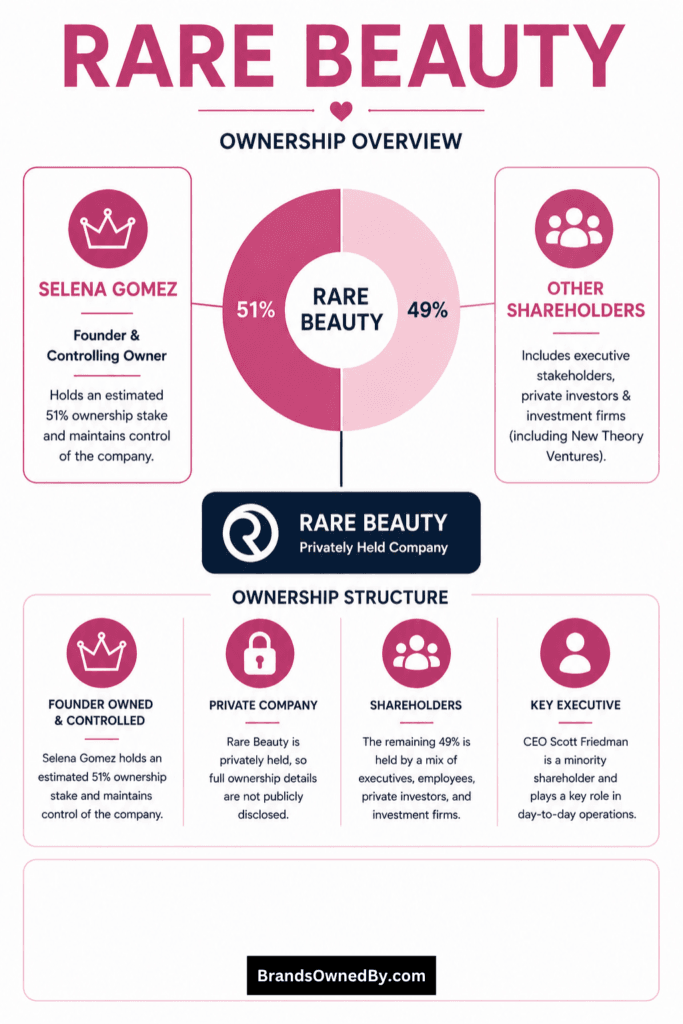
- Selena Gomez is the founder, largest shareholder, and controlling owner of Rare Beauty, with an estimated 51% ownership stake as of 2026.
- Rare Beauty operates as a privately held cosmetics company, meaning its full shareholder structure and exact equity distribution are not publicly disclosed like publicly traded corporations.
- The remaining estimated 49% ownership is believed to be divided among executive stakeholders, private investors, and investment firms including New Theory Ventures, while CEO Scott Friedman is also considered a minority stakeholder.
Rare Beauty is a beauty and cosmetics company known for its inclusive makeup products and emotionally driven branding strategy. The brand launched in 2020 and quickly became one of the most recognizable celebrity-backed beauty companies in the market.
The company focuses on makeup products designed for different skin tones, skin types, and beauty preferences. Its product lineup includes foundations, concealers, blushes, lip products, primers, setting sprays, and beauty tools.
Rare Beauty built its reputation around simplicity and accessibility. Many products are designed for easy application rather than heavy professional-style makeup routines. This approach helped the company attract younger consumers and casual makeup users.
The brand also became highly visible on social media platforms. Viral product demonstrations, influencer reviews, and customer-generated content played a major role in expanding awareness. Products like the Soft Pinch Liquid Blush gained strong popularity because of their pigmentation and ease of use.
Another major part of the company’s identity is mental health advocacy. Rare Beauty integrates emotional wellness messaging into its campaigns and supports related initiatives through the Rare Impact Fund.
The company mainly sells products through direct ecommerce channels and retail partnerships with Sephora.
Rare Beauty Founder
Rare Beauty was founded in February 2020 by Selena Gomez. The company was created after years of product development and planning with beauty industry executives and cosmetic experts. Selena Gomez launched the brand to focus on inclusive beauty products and realistic beauty standards rather than traditional celebrity-driven cosmetics marketing.
Selena Gomez
Selena Gomez is the founder and key decision-maker behind Rare Beauty.
She played a direct role in shaping the brand’s product strategy, packaging, and marketing identity. Gomez wanted the company to focus on lightweight makeup products designed for different skin tones and everyday users.
She also integrated mental health advocacy into the company through the Rare Impact Fund, which became a major part of the brand’s identity.
Before founding Rare Beauty, Gomez had already built a global audience through music, television, and film. That visibility helped the company gain strong early market attention after launch.
Ownership History
The ownership history of Rare Beauty is closely tied to the growth of celebrity-led beauty companies in the global cosmetics industry. Unlike many celebrity brands that quickly sold controlling stakes to large beauty corporations, Rare Beauty developed as a privately controlled business with strong founder involvement from Selena Gomez.
2018–2019: Early Brand Development Phase
Before Rare Beauty officially launched, Selena Gomez spent several years developing the brand behind the scenes. During this stage, the company worked with cosmetic manufacturers, branding consultants, and beauty executives to create product formulas and define the company’s market position.
The business was structured as an independent beauty company rather than a licensing arrangement. This was important because many celebrity brands only license a celebrity name while outside firms control operations and ownership.
Gomez reportedly wanted stronger involvement in decision-making, product development, and long-term brand strategy. That approach shaped the company’s ownership structure from the beginning.
2020: Official Launch and Founder-Led Ownership
Rare Beauty officially launched in February 2020 through a major retail partnership with Sephora.
At launch, the company remained privately held. Selena Gomez became the primary public owner and the central figure behind the business.
Unlike brands acquired early by large cosmetic groups, Rare Beauty maintained independent ownership control during its launch period. This gave the company flexibility over branding, pricing strategies, and product development decisions.
The founder-led ownership structure also allowed the company to build campaigns focused on mental health awareness and inclusivity without outside corporate pressure.
Growth Period and Investor Interest
As Rare Beauty expanded, industry analysts and investors began paying closer attention to the company because of its rapid sales growth and strong social media performance.
Viral products helped increase the brand’s market value. This growth likely attracted private investors and operational partners interested in supporting manufacturing expansion, inventory scaling, and international growth.
Although the company may have accepted private investment support during expansion phases, no public information has confirmed a sale of controlling ownership to a major beauty conglomerate.
This distinction is important. Many beauty startups eventually give up majority ownership in exchange for large-scale distribution and capital investment. Rare Beauty continued operating independently.
Current Ownership Structure
As of 2026, Rare Beauty continues operating as a private company with strong founder influence from Selena Gomez.
The ownership structure likely includes:
- Selena Gomez as the leading stakeholder
- Private investors
- Executive stakeholders
- Operational and investment partners.
Exact ownership percentages are not publicly available because the company is privately held.
Even without public shareholder disclosures, Selena Gomez remains the most influential figure connected to the company’s ownership and strategic direction.
Who Owns Rare Beauty?
Rare Beauty operates as a privately held cosmetics company. Because the company is private, it does not publish official shareholder filings or full cap table disclosures like publicly traded corporations.
As of 2026, Selena Gomez remains the controlling owner of the company. Multiple business reports estimate that Gomez holds around 51% ownership in Rare Beauty, giving her majority control over the business and its strategic decisions.
The remaining ownership is believed to be divided between early investors, executive stakeholders, and private investment partners connected to the company’s expansion phase.
Selena Gomez
Selena Gomez is the founder, largest shareholder, and controlling stakeholder of Rare Beauty.
Business reports estimate that she owns approximately 51% of the company as of 2026. This majority stake gives her voting control and major influence over:
- Brand strategy
- Product development
- Executive leadership decisions
- Retail partnerships
- Expansion plans
- Marketing direction.
Her ownership structure is important because it allows Rare Beauty to operate independently instead of being controlled by a large cosmetics conglomerate.
Unlike celebrity founders who eventually become minority shareholders after selling their brands, Gomez has reportedly retained control of Rare Beauty during its growth phase.
Scott Friedman
Scott Friedman is the CEO of Rare Beauty and one of the publicly identified stakeholders connected to the company.
While his exact ownership percentage has not been publicly disclosed, industry reports identify him as one of the known investors and equity holders in the business.
Friedman previously worked with NYX Cosmetics before its acquisition by L’Oréal. His experience in scaling cosmetics brands likely made him a valuable operational partner in Rare Beauty’s expansion.
Based on private-company ownership structures in similar beauty startups, his stake is believed to be a smaller minority position tied to executive equity participation.
New Theory Ventures
New Theory Ventures is one of the publicly known investment firms connected to Rare Beauty.
The firm, founded by Nikki Eslami, reportedly invested in the company during its growth stages. However, the exact ownership percentage has not been publicly released.
Its involvement likely provided capital support for:
- Inventory scaling
- Product manufacturing
- retail expansion
- operational growth
- international distribution.
The investment appears to represent a minority stake rather than controlling ownership.
Other Private Stakeholders
Rare Beauty likely has additional minority stakeholders connected to its early operations and expansion strategy.
These stakeholders may include:
- senior executives
- operational partners
- early-stage private investors
- advisory stakeholders.
Their combined ownership percentages have not been publicly disclosed.
Competitor Ownership Comparison
The ownership structure behind Rare Beauty is very different from several competing celebrity beauty brands. Some competitors are fully controlled by large multinational cosmetics corporations. Others started as founder-led companies but later sold majority stakes to outside buyers.
These ownership differences affect how brands operate. They influence product development, expansion speed, pricing strategy, manufacturing control, and long-term brand direction.
Rare Beauty stands out because Selena Gomez still reportedly controls the company through her estimated majority ownership stake. Many competing celebrity beauty brands no longer operate under founder control.
| Brand | Founder | Ownership Structure | Controlling Stakeholder | Key Ownership Difference |
|---|---|---|---|---|
| Rare Beauty | Selena Gomez | Privately held founder-controlled company | Selena Gomez | Founder reportedly retains majority control |
| Fenty Beauty | Rihanna | Corporate partnership structure | LVMH-backed structure | Built using luxury conglomerate infrastructure |
| Kylie Cosmetics | Kylie Jenner | Corporate-controlled after acquisition | Coty Inc. | Founder lost majority ownership after sale |
| Rhode | Hailey Bieber | Founder-led private company | Hailey Bieber | Independent ecommerce-focused structure |
| Haus Labs | Lady Gaga | Investor-supported company | Mixed stakeholders | Greater outside operational involvement |
Rare Beauty — Selena Gomez Maintains Majority Control
Rare Beauty operates as a privately held cosmetics company with Selena Gomez reportedly owning around 51% of the business as of 2026.
This ownership structure gives Gomez significant influence over the company’s operations and long-term direction. She is not only the public face of the brand but also one of the main decision-makers behind:
- product launches
- marketing campaigns
- retail partnerships
- expansion strategy
- brand positioning
- social impact initiatives.
This is important because many celebrity beauty brands eventually lose founder control after outside acquisitions or investment deals.
Rare Beauty’s independent structure allows the company to maintain a consistent identity focused on inclusivity and mental health advocacy. The company does not need approval from a large corporate parent company before launching campaigns or changing brand strategy.
For example, the company integrated the Rare Impact Fund into its business model as a long-term mental health initiative rather than a short-term marketing campaign. Founder-controlled ownership made that possible without pressure from outside shareholders focused only on quarterly profitability.
However, independent ownership also creates challenges. Rare Beauty must build and manage supply chains, inventory systems, and international expansion operations without relying on the infrastructure of a global cosmetics conglomerate.
Fenty Beauty — Backed by LVMH’s Luxury Infrastructure
Fenty Beauty operates under a very different ownership structure.
The company was launched in 2017 by Rihanna in partnership with LVMH through its beauty incubator division.
Unlike Rare Beauty, Fenty Beauty had immediate access to LVMH’s global luxury infrastructure from the start.
This gave the company major advantages:
- international retail distribution
- manufacturing scale
- luxury supply chain access
- global marketing support
- operational logistics
- premium retail relationships.
Because of this structure, Fenty Beauty expanded globally much faster than most independent beauty startups.
The brand entered multiple international markets quickly through established retail channels. LVMH’s backing also gave the company stronger negotiating power with suppliers and retailers.
However, corporate-backed ownership structures usually involve more centralized oversight. Strategic decisions often involve corporate leadership teams and investor expectations.
Rare Beauty operates with more founder-level flexibility compared to that structure.
Kylie Cosmetics — Shift From Founder Ownership to Corporate Control
Kylie Cosmetics represents one of the biggest examples of ownership transition in the celebrity beauty industry.
The company was founded by Kylie Jenner in 2015 as a founder-led cosmetics business.
In 2019, Coty Inc. acquired a 51% controlling stake in Kylie Cosmetics for $600 million.
After the acquisition, Coty gained majority ownership and operational control over the company.
This changed the power structure significantly.
Before the deal, Kylie Jenner controlled most major business decisions connected to the brand. After Coty’s investment, the company became part of a much larger corporate beauty portfolio.
Coty integrated Kylie Cosmetics into its broader cosmetics operations and expansion strategy.
This structure gave Kylie Cosmetics access to:
- larger manufacturing capabilities
- international expansion resources
- global retail partnerships
- corporate operational systems.
But it also reduced founder control.
This is one of the biggest differences between Kylie Cosmetics and Rare Beauty. Selena Gomez reportedly still controls Rare Beauty through her majority ownership position, while Kylie Jenner no longer controls Kylie Cosmetics.
Rhode — Independent Founder-Led Growth Strategy
Rhode was founded by Hailey Bieber.
Like Rare Beauty, Rhode operates with strong founder involvement and a relatively independent ownership structure.
The company focuses heavily on direct-to-consumer ecommerce sales instead of relying primarily on traditional retail expansion.
Rhode’s ownership structure allows the brand to move quickly with product launches and digital marketing campaigns.
However, Rhode operates mainly in skincare, while Rare Beauty built a stronger positioning in makeup and color cosmetics.
Rare Beauty also expanded faster into large-scale retail distribution through its partnership with Sephora.
Haus Labs — Investor-Supported Brand Structure
Haus Labs was founded by Lady Gaga.
The company launched with external investment and partnership support rather than operating as a purely founder-controlled business.
Haus Labs later repositioned its branding strategy and expanded into broader retail distribution.
Compared to Rare Beauty, the brand experienced more structural and strategic adjustments during its expansion stages.
Rare Beauty maintained more consistent branding and market positioning during its growth period.
Who Controls Rare Beauty?
Control of Rare Beauty is centered around a founder-led leadership structure where Selena Gomez remains the most influential figure in the company’s strategic direction.
Although Rare Beauty has executives managing daily operations, Gomez reportedly maintains majority ownership control through her estimated 51% stake in the company. This gives her significant authority over long-term decisions involving branding, expansion, partnerships, and company positioning.
The company operates differently from many celebrity beauty brands, where founders eventually lose operational influence after corporate acquisitions.
Selena Gomez — Founder and Controlling Decision-Maker
Selena Gomez is the founder and controlling stakeholder behind Rare Beauty.
Because she reportedly owns around 51% of the company, Gomez likely holds majority voting power over major corporate decisions. This level of ownership gives her influence across several critical business areas:
- brand strategy
- executive leadership decisions
- product development direction
- marketing campaigns
- retail partnerships
- expansion planning
- public brand identity.
Her involvement goes beyond celebrity endorsement.
Unlike licensing-based celebrity brands where founders mainly appear in advertisements, Gomez reportedly participates in creative and strategic decisions connected to the company.
For example, Rare Beauty’s focus on inclusive makeup shades and accessible packaging design reportedly came directly from Gomez’s input during product development stages.
She also played a major role in integrating mental health advocacy into the company’s business identity through the Rare Impact Fund.
Scott Friedman — CEO and Operational Leader
Scott Friedman serves as the CEO of Rare Beauty and manages the company’s operational and commercial activities.
While Selena Gomez influences strategic direction and brand identity, Friedman oversees the execution side of the business.
His responsibilities likely include:
- retail expansion
- supply chain management
- inventory operations
- manufacturing coordination
- financial planning
- distribution strategy
- operational scaling.
Friedman brought significant industry experience to Rare Beauty before becoming CEO.
Prior to joining the company, he worked with NYX Cosmetics and helped scale the brand before its acquisition by L’Oréal.
That background became valuable as Rare Beauty expanded rapidly through retail partnerships and international distribution growth.
Executive Leadership Structure
Rare Beauty operates with a centralized executive structure common among fast-growing private beauty companies.
The leadership team likely includes executives responsible for:
- product innovation
- cosmetics formulation
- digital commerce
- brand marketing
- retail partnerships
- finance operations
- international expansion.
These executives manage day-to-day business operations while major strategic direction remains closely tied to Selena Gomez and senior leadership.
Because the company is privately held, the executive structure can move faster than many publicly traded beauty corporations that require multiple layers of shareholder approvals.
Influence of Sephora Partnership
One of the most important operational relationships influencing Rare Beauty’s growth is its partnership with Sephora.
Although Sephora does not control Rare Beauty, the retailer plays a major role in the company’s distribution strategy and market visibility.
The partnership helped Rare Beauty gain rapid access to:
- premium retail shelf space
- international retail markets
- beauty-focused customer bases
- in-store product marketing
- online retail exposure.
This relationship significantly accelerated the company’s expansion after launch.
Decision-Making Structure Inside Rare Beauty
Rare Beauty appears to operate under a hybrid leadership model combining founder influence with executive management expertise.
Under this structure:
- Selena Gomez influences long-term vision and branding
- executives manage operations and scaling
- leadership teams oversee specialized departments
- retail and manufacturing partners support distribution growth.
This structure allows the company to maintain founder-driven branding while still operating at a large commercial scale.
Rare Beauty Annual Revenue and Net Worth
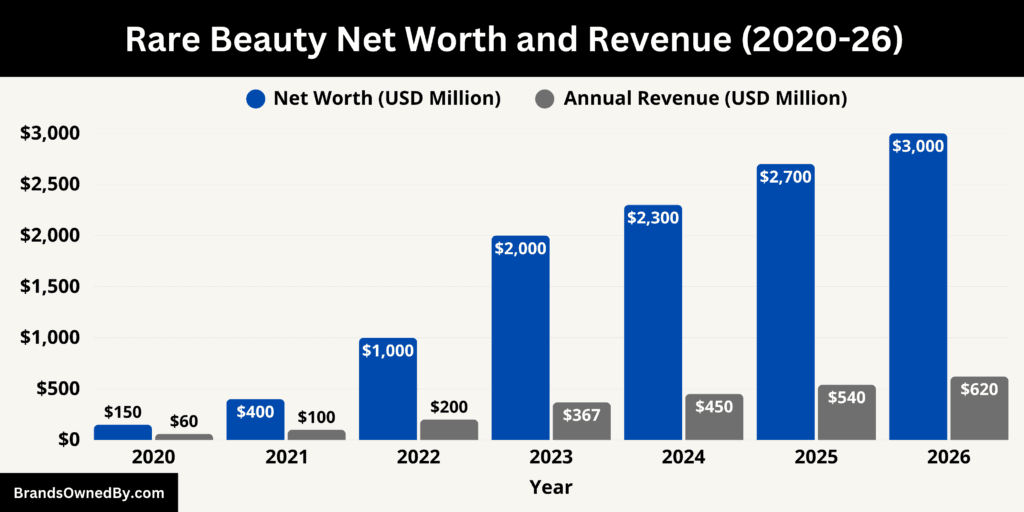
As of April 2026, Rare Beauty is estimated to generate approximately $620 million in annual revenue and holds an estimated market valuation of nearly $3 billion. The company has become one of the strongest-performing celebrity beauty brands in the cosmetics industry within only six years of launch.
The financial growth of Rare Beauty accelerated because of several measurable factors. The brand became one of the top-performing makeup brands at Sephora, generated massive earned media value across TikTok and Instagram, and expanded internationally across North America, Europe, Asia, and the Middle East.
2026 Revenue Breakdown
Rare Beauty’s estimated $620 million revenue in 2026 comes from multiple high-performing business segments.
The company’s makeup division remains the largest revenue source. Industry estimates suggest complexion and color cosmetics products generated nearly $410 million in annual sales during 2026.
The company’s bestselling categories include:
- liquid blushes
- foundations
- concealers
- lip oils
- contour products
- highlighters.
The Soft Pinch Liquid Blush alone reportedly generated more than $70 million in annual sales volume during its strongest growth period.
Direct-to-consumer ecommerce sales contributed an estimated $145 million in 2026 revenue. These sales are especially important because direct online sales generate higher margins than wholesale retail distribution.
Retail partnerships generated another major share of revenue. Sephora remained the company’s largest retail partner globally. In 2026, Rare Beauty also expanded distribution through Ulta Beauty locations across the United States. The Ulta rollout covered approximately 1,500 stores, marking one of the brand’s biggest retail expansion moves since launch.
International sales also became a critical revenue driver in 2026.
Analysts estimate that nearly 32% of total company revenue now comes from markets outside the United States. Europe and Southeast Asia became two of the company’s fastest-growing international regions.
How Rare Beauty Reached $620 Million in Revenue
Rare Beauty’s growth strategy differs from many traditional cosmetics brands.
The company relied heavily on social-driven consumer engagement instead of depending primarily on expensive advertising campaigns.
In 2024, Rare Beauty generated approximately $282 million in earned media value, outperforming several competing celebrity beauty brands including Fenty Beauty and Kylie Cosmetics in social media engagement rankings.
This strong digital visibility lowered customer acquisition costs and increased repeat customer conversion rates.
The company also benefited from high product retention rates. Several products became repeat-purchase items rather than one-time viral purchases.
Another important factor was accessibility-focused product design. Rare Beauty created packaging that was easier to handle for users with mobility limitations, partly influenced by Selena Gomez’s experience managing lupus-related hand mobility challenges.
Net Worth and Valuation Analysis
Rare Beauty’s estimated $3 billion valuation in 2026 reflects both financial performance and strategic market positioning.
Beauty industry investors value cosmetics companies based on several performance metrics:
- annual revenue growth
- customer retention
- brand loyalty
- profit margins
- international scalability
- retail expansion potential
- digital engagement performance.
Rare Beauty scores strongly across most of these categories.
The company also became attractive because it operates independently rather than under ownership from a multinational beauty conglomerate.
Several beauty-focused investment analysts reportedly viewed Rare Beauty as one of the most attractive acquisition targets in the celebrity beauty industry because of its fast revenue growth and strong Gen Z consumer base.
Estimated Profitability and Margin Structure
Although Rare Beauty does not publicly release profit margins, analysts believe the company operates with strong gross margins typical of premium cosmetics brands.
Color cosmetics products often generate gross margins between 60% and 80%, especially through direct ecommerce sales channels.
Rare Beauty’s operational model likely improved profitability because the brand achieved strong organic exposure through social media rather than relying entirely on paid advertising campaigns.
The combination of ecommerce sales, retail distribution, and strong product demand likely helped improve operational efficiency as production scaled globally.
Future Revenue Forecast (2027–2030)
Industry analysts expect Rare Beauty to continue expanding aggressively through international retail growth, product diversification, fragrance expansion, and ecommerce scaling.
One major future growth driver is category diversification. In recent years, the company expanded beyond makeup into body care and fragrance products. This creates additional recurring revenue streams beyond cosmetics alone.
Another expected growth driver is international penetration. The company still has significant expansion opportunities across Latin America, South Asia, and additional European markets.
Analysts also expect the Ulta Beauty partnership launched in 2026 to increase U.S. retail sales significantly over the next several years.
Based on current growth rates and market expansion trends, projected revenue forecasts are:
- 2027: Estimated revenue of $760 million with valuation reaching approximately $3.5 billion
- 2028: Estimated revenue of $910 million with valuation approaching $4.1 billion
- 2029: Estimated revenue of $1.05 billion with valuation reaching nearly $4.8 billion
- 2030: Estimated revenue of $1.25 billion with valuation potentially surpassing $5.5 billion.
If Rare Beauty maintains current customer retention levels and continues successful retail expansion, analysts expect the company to remain one of the most valuable independently controlled celebrity beauty brands in the global cosmetics market.
Brands Owned by Rare Beauty
As of 2026, Rare Beauty operates a focused brand structure instead of a large multi-brand cosmetics portfolio. Unlike beauty conglomerates that own dozens of subsidiaries and makeup labels, Rare Beauty concentrated on expanding its own branded ecosystem under the Rare Beauty identity.
| Brand / Entity | Type | Launch Year | Main Focus | Key Details |
|---|---|---|---|---|
| Rare Beauty | Cosmetics Brand | 2020 | Makeup and beauty products | Core brand founded by Selena Gomez. Operates across complexion, lip, eye, and beauty tool categories. Distributed globally through Sephora and expanded into Ulta Beauty locations in 2026. |
| Soft Pinch Collection | Product Brand Collection | 2020 | Blush and lip products | One of Rare Beauty’s most successful product collections. Includes the Soft Pinch Liquid Blush and Soft Pinch Tinted Lip Oil. Helped drive viral growth on TikTok and beauty influencer platforms. |
| Positive Light Collection | Product Brand Collection | 2021 | Highlighters and complexion glow products | Focuses on radiant skin-finish products including luminizers and under-eye brighteners. Designed around lightweight and natural makeup aesthetics. |
| Kind Words Collection | Product Brand Collection | 2022 | Lip cosmetics | Lip-focused collection including lip liners and matte lipsticks. Built around positive messaging and emotional self-expression branding. |
| Rare Impact Fund | Social Impact Entity | 2020 | Mental health initiatives | Mental health-focused entity operated by Rare Beauty. Supports youth mental health programs, emotional wellness initiatives, and mental health accessibility projects. |
| Rare Beauty Fragrance Expansion | Beauty Category Entity | 2025 | Fragrance products | Expansion into fragrance-related beauty categories to diversify revenue beyond makeup products and strengthen lifestyle beauty positioning. |
| Rare Beauty Body Collection | Body Care Product Entity | 2025 | Body care and self-care products | Expansion into body-care-focused beauty products designed to increase customer retention across multiple beauty categories. |
Rare Beauty Cosmetics
Rare Beauty Cosmetics is the company’s flagship and primary operating brand.
This is the core beauty brand launched by Selena Gomez in 2020. The brand focuses on inclusive makeup products designed for different skin tones, skin textures, and makeup preferences.
By 2026, Rare Beauty Cosmetics had become one of the strongest-performing celebrity beauty brands globally.
The brand operates across several major beauty categories including:
- face makeup
- lip cosmetics
- eye makeup
- blush products
- complexion products
- beauty tools.
Several products became major commercial successes for the company.
The Soft Pinch Liquid Blush became one of the most recognized products in the brand’s portfolio and helped increase the company’s visibility across TikTok and beauty influencer communities.
Rare Beauty Cosmetics also became known for its accessibility-focused packaging design and lightweight makeup formulas targeted toward everyday consumers rather than heavy glam makeup users.
Soft Pinch Collection
The Soft Pinch Collection became one of the company’s most commercially successful branded product lines.
The collection includes:
- Soft Pinch Liquid Blush
- Soft Pinch Tinted Lip Oil
- Soft Pinch Luminous Powder Blush.
The success of this collection significantly contributed to the company’s rapid revenue growth after 2021.
The Liquid Blush products became especially viral because of their strong pigmentation and long-lasting formulas. Beauty influencers and makeup creators helped push the collection into mainstream popularity through social media tutorials and product reviews.
By 2026, the Soft Pinch line remained one of the company’s highest-selling product families.
Positive Light Collection
The Positive Light Collection is one of Rare Beauty’s major complexion and glow-focused product brands.
This collection includes products such as:
- liquid luminizers
- highlighters
- under-eye brighteners.
The collection was created to support the brand’s natural makeup philosophy, focused on lightweight and radiant skin finishes.
The Positive Light products became popular among consumers looking for minimal makeup aesthetics rather than full-coverage glam cosmetics.
Kind Words Collection
The Kind Words Collection is Rare Beauty’s lip-focused product line.
This collection includes:
- lip liners
- matte lipsticks
- lip color products.
The branding behind the collection aligns with Rare Beauty’s emotional wellness positioning and messaging around positive self-expression.
The line expanded the company’s presence in the premium lip cosmetics category.
Rare Impact Fund
The Rare Impact Fund is one of the most important entities created and operated by Rare Beauty.
The initiative launched alongside the company in 2020 and became a core part of the brand’s identity.
Unlike standard corporate charity programs, the Rare Impact Fund operates as a dedicated mental health-focused initiative tied directly to the company’s long-term mission.
The entity supports organizations and programs focused on:
- youth mental health services
- emotional wellness education
- mental health accessibility
- community mental health support.
The fund helped differentiate Rare Beauty from competing celebrity beauty brands by integrating social impact directly into the company’s public identity.
Rare Beauty Fragrance Expansion
By 2026, Rare Beauty expanded into fragrance-related product categories as part of its broader beauty ecosystem expansion strategy.
This expansion allowed the company to move beyond makeup products and enter adjacent beauty segments with higher long-term customer retention potential.
Industry analysts viewed this category expansion as an important move toward building Rare Beauty into a larger lifestyle-oriented beauty brand rather than remaining only a makeup company.
Rare Beauty Body Collection
Rare Beauty also expanded into body-care-related beauty products as part of its category diversification strategy.
The company introduced products connected to self-care and skin-focused routines to strengthen its broader beauty ecosystem.
This expansion helped increase cross-category customer spending and supported the company’s long-term growth strategy.
Final Thoughts
Rare Beauty remains primarily associated with and controlled by Selena Gomez. While the exact ownership percentages are private, Gomez is widely recognized as the leading shareholder and strategic force behind the company.
The brand succeeded because it combined celebrity influence with strong product execution and emotional branding. Many celebrity beauty brands rely heavily on fame alone. Rare Beauty built long-term consumer loyalty through product quality, inclusive marketing, and strong digital engagement.
As of 2026, the company continues operating as a private beauty business rather than a subsidiary of a major cosmetics conglomerate. That independence gives Rare Beauty greater control over its future direction and brand identity.
FAQs
Where was Rare Beauty founded?
Rare Beauty was founded in the United States and officially launched in February 2020. The company established its operations in California, where much of its early brand development, product strategy, and executive planning took place before partnering with Sephora for its retail launch.
Who owns Rare Beauty products?
Rare Beauty products are owned by Rare Beauty, the privately held cosmetics company founded by Selena Gomez. As of 2026, Selena Gomez reportedly remains the majority owner of the company with an estimated 51% ownership stake.
Why was Rare Beauty created?
Rare Beauty was created to challenge unrealistic beauty standards often promoted in the cosmetics industry. Selena Gomez wanted to build a beauty brand focused on inclusivity, self-acceptance, and accessible makeup products for different skin tones and beauty preferences.
The company also integrated mental health awareness into its brand identity through the Rare Impact Fund, making emotional wellness a core part of the business strategy rather than only a marketing campaign.
Who created Rare Beauty?
Selena Gomez created Rare Beauty in 2020 after working with beauty industry executives, cosmetic developers, and branding specialists during the company’s development phase.
She helped shape the brand’s product direction, packaging design, and marketing identity from the beginning.
Who is the CEO of Rare Beauty?
As of 2026, the CEO of Rare Beauty is Scott Friedman.
Friedman oversees the company’s business operations, retail expansion, supply chain strategy, and global growth initiatives. Before joining Rare Beauty, he worked in the cosmetics industry and previously helped scale NYX Cosmetics before its acquisition by L’Oréal.