

- Al Jazeera is 100% owned by the state of Qatar, with no private, institutional, or public shareholders involved.
- The network operates under Al Jazeera Media Network as a state-backed public benefit foundation, not a publicly traded company.
- Control is exercised through Qatar’s ruling system, with leadership (chairman and board) appointed by the Emir, ensuring centralized decision-making.
- Unlike competitors, Al Jazeera has no stock market listing or equity investors, making it a fully state-funded global media organization focused on influence rather than shareholder returns.
Al Jazeera Media Network is a global news organization headquartered in Doha. It delivers news across television, digital platforms, and social media. The network operates in multiple languages, including Arabic and English.
Al Jazeera focuses on international coverage. It gives strong attention to regions often underrepresented in Western media. Its reporting style blends live news, analysis, documentaries, and investigative journalism.
The network has built a wide global presence. It maintains bureaus in major cities worldwide. Its content reaches audiences across more than 150 countries. Platforms like Al Jazeera English and AJ+ target global and younger audiences.
Editorially, Al Jazeera positions itself as an alternative voice in global media. It often highlights political, social, and humanitarian issues with a perspective shaped by its regional roots.
Al Jazeera Founder
Al Jazeera was established in 1996 under the leadership of Hamad bin Khalifa Al Thani. He played the central role in founding the network. His vision was to create an independent Arab news platform that could compete globally.
The launch was supported by key figures within Qatar’s leadership. These individuals helped structure the organization and recruit journalists. Many early staff members came from the Arabic service of the BBC, which had recently shut down.
While Hamad bin Khalifa Al Thani is widely recognized as the founder, Al Jazeera was not created by a single entrepreneur. It was a state-backed initiative. The goal was strategic. It aimed to strengthen Qatar’s global media presence and influence.
The founding team emphasized editorial freedom compared to traditional state media in the region. This approach helped Al Jazeera quickly gain credibility and international attention.
Ownership History
The ownership history of Al Jazeera Media Network is unique. It has remained largely consistent since its launch. However, its legal structure, governance model, and global positioning have evolved significantly. As of April 2026, Al Jazeera operates as a state-funded but institutionally structured media network with a hybrid identity—part public service, part global broadcaster.
Founding and Direct State Ownership (1996–early 2000s)
Al Jazeera was founded in 1996 by Hamad bin Khalifa Al Thani. From the beginning, ownership was directly tied to the state of Qatar.
The network was launched with an initial government-backed financial package. This support allowed it to operate without commercial pressure. Unlike private media companies, Al Jazeera did not rely on advertisers or investors during its early years.
Ownership during this phase was simple. The Qatari government fully controls funding, governance, and strategic direction. The goal was clear: to create a powerful Arab media voice that could challenge regional narratives and expand Qatar’s global influence.
Growth, Influence, and Continued State Backing (2000–2010)
As Al Jazeera expanded globally in the early 2000s, its ownership structure did not change. It remained fully backed by the Qatari state.
However, its role evolved. The network became a major international broadcaster. It gained global recognition during major geopolitical events such as wars in Afghanistan and Iraq.
During this phase, Al Jazeera began generating some commercial revenue. This included advertising and content licensing. Despite this, the majority of its funding still came from the government. Estimates over time suggested that a large portion of its budget continued to rely on state support.
This period established a key pattern. Al Jazeera would grow commercially, but ownership would remain centralized under Qatar.
Legal Restructuring and Institutional Shift (2011)
A major turning point came in 2011. Al Jazeera was restructured legally. It transitioned from a traditional public institution into a “private foundation for public benefit” under Qatari law.
This change did not mean privatization. Instead, it introduced a more flexible governance model. The network could operate with faster decision-making and broader administrative independence.
However, ownership remained effectively unchanged. The Qatari government still funded the network. Leadership appointments continued to be linked to the ruling system. The Emir retained influence through board appointments.
This restructuring created what many analysts call a hybrid model. Al Jazeera became neither fully state-controlled nor fully independent.
Consolidation Under a State-Backed Media Network (2010s–early 2020s)
After restructuring, Al Jazeera consolidated its operations under a unified corporate identity. The Al Jazeera Media Network became the central entity overseeing all channels and digital platforms.
Governance became more formalized. The chairman—often a member of Qatar’s ruling family—played a key strategic role. For example, Hamad bin Thamer Al Thani has been a long-standing figure in leadership.
At the same time, the network expanded globally. It launched new platforms and strengthened its international presence.
Despite these developments, ownership fundamentals did not change. The network continued to rely heavily on Qatari state funding. It remained outside public markets. It had no private shareholders.
This period reinforced Al Jazeera’s identity as a state-backed global media organization with increasing institutional complexity.
Modern Ownership Structure (2025–April 2026)
As of April 2026, Al Jazeera’s ownership structure is stable and clearly defined.
The network operates as a statutory foundation for public benefit. It is primarily funded by the government of Qatar.
Leadership reflects this structure. In September 2025, Sheikh Nasser bin Faisal Al Thani was appointed Director-General. He now oversees strategic direction and global operations.
The chairman and board continue to be closely linked to Qatar’s ruling framework. This ensures alignment between the network’s long-term strategy and national interests.
At the same time, Al Jazeera publicly maintains that it operates with editorial independence. It presents itself as a global news organization rather than a state propaganda outlet.
Who Owns Al Jazeera?
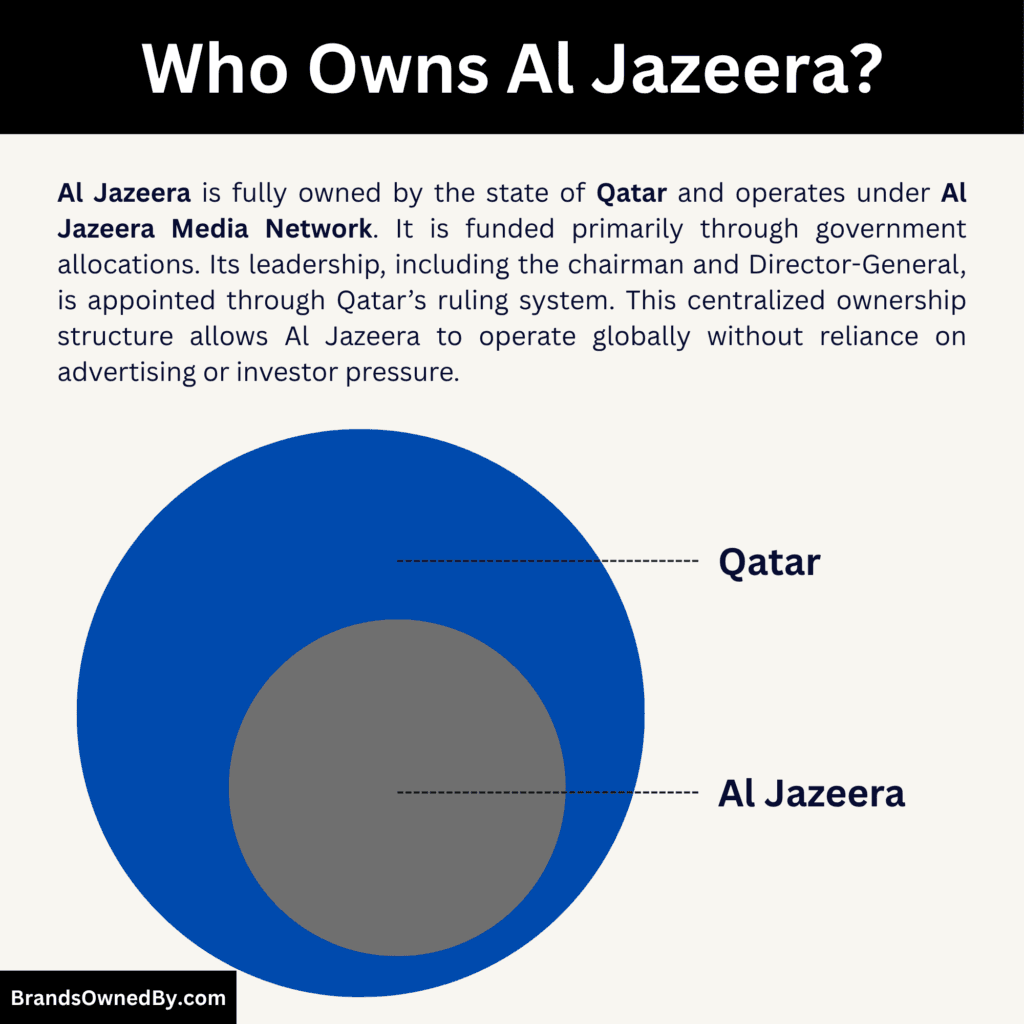
Al Jazeera Media Network is owned and funded by the state of Qatar. There are no private shareholders and no publicly traded equity. As of April 2026, the network operates as a state-backed media foundation. Control is exercised through Qatar’s ruling system, with leadership appointments made by the Emir and governance handled through a state-aligned board structure.
State of Qatar (100% Ownership and Funding Authority)
The State of Qatar is the sole owner of Al Jazeera. It provides the majority of the network’s funding and retains full control over its governance framework.
Al Jazeera was established by royal decree in 1996. Since then, ownership has not changed. The network has never issued shares or brought in external investors. This means Qatar holds 100% ownership in practical and legal terms.
Funding is allocated through state budgets rather than commercial markets. This allows the network to operate without dependence on advertising cycles or investor expectations. It also enables long-term investments in global bureaus, investigative journalism, and multilingual expansion.
The Qatari government’s ownership ensures that Al Jazeera remains a strategic national asset. It plays a role in shaping Qatar’s international media presence and soft power influence.
House of Al Thani (Direct Governance and Strategic Control)
The House of Al Thani exercises direct control over Al Jazeera through leadership appointments and board oversight.
The Emir of Qatar appoints the chairman of the network. As of 2026, Hamad bin Thamer Al Thani continues to serve as chairman. He has held this role for many years and is a key figure in shaping the network’s long-term direction.
This is not symbolic involvement. The chairman oversees strategic priorities, expansion plans, and institutional alignment. Major decisions, including leadership changes and global initiatives, are influenced at this level.
Members of the ruling family have historically maintained close oversight of Al Jazeera. This ensures continuity in governance and alignment with national interests.
Al Jazeera Media Network (Legal Ownership Entity)
The Al Jazeera Media Network itself is the legal entity through which all operations are conducted.
Since 2011, it has been structured as a “private foundation for public benefit” under Qatari law. This legal form is important. It allows the network to operate with administrative flexibility while remaining state-owned.
The foundation does not issue shares. It does not distribute profits. Its mandate is to operate media services at a global scale.
This structure enables:
- Independent budgeting within allocated state funding
- Global hiring and bureau expansion
- Multi-brand media operations across television and digital.
Despite this operational independence, ownership remains fully tied to the Qatari state.
Government-Appointed Board of Directors (Governance Layer)
The board of directors acts as the governing authority representing the owner.
Board members are appointed through Qatar’s leadership system. This typically includes senior officials and individuals closely linked to the ruling structure.
The board is responsible for:
- Setting long-term strategy
- Approving major investments and expansions
- Appointing executive leadership
- Ensuring alignment with national priorities.
Unlike publicly listed companies, there is no shareholder voting. The board replaces that function. It operates as the direct governance mechanism of state ownership.
This centralized governance model allows faster decision-making compared to shareholder-driven corporations.
Competitor Ownership Comparison
Al Jazeera operates under a state-owned model. This makes it structurally different from most global news competitors. To understand its position, you need to compare how other major networks are owned, funded, and controlled as of 2026. These differences directly impact editorial priorities, revenue models, and global strategy.
| Network | Owner | Ownership Type | Funding Model | Control Structure |
|---|---|---|---|---|
| Al Jazeera Media Network | State of Qatar | Fully state-owned | Government funding (primary source) | Centralized control via Emir-appointed leadership and board |
| BBC | UK public (via license fee system) | Public service broadcaster | Television license fee + limited commercial revenue | Governed by Royal Charter and independent board |
| CNN | Warner Bros. Discovery | Corporate (publicly traded parent) | Advertising, subscriptions, affiliate fees | Controlled by corporate executives and shareholders |
| Fox News | Fox Corporation | Public company with family control | Advertising and cable distribution revenue | Controlled by Murdoch family via voting power |
| RT | Russian government | Fully state-owned | Direct state funding | Centralized government control |
| France 24 | France Médias Monde | State-owned public broadcaster | Government funding | Operates under state media group with structured governance |
| Sky News | Comcast | Corporate ownership | Advertising + corporate funding | Controlled by parent company strategy and executives |
Al Jazeera vs BBC (Public Service Model)
BBC operates under a public service ownership model. It is not owned by private investors or the government directly.
Instead, the BBC is funded primarily through a mandatory television license fee paid by UK households. It operates under a Royal Charter, which defines its independence and governance.
The UK government does not “own” the BBC in a commercial sense. However, it influences the framework through charter renewals and regulatory oversight.
In contrast, Al Jazeera is directly funded and owned by the state of Qatar. There is no equivalent public funding mechanism or independent charter system. Ownership is centralized rather than distributed across the public.
Al Jazeera vs CNN (Corporate Ownership Model)
CNN operates under a corporate ownership structure.
It is owned by Warner Bros. Discovery, a publicly traded company. This means CNN ultimately answers to shareholders, including institutional investors and the company’s board of directors.
Revenue is driven by advertising, affiliate fees, and digital subscriptions. Strategic decisions are influenced by profitability and shareholder value.
Al Jazeera differs fundamentally. It does not have shareholders. It does not operate under profit pressure in the same way. Its funding comes primarily from the Qatari government, allowing long-term investments without immediate commercial returns.
Al Jazeera vs Fox News (Family-Controlled Public Company)
Fox News is owned by Fox Corporation.
Fox Corporation is publicly traded. However, it is effectively controlled by the Murdoch family through voting power. This creates a hybrid structure—public ownership with concentrated family control.
Fox News operates as a profit-driven business. Its editorial direction is often aligned with its audience demographics and market positioning.
Compared to this, Al Jazeera has no family ownership in a financial sense. While Qatar’s ruling family plays a governance role, there are no shares or dividends involved. Control is political and institutional rather than equity-based.
Al Jazeera vs RT (State-Owned Media Model)
RT is one of the closest comparisons to Al Jazeera in ownership structure.
RT is funded and controlled by the Russian government. It serves as an international media arm aligned with national interests.
Like Al Jazeera, RT does not have private shareholders. Its funding comes from state budgets. Leadership is appointed through government channels.
However, there are key differences. Al Jazeera operates under a “public benefit foundation” structure, which gives it some administrative flexibility. RT is more directly integrated into state communication systems.
Both networks demonstrate how state ownership can support global media expansion without reliance on commercial markets.
Al Jazeera vs France 24 (State-Owned Public Broadcaster)
France 24 is owned by the French state through France Médias Monde.
It is publicly funded but operates under a structured media group. The French government provides funding while maintaining a framework for editorial independence.
France 24 represents a European model of state-backed international broadcasting. It combines public funding with institutional safeguards.
Al Jazeera shares similarities in state funding. However, its governance is more centralized within Qatar’s ruling system rather than distributed through a broader public media framework.
Al Jazeera vs Sky News (Corporate Acquisition Model)
Sky News is owned by Comcast through its subsidiary Sky Group.
This represents a corporate acquisition model. Ownership is part of a larger media and telecommunications conglomerate.
Sky News operates under commercial pressures. It must align with corporate strategy and financial performance goals.
In contrast, Al Jazeera does not belong to a diversified corporate group. Its ownership is singular and state-based, with no external shareholders or parent conglomerate.
Who Controls Al Jazeera?
Control of Al Jazeera Media Network is centralized and state-linked. As of April 2026, control flows from the leadership of Qatar down to the network’s board and executive management. There are no shareholders influencing decisions. Instead, authority is exercised through appointments, governance frameworks, and institutional hierarchy.
The control of Al Jazeera follows a clear hierarchy:
- Ultimate authority: Emir of Qatar
- Strategic control: Chairman
- Governance: Board of Directors
- Operations: Director-General
- Execution: Editorial and management teams.
Emir of Qatar (Ultimate Authority)
The highest level of control sits with the Emir of Qatar, currently Tamim bin Hamad Al Thani.
The Emir does not manage daily operations. However, he holds ultimate authority over the network’s structure. This includes:
- Appointing the chairman of Al Jazeera
- Approving key leadership changes
- Defining the broader strategic environment.
Because Al Jazeera is state-owned, its top-level governance aligns with Qatar’s national leadership. This makes the Emir the final authority in the control chain.
Chairman of the Board (Strategic Oversight)
The chairman plays the most important role in the direct control of the network.
As of 2026, Hamad bin Thamer Al Thani serves as chairman. He has held this position for many years and is a senior member of Qatar’s ruling family.
His responsibilities include:
- Setting long-term strategic direction
- Overseeing global expansion plans
- Supervising executive leadership
- Ensuring alignment with national priorities.
The chairman acts as the bridge between state ownership and operational leadership. Major institutional decisions pass through this level.
Board of Directors (Governance and Policy Control)
The board of directors functions as the central governance body.
Board members are appointed through Qatar’s leadership system. They are not elected by shareholders. This ensures that control remains within a closed governance structure.
The board is responsible for:
- Approving major investments and budgets
- Appointing the Director-General
- Setting editorial and organizational policies
- Monitoring performance across all divisions.
In a publicly traded company, shareholders would influence these decisions. At Al Jazeera, the board fully replaces that role.
Director-General (Operational Control)
Day-to-day control is handled by the Director-General.
As of April 2026, Nasser bin Thamer Al Thani leads the organization. He was appointed in September 2025.
The Director-General is responsible for:
- Managing global newsroom operations
- Executing strategic plans set by the board
- Overseeing all channels and digital platforms
- Leading senior editorial and business teams.
This role is equivalent to a CEO in a corporate structure. However, authority is delegated rather than independent. The Director-General operates within the framework defined by the chairman and board.
Editorial Leadership (Newsroom-Level Control)
Editorial control is distributed across senior editors and channel heads.
Each division—such as Al Jazeera Arabic and Al Jazeera English—has its own editorial leadership. These teams manage:
- News coverage decisions
- Editorial priorities
- Investigative reporting directions.
While journalists operate with a degree of independence, editorial leadership ultimately aligns with the network’s governance structure.
This layered system allows operational flexibility. At the same time, it maintains consistency with the overall strategic direction.
Al Jazeera Annual Revenue and Net Worth
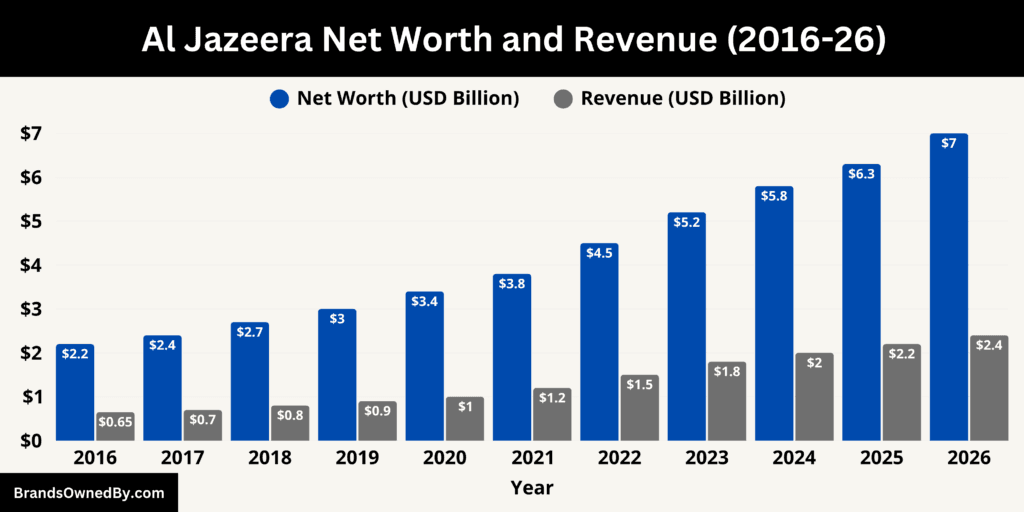
As of April 2026, Al Jazeera Media Network operates with $2.4 billion in annual revenue (state funding and commercial income combined) and an estimated net worth of $7 billion. These figures place it among the largest state-backed global media networks. Unlike commercial broadcasters, its financial scale is driven by sovereign funding, global infrastructure, and audience reach rather than profit margins.
2026 Revenue Breakdown
The $2.4 billion revenue in 2026 is heavily concentrated in state funding, which accounts for the majority of total inflows. Estimates indicate that 70%–80% ($1.7–$1.9 billion) comes directly from allocations by the Qatari government.
The remaining 20%–30% ($500–$700 million) is generated through commercial and operational activities. This includes:
- International advertising across TV and digital platforms
- Content syndication deals with global broadcasters
- Licensing of documentaries and investigative content
- Digital monetization via YouTube, OTT platforms, and branded partnerships.
Digital alone has become a meaningful revenue layer. AJ+ and Al Jazeera English digital platforms collectively generate $150–$250 million annually, reflecting strong engagement across North America, Europe, and South Asia.
Geographically, revenue influence is not evenly distributed. While funding originates from Qatar, audience-driven commercial revenue is concentrated in English-speaking markets and high-growth regions like Africa and Southeast Asia.
Net Worth 2026
The $7 billion net worth, as of April 2026, reflects accumulated infrastructure, brand equity, and global operations rather than retained earnings.
A large portion of this valuation comes from physical and operational assets. Al Jazeera maintains 70+ international bureaus and multiple broadcast centers, including its flagship Doha headquarters. Replicating this infrastructure today would cost billions in capital expenditure alone.
Brand valuation is another major component. Al Jazeera ranks among the most recognized international news networks outside Western markets. Its audience reach exceeds 430 million households globally, which significantly strengthens its intangible value.
Content assets also contribute materially. The network produces thousands of hours of original programming annually, including investigative series, documentaries, and live global coverage. This content library holds long-term licensing and strategic value.
Unlike publicly traded peers, this valuation is not market-priced. It reflects replacement cost, influence, and global distribution power.
Cost Allocation and Spending Priorities
A significant portion of the $2.4 billion annual funding is spent on maintaining global operations.
The largest cost center is the newsroom and staffing. Al Jazeera employs thousands of journalists, producers, and technical staff worldwide, making payroll one of its biggest expenditures.
International bureau operations form another major cost layer. Maintaining correspondents in politically sensitive and remote regions requires high logistical and security spending.
Technology investment is also substantial. The network allocates hundreds of millions annually toward:
- Satellite distribution and broadcasting
- OTT and streaming infrastructure
- Mobile-first content delivery systems.
Content production remains capital-intensive. High-end investigative journalism and documentaries often require months of production and cross-border reporting.
Because the network is not profit-driven, nearly all funding is reinvested into operations, expansion, and content quality.
Financial Position vs Global Competitors
At $2.4 billion in annual revenue, Al Jazeera operates at a scale comparable to major international broadcasters.
However, the structure is fundamentally different. Competitors like CNN and Fox News depend on advertising cycles and subscriber fees. Their revenues fluctuate based on market performance.
Al Jazeera’s funding is stable and pre-allocated. This allows it to maintain operations even in low-revenue environments and invest in long-term global coverage.
This stability has enabled expansion into regions that are commercially unattractive but strategically important. It also explains how the network sustains large-scale investigative journalism without direct monetization pressure.
Growth Trajectory and Financial Momentum
The jump from approximately $1.0 billion in 2020 to $2.4 billion in 2026 shows a clear acceleration phase. This growth aligns with:
- Increased geopolitical relevance of Qatar
- Expansion of English-language and digital platforms
- Higher global demand for non-Western news perspectives.
The most significant growth occurred post-2021, when digital consumption surged and Al Jazeera scaled its online presence aggressively.
Future Revenue Forecast (2026–2030)
Based on current funding trends and expansion strategy, revenue is expected to continue growing:
- 2027: $2.5 billion – Expansion in OTT platforms and mobile-first content
- 2028: $2.6–$2.7 billion – Stronger global licensing and partnerships
- 2029: $2.8 billion – Increased monetization of digital audiences
- 2030: $3.0 billion – Fully diversified hybrid revenue model.
Brands Owned by Al Jazeera
Al Jazeera Media Network operates a diversified portfolio of channels, digital platforms, and media units. As of 2026, its structure is built around global broadcasting, digital-first media, and specialized content divisions. These entities are owned and operated directly under the network.
| Entity / Brand | Type | Launch Year | Primary Focus | Key Details |
|---|---|---|---|---|
| Al Jazeera Arabic | TV Channel | 1996 | Arabic news & politics | Flagship channel with strong influence across Middle East and North Africa; known for live debates and regional coverage |
| Al Jazeera English | TV Channel | 2006 | Global news | Broadcasts in 150+ countries; focuses on Global South coverage; hubs in Doha, London, Washington |
| AJ+ | Digital Platform | 2014 | Social-first news | Targets younger audiences; generates hundreds of millions of monthly views across platforms |
| Al Jazeera Mubasher | TV Channel | 2005 | Live events | Airs unfiltered live coverage of political events, conferences, and speeches |
| Al Jazeera Documentary Channel | TV Channel | 2007 | Documentaries | Produces long-form content on culture, history, and geopolitics; strong Arabic content library |
| Al Jazeera Balkans | Regional TV Channel | 2011 | Balkan region news | Broadcasts in local languages; covers Southeast Europe politics and society |
| Al Jazeera Digital | Digital Division | 2000s (expanded 2010s) | Online news | Manages websites, apps, and digital publishing; millions of daily users globally |
| Al Jazeera Media Institute | Training Institute | 2004 | Journalism education | Provides training programs, certifications, and workshops for global media professionals |
| Al Jazeera Center for Studies | Research Center | 2006 | Policy & research | Produces geopolitical and economic analysis; supports editorial depth |
| Al Jazeera Creative | Creative Division | 2010s | Branding & design | Handles visual identity, storytelling formats, and global campaigns |
| Al Jazeera Investigative Unit | Editorial Unit | 2000s | Investigative journalism | Produces high-impact global investigations; collaborates internationally |
| Al Jazeera Podcasts | Audio Platform | 2018 | Podcasts & audio | Focuses on daily news podcasts and long-form storytelling for global audiences |
| Al Jazeera Contrast | Innovation Unit | 2020s | Experimental media | Develops immersive, interactive, and next-gen storytelling formats |
Al Jazeera Arabic
Al Jazeera Arabic is the flagship channel of the network. It was launched in 1996 and remains one of the most influential Arabic-language news broadcasters.
It targets audiences across the Middle East and North Africa. The channel focuses on regional politics, live debates, and breaking news coverage. It has consistently maintained high viewership across Arab-speaking populations.
Its editorial style is known for in-depth political coverage and live panel discussions. It also plays a central role in shaping the network’s identity and influence in the region.
Al Jazeera English
Al Jazeera English was launched in 2006 to expand global reach.
It broadcasts to over 150 countries and reaches hundreds of millions of households. The channel focuses on international news with strong coverage of Africa, Asia, and Latin America—regions often underrepresented in Western media.
It operates major broadcast hubs in Doha, London, and Washington, D.C. Its content includes live news, documentaries, and investigative reporting.
AJ+
AJ+ is the network’s digital-first brand targeting younger audiences.
Launched in 2014, AJ+ produces short-form video content designed for platforms like YouTube, Facebook, Instagram, and TikTok. It focuses on social issues, politics, and global trends.
By 2026, AJ+ generates hundreds of millions of monthly views. It plays a key role in Al Jazeera’s digital monetization strategy and audience expansion in Western markets.
Al Jazeera Mubasher
Al Jazeera Mubasher is a live broadcasting channel that focuses on real-time coverage.
It airs conferences, political speeches, parliamentary sessions, and public events without heavy editorial filtering. The channel is widely used for unedited live transmissions across the Arab world.
Its format differentiates it from traditional news channels by prioritizing transparency and direct access to events.
Al Jazeera Documentary Channel
Al Jazeera Documentary Channel specializes in long-form storytelling.
It produces and broadcasts documentaries on history, culture, science, and geopolitics. The channel has built a strong reputation for high-quality Arabic-language documentaries.
It also licenses content internationally and collaborates with global production houses.
Al Jazeera Balkans
Al Jazeera Balkans serves audiences in Bosnia and Herzegovina, Serbia, Croatia, and neighboring countries.
Launched in 2011, it broadcasts in local languages and focuses on regional politics, social issues, and European affairs.
It represents Al Jazeera’s localized expansion strategy, adapting content for specific regional audiences.
Al Jazeera Digital
Al Jazeera Digital is the network’s central digital publishing arm.
It manages websites, mobile apps, and online content distribution. Its English and Arabic websites attract millions of daily users globally.
The division integrates video, text, and interactive journalism. It is a key driver of audience growth and digital revenue.
Al Jazeera Media Institute
Al Jazeera Media Institute focuses on training and development.
It offers journalism courses, workshops, and certifications. The institute trains media professionals from across the world.
It also conducts research on media trends and supports innovation in journalism.
Al Jazeera Center for Studies
Al Jazeera Center for Studies is a policy and research unit.
It produces analytical reports on geopolitics, economics, and global affairs. The center supports the network’s editorial depth by providing expert insights.
Its publications are widely referenced in academic and policy discussions.
Al Jazeera Creative (AJ Creative)
Al Jazeera Creative handles branding, design, and content innovation.
It develops visual identity, promotional campaigns, and storytelling formats for the network. This unit plays a critical role in maintaining Al Jazeera’s global brand consistency.
Al Jazeera Investigative Unit
Al Jazeera Investigative Unit is responsible for high-impact investigations.
It produces long-form investigative reports covering corruption, politics, and global issues. This unit has contributed to several internationally recognized investigations.
It operates across multiple regions and collaborates with journalists worldwide.
Al Jazeera Podcasts
Al Jazeera Podcasts is the network’s audio content arm.
It produces daily news podcasts, deep-dive series, and narrative storytelling content. This division reflects Al Jazeera’s expansion into on-demand audio formats.
Its shows attract global audiences, particularly among younger listeners.
Al Jazeera Contrast (Digital Innovation Unit)
Al Jazeera Contrast focuses on experimental content.
It develops interactive journalism, virtual storytelling, and new media formats. This unit positions Al Jazeera at the forefront of digital media innovation.
Final Thoughts
Al Jazeera stands out as a globally influential media network with a unique ownership and control model. If you are asking who owns Al Jazeera, the answer is clear—it is fully owned and funded by the state of Qatar. This centralized structure shapes how the network operates, expands, and positions itself in the global media landscape.
Its strength comes from scale, reach, and consistent backing rather than traditional profit-driven growth. This allows Al Jazeera to invest in international coverage and diverse content while maintaining a distinct editorial voice.
FAQs
Who owns Al Jazeera?
Al Jazeera Media Network is fully owned by the state of Qatar. It is not a private company and has no public shareholders or institutional investors. Ownership is centralized under the Qatari government, and the network operates as a state-backed public benefit foundation. This means all strategic decisions, leadership appointments, and long-term direction ultimately align with Qatar’s governance framework.
Who is Al Jazeera funded by?
Al Jazeera is primarily funded by the government of Qatar, which provides the majority of its annual budget. As of 2026, this funding forms the backbone of its estimated $2.4 billion revenue. In addition to state support, the network generates supplementary income through advertising, content licensing, syndication, and digital platforms. However, these commercial revenues represent a smaller share compared to state funding, making it fundamentally a government-backed media organization.
Who founded Al Jazeera?
Al Jazeera was founded in 1996 by Hamad bin Khalifa Al Thani. The initiative was part of a broader vision to establish a globally competitive Arab news network. The founding was supported by state funding and involved recruiting experienced journalists, including many from the Arabic service of the BBC. This foundation helped Al Jazeera quickly gain credibility and expand its influence.
Where did Al Jazeera originate?
Al Jazeera originated in Doha in 1996. The city remains the central hub for its operations, including its main broadcast headquarters and production facilities. From Doha, the network expanded into a global media organization with bureaus and correspondents across every major region.
Where is Al Jazeera located?
The headquarters of Al Jazeera is in Doha. In addition to its main base, the network operates a large international footprint with more than 70 bureaus worldwide. Key operational hubs also exist in cities like London and Washington, D.C., which support its global news coverage and English-language broadcasting.
Who is the CEO of Al Jazeera?
As of 2026, Nasser bin Thamer Al Thani serves as the Director-General, which is equivalent to a CEO role. He is responsible for overseeing global operations, managing editorial and business divisions, and executing the network’s long-term strategy. This position is appointed through Qatar’s leadership structure, reflecting the organization’s state-linked governance.
Is Al Jazeera independent?
Al Jazeera operates with professional editorial teams and international journalists who manage day-to-day reporting and newsroom decisions. However, it is funded and owned by the state of Qatar, which means its governance and strategic direction are ultimately tied to the government. This creates a hybrid model: operational editorial processes function independently, but institutional control remains state-linked.