

- The Walt Disney Company owns 72.9% of FuboTV Inc., making it the controlling shareholder with full strategic and voting control.
- The remaining 27.1% is held by institutional investors, insiders, and public shareholders, but no single entity has enough stake to influence decisions independently.
- Despite Disney’s control, Fubo continues to operate as a publicly traded company with its own management team, led by David Gandler.
- Fubo’s ownership structure is a hybrid model, combining centralized control under Disney with distributed minority ownership, shaping both its strategy and market positioning.
FuboTV Inc. is a live TV streaming platform with a strong sports-first identity. It delivers cable-style channels over the internet. Users can watch live sports, news, and entertainment without a traditional TV subscription.
The platform has evolved beyond its early niche. It now offers a broad mix of content, including major U.S. sports leagues, international competitions, and general entertainment networks. Fubo also emphasizes premium sports coverage, including regional sports networks and add-on packages.
Its product is built for flexibility. Users can stream across smart TVs, mobile devices, and web browsers. Key features include cloud DVR, multi-view streaming, and personalized channel guides. Fubo has also focused on improving ad technology and user experience to compete with larger streaming platforms.
As of April 2026, Fubo positions itself as a sports-centric alternative to both cable TV and general streaming services. Its strategy is to combine live sports, interactive viewing, and bundled content into a single platform.
Fubo Founders
Fubo was founded in 2015 by a group of media and technology entrepreneurs who identified a clear gap in the market. At the time, sports fans—especially soccer viewers—had limited legal streaming options. The founders saw an opportunity to build a digital-first platform focused on live sports, rather than on-demand entertainment.
From the beginning, the vision was not just to stream matches. It was to recreate the full live TV experience through the internet, with sports at its core. This vision shaped Fubo’s early product decisions and continues to influence its strategy as of 2026.
David Gandler
David Gandler is the co-founder and current CEO. He has a strong background in media distribution and digital advertising. Before Fubo, he worked in television and content licensing, which helped him understand how to secure sports rights and build partnerships.
Gandler has been the driving force behind Fubo’s transformation. He led the shift from a niche soccer streaming service to a full live TV platform. He also pushed the company toward innovation in areas like interactive viewing and sports-focused features.
Alberto Horihuela
Alberto Horihuela played a key role in shaping the company’s early business strategy. He helped define the initial market focus on soccer and international sports. His work contributed to early partnerships and content acquisition strategies.
Horihuela was instrumental during Fubo’s startup phase. He helped position the platform in a crowded media landscape by targeting underserved sports audiences.
Sung Ho Choi
Sung Ho Choi brought technical expertise to the founding team. He focused on building the streaming infrastructure and product architecture. His contributions ensured that Fubo could deliver live sports reliably across devices.
Choi’s work laid the foundation for Fubo’s scalability. As the platform expanded into new markets and added more channels, its underlying technology remained a critical advantage.
Together, the founders combined media knowledge, technical capability, and market insight. Their early decisions shaped Fubo’s identity as a sports-first streaming service, a positioning that continues to define the company in April 2026.
Ownership History
The ownership history of FuboTV Inc. has undergone a major transformation. What began as a founder-led startup later became a publicly traded company and is now controlled by a global media giant. As of April 2026, Fubo is no longer independent. It operates under the majority ownership of The Walt Disney Company following a completed strategic combination with Hulu + Live TV.
Founder-Led Startup Phase (2015–2017)
Fubo was launched in 2015 as a privately owned company. Ownership at this stage was concentrated among its founders and a small group of early investors. The company’s initial focus was narrow. It targeted soccer fans who lacked access to affordable streaming options for international matches.
This early phase was defined by tight control. Founders were directly involved in product decisions, partnerships, and growth strategy. There was no external pressure from large shareholders. This allowed the company to experiment and refine its sports-first identity.
Capital was limited, but so was complexity. The ownership structure remained simple, with founders holding a meaningful share and maintaining operational control.
Venture Capital and Strategic Investment Expansion (2017–2020)
As Fubo began expanding into a broader live TV streaming platform, it required significant funding. This led to multiple venture capital rounds. New investors entered the company, including institutional funds and media-related stakeholders.
Ownership became more fragmented during this stage. Founders were diluted but remained influential. Strategic investors played an important role. One notable investor was AMC Networks, which provided both capital and industry alignment.
This phase marked a shift in how ownership influenced strategy. Investors began prioritizing scale, subscriber growth, and content acquisition. Fubo transitioned from a niche product into a competitive streaming platform aiming to rival traditional cable bundles.
Public Listing and Dispersed Ownership (2020–2024)
In 2020, Fubo went public on the New York Stock Exchange. This event significantly changed its ownership structure. Shares were now available to institutional investors, hedge funds, and retail shareholders.
No single entity controlled the company during this period. Ownership was widely distributed. Large asset managers accumulated shares, but none held a majority stake. Fubo operated as an independent public company, with its management team leading strategic decisions.
The board of directors gained importance. Shareholder voting rights became a key mechanism for governance. Institutional investors influenced long-term direction, but they did not directly manage operations.
This period also saw volatility in ownership. Institutional holdings shifted over time. Early investors reduced positions. New investors entered based on market conditions. Despite these changes, the company remained independent and self-directed.
Strategic Combination with Disney and Hulu + Live TV (2025)
The most significant shift in Fubo’s ownership came in 2025. The Walt Disney Company moved to consolidate its position in the live TV streaming market. It combined Fubo with its Hulu + Live TV business in a major strategic transaction.
This was not a passive investment. It was a control deal that restructured ownership.
Disney emerged as the majority shareholder of the combined entity. It secured approximately 70% ownership. Existing Fubo shareholders retained the remaining minority stake. The deal was approved by shareholders and completed later in 2025.
The transaction created a larger streaming platform that combined Fubo’s sports-focused offering with Hulu’s broader entertainment bundle. While the services continue to operate as distinct brands, they are now aligned under a single ownership structure.
This marked the end of Fubo’s independence as a standalone public company.
Ownership Structure as of April 2026
As of April 2026, Fubo operates under a majority-controlled structure led by The Walt Disney Company. Disney holds a controlling stake of around 70%, giving it decisive voting power and strategic authority.
Fubo’s remaining shares are held by legacy public investors. These include institutional funds, insiders, and retail shareholders who retained equity after the transaction. However, their combined stake represents a minority position.
Despite the ownership change, Fubo continues to operate with its existing leadership team. David Gandler remains CEO. He oversees day-to-day operations and platform strategy. However, major strategic decisions now align with Disney’s broader streaming ecosystem.
The company is effectively integrated into a larger portfolio that includes Hulu and other streaming assets. This integration influences content strategy, distribution, and long-term growth plans.
Who Owns Fubo in 2026?
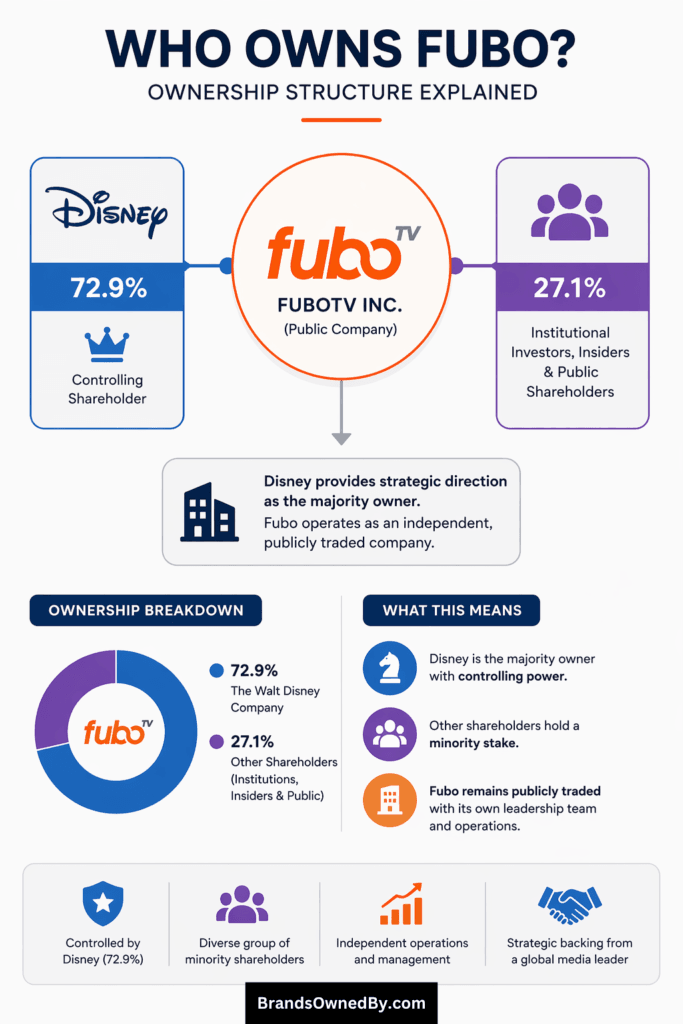
The ownership of FuboTV Inc. is now highly concentrated and structurally different from its earlier public-company model. As of April 2026, Fubo operates as a public subsidiary controlled by The Walt Disney Company, which holds a dominant majority stake following its merger with Hulu + Live TV.
This means there is now a clear controlling shareholder, unlike the past when ownership was widely distributed. However, Fubo still has a meaningful base of institutional investors, legacy shareholders, and insiders who retain minority stakes. These shareholders do not control the company but still participate economically and influence market sentiment.
Fubo’s ownership structure can be clearly summarized as follows:
- The Walt Disney Company: 72.9% (controlling stake)
- Institutional investors: 20% to 23% (combined minority)
- Insiders: 2% to 3%
- Retail investors: 3% to 5%.
Below is a detailed breakdown of the major shareholders as of 2026:
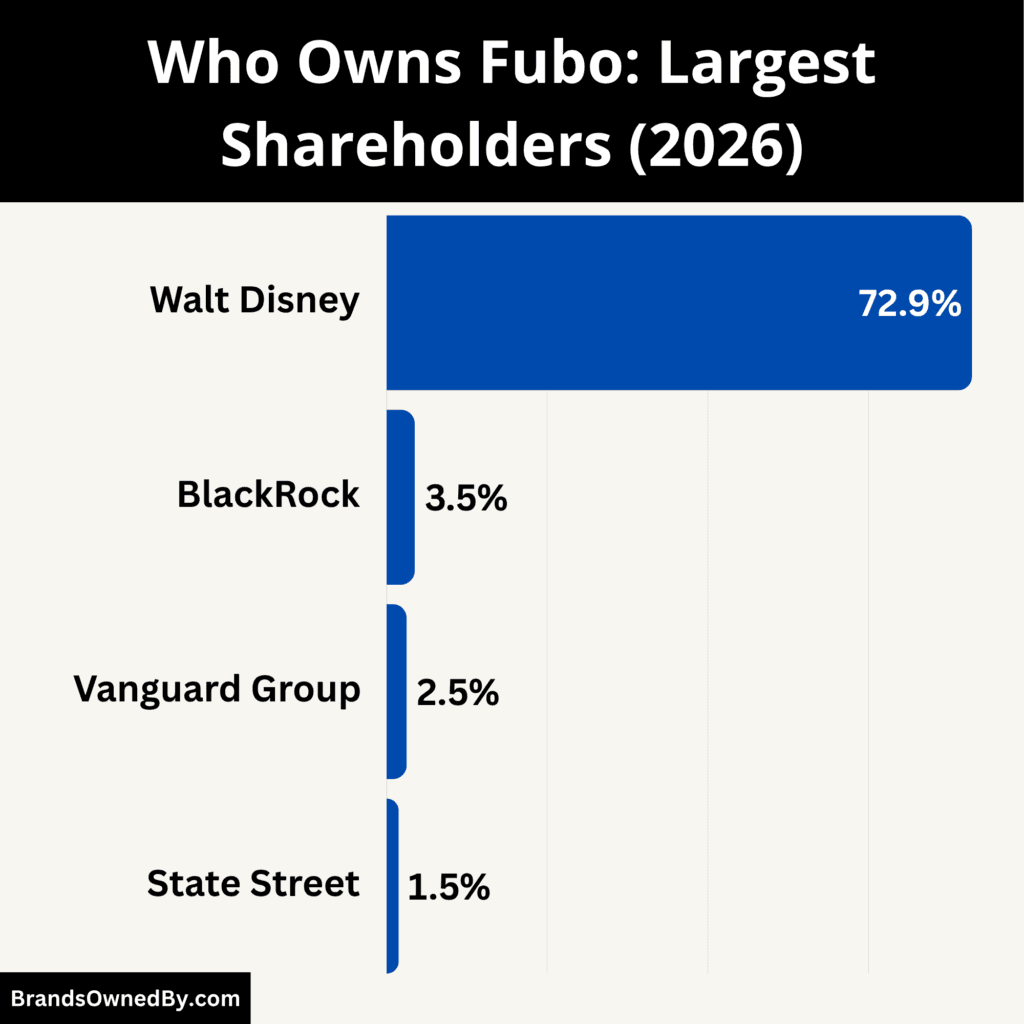
The Walt Disney Company (72.9%)
The Walt Disney Company is the largest and controlling shareholder of Fubo.
As of early 2026, regulatory filings show that Disney (together with its subsidiary Hulu) owns approximately 72.9% of Fubo’s equity on a fully converted basis.
This is a decisive majority. It gives Disney full control over:
- Board appointments
- Strategic direction
- Major financial and operational decisions
- Long-term integration with its streaming ecosystem.
This stake came from the 2025 transaction where Disney merged its Hulu + Live TV business into Fubo.
As a result, Fubo is now part of Disney’s broader streaming strategy alongside Hulu, Disney+, and ESPN platforms. While Fubo remains publicly traded, Disney effectively controls the company.
Hulu, LLC (Joint Beneficial Owner)
Hulu plays a structural role in Fubo’s ownership.
Hulu is fully controlled by Disney and is listed as a joint beneficial owner of Fubo shares alongside Disney in regulatory filings.
This reflects how the deal was structured:
- Hulu + Live TV was contributed to Fubo
- Ownership is shared at a legal level between Disney and Hulu
- Voting and control rights are exercised jointly.
Hulu itself does not act independently. Its ownership exists within Disney’s corporate structure. However, it remains important because it represents the operational business that was merged into Fubo.
Institutional Shareholders
After the controlling stake held by The Walt Disney Company, the remaining ownership of FuboTV Inc. is largely held by institutional investors. As of April 2026, institutions collectively own 20% to 23% of the company’s outstanding shares.
This group includes asset managers, pension funds, ETFs, and hedge funds. Unlike Disney, these investors do not operate as a unified block. Each firm holds a relatively small percentage, but together they represent the largest minority ownership segment.
Institutional ownership plays a critical role in Fubo’s stock performance and governance. These investors participate in shareholder voting, influence corporate governance standards, and provide long-term capital stability. However, none of them individually have enough shares to challenge Disney’s control.
BlackRock, Inc.
BlackRock is one of the most prominent institutional shareholders in Fubo, with an estimated 3% to 4% ownership stake.
BlackRock’s investment is primarily held through its vast range of index funds and exchange-traded funds (ETFs), such as those tracking U.S. equities. This means its position is largely passive rather than strategic. The firm does not actively manage Fubo’s operations or direction.
However, BlackRock still plays an important governance role. It votes on shareholder resolutions, board appointments, and executive compensation. Given its global influence, its voting policies can shape corporate governance practices even without direct control.
Its continued presence also signals institutional confidence. Large asset managers like BlackRock tend to maintain positions in companies that are included in major indices, ensuring steady capital inflow.
Vanguard Group
Vanguard Group holds approximately 2% to 3% of Fubo’s shares, making it another key institutional investor.
Vanguard’s investment approach is long-term and passive. Its stake comes mainly through index funds and retirement-focused mutual funds. Like BlackRock, it does not seek to control companies but focuses on broad market exposure.
Despite its passive strategy, Vanguard has influence through proxy voting. It regularly engages with companies on governance issues such as board independence, executive pay, and shareholder rights.
Vanguard’s presence adds stability to Fubo’s shareholder base. Its investment horizon is typically long-term, which reduces volatility compared to more active trading firms.
State Street Corporation
State Street Corporation owns around 1% to 2% of Fubo’s equity.
State Street is known for managing large ETF products, including SPDR funds. Its stake in Fubo is largely tied to index tracking. This makes it a passive but consistent investor.
While its ownership percentage is smaller than BlackRock and Vanguard, State Street still participates in governance through proxy voting. It also supports liquidity in the stock by maintaining steady holdings across its funds.
State Street’s role is important in maintaining institutional depth. Its presence ensures that Fubo remains part of broader institutional portfolios.
Hedge Funds and Quant Investors
A group of hedge funds and quantitative investment firms collectively hold 3% to 5% of Fubo’s shares. This includes firms like Renaissance Technologies, Citadel, and Two Sigma.
Unlike traditional asset managers, these firms use data-driven and algorithmic strategies. Their positions at Fubo are more dynamic. They may increase or reduce holdings based on market signals, volatility, or short-term opportunities.
These investors can influence trading activity. Their buying and selling patterns often contribute to stock price fluctuations. However, they typically do not engage deeply in long-term governance or strategic planning.
In some cases, hedge funds may push for changes if they see value opportunities. But given Disney’s controlling stake, their ability to influence major decisions is limited.
Other Institutional Investors
Beyond the major names, a wide range of smaller institutional investors collectively hold 8% to 10% of Fubo’s shares.
These include regional asset managers, wealth management firms, pension funds, and specialized investment vehicles. Each holds a relatively small stake, often well below 1%.
Individually, these investors have minimal influence. However, collectively they contribute to the overall institutional ownership base. They provide additional liquidity and diversify the shareholder structure.
Their investment strategies vary. Some focus on long-term growth, while others take opportunistic positions. Despite this diversity, they remain minority stakeholders with no control over company decisions.
Insider Ownership
Company insiders, including executives and board members, collectively own 2% to 3% of Fubo’s shares.
The most notable insider is David Gandler. As co-founder and CEO, he retains a personal stake in the company. This ownership aligns his interests with shareholders, particularly in terms of long-term growth and stock performance.
Other executives and directors also hold shares through compensation packages, stock options, and equity incentives. These holdings are designed to motivate leadership and retain key talent.
Despite this alignment, insider ownership is relatively small compared to Disney’s stake. Insiders do not have the voting power to influence major corporate decisions independently. Their authority comes from their management roles rather than equity control.
Retail and Public Shareholders
Retail investors collectively hold 3% to 5% of Fubo’s shares as of April 2026.
This group includes individual investors who buy shares through brokerage platforms. Their ownership is highly fragmented. No single retail investor holds a significant percentage.
Retail investors play an important role in the market. They contribute to daily trading volume, liquidity, and price discovery. Their sentiment can influence short-term stock movements, especially during periods of high volatility.
However, their impact on governance is limited. While they can vote on shareholder matters, their combined voting power is far smaller than that of institutional investors and vastly smaller than Disney’s controlling stake.
Competitor Ownership Comparison
The ownership structure of a streaming platform directly affects its content access, pricing power, technology, and long-term strategy. In the live TV streaming market, competitors fall into distinct ownership categories: media conglomerates, technology giants, telecom companies, and private equity-backed operators.
FuboTV Inc. now operates under a media conglomerate-controlled model, with The Walt Disney Company holding a dominant stake. This places it in a very different competitive position compared to its earlier independent status.
| Platform | Owner | Ownership Type | Core Strengths | Strategic Advantages | Key Limitations |
|---|---|---|---|---|---|
| FuboTV Inc. | The Walt Disney Company (72.9%) | Media conglomerate-controlled (public subsidiary) | Sports-focused live TV, niche sports coverage, integrated streaming features | Access to Disney’s content ecosystem, integration with Hulu + Live TV, strong advertising and distribution capabilities | Reduced independence, strategy aligned with Disney’s broader goals |
| Hulu + Live TV | The Walt Disney Company | Fully owned media platform | Broad entertainment + live TV bundle, integration with Disney+ and ESPN+ | Vertical integration with Disney content, bundling strategy, strong subscriber ecosystem | Less specialization in sports compared to Fubo |
| YouTube TV | Alphabet Inc. | Technology company ownership | Advanced UI/UX, scalability, high streaming reliability | Google Cloud infrastructure, AI-driven recommendations, deep advertising ecosystem | Limited proprietary content ownership, high licensing costs |
| Sling TV | Dish Network | Telecom-owned platform | Flexible channel bundles, lower pricing | Leverages satellite TV relationships, cost-efficient packaging | Limited exclusive content, weaker ecosystem compared to Disney/Google |
| DirecTV Stream | DirecTV / TPG Capital | Private equity-backed telecom | Premium channel offerings, strong legacy customer base | Established distribution network, strong sports and premium content access | Slower innovation, focus on profitability over ecosystem expansion |
| Philo | AMC Networks, Warner Bros. Discovery | Media consortium ownership | Low-cost entertainment bundles, simple offering | Direct access to owned content, lower operating costs | No sports content, limited appeal for sports-focused users. |
Hulu + Live TV (Owned by The Walt Disney Company)
Hulu + Live TV is fully controlled by The Walt Disney Company, making it part of the same corporate ecosystem as Fubo.
This ownership creates a strategic dual-platform approach. Disney now operates both Fubo and Hulu + Live TV to target different user segments. Hulu is positioned as a broader entertainment bundle, offering a mix of live TV, on-demand content, and integrations with Disney+ and ESPN+. Fubo, on the other hand, continues to emphasize sports-heavy programming and niche sports coverage.
Disney benefits from owning both platforms because it can:
- Negotiate content rights at scale across multiple services
- Bundle subscriptions to increase customer lifetime value
- Optimize pricing strategies without direct internal competition
- Share advertising technology and user data infrastructure.
The key advantage here is vertical integration. Disney controls both content production and distribution. This allows Hulu + Live TV to offer strong entertainment packages, while Fubo complements it with sports-focused differentiation.
YouTube TV (Owned by Google / Alphabet)
YouTube TV is owned by Google, which operates under Alphabet Inc..
This ownership model is fundamentally different from Fubo’s. YouTube TV is backed by a technology-first company rather than a content-driven media group.
Google provides several structural advantages:
- Massive global cloud infrastructure through Google Cloud
- Advanced recommendation algorithms and machine learning
- Deep integration with YouTube’s global user base
- Industry-leading advertising technology.
Unlike Disney, Google does not own a large portfolio of traditional TV content. Instead, it focuses on distribution efficiency and user experience. YouTube TV excels in interface design, streaming quality, and scalability.
This creates a contrast with Fubo. While Fubo benefits from Disney’s content ecosystem, YouTube TV competes on technology, reliability, and user experience. Its ownership allows it to scale rapidly without the same content cost pressures.
Sling TV (Owned by Dish Network)
Sling TV is owned by Dish Network.
Sling TV represents a telecom-driven ownership model. Dish Network originally launched Sling as a way to transition from satellite TV to internet-based distribution. This legacy background shapes Sling’s strategy.
Dish uses Sling TV to:
- Retain cord-cutting customers moving away from satellite
- Offer flexible, lower-cost alternatives to traditional TV bundles
- Leverage existing distribution agreements and infrastructure.
Unlike Disney or Google, Dish does not have strong proprietary content or advanced technology platforms. Its advantage lies in pricing and packaging flexibility. Sling allows users to customize channel bundles, making it one of the more affordable options in the market.
Compared to Fubo, Sling operates with more independence but fewer resources. It lacks the content depth of Disney-backed services and the technological edge of Google-backed platforms.
DirecTV Stream (Owned by DirecTV / TPG Capital)
DirecTV Stream is owned by DirecTV, which is backed by private equity firm TPG Capital.
This ownership model is driven by financial restructuring and asset optimization. Unlike Disney or Google, the focus here is on profitability and operational efficiency rather than ecosystem expansion.
DirecTV Stream benefits from:
- Established relationships with content providers
- A large base of legacy TV customers
- Premium channel offerings and sports packages.
However, private equity ownership also brings constraints. Investment decisions are often focused on returns and cost control. This can limit long-term innovation compared to tech or media-backed competitors.
Compared to Fubo, DirecTV Stream has stronger legacy infrastructure but less strategic integration with a broader digital ecosystem.
Philo (Owned by Media Consortium)
Philo is owned by a consortium of media companies, including AMC Networks and Warner Bros. Discovery.
This ownership structure is collaborative. Content providers directly own and operate the platform. The strategy is to distribute their channels efficiently without relying on third-party platforms.
Philo focuses on:
- Low-cost entertainment bundles
- Direct access to owned content libraries
- Simplified channel offerings without sports.
Because its owners are content creators, Philo avoids expensive sports rights. This keeps costs low and pricing competitive.
Compared to Fubo, Philo operates in a different segment. Fubo invests heavily in sports content, while Philo prioritizes affordability and entertainment channels.
Key Ownership Model Differences
Across competitors, ownership shapes competitive strengths in distinct ways.
Media conglomerate ownership, like Disney’s control of Fubo and Hulu, provides strong content access and vertical integration. These platforms benefit from exclusive rights and bundled ecosystems.
Technology ownership, as seen with Google and YouTube TV, emphasizes scalability, data, and user experience. These platforms lead in performance and innovation.
Telecom ownership, like Dish and Sling TV, focuses on transitioning legacy TV businesses into digital formats. Pricing flexibility is a key advantage.
Private equity ownership, as with DirecTV Stream, prioritizes financial performance and operational efficiency rather than long-term ecosystem building.
Collaborative media ownership, like Philo, enables cost-efficient distribution of owned content but limits expansion into expensive categories like sports.
Where Fubo Stands in Comparison
Fubo’s position has fundamentally shifted after becoming majority-owned by The Walt Disney Company.
It now benefits from:
- Access to Disney’s content ecosystem
- Integration with Hulu + Live TV operations
- Enhanced advertising and distribution capabilities.
At the same time, it operates within a controlled framework. Strategic decisions must align with Disney’s broader goals.
This places Fubo in a hybrid competitive position. It combines the flexibility of a public company with the backing of a global media giant. Compared to its competitors, it now competes with stronger resources but less independence.
This ownership-driven shift is central to understanding how Fubo competes in the evolving streaming industry.
Who Controls Fubo?
Control of FuboTV Inc. is exercised through a multi-layered structure. As of April 2026, ultimate authority sits with The Walt Disney Company due to its 72.9% ownership.
However, real control is not just about ownership. It is distributed across three core layers:
- Strategic control (Disney)
- Governance control (Board of Directors)
- Operational control (Executive Leadership).
Below is a detailed breakdown with actual leadership names and roles.
The Walt Disney Company: Ultimate Decision-Maker
The Walt Disney Company holds 72.9% of Fubo. This gives it absolute voting control.
At the corporate level, Disney’s leadership ultimately influences Fubo’s direction. Key figures include:
- Bob Iger – Sets overall corporate strategy, including streaming priorities
- Dana Walden – Oversees content and streaming operations
- Jimmy Pitaro – Influences sports strategy, which directly impacts Fubo.
These executives do not run Fubo day-to-day. But they shape high-level strategic decisions, especially around content, bundling, and platform positioning.
Board of Directors: Governance and Oversight
Fubo’s board of directors is responsible for governance, oversight, and approving major corporate decisions. However, its composition is influenced by Disney due to its majority stake.
Key board members include:
- Edgar Bronfman Jr. – Serves as Executive Chairman and plays a central role in governance and strategic oversight
- David Gandler – Also sits on the board, linking management with governance
- Neil Glat – Brings experience from sports and media organizations
- Pamela Duckworth – Provides expertise in investment and corporate strategy
- Steven A. Cohen – Adds financial and investment oversight perspective.
The board’s role includes:
- Approving major transactions and partnerships
- Overseeing financial performance and risk
- Evaluating executive leadership
- Ensuring alignment with shareholder interests.
Because Disney controls voting power, it effectively shapes the board’s composition. This means governance aligns closely with Disney’s strategic direction.
David Gandler: Chief Executive Officer
David Gandler is the most important operational leader at Fubo.
As co-founder and CEO, he has led the company since its early days. His role includes:
- Defining product strategy and platform direction
- Leading content acquisition and partnerships
- Driving subscriber growth and monetization
- Managing overall business performance.
Gandler remains central even after the Disney deal. He ensures continuity and executes the company’s strategy within the framework set by Disney.
However, he does not operate independently. Major strategic decisions must align with Disney and be approved by the board.
Executive Leadership Team
Fubo’s executive team manages the company’s core functions. These leaders handle execution across technology, finance, content, and operations.
Key executives include:
- Edgar Bronfman Jr. – Beyond the board role, he contributes to strategic direction and industry relationships
- John Janedis – Oversees financial strategy, reporting, and capital management
- Mike Berkley – Leads product development and user experience innovation
- Todd Mathers – Drives customer acquisition, branding, and growth strategy.
These executives are responsible for:
- Running daily operations
- Executing growth and monetization strategies
- Managing platform performance and innovation
- Delivering financial and operational targets.
Their authority is operational. They ensure the company functions effectively, but they do not control ownership or high-level strategy.
How Control Works in Reality
In practice, control flows in a clear hierarchy:
- Disney defines long-term strategy and has final authority
- The board formalizes decisions and provides oversight
- David Gandler and the executive team execute the strategy.
This creates a top-down control model. Strategic decisions originate at the ownership level. Execution happens at the management level.
Fubo Annual Revenue and Net Worth
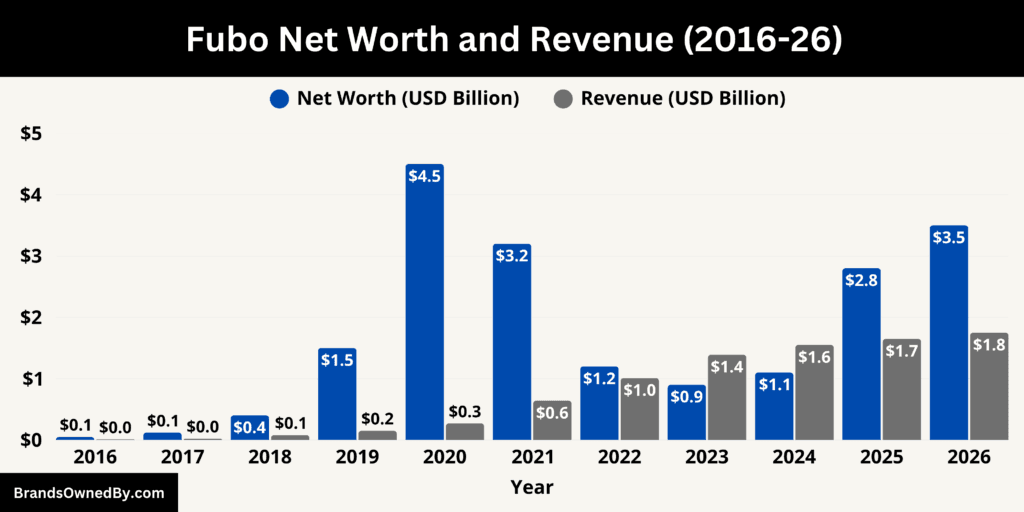
The financial trajectory of FuboTV Inc. has evolved rapidly, especially after its strategic combination with The Walt Disney Company.
As of April 2026, Fubo is generating over $1.55 billion in annual revenue, with a pro forma combined revenue base exceeding $6.0 billion after integrating Hulu + Live TV operations. As of April 2026, Fubo has a net worth of $3.5 billion.
Its net worth (market valuation) has also improved due to Disney’s majority ownership, positioning Fubo as part of a significantly larger streaming ecosystem with stronger financial backing.
Revenue Breakdown and Growth Drivers (2026)
Fubo’s 2026 revenue reflects both organic growth and the impact of its merger with Hulu + Live TV.
For Q1 2026 alone, the company reported:
- $1.549 billion in reported quarterly revenue
- $1.683 billion pro forma quarterly revenue including Hulu integration
On a trailing twelve-month basis:
- $4.9 billion reported revenue
- $6.2 billion pro forma revenue.
This indicates that Fubo has transitioned from a mid-sized streaming company into a multi-billion-dollar revenue platform.
The revenue model is divided into two primary streams:
Subscription Revenue: This is the largest contributor. It comes from monthly fees paid by subscribers. As of 2026, Fubo and its combined platform serve over 6.2 million subscribers in North America, significantly boosting recurring revenue.
Advertising Revenue: Advertising is the second major pillar. With a growing user base and live sports content, Fubo attracts premium advertisers. The integration with Disney enhances ad monetization through advanced targeting and cross-platform campaigns.
The combination of these two streams has created a high-growth but capital-intensive revenue model, where scale is critical to profitability.
Profitability and EBITDA Position
While revenue has grown significantly, profitability is still evolving.
Fubo reported improving financial performance in 2026:
- Adjusted EBITDA projected between $80 million and $100 million for FY2026
- Positive EBITDA already achieved on a quarterly basis post-merger.
This marks a turning point. Historically, Fubo operated at a loss due to high content licensing costs. Now, the company is moving toward sustainable profitability.
The company also expects to:
- Achieve positive free cash flow starting in 2027
- Reach $300 million+ EBITDA by 2028.
This signals a shift from growth-at-all-costs to financial discipline and margin expansion.
Net Worth and Market Valuation (April 2026)
As of April 2026, the net worth of FuboTV Inc. is approximately $3.5 billion based on its market capitalization.
This valuation reflects a major recovery and structural shift in the company’s financial position. Fubo is no longer valued as a small, high-risk streaming startup. It now operates as part of a scaled streaming business following its combination with The Walt Disney Company.
The $3.5 billion valuation is supported by several concrete performance indicators.
Fubo is now part of a platform generating more than $6.0 billion in combined annual revenue after integrating Hulu + Live TV. This places it among the larger virtual MVPD platforms in North America. The scale of revenue significantly strengthens its valuation compared to earlier years when revenue was below $2 billion.
The company also serves over 6 million subscribers across its combined platform. This large and recurring subscriber base provides stable subscription revenue, which is a key factor supporting valuation in the streaming industry.
From an earnings perspective, Fubo is projecting $80 million to $100 million in EBITDA for 2026. This marks a transition from negative margins in previous years to positive operating performance. The shift toward profitability is a major driver of improved investor confidence.
Another important factor is ownership. With The Walt Disney Company holding 72.9% of the company, Fubo benefits from strong strategic backing. This includes access to premium content, advanced advertising infrastructure, and distribution scale. These elements directly strengthen the company’s long-term financial outlook.
The valuation also reflects improved monetization. Fubo generates revenue from both subscriptions and advertising, with advertising becoming increasingly important due to live sports content attracting premium ad rates.
Overall, the $3.5 billion net worth in April 2026 represents a company that has moved beyond early-stage volatility. It is now valued based on scale, improving profitability, and integration within a larger media ecosystem.
Financial Transformation After Disney Deal
The combination with The Walt Disney Company significantly changed the financial structure of FuboTV Inc.. Before the deal, Fubo operated as a smaller standalone platform. It faced high content costs, especially for sports rights, which limited profitability despite strong revenue growth. Its scale was not large enough to offset fixed costs, and margins remained under pressure.
After the transaction, Fubo’s scale increased immediately through the integration of Hulu + Live TV. This expansion improved operating leverage, as costs are now spread across a much larger subscriber base. At the same time, Disney’s bargaining power helps reduce content costs over time, improving margins.
Advertising has also become more efficient. With access to Disney’s ad infrastructure, Fubo can generate higher revenue per user. This strengthens its overall monetization without significantly increasing costs.
As a result, Fubo has shifted from a high-growth but loss-heavy model to a more balanced structure with improving EBITDA and a clearer path to profitability. It now operates as a more stable, scaled streaming platform within a larger ecosystem.
Future Revenue Forecast (2027–2030)
Fubo’s revenue growth over the next few years is expected to remain strong, driven by scale, bundling, and improved monetization.
- 2027: $6.8 billion
- 2028: $7.5 billion
- 2029: $8.3 billion
- 2030: $9.2 billion.
This growth will be supported by deeper integration with Disney’s platforms, which helps increase subscribers and reduce churn. Advertising revenue is also expected to expand as targeting improves and live sports continue to attract premium ad spending.
Pricing power will play a role as well. As the platform grows, Fubo can introduce tiered plans, bundled offers, and premium add-ons to increase average revenue per user.
Over time, the business is expected to rely less on rapid subscriber growth and more on monetization efficiency. By 2030, Fubo is positioned to operate as a large, diversified streaming platform with multiple revenue streams and stronger financial stability.
Brands Owned by Fubo
As of April 2026, FuboTV Inc. operates a focused portfolio of brands and business divisions rather than a large acquisition-heavy structure. The company has built most of its ecosystem internally, with a few strategic acquisitions that expanded its capabilities in streaming technology and sports content.
Below are the key companies, brands, and divisions directly owned and operated by Fubo as of April 2026:
| Company / Brand | Type | Ownership | Core Function | Key Details |
|---|---|---|---|---|
| Fubo (Core Platform) | Streaming Service | Fully owned | Live TV streaming platform | Main product of the company. Offers sports, news, and entertainment channels. Generates majority of revenue through subscriptions and ads. |
| Fubo Sports Network | Media Network | Fully owned | Sports content and programming | Provides live sports, original shows, and analysis. Distributed both inside and outside Fubo platform to expand reach and ad revenue. |
| Molotov TV | Streaming Platform | Fully owned (acquired) | International live TV service | France-based platform offering free and paid TV. Key asset for European expansion with localized content and partnerships. |
| Edisn.ai | AdTech Company | Fully owned (acquired) | Advertising and data targeting | Enhances ad targeting and monetization through data-driven advertising solutions and audience segmentation. |
| Fubo Gaming | Gaming Division | Fully owned | Sports betting and interactive features | Focused on integrating betting with streaming. Sportsbook scaled back, but remains part of long-term engagement strategy. |
| Fubo Latino | Content Offering / Brand | Fully owned | Spanish-language streaming package | Targets Hispanic audience with curated Spanish-language channels. Expands subscriber base in key demographic segment. |
| Fubo Extra & Add-On Packages | Subscription Add-ons | Fully owned | Premium content bundles | Includes Sports Plus and other add-ons. Increases ARPU by offering customizable content packages for niche audiences. |
Fubo
The flagship brand is Fubo itself. This is the company’s primary product and revenue engine.
Fubo is a live TV streaming service that delivers sports, news, and entertainment channels over the internet. It is designed as a cable replacement, with a strong emphasis on sports coverage. The platform includes features such as cloud DVR, multi-view streaming, and personalized channel experiences.
As of 2026, Fubo serves millions of subscribers and generates the majority of its revenue through subscriptions and advertising. It remains the central brand around which all other divisions operate.
Fubo Sports Network
Fubo Sports Network is a fully owned content brand launched by Fubo to expand its presence in sports media.
The network provides live sports events, original shows, documentaries, and analysis programming. It is distributed both within the Fubo platform and on external streaming services, increasing its reach and advertising potential.
This brand allows Fubo to own and control part of its content pipeline, reducing reliance on third-party networks and improving long-term margins.
Molotov
Molotov TV is a major acquisition completed by Fubo to expand internationally.
Molotov is a France-based live TV streaming platform that offers both free and paid television services. It provides access to French channels, on-demand content, and cloud recording features.
This acquisition gave Fubo a strong foothold in the European market. Molotov operates as a distinct brand tailored to French audiences, with localized content and partnerships.
It represents Fubo’s most significant international asset and a key part of its global expansion strategy.
Edisn.ai
Edisn.ai is an ad-tech company acquired by Fubo to strengthen its advertising capabilities.
Edisn.ai focuses on data-driven advertising solutions, including contextual targeting and audience segmentation. The technology enables Fubo to deliver more relevant ads to users, increasing ad efficiency and revenue per user.
This acquisition supports Fubo’s transition toward a more advanced advertising model, which is critical for long-term profitability in the streaming industry.
Fubo Gaming
Fubo Gaming was created to explore the integration of sports streaming and betting.
The division initially launched Fubo Sportsbook, aiming to combine live viewing with real-time wagering. While the standalone sportsbook operations were later scaled back, the division itself represents Fubo’s broader strategy of interactive sports engagement.
As of 2026, Fubo Gaming is not a major revenue driver. However, it remains part of the company’s long-term vision to enhance user engagement and monetization through interactive features.
Fubo Latino
Fubo Latino is a specialized content offering targeting Spanish-speaking audiences.
It provides a curated selection of Spanish-language channels, including sports, news, and entertainment. This offering helps Fubo expand its reach within the U.S. Hispanic market.
While not a separate company, Fubo Latino operates as a distinct branded package within the platform, contributing to subscriber growth and diversification.
Fubo Extra and Add-On Packages
Fubo offers several branded add-on packages, such as Fubo Extra, Sports Plus, and international channel bundles.
These packages allow users to customize their subscriptions by adding premium channels and niche content. They increase average revenue per user and enhance the platform’s flexibility.
Each package functions as a micro-brand within the Fubo ecosystem, targeting specific audience segments such as sports enthusiasts or international viewers.
Conclusion
The answer to who owns Fubo reflects how much the company has evolved. It now operates within a controlled ownership structure, where strategic direction is set at the top while day-to-day operations remain with its own management.
Fubo continues to focus on its core strength in sports-led streaming while expanding its content and monetization capabilities. Its streamlined portfolio and integrated approach give it a defined position in a competitive market.
Going forward, its ownership model and platform focus will play a key role in shaping how it grows and competes in the broader streaming landscape.
FAQs
Where is Fubo based?
FuboTV Inc. is headquartered in New York City, United States. The company primarily operates in North America, especially the U.S. and Canada, where it offers its live TV streaming service. It also has international operations through its subsidiary platforms, including Europe, which support its broader expansion strategy.
Who is Fubo owned by?
Fubo is majority-owned by The Walt Disney Company, which holds 72.9% of the company’s shares. This gives Disney full control over strategic decisions, including partnerships, content direction, and long-term growth plans. The remaining 27.1% is owned by institutional investors, insiders, and retail shareholders, who participate financially but do not control the company.
Who owns Fubo TV streaming?
The Fubo TV streaming service is owned and operated by FuboTV Inc.. However, since Disney holds a majority stake in Fubo, it indirectly controls the streaming platform. This means that while Fubo runs its own service and operations, it aligns with Disney’s broader streaming ecosystem and strategy.
What company owns Fubo?
The Walt Disney Company is the parent company of Fubo. It became the controlling owner after completing a strategic combination with Hulu + Live TV in 2025. This deal positioned Disney as the dominant shareholder and integrated Fubo into its portfolio of streaming platforms.
What does Fubo stand for?
The name “Fubo” is derived from “fútbol,” the Spanish word for football (soccer). This reflects the company’s origins as a soccer-focused streaming service when it launched in 2015. Over time, the platform expanded beyond soccer to include a full range of live TV content, especially sports, while retaining its original branding.
Does Netflix own Fubo?
No, Netflix does not own Fubo and has no ownership stake in the company. Netflix operates as a separate streaming platform focused on on-demand content, while Fubo specializes in live TV streaming. Fubo is owned and controlled by The Walt Disney Company.
Who is the CEO of Fubo?
The CEO of Fubo is David Gandler. He is also a co-founder of the company and has led its growth from a niche sports streaming service into a full live TV platform. As CEO, he oversees operations, product strategy, partnerships, and overall business performance, while aligning with Disney’s strategic direction.
How much of Fubo does Disney own?
The Walt Disney Company owns 72.9% of Fubo’s total equity. This majority stake gives Disney complete control over shareholder voting, board decisions, and strategic initiatives. It effectively makes Fubo a controlled subsidiary within Disney’s streaming ecosystem.
When did Disney buy Fubo?
Disney became the majority owner of Fubo in 2025, when it completed a business combination that merged its Hulu + Live TV operations with Fubo. This transaction was not a traditional full acquisition but resulted in Disney holding a controlling stake, fundamentally changing Fubo’s ownership structure and strategic positioning.