
- Lamborghini is directly owned by Audi, which operates as a subsidiary of Volkswagen Group, making it part of one of the world’s largest automotive groups.
- The ultimate controlling shareholder is Porsche SE, which holds the majority of voting rights in Volkswagen Group and indirectly controls Lamborghini through this layered structure.
- This ownership model provides Lamborghini with strong financial backing, advanced technology access, and global scale, while allowing it to maintain brand independence in design, engineering, and performance.
Lamborghini is a high-performance automobile manufacturer headquartered in Sant’Agata Bolognese, Italy. The company specializes in luxury supercars known for their bold styling and powerful engines.
The brand is defined by its aggressive design language. Sharp edges, low stances, and futuristic interiors are key characteristics. Lamborghini focuses on delivering extreme performance combined with everyday drivability.
The company operates with a limited production approach. This keeps its vehicles exclusive and highly desirable. Each model reflects a balance between cutting-edge technology and traditional craftsmanship.
As of April 2026, Lamborghini continues to expand its lineup while maintaining its core identity. The introduction of hybrid supercars and performance SUVs shows a shift toward modern engineering without losing its signature performance DNA.
Lamborghini Founder
Lamborghini was founded in 1963 by Ferruccio Lamborghini, an Italian industrialist who built his fortune in the tractor manufacturing business. He was not originally part of the luxury car industry. His entry into the market came from a desire to build better high-performance road cars after being dissatisfied with existing options.
His engineering background and business success allowed him to establish Lamborghini as a serious competitor in the sports car segment from the very beginning.
Ferruccio Lamborghini
Ferruccio Lamborghini started his career by building tractors using surplus military machinery after World War II. His company quickly became one of Italy’s leading agricultural equipment manufacturers.
He developed strong expertise in engines and mechanical systems. This knowledge later became the foundation for Lamborghini’s automotive engineering.
Ferruccio was also passionate about luxury cars. He owned several high-end models, including Ferraris. However, he found them uncomfortable and unreliable for regular driving.
A key moment came when he approached Enzo Ferrari with feedback. Ferrari reportedly dismissed him. This pushed Ferruccio to start his own car company.
The Vision Behind Lamborghini
Ferruccio Lamborghini’s goal was to create high-performance grand touring cars. He wanted them to be powerful but also refined and comfortable.
This vision shaped Lamborghini’s early models. Cars like the 350 GT focused on smooth driving and strong performance rather than racing dominance.
His approach differentiated Lamborghini from competitors. It also laid the foundation for the brand’s long-term identity, which continues as of April 2026.
Ownership History
Lamborghini’s ownership history reflects cycles of ambition, financial stress, and strategic rescue. The company has moved through multiple hands, each shaping its engineering direction, product portfolio, and global positioning. From founder-led independence to being part of one of the world’s largest automotive groups, every phase added a new layer to Lamborghini’s identity.
Founding and Early Independence (1963–1972)
Ferruccio Lamborghini established Lamborghini in 1963 as a privately owned company. He fully controlled the business and funded its early operations through profits from his tractor manufacturing empire.
This period focused on building high-quality grand touring cars. Lamborghini aimed to compete directly with Ferrari but with a different philosophy. Instead of race-first engineering, the company emphasized comfort, drivability, and refinement.
Early models such as the 350 GT and Miura helped build the brand’s reputation. The Miura, in particular, introduced a revolutionary mid-engine layout. It set new standards in the sports car segment.
Despite strong brand recognition, the company operated with limited capital. Production volumes were low. Development costs were high. This created structural financial pressure even during its early success.
Financial Crisis and Ownership Exit (1972–1974)
By the early 1970s, Lamborghini faced a serious financial crisis. The global economic environment worsened. The oil crisis reduced demand for high-performance cars.
At the same time, Ferruccio’s tractor business faced a major contract cancellation. This directly impacted his ability to fund Lamborghini.
In 1972, he sold a controlling 51% stake to Georges-Henri Rossetti. In 1974, he sold the remaining shares to René Leimer.
This marked a complete ownership transition. Lamborghini moved from founder-led vision to investor-driven management. However, the new owners lacked long-term industrial strategy, which weakened stability.
Bankruptcy and Receivership Phase (1978–1980)
The situation deteriorated further under the new ownership. Poor financial management and declining sales pushed the company into bankruptcy in 1978.
Lamborghini entered receivership. It was managed by court-appointed administrators. Production nearly stopped. Employees were reduced. New product development was limited.
During this phase, Lamborghini survived primarily due to its brand value rather than operational strength. The company remained alive, but without clear direction or investment.
Mimran Brothers Revival (1980–1987)
In 1980, Lamborghini was acquired by the Mimran brothers, Jean-Claude Mimran and Patrick Mimran.
This period marked a structured revival. The new owners invested heavily in infrastructure. The Sant’Agata factory was modernized. Production processes were improved.
They also focused on rebuilding the product lineup. The Jalpa was introduced as an entry-level sports car. The LM002, a high-performance off-road vehicle, showed Lamborghini’s willingness to experiment.
The Mimran era restored operational stability. However, Lamborghini still lacked the scale and global reach needed for long-term competitiveness.
Chrysler Ownership and Industrial Backing (1987–1994)
In 1987, Lamborghini was acquired by Chrysler. This was the company’s first integration into a major global automotive group.
Chrysler provided financial resources and engineering support. It also introduced more structured management practices.
One of the key outcomes of this period was the development of the Diablo. This model became a flagship product and carried Lamborghini into the 1990s.
However, Lamborghini remained a small part of Chrysler’s broader portfolio. Strategic focus was limited. The brand did not receive the level of integration or investment needed to scale globally.
Indonesian Ownership and Transitional Phase (1994–1998)
In 1994, Chrysler sold Lamborghini to an Indonesian investment group led by Tommy Suharto.
This period was marked by uncertainty. The company faced inconsistent investment and lacked a clear long-term roadmap. Economic challenges in Asia also affected the group’s ability to support Lamborghini.
Product development slowed. Global expansion remained limited. The brand maintained its image but struggled operationally.
This phase is often viewed as a holding period before a more strategic owner took over.
Audi Acquisition and Volkswagen Group Integration (1998–Present)
The most transformative moment came in 1998. Lamborghini was acquired by Audi, which is part of the Volkswagen Group.
This acquisition fundamentally changed Lamborghini’s trajectory.
Audi introduced strong engineering discipline, quality control systems, and advanced manufacturing processes. It also integrated Lamborghini into a global supply chain and R&D network.
New platforms and technologies became accessible. This allowed Lamborghini to develop more reliable and scalable vehicles.
Under this ownership, Lamborghini launched several successful models. The Murciélago re-established the brand’s flagship presence. The Gallardo became a commercial success with higher production volumes. Later, the Aventador and Huracán strengthened its global position.
The introduction of the Urus marked a major strategic shift. It expanded Lamborghini into the luxury SUV segment, significantly increasing production capacity and market reach.
As of April 2026, Lamborghini remains under Audi within Volkswagen Group. This ownership structure provides long-term stability, access to capital, and technological leadership.
This era represents Lamborghini’s most successful phase. The company has achieved consistent growth, stronger global presence, and a balanced product portfolio while maintaining its core brand identity.
Who Owns Lamborghini?
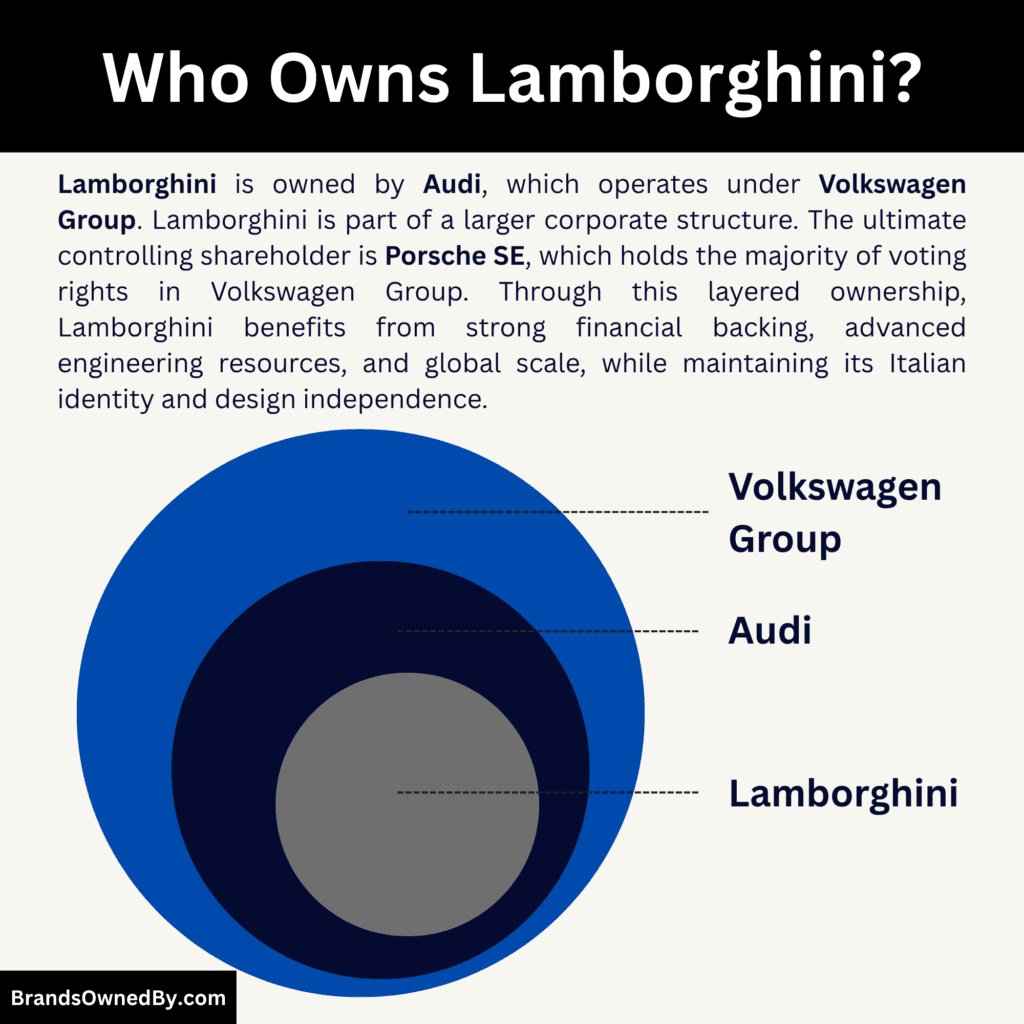
As of April 2026, Lamborghini is directly owned by Audi, which itself is a core subsidiary of Volkswagen Group.
This means Lamborghini sits several levels below its ultimate controlling entity. At the top of this structure is Porsche SE, which holds the majority of voting rights in Volkswagen Group. Through this layered system, Porsche SE indirectly controls Lamborghini.
This ownership model is critical to understanding Lamborghini’s modern success. It combines Italian design and heritage with German engineering discipline, capital strength, and global scale. The result is a brand that retains its identity while operating with the backing of one of the most powerful automotive groups in the world.
Direct Ownership: Audi’s Strategic Role
Audi acquired Lamborghini in 1998. Since then, Audi has acted as the direct controlling entity responsible for Lamborghini’s operational oversight.
Audi’s role goes far beyond ownership on paper. It provides:
- Engineering platforms and component sharing
- Quality control systems and manufacturing processes
- Access to advanced research in electrification and performance technologies
- Financial discipline and long-term product planning.
Audi effectively transformed Lamborghini from an unstable niche manufacturer into a structured, process-driven company. It introduced German industrial standards while allowing Lamborghini to retain creative control over design and brand identity.
This balance is key. Lamborghini’s cars remain emotionally driven and visually bold, while their reliability and engineering precision have significantly improved under Audi.
Parent Company: Volkswagen Group’s Global Influence
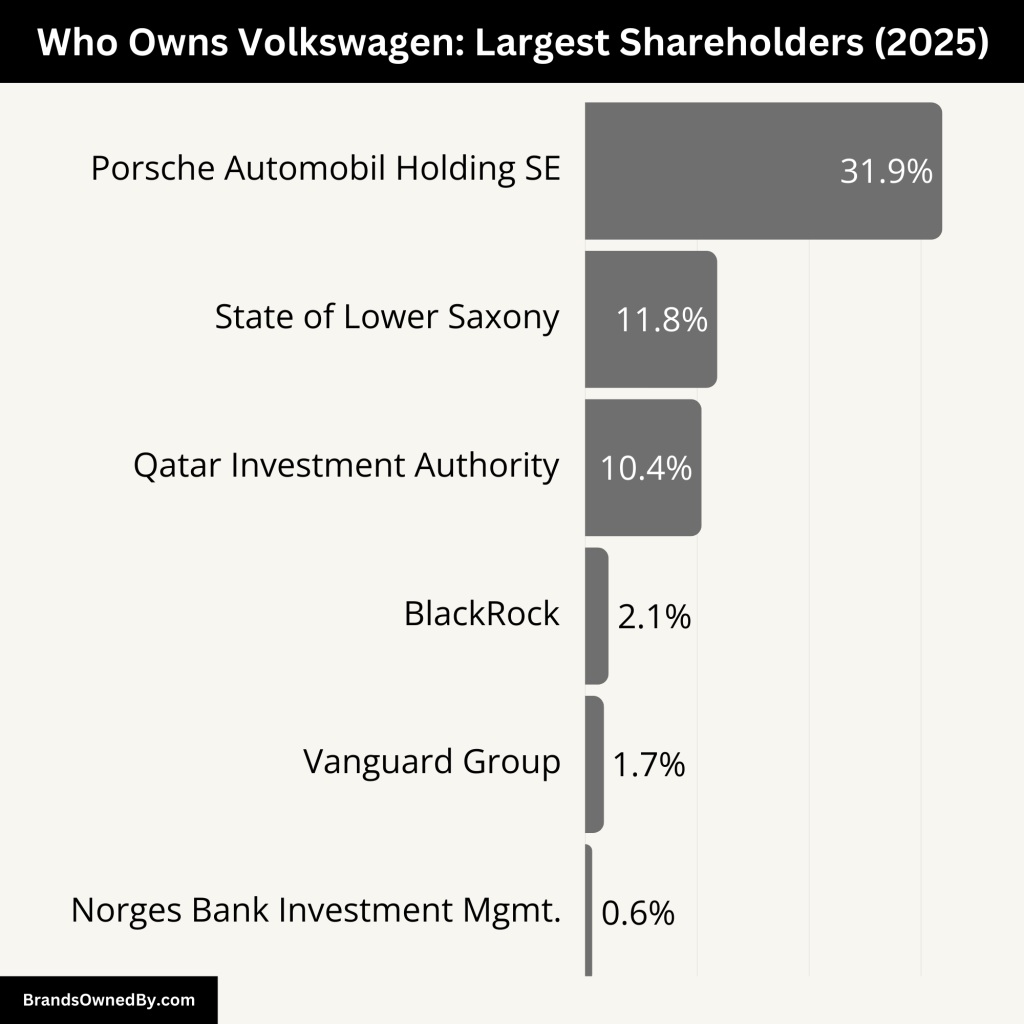
Volkswagen Group is the ultimate parent company of Lamborghini.
Volkswagen Group operates a multi-brand strategy. Each brand serves a specific market segment. Lamborghini represents the extreme high-performance and exotic luxury segment within this portfolio.
Other major brands under Volkswagen Group include:
- Porsche (performance luxury)
- Bentley (ultra-luxury)
- Audi (premium segment)
- Bugatti (hypercar segment, now in joint venture structure).
This ecosystem allows resource sharing across brands. For Lamborghini, this means access to:
- Shared R&D infrastructure
- Global supply chains
- Advanced powertrain development
- Scalable production systems.
Volkswagen Group does not interfere with Lamborghini’s day-to-day creative decisions. However, it defines long-term strategic direction, especially in areas like electrification, sustainability, and platform integration.
Ultimate Control: Porsche SE’s Influence
Porsche SE is the largest shareholder of Volkswagen Group. It holds a majority of voting rights, giving it effective control over the group.
Porsche SE is controlled by the Porsche and Piëch families. These families have historically shaped Volkswagen Group’s long-term vision.
This means Lamborghini is indirectly influenced at the highest level by one of the most powerful automotive dynasties in the world.
While Porsche SE does not manage Lamborghini directly, it influences:
- Board-level decisions
- Executive appointments
- Long-term investment strategies.
This layer of control ensures stability. It also aligns Lamborghini with broader group priorities while preserving its niche positioning.
Acquisition Details: Why Audi Bought Lamborghini
The 1998 acquisition by Audi was not just a financial transaction. It was a strategic move by Volkswagen Group to expand into the high-performance luxury segment.
Before the acquisition, Lamborghini faced:
- Inconsistent ownership
- Limited capital
- Weak global distribution
- Quality and reliability issues.
Audi identified Lamborghini as a brand with a strong heritage but underdeveloped potential.
Post-acquisition, Audi implemented a structured transformation:
- Modernized production facilities in Sant’Agata Bolognese
- Introduced strict quality control processes
- Integrated advanced engineering systems
- Expanded global dealership networks.
The first major success of this new era was the Murciélago. This was followed by the Gallardo, which significantly increased production volumes and profitability.
This acquisition is widely considered one of the most successful brand turnarounds in the automotive industry.
Ownership Structure Breakdown
Lamborghini’s ownership can be understood in a hierarchical structure:
- Porsche SE (top-level controlling shareholder)
- Volkswagen Group (parent company)
- Audi (direct owner)
- Lamborghini (operating brand).
Each layer has a specific function. Porsche SE provides control. Volkswagen Group provides scale and strategy. Audi provides operational management. Lamborghini executes its brand vision and product development.
This structure allows Lamborghini to operate efficiently without losing its identity.
Operational Independence vs Corporate Control
One of the most important aspects of Lamborghini’s ownership is the balance between independence and control.
Lamborghini retains:
- Its headquarters in Sant’Agata Bolognese
- Its Italian design and engineering teams
- Its brand identity and creative direction
However, it aligns with group-level priorities in areas such as:
- Electrification and hybrid technology
- Emissions compliance
- Platform sharing
- Global expansion strategies.
This hybrid model ensures Lamborghini remains innovative while benefiting from corporate stability.
Strategic Position as of April 2026
As of April 2026, Lamborghini is positioned as a key performance brand within Volkswagen Group’s luxury portfolio.
Its role includes:
- Driving innovation in high-performance hybrid systems
- Maintaining brand prestige in the supercar segment
- Expanding into new categories like performance SUVs
- Acting as a halo brand that enhances group image.
The ownership structure has enabled Lamborghini to scale without becoming diluted. It remains exclusive, but financially strong.
This is the direct result of its current ownership model. Without Audi and Volkswagen Group, Lamborghini would likely have remained a niche and unstable manufacturer. Instead, it has evolved into a globally dominant luxury performance brand.
Competitor Ownership Comparison
Lamborghini operates in a highly specialized segment of the automotive industry. Its direct competitors include brands that produce high-performance supercars and ultra-luxury vehicles. However, what differentiates these competitors is not just their cars, but how they are owned and controlled.
Understanding competitor ownership reveals how financial backing, corporate structure, and strategic control impact innovation, pricing power, and long-term stability.
| Brand | Ownership Type | Parent Company / Key Owners | Level of Independence | Strategic Advantage | Key Limitation |
|---|---|---|---|---|---|
| Lamborghini | Subsidiary | Audi → Volkswagen Group (controlled by Porsche SE) | Moderate (brand independence, group control) | Strong financial backing, shared R&D, global scale | Less full autonomy in long-term strategy |
| Ferrari | Public company | Independent (spun off from Fiat Chrysler Automobiles, now part of Stellantis) | High | Full control over brand, pricing, and production | No large group-level R&D support |
| Bugatti | Joint venture | Bugatti-Rimac (Rimac Group + Porsche) | Moderate | Access to EV innovation and niche hypercar focus | Limited scale and extremely niche market |
| McLaren | Private ownership | McLaren Group (private investors, sovereign funds) | High | Full strategic flexibility | Financial instability and reliance on external funding |
| Aston Martin | Public company | Institutional investors + Lawrence Stroll | Moderate to High | Strategic partnerships and brand heritage | Financial pressure and limited internal resources |
| Porsche | Subsidiary / Public hybrid | Volkswagen Group (controlled by Porsche SE) | Moderate | Strong integration, scale, and performance engineering | Internal competition within the same group |
Lamborghini vs Ferrari: Independent vs Group-Owned
Ferrari is Lamborghini’s most iconic rival. Unlike Lamborghini, Ferrari operates as an independent, publicly traded company.
Ferrari was spun off from Fiat Chrysler Automobiles (now part of Stellantis). Today, Ferrari is listed on stock exchanges and has a diversified shareholder base that includes institutional investors and long-term strategic holders.
This independence gives Ferrari full control over its strategy, branding, and product decisions. It does not rely on a parent group for technology or funding. However, it also does not benefit from shared platforms or large-scale R&D resources like Lamborghini.
In contrast, Lamborghini’s integration within Volkswagen Group provides strong financial backing and access to advanced engineering. This allows faster adoption of new technologies, especially in hybrid and electrification systems.
Lamborghini vs Bugatti: Shared Group Legacy, Different Structure
Bugatti was historically part of Volkswagen Group, just like Lamborghini. However, its ownership structure has evolved.
Bugatti is now part of Bugatti-Rimac, a joint venture between Rimac Group and Porsche. This structure combines traditional luxury with cutting-edge electric vehicle technology.
While Lamborghini remains fully within Volkswagen Group through Audi, Bugatti operates in a more specialized partnership model. This allows Bugatti to focus on hypercars and electric innovation without being tightly integrated into Volkswagen’s broader brand hierarchy.
The key difference is strategic positioning. Lamborghini targets a broader high-performance luxury market, while Bugatti focuses on ultra-exclusive hypercars with extremely limited production.
Lamborghini vs McLaren: Private Ownership and Financial Volatility
McLaren operates under the McLaren Group. It has historically been privately owned, with investments from sovereign wealth funds and private investors.
McLaren’s ownership structure has faced financial instability in recent years. The company required restructuring and external funding to maintain operations.
Unlike Lamborghini, McLaren does not have the backing of a large automotive conglomerate. This limits its access to shared technology and capital. It must fund its R&D and operations independently or through external investors.
Lamborghini’s position within Volkswagen Group gives it a major advantage. It benefits from consistent funding, large-scale infrastructure, and long-term planning.
Lamborghini vs Aston Martin: Public Company with Strategic Investors
Aston Martin is a publicly traded company. It has a mixed ownership structure that includes institutional investors and strategic stakeholders.
One of its key investors is Lawrence Stroll, who has played a major role in restructuring the company. Aston Martin also has strategic partnerships for technology and engine supply.
Despite these partnerships, Aston Martin operates independently. It does not have the same level of integration or resource sharing as Lamborghini.
This creates both flexibility and risk. The company can make independent decisions but must also manage financial pressures without the safety net of a large parent group.
Lamborghini vs Porsche: Sibling Brand Within the Same Group
Porsche is another key competitor. Unlike Ferrari or McLaren, Porsche shares the same parent company as Lamborghini.
Both brands operate under Volkswagen Group, but they target different segments. Porsche focuses on performance luxury with higher production volumes. Lamborghini focuses on low-volume, high-exclusivity supercars.
Porsche also plays a unique role as a controlling shareholder through Porsche SE. This creates an interesting dynamic where Porsche indirectly influences Lamborghini at the group level.
The shared ownership allows collaboration in technology, especially in electrification and performance engineering. However, brand differentiation is strictly maintained.
Key Takeaways from Ownership Comparison
Ownership structure directly impacts how each competitor operates.
Lamborghini benefits from strong corporate backing. This ensures stability, access to advanced technology, and global scalability.
Ferrari stands out for its independence and strong brand-driven profitability. It operates without reliance on a parent group.
McLaren and Aston Martin face greater financial pressure due to their ownership structures. They rely more on external funding and partnerships.
Bugatti operates in a hybrid ownership model focused on innovation and exclusivity.
Porsche shares the same group ecosystem, creating both collaboration and internal competition.
As of April 2026, Lamborghini’s ownership under Audi and Volkswagen Group provides a balanced advantage. It combines financial strength with brand independence, positioning it strongly against both independent and group-owned competitors.
Who Controls Lamborghini?
Control of Lamborghini is defined by a layered corporate structure rather than a single owner or executive. As of April 2026, Lamborghini is controlled through its direct parent Audi, which operates under Volkswagen Group. Ultimate control sits with Porsche SE, the largest voting shareholder of Volkswagen Group.
This structure separates control into three layers: shareholder control at the top, strategic control at the group level, and operational control at the brand level.
Ultimate Control: Porsche SE and Voting Power
At the highest level, control is exercised by Porsche SE. It holds the majority of voting rights in Volkswagen Group, despite not owning 100% of its economic shares.
This distinction is critical. Voting control allows Porsche SE to influence board composition, executive appointments, and long-term strategic direction across the entire group. As a result, Lamborghini is indirectly controlled by the Porsche and Piëch family interests that dominate Porsche SE.
This level does not intervene in daily operations. Its role is governance, capital allocation philosophy, and long-term positioning of the group’s automotive assets.
Strategic Control: Volkswagen Group
Volkswagen Group is where real strategic control over Lamborghini is exercised.
Volkswagen Group defines the framework within which Lamborghini operates. This includes decisions related to electrification timelines, platform sharing, emissions compliance, and capital-intensive projects.
For example, Lamborghini’s transition into hybrid supercars and its roadmap toward electrification are aligned with Volkswagen Group’s broader strategy. These are not isolated brand decisions. They are coordinated across multiple brands within the group.
Volkswagen Group also controls major financial decisions. Budget approvals, large-scale investments, and expansion into new segments require group-level authorization.
Direct Control: Audi’s Management Oversight
Audi exercises direct control over Lamborghini.
This control is operational and managerial. Audi supervises Lamborghini’s execution in areas such as engineering processes, manufacturing systems, supplier networks, and quality standards.
It ensures that Lamborghini operates within the technical and industrial frameworks of the group. This includes shared architectures, component strategies, and performance engineering systems.
At the same time, Audi does not dictate Lamborghini’s design language or brand positioning. Its role is to ensure discipline, efficiency, and technical excellence.
Executive Control: Lamborghini Leadership
At the brand level, control is led by the CEO and executive committee.
As of April 2026, Stephan Winkelmann serves as CEO. He is responsible for translating group strategy into brand-specific execution.
His role includes defining Lamborghini’s product direction, overseeing global operations, and maintaining the brand’s positioning in the luxury performance segment.
However, his authority operates within defined boundaries. Major strategic decisions require alignment with Audi and Volkswagen Group. This includes new vehicle platforms, technology shifts, and large capital investments.
This creates a controlled autonomy. Lamborghini’s leadership can shape how products are built and marketed, but not the broader strategic direction independently.
How Decision-Making Actually Works
Decision-making at Lamborghini follows a structured escalation model.
Product-level decisions such as design, driving dynamics, and customer experience are handled internally. This is where Lamborghini retains strong creative control.
In contrast, decisions involving technology platforms, electrification strategy, or major investments are reviewed and approved at higher levels. Audi acts as the first checkpoint, followed by Volkswagen Group if required.
This ensures alignment across brands while avoiding duplication of investment and technology.
Lamborghini Annual Revenue and Net Worth
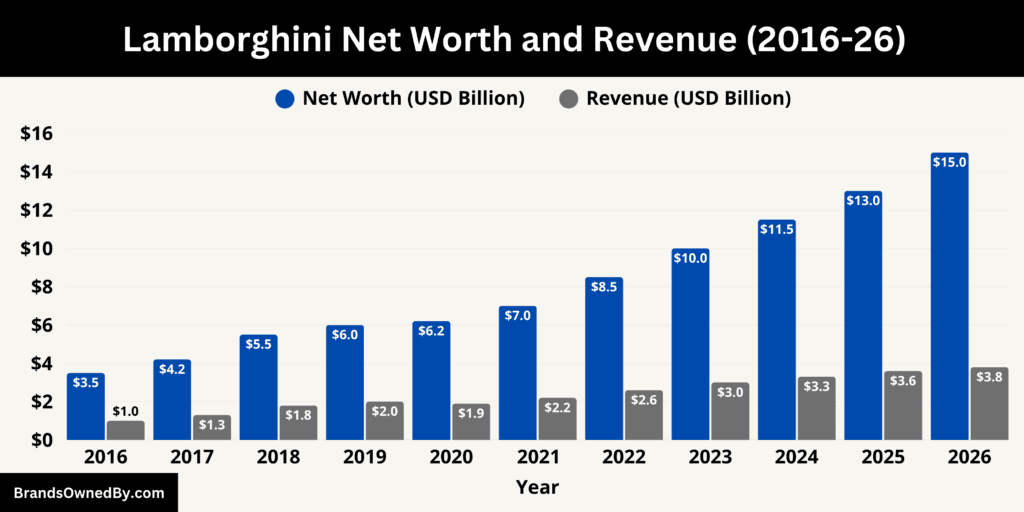
Lamborghini has entered its strongest financial phase as of April 2026. The company has crossed €3.2 billion ($3.7 billion) in annual revenue, with estimated brand valuation (net worth) now ranging between $14 billion and $16 billion. This growth reflects a decade-long transformation driven by product expansion, pricing power, and integration within Volkswagen Group.
2026 Revenue and Net Worth
As of April 2026, Lamborghini’s estimated full-year revenue is projected between €3.3 billion and €3.5 billion ($3.8B–$4.0B). This projection is based on 2025 performance and continued demand momentum.
In 2025, Lamborghini generated approximately €3.197 billion in revenue, marking steady growth from €3.09 billion in 2024.
The company delivered 10,747 vehicles in 2025, its highest ever, which directly contributed to revenue expansion.
Net worth is not officially disclosed because Lamborghini is not publicly listed. However, based on profit margins, brand strength, and comparable luxury valuations, analysts estimate Lamborghini’s enterprise value between $14 billion and $16 billion in 2026.
This valuation reflects three core drivers. First is pricing power, where average selling prices exceed $300,000 per vehicle. Second is high operating margins, which remain above 20%. Third is strong brand equity in the ultra-luxury segment.
Revenue Breakdown and Business Drivers
Lamborghini’s revenue is highly concentrated but strategically diversified across key segments.
The largest portion of revenue comes from vehicle sales, particularly models like the Revuelto, Huracán, and Urus. The Urus SUV alone has been a major growth engine, significantly increasing volume without diluting brand exclusivity.
Geographically, revenue is distributed across three major regions. The United States remains the largest market, contributing roughly 30% of total sales. Europe and the Middle East form the second major cluster, followed by Asia-Pacific markets including China and Japan.
Another important component is customization and personalization. Lamborghini generates additional revenue through bespoke options, limited editions, and special configurations. These high-margin add-ons significantly increase per-unit profitability.
The company also benefits from motorsport and brand extensions, although these contribute a smaller share compared to vehicle sales.
Profitability and Margin Structure
Lamborghini operates with one of the highest margins in the automotive industry.
In 2024, the company reported an operating income of €835 million on €3.09 billion revenue, translating to margins above 25%.
In 2025, operating profit slightly declined to €768 million, primarily due to external pressures like tariffs and strategic adjustments. However, margins remained strong at around 24%.
This profitability is driven by limited production, premium pricing, and strong demand. Lamborghini does not compete on volume. It competes on exclusivity and brand value.
Growth Evolution (2016–2026)
From 2016 to 2026, Lamborghini has nearly quadrupled its revenue.
In 2016, revenue was close to $1 billion. By 2024, it crossed €3 billion for the first time.
The turning point came in 2018 with the launch of the Urus. This expanded Lamborghini into the luxury SUV market. It increased production capacity and broadened the customer base.
From 2021 onward, growth accelerated further due to strong global demand and the introduction of hybrid models. The shift toward electrification, particularly plug-in hybrid systems, has positioned Lamborghini for long-term regulatory compliance while maintaining performance.
Net Worth and Brand Valuation Insights
The net worth of Lamborghini is not officially disclosed because it operates as a wholly owned subsidiary of Audi within Volkswagen Group. However, its valuation can be estimated using a combination of financial performance, margin structure, and comparable luxury automotive benchmarks.
As of April 2026, Lamborghini’s estimated valuation ranges between $14 billion and $16 billion, with some aggressive analyst models pushing it closer to $18 billion under premium brand multiples. This valuation is not arbitrary. It is derived from a structured approach using EBITDA multiples, brand strength indices, and peer comparison with companies like Ferrari.
Ferrari trades at significantly higher valuation multiples, often exceeding 20x EBITDA, due to its positioning as a luxury goods company rather than a traditional automaker. Lamborghini, while not publicly traded, operates on a similar high-margin, low-volume model. However, its integration within Volkswagen Group slightly compresses its standalone multiple due to shared platforms and industrial dependencies.
A more grounded valuation approach places Lamborghini in the 12x–16x EBITDA range. With estimated operating profits between €750 million and €850 million, this directly supports a multi-billion-dollar valuation in the $14B–$16B range.
Another critical driver of Lamborghini’s net worth is its pricing power and revenue per unit. With average vehicle prices exceeding $300,000, and many customized builds crossing $500,000, Lamborghini generates significantly higher revenue per customer compared to mass-market brands. This supports strong margins and premium valuation positioning.
Brand equity also plays a major role. Lamborghini is consistently ranked among the most recognizable luxury automotive brands globally. Its association with exclusivity, performance, and design allows it to maintain waiting lists for key models. This demand-supply imbalance directly increases intangible brand value.
Additionally, Lamborghini’s strategic importance within Volkswagen Group enhances its valuation. It acts as a halo brand, elevating the group’s image in the ultra-luxury segment. This indirect value is not captured in revenue alone but is factored into internal group-level importance.
As of 2026, Lamborghini’s valuation reflects a hybrid identity. It is part industrial asset, part luxury brand, and part technological flagship. This combination is what supports its strong and steadily rising net worth.
Future Revenue Forecast (2026–2030)
Lamborghini’s revenue outlook is closely tied to three structural drivers: hybridization of its entire lineup, controlled production expansion, and sustained demand in high-net-worth customer segments.
The company is transitioning from traditional internal combustion engines to plug-in hybrid architectures, starting with models like the Revuelto and upcoming replacements for the Huracán. This transition is expected to increase average selling prices due to higher technology content and regulatory compliance costs, while also preserving performance benchmarks.
Another key factor is production scaling without mass dilution. Lamborghini is not pursuing volume growth in the traditional sense. Instead, it is selectively increasing output while maintaining exclusivity. Annual deliveries are expected to move gradually from around 10,000–11,000 units toward 13,000–15,000 units by 2030, without entering mass production territory.
Geographically, growth will continue to be driven by the United States, Middle East, and emerging ultra-wealth segments in Asia. China remains a complex but important market due to regulatory shifts and evolving luxury demand.
The forecast below reflects a realistic growth trajectory based on current order books, product pipeline, and pricing trends:
- 2026: $3.8B–$4.0B driven by full-year impact of hybrid flagship models and strong Urus demand
- 2027: $4.2B–$4.5B supported by next-generation entry-level supercar replacement and higher customization revenue
- 2028: $4.6B–$5.0B as hybrid lineup stabilizes and pricing increases across all models
- 2029: $5.0B–$5.5B driven by limited editions, one-off programs, and expanded personalization programs
- 2030: $5.5B–$6.0B supported by a fully hybrid portfolio and mature global demand base.
A key structural shift in this forecast is revenue quality, not just revenue size. Lamborghini is expected to increase revenue per vehicle rather than purely increasing unit sales. Customization, special editions, and exclusive client programs will contribute a larger share of total revenue.
By 2030, Lamborghini is projected to remain a low-volume, ultra-high-margin manufacturer, with operating margins expected to stay above 22%–25%. Its financial model will continue to prioritize exclusivity, brand equity, and profitability over aggressive expansion.
Brands Owned by Lamborghini
As of April 2026, Lamborghini owns and operates several key entities and brand extensions that support its global operations, innovation pipeline, and brand equity. These are not separate public companies but structured divisions and controlled entities within Automobili Lamborghini S.p.A.
| Entity / Division | Type | Core Function | Key Responsibilities | Strategic Importance |
|---|---|---|---|---|
| Automobili Lamborghini S.p.A. | Core Company | Manufacturing & Global Operations | Vehicle design, engineering, production, global sales, dealer network management | Primary revenue generator and central operational backbone |
| Lamborghini Squadra Corse | Motorsport Division | Racing & Performance Development | Development of GT3 and Super Trofeo race cars, motorsport participation, customer racing programs | Drives performance innovation and strengthens brand credibility in motorsports |
| Lamborghini Polo Storico | Heritage Division | Classic Car Restoration & Certification | Restoration of vintage models, authenticity certification, archival documentation | Preserves brand legacy and supports long-term brand value |
| Lamborghini Centro Stile | Design Division | Design & Innovation | Exterior and interior design, concept development, design language evolution | Maintains Lamborghini’s distinct visual identity and future design direction |
| Lamborghini Ad Personam | Customization Division | Personalization & Bespoke Services | Custom builds, materials selection, exclusive configurations for clients | Increases revenue per vehicle and enhances customer exclusivity |
| Lamborghini Accademia | Driving Program | Driver Training | High-performance driving education and training programs | Builds customer engagement and enhances driving experience |
| Lamborghini Esperienza | Experience Program | Brand Experience & Events | Global driving tours, track events, lifestyle experiences | Strengthens customer loyalty and luxury brand positioning |
| Lamborghini Financial Services | Financial Operations | Financing & Leasing Support | Vehicle financing, leasing, and insurance (market-specific) | Facilitates purchases and expands accessibility in key markets |
| Lamborghini Licensing Division | Brand Extension | Merchandise & Partnerships | Apparel, accessories, licensing deals, brand collaborations | Expands brand into lifestyle segment and increases global visibility |
Automobili Lamborghini S.p.A.
This is the main legal and operational entity of Lamborghini. It is responsible for all core business functions including vehicle design, engineering, manufacturing, and global distribution.
The company operates from its headquarters in Sant’Agata Bolognese, Italy. All flagship models such as the Revuelto, Huracán successor, and Urus are developed and produced under this entity.
It also manages Lamborghini’s global dealer network, customer relations, and international market expansion. This entity is the backbone of Lamborghini’s revenue generation and brand positioning.
Lamborghini Squadra Corse
Lamborghini Squadra Corse is the official motorsport division. It is responsible for all racing activities and performance programs.
This division develops race cars such as the Huracán GT3 and Super Trofeo models. It also manages Lamborghini’s participation in global racing championships.
Squadra Corse plays a strategic role beyond racing. It acts as a testing ground for performance technologies that later influence road cars. It also strengthens Lamborghini’s brand among performance enthusiasts and professional drivers.
In addition, it runs exclusive customer racing programs. These programs allow high-net-worth clients to participate in track events using factory-supported race cars.
Lamborghini Polo Storico
Lamborghini Polo Storico is the heritage and restoration division. It focuses on preserving the brand’s legacy and historical vehicles.
This division handles restoration of classic Lamborghini models such as the Miura, Countach, and Diablo. It also provides certification services to verify authenticity.
Polo Storico plays a key role in maintaining Lamborghini’s long-term brand value. Classic cars are an important part of the luxury ecosystem, and this division ensures their historical accuracy and market credibility.
It also supports collectors by maintaining original specifications, documentation, and archival records.
Lamborghini Centro Stile
Lamborghini Centro Stile is the in-house design studio. It is responsible for the visual identity and design language of all Lamborghini vehicles.
This division defines exterior styling, interior design, and concept development. It ensures that every Lamborghini maintains a consistent yet evolving design philosophy.
Centro Stile operates independently within the company. This allows Lamborghini to retain creative control over its products without external design influence.
The studio also works on concept cars and future design direction, making it central to Lamborghini’s innovation pipeline.
Lamborghini Ad Personam
Ad Personam is Lamborghini’s personalization division. It allows customers to customize their vehicles extensively.
Clients can choose from a wide range of colors, materials, finishes, and bespoke features. In many cases, vehicles are built to unique specifications tailored to individual buyers.
This division significantly increases revenue per vehicle. Customization packages can add substantial value beyond the base price.
Ad Personam also strengthens customer engagement. It transforms the buying process into a luxury experience, reinforcing exclusivity and brand loyalty.
Lamborghini Accademia and Esperienza Programs
These are official driving and customer experience programs operated by Lamborghini.
Accademia focuses on driver training. It offers structured programs that teach high-performance driving techniques using Lamborghini vehicles.
Esperienza programs provide immersive brand experiences. These include track events, road tours, and global driving events organized for Lamborghini clients.
These programs are not direct revenue drivers at the same scale as vehicle sales. However, they play a critical role in customer retention, brand engagement, and lifestyle positioning.
Lamborghini Financial Services
In selected markets, Lamborghini operates financial services in collaboration with partners. These services support vehicle financing, leasing, and insurance solutions.
While not always structured as a standalone global company, these operations are essential for enabling purchases in key markets.
They also align Lamborghini with modern luxury purchasing behavior, where financing plays a role even among high-net-worth buyers.
Lamborghini Licensing and Merchandise Division
Lamborghini operates a licensing arm that manages branded merchandise and collaborations.
This includes apparel, accessories, and lifestyle products sold under the Lamborghini brand. It also manages partnerships with other luxury and consumer brands.
This division extends Lamborghini beyond automobiles. It positions the brand as a lifestyle symbol and increases global visibility.
Final Words
Lamborghini is not owned by an individual. It is part of a powerful corporate structure. Audi owns Lamborghini, while Volkswagen Group sits above Audi. Porsche SE holds the controlling stake in Volkswagen.
This layered ownership has helped Lamborghini grow into a global luxury powerhouse. It combines Italian design with German engineering and financial strength.
FAQs
Is Lamborghini owned by Volkswagen?
Yes, Lamborghini is indirectly owned by Volkswagen Group. It is directly owned by Audi, which is a subsidiary of Volkswagen Group.
Who owns Lamborghini car company?
The Lamborghini car company is owned by Audi. Audi itself is part of Volkswagen Group, making Volkswagen the ultimate parent company behind Lamborghini.
Who makes Lamborghini engines?
Lamborghini designs and manufactures its own engines in-house at its facility in Sant’Agata Bolognese. However, it benefits from engineering collaboration and technology sharing within Volkswagen Group, especially for hybrid systems.
Who owns Lamborghini tractors?
Lamborghini tractors are not owned by the car company. They are owned by SDF Group (Same Deutz-Fahr). This business is separate from the Lamborghini automobile brand.
Who owns Lamborghini Veneno?
The Lamborghini Veneno is owned by private collectors. Only a few units were produced, and each is owned by individual buyers, typically ultra-high-net-worth individuals.
Where are Lamborghinis made?
Lamborghinis are manufactured in Sant’Agata Bolognese, Italy. This is the company’s main production facility where all core models are built.
Where is Lamborghini located?
Lamborghini is headquartered in Sant’Agata Bolognese, a town in northern Italy. This location has been the brand’s home since its founding.
Is Bugatti owned by Lamborghini?
No, Bugatti is not owned by Lamborghini. It is part of Bugatti-Rimac, a joint venture involving Rimac Group and Porsche.
Does Volkswagen own 100% of Lamborghini?
Volkswagen Group effectively owns 100% of Lamborghini through Audi. There are no public shareholders at the Lamborghini level.
Why did Ferruccio sell Lamborghini?
Ferruccio Lamborghini sold Lamborghini due to financial difficulties. The oil crisis and problems in his tractor business reduced his ability to support the car company.
Who owned Lamborghini before Volkswagen?
Before Volkswagen Group, Lamborghini was owned by several entities over time. These included Chrysler, Indonesian investors led by Tommy Suharto, and earlier private investors after Ferruccio Lamborghini exited the business.