

- The Clorox Company is publicly owned, with institutional investors holding about 63.93% of shares and retail/public investors owning around 34.68%, while insiders hold a small 1.39% stake.
- The largest shareholders are The Vanguard Group (12.9%), BlackRock (8.5%), and State Street Corporation (7.0%), together controlling a significant voting bloc.
- Despite concentrated institutional ownership, no single shareholder has controlling power, making Clorox a widely held company governed through collective shareholder voting.
- Control is exercised through a professional governance structure, where management runs operations, the board oversees strategy, and major shareholders influence decisions through voting rights.
The Clorox Company is a global manufacturer of household and lifestyle products, headquartered in Oakland, California. The company operates across more than 100 countries and focuses on everyday consumer essentials such as cleaning, disinfecting, food products, and personal care items.
Its business model is built around strong, recognizable brands that generate repeat demand. Clorox organizes its operations into segments like Health and Wellness, Household, Lifestyle, and International. Each segment serves a specific category, ranging from disinfecting products to grilling and natural skincare.
The company is widely associated with hygiene and sanitation. Its products play a critical role in homes, workplaces, and healthcare environments. Over time, Clorox has positioned itself as a brand-led company, focusing on innovation, sustainability, and consumer trust rather than diversification into unrelated industries.
In recent developments as of early 2026, Clorox has continued expanding its portfolio through strategic acquisitions, including a major agreement to acquire Gojo Industries, the maker of Purell. This reflects its ongoing focus on hygiene and health-related categories.
Founders of The Clorox Company
The Clorox Company was founded in 1913 by five entrepreneurs: Archibald Taft, Edward Hughes, Charles Husband, Rufus Myers, and William Hussey.
They established the business under the original name Electro-Alkaline Company. Their goal was to produce liquid bleach at a commercial scale using an electrolytic process that converted brine into sodium hypochlorite.
Each founder invested a small amount of capital. Despite limited resources, they built the first commercial liquid bleach operation in the United States.
Interestingly, only one of the founders had technical knowledge of chemistry. The others came from diverse professional backgrounds such as banking, mining, bookkeeping, and law. This mix of skills helped the company balance technical production with business execution.
In its early years, the company struggled to gain traction. Liquid bleach was not widely understood by consumers. The turning point came when early investor William Murray and his wife Annie Murray helped reposition the product for household use. Their marketing efforts created demand and set the foundation for long-term growth.
The company later adopted the name “Clorox,” derived from chlorine and sodium hydroxide, the key ingredients in its bleach. This rebranding helped establish a strong identity that continues to define the company today.
Ownership History
The ownership history of The Clorox Company reflects its transformation from a small, founder-led business into a widely held public corporation. Over more than a century, its ownership has shifted through key phases shaped by expansion, regulation, and capital markets.
Early Founder Ownership (1913–1920s)
When Clorox was founded in 1913, ownership was concentrated among its five founders—Archibald Taft, Edward Hughes, Charles Husband, Rufus Myers, and William Hussey.
At this stage, the company operated as a closely held business. Each founder contributed capital and played a role in operations. However, the company faced financial and operational challenges in its early years. Demand for liquid bleach was limited, and production costs were high.
Ownership began to shift when additional investors entered the business to stabilize operations and support growth. This marked the first dilution of founder control.
Transition to Broader Ownership (1920s–1940s)
During the 1920s, Clorox expanded its product reach from industrial use to household cleaning. This shift increased demand and required more capital for production and distribution.
As a result, ownership gradually became more dispersed. Early investors and stakeholders acquired shares, reducing the founders’ direct control. The company also strengthened its brand identity during this period, laying the groundwork for future institutional interest.
By the 1940s, Clorox had evolved into a recognized consumer brand, making it attractive to larger corporations.
Acquisition by Procter & Gamble (1950s–1967)
A major turning point came when Procter & Gamble acquired a controlling stake in Clorox in the 1950s. This acquisition placed Clorox under the ownership of one of the largest consumer goods companies in the world.
Under P&G, Clorox benefited from advanced marketing, distribution networks, and operational expertise. However, the acquisition raised serious antitrust concerns in the United States. Regulators argued that P&G’s ownership reduced competition in the household cleaning market.
This led to a landmark legal battle.
Antitrust Case and Forced Divestiture (1967)
In 1967, the U.S. Supreme Court ruled against P&G in the case of FTC v. Procter & Gamble Co.. The court concluded that the acquisition violated antitrust laws by limiting competition.
As a result, P&G was forced to divest Clorox. This decision returned Clorox to independent ownership and marked a defining moment in its history.
Following the divestiture, Clorox shares were redistributed to public investors. This effectively transformed the company into a widely held public entity.
Emergence as a Publicly Traded Company (1970s–2000s)
After regaining independence, Clorox established itself as a publicly traded company listed on the New York Stock Exchange. Ownership became increasingly distributed among institutional investors, mutual funds, and individual shareholders.
During this period, no single shareholder held a controlling stake. Instead, ownership was fragmented. This structure allowed professional management to take control of operations while remaining accountable to shareholders.
Clorox also expanded through acquisitions and brand development, which attracted long-term institutional investors.
Modern Institutional Ownership (2010s–2026)
As of 2026, Clorox is primarily owned by large institutional investors. Asset management firms such as The Vanguard Group, BlackRock, and State Street Corporation hold significant stakes through index funds and ETFs.
This type of ownership reflects modern capital markets. Passive investment strategies dominate, and shares are widely distributed across global investors.
Importantly, no single entity controls Clorox. Ownership is decentralized. Control is exercised through shareholder voting, board governance, and executive leadership.
This evolution—from founder ownership to institutional dominance—has shaped Clorox into a stable, professionally managed global company.
Who Owns The Clorox Company: Major Shareholders
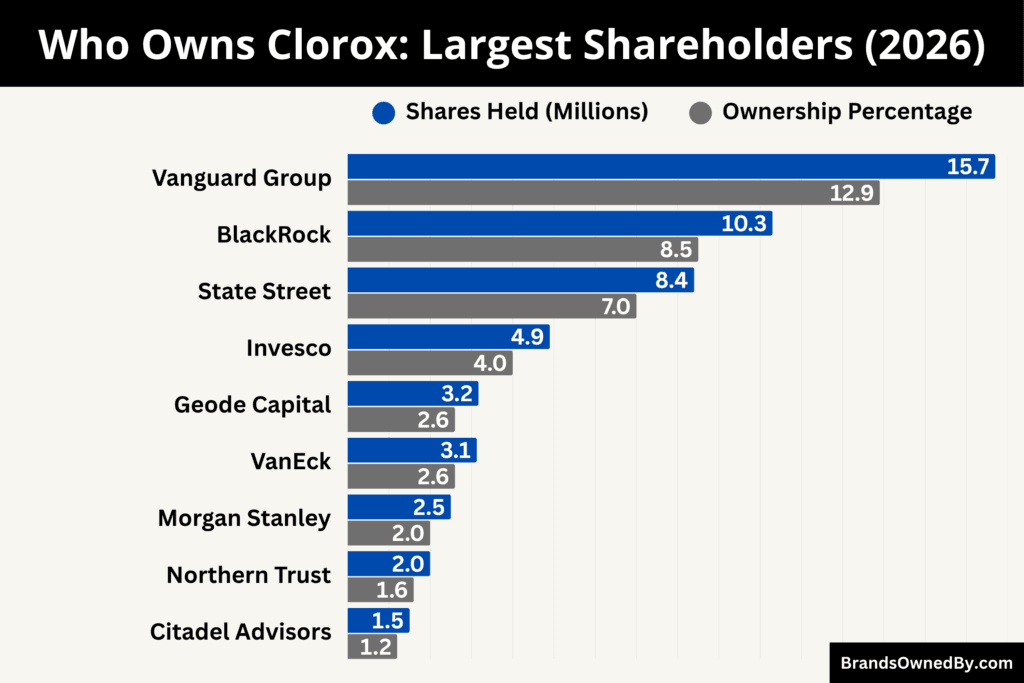
The Clorox Company is a public company reflecting a highly institutionalized structure typical of large U.S. consumer goods corporations. As of March 2026, the company is widely held, with no single shareholder exercising outright control. Instead, ownership is concentrated among a small group of powerful asset managers, supported by hundreds of smaller institutional investors and millions of retail shareholders.
Institutional investors collectively hold approximately 63.93% of total shares. Retail investors account for about 34.68%, while insiders own close to 1.39%. This distribution creates a balanced but influence-heavy system, where large institutions shape governance through voting power, while management retains operational control.
What stands out in Clorox’s ownership is the dominance of passive investment firms. These firms do not actively run the business, but their large shareholdings give them significant influence over board composition, executive compensation, ESG policies, and long-term strategic direction.
Below is a detailed overview of the major shareholders of Clorox as of March 2026:
The Vanguard Group
The Vanguard Group is the largest shareholder of Clorox, holding approximately 15.7 million shares. This stake represents about 12.9% of the company, making Vanguard the most influential single investor.
Vanguard’s ownership is primarily held through its index funds and exchange-traded funds, especially those tracking broad market indices like the S&P 500. Because of its passive investment strategy, Vanguard does not engage in day-to-day decision-making or operational management. However, its role in corporate governance is substantial.
With nearly 16 million shares, Vanguard has a decisive say in shareholder votes. It plays a critical role in electing board members, approving executive compensation packages, and influencing major corporate policies. Its voting decisions are often aligned with long-term value creation, risk management, and governance standards.
Despite being a passive investor, Vanguard’s sheer scale makes it one of the most powerful stakeholders in Clorox’s ownership structure.
BlackRock
BlackRock holds approximately 10.3 million shares of Clorox, representing about 8.5% ownership. This makes it the second-largest shareholder and a key pillar of institutional control.
BlackRock’s stake is distributed across its iShares ETFs, index funds, and actively managed portfolios. While a large portion of its holdings is passive, BlackRock is known for taking a more active approach to governance compared to other index fund managers.
The firm regularly engages with company leadership on issues such as sustainability, operational efficiency, and long-term strategy. Its voting power, combined with its global influence, allows it to shape important corporate decisions.
When BlackRock’s votes align with those of Vanguard and State Street, they effectively create a dominant voting bloc. This coalition can influence major outcomes at shareholder meetings, even without direct control.
State Street Corporation
State Street Corporation owns approximately 8.4 million shares, giving it about 7.0% ownership in Clorox. It is the third-largest shareholder and completes the “big three” institutional investors.
State Street’s holdings are primarily tied to its SPDR ETF products and institutional investment mandates. Like Vanguard, it follows a passive investment approach. However, it remains highly active in governance matters.
State Street places strong emphasis on board accountability, diversity, and long-term performance. It frequently uses its voting rights to push for governance improvements and transparency.
Together, Vanguard, BlackRock, and State Street control a significant portion of Clorox’s shares. Their combined holdings exceed 34 million shares, forming the most influential ownership group in the company.
Invesco Ltd.
Invesco holds approximately 4.9 million shares of Clorox, making it one of the largest active investment managers in the shareholder base.
Unlike the top three shareholders, Invesco operates a mix of active and passive funds. This means its investment decisions may change based on market conditions, company performance, and portfolio strategy.
Invesco’s stake provides an additional layer of oversight, as active managers tend to evaluate company performance more critically. The firm may increase or reduce its holdings depending on Clorox’s growth prospects and operational execution.
Its presence also signals institutional confidence in Clorox’s long-term value within the consumer staples sector.
Geode Capital Management
Geode Capital Management owns approximately 3.17 million shares, representing about 2.6% of Clorox.
Geode is a quantitative asset manager that often works behind the scenes. It manages assets linked to index strategies and institutional portfolios, including those associated with Vanguard.
Although it does not actively engage in corporate strategy, its consistent ownership reflects long-term investment stability. Geode’s role is important in maintaining liquidity and supporting the broader institutional ownership base.
Its stake, while smaller, contributes to the overall dominance of passive investment firms in Clorox’s ownership structure.
VanEck Associates Corporation
VanEck holds approximately 3.13 million shares of Clorox. The firm is known for its thematic and sector-focused investment strategies.
VanEck’s investment in Clorox reflects confidence in defensive sectors like consumer staples. These sectors tend to perform well during economic uncertainty, making Clorox an attractive long-term holding.
Unlike purely passive investors, VanEck often builds positions based on macroeconomic trends and sector outlooks. This adds diversity to Clorox’s shareholder base and introduces a more strategic investment perspective.
Morgan Stanley
Morgan Stanley is a notable institutional shareholder with holdings spread across wealth management accounts, mutual funds, and institutional portfolios.
Its investment in Clorox is typically part of diversified portfolios designed for clients seeking stable, dividend-paying companies. While its individual stake is smaller compared to top shareholders, its influence comes from its role as a major financial intermediary.
Morgan Stanley also contributes to market liquidity and trading activity, helping maintain active participation in Clorox’s stock.
Northern Trust Corporation
Northern Trust holds shares primarily on behalf of institutional clients such as pension funds, endowments, and asset managers.
Its role is largely custodial and fiduciary. It ensures that client assets are invested in stable and reliable companies like Clorox.
Although it does not actively influence strategy, its presence reinforces the institutional nature of Clorox’s ownership.
Citadel Advisors
Citadel Advisors represents the hedge fund segment of Clorox’s ownership. Unlike passive investors, hedge funds may take more dynamic positions based on short-term opportunities.
Citadel’s involvement adds a layer of market activity and price discovery. While its stake is not large enough to control decisions, hedge funds can influence market sentiment and occasionally advocate for changes.
Arrowstreet Capital
Arrowstreet Capital is a quantitative investment firm with global exposure. Its stake in Clorox reflects international institutional interest in the company.
The firm uses data-driven strategies to allocate capital across global equities. Its investment in Clorox highlights the company’s appeal as a stable, defensive asset within global portfolios.
Insider Ownership
Insiders, including executives and board members, collectively hold approximately 1.39% of Clorox shares. This translates into a relatively small number of shares compared to institutional holdings.
This low insider ownership is common in large public companies. It ensures that management decisions are guided by professional governance rather than concentrated ownership.
However, insiders still play a crucial role in shaping strategy, as they are directly responsible for executing the company’s vision.
Retail Investors
Retail investors collectively hold approximately 34.68% of Clorox shares. This includes individual investors, retirement accounts, and small-scale funds.
While each investor holds a small number of shares, together they represent a significant ownership block. Retail participation adds liquidity and broadens the shareholder base.
However, unlike institutional investors, retail shareholders have limited coordinated influence over corporate decisions.
Competitor Ownership Comparison
To fully understand who owns The Clorox Company, it is essential to compare its ownership structure with its closest competitors. While most large consumer goods companies are publicly traded and institutionally owned, the degree of concentration, geographic spread, and control mechanisms differ significantly.
Clorox itself is heavily concentrated among a few large U.S. institutional investors such as The Vanguard Group, BlackRock, and State Street Corporation, which together hold tens of millions of shares.
Procter & Gamble Ownership Structure
Procter & Gamble has a very similar institutional ownership model to Clorox, but at a much larger scale.
As of late 2025 filings, institutional investors own about 70% of P&G shares. The largest shareholders include Vanguard with over 237 million shares (10.22%), BlackRock with around 184 million shares (7.92%), and State Street with over 100 million shares (4.31%).
This shows a key difference from Clorox:
- P&G has far more dispersed ownership in absolute terms due to its size
- Even its largest shareholder holds a smaller percentage compared to Clorox’s top holder.
Another important distinction is scale-driven diversification. P&G’s shareholder base includes a broader mix of global institutions, pension funds, and sovereign investors. This reduces concentration risk and dilutes the relative power of any single investor.
In contrast, Clorox’s ownership is more concentrated. Its top three investors hold a larger combined percentage, giving them a stronger coordinated influence.
Unilever Ownership Structure
Unilever operates with a more globally diversified shareholder base compared to Clorox.
Unilever is listed in multiple markets and attracts a high proportion of European institutional investors, sovereign wealth funds, and global asset managers. Like Clorox, its largest shareholders still include Vanguard and BlackRock, but ownership is more geographically distributed.
The key structural differences are:
- Higher international ownership exposure
- Strong presence of European pension funds and long-term investors
- Broader regulatory and governance influences.
This global mix creates a more diversified governance environment. Decision-making often reflects international priorities such as sustainability regulations and regional market dynamics.
Clorox, on the other hand, is heavily U.S.-centric in ownership. This results in a more unified governance approach, but less geographic diversity in shareholder influence.
Reckitt Ownership Structure
Reckitt follows a structure closer to Unilever than Clorox.
Reckitt is publicly traded in the UK and has a globally distributed institutional investor base. Major shareholders include global asset managers, but European institutions hold a larger share compared to U.S.-focused companies.
Key differences compared to Clorox:
- Greater European institutional dominance
- Stronger influence from long-term pension funds
- Less concentration among a small group of U.S. asset managers.
This results in a governance model that emphasizes long-term sustainability, regulatory compliance, and international expansion.
Clorox’s ownership, by contrast, is more concentrated and dominated by U.S. index funds, which prioritize efficiency, returns, and shareholder value.
Colgate-Palmolive Ownership Structure
Colgate-Palmolive is one of the closest ownership matches to Clorox.
Like Clorox, Colgate is heavily owned by institutional investors, with Vanguard, BlackRock, and State Street consistently appearing as top shareholders.
The similarities include:
- Strong dominance of U.S.-based institutional investors
- High ownership through index funds and ETFs
- Low insider ownership.
However, Colgate differs slightly in that it has a more globally diversified revenue base, which attracts a broader international investor pool.
Overall, Clorox and Colgate share nearly identical governance models. Both are driven by institutional capital with no controlling shareholder.
Henkel Ownership Structure
Henkel represents a fundamentally different ownership model.
Unlike Clorox, Henkel is partially family controlled. The Henkel family holds a significant portion of voting rights through a shareholder pool, giving them long-term strategic control.
This creates a hybrid structure:
- Publicly traded shares provide market liquidity
- Family ownership ensures stable, long-term control.
This is a major contrast to Clorox, where:
- No founder or family retains control
- All ownership is market-driven
- Control is exercised collectively by institutions.
Henkel’s model allows for long-term decision-making without heavy pressure from short-term market expectations. Clorox, in comparison, must balance multiple institutional interests.
Key Comparative Insights
Across all competitors, a few clear patterns emerge:
- Institutional dominance is universal across global consumer goods companies
- The “Big Three” (Vanguard, BlackRock, State Street) are major shareholders in almost every company
- Differences arise in concentration vs diversification.
Clorox stands out in three ways:
- Higher ownership concentration among top U.S. institutions
- Lower geographic diversity in shareholders
- No controlling shareholder or family influence.
Strategic Implications of Ownership Differences
Ownership structure directly shapes how companies operate and make decisions.
Clorox’s concentrated institutional ownership leads to:
- Strong governance discipline
- High accountability to shareholders
- Focus on efficiency, margins, and capital returns.
Competitors like Unilever and Reckitt operate under more globally diverse ownership. This introduces broader perspectives but can slow decision-making.
Companies like Henkel benefit from family control, allowing long-term strategic consistency but limiting shareholder influence.
In practical terms, Clorox sits between these models. It combines institutional efficiency with distributed control, making it highly responsive to shareholder expectations while maintaining operational independence.
Who Controls The Clorox Company?
Control of The Clorox Company is defined by governance structure rather than ownership concentration. As of 2026, the company operates under a dispersed ownership model with centralized managerial control. No shareholder has controlling power. Instead, authority is distributed across executive leadership, the board of directors, and institutional shareholders through formal governance mechanisms.
CEO and Executive Management Authority
The highest level of operational control sits with the CEO, Linda Rendle, who also serves as Chair of the Board. This dual role consolidates strategic and governance influence at the top.
The CEO has direct authority over:
- Corporate strategy and long-term planning
- Capital allocation and investment decisions
- Global operations and supply chain execution
- Brand portfolio management and innovation
- Senior executive appointments.
The executive leadership team reports to the CEO and executes decisions across Clorox’s business segments. This structure ensures centralized decision-making with clear accountability.
Board Structure and Governance Power
The board of directors is the primary governing body overseeing management. It is composed of independent directors along with the CEO.
The board operates through key committees, including:
- Audit Committee (financial oversight and risk control)
- Compensation Committee (executive pay and incentives)
- Governance Committee (board structure and policies).
Its authority includes:
- Approving major acquisitions, divestitures, and strategic initiatives
- Monitoring financial performance and risk exposure
- Evaluating CEO performance and leadership effectiveness
- Setting governance standards and compliance frameworks.
Because Clorox has no controlling shareholder, the board plays a critical role in balancing management power and protecting shareholder interests.
Shareholder Voting Power and Control Mechanism
Control at Clorox is heavily influenced through shareholder voting rights. Each share carries voting power, meaning large institutional investors have significant influence.
Key decisions subject to shareholder voting include:
- Election of directors
- Approval of executive compensation (“say-on-pay”)
- Major corporate actions and policy changes.
The largest shareholders—The Vanguard Group, BlackRock, and State Street Corporation—collectively hold tens of millions of shares. When these firms align, they can effectively determine voting outcomes.
However, they do not manage operations. Their control is indirect and exercised through governance rather than execution.
Combined Institutional Influence (“Big Three Effect”)
A defining feature of Clorox’s control structure is the influence of the “Big Three” asset managers:
- The Vanguard Group
- BlackRock
- State Street Corporation.
Together, they represent the largest voting bloc in the company. Their combined ownership gives them the ability to:
- Influence board composition
- Shape governance policies
- Push for ESG and sustainability initiatives
- Impact executive compensation structures.
While each firm acts independently, their voting patterns often align on governance standards. This creates a powerful, though decentralized, control mechanism.
Absence of Founder or Family Control
Unlike some competitors, Clorox has no founder, family, or insider group controlling voting rights. Insider ownership remains very low, at around 1.39%.
This has several implications:
- No individual can override board or shareholder decisions
- Control is entirely market-driven
- Leadership is accountable to shareholders rather than a controlling entity.
This structure increases transparency and governance discipline but also places greater pressure on management to deliver consistent performance.
Control Through Corporate Governance Framework
Clorox operates under a formal corporate governance system designed to distribute control efficiently.
Key elements include:
- One-share, one-vote structure ensuring proportional influence
- Independent board majority to reduce management bias
- Regular shareholder meetings and proxy voting
- Strong disclosure and compliance requirements.
This framework ensures that control is not concentrated but instead exercised through structured processes.
Clorox Annual Revenue and Net Worth
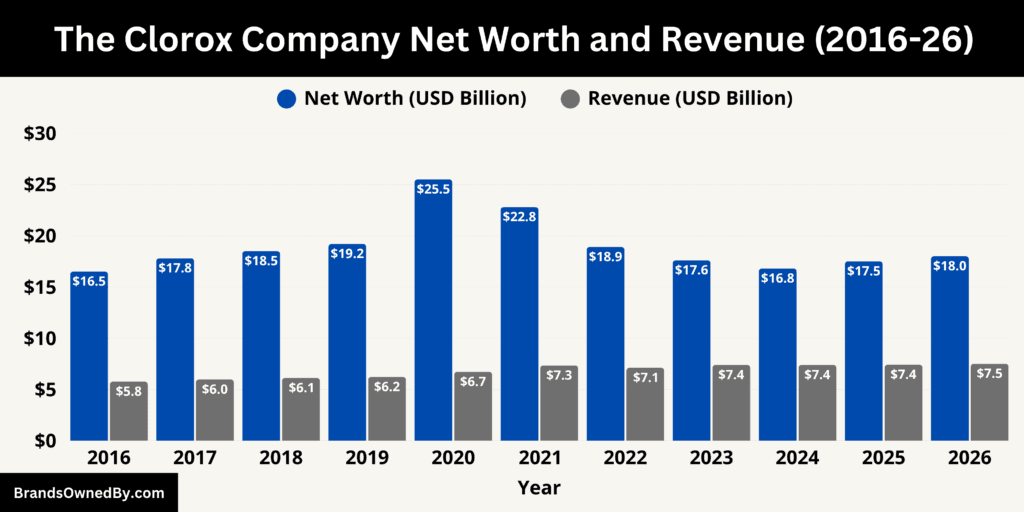
As of March 2026, The Clorox Company operates with $7.5 billion in annual revenue and an estimated $18.0 billion market capitalization. These figures reflect a normalized post-pandemic operating environment, where demand has stabilized, but structural pressures remain.
The 2026 financial profile is not driven by growth spikes. It is shaped by volume decline, pricing adjustments, and operational restructuring, particularly following the company’s ERP system transition and shifting consumer demand patterns.
2026 Revenue
The $7.5 billion revenue figure for 2026 must be understood in the context of real operating conditions during the year.
Clorox reported quarterly revenue of $1.67 billion in Q2 FY2026, showing a 1% year-over-year decline, primarily due to lower consumer demand and reduced shipment volumes.
Earlier in the fiscal year, Q1 revenue dropped to $1.43 billion, reflecting a 19% decline, largely caused by inventory corrections following the ERP system rollout.
This indicates that the full-year revenue of $7.5 billion is not growth-driven. Instead, it is the result of:
- Recovery from temporary supply chain and ERP disruptions
- Stabilization of shipment volumes after inventory drawdowns
- Continued pricing strategies to offset lower volume.
A critical factor affecting 2026 revenue is the ERP transition impact. In 2025, Clorox shipped excess inventory to retailers. In 2026, retailers reduced orders and consumed existing stock, leading to an artificial decline in shipments.
This created a temporary but significant revenue distortion across multiple quarters.
Segment-Level Revenue Breakdown
Clorox’s revenue in 2026 is distributed across four core segments, each showing different performance trends.
The Health and Wellness segment remains the largest contributor. In Q2 2026 alone, it generated approximately $643 million, supported by cleaning and professional products. However, growth is modest and tied to shipment timing rather than strong demand expansion.
The Household segment generated around $419 million in Q2 but declined by 6% year-over-year. This decline is driven by reduced consumption and unfavorable product mix, highlighting pressure from lower-cost alternatives.
The Lifestyle segment contributed about $321 million, declining by 5% due to lower consumer demand, especially in food and personal care categories.
The International segment is the only clear growth driver. It generated approximately $294 million, growing 7%, supported by pricing, currency effects, and volume growth in regions like Latin America.
This breakdown shows that Clorox’s 2026 revenue is not evenly strong across segments. Growth is selective and largely offset by declines in core U.S. categories.
Margin Pressure and Cost Structure Impact
Revenue alone does not reflect the full financial picture. Clorox is facing significant margin pressure in 2026.
Gross margin declined to 43.2%, down from 43.8% the previous year, mainly due to:
- Higher manufacturing costs
- Increased logistics expenses
- Lower operating leverage from reduced volumes.
At the same time, the company continues to invest heavily in:
- Digital transformation
- Productivity improvements
- Brand advertising.
These investments, while necessary, further compress short-term profitability.
2026 Net Worth and Market Valuation
Clorox’s estimated $18.0 billion market capitalization as of March 2026 reflects a company in transition rather than peak performance.
The valuation is influenced by:
- Slower revenue growth
- Earnings pressure due to cost inflation
- Temporary operational disruptions (ERP transition)
- Changing consumer behavior toward cheaper alternatives.
Market reaction to earnings confirms this trend. After its Q2 2026 results, Clorox stock declined as investors reacted to weaker earnings and ongoing demand softness.
Despite this, the company maintains a strong valuation because it operates in the defensive consumer staples sector, where demand remains relatively stable even during economic uncertainty.
Financial Position Interpretation
The 2026 financial data show a company in a rebalancing phase rather than growth mode.
Revenue of $7.5 billion reflects:
- Stable underlying demand for essential products
- Temporary declines caused by operational and inventory factors.
The $18.0 billion valuation reflects:
- Long-term confidence in brand strength
- Market expectations of a gradual recovery
- Recognition of Clorox as a defensive, cash-generating business.
This combination indicates that Clorox is transitioning toward efficiency-driven growth rather than volume-driven expansion.
Future Revenue Forecast (2027–2030)
Based on current performance trends, operational recovery, and market positioning, Clorox is expected to grow gradually over the next few years:
- 2027: $7.7 billion
- 2028: $8.0 billion
- 2029: $8.3 billion
- 2030: $8.7 billion
This forecast reflects a low-growth, high-stability trajectory, typical of mature consumer staples companies. Growth is expected to come from pricing, innovation, and international expansion rather than significant volume increases.
Companies Owned by Clorox
The portfolio of The Clorox Company as of 2026 is built around category leadership rather than diversification. The company focuses on a limited number of product categories where it holds strong market share, pricing power, and brand recognition.
Clorox operates through three core verticals: Cleaning & Professional Products, Household & Lifestyle, and Health & Wellness. Each brand within the portfolio is positioned to dominate a specific niche, ensuring recurring demand and high margins.
Below is a detailed breakdown of the major brands, subsidiaries, and operating entities owned by Clorox as of March 2026:
| Brand / Entity | Category | Core Products / Services | Strategic Role in Portfolio |
|---|---|---|---|
| Clorox | Cleaning & Disinfecting | Bleach, wipes, sprays, cleaners | Flagship brand. Category leader in disinfecting. Drives core revenue and brand identity. |
| CloroxPro | Professional / B2B | Commercial cleaning and sanitization solutions | Provides stable institutional revenue from hospitals, schools, and businesses. |
| Clorox Healthcare | Medical / Professional | Hospital-grade disinfectants | High-margin healthcare segment. Strong regulatory positioning and long-term growth driver. |
| Pine-Sol | Household Cleaning | Multi-surface cleaners | Legacy brand. Strong consumer loyalty in heavy-duty cleaning segment. |
| Formula 409 | Household Cleaning | Kitchen and surface cleaners | Functional brand focused on grease removal and everyday cleaning. |
| Tilex | Specialized Cleaning | Mold and mildew removers | Niche brand targeting bathroom and moisture-related cleaning needs. |
| Liquid-Plumr | Home Maintenance | Drain cleaners | Expands portfolio into plumbing solutions with high-margin problem-solving products. |
| Glad (JV) | Household Essentials | Trash bags, food storage | High-volume, recurring-use brand. Joint venture with Procter & Gamble. |
| Kingsford | Outdoor / Lifestyle | Charcoal, grilling products | Market leader in charcoal. Seasonal demand with strong pricing power. |
| Hidden Valley | Food & Lifestyle | Ranch dressing, sauces, dips | Leading U.S. food brand. Diversifies revenue beyond cleaning products. |
| Burt’s Bees | Personal Care | Skincare, lip care, beauty products | Premium natural brand. Strong growth potential in wellness and sustainability. |
| Brita | Water Filtration | Water filters, pitchers, cartridges | Recurring revenue model through filter replacements. Health-focused category. |
| Fresh Step | Pet Care | Cat litter | Premium pet hygiene brand. Strong recurring demand and odor control positioning. |
| Scoop Away | Pet Care | Cat litter | Value-focused brand complementing Fresh Step in pet hygiene segment. |
| Green Works | Eco-Friendly Cleaning | Plant-based cleaning products | Sustainability-focused brand targeting eco-conscious consumers. |
| RenewLife | Health & Wellness | Probiotics, digestive supplements | Entry into high-growth gut health and wellness category. |
| Rainbow Light | Health & Wellness | Vitamins and supplements | Complements RenewLife. Targets daily nutrition and wellness consumers. |
| Nutranext | Business Unit | Manages supplement brands | Strategic unit overseeing wellness portfolio and future growth expansion. |
| Clorox International | Global Operations | Regional product distribution | Drives international expansion and adapts brands to local markets. |
Clorox
The Clorox brand is the company’s core revenue driver and one of the most dominant disinfecting brands in North America. It includes liquid bleach, disinfecting wipes, sprays, and surface cleaners.
This brand is deeply embedded in both household and institutional cleaning routines. It is widely used in homes, hospitals, schools, and commercial facilities. The strength of Clorox lies in its dual-channel presence—retail and professional.
The brand also benefits from regulatory credibility. Many Clorox disinfecting products meet EPA standards for killing viruses and bacteria. This gives it a competitive advantage over generic and private-label products.
Clorox is not just a product line. It is a category-defining brand, which allows the company to maintain premium pricing even in competitive environments.
CloroxPro
CloroxPro represents the company’s institutional and commercial business. It focuses on large-scale cleaning, sanitization, and infection control solutions.
This division supplies products to hospitals, airlines, schools, offices, and government facilities. Unlike retail products, CloroxPro formulations are often stronger, more specialized, and designed for frequent use.
The importance of CloroxPro has increased significantly in recent years. Institutional clients provide stable, contract-based revenue, which is less volatile than consumer demand.
This segment also strengthens Clorox’s positioning in the healthcare ecosystem, where hygiene standards are continuously rising.
Clorox Healthcare
Clorox Healthcare is a specialized extension of CloroxPro. It focuses exclusively on medical-grade disinfectants used in hospitals and clinical environments.
Products in this category are designed to meet strict infection control standards. They are used to prevent healthcare-associated infections (HAIs), making them critical in medical settings.
This division operates in a highly regulated environment. It requires compliance with healthcare protocols, which creates a barrier to entry for competitors.
Clorox Healthcare provides high-margin, high-trust revenue, making it strategically important for long-term growth.
Pine-Sol
Pine-Sol is a legacy brand that focuses on multi-surface cleaning. It is known for its strong disinfecting ability and distinctive scent.
The brand has a long-standing reputation in U.S. households. It is positioned as a powerful, traditional cleaner, often associated with deep cleaning rather than everyday maintenance.
Pine-Sol competes in a crowded category but retains strong loyalty among consumers who prefer heavy-duty cleaning solutions.
Formula 409
Formula 409 is designed for grease-cutting and kitchen cleaning. It targets surfaces such as countertops, stovetops, and appliances.
The brand is positioned as a practical, performance-driven cleaner. It complements Clorox’s broader portfolio by addressing specific use cases like grease removal.
Its strength lies in functionality rather than brand emotion. It serves as a reliable, everyday cleaning solution.
Tilex
Tilex focuses on mold and mildew removal, particularly in bathrooms and damp environments.
This is a highly specialized category where performance is critical. Consumers use Tilex for targeted problems rather than general cleaning.
The brand strengthens Clorox’s portfolio by addressing niche cleaning needs. It also benefits from recurring demand in humid environments.
Liquid-Plumr
Liquid-Plumr operates in the drain cleaning category. It offers products designed to dissolve clogs and maintain plumbing systems.
This is a smaller but essential category. Demand is problem-driven rather than habitual, but margins are typically higher.
Liquid-Plumr allows Clorox to extend beyond surface cleaning into functional home maintenance solutions.
Glad (Joint Venture)
Glad is one of the most important non-cleaning brands in Clorox’s portfolio. It is operated as a joint venture with Procter & Gamble.
The brand produces trash bags, food storage containers, and wraps. It holds a leading position in North America.
Glad provides consistent, high-volume revenue due to its everyday use in households. The joint venture structure allows Clorox to share costs and expertise while maintaining strong market presence.
Kingsford
Kingsford is the dominant charcoal brand in the United States. It controls a large share of the grilling fuel market.
The brand benefits from strong seasonal demand, especially during summer and holiday periods. It also extends into grilling accessories and related products.
Kingsford is a category leader with limited competition at scale, giving Clorox strong pricing power in this segment.
Hidden Valley
Hidden Valley is a leading food brand centered around ranch dressing. It is one of the most recognized names in the U.S. food industry.
The brand has expanded beyond dressings into dips, seasoning mixes, and sauces. This extension strategy has increased its relevance across multiple meal occasions.
Hidden Valley provides Clorox with exposure to the food category, which behaves differently from cleaning products and adds revenue stability.
Burt’s Bees
Burt’s Bees is Clorox’s entry into natural personal care. It includes lip balms, skincare, and beauty products made from natural ingredients.
The brand is positioned as eco-friendly and premium, targeting consumers who prioritize sustainability and wellness.
Burt’s Bees operates in a competitive market but benefits from strong brand identity and loyal customers. It is one of Clorox’s key growth assets outside cleaning.
Brita
Brita is a global leader in water filtration. It produces pitchers, faucet filters, and replacement cartridges.
The brand benefits from increasing awareness around water quality and health. It generates recurring revenue through filter replacements.
Brita operates in a different category than cleaning products, making it a valuable diversification asset within Clorox’s portfolio.
Fresh Step
Fresh Step is a leading cat litter brand focused on odor control and hygiene.
The brand leverages Clorox’s expertise in deodorization and sanitation. It competes in a growing pet care market with strong recurring demand.
Fresh Step is positioned as a premium product, offering superior odor control compared to lower-cost alternatives.
Scoop Away
Scoop Away is another cat litter brand owned by Clorox. It focuses on clumping performance and ease of use.
This brand targets a slightly different consumer segment than Fresh Step, allowing Clorox to cover multiple price points within the same category.
Together, Fresh Step and Scoop Away create a multi-brand strategy within the pet hygiene market.
Green Works
Green Works is Clorox’s environmentally friendly cleaning brand. It uses plant-based ingredients and avoids harsh chemicals.
The brand targets eco-conscious consumers and competes in the growing natural cleaning segment.
Green Works reflects Clorox’s shift toward sustainability and helps future-proof its portfolio against changing consumer preferences.
RenewLife
RenewLife is a digestive health brand focused on probiotics and gut health supplements.
It operates in the fast-growing wellness category. The brand is positioned around science-backed health benefits and natural ingredients.
RenewLife allows Clorox to participate in a higher-growth segment compared to traditional household products.
Rainbow Light
Rainbow Light focuses on vitamins and nutritional supplements. It targets health-conscious consumers looking for daily nutrition support.
The brand complements RenewLife and strengthens Clorox’s presence in the wellness space.
Nutranext
Nutranext is the operating unit that manages Clorox’s supplement brands, including RenewLife and Rainbow Light.
It represents Clorox’s broader strategy to expand into health and wellness. While smaller than core segments, it offers long-term growth potential.
Clorox International
Clorox operates dedicated international business units across Latin America, Asia-Pacific, and parts of Europe.
These operations adapt core brands to local markets and consumer preferences. International revenue is smaller compared to the U.S. but represents a key growth area.
Final Thoughts
The answer to who owns The Clorox Company lies in its institutional ownership structure and governance model. Large asset managers hold the majority of shares, but no single entity has controlling power.
Control is exercised through a combination of executive leadership, board oversight, and shareholder voting. This setup keeps decision-making disciplined while allowing operational flexibility.
Clorox’s strength comes from this balance. It supports consistent performance, protects shareholder interests, and enables the company to adapt while maintaining its position in essential consumer categories.
FAQs
Who Is Clorox Owned By?
The Clorox Company is a publicly traded company. It is owned by a mix of institutional investors, retail shareholders, and insiders. No single entity owns or controls the company.
Who Are the Largest Shareholders of Clorox?
The largest shareholders are The Vanguard Group (~12.9%), BlackRock (~8.5%), and State Street Corporation (~7.0%). These institutional investors hold the biggest stakes and influence governance through voting.
What Brands Are Owned by Clorox Company?
Clorox owns several major brands including Clorox, CloroxPro, Pine-Sol, Formula 409, Tilex, Liquid-Plumr, Glad (joint venture), Kingsford, Hidden Valley, Burt’s Bees, Brita, Fresh Step, Scoop Away, Green Works, RenewLife, and Rainbow Light.
Is Clorox Owned by P&G?
No, Procter & Gamble does not own Clorox. While P&G previously owned Clorox decades ago, it was required to divest the company due to antitrust regulations. Today, Clorox is fully independent.
Where Was Clorox Founded?
Clorox was founded in Oakland, California, United States, where it is still headquartered today.
Who Is the Chairman of Clorox?
The current Chair and CEO of Clorox is Linda Rendle. She leads both the board and executive management.
Is Clorox a Unilever Brand?
No, Unilever does not own Clorox. They are separate companies and competitors in the consumer goods industry.
Is Clorox Made in the USA?
Yes, many Clorox products are manufactured in the United States. The company operates multiple production facilities across the country, though it also produces goods internationally.
Is Clorox in the UK?
Clorox has a limited presence in the UK market. Some of its brands, such as Burt’s Bees and Brita, are available internationally, including in the UK, but Clorox does not have the same scale there as in the United States.