
- Spirit Halloween is fully owned by Spencer Spirit Holdings through Spencer Gifts, making it a privately held company with no public shareholders.
- The largest and only controlling shareholder is the parent company itself, which holds 100% ownership and makes all strategic, financial, and operational decisions.
- This centralized private ownership enables faster decision-making, aggressive seasonal expansion, and long-term strategic control without pressure from public markets.
Spirit Halloween is a seasonal retail brand that specializes in Halloween costumes, decorations, animatronics, and themed accessories. It operates on a unique pop-up store model. Each year, the company opens temporary retail locations in vacant storefronts across the United States and Canada.
This approach allows Spirit Halloween to scale quickly during peak season. Stores typically open in late summer and close shortly after Halloween. The brand focuses heavily on immersive in-store experiences. Many locations feature interactive displays and themed sections based on horror, pop culture, and trending characters.
Spirit Halloween has built a strong reputation for variety and convenience. Customers can find products for all age groups, including children, adults, and pets. The company also benefits from centralized logistics through its parent company, Spencer Gifts, which supports inventory distribution and operations.
Its seasonal dominance and flexible retail strategy have made it the largest Halloween-focused retailer in North America.
Founder of Spirit Halloween
Spirit Halloween was founded by Joseph Marver in 1983. He started the business in Castro Valley, California, with a single store.
Marver identified a gap in the market for a dedicated Halloween retail experience. At the time, most stores only offered limited seasonal products. He introduced a concept focused entirely on Halloween, combining costumes, decorations, and themed environments in one place.
His early success came from understanding seasonal demand and customer behavior. Instead of operating year-round, he leaned into a short, high-demand sales window. This strategy became the foundation of Spirit Halloween’s modern business model.
Under his leadership, the company expanded steadily before being acquired in 1999. Despite the change in ownership, Marver’s original vision continues to shape how Spirit Halloween operates today.
Ownership History
Spirit Halloween’s ownership history is relatively straightforward but strategically important. The company moved from an independent seasonal retailer to becoming part of a larger private retail group. Each phase of ownership directly shaped its growth model, scale, and market dominance.
Independent Growth Under Joseph Marver (1983–1999)
Spirit Halloween began as an independent business founded by Joseph Marver in 1983. The company started with a single store and expanded gradually across the United States.
During this phase, ownership was simple. Marver had full control over operations and strategy. The company focused on testing and refining its seasonal retail model. It experimented with short-term leases and high-demand inventory cycles.
By the late 1990s, Spirit Halloween had grown to around 60 seasonal locations. This proved that the concept could scale beyond a local market. However, expansion required capital, infrastructure, and logistics that were difficult to build independently.
This set the stage for a strategic acquisition.
Acquisition by Spencer Gifts (1999)
In 1999, Spirit Halloween was acquired by Spencer Gifts.
At the time of acquisition, Spencer Gifts was an established mall-based retailer with decades of operational experience. The acquisition was not just a purchase. It was a strategic expansion into the seasonal retail segment.
This deal fundamentally changed ownership. Spirit Halloween shifted from founder-led ownership to corporate ownership under Spencer Gifts.
The impact was immediate:
- Access to national retail infrastructure
- Improved sourcing and supplier relationships
- Better distribution and logistics systems
- Ability to scale rapidly across multiple states.
Following the acquisition, founder Joseph Marver remained involved for a period. This ensured continuity in the business model while integrating into a larger organization.
Formation of Spencer Spirit Holdings Structure
After the acquisition, Spirit Halloween became part of a broader corporate structure tied to Spencer Spirit Holdings.
Spencer Gifts itself went through multiple ownership transitions over time. It was owned by major entities like Vivendi Universal before being sold to private equity investors in the early 2000s.
In 2003, Spencer Gifts was acquired by a joint venture backed by Gordon Brothers and Palladin Capital.
Later, in 2007, a management-led buyout supported by ACON Investments further reshaped ownership at the parent level.
These transactions did not separate Spirit Halloween. Instead, they reinforced its position within the same corporate group.
As a result, Spirit Halloween remained under the same umbrella but benefited from evolving ownership at the parent level.
Consolidation and Scaling Phase (2000s–2026)
From the early 2000s to 2026, ownership has remained stable under Spencer Spirit Holdings. What changed was execution and scale.
With strong backing, Spirit Halloween expanded aggressively:
- From ~60 stores in 1999 to over 1,500+ locations annually
- Entry into nearly every major retail market in the U.S. and Canada
- Development of a highly efficient pop-up retail system.
The company also leveraged market shifts. As traditional retailers closed stores, Spirit Halloween used vacant retail spaces for temporary leases. This became a defining advantage.
Recent developments also show ownership-backed expansion beyond Halloween. The company launched “Spirit Christmas” stores, scaling from pilot locations in 2024 to dozens of stores in 2025.
This indicates that ownership is actively exploring multi-season retail opportunities.
Current Ownership Status (2026)
As of 2026, Spirit Halloween remains a privately owned subsidiary of Spencer Spirit Holdings through Spencer Gifts.
There are no public shareholders. Ownership is concentrated at the parent company level, which operates both Spencer Gifts and Spirit Halloween as part of a unified retail group.
This structure provides key strategic advantages:
- Centralized decision-making
- Flexibility in expansion and experimentation
- No public market disclosure requirements
- Long-term strategic control.
The consistency in ownership since 1999, combined with evolving private equity backing at the parent level, has been a major factor behind Spirit Halloween’s sustained dominance in the seasonal retail industry.
Who Owns Spirit Halloween?
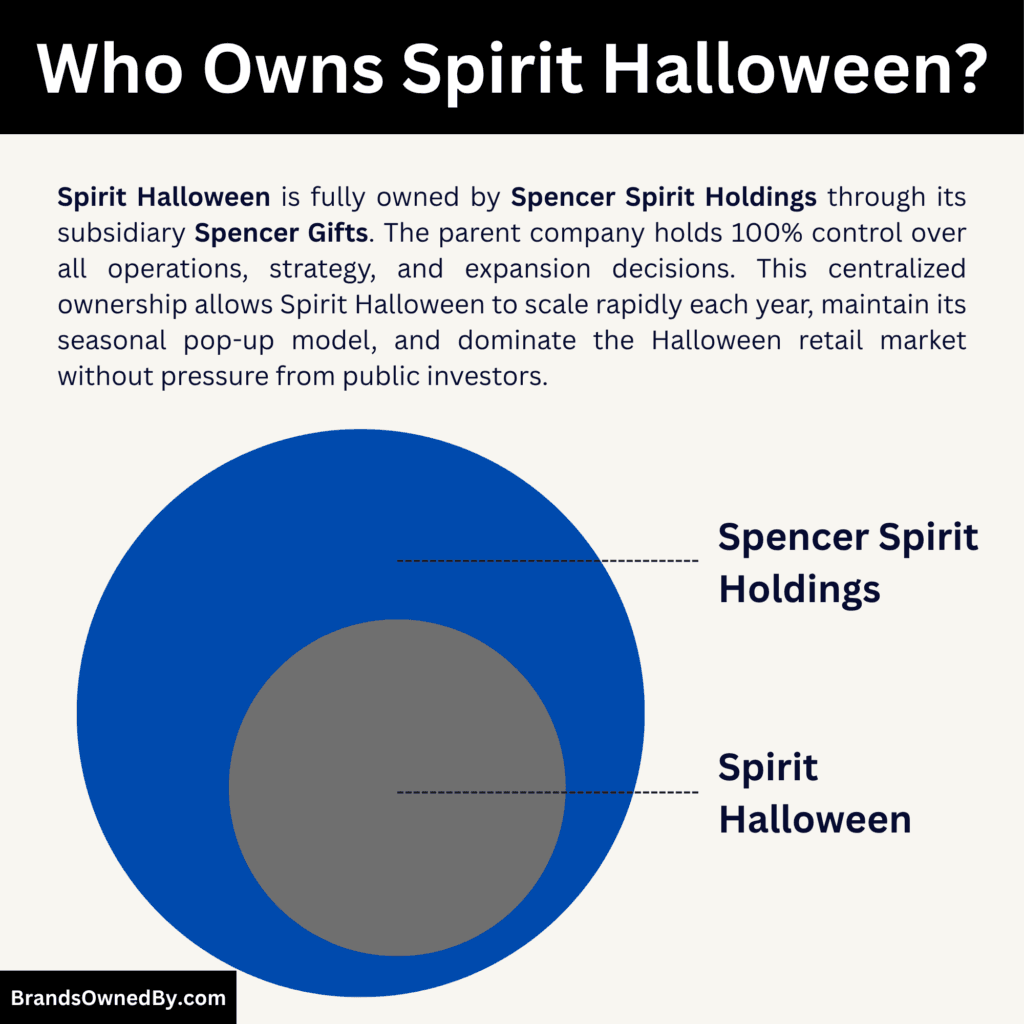
Spirit Halloween is owned by Spencer Spirit Holdings. It operates as a wholly owned subsidiary through Spencer Gifts. The company is privately held. There are no public shareholders at the Spirit Halloween level. Full ownership and control sit with the parent company.
This structure is important. It explains how Spirit Halloween scales rapidly each year, secures retail locations quickly, and maintains consistent market leadership without the pressure of public markets.
Parent Company: Spencer Spirit Holdings
Spencer Spirit Holdings is the ultimate owner of Spirit Halloween. It is a private retail holding company that oversees both Spencer Gifts and Spirit Halloween as part of a unified business model.
The parent company operates with a dual-brand strategy:
- Spencer Gifts runs year-round mall-based stores
- Spirit Halloween operates seasonal pop-up stores.
This combination creates operational efficiency. Spencer Gifts provides the infrastructure. Spirit Halloween drives seasonal revenue spikes.
Spencer Spirit Holdings controls all key functions, including:
- Supply chain and vendor relationships
- Inventory planning and distribution
- Real estate strategy for store locations
- Licensing deals for costumes and merchandise
- Marketing and brand positioning.
The company has built strong partnerships with major licensors. This allows Spirit Halloween to sell costumes tied to popular movies, TV shows, and gaming franchises. These licensing agreements are negotiated at the parent company level.
Leadership is also centralized. Executives at Spencer Gifts oversee both brands. This ensures alignment in decision-making and execution.
Another key strength is real estate strategy. The parent company has developed a system to identify and secure short-term leases in vacant retail spaces. This capability gives Spirit Halloween a major advantage over competitors.
Spencer Spirit Holdings has remained privately controlled. Over time, it has been backed by private equity investors and management stakeholders. This ownership model allows long-term planning without public disclosure requirements.
Acquisition Details: Spencer Gifts Acquires Spirit Halloween (1999)
The acquisition of Spirit Halloween in 1999 by Spencer Gifts was a strategic move that reshaped the business.
At the time, Spirit Halloween was a small but growing seasonal retailer founded by Joseph Marver. It had proven demand but lacked the infrastructure to scale nationally.
Spencer Gifts identified a clear opportunity. Its core business was mall-based retail, which faced seasonal fluctuations. By acquiring Spirit Halloween, the company could expand into a high-demand seasonal category.
The acquisition delivered immediate strategic benefits:
First, it added a new revenue stream. Halloween retail generates strong seasonal demand with high-margin products.
Second, it allowed Spencer Gifts to leverage its existing capabilities. This included sourcing, logistics, and store operations.
Third, it created a scalable model. Spirit Halloween could rapidly expand by using temporary retail spaces instead of committing to long-term leases.
After the acquisition, Spirit Halloween was fully integrated into Spencer Gifts’ operations. However, its brand identity and seasonal focus were preserved.
Joseph Marver remained involved during the transition period. This helped maintain continuity in the business model while scaling operations.
Post-Acquisition Expansion and Integration
Following the acquisition, Spencer Gifts transformed Spirit Halloween into a national powerhouse.
The company expanded aggressively across the United States and later into Canada. It increased store count year after year by refining its pop-up retail strategy.
One of the most important developments was the use of vacant retail spaces. As traditional retailers began closing stores, Spirit Halloween filled those locations with short-term leases.
This approach reduced costs and increased flexibility. It also allowed the company to enter prime retail locations without long-term commitments.
Integration with Spencer Gifts created additional advantages:
- Shared warehousing and distribution networks
- Centralized purchasing power
- Consistent merchandising strategies
- Cross-functional retail expertise.
Over time, Spirit Halloween became the dominant brand in its category. It outscaled competitors and built strong brand recognition.
Current Ownership Position and Strategic Implications
As of 2026, Spirit Halloween remains fully owned by Spencer Spirit Holdings through Spencer Gifts. The ownership has not changed since the 1999 acquisition.
This stability has enabled long-term strategic execution. The company continues to refine its seasonal model and expand its footprint.
Recent initiatives show how ownership supports innovation. The launch of “Spirit Christmas” stores is one example. It demonstrates how the parent company is leveraging its seasonal retail expertise beyond Halloween.
The private ownership structure continues to provide key advantages:
- Fast execution without shareholder approval delays
- Flexibility to test new retail concepts
- Strong control over brand and operations
- Ability to reinvest profits into expansion.
In practical terms, Spirit Halloween is not just a standalone brand. It is a critical part of a larger retail system designed for efficiency, scalability, and seasonal dominance.
Competitor Ownership Comparison
Spirit Halloween’s ownership model stands out when compared with its key competitors. The company operates under a privately held, centralized structure, which gives it speed and flexibility. In contrast, competitors operate under public markets, distressed ownership, or diversified retail structures. These differences directly impact performance, expansion, and long-term survival.
Spirit Halloween vs Party City (Bankruptcy and Ownership Shift)
Party City was historically the closest competitor to Spirit Halloween. However, its ownership journey has been unstable, especially in recent years.
As of 2024–2025, Party City filed for Chapter 11 bankruptcy twice and ultimately moved toward liquidation of its retail operations.
By early 2025, most of its U.S. stores were shut down, and its intellectual property and wholesale business were sold for about $20 million to an affiliate of Ad Populum.
This represents a major ownership shift:
- Pre-2024: Public company with heavy debt and institutional investors
- 2025 onward: Assets controlled by a private buyer (Ad Populum affiliate)
- Retail footprint: Largely liquidated.
This collapse highlights a key contrast. Party City’s ownership structure, combined with debt and public market pressure, limited its ability to adapt.
Spirit Halloween, owned by Spencer Spirit Holdings, avoided these issues. It operates with:
- No public shareholders
- No heavy debt burden tied to store networks
- Flexible seasonal leases instead of permanent stores.
As Party City declined, Spirit Halloween expanded. This shift in competitive balance is directly tied to ownership structure.
Spirit Halloween vs Halloween City (Dependent Ownership Model)
Halloween City operates as a seasonal extension of Party City.
This means it does not have independent ownership. Its strategy, budget, and expansion depend entirely on Party City’s corporate health.
When Party City entered bankruptcy and began liquidation:
- Halloween City’s operations were heavily impacted
- Expansion slowed or became uncertain
- Brand continuity became dependent on new ownership.
In contrast, Spirit Halloween operates as a core business unit, not a side project. Its parent company is built around supporting both year-round and seasonal retail.
This difference matters. Spirit Halloween receives dedicated focus and investment. Halloween City does not.
Spirit Halloween vs Walmart and Target (Public Ownership Model)
Retail giants like Walmart and Target compete in Halloween products, but their ownership model is fundamentally different.
Both companies are publicly traded. They are owned by:
- Institutional investors
- Pension funds
- Retail shareholders.
Halloween is a small category within their broader business. Their priorities include groceries, apparel, electronics, and general merchandise.
This creates structural limitations:
- Seasonal categories receive limited strategic focus
- Store layouts are not optimized for Halloween experiences
- Inventory decisions are tied to overall retail performance.
Spirit Halloween’s ownership allows specialization. It focuses entirely on Halloween during its operating cycle. This creates deeper product variety and a more immersive customer experience.
Spirit Halloween vs Amazon (Platform Ownership Model)
Amazon represents a different type of competitor. It is a publicly traded technology and retail platform.
Amazon’s ownership is distributed across global shareholders, including institutions and founders. Its business model is built on:
- Marketplace scalability
- Logistics and delivery
- Price competition.
Amazon competes heavily in Halloween costumes and decorations. However, its model lacks physical retail experience.
Spirit Halloween’s ownership supports a different strategy:
- Physical, immersive stores
- Experiential retail with themed displays
- Immediate product availability.
While Amazon dominates online convenience, Spirit Halloween dominates in-person seasonal retail.
Structural Differences That Drive Competitive Advantage
Ownership structure is not just a legal detail. It directly shapes competitive performance.
Spirit Halloween benefits from:
- Private ownership with centralized control
- Seasonal business focus without year-round cost burden
- Ability to scale quickly using temporary leases.
Competitors face structural constraints:
- Party City: Debt-heavy model and bankruptcy-led ownership collapse
- Halloween City: Dependent ownership with limited autonomy
- Walmart/Target: Diversified focus with limited seasonal specialization
- Amazon: Digital-first model without physical retail immersion.
Who Controls Spirit Halloween?
Control of Spirit Halloween is centralized and flows directly from its parent company. The brand does not operate as an independent corporation with its own executive hierarchy. Instead, it is controlled through a unified leadership structure that combines strategy, operations, and execution under one system.
Ultimate Control: Spencer Spirit Holdings
The highest level of control sits with Spencer Spirit Holdings. This private holding company owns Spirit Halloween through its subsidiary Spencer Gifts and defines the long-term direction of the business.
All major strategic decisions originate at this level. These include expansion across North America, investment into new seasonal formats, and high-value licensing agreements with major entertainment franchises. Because the company is privately held, it does not face pressure from public shareholders. This allows leadership to prioritize long-term growth and aggressive seasonal scaling.
Executive Leadership and CEO Oversight
Day-to-day and strategic control is concentrated under the leadership of Steven Silverstein, who has led the business since 2003. He oversees both Spencer Gifts and Spirit Halloween as a single integrated retail system rather than two separate companies.
Under his leadership, Spirit Halloween has expanded from a relatively small seasonal chain into a dominant retailer operating more than 1,500 temporary stores annually across the United States and Canada. This level of scale reflects consistent executive control and long-term strategic continuity.
Silverstein’s role goes beyond oversight. He directly influences merchandising direction, seasonal rollout timing, licensing priorities, and overall retail strategy. His long tenure has ensured that the company maintains a consistent operating model while adapting to changes in retail trends, including the increasing availability of vacant commercial real estate.
Operational Control Through Spencer Gifts
Operational control is executed through Spencer Gifts, which functions as the backbone of the entire business. Spirit Halloween is structured as a division within this system rather than a standalone company.
This structure allows all core functions to remain centralized. Logistics, inventory planning, real estate acquisition, staffing, and merchandising are managed through shared teams. This centralized execution model is essential because the company must launch and operate over a thousand stores within a very short seasonal window each year.
The integration also ensures that Spirit Halloween benefits from year-round infrastructure. Spencer Gifts maintains supplier relationships, warehouse systems, and retail expertise that can be rapidly deployed when the Halloween season begins.
Centralized Decision-Making and Execution
Spirit Halloween operates under a top-down decision-making framework. Strategic planning is handled at the parent company level, while execution is carried out by coordinated teams across the organization.
Control is especially evident in how the company manages real estate and inventory. Each year, the company identifies and secures short-term leases in high-traffic retail locations, many of which are left vacant by other retailers. At the same time, it aligns product offerings with current entertainment trends, ensuring that costumes and decorations reflect popular movies, shows, and cultural moments.
This centralized model allows for speed and precision. The company can finalize store locations, stock inventory, and launch operations within tight seasonal timelines, something decentralized competitors struggle to achieve.
Role of Private Ownership in Control
Private ownership plays a defining role in how Spirit Halloween is controlled. Without the constraints of public markets, the company can make decisions quickly and adjust strategies without external approval.
This flexibility has become even more important as the retail landscape has shifted. As of 2026, the company continues to take advantage of increased retail vacancies and changing consumer behavior. It has also expanded into adjacent seasonal concepts such as Spirit Christmas, showing that control is not only centralized but also adaptive.
Spirit Halloween Annual Revenue and Net Worth
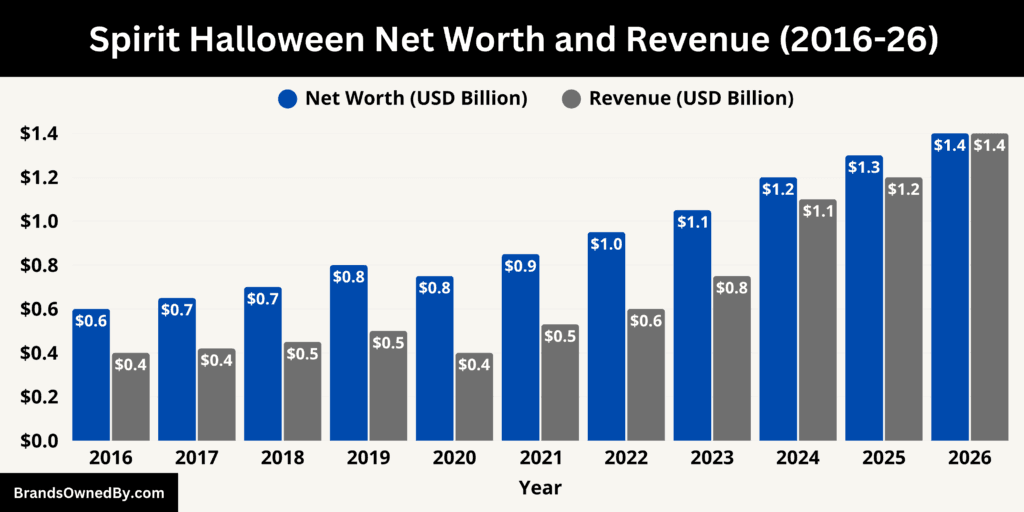
As of March 2026, Spirit Halloween generates $1.3–$1.5 billion in annual revenue, with a brand-level valuation of around $1.4 billion. This scale is significant for a business that operates primarily within a 10–12 week seasonal window and relies heavily on temporary retail locations.
2026 Revenue Breakdown and Operational Scale
In 2026, Spirit Halloween operates at a scale that few seasonal retailers have achieved. The company runs over 1,500 pop-up stores across the United States and Canada, making it the largest Halloween-focused retail chain in North America.
The estimated $1.3–$1.5 billion revenue is driven primarily by physical retail. Roughly 85%–90% of total revenue comes from in-store sales, while e-commerce contributes the remaining share. Online sales have grown steadily but remain secondary to the in-person shopping experience, which is a core part of the brand’s value proposition.
Revenue concentration is extremely high. Around 65%–75% of total annual sales occur in the final three to four weeks before Halloween. This creates a compressed revenue cycle where execution timing is critical. Inventory planning, store readiness, and merchandising accuracy directly impact financial performance.
Average store-level performance also provides insight into scale. With over 1,500 stores generating more than $1.3 billion in revenue, the average store generates approximately $850,000 to $1 million per season, depending on location and size.
Product-Level Revenue Composition
Spirit Halloween’s revenue is diversified across several product categories, each contributing differently to overall performance.
Costumes represent the largest segment, accounting for an estimated 45%–50% of total revenue. This includes licensed costumes tied to movies, TV shows, and gaming franchises, as well as original designs.
Decorations and animatronics contribute around 30%–35% of revenue. This category has grown rapidly due to higher-priced items such as life-size props and interactive displays, which significantly increase average transaction value.
Accessories, makeup, and smaller add-ons make up the remaining 15%–20%, often serving as high-margin impulse purchases that boost overall profitability.
2026 Net Worth and Valuation Drivers
As of March 2026, Spirit Halloween’s estimated $1.4 billion net worth reflects more than just revenue. It is driven by a combination of brand dominance, operational efficiency, and scalability.
One of the most important valuation drivers is its low fixed-cost structure. Unlike traditional retailers, Spirit Halloween does not maintain permanent store leases. Instead, it uses short-term agreements in vacant retail spaces. This reduces long-term liabilities and increases return on capital.
Another factor is inventory efficiency. A significant portion of its products, especially decorations and generic costumes, can be reused or resold in future seasons. This reduces waste and improves margins.
Brand equity also plays a major role. Spirit Halloween has become synonymous with Halloween retail in North America. This level of brand recognition allows it to command premium pricing in certain categories, particularly licensed costumes and large-scale decorations.
Growth Acceleration From 2022 to 2026
The period from 2022 to 2026 represents the fastest growth phase in the company’s history. Revenue increased from around $0.60B in 2022 to over $1.3B in 2026.
This growth was driven by several structural shifts in the retail market. The rise in vacant commercial real estate created more opportunities for short-term leases. At the same time, consumer spending on holidays and experiences increased significantly, especially after pandemic-related restrictions eased.
Spirit Halloween capitalized on both trends. It expanded store count, secured better retail locations, and increased average transaction values through premium product offerings.
Future Revenue Forecast (2027–2030)
Spirit Halloween’s future growth is expected to come from higher per-store revenue, improved product mix, and expansion into new seasonal concepts, rather than just adding more locations.
- 2027: $1.5B–$1.6B
- 2028: $1.6B–$1.8B
- 2029: $1.8B–$2.0B
- 2030: $2.0B–$2.3B.
The company already operates more than 1,500 stores, so incremental growth will rely on increasing average store revenue, which is currently close to $1 million per location. Even small improvements in pricing, merchandising, and location quality can add hundreds of millions in total revenue.
Another key driver is the shift toward higher-value products such as animatronics and licensed costumes, which increase average transaction size. At the same time, e-commerce is expected to grow steadily, expanding beyond its current ~10–15% share of revenue.
Expansion into adjacent concepts like Spirit Christmas also supports long-term growth by extending the seasonal model beyond Halloween.
Overall, the company is well positioned to cross the $2 billion revenue mark by 2030, supported by strong demand and a highly scalable business model.
Brands Owned by Spirit Halloween
Spirit Halloween does not operate as a traditional parent company with a portfolio of acquisitions or subsidiaries. It is itself a brand under Spencer Gifts. However, over time, it has developed and operated distinct internal brands, product lines, and seasonal retail concepts that function like standalone entities within its ecosystem.
As of 2026, these are the key brands and entities directly operated under Spirit Halloween:
| Entity / Brand | Type | Description | Role in Business | Key Details |
|---|---|---|---|---|
| Spirit Halloween | Core Brand | Seasonal retail chain focused on Halloween costumes and decorations | Primary revenue driver | Operates 1,500+ pop-up stores annually across North America |
| SpiritHalloween.com | E-commerce Platform | Official online store operating year-round | Digital sales and customer retention | Contributes ~10–15% of total revenue; supports pre- and post-season sales |
| Spirit Halloween Superstores | Retail Network | Temporary large-format pop-up stores | Physical retail execution | Average store generates ~$850K–$1M per season |
| Spirit Halloween Animatronics | Product Line | Exclusive life-size animated props and decorations | High-margin product segment | Key driver of decoration sales and premium pricing |
| Licensed Product Division | Product Division | Handles officially licensed costumes and merchandise | Major revenue contributor | Includes partnerships with movies, TV shows, and gaming franchises |
| Private Label Brands | Product Line | In-house designed costumes, accessories, and décor | Margin optimization and differentiation | Exclusive products with higher profit margins |
| Spirit Christmas | Seasonal Concept | Holiday retail expansion beyond Halloween | Growth and diversification strategy | Expanded to ~30 stores in 2025 with further growth expected |
| In-Store Experience Division | Operational Unit | Designs themed layouts and interactive store elements | Enhances customer engagement and sales | Includes animatronic displays and immersive walkthrough setups |
Spirit Halloween (Core Retail Brand)
Spirit Halloween is the primary and most important entity. It operates as a seasonal retail chain specializing in Halloween costumes, decorations, props, and accessories.
The brand runs over 1,500 temporary stores annually across North America. These stores are typically located in vacant retail spaces and operate for a limited period between August and early November.
Its core strength lies in its pop-up retail model, which allows rapid expansion with minimal long-term cost commitments. The brand also focuses heavily on in-store experiences, featuring themed displays, animatronics, and interactive setups.
Spirit Halloween generates the majority of its revenue from this core operation.
SpiritHalloween.com (E-commerce Platform)
SpiritHalloween.com is the official digital storefront of the brand. It operates as a year-round e-commerce platform, unlike the physical stores which are seasonal.
The website allows the company to capture early demand before stores open and extend sales beyond physical locations. It also supports last-minute purchases during peak season.
The platform plays a growing role in revenue generation, contributing an estimated 10–15% of total sales. It also helps the brand maintain customer engagement outside the Halloween season.
Spirit Halloween Superstores (Pop-Up Store Network)
The physical store network itself functions as a distinct operational entity. These “superstores” are not permanent locations but are rapidly deployed each year using a standardized setup model.
Each store is designed to maximize seasonal sales through:
- High-traffic retail locations
- Large floor space for immersive displays
- Optimized product placement for impulse purchases
This network is one of the company’s biggest competitive advantages. It allows Spirit Halloween to scale to thousands of locations without long-term leases.
Spirit Halloween Animatronics Line
Spirit Halloween operates its own line of animatronic products, which are among its most popular and high-margin offerings.
These include life-size animated figures, horror-themed props, and interactive decorations. The animatronics category has grown significantly and now represents a major share of decoration revenue.
Many of these products are exclusive to the brand, which strengthens customer loyalty and reduces direct competition.
Spirit Halloween Licensed Product Division
Spirit Halloween manages a large portfolio of licensed products tied to movies, TV shows, and gaming franchises.
This division is responsible for producing and selling officially licensed costumes and merchandise. It collaborates with major entertainment companies to bring trending characters into stores each season.
Licensed products are a key revenue driver, especially for children and young adults. They also allow the brand to stay relevant with current pop culture trends.
Spirit Halloween Private Label Brands
Spirit Halloween also develops and sells private label products across multiple categories. These include costumes, decorations, accessories, and themed kits.
Private label brands allow the company to control pricing, improve margins, and differentiate its offerings from competitors. These products are often designed in-house and sold exclusively through Spirit Halloween channels.
This internal branding strategy plays a significant role in profitability.
Spirit Christmas (Seasonal Expansion Concept)
Spirit Christmas is a newer seasonal retail concept launched by Spirit Halloween. It represents the company’s expansion beyond Halloween into other holiday markets.
The concept was initially tested with a small number of stores and expanded to around 30 locations in 2025. It follows a similar pop-up model, focusing on Christmas decorations, gifts, and festive merchandise.
This entity is important because it shows how the company is leveraging its existing infrastructure to create additional revenue streams.
In-Store Experience and Themed Attractions Division
Another key operational entity is the in-store experience division. This includes the design and execution of themed layouts, interactive displays, and walkthrough experiences inside stores.
These elements are not separate companies but function as a distinct part of the business. They enhance customer engagement and increase time spent in stores, which directly impacts sales.
The company invests heavily in creating immersive environments that differentiate it from traditional retailers.
Final Words
Spirit Halloween is owned by Spencer Spirit Holdings through its subsidiary Spencer Gifts. This private ownership structure allows the company to operate efficiently and scale aggressively during the Halloween season.
Its unique pop-up retail model, combined with centralized control, has made it the leading Halloween retailer in North America. While it does not own other companies, it plays a crucial role within a larger retail ecosystem.
FAQs
Where is Spirit Halloween headquarters?
Spirit Halloween’s headquarters is located in Egg Harbor Township, New Jersey, United States. This is where its corporate operations, planning, and seasonal logistics are managed.
Who owns Spirit Halloween products?
Spirit Halloween products are owned and managed by Spencer Spirit Holdings through its subsidiary Spencer Gifts. The company develops a mix of licensed and private label products, all controlled internally.
Where is Spirit Halloween located?
Spirit Halloween operates across the United States and Canada. It does not have permanent locations. Instead, it opens over 1,500 temporary stores each year in vacant retail spaces during the Halloween season.
Who owns Spirit Halloween stores?
All Spirit Halloween stores are owned and operated by Spencer Spirit Holdings. These are company-operated stores, not individually owned outlets.
Is Spirit Halloween a franchise?
No, Spirit Halloween is not a franchise. All stores are corporate-owned and centrally managed. The company does not offer franchising opportunities.
Are Spirit Halloween and Spencers owned by the same company?
Yes, both Spirit Halloween and Spencer Gifts are owned by Spencer Spirit Holdings. They operate as part of the same retail group.
What is the world’s #1 Halloween store?
Spirit Halloween is widely considered the world’s #1 Halloween store. It is the largest Halloween-focused retailer, with the most locations and the widest range of products in North America.
Who is the CEO of Spirit Halloween?
Spirit Halloween does not have a separate CEO. It is managed under Spencer Gifts. The overall leadership is handled by Steven Silverstein, who oversees both brands.