
- The Honest Company is a publicly traded consumer goods company listed on NASDAQ under the ticker HNST, with ownership distributed across institutional investors, public shareholders, and company insiders.
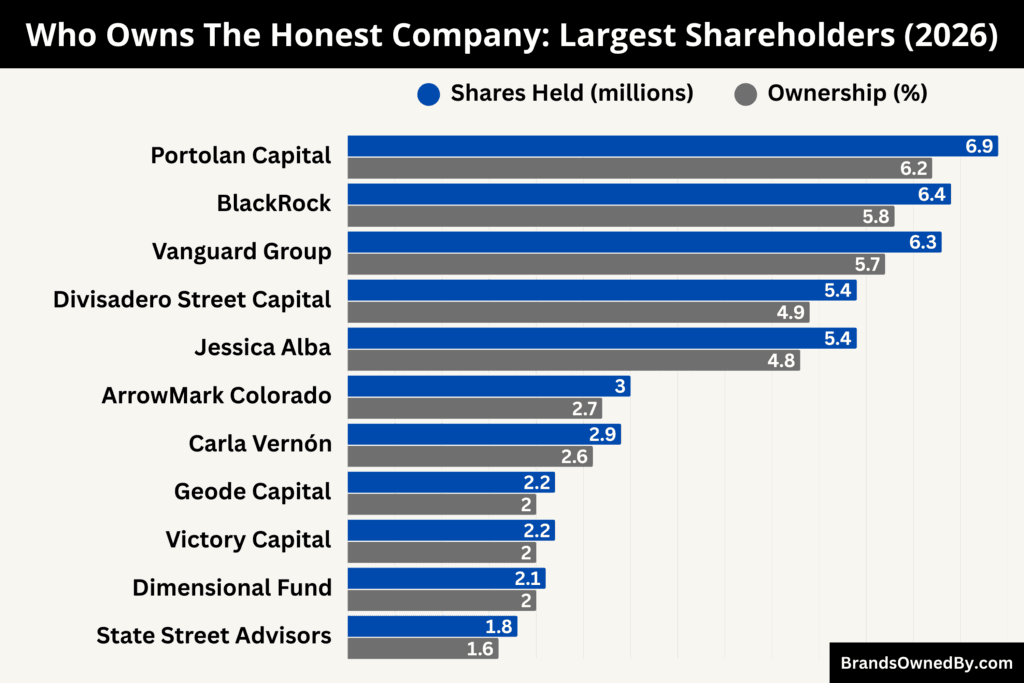
- Institutional investors collectively hold about 45–50% of the company, making them the largest ownership group. The biggest shareholders include Portolan Capital Management (6.2%), BlackRock (5.8%), and The Vanguard Group (5.7%).
- Founder Jessica Alba remains one of the largest individual shareholders with about 4.8% of the company, representing more than 5.4 million shares.
- Other notable shareholders include Divisadero Street Capital Management (4.9%), ArrowMark Colorado Holdings (2.7%), and CEO Carla Vernón (2.6%), while public retail investors collectively hold about 50–55% of the outstanding shares.
The Honest Company is an American consumer goods brand that focuses on clean, safe, and environmentally friendly products. The company primarily sells baby products, personal care items, beauty products, and household essentials. Its products are designed with an emphasis on plant-based ingredients, transparency, and sustainability.
The company launched in 2011 with the goal of providing safer alternatives to conventional household and baby products. Many traditional consumer goods contain chemicals that some consumers prefer to avoid. The Honest Company positioned itself as a brand that prioritizes clean ingredients and ethical manufacturing practices.
Over time, the brand expanded its product portfolio. It now offers a wide range of items including diapers, wipes, skincare products, cosmetics, bath products, and household cleaners. These products are sold through the company’s website as well as major retail stores and online marketplaces.
The Honest Company built its identity around transparency. Product labels and ingredient disclosures are central to the brand’s messaging. This approach helped the company build trust among parents and health-conscious consumers.
Today, The Honest Company operates as a lifestyle brand that promotes clean living, sustainability, and responsible product design.
Founders of The Honest Company
The Honest Company was created by a group of entrepreneurs who shared the goal of producing safer consumer products for families. The company was founded in 2011 and officially launched its first products in 2012. The founding team consisted of Jessica Alba, Brian Lee, Christopher Gavigan, and Sean Kane.
Each founder brought different expertise to the business.
Jessica Alba
Jessica Alba is the most recognizable founder of The Honest Company. She is an American actress and entrepreneur who played a central role in developing the brand’s mission and public image.
The idea for the company originated from Alba’s personal experience as a mother. After developing an allergic reaction while washing baby clothes with a common detergent, she began researching the ingredients used in everyday household products. This experience convinced her that many families lacked access to safer alternatives.
Alba helped shape the company’s identity around transparency, sustainability, and clean ingredients. She served as the company’s Chief Creative Officer for several years and was heavily involved in product development and branding. In April 2024, she stepped down from that executive role but remains closely associated with the brand as a co-founder.
Her celebrity status helped the company attract media attention and early customers.
Brian Lee
Brian Lee is a technology entrepreneur and startup founder who played a major role in building the business structure of The Honest Company.
Before launching Honest, Lee had already co-founded several successful companies. These include LegalZoom, an online legal services platform, and ShoeDazzle, a fashion subscription company. His experience in launching high-growth startups helped guide the early strategy of the Honest business.
Lee helped lead the company’s early fundraising efforts and operational strategy. He also served as the company’s first Chief Executive Officer during the startup phase.
His expertise in e-commerce and venture funding played a key role in scaling the business during its early years.
Christopher Gavigan
Christopher Gavigan is an environmental health advocate, entrepreneur, and author who co-founded The Honest Company.
Before joining the founding team, he served as the CEO of Healthy Child Healthy World, a nonprofit organization focused on protecting children from harmful chemicals. His work in environmental health helped shape the company’s product philosophy.
At The Honest Company, Gavigan focused on product safety standards, ingredient transparency, and sustainability. He helped establish the company’s product development guidelines and worked on building trust with consumers who wanted safer alternatives for their families.
His background in environmental advocacy gave the company credibility in the clean consumer products space.
Sean Kane
Sean Kane is the fourth co-founder of The Honest Company. He worked with the founding team during the early development of the business and helped launch the company’s initial operations.
Before joining Honest, Kane worked in the technology and digital commerce industry. He was previously associated with PriceGrabber, an online shopping comparison platform.
Kane contributed to building the company’s operational infrastructure and early technology systems. Although he has remained less publicly visible than some of the other founders, he played an important role in helping bring the company’s initial vision to market.
Together, the four founders combined expertise in entertainment, entrepreneurship, environmental health, and digital commerce. This combination of skills helped The Honest Company evolve from a startup idea into a well-known clean consumer goods brand.
Ownership History
The ownership history of The Honest Company shows how the brand evolved from a founder-led startup into a publicly traded consumer goods company. It was founded in 2011 by Jessica Alba, Brian Lee, Christopher Gavigan, and Sean Kane. In the early years, the founders held most of the ownership.
As the company grew, venture capital firms invested and received equity stakes. This gradually reduced founder ownership and expanded the investor base. A major shift happened in 2021 when The Honest Company went public on the NASDAQ.
Since then, ownership has been divided among institutional investors, company insiders, and public shareholders.
Early Founder Ownership (2011–2012)
The Honest Company began as a privately owned startup in 2011. The company was founded by Jessica Alba, Brian Lee, Christopher Gavigan, and Sean Kane. In the early stage, ownership was primarily held by the founding team.
Brian Lee played a key role in structuring the company’s early business model. He helped secure early investments and build the operational framework. Jessica Alba became the public face of the company and helped establish its brand identity. Christopher Gavigan focused on product standards and environmental safety principles, while Sean Kane contributed to building the company’s operational systems.
During the initial phase, the founders controlled most of the company’s equity. The company launched with a limited range of products that focused mainly on baby care essentials such as diapers, wipes, and bath products.
The founders built the business around a subscription-based e-commerce model. Customers could receive recurring shipments of diapers and household products. This model helped generate consistent revenue and rapid customer growth in the early years.
Venture Capital Investment and Expansion (2013–2016)
As the brand gained popularity, The Honest Company began attracting venture capital investment. These investments significantly changed the company’s ownership structure.
Several venture capital firms invested in the company during its growth phase. Major investors included Lightspeed Venture Partners, Institutional Venture Partners, and General Catalyst. These firms acquired equity stakes in exchange for providing capital to expand the business.
The funding allowed the company to expand its product line beyond baby items. It launched new categories such as beauty products, skincare items, and household cleaning products.
Retail expansion also accelerated during this period. Honest products began appearing in major retail chains and online marketplaces. This move increased the company’s visibility and broadened its customer base.
As more investors joined the company, ownership became more distributed. The founders still held significant stakes, but venture capital firms gained substantial influence due to their investment size.
Billion-Dollar Valuation and Investor Growth (2015–2019)
By the mid-2010s, The Honest Company had become one of the most well-known clean consumer brands in the United States. The company’s rapid growth attracted additional investment and pushed its valuation above $1 billion at one point.
Large institutional investors began participating in funding rounds. These investors believed the company could compete with traditional consumer goods companies in the growing natural products market.
The company used the new capital to expand marketing, improve supply chains, and develop additional product lines. Honest Beauty became one of the most important new segments during this period.
However, this growth stage also brought increased competition. Large consumer goods companies began launching their own natural product lines. As a result, The Honest Company had to strengthen its brand differentiation and maintain product transparency.
Ownership during this period consisted mainly of founders, venture capital firms, and private investors.
Leadership Changes and Ownership Adjustments (2017–2020)
As the company matured, its leadership structure evolved. In 2017, Brian Lee stepped down as CEO. He remained involved with the company but shifted away from daily operations.
Nick Vlahos, a former executive at major consumer brands, became the new CEO. His appointment reflected the company’s transition from startup culture to a more structured corporate organization.
During this period, some early investors adjusted their stakes as the company prepared for long-term growth. Ownership continued to include venture capital firms, private investors, and company insiders.
The company also expanded its retail presence significantly. Honest products became widely available in major retailers such as Target, Walmart, and Amazon. This retail expansion strengthened the company’s market position ahead of its eventual public listing.
Initial Public Offering (IPO) and Public Ownership (2021)
A major milestone in the ownership history of The Honest Company occurred in May 2021. The company launched its initial public offering (IPO) and became a publicly traded company.
The IPO listed the company on the NASDAQ stock exchange under the ticker symbol HNST. Through the offering, the company sold shares to public investors and raised capital for future growth.
Once the IPO was completed, ownership shifted from private investors to public shareholders. Institutional investors, mutual funds, and individual investors could now purchase shares of the company.
The public listing also reduced the percentage ownership held by the founders and early venture capital investors. However, many of these stakeholders retained shares and continued to benefit from the company’s performance.
Institutional Shareholder Dominance (2021–2026)
After the IPO, institutional investors gradually became the largest shareholders of The Honest Company. Large investment firms manage funds that purchase shares in publicly traded companies across many industries.
Asset management companies such as Vanguard Group, BlackRock, and other institutional investors hold shares through various mutual funds and exchange-traded funds.
Institutional investors often hold significant voting power because they control large numbers of shares. Their investment decisions can influence company strategy, governance practices, and leadership appointments.
Despite this shift toward institutional ownership, company insiders still retain shares. These include executives, board members, and co-founder Jessica Alba.
As of 2026, ownership of The Honest Company remains widely distributed among institutional investors, insiders, and retail shareholders. This structure is typical for publicly traded consumer goods companies.
Who Owns The Honest Company: Top Shareholders
The Honest Company is a publicly traded consumer goods company listed on the NASDAQ under the ticker symbol HNST. Its ownership structure is dominated by institutional investors, which collectively hold a significant portion of the company’s outstanding shares.
As of March 2026, institutional investors control roughly 45–50% of The Honest Company’s shares, while the remaining shares are primarily held by retail investors and company insiders, including executives and founders.
Among all shareholders, Portolan Capital Management is currently the largest single institutional shareholder, holding about 6.2% of the company’s outstanding shares. Other major investors include global asset management firms such as BlackRock and The Vanguard Group, which hold significant positions through investment funds and ETFs.
Founder Jessica Alba also remains one of the largest individual shareholders with a stake of roughly 4–5%, keeping her closely connected to the company she helped launch. This mix of institutional ownership, insider stakes, and public investors shapes the company’s governance and shareholder voting power.
Below are the major shareholders of The Honest Company based as of March 2026:
Portolan Capital Management, LLC
Portolan Capital Management is the largest institutional shareholder of The Honest Company. The investment firm owns approximately 6.2% of the company, representing around 6.9 million shares.
Portolan is a U.S.-based hedge fund that focuses on small-cap and mid-cap public companies. The firm often invests in companies that it believes have strong long-term growth potential. Its stake in The Honest Company makes it one of the most influential institutional investors in the business.
Because of the size of its holdings, Portolan can have a meaningful influence on shareholder votes and corporate governance decisions.
BlackRock, Inc.
BlackRock is one of the largest asset management companies in the world and holds one of the largest stakes in The Honest Company. The firm owns roughly 5.8% of the company, equal to more than 6.4 million shares.
BlackRock manages trillions of dollars in assets globally through mutual funds, pension funds, and ETFs. Many of its investments in public companies come through index funds that track major stock market indexes.
Because BlackRock manages such large investment portfolios, it frequently appears as a top shareholder in many publicly traded companies. Its stake in The Honest Company reflects the company’s inclusion in various investment funds.
The Vanguard Group, Inc.
The Vanguard Group is another major shareholder of The Honest Company. The investment firm owns around 5.7% of the company, which represents more than 6.3 million shares.
Vanguard is one of the world’s largest asset managers and is known for its low-cost index funds. Many individual investors indirectly own shares of The Honest Company through Vanguard ETFs and mutual funds.
Because Vanguard represents millions of investors, it often holds large positions in public companies and plays an important role in shareholder voting and corporate governance.
Divisadero Street Capital Management, LP
Divisadero Street Capital Management is another important institutional shareholder. The firm owns roughly 4.9% of The Honest Company.
The investment firm focuses on long-term equity investments in public companies. Its stake in The Honest Company reflects confidence in the company’s potential within the clean consumer products market.
Institutional investors like Divisadero often analyze a company’s brand strength, growth potential, and market positioning before making large investments.
Jessica Alba
Jessica Alba is one of the most notable individual shareholders in The Honest Company. She owns roughly 4.8% of the company, representing more than 5.4 million shares.
As a co-founder, Alba played a key role in launching the brand and shaping its identity. She helped create the company after experiencing concerns about chemicals used in household and baby products.
Although she no longer manages daily operations, her ownership stake still makes her one of the largest individual shareholders. Alba remains closely associated with the brand and continues to influence its public image.
ArrowMark Colorado Holdings LLC
ArrowMark Colorado Holdings is an institutional investment firm that owns about 2.7% of The Honest Company.
The firm focuses on growth-oriented companies across several industries. ArrowMark invests in businesses it believes have strong innovation potential and scalable business models.
Its investment in The Honest Company reflects interest in the expanding clean consumer goods market.
Carla Vernón
Carla Vernón, the current Chief Executive Officer of The Honest Company, also holds a significant ownership stake. She owns roughly 2.6% of the company.
Executive ownership is common in public companies because stock compensation is often used as part of leadership incentive packages. By holding shares, executives benefit directly from improvements in company performance.
Vernón’s ownership stake aligns her interests with other shareholders.
Geode Capital Management LLC
Geode Capital Management is another major institutional investor. The firm owns just over 2% of the company.
Geode manages investment funds that track market indexes. Many of its holdings come from index funds that replicate the performance of major equity markets.
As a result, Geode frequently appears as a shareholder in many public companies.
Victory Capital Management Inc.
Victory Capital Management owns approximately 2% of The Honest Company’s shares.
Victory Capital is a global investment management firm that oversees a wide range of investment strategies including equity funds, ETFs, and institutional portfolios.
Its investment in Honest reflects institutional interest in companies operating in the clean beauty and sustainable consumer goods sector.
Dimensional Fund Advisors LP
Dimensional Fund Advisors is another institutional investor that owns around 2% of the company’s shares.
The firm specializes in systematic investment strategies that focus on long-term market performance. Dimensional typically invests through diversified portfolios that include small-cap and mid-cap companies like The Honest Company.
State Street Global Advisors
State Street Global Advisors holds roughly 1.6% of the company’s shares.
State Street is one of the world’s largest asset management firms and operates the popular SPDR family of ETFs. Many institutional and retail investors gain exposure to companies like Honest through State Street investment funds.
Because of its large portfolio size, State Street frequently appears among the largest shareholders in many publicly traded companies.
Overall Shareholder Distribution
The ownership of The Honest Company is spread across multiple categories of investors. Institutional investors hold a large portion of the shares, while insiders and executives also maintain meaningful stakes. Retail investors collectively own a substantial percentage of the company as well.
This diversified ownership structure is common for publicly traded companies. It ensures that decision-making power is shared among investors rather than concentrated in the hands of a single owner.
The combination of institutional investment and insider ownership continues to shape the strategic direction of The Honest Company as it competes in the global consumer goods market.
Competitor Ownership Comparison
The Honest Company operates in a highly competitive consumer goods market that includes baby care, personal care, and household cleaning products. Many of its competitors are significantly larger companies with global distribution networks and diverse brand portfolios. These competitors often operate as multinational corporations or subsidiaries within larger corporate groups.
While The Honest Company focuses mainly on clean and sustainable consumer products under a single primary brand, several competing products are owned by large conglomerates that control dozens or even hundreds of brands worldwide. These ownership structures give competitors strong financial resources, global supply chains, and extensive retail partnerships.
| Company / Brand | Ownership Type | Parent Company / Major Owner | Key Competing Products | Ownership Structure Details |
|---|---|---|---|---|
| The Honest Company | Public Company | Public shareholders (largest shareholder: Portolan Capital Management ~6.2%) | Honest diapers, wipes, beauty products, household cleaners | Listed on NASDAQ (HNST). Ownership is largely held by institutional investors (~45–50%), with the rest held by retail investors and insiders including founder Jessica Alba. |
| Procter & Gamble | Public Company | Public shareholders | Pampers, Pampers Pure, Luvs, Tide | One of the world’s largest consumer goods corporations. Shares are widely held by institutional investors such as BlackRock, Vanguard, and State Street. |
| Kimberly-Clark | Public Company | Public shareholders | Huggies diapers, Pull-Ups, Cottonelle wipes | Publicly traded multinational hygiene company with institutional investors holding large stakes through global funds and ETFs. |
| Unilever | Public Company | Global institutional investors and public shareholders | Dove, Baby Dove, Vaseline, household cleaning products | Multinational consumer goods company headquartered in London. Ownership is widely distributed among global asset managers and institutional investors. |
| Seventh Generation | Subsidiary Brand | Unilever | Eco-friendly cleaning products, baby products | Sustainability-focused brand fully owned by Unilever since its acquisition in 2016. |
| Babyganics | Subsidiary Brand | S. C. Johnson & Son | Baby wipes, skincare products, household cleaners | Owned by privately held S. C. Johnson, a family-controlled consumer goods company known for brands like Windex and Ziploc. |
Procter & Gamble
Procter & Gamble is one of the largest competitors to The Honest Company in the baby care and household product categories. The company produces globally recognized brands such as Pampers, Pampers Pure, and Luvs diapers, which compete directly with Honest’s baby product line.
Procter & Gamble is a publicly traded multinational corporation listed on the New York Stock Exchange. Its ownership is widely distributed among institutional investors, pension funds, and millions of retail shareholders. Large asset managers such as BlackRock and Vanguard typically appear among its top shareholders due to their index funds and ETFs.
Because of its massive scale, Procter & Gamble has significantly greater resources than The Honest Company. The corporation operates dozens of major brands and maintains manufacturing, marketing, and distribution operations across the world.
Kimberly-Clark
Kimberly-Clark is another major competitor in the baby care category. The company produces brands such as Huggies diapers and Cottonelle wipes, which compete directly with Honest diapers and wipes.
Like many large consumer goods companies, Kimberly-Clark is publicly traded. Its ownership is spread among institutional investors, investment funds, and individual shareholders. Major asset managers often hold significant stakes through diversified portfolios.
Kimberly-Clark benefits from long-established brand recognition and global manufacturing capabilities. This gives the company a strong position in the diaper and hygiene markets where The Honest Company competes.
Unilever
Unilever is one of the world’s largest consumer goods companies and competes with Honest in personal care and household products. The company owns a vast portfolio of brands across beauty, cleaning products, and food categories.
Unilever is a publicly traded multinational corporation headquartered in London. It was formed through the merger of Margarine Unie and Lever Brothers and now operates globally with more than 100,000 employees.
Ownership of Unilever is widely distributed among institutional investors and global shareholders. Because the company operates hundreds of brands and generates tens of billions in annual revenue, it has significantly greater resources than smaller consumer brands such as Honest.
Unilever also owns several brands positioned around sustainability and environmentally friendly products.
Seventh Generation
Seventh Generation is one of the most direct competitors to The Honest Company in the eco-friendly household and personal care market. The brand focuses on plant-based cleaning products, paper goods, and baby products.
Unlike Honest, Seventh Generation is not an independent company. It operates as a subsidiary of Unilever after the multinational company acquired it in 2016 for an estimated $700 million.
As part of Unilever, Seventh Generation benefits from the parent company’s global distribution networks, research capabilities, and financial backing. This allows the brand to compete effectively in the natural products market while still maintaining its sustainability-focused identity.
Babyganics
Babyganics is another competitor that focuses on baby care and household products designed for families. The brand sells items such as baby wipes, skincare products, and cleaning supplies.
Babyganics is owned by S. C. Johnson & Son, a large American consumer goods company. S. C. Johnson is privately owned by the Johnson family and has remained a family-controlled business for generations.
The company operates many well-known household brands including Windex, Ziploc, Glade, and Raid. It acquired Babyganics to strengthen its presence in the baby care and family product market.
Because S. C. Johnson is privately held, strategic decisions are controlled by the Johnson family rather than public shareholders.
Key Ownership Differences
The Honest Company competes against companies with very different ownership structures. Some competitors, such as Procter & Gamble and Unilever, are large multinational corporations owned by global investors. Others, such as Babyganics’ parent company S. C. Johnson, remain privately owned and controlled by a founding family.
These companies operate dozens or even hundreds of brands across multiple product categories. Their large scale allows them to invest heavily in marketing, manufacturing, and research.
In contrast, The Honest Company operates primarily under a single brand with a focused mission centered on clean ingredients and environmentally responsible products. This specialization allows the company to target a specific segment of consumers who prioritize sustainability and product transparency.
Who Controls The Honest Company?
Control of The Honest Company is exercised through its executive leadership and board of directors. While the company has thousands of shareholders, day-to-day management decisions are made by the executive team. Strategic oversight is handled by the board of directors, which represents the interests of shareholders.
The company operates under a typical public company governance structure. The CEO leads operations and corporate strategy. Senior executives manage key divisions such as marketing, product development, supply chain, and finance. The board of directors approves major decisions, including executive appointments, long-term strategy, and corporate governance policies.
This structure ensures that operational control remains centralized while ownership remains distributed among investors.
Carla Vernón: Chief Executive Officer
Carla Vernón is the Chief Executive Officer of The Honest Company. She took over the role in January 2023 and is responsible for leading the company’s overall strategy and operations.
Vernón brought extensive experience in the consumer goods industry before joining Honest. She previously held senior leadership positions at several large consumer brands, including Amazon and General Mills. Her background in brand management and marketing has helped shape Honest’s strategy in the competitive beauty and baby care markets.
As CEO, Vernón oversees product innovation, retail partnerships, and long-term growth initiatives. She also works closely with the board of directors to guide the company’s business strategy and operational priorities.
Role of the Board of Directors
The board of directors plays a critical role in controlling the company’s strategic direction. The board represents shareholders and is responsible for overseeing corporate governance.
Board members approve major corporate decisions such as executive compensation, mergers and acquisitions, and long-term business strategies. They also monitor financial performance and ensure the company operates in the best interest of shareholders.
The board typically includes a combination of independent directors and company representatives. Independent directors bring outside expertise from industries such as finance, technology, and consumer goods. Their role is to provide objective oversight and strategic guidance.
The board also evaluates the performance of the CEO and senior leadership team.
Executive Leadership Team
Beyond the CEO, The Honest Company is managed by a team of senior executives responsible for different areas of the business.
These executives oversee departments such as marketing, product innovation, finance, operations, and supply chain management. Their responsibilities include managing product launches, maintaining relationships with retail partners, and improving operational efficiency.
This leadership structure ensures that the company’s strategy is executed effectively across all business segments.
Jessica Alba’s Influence
Jessica Alba, one of the founders of The Honest Company, remains closely associated with the brand. She played a key role in establishing the company’s identity and mission.
For many years, Alba served as the company’s Chief Creative Officer. In that role, she helped guide brand messaging, marketing campaigns, and product development strategies.
Although she stepped away from daily executive responsibilities in 2024, she still holds shares in the company and remains one of its most recognizable stakeholders. Her continued association with the brand contributes to its public image and marketing appeal.
Decision-Making Structure
Decision-making at The Honest Company follows a structured corporate governance process.
Operational decisions are handled by the executive leadership team led by the CEO. Strategic initiatives, such as major partnerships, acquisitions, or large investments, typically require approval from the board of directors.
Shareholders influence governance primarily through voting rights attached to their shares. Institutional investors with large stakes may have more influence during shareholder votes, particularly when approving board members or corporate policies.
This governance structure balances executive leadership with shareholder oversight, ensuring that the company’s management remains accountable to its investors.
The Honest Company Annual Revenue and Net Worth
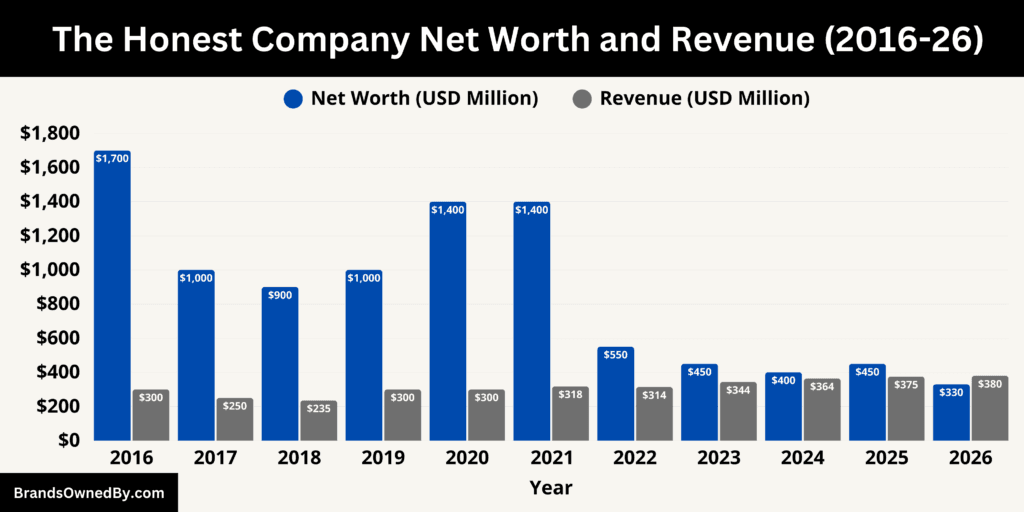
As of March 2026, the company produces about $370–$380 million in annual revenue and has a market valuation of roughly $300–$330 million, depending on stock price fluctuations. The company generates most of its revenue from baby products, wipes, and personal care items sold through large retailers such as Target, Walmart, Amazon, and specialty beauty stores.
Although its revenue has remained relatively stable in recent years, the company’s market value has fluctuated as it continues restructuring operations and focusing on its most profitable product categories.
Revenue Performance and Business Segments
The Honest Company earns revenue primarily from selling consumer products in three main categories: diapers and wipes, personal care products, and beauty products. These products are sold through retail partners and digital marketplaces.
In fiscal year 2024, the company reported approximately $378 million in revenue, representing about 10% growth compared to the previous year. This growth was driven by higher demand for wipes, diapers, and Honest Beauty products, along with improvements in gross margins.
During 2025, revenue slightly declined to around $371 million as the company deliberately exited some lower-margin product categories and focused on core segments such as wipes, personal care, and diapers.
Most of the company’s revenue comes from everyday household essentials rather than luxury products. Baby products such as diapers and wipes remain the company’s largest revenue drivers, followed by skincare and personal care items sold under the Honest Beauty and Honest Personal Care lines.
Retail distribution also contributes significantly to revenue growth. The company has expanded shelf presence across large retailers and beauty chains, which increases product accessibility for consumers.
Net Worth and Market Valuation in 2026
The net worth of The Honest Company is typically measured through its market capitalization, which reflects the total value of all publicly traded shares.
As of March 2026, the company’s market capitalization ranges between about $300 million and $330 million, depending on stock price fluctuations and investor sentiment.
Market capitalization is influenced by several factors, including revenue growth, profitability, investor expectations, and overall market conditions. The Honest Company has experienced volatility in its valuation since its IPO due to competition in the consumer goods sector and changes in its product strategy.
Despite fluctuations in valuation, the company maintains a strong brand presence in the clean consumer products market. Its focus on transparency, sustainability, and eco-friendly ingredients continues to attract a loyal customer base.
Financial Structure and Profitability
Although the company generates significant revenue, profitability has historically been a challenge due to marketing expenses, supply chain costs, and competition from large multinational brands.
For example, the company reported a net loss of about $6 million in 2024, even though revenue increased. The loss was significantly smaller than previous years due to improvements in operational efficiency and higher gross margins.
The company has focused heavily on improving margins and reducing operating costs. Gross margins have improved to around 38%, reflecting better supply chain management and pricing strategies.
Management has also implemented strategic restructuring efforts, including exiting non-core business lines and focusing on the most profitable product categories.
Revenue Outlook and Future Forecast
The Honest Company expects moderate but steady revenue growth over the next several years as it focuses on strengthening its core product categories. Management has emphasized expanding high-margin products such as wipes, diapers, and personal care items while improving supply chain efficiency and retail distribution.
A major strategic change supporting future growth is the company’s shift away from certain lower-margin direct-to-consumer programs. Instead, the company is prioritizing large retail channels including Walmart, Target, Amazon, and beauty retailers. This strategy is designed to simplify logistics, increase product visibility, and improve margins.
If the company maintains an annual growth rate of roughly 4% to 6%, analysts expect revenue to gradually increase through the end of the decade. Based on current projections and industry growth trends, the company’s revenue outlook could develop as follows:
- 2026: Revenue is expected to reach approximately $390 million, driven by strong sales of baby wipes, diapers, and personal care products. Expanded retail shelf space and improved marketing are expected to support growth.
- 2027: Revenue could grow to around $405 million as the company launches additional products in the personal care and beauty segments and continues expanding retail partnerships.
- 2028: Revenue is projected to reach roughly $450–$460 million, supported by continued demand for eco-friendly baby products and stronger performance from the Honest Beauty product line.
- 2029: Revenue may increase further to approximately $470–$480 million as the brand strengthens its position in the clean consumer goods market and introduces additional innovations in baby and household products.
- 2030: If current growth trends continue, annual revenue could reach approximately $500–$520 million, marking a major milestone for the company as it moves toward becoming a half-billion-dollar consumer goods brand.
Future growth will likely depend on several factors. These include expanding retail distribution, strengthening brand loyalty, launching new products, and maintaining its reputation for clean and sustainable ingredients. As consumer demand for environmentally friendly products continues to grow, The Honest Company is positioned to benefit from this long-term market trend.
Brands Owned by The Honest Company
The Honest Company primarily operates through its core brand ecosystem rather than owning dozens of independent subsidiaries.
As of 2026, the company operates several product lines, brand divisions, and internal entities that manage different categories such as baby care, beauty, personal care, and household cleaning products. These divisions function as major operational brands within the company and drive most of its revenue.
| Brand / Division | Category | Main Products | Key Details |
|---|---|---|---|
| Honest Baby | Baby Care | Diapers, wipes, baby shampoo, baby lotion, diaper rash cream, bath products | The company’s largest and most established product segment. Honest diapers and wipes are flagship products widely sold through major retailers such as Target, Walmart, and online marketplaces. |
| Honest Beauty | Beauty & Skincare | Facial cleansers, serums, moisturizers, foundations, lip products, eye makeup | Clean beauty brand focused on ingredient transparency and safer cosmetic formulations. One of the fastest-growing divisions of the company. |
| Honest Personal Care | Personal Hygiene | Shampoo, conditioner, body wash, deodorant, hand soap, lotions | Everyday personal care products designed with plant-based ingredients and formulated without certain harsh chemicals. |
| Honest Household Products | Household Cleaning | Laundry detergent, dish soap, multi-surface cleaners, disinfecting sprays | Eco-friendly cleaning products designed as safer alternatives to traditional chemical-based cleaners. |
| Honest Health and Wellness | Hygiene & Wellness | Hand sanitizers, hygiene products, wellness-related personal care items | Health-focused product category aligned with the company’s mission of safe and transparent consumer products. |
| Honest Diapers and Wipes Product Line | Baby Essentials | Diapers, training pants, baby wipes | One of the most important internal product lines. Diapers and wipes generate a large share of recurring revenue due to repeat purchases by parents. |
| Honest Direct-to-Consumer Platform | E-commerce Operations | Online product sales, subscription purchases | The company’s digital sales infrastructure that allows consumers to purchase Honest products directly through its website and online platforms. |
| Honest Brand Licensing & Partnerships | Licensing & Brand Expansion | Licensed Honest-branded products through manufacturing partners | Enables expansion of the Honest brand into additional product categories through strategic licensing agreements and partnerships. |
Honest Baby
Honest Baby is the largest and most important product division of The Honest Company. It focuses on baby care products designed for infants and toddlers.
The brand’s most recognizable products are Honest diapers and baby wipes, which helped the company gain early popularity. These products emphasize plant-based materials, hypoallergenic formulas, and environmentally friendly manufacturing.
The diaper segment remains one of the company’s core revenue drivers. Honest diapers are widely sold through major retailers including Target, Walmart, and online marketplaces. The product line includes diapers, training pants, wipes, baby shampoo, baby lotion, baby bath products, and diaper rash creams.
Honest Baby products are marketed as safe alternatives to traditional baby care products. The company promotes ingredient transparency and avoids certain chemicals commonly found in conventional baby products.
Honest Beauty
Honest Beauty is the company’s cosmetics and skincare division. It focuses on clean beauty products that use carefully selected ingredients and avoid certain synthetic chemicals.
The brand launched several years after the company’s initial baby product success. Honest Beauty quickly became an important part of the company’s expansion into the personal care and cosmetics markets.
The product portfolio includes facial cleansers, moisturizers, serums, foundations, lip products, eye makeup, and skincare treatments. These products are designed to appeal to consumers seeking beauty products made with safer ingredients.
Honest Beauty has become one of the fastest-growing segments within the company. It also helped the brand expand into beauty-focused retail channels and cosmetic sections in major stores.
Honest Personal Care
The Honest Personal Care division includes everyday hygiene and body care products for adults and families.
This segment includes products such as shampoo, conditioner, body wash, deodorant, hand soap, lotions, and sanitizers. Many of these items are formulated with plant-based ingredients and are designed to avoid harsh chemicals such as parabens and certain synthetic fragrances.
The personal care line allows the company to reach a broader consumer base beyond baby products. These products are frequently purchased by families already familiar with Honest baby products.
Because these items are used daily, the segment contributes consistent recurring revenue for the company.
Honest Household Products
The Honest Company also operates a household cleaning product division that focuses on environmentally friendly cleaning solutions.
This category includes products such as laundry detergent, multi-surface cleaners, dish soap, disinfecting sprays, and other cleaning supplies.
The brand markets these products as safer alternatives to traditional chemical-heavy cleaning products. They are designed to reduce exposure to certain harsh chemicals while still delivering effective cleaning performance.
The household products division supports the company’s broader mission of providing safer everyday products for families and homes.
Honest Health and Wellness
The Honest Health and Wellness category includes products designed to support everyday health and self-care routines.
This segment includes items such as hand sanitizers, hygiene products, and wellness-focused personal care items. Many of these products gained popularity during the global health crisis when consumers increased demand for hygiene and sanitation products.
The wellness category aligns with the company’s broader focus on safe, transparent ingredients and family-friendly products.
Honest Diapers and Wipes Product Line
Within the Honest Baby segment, the diaper and wipes category functions as a major internal product entity due to its importance to the company’s overall business.
Honest diapers became the company’s flagship product shortly after launch. The diapers are designed with plant-based materials, stylish prints, and hypoallergenic features.
The wipes product line is another major revenue contributor. Honest wipes are marketed as gentle, fragrance-free, and safe for sensitive skin.
Because diapers and wipes are essential everyday products for parents, this category drives repeat purchases and long-term customer loyalty.
Honest Direct-to-Consumer Platform
The Honest Company historically operated a subscription-based direct-to-consumer platform that allowed customers to order products online and receive recurring shipments.
Although the company has shifted much of its focus to retail distribution, its digital platform remains an important part of its business model. The website and e-commerce infrastructure allow customers to purchase products directly from the brand.
The digital platform also helps the company gather consumer data, test new products, and strengthen customer relationships.
Honest Brand Licensing and Partnerships
The Honest Company also operates licensing and partnership arrangements that extend the brand into additional product categories.
Through licensing agreements, the Honest brand can appear on products that are developed in collaboration with manufacturing partners. These partnerships allow the company to expand its product range without directly managing every production process.
Brand licensing helps increase brand visibility and reach new consumer segments while maintaining the company’s focus on product safety and sustainability.
Final Thoughts
Ownership of The Honest Company is spread across institutional investors, company insiders, and public shareholders following its transition into a publicly traded business. Large investment firms hold significant stakes, while founder Jessica Alba and company leadership also maintain ownership positions.
The company continues to operate through its Honest-branded product ecosystem, which includes baby products, beauty items, personal care goods, and household essentials. With a strong focus on clean ingredients and transparency, The Honest Company remains an established brand in the growing market for environmentally conscious consumer products.
FAQs
Who bought The Honest Company?
The Honest Company has not been bought by another corporation. It became a publicly traded company in May 2021 through an initial public offering (IPO) on the NASDAQ under the ticker HNST. Since then, its shares have been owned by institutional investors, public shareholders, and company insiders. The largest shareholders include investment firms such as Portolan Capital Management, BlackRock, and The Vanguard Group.
Who owns the Honest brand?
The Honest brand is owned by The Honest Company, Inc., the publicly traded company that develops and sells its products. Because the company is listed on the stock market, ownership of the brand ultimately belongs to its shareholders, including institutional investors, public investors, and company insiders.
Who created Honest Company?
The Honest Company was created in 2011 by Jessica Alba together with entrepreneurs Brian Lee, Christopher Gavigan, and Sean Kane. The idea for the company came from Alba’s concerns about chemicals used in household and baby products, which inspired the founders to build a brand focused on safer and more transparent ingredients.
Who founded The Honest Company?
The Honest Company was founded by four individuals: Jessica Alba, Brian Lee, Christopher Gavigan, and Sean Kane. The company launched with a small lineup of baby products and quickly expanded into beauty, personal care, and household products.
Does Jessica Alba still own an Honest Company?
Yes, Jessica Alba still owns shares in The Honest Company. She remains one of the company’s largest individual shareholders with a stake of about 4.8 percent. Although she stepped down from her executive role as Chief Creative Officer in 2024, she continues to be associated with the brand as a co-founder and shareholder.
How much did Jessica Alba make from The Honest Company?
Jessica Alba’s wealth from The Honest Company primarily comes from her ownership stake. When the company went public in 2021, her shares were valued at tens of millions of dollars based on the company’s market value at the time. The exact amount varies because the value of her shares changes with the company’s stock price.
What is the Honest brand controversy?
The Honest Company has faced several controversies over the years related to product claims and labeling. One of the most notable controversies occurred in 2015 when some consumers questioned whether the company’s sunscreen product was as effective as advertised. The company also faced lawsuits regarding claims about product ingredients and labeling. Honest denied wrongdoing in many of these cases and made adjustments to product formulas and marketing practices.
How much did Jessica Alba sell The Honest Company for?
Jessica Alba did not sell The Honest Company to another corporation. Instead, the company went public in 2021 through an IPO that valued the business at around $1.4 billion at the time of listing. Alba retained her ownership stake after the IPO rather than selling the company outright.