
- Formula One is owned by Liberty Media, which controls the sport through the Formula One Group tracking stock structure.
- Ownership is public, but control is concentrated due to a dual-class share system that gives higher voting power to insiders.
- John Malone holds the most significant voting influence, making him the key decision-maker behind Formula One’s ownership.
- Institutional investors like Vanguard and BlackRock own large economic stakes, but they have limited control over strategic decisions.
Formula One, commonly known as F1, is the highest class of international single-seater auto racing. It operates under the governance of the Fédération Internationale de l’Automobile (FIA), which sets the rules, safety standards, and sporting regulations.
The sport is structured around a global championship season known as the Formula One World Championship. This consists of races called Grands Prix, held across multiple countries. Each race takes place on purpose-built circuits or closed public roads.
Formula One is defined by advanced engineering, strict regulations, and intense competition between teams. Constructors such as Ferrari, Mercedes, and Red Bull design and build their own cars. Drivers compete for both the Drivers’ Championship and the Constructors’ Championship.
The sport combines technology, strategy, and athletic performance. Teams constantly innovate in aerodynamics, power units, and race strategy. Pit stops, tire management, and data analytics play a critical role in race outcomes.
Formula One also operates as a centralized commercial entity. While the FIA governs the sport, the commercial rights are managed by the Formula One Group. This dual structure separates sporting control from business operations.
Founders of Formula One
Formula One does not have a single founder. Instead, it emerged as a formal championship through the efforts of governing bodies and early race organizers.
Fédération Internationale de l’Automobile (FIA)
The foundation of Formula One dates back to 1950, when the Fédération Internationale de l’Automobile organized the first official Formula One World Championship.
The FIA acted as the primary architect of the sport. It created standardized rules and brought together various national racing events into one global competition. This marked the official birth of Formula One as a structured championship.
Early Race Organizers and Teams
Before 1950, Grand Prix racing already existed in Europe. Various independent organizers hosted races with their own rules. The FIA unified these events under a single championship format.
Teams such as Alfa Romeo, Ferrari, and Maserati were instrumental in shaping the early years of Formula One. They helped establish the competitive and technical foundation of the sport.
Bernie Ecclestone’s Role in Modern F1
Although not a founder, Bernie Ecclestone played a crucial role in transforming Formula One into a global business.
In the 1970s and 1980s, he centralized the commercial rights of the sport. He negotiated television deals and sponsorships, turning Formula One into a worldwide entertainment product.
His influence shaped the modern structure of Formula One. While the FIA created the sport, Ecclestone commercialized it and expanded its global reach.
Ownership History
The ownership history of Formula One reflects a gradual shift from fragmented control to a highly structured global media asset. Over decades, the sport moved from regulatory oversight to centralized commercial dominance, then into private equity hands, and finally into a publicly traded corporate framework as of 2026.
Early Structure Under FIA (1950–1970s)
Formula One was officially established in 1950 by the Fédération Internationale de l’Automobile (FIA). At this stage, there was no true “owner” of Formula One.
The FIA acted as the governing authority. It set technical regulations, safety standards, and race calendars. However, commercial rights were not centralized.
Race promoters organized individual Grands Prix. Teams negotiated their own sponsorships. Broadcasters dealt with events separately. This created a fragmented ecosystem with no unified revenue model.
In simple terms, Formula One existed as a sporting championship rather than a commercial business.
Bernie Ecclestone and Commercial Consolidation (1970s–1990s)
The structure of Formula One changed dramatically with the rise of Bernie Ecclestone.
Ecclestone became a central figure through his leadership of the Formula One Constructors Association (FOCA). He negotiated on behalf of teams and began centralizing television rights.
He recognized that Formula One’s value lay in its global broadcast potential. By bundling TV rights and negotiating collectively, he created a scalable revenue model.
Ecclestone later formed entities such as Formula One Promotions and Administration. These entities controlled commercial rights, including broadcasting, advertising, and race hosting agreements.
Although the FIA retained regulatory control, Ecclestone effectively controlled the business side of Formula One. This marked the birth of the modern commercial structure.
Media Ownership and Financial Turbulence (1990s–2005)
In the late 1990s and early 2000s, ownership of Formula One’s commercial rights began shifting to large media investors.
German media company Kirch Group acquired a significant stake in Formula One’s holding companies. The goal was to leverage broadcasting rights across Europe.
However, Kirch Group collapsed in 2002 due to financial issues. This triggered a major ownership crisis.
Control of Formula One temporarily passed to a group of creditor banks, including Bayerische Landesbank, JPMorgan, and Lehman Brothers. These banks had no long-term interest in running a motorsport business.
As a result, they sought to sell their stakes. This period highlighted the risks of leveraged ownership and lack of strategic alignment.
CVC Capital Partners and Private Equity Control (2006–2017)
In 2006, CVC Capital Partners acquired the majority stake in Formula One.
This marked the beginning of the private equity era. Formula One was now treated as a financial asset focused on profitability and long-term contracts.
CVC implemented a structured commercial strategy:
- Long-term race hosting agreements with governments
- Stable and high-value broadcasting deals
- Expansion into emerging markets such as Asia and the Middle East.
Bernie Ecclestone remained CEO and continued to manage operations. However, strategic ownership decisions were driven by CVC and its investors.
By the mid-2010s, CVC had significantly increased the valuation of Formula One. The business became more predictable and attractive to large-scale buyers.
Liberty Media Acquisition and Modern Era (2017–Present)
The most transformative moment in Formula One ownership came in 2017, when Liberty Media acquired the sport for approximately $8 billion.
As of April 2026, Liberty Media remains the owner of Formula One through the Formula One Group tracking stock.
This structure allows investors to hold shares specifically tied to the performance of Formula One, separate from Liberty Media’s other assets.
Under Liberty Media, the strategy shifted from pure profitability to long-term brand growth. Key changes include:
- Expansion in the United States with races in Miami, Austin, and Las Vegas
- Increased focus on digital platforms such as F1 TV
- Strong emphasis on younger audiences and global fan engagement
- Greater transparency due to public market reporting.
Leadership also evolved. Bernie Ecclestone stepped down following the acquisition. New executives were brought in to modernize operations and align with a media-driven strategy.
Ownership Structure as of 2026
As of April 2026, Formula One is not owned by a single individual. It is controlled by Liberty Media, a publicly traded corporation.
Ownership is distributed among:
- Institutional investors such as Vanguard and BlackRock
- Individual shareholders
- Key insiders with high-voting shares.
The largest individual influence comes from John Malone, who holds significant voting power within Liberty Media.
Despite widespread shareholding, control remains concentrated. This is due to Liberty Media’s multi-class share structure, which gives select stakeholders greater voting rights.
The FIA continues to oversee sporting regulations, while Liberty Media controls all commercial and strategic decisions.
This modern structure represents the most stable and scalable ownership model in Formula One’s history. It combines global investment access with centralized executive control.
Who Owns Formula One?
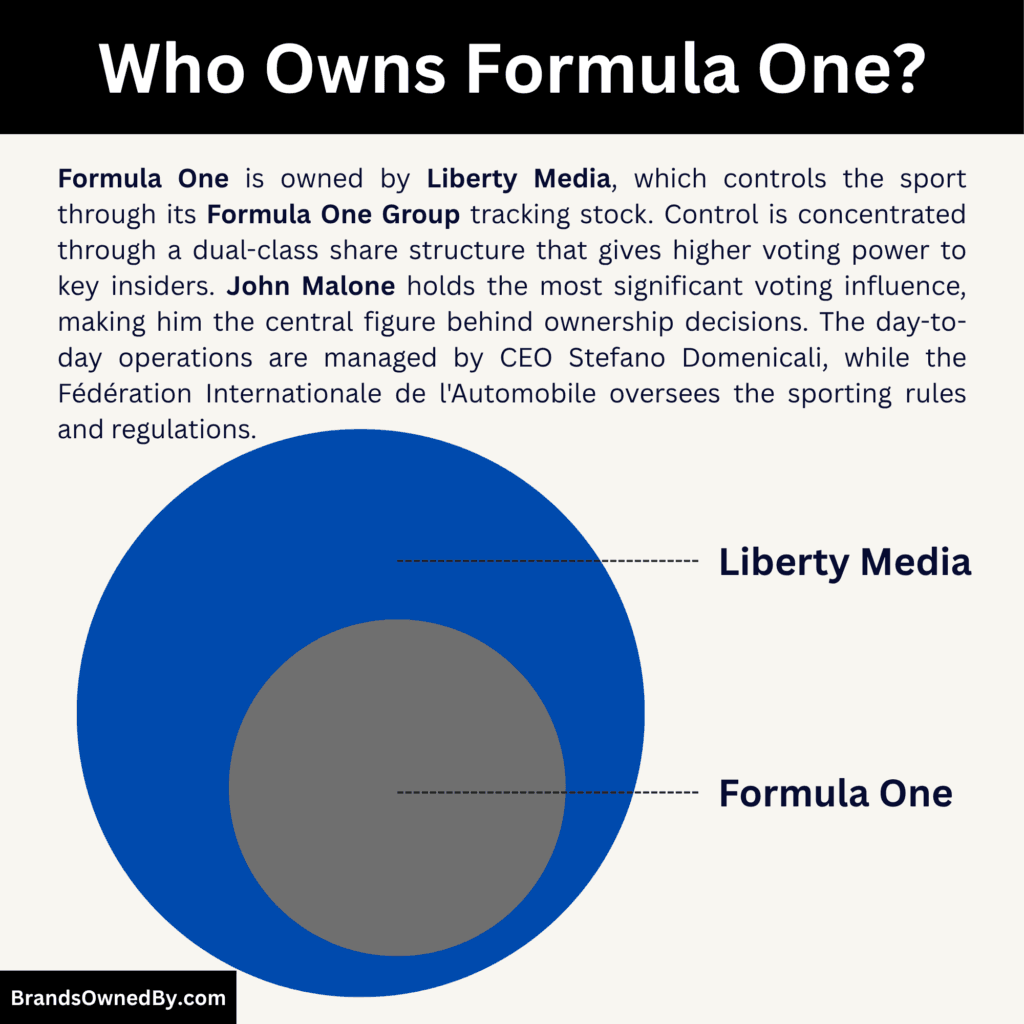
Formula One is owned by Liberty Media. It is not owned by a single person or a racing team.
As of April 2026, Formula One operates under Liberty Media’s Formula One Group tracking stock. This structure allows investors to invest specifically in the F1 business. However, ownership and control are not the same.
Liberty Media is the legal owner. Its shareholders indirectly own Formula One. But control is concentrated among key insiders due to a special share structure.
Liberty Media Corporation
Liberty Media is the legal owner of Formula One. It is a diversified media company with interests in live sports, entertainment, and broadcasting.
Liberty Media acquired Formula One in 2017. The goal was to transform the sport into a modern global media business. Since then, the company has focused on expanding the sport’s audience, especially in the United States, and strengthening its digital ecosystem.
The company uses a tracking stock model. Formula One Group is one of its primary tracking stocks. This structure allows Liberty Media to separate the financial performance of F1 from its other assets while keeping full ownership.
Under this model:
- Formula One has its own financial reporting
- Investors can target F1-specific growth
- Liberty Media retains strategic and operational control.
Liberty Media does not run races directly. Instead, it owns the commercial rights. These include broadcasting deals, sponsorship agreements, and race promotion contracts. This is where the majority of Formula One’s business value lies.
The most important aspect of Formula One ownership is the share structure used by Liberty Media.
The company operates a multi-class share system:
- Series A shares: Publicly traded with standard voting rights
- Series C shares: Publicly traded with no voting rights
- Series B shares: High-voting shares held by insiders.
This structure separates economic ownership from control.
For example:
- Public investors may collectively own a large percentage of the company
- But insiders holding Series B shares control a majority of voting power.
This ensures that strategic decisions remain centralized. It prevents short-term market pressures from disrupting long-term plans.
John Malone
John Malone is the most influential individual behind Formula One’s ownership.
As of 2026, Malone holds the highest voting power within Liberty Media. His influence comes from high-voting shares, not just the number of shares he owns.
This distinction is important. Many investors may own more shares economically, but Malone controls a larger percentage of votes. This gives him effective control over major corporate decisions.
Malone is known for building and structuring media empires. His approach focuses on long-term value creation, strategic acquisitions, and efficient capital allocation.
Even after stepping back from day-to-day leadership roles, he remains a central figure in shaping Liberty Media’s direction. This includes decisions related to Formula One’s expansion, partnerships, and overall strategy.
Public and Institutional Shareholders
Because Liberty Media is publicly traded, a large portion of its ownership is held by institutional and retail investors.
Major institutional investors include firms such as Vanguard, BlackRock, and State Street. These firms manage trillions of dollars in assets and invest in Liberty Media through index funds and actively managed portfolios.
Their role is primarily financial:
- They provide capital and liquidity
- They benefit from stock price appreciation
- They participate in shareholder voting.
However, their influence is limited. Most institutional investors hold low-voting shares. This means they cannot easily influence strategic decisions or leadership appointments.
Retail investors also own a portion of Liberty Media shares. These are individual investors who gain exposure to Formula One through stock ownership. Like institutions, their control is minimal due to the share structure.
Competitor Ownership Comparison
Formula One is owned by Liberty Media, making it the only major global motorsport series controlled by a publicly traded media corporation. This ownership model is fundamentally different from its competitors, which are mostly privately held, family-controlled, or backed by investment groups.
As of April 2026, this distinction shapes how each motorsport operates, grows, and monetizes its audience. Formula One functions as a global media business with centralized commercial rights, while most competitors operate under more traditional or privately controlled structures.
| Motorsport Series | Owner | Ownership Type | Control Structure | Key 2026 Details |
|---|---|---|---|---|
| Formula One | Liberty Media | Public (tracking stock) | Centralized under Liberty Media with dual-class shares | Only major motorsport owned by a publicly traded media company; global media-driven model with strong capital access |
| NASCAR | NASCAR (France family) | Private (family-owned) | Direct family control | Fully controlled by the France family; unified structure after ISC merger; no public investors |
| MotoGP | Dorna Sports | Private (private equity-backed) | Centralized under Dorna management | Owned by investors like Bridgepoint and CPP Investments; controls all commercial rights since 1992 |
| IndyCar | Penske Corporation | Private (corporate-owned) | Controlled by Roger Penske | Acquired in 2020; integrated with Indianapolis Motor Speedway; centralized leadership |
| Formula E | Private investors + FIA partnership | Hybrid (private + governance) | Shared influence between investors and FIA | Backed by investors including Liberty Global; FIA plays strong regulatory role |
| WEC | FIA + ACO | Governing body-led | Regulatory and organizer-driven | No centralized commercial owner; operates as a traditional championship |
NASCAR
NASCAR follows a long-standing family ownership model. The sport is controlled by the France family, which has retained ownership since its founding in 1948.
Over time, NASCAR has consolidated its operations. A major milestone came in 2019 when NASCAR acquired International Speedway Corporation, a company also controlled by the France family. This move unified race promotion, track ownership, and sanctioning under one structure.
As of 2026, NASCAR operates as a fully private entity. There are no public shareholders, and financial disclosures are limited. The France family maintains direct control over strategic decisions, scheduling, media rights negotiations, and commercial partnerships.
This structure provides stability and consistency. However, it also limits NASCAR’s ability to raise capital compared to Formula One. While Formula One can leverage public equity markets through Liberty Media, NASCAR relies on internal cash flow and private financing.
MotoGP
MotoGP is commercially controlled by Dorna Sports, which has held exclusive rights to the championship since 1992.
Dorna operates as a private company. Its ownership includes private equity firms such as Bridgepoint and long-term institutional investors like CPP Investments. These investors focus on steady returns and long-term value creation.
As of 2026, Dorna manages all commercial aspects of MotoGP. This includes global broadcasting agreements, sponsorship deals, and race promotion contracts. The company has successfully expanded MotoGP’s international presence, particularly in Europe and Asia.
However, unlike Formula One, MotoGP does not operate under a public market structure. It does not have a tracking stock or a broad shareholder base. This limits transparency and access to large-scale capital.
While MotoGP is highly professional and globally recognized, its ownership model is more traditional. It relies on private investment rather than public market participation.
IndyCar
IndyCar is owned by Penske Corporation, which is controlled by Roger Penske.
Penske acquired IndyCar and the Indianapolis Motor Speedway in 2020. This acquisition brought the entire ecosystem of the series under one ownership group. It included race operations, event promotion, and one of the most iconic venues in motorsport.
As of 2026, IndyCar operates as part of Penske’s broader business portfolio, which includes transportation, logistics, and automotive services. This integration allows for operational efficiency and unified decision-making.
The ownership model is highly centralized. Roger Penske has direct influence over strategy, partnerships, and long-term planning. This allows for quick decisions and strong leadership alignment.
However, IndyCar does not have the same global scale as Formula One. Its ownership structure does not provide access to public capital markets or the same level of international commercial expansion.
Formula E
Formula E operates under a hybrid ownership model that combines private investment with regulatory partnership.
The series was launched with backing from private investors and has since attracted strategic stakeholders. It works closely with the Fédération Internationale de l’Automobile, which governs the sporting regulations.
As of 2026, Formula E includes investment from companies such as Liberty Global and other institutional partners. These investors support the growth of electric racing and sustainable motorsport.
Unlike Formula One, Formula E does not separate ownership and governance as clearly. The FIA plays a more visible role in shaping the championship, although it does not directly own the commercial rights in the same way Liberty Media owns Formula One.
This hybrid structure allows Formula E to innovate and grow in emerging markets. However, it does not yet match the scale, financial power, or global reach of Formula One.
World Endurance Championship (WEC)
The FIA World Endurance Championship is co-organized by the FIA and the Automobile Club de l’Ouest (ACO). It represents a more traditional motorsport structure.
As of 2026, WEC does not operate under a centralized commercial owner like Formula One. Instead, it is governed by regulatory bodies and event organizers working together.
This model prioritizes sporting integrity and manufacturer participation. It is less focused on centralized commercial control or global media monetization.
As a result, WEC has a different business profile. It relies more on manufacturer involvement and race event revenues rather than large-scale media rights deals.
Who Controls Formula One?
Control of Formula One is not held by a single person or organization. It operates under a layered governance model where commercial control, operational execution, and sporting regulation are clearly separated. As of April 2026, the sport is strategically controlled by Liberty Media, operationally managed by Formula One’s executive leadership, and regulated by the Fédération Internationale de l’Automobile (FIA).
This structure ensures that no single stakeholder has absolute authority. Instead, control is distributed across defined roles, which allows Formula One to scale globally while maintaining sporting integrity.
Liberty Media: Strategic Control and Board Authority
At the highest level, Liberty Media exercises strategic and financial control over Formula One.
Liberty Media owns the commercial rights to Formula One and operates it through the Formula One Group tracking stock. This gives the company full authority over the business side of the sport. It decides how Formula One grows, where it expands, and how it monetizes its global audience.
As of 2026, Liberty Media’s influence is exercised through its board of directors and senior leadership. Major decisions such as entering new markets, approving long-term race agreements, and negotiating high-value media rights deals are made at this level.
A key factor in this control is Liberty Media’s dual-class share structure. High-voting shares are concentrated among insiders, with John Malone holding the largest voting influence. This allows Liberty Media to maintain a consistent long-term strategy without being disrupted by short-term shareholder pressures.
In practical terms, Liberty Media sets the direction. It does not run races or manage teams, but it controls the economic engine of Formula One.
Formula One Management: Executive and Operational Control
Day-to-day control of Formula One is handled by its executive leadership team.
The current CEO is Stefano Domenicali, who has been leading the organization since 2021 and continues in this role as of April 2026. Domenicali is responsible for executing Liberty Media’s strategy and managing the global operations of the sport.
Under his leadership, Formula One has expanded aggressively in key markets, particularly the United States. The addition of races such as the Miami Grand Prix and Las Vegas Grand Prix reflects a deliberate push to increase commercial value and audience reach.
Domenicali oversees all major business functions. This includes negotiating race hosting agreements, managing relationships with teams and sponsors, and expanding digital platforms like F1 TV. He also plays a central role in shaping Formula One’s brand positioning as a global entertainment product.
Supporting him is a structured executive team responsible for commercial rights, media distribution, marketing, and legal operations. This corporate setup reflects Formula One’s transformation into a modern media-driven organization rather than just a racing series.
FIA: Sporting Governance and Regulatory Authority
While Liberty Media controls the business, the sporting side of Formula One is governed by the Fédération Internationale de l’Automobile.
The FIA is responsible for all technical and sporting regulations. It defines how the sport is run on track, including car specifications, race procedures, safety standards, and compliance rules.
As of 2026, the FIA also plays a central role in shaping long-term technical direction. This includes hybrid engine regulations, sustainability initiatives, and cost control measures such as the budget cap.
Importantly, Liberty Media cannot unilaterally change the rules of the sport. Any regulatory changes must go through FIA governance structures. This separation ensures fairness and prevents commercial interests from overriding sporting integrity.
Formula One Commission: Shared Decision-Making
Another critical layer of control is the Formula One Commission.
This body brings together key stakeholders, including the FIA, Formula One management, and the teams. It acts as a formal decision-making platform for major changes to the sport.
The Commission reviews and votes on:
- Sporting regulations
- Technical rules
- Financial frameworks such as cost caps
As of 2026, this system ensures that teams have a voice in how the sport evolves. However, decisions are structured and require formal approval processes, preventing any single group from dominating outcomes.
This governance model balances interests between commercial growth, competitive fairness, and team sustainability.
Role of Teams and Competitive Influence
Formula One teams do not own the sport, but they play an important role in influencing decisions.
Teams such as Ferrari, Mercedes, and Red Bull are key stakeholders. Their participation is essential to the sport’s success, and they are involved in discussions around regulations, revenue distribution, and long-term strategy.
Some teams also have historical agreements that give them additional influence. Ferrari, for example, has long held a unique position due to its legacy within the sport.
However, this influence is structured and limited. Teams cannot independently control Formula One. Their role is advisory and participatory within formal governance systems like the Commission.
Evolution from Centralized to Corporate Control
Control of Formula One has changed significantly over time.
During the late 20th century, Bernie Ecclestone exercised near-total control over the commercial side of the sport. He personally negotiated television deals and race contracts, effectively acting as the central authority.
After Liberty Media’s acquisition in 2017, this model shifted to a corporate governance structure. Leadership became more distributed, and decision-making moved into formal boardrooms and executive teams.
Chase Carey led the initial transition phase. He focused on restructuring the business and improving transparency. Stefano Domenicali later continued this evolution with a stronger focus on global expansion and fan engagement.
As of 2026, Formula One operates like a major international media company, with defined roles and institutional control.
How Control Works in Reality
In practice, control of Formula One is coordinated across all levels.
Liberty Media defines long-term strategy and financial priorities. Formula One management executes these strategies through operations, partnerships, and market expansion. The FIA ensures that all sporting aspects remain fair, regulated, and safe.
This multi-layered system allows Formula One to operate efficiently at a global scale. It also ensures that commercial growth does not compromise the integrity of the sport.
Formula One Annual Revenue and Net Worth
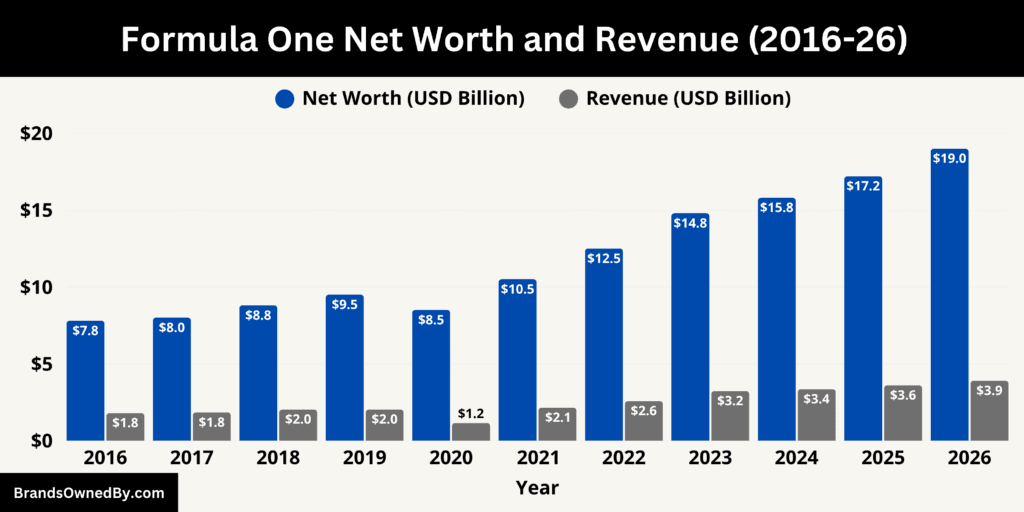
As of April 2026, Formula One has reached its strongest financial position in history under Liberty Media. The sport generated approximately $3.9 billion in revenue in 2025, and its valuation has climbed to around $19 billion as of April 2026. This growth is not incidental. It is driven by long-term contracts, premium race pricing, and rising global demand for live sports content.
Revenue Structure and Breakdown (2026)
Formula One’s revenue is divided into three primary segments, each contributing significantly to the total.
The largest segment is media rights, generating approximately $1.3 billion annually. These are long-term contracts with broadcasters and streaming platforms across major markets such as the United States, Europe, and Asia. Recent increases in U.S. viewership and global demand have pushed rights values higher, making this the most stable and high-margin revenue stream.
The second major segment is race promotion revenue, contributing around $1.7 billion. This comes from fees paid by host cities and governments to secure a place on the Formula One calendar. These contracts typically span multiple years and include annual fee escalations. Premium events such as Las Vegas command significantly higher fees than traditional races, increasing the overall average revenue per race.
The third core segment is sponsorship and advertising, which generates approximately $900 million annually. This includes global partnerships, trackside branding, and official sponsorship deals. Growth in this segment is driven by increased global viewership and strong demand from industries such as technology, finance, and luxury goods.
Additional revenue streams, including hospitality (Paddock Club), licensing, and digital platforms like F1 TV, contribute several hundred million dollars annually. These segments are growing faster than traditional revenue streams due to higher margins and direct-to-consumer models.
Profitability and Financial Efficiency
Formula One is not only growing revenue but also improving profitability.
As of 2025, operating income exceeded $630 million, while adjusted operating profit approached $950 million. This reflects strong cost control and high-margin revenue streams, particularly in media rights.
A significant portion of revenue is shared with teams under the Concorde Agreement. In 2025, approximately $1.4 billion was distributed to teams. Despite this, Formula One retains substantial operating margins due to its centralized commercial structure.
The cost cap introduced in recent years has also improved financial sustainability across the sport. Teams are now more financially stable, which reduces risk and ensures long-term participation.
Net Worth and Valuation Growth (2016–2026)
Formula One’s valuation has more than doubled since its acquisition by Liberty Media.
In 2016, the sport was valued at under $8 billion. After Liberty Media’s acquisition in 2017 for approximately $8 billion, the focus shifted toward long-term growth, digital expansion, and market diversification.
By 2023, valuation had crossed $14 billion. Continued expansion in the United States, combined with record revenues in 2024 and 2025, pushed the valuation to approximately $19 billion as of April 2026.
This increase is supported by:
- Long-term media contracts with escalating fees
- High-value race hosting agreements
- Strong global audience growth
- Increased sponsorship demand.
Formula One is now valued similarly to major global sports leagues, reflecting its position as a premium live content provider.
Future Revenue Forecast (2027–2030)
Formula One’s revenue growth through 2030 is grounded in contractual escalation, pricing power, and structural expansion under Liberty Media. Unlike many sports leagues that rely on uncertain growth drivers, Formula One already has a large portion of its future income locked in through long-term agreements.
A key factor is that most race hosting contracts include annual fee escalations of 3% to 5%, while media rights deals are renegotiated at significantly higher values as viewership increases. This creates a compounding effect on total revenue.
- 2027: $4.2 billion
- 2028: $4.5 billion
- 2029: $4.8 billion
- 2030: $5.2 billion.
By 2027, revenue growth will be driven primarily by media rights repricing, especially in the United States, where Formula One’s popularity has surged. Current broadcast deals are expected to reset at higher valuations, reflecting increased demand from both traditional networks and streaming platforms.
In 2028, growth will come from higher per-race economics rather than calendar expansion. Formula One is already operating near its maximum number of races, so revenue increases will depend on charging more for each event. Premium races such as Las Vegas and Miami will continue to lift the average race fee significantly.
By 2029, Formula One’s business model will be operating at full scale. At this stage, sponsorship revenue and digital income will become more important contributors. Global brands are increasing their spending in Formula One due to its younger audience and global reach, while platforms like F1 TV are expected to generate higher subscription revenue.
In 2030, revenue is projected to exceed $5.2 billion. This will coincide with the final phase of the current Concorde Agreement cycle, where team cost controls, revenue sharing, and commercial rights are fully optimized. At this point, Formula One will be generating more than double the revenue it produced before Liberty Media’s acquisition.
Brands Owned by Formula One
Formula One operates through a group of tightly integrated entities that manage its commercial rights, media distribution, logistics, and fan engagement. As of 2026, these companies and brands are not independent acquisitions in the traditional sense. Instead, they are structured subsidiaries and operating units under the Formula One Group, controlled by Liberty Media.
Each entity plays a specific role in monetizing the sport globally, from broadcasting and race promotion to hospitality and digital platforms.
| Entity / Brand | Type | Core Function | Key Details |
|---|---|---|---|
| Formula One Management | Commercial Entity | Manages commercial rights | Controls broadcasting, sponsorships, and race promotion; produces global race feed and distributes revenue |
| Formula One Administration | Administrative Entity | Legal and contractual management | Handles agreements with teams, sponsors, and race promoters; ensures governance compliance |
| Formula One Licensing BV | Licensing Entity | Brand licensing and IP monetization | Manages global licensing deals for merchandise, games, and branded products |
| F1 TV | Digital Platform | Streaming and direct-to-consumer media | Subscription-based service offering live races, onboard cameras, and exclusive content |
| F1 Experiences | Hospitality Division | Premium fan experiences | Sells VIP packages including paddock access, pit lane walks, and exclusive event access |
| Paddock Club | Premium Brand | High-end hospitality | Luxury trackside experience with VIP access, dining, and team interaction; major high-margin revenue source |
| F1 Authentics | E-commerce Platform | Memorabilia and collectibles | Sells race-used items, signed gear, and limited-edition collectibles |
| Formula 2 (F2) | Racing Series | Driver development | Primary feeder series to Formula One; races alongside F1 weekends |
| Formula 3 (F3) | Racing Series | Entry-level development | Junior category below F2; develops young drivers within F1 ecosystem |
| Formula One Digital Media | Media Division | Digital content and audience growth | Manages website, apps, and social platforms; drives engagement and ad revenue |
| F1 Arcade | Experiential Brand | Location-based entertainment | Physical venues with simulators, food, and interactive F1 experiences |
| Formula One Logistics (Operations) | Operational Unit | Global event logistics | Coordinates transport of cars and equipment worldwide; critical for race calendar execution |
Formula One Management (FOM)
Formula One Management is the core commercial engine of Formula One.
FOM controls all commercial rights to the sport. This includes broadcasting agreements, sponsorship deals, and race promotion contracts. Every Grand Prix is commercially managed through FOM, which negotiates hosting fees with race organizers and governments.
It is responsible for distributing television feeds worldwide. It produces the official race broadcast and supplies it to global broadcasters. This centralized production model ensures consistency and allows Formula One to maintain control over its global media product.
FOM is also responsible for revenue distribution to teams under the Concorde Agreement. This makes it one of the most critical entities in the Formula One ecosystem.
Formula One Administration (FOA)
Formula One Administration handles the legal and contractual framework of the sport.
FOA manages agreements with teams, sponsors, and race promoters. It ensures compliance with long-term contracts and supports governance structures within Formula One.
This entity works closely with FOM but focuses more on regulatory, financial, and administrative responsibilities rather than commercial execution.
Formula One Licensing BV
Formula One Licensing BV manages the global licensing of the Formula One brand.
This entity oversees the use of Formula One trademarks across merchandise, video games, apparel, and consumer products. Licensing agreements allow third-party companies to produce official Formula One products while paying royalties.
This business has grown significantly due to increased global fan engagement. Products range from clothing collaborations to collectibles and gaming partnerships, making licensing a key revenue stream beyond racing.
F1 TV
F1 TV is Formula One’s official direct-to-consumer streaming platform.
Launched to reduce reliance on traditional broadcasters, F1 TV offers live race coverage, onboard cameras, team radios, and exclusive content. It operates on a subscription model and is available in multiple countries.
As of 2026, F1 TV is a major growth driver. It allows Formula One to capture data on viewers, increase engagement, and generate recurring revenue directly from fans.
The platform also supports multiple languages and advanced features, positioning it as a premium digital product in global sports streaming.
F1 Experiences
F1 Experiences is the official hospitality and fan experience division of Formula One.
This entity sells premium packages that include paddock access, pit lane walks, driver meet-and-greets, and VIP seating. These packages are priced significantly higher than standard tickets and are targeted at corporate clients and high-net-worth individuals.
F1 Experiences has become a major revenue contributor, especially at high-profile races such as Monaco, Miami, and Las Vegas. It also plays a key role in positioning Formula One as a luxury entertainment brand.
Paddock Club
The Paddock Club is Formula One’s flagship hospitality product.
It operates as a premium trackside experience offering exclusive views, fine dining, and direct access to teams and drivers. It is managed under the broader F1 Experiences structure but functions as a distinct high-end brand.
The Paddock Club generates substantial per-event revenue. Tickets can cost several thousand dollars per race weekend, making it one of the most profitable segments of Formula One’s business.
F1 Authentics
F1 Authentics is the official memorabilia and collectibles platform of Formula One.
It sells race-used items, signed merchandise, and limited-edition collectibles. These include car parts, driver gear, and exclusive auction items.
This platform taps into the growing demand for sports memorabilia. It also creates a direct connection between fans and the sport by offering unique, authenticated products.
Formula 2 (F2)
Formula 2 is a junior racing series owned and operated by Formula One.
It serves as the primary feeder series for Formula One, developing young drivers and preparing them for the top level of motorsport. F2 races take place alongside Formula One weekends, giving drivers exposure to teams and audiences.
Although it operates as a separate championship, it is fully integrated into the Formula One ecosystem and supports its long-term talent pipeline.
Formula 3 (F3)
Formula 3 is another junior category under Formula One.
It sits below Formula 2 and acts as an entry point for young drivers progressing through single-seater racing. Like F2, it runs alongside Formula One events and is managed within the same commercial structure.
F3 strengthens Formula One’s development system and ensures a continuous flow of talent into the sport.
Formula One Digital Media
Formula One Digital Media manages the sport’s digital presence.
This includes official websites, mobile apps, social media platforms, and content production. It plays a critical role in audience growth, especially among younger demographics.
As of 2026, Formula One has one of the fastest-growing digital audiences in sports. This entity is responsible for monetizing that audience through advertising, subscriptions, and partnerships.
F1 Arcade
F1 Arcade is a newer experiential entertainment concept linked to Formula One.
It combines racing simulators, food, and entertainment in physical venues. These locations are designed to bring the Formula One experience to urban audiences outside of race weekends.
While still expanding, F1 Arcade represents Formula One’s move into location-based entertainment and experiential branding.
Formula One Logistics
Formula One’s global logistics operations are managed through partnerships but function as a core operational unit.
The sport transports cars, equipment, and infrastructure across continents for each race. This is one of the most complex logistics operations in sports.
Although supported by partners like DHL, the coordination and planning are centrally managed within Formula One’s operational structure.
Conclusion
Understanding who owns Formula One comes down to its unique structure. The sport is owned by Liberty Media, but control is shared across its leadership, management, and governing body. This setup allows Formula One to grow as a global business while keeping the sport regulated and competitive.
Over time, Formula One has evolved from a fragmented racing series into a centralized, media-driven platform. Its ownership model supports long-term stability, consistent decision-making, and global expansion, making it one of the most influential sports properties in the world.
FAQs
Who owns Formula One Autocentres?
Formula One Autocentres is not related to Formula One racing. It is a UK-based car service and repair company owned by Halfords Group.
Who owns Formula 1 racing?
Formula 1 racing is owned by Liberty Media through the Formula One Group tracking stock. Shareholders of Liberty Media indirectly own the sport.
When did Formula One start?
Formula One officially started in 1950, when the Fédération Internationale de l’Automobile organized the first Formula One World Championship.
Who runs Formula 1?
Formula 1 is run by its executive team led by CEO Stefano Domenicali. The business is managed by Formula One Group, while the FIA governs the sporting rules.
What company owns Formula 1 now?
As of 2026, Formula 1 is owned by Liberty Media.
Does Bernie Ecclestone still own F1?
No, Bernie Ecclestone does not own Formula One. He previously controlled its commercial rights but stepped down after Liberty Media acquired the sport in 2017.
Did Vijay Mallya own F1?
Vijay Mallya did not own Formula One. He owned the Force India Formula One team, which competed in the sport but did not control it.
Who owned F1 before Liberty Media?
Before Liberty Media, Formula One was primarily owned by CVC Capital Partners, which held the majority stake from 2006 to 2017.