
- Dairy Queen is a privately held company fully owned by Berkshire Hathaway, which acquired 100% of the brand in 1998 in an all-cash deal, making Dairy Queen a wholly owned subsidiary with no public shareholders.
- All ownership control sits at the parent-company level, meaning Dairy Queen does not issue its own stock and is not listed on any stock exchange, allowing it to operate without public market pressure.
- Berkshire Hathaway’s largest individual shareholder is Warren Buffett, whose long-term ownership philosophy shapes Dairy Queen’s stable, franchise-focused strategy rather than short-term performance goals.
Dairy Queen is a global quick-service restaurant brand that operates at the intersection of frozen desserts and fast food. The brand is best known for its soft-serve ice cream, blended treats, and casual dining menu. From its earliest days, Dairy Queen differentiated itself through product consistency and a franchise-first growth strategy. This approach allowed the brand to scale rapidly while maintaining local ownership at the store level.
Today, Dairy Queen functions as a franchise-driven system where corporate leadership focuses on brand standards, menu innovation, marketing, and supply chain coordination. Individual franchise owners handle daily operations, staffing, and local market execution. This balance has helped Dairy Queen remain resilient through changing consumer preferences and competitive pressures.
The brand has also evolved beyond its original seasonal identity. Modern Dairy Queen locations operate year-round and emphasize a broader menu that includes hot food, desserts, and beverages. Its adaptability and strong brand recognition have allowed it to remain relevant across multiple generations.
Dairy Queen Founders
Dairy Queen was founded through the combined efforts of John Fremont “J.F.” McCullough, his son Alex McCullough, and business partner Sherb Noble.
The foundation of the company lies in the McCulloughs’ experimentation with a soft-serve ice cream formula that could be served at warmer temperatures than traditional ice cream. This innovation allowed for faster service and a smoother texture, which proved immediately popular with customers.
Sherb Noble, who owned an ice cream shop in Illinois, played a critical role by providing a real-world testing ground for the product. The overwhelming customer response confirmed the commercial potential of soft serve as a standalone business concept. This led to the decision to open a dedicated Dairy Queen store rather than selling the product through third-party retailers.
The founders prioritized franchising from the beginning. Instead of expanding through company-owned stores, they focused on empowering local entrepreneurs. This strategy accelerated growth, reduced capital requirements, and embedded Dairy Queen into local communities across the United States.
Major Milestones
- 1938: J.F. McCullough and Alex McCullough develop a soft-serve ice cream formula and begin testing it with Sherb Noble at his Illinois ice cream shop
- 1940: The first official Dairy Queen store opens in Joliet, Illinois, establishing the brand as a standalone business
- 1941: Dairy Queen begins franchising, allowing independent operators to open locations under the brand name
- 1947: The brand surpasses 100 locations, proving the scalability of the franchise model
- 1950: Dairy Queen grows to over 1,400 stores across the United States
- 1951: Banana splits are introduced, marking early menu diversification beyond cones
- 1953: Dairy Queen opens its first international location in Canada, beginning global expansion
- 1955: The Dilly Bar is launched and becomes a permanent menu staple
- 1957: The Dairy Queen Brazier concept is introduced, adding hot food items to the menu
- 1962: International Dairy Queen, Inc. is formed to manage brand standards and international growth
- 1967: Dairy Queen expands further into global markets outside North America
- 1979: The brand enters the Middle East, strengthening its international presence
- 1985: The Blizzard treat is introduced and quickly becomes one of Dairy Queen’s most iconic products
- 1988: Dairy Queen acquires the Orange Julius brand, expanding into fruit-based beverages
- 1995: Dairy Queen begins updating store designs to support year-round operations
- 1998: Dairy Queen is acquired by Berkshire Hathaway, placing the brand under long-term private ownership
- 2001: The Grill & Chill restaurant format is launched, combining desserts with a full hot-food menu
- 2005: Dairy Queen accelerates international franchising in Asia and Latin America
- 2010: The brand focuses on modernizing menus and improving franchisee support systems
- 2015: Digital ordering and loyalty initiatives begin rolling out across select markets
- 2020: Dairy Queen adapts operations to support off-premise dining and delivery models
- 2023: Continued emphasis on store remodels and streamlined menus to meet changing consumer preferences
- 2025: Dairy Queen operates as a mature global franchise brand with a strong focus on consistency, innovation, and franchise growth.
Who Owns Dairy Queen?
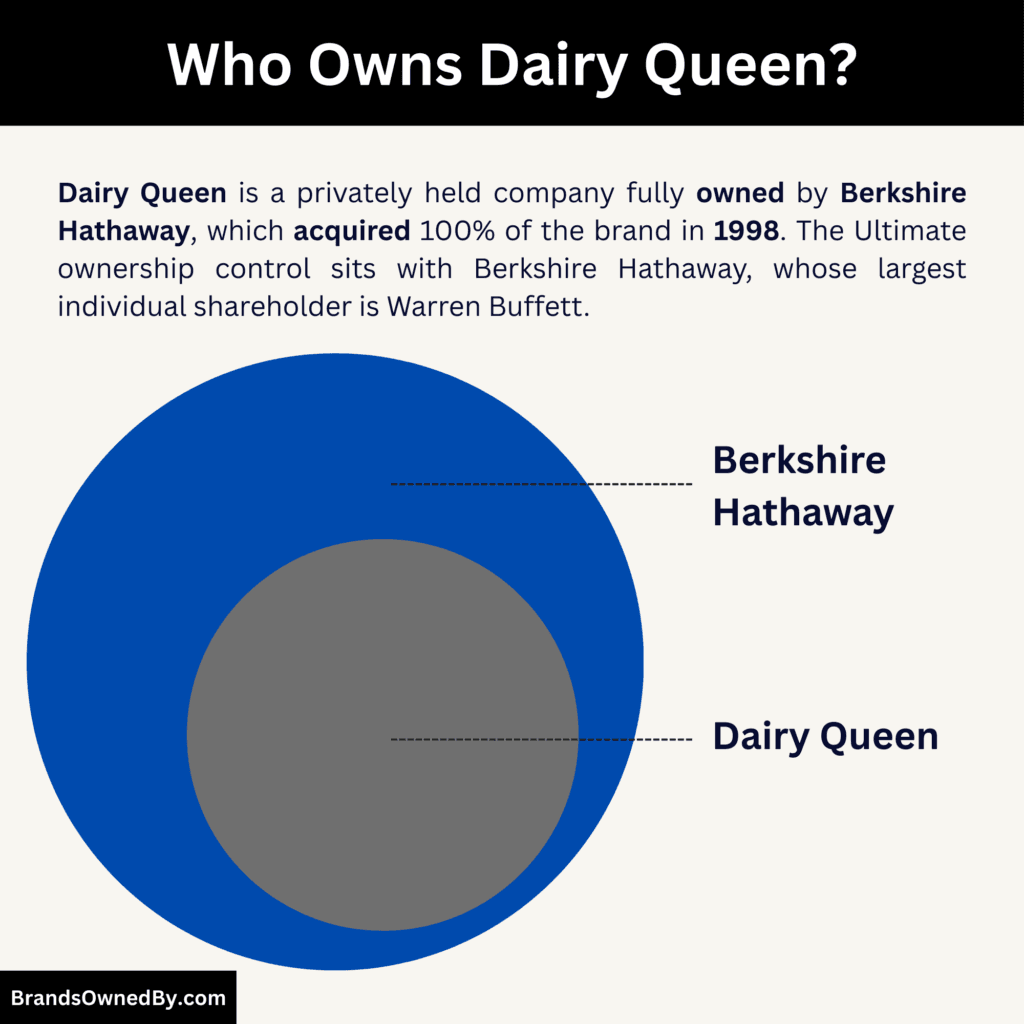
Dairy Queen is wholly owned by Berkshire Hathaway.
Berkshire Hathaway acquired Dairy Queen in 1998 through its subsidiary Berkshire Hathaway Inc. Since the acquisition, Dairy Queen has remained a fully owned, privately held subsidiary.
The acquisition aligned with Berkshire’s long-term investment philosophy. The conglomerate focuses on stable, cash-generating consumer brands with strong franchising economics and durable customer loyalty.
This ownership structure allows Dairy Queen to focus on long-term brand growth, franchise stability, and operational consistency without the pressure of quarterly earnings or market volatility.
Here’s a quick summary of Dairy Queen’s ownership:
- Company Name: Dairy Queen
- Ownership Status: Privately held
- Parent Company: Berkshire Hathaway
- Year Acquired: 1998
- Acquisition Value: $585 million (all-cash deal)
- Ownership Stake: 100% owned by Berkshire Hathaway
- Public Listing: Not publicly traded
- Business Model: Franchise-based restaurant system
- Operational Control: Managed by Dairy Queen’s executive team
- Ultimate Owner Influence: Warren Buffett (the largest individual shareholder of the parent company)
- Ownership Stability: No spin-offs, sell-downs, or IPO plans since acquisition.
Parent Company of Dairy Queen
Dairy Queen is wholly owned by Berkshire Hathaway. It operates as a private subsidiary and is not publicly traded. Dairy Queen has no direct public shareholders and does not issue its own stock.
Berkshire Hathaway owns Dairy Queen outright and retains full ownership control. However, Dairy Queen is not run as an integrated division within the conglomerate. It functions as an independent operating company with its own executive leadership, corporate headquarters, brand strategy, and franchise governance.
Berkshire Hathaway follows a decentralized ownership model. It does not involve itself in Dairy Queen’s daily operations, menu development, marketing execution, or franchise management. These responsibilities remain with Dairy Queen’s internal leadership team. Berkshire’s role is limited to ownership, capital support when needed, and high-level oversight.
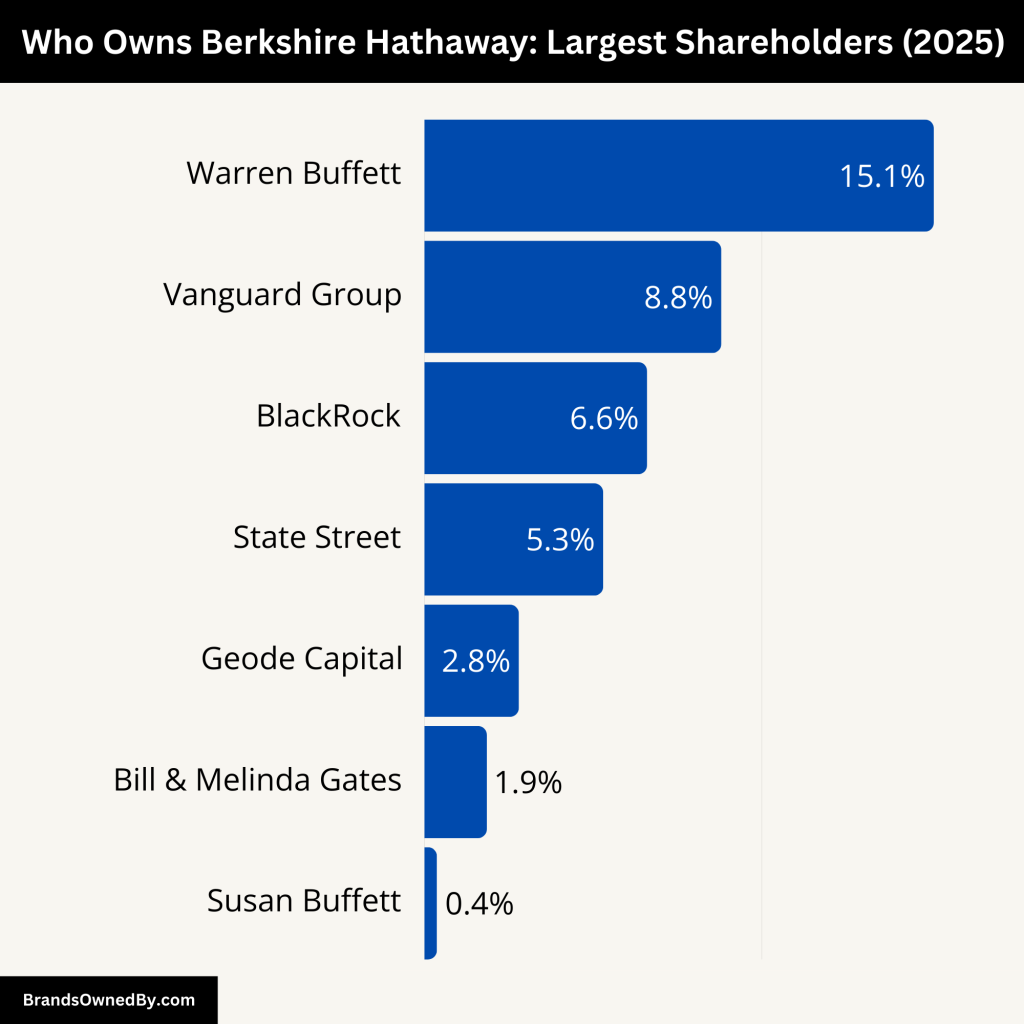
While Dairy Queen itself is privately held, its parent company, Berkshire Hathaway, is publicly traded. Ownership of Berkshire Hathaway is concentrated among long-term institutional investors and its founder-led leadership.
Warren Buffett is the largest individual shareholder of Berkshire Hathaway. He serves as Chairman and CEO and holds significant voting power, giving him substantial influence over the company’s long-term strategy and capital allocation decisions.
Other major shareholders of Berkshire Hathaway include large institutional investors such as BlackRock and Vanguard Group. These firms hold sizeable stakes on behalf of index funds, mutual funds, and long-term investors. Their role is primarily passive, with no involvement in day-to-day management.
Acquisition of Dairy Queen by Berkshire Hathaway
Berkshire Hathaway acquired Dairy Queen in 1998 in an all-cash transaction valued at $585 million. The deal resulted in Berkshire Hathaway purchasing 100% ownership of Dairy Queen and taking the company fully private.
At the time of the acquisition, Dairy Queen was already a well-established franchise brand with thousands of locations, a mature franchising system, and strong brand recognition in the United States and international markets. The purchase was not a turnaround acquisition and was not driven by operational distress or declining demand.
The transaction structure was straightforward. Berkshire Hathaway bought Dairy Queen outright rather than acquiring a minority stake or forming a joint venture. Dairy Queen became a wholly owned subsidiary and ceased to have any public or external shareholders after the deal closed.
Following the acquisition, Berkshire Hathaway did not merge Dairy Queen with any other food or restaurant businesses. Dairy Queen retained its corporate structure, leadership team, franchise agreements, and brand identity. The franchising model remained unchanged, and store ownership continued to rest primarily with independent franchisees.
Berkshire Hathaway did not impose centralized operational control after the acquisition. Dairy Queen continued to manage menu development, store formats, marketing strategy, and international expansion internally. Berkshire’s involvement remained limited to ownership and long-term oversight rather than day-to-day management.
Since 1998, Dairy Queen has remained under uninterrupted Berkshire Hathaway ownership. There have been no partial sell-downs, spin-offs, or public listing plans. The brand continues to operate as a permanent, fully owned subsidiary within Berkshire Hathaway’s portfolio.
Role of Warren Buffett in Dairy Queen Ownership
Warren Buffett is the Chairman and CEO of Berkshire Hathaway and the largest individual shareholder of the parent company.
Buffett does not manage Dairy Queen’s daily operations. However, his investment philosophy directly influences the brand’s long-term positioning. He favors companies with strong brand identity, repeat customers, and franchising advantages. Dairy Queen fits this profile closely.
Buffett has publicly highlighted Dairy Queen as an example of a business with enduring customer loyalty and simple, understandable operations.
Who is the CEO of Dairy Queen?
The CEO of Dairy Queen is Troy Bader.
Troy Bader serves as the President and Chief Executive Officer of International Dairy Queen, Inc., the corporate entity that owns and operates the Dairy Queen brand. He leads the company’s global strategy, franchise relations, operations, and brand initiatives.
Bader reports within the ownership structure of Berkshire Hathaway but has operational autonomy to guide Dairy Queen’s growth and strategic direction.
Bader oversees more than 7,700 Dairy Queen locations worldwide and manages efforts related to menu innovation, franchise development, and international expansion.
Under his leadership, the company has emphasized consistency in brand execution, modernization of restaurant formats, and expanding the chain’s global footprint.
Career Background and Leadership Path
Troy Bader’s career at Dairy Queen spans over two decades. He joined the company in 2001 and served in various executive roles before being appointed Chief Operating Officer in 2011. In this capacity, Bader was responsible for core corporate functions including marketing, operations, franchise development, and supply chain management.
He succeeded John Gainor as President and CEO effective January 1, 2018, following a planned leadership transition and endorsement from Gainor. Bader’s promotion reflected his deep experience within Dairy Queen’s franchise system and his understanding of the brand’s operational complexity.
Before joining Dairy Queen, Bader practiced law as an attorney and then partner at a Minneapolis law firm, where he advised corporate clients, giving him a strong foundation in legal, contractual, and business operations.
Leadership Responsibilities
As CEO, Bader is responsible for:
- Global brand strategy and long-term planning
- Franchise system governance and standards
- Menu innovation and product development oversight
- International market expansion and licensing
- Supply chain coordination and vendor relationships.
He works closely with regional leadership teams and franchise advisory councils to ensure alignment between corporate objectives and franchisee economics.
Dairy Queen Annual Revenue
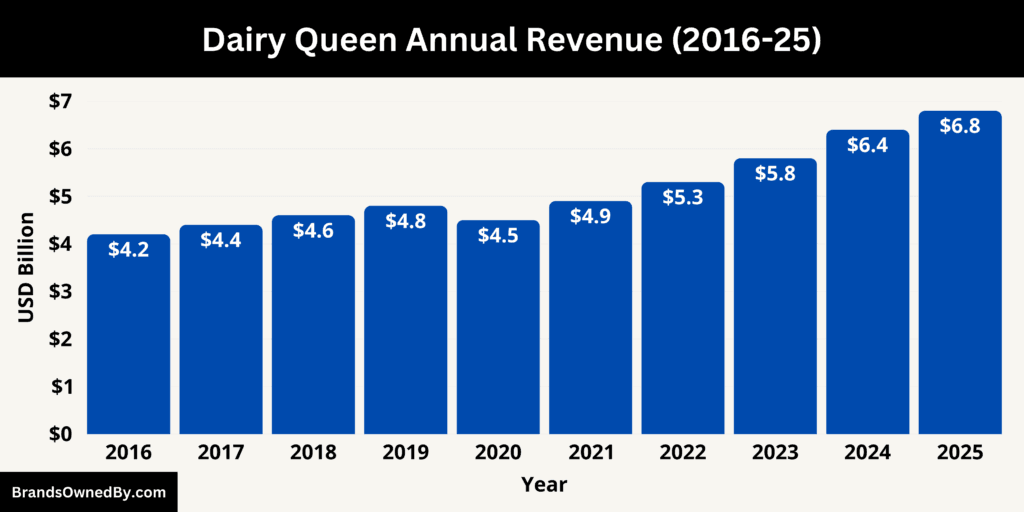
Dairy Queen’s latest figures indicate that the brand generates several billion dollars in annual revenue worldwide, driven by its extensive franchise network spanning more than 20 countries.
In 2024, Dairy Queen’s systemwide sales were reported at approximately $6.4 billion globally, a figure that reflects combined sales across all franchise locations. Dairy Queen continues to pursue growth initiatives with a long-term target of reaching $10 billion in systemwide sales by 2030, emphasizing international expansion and broader menu offerings.
Annual Revenue and Systemwide Sales
Dairy Queen does not disclose standalone corporate revenue because it operates through a franchise model and is a private subsidiary of Berkshire Hathaway. Instead, systemwide sales — the total revenue generated by all franchise locations — provide the best indicator of the brand’s financial scale.
In 2024, Dairy Queen’s global systemwide sales were approximately $6.4 billion. This reflects performance across thousands of franchised outlets, with nearly half of that amount coming from U.S. operations and the remainder from international markets.
The growth trend has been supported by strong franchise activity in markets such as China and the Middle East, where new locations and diversified menus are expanding the customer base.
This global sales figure does not represent Dairy Queen’s corporate revenue in the traditional sense (as the franchisor does not collect full sales from outlets). Instead, Dairy Queen receives a share of this through franchise royalties, licensing fees, and related income streams. These streams are not itemized publicly but contribute to the parent company’s consolidated performance where applicable.
Global Expansion and Impact on Financial Scale
Dairy Queen’s revenue trajectory is tied closely to its ongoing international expansion strategy. With more than 7,700 franchised restaurants worldwide, international markets now represent a growing portion of total system sales. Operators in China, for example, account for a significant share of net new openings, and the addition of full-service menus in select regions has broadened the brand’s appeal.
Growth outside the United States is a key component of Dairy Queen’s plan to increase its total systemwide sales toward the $10 billion by 2030 goal. This reflects both more locations and expanded menu offerings tailored to local preferences.
Brands Owned by Dairy Queen
International Dairy Queen, Inc. operates a focused portfolio of brands, restaurant formats, and trademarks that support its global franchise system. As of 2025, the company’s structure centers on its core Dairy Queen brand, supported by complementary beverage concepts, regional operating entities, and proprietary product formats designed to drive consistency and scalable growth across markets.
Below is a list of the brands owned by Dairy Queen as of December 2025:
| Company / Brand / Entity | Type | Year Introduced / Acquired | Description and Role |
|---|---|---|---|
| Dairy Queen | Core brand | 1940 | The flagship brand and primary operating business. Oversees global franchising, brand strategy, menu development, marketing, and trademark licensing. Operates thousands of franchised locations worldwide under centralized standards. |
| International Dairy Queen, Inc. | Corporate entity | 1962 | The main corporate company that owns and manages the Dairy Queen system globally. Responsible for franchise governance, international licensing, product innovation, and brand protection. |
| Orange Julius | Beverage brand | 1988 (acquired) | A blended beverage and smoothie brand integrated into Dairy Queen locations and select stand-alone outlets. Expands menu offerings beyond ice cream and supports higher beverage sales. |
| Karmelkorn | Legacy snack brand | 1986 (acquired) | A caramel popcorn brand historically co-branded with Dairy Queen and Orange Julius in mall locations. As of 2025, it remains a legacy trademark with limited active retail presence. |
| DQ Grill & Chill | Restaurant format | 2001 | A full-service, year-round restaurant concept combining soft-serve desserts with hot food items. Represents the dominant format for new Dairy Queen locations. |
| DQ Treat / Treat Center | Restaurant format | 1950s | A dessert-focused format emphasizing soft-serve, Blizzards, and beverages. Often used in smaller footprints and co-branded with Orange Julius. |
| American Dairy Queen (U.S. operations) | Regional operating entity | N/A | Manages U.S. franchise operations, marketing programs, supply chain coordination, and compliance with domestic regulations. |
| Dairy Queen Canada | Regional operating entity | 1953 | Oversees Canadian franchise development, marketing, and localized menu strategies tailored to the Canadian market. |
| International Franchise Entities | Regional licensing entities | Various | Territory-specific corporate structures that manage franchising, licensing, and operations in Asia, the Middle East, Latin America, and other international markets. |
| Dairy Queen Trademarks & Product IP | Intellectual property | Ongoing | Includes proprietary product names, recipes, logos, and brand marks such as Blizzard and Dilly Bar. Licensed to franchisees and centrally protected by corporate management. |
Dairy Queen
Dairy Queen is the flagship brand and operating company of International Dairy Queen, Inc.
As of 2025, it remains the primary business unit that develops products, establishes franchise standards, and manages global brand strategy. The company operates multiple restaurant formats—full-service and limited-menu outlets—and licenses the Dairy Queen name and trademarks to franchisees. Corporate responsibilities include product development (Blizzard, Dilly Bar and other signature items), marketing, franchise training and support, supply-chain coordination, and approval of store designs and menu programs.
Dairy Queen’s corporate structure is organized to support franchising, so most stores are independently owned and operated while corporate focuses on systemwide standards and growth initiatives.
Orange Julius
Orange Julius is a beverage and blended-drink brand that has been part of the Dairy Queen system since the late 1980s. International Dairy Queen integrated Orange Julius into its Treat Center and mall-food concepts and continues to offer Orange Julius beverages in co-branded locations and select stand-alone outlets.
As of 2025, there are several hundred Orange Julius-branded points of sale worldwide, many of which operate within Dairy Queen or DQ Treat formats. The brand contributes product variety—fruit-based smoothies and blended drinks—that complements Dairy Queen’s frozen desserts and helps franchisees broaden day-part sales.
Karmelkorn
Karmelkorn was acquired into the Dairy Queen corporate family in the mid-1980s and was co-branded with Dairy Queen and Orange Julius in Treat Center locations during the 1980s and 1990s. Over time, Karmelkorn’s mall-based retail footprint declined with changes in retail patterns.
By the late 2010s, Dairy Queen phased active support for remaining Karmelkorn retail locations, though the company retained the Karmelkorn trademark and historical association.
As of 2025, Karmelkorn exists largely as a legacy brand within Dairy Queen’s trademark portfolio rather than a significant, actively expanded retail chain.
American DQ / Regional Corporate Entities
International Dairy Queen operates regionally through subsidiary and operating entities that administer territory-specific franchise systems. These include corporate structures commonly referred to as American DQ (U.S. operations) and Dairy Queen Canada for Canadian operations.
Those entities manage regional marketing, franchise development, regulatory compliance, and vendor relationships tailored to their markets. They also implement localized menu adaptations and execute remodel and new-store programs per regional consumer preferences.
DQ Grill & Chill and DQ Treat
DQ Grill & Chill and DQ Treat are branded restaurant formats developed and owned by International Dairy Queen. DQ Grill & Chill is the full-service, year-round restaurant format that includes expanded hot-food menus, table service elements, and updated store designs.
DQ Treat (or Treat Center) identifies smaller footprint locations that emphasize desserts and blended beverages and often house Orange Julius counters or legacy Karmelkorn stands. While these are not separate corporate subsidiaries, they are formalized brand concepts owned and operated by Dairy Queen that guide real-estate, licensing and franchise agreements.
Former and Divested Brands
Over its corporate history, IDQ has acquired and later divested or reduced active support for several smaller food and retail concepts. These include mall-centric or regional chains that were folded into co-branding experiments with DQ and Orange Julius.
By 2025, these names remain part of Dairy Queen’s historical footprint or trademark holdings rather than active growth brands; corporate emphasis has been placed on DQ, Orange Julius and the company’s store formats.
Trademarks and Product IP
Beyond corporate brands and formats, International Dairy Queen owns an extensive portfolio of trademarks and product intellectual property—product names, logos, and proprietary recipes (for example, Blizzard, Dilly Bar, Peanut Buster Parfait, and related marks).
These trademarks are centrally owned and licensed to franchisees. They form a major part of the company’s brand equity and are managed through the corporate IP and legal teams to protect consistency and value across markets.
Final Thoughts
Clarity around who owns Dairy Queen highlights why the brand has maintained steady growth and operational consistency for decades. Operating as a privately held company under Berkshire Hathaway’s ownership, Dairy Queen benefits from long-term strategic backing rather than short-term market pressures. This structure supports a strong franchise system, disciplined brand management, and measured expansion, allowing Dairy Queen to continue strengthening its global presence while preserving the identity that made it a household name.
FAQs
Who is the main owner of Dairy Queen?
The main owner of Dairy Queen is Berkshire Hathaway, which owns 100% of the company. Dairy Queen operates as a wholly owned, private subsidiary under this parent company.
Does Warren Buffett still own Dairy Queen?
Warren Buffett does not own Dairy Queen directly, but he does own it indirectly as the largest individual shareholder of Berkshire Hathaway, the parent company that fully owns Dairy Queen.
Who owns Dairy Queen Canada?
Dairy Queen Canada is owned and operated by International Dairy Queen, Inc., the same corporate entity that manages Dairy Queen globally. It is not separately owned or franchised at the national level.
Is Dairy Queen publicly traded?
No, Dairy Queen is not publicly traded. It is a private company and does not have shares listed on any stock exchange.
Is Dairy Queen a franchise?
Yes, Dairy Queen operates primarily as a franchise. Most Dairy Queen restaurants worldwide are owned and operated by independent franchisees under corporate licensing agreements.
What company owns Dairy Queen?
Dairy Queen is owned by Berkshire Hathaway, which acquired the brand in 1998 and has retained full ownership since then.
Who owns Dairy Queen now?
Dairy Queen is currently owned entirely by Berkshire Hathaway. There have been no ownership changes, spin-offs, or partial sales since the acquisition.
Who owns Dairy Queen franchises?
Individual Dairy Queen franchises are owned by independent franchise operators. These owners run day-to-day store operations while following standards set by Dairy Queen corporate.
Why did Warren Buffett buy Dairy Queen?
Warren Buffett supported the acquisition because Dairy Queen fit Berkshire Hathaway’s investment philosophy. The brand had strong customer loyalty, a proven franchise model, and predictable long-term performance without operational complexity.
Is Dairy Queen a US company?
Yes, Dairy Queen is an American company. It was founded in the United States and continues to be headquartered there, despite having a large international presence.
Who owns the most Dairy Queens?
No single franchisee publicly holds the largest number of Dairy Queen locations. Store ownership is spread across hundreds of independent franchise operators, some of whom own multiple locations within specific regions.
Who founded Dairy Queen?
Dairy Queen was founded by John Fremont “J.F.” McCullough, his son Alex McCullough, and business partner Sherb Noble.
Is the first Dairy Queen still open?
No, the first Dairy Queen store opened in Joliet, Illinois, in 1940, is no longer operating.
Where is Dairy Queen headquartered?
Dairy Queen is headquartered in Minneapolis, Minnesota, where its corporate leadership and global brand management teams are based.
Is Dairy Queen a franchise?
Yes, Dairy Queen is a franchise-based business. While the brand is corporately owned, most locations are independently owned and operated by franchisees under licensing agreements.