
- Fiat is owned by Stellantis N.V., a publicly listed global automaker, meaning Fiat itself has no independent shareholders, stock listing, or corporate ownership outside the Stellantis group.
- The largest shareholder of Stellantis is Exor N.V., controlled by the Agnelli family, the same family that founded Fiat and led the company for more than a century before it merged into a larger corporate structure.
- Ownership of Fiat is therefore indirect — investors own Fiat only by buying Stellantis shares, and strategic control over the brand is exercised through Stellantis’ board and executive leadership, not through Fiat as a standalone company.
Fiat is one of the oldest and most recognizable automobile brands in the world. It was established to make mobility accessible to many. Over more than a century, it helped define European motoring with small, practical cars.
In 2025, Fiat no longer stands alone as an independent automaker. Instead, it operates under a global automotive group. The brand name continues, but the business structure and ownership have evolved substantially.
Fiat Founders
Fiat was founded in 1899 in Turin, Italy. The original company name was “Fabbrica Italiana Automobili Torino.” Among its founders was Giovanni Agnelli, a prominent industrialist, who played a central role in establishing the company.
In its earliest days, Fiat began producing cars in 1900. Their first car models included small, compact vehicles suitable for the evolving demand for personal transportation. In the initial years, the company expanded production quickly. By 1906, Fiat had already become well established and the brand name had been standardized.
From the start, Fiat embraced innovation and diversified beyond passenger cars. Early on, it produced not only cars but also trucks, commercial vehicles, and even developed engines including aircraft engines. It soon became Italy’s leading automaker.
Over the decades, Fiat built a reputation for designing small and medium-sized city and family cars. Its cars became popular across Europe.
Major Milestones
- 1899: Fiat was founded in Turin, Italy by Giovanni Agnelli and his partners to manufacture automobiles for the emerging Italian market.
- 1900: Fiat produced its first vehicle, officially entering automobile manufacturing.
- 1903: The company diversified into trucks, buses, engines, and commercial vehicles.
- 1906: Fiat began exporting vehicles internationally and opened facilities outside Italy.
- 1910: Fiat became the largest automobile manufacturer in Italy.
- 1923: The Lingotto factory opened, featuring a rooftop test track and advanced industrial design.
- 1936: Fiat launched the Fiat 500 “Topolino,” making cars affordable for working-class buyers.
- 1957: The modern Fiat 500 was released, becoming a global symbol of Italian design.
- 1969: Fiat acquired a controlling stake in Ferrari, entering the luxury and performance segment.
- 1978: Fiat took control of Lancia, expanding into premium vehicles and rally motorsports.
- 1986: Alfa Romeo became part of Fiat’s growing automotive group.
- 1990s: Global competition and rising costs slowed Fiat’s international growth.
- 2004: Financial strain led to restructuring and leadership changes.
- 2009: Fiat acquired Chrysler, returning to the North American market.
- 2014: Fiat Chrysler Automobiles (FCA) was formed through full integration with Chrysler.
- 2016: Ferrari was separated and became an independent company.
- 2021: Fiat became part of Stellantis following the merger with PSA Group.
- 2022: Fiat announced a major shift toward electric vehicle production.
- 2023: The Fiat 500e expanded into additional international markets.
- 2024: Fiat was repositioned as a global urban mobility and compact-car brand.
- 2025: Fiat operates globally as a city-car and electric-focused brand under Stellantis.
Who Owns Fiat in 2025?
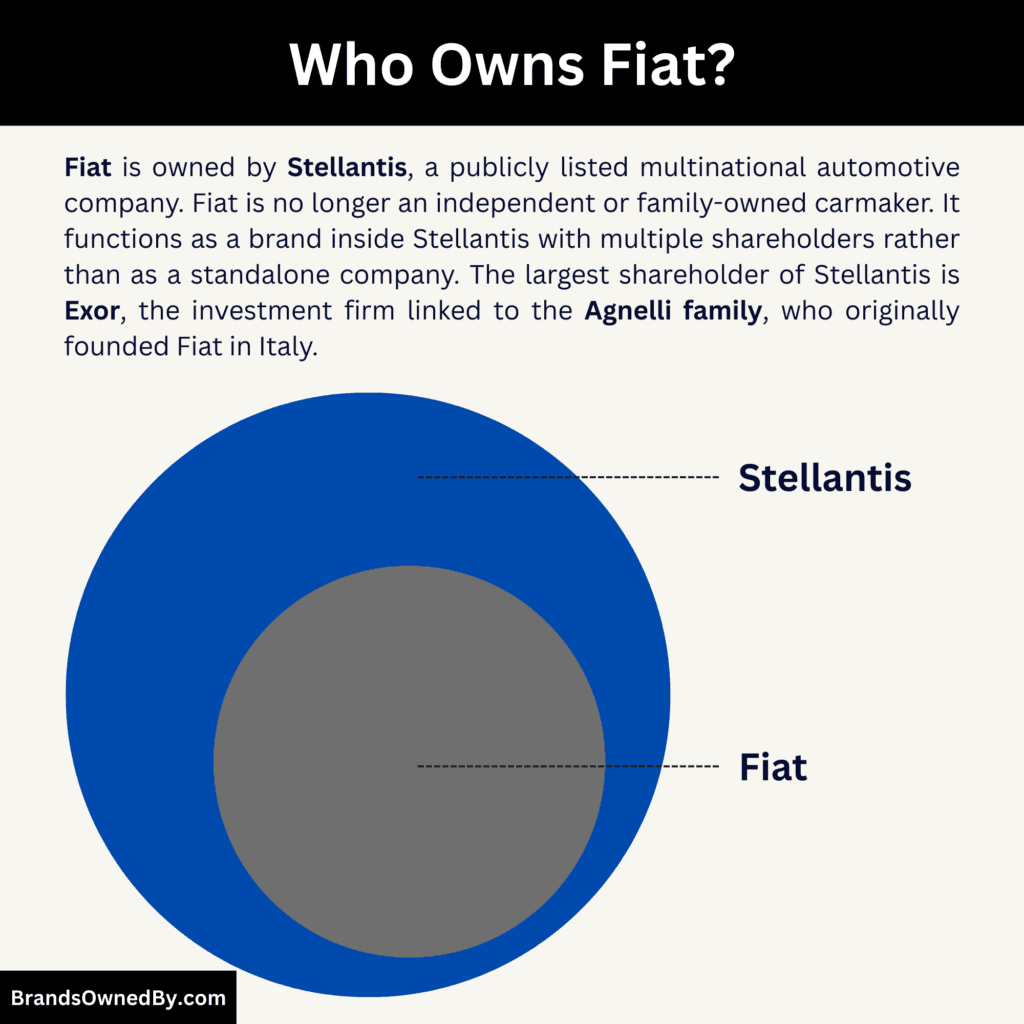
Fiat is owned by Stellantis N.V. which is a publicly traded multinational automotive corporation. Anyone who buys Stellantis stock indirectly owns part of Fiat.
There is no single individual owner today. Fiat is controlled through shareholders, board leadership, and executive management inside Stellantis.
The largest shareholder is Exor N.V. Exor is the investment company of the Agnelli family. The family built Fiat and led it for more than 100 years. Although they no longer run Fiat directly, they remain the most powerful investor in the group.
Parent Company: Stellantis N.V.
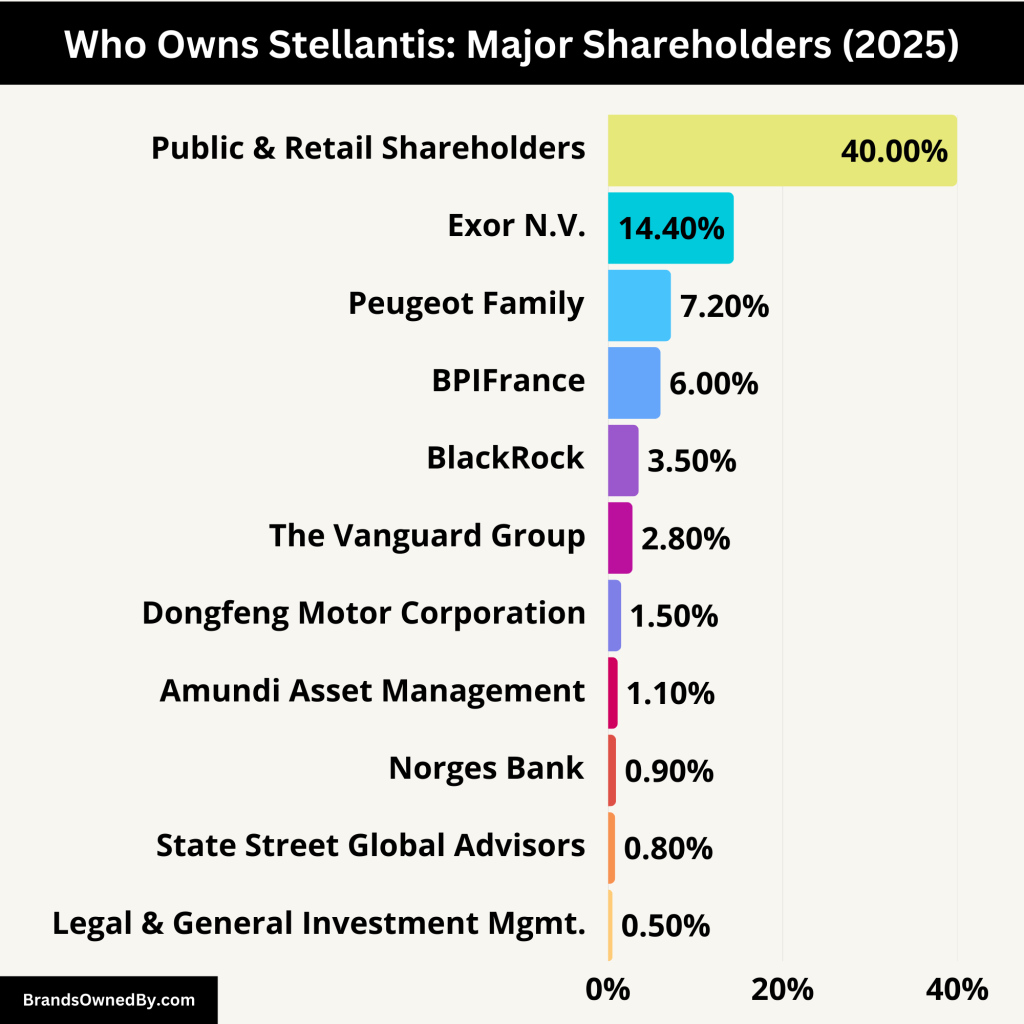
Stellantis N.V. is the legal owner of Fiat. Fiat is not a subsidiary in the traditional sense. It is not structured as a separate corporation inside the group. It exists as a controlled automotive brand within Stellantis’ single corporate entity.
Stellantis is a publicly traded company. Ownership is spread across thousands of shareholders worldwide. No individual owns the company outright.
The largest shareholder is Exor N.V., the investment company controlled by the Agnelli family. The family founded Fiat and historically controlled it for more than a century. Today, they influence Stellantis through Exor rather than directly through Fiat.
Stellantis operates as the sole controlling company for everything related to Fiat. This includes ownership of trademarks, vehicle platform rights, product design authority, manufacturing decisions, and long-term investment planning. Fiat cannot act independently in any of these areas.
Although Fiat continues to design cars and operate marketing teams in different regions, those teams do not hold corporate authority. Fiat has no independent ownership, no stock listing, and no board of directors separate from Stellantis.
Every major decision related to Fiat is made centrally by Stellantis, including:
- Product approvals and cancellations
- Factory location and closure decisions
- Electric vehicle strategy
- Pricing frameworks
- Cost control and sourcing
- Supplier agreements
- Technology sharing
- Capital spending
- Long-term market planning.
Engineering for Fiat vehicles is shared across the group using Stellantis platforms. Fiat no longer develops complete vehicle architectures on its own. Vehicles are built using common systems that are also used by other Stellantis brands, such as Peugeot, Opel, and Citroën. This reduces cost and standardizes technology across brands.
Manufacturing is also controlled by Stellantis. Fiat does not own factories independently. All plants producing Fiat vehicles are owned, leased, or contract-managed by Stellantis. Production volume is set by corporate demand planning, not by Fiat’s brand leadership.
Financial control is fully centralized. Fiat does not manage its own capital. It does not control major spending. All funding is approved within Stellantis’ financial structure.
Brand strategy is the only area where Fiat retains partial independence. However, even this authority is limited. Brand positioning, visual identity, regional direction, and market role must all align with Stellantis’ global plan to avoid overlap between brands.
How Fiat Was Acquired and Restructured
Fiat was not “bought” by Stellantis in a traditional takeover. Instead, Fiat lost its independence through a series of mergers that transformed it from a standalone company into a brand within a multinational group.
Fiat’s takeover of Chrysler
Fiat’s first major ownership shift came when it acquired control of Chrysler after Chrysler collapsed financially. The US government facilitated the deal to save Chrysler from liquidation. Fiat gradually increased its stake and eventually became Chrysler’s controlling owner.
This merger created a new company called Fiat Chrysler Automobiles (FCA). FCA united Fiat, Chrysler, Jeep, Dodge, Ram, and other brands under one corporate structure.
Although Fiat became the controlling side, the merger changed Fiat permanently. The company became part of a transatlantic corporation with shared engineers, platforms, and leadership. Fiat was no longer an Italian-only automaker. It became part of a global group.
Formation of Stellantis
FCA later merged with PSA Group, the French automotive company behind Peugeot, Citroën, and Opel.
This was not an acquisition where one side bought the other. It was a merger of equals. The new company was named Stellantis. FCA ceased to exist as a legal entity. PSA also ceased to exist.
Fiat was absorbed into Stellantis along with every other brand.
Fiat did not retain corporate status. It became one of many consumer brands inside a single company.
Read more about Stellantis’ formation in this article.
What changed for Fiat after Stellantis
After the merger, Fiat lost:
- Independent financial reporting
- Separate shareholders
- Control over assets
- Authority to make acquisitions
- Authority to issue stock
- Independent board control.
All ownership, operations, and strategy were centralized at the Stellantis level.
From that point forward, Fiat no longer existed as a corporation.
It existed only as a badge on vehicles.
Who is the CEO of Fiat?
As of December 2025, the CEO of Fiat is Olivier François. He is the President and CEO of the Fiat brand and also leads Abarth. In addition to this, he serves as Global Chief Marketing Officer (CMO) of Stellantis and is a member of the group’s top leadership council.
François has held the CEO role for Fiat since 2011 and has been one of the longest-serving brand heads within the group.
Current Role and Responsibilities
In his current position, Olivier François is responsible for the global strategy and positioning of the Fiat brand. His remit covers how Fiat is perceived in the market, which products carry the Fiat badge, and how those products are communicated to customers.
His responsibilities include:
- Defining Fiat’s global brand positioning and identity
- Shaping the long-term product and model strategy for Fiat and Abarth
- Guiding design direction and the overall “look and feel” of the brand
- Approving major global marketing campaigns and communication platforms
- Ensuring brand consistency across regions (Europe, Latin America, and other key markets).
Alongside Fiat and Abarth, his CMO role at Stellantis means he also influences marketing for other group brands and participates in high-level strategic decisions at the group level.
Career Background and Past Positions
Olivier François has a long history in the automotive industry, especially in brand and marketing leadership.
He began his automotive career in 1990 at Citroën, where he moved up through various roles. In 1999, he became Managing Director of Citroën Denmark, and in 2001, he was appointed Managing Director of Citroën Italy.
In 2005, he joined Fiat and soon took on higher responsibilities:
- CEO of Lancia Automobiles S.p.A. – leading Fiat Group’s Lancia brand
- Head of Marketing and Communication, Fiat Group Automobiles – overseeing marketing strategy for multiple Fiat Group brands.
After Fiat acquired a stake in Chrysler, François was appointed President and CEO of the Chrysler brand and Lead Marketing Executive for Chrysler Group. In that role, he was responsible for marketing strategies, brand development, and advertising for:
- Chrysler
- Jeep
- Dodge
- Ram
- Fiat
- Alfa Romeo
- Maserati
- Abarth
- Lancia.
In September 2011, he was named Head of the Fiat brand and Chief Marketing Officer of the Fiat Chrysler Automobiles (FCA) Group, becoming part of the FCA Group Executive Council. He kept these responsibilities through the creation of Stellantis and continues under the new structure as CEO of Fiat and Abarth and CMO of Stellantis.
Key Achievements at Fiat
Under Olivier François’ leadership, Fiat has focused on small, design-led cars and expanded its core product families.
Some notable product and brand achievements include:
- Expanding the Fiat 500 lineup with the 500L (2012) and 500X (2014), turning the 500 name into a full family of models
- Launching the modern Fiat 124 Spider, reviving a historic name with a contemporary roadster
- Introducing the new Fiat Tipo as a compact model targeted at value-focused buyers in Europe and emerging markets
- Presenting the Fiat Centoventi concept, an electric-oriented concept that reimagined Fiat’s approach to modular, urban EV mobility.
These moves helped position Fiat as a specialist in compact and city-focused vehicles rather than a broad full-range manufacturer.
Recognition and Industry Influence
Olivier François is widely recognized in the advertising and marketing world for his work on automotive brands.
He has received multiple high-profile marketing awards, including “Automotive Marketer of the Year,” “Brand Genius,” and listings among top global CMOs. In 2024, he was inducted into the American Advertising Federation Hall of Fame, highlighting his long-term impact on brand-building and automotive communications.
His campaigns have frequently used high-profile cultural partnerships and Super Bowl commercials to lift both Fiat and other group brands into mainstream attention.
Why His Role Matters for Fiat
Because Fiat now operates as a brand inside a large automotive group, the CEO of Fiat plays a critical role in protecting and defining the brand’s identity.
Olivier François:
- Represents Fiat’s interests inside Stellantis
- Ensures the brand has a clear, distinct positioning versus other group brands
- Guides which types of products and concepts are appropriate for Fiat’s image
- Helps align Fiat’s historic character (Italian, urban, accessible) with future technologies such as electrification.
In short, he is the central figure responsible for what Fiat stands for in 2025 and how that translates into actual models and marketing in the market.
Fiat Annual Revenue and Net Worth
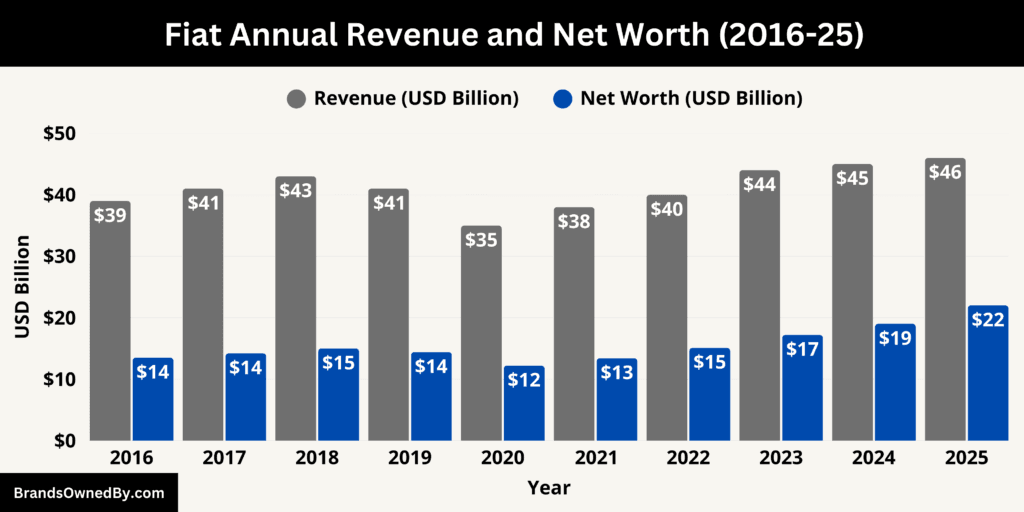
As of December 2025, Fiat is estimated to generate around $46 billion in annual revenue from global vehicle sales, parts, and brand licensing. The brand’s estimated net worth is around $22 billion, reflecting its intellectual property value, global recognition, manufacturing footprint, and long-term market presence.
These figures represent Fiat as a brand and operating business, not the financial results of its parent group.
Revenue in 2025
Fiat remains one of the highest-volume car brands under Stellantis and continues to perform strongly in Europe, South America, Turkey, and parts of Africa.
In 2025, Fiat’s estimated revenue is driven primarily by:
- Passenger vehicle sales across Latin America and Europe
- Light commercial vehicle sales in developing markets
- Brand licensing and merchandise
- After-sales service and parts
- Electric vehicle lineup expansion.
Countries such as Brazil, Italy, Turkey, and Argentina continue to represent Fiat’s most consistent revenue markets. The brand’s dominance in compact vehicles and affordable transportation plays a major role in sustaining its high global sales volume.
Fiat’s product lineup remains centered on:
- Small city cars
- Economy family vehicles
- Cargo vans and utility vehicles
- Electric compact models.
This positioning continues to attract price-sensitive buyers and fleet customers.
Net Worth and Brand Value
Fiat’s estimated net worth of $22 billion reflects the brand’s long-term value rather than yearly earnings alone.
Key drivers of this valuation include:
- More than 120 years of operating history
- High consumer recognition across multiple continents
- Manufacturing operations in several countries
- Design patents and trademarks
- Dealer networks and brand loyalty
- Legacy models with cultural value.
The Fiat name itself holds strong commercial power, especially in emerging markets where affordability and reliability are critical.
Financial Strength by Region
Fiat’s financial health depends heavily on developing and mid-income economies rather than luxury markets.
South America represents one of Fiat’s strongest profit regions due to:
- High sales volume
- Lower manufacturing costs
- Fewer competitors in entry-level segments
- Strong buyer loyalty.
Europe continues to provide brand status and historical sales strength, while Africa and Eastern Europe offer long-term growth potential.
Market Position vs Competitors
Fiat does not compete as a premium brand.
Instead, it competes with:
Its pricing strategy makes it a volume leader rather than a margin leader, but that volume translates into strong brand-level revenue.
Brands Owned by Fiat
Below is a list of the major brands owned by Fiat as of December 2025:
| Brand / Entity | Relationship With Fiat | Year Fiat Gained Control | Core Function | Current Status |
|---|---|---|---|---|
| Abarth | Acquired and developed as Fiat’s performance division | 1971 | Performance tuning and high-performance road cars | Operates as Fiat’s performance sub-brand |
| Fiat Professional | Created by Fiat | 2007 | Light commercial vehicles (vans, pickups, chassis cabs) | Active as Fiat’s commercial vehicle arm |
| Fiat Brazil Operations | Built and operated by Fiat | 1970s | Local manufacturing and sales in South America | Active, major regional hub |
| Fiat Argentina Operations | Built and operated by Fiat | 1919 | Manufacturing and regional operations | Active |
| Tofaş (Turkey) | Joint Venture created by Fiat | 1968 | Manufacturing and sales for Turkish market | Active JV |
| Alfa Romeo | Acquired by Fiat | 1986 | Premium and performance passenger vehicles | Brand continues inside Stellantis |
| Lancia | Acquired by Fiat | 1969 | Premium and rally-focused vehicles | Brand exists with limited portfolio |
| Maserati | Acquired fully by Fiat | 2005 | Luxury performance vehicles | Active brand |
| Ferrari | Acquired majority stake by Fiat | 1969 (full control by 1988) | Supercars and racing | Later spun off as independent |
| Chrysler | Acquired and merged by Fiat | 2009–2014 | US automaker and truck brands | Merged into FCA |
| Fiat Chrysler Automobiles (FCA) | Created by Fiat | 2014 | Multinational auto group | Later merged into Stellantis |
| Fiat Group Automobiles | Corporate structure created by Fiat | 2007 | Internal holding unit for its car brands | Absorbed into FCA |
| Fiat Automobiles S.p.A. | Subsidiary created by Fiat | 2007 | Legal entity for Fiat brand | Later merged into FCA |
| Alfa Romeo Automobiles S.p.A. | Subsidiary created by Fiat | 2007 | Corporate management of Alfa Romeo | Later merged into FCA |
| Lancia Automobiles S.p.A. | Subsidiary created by Fiat | 2007 | Corporate management of Lancia | Administrative shell later dissolved |
| Fiat Light Commercial Vehicles | Division created by Fiat | 2007 | Commercial vans and logistics units | Integrated into Fiat Professional |
| Iveco (Historic ownership) | Formerly owned by Fiat | 1970s | Trucks and industrial vehicles | Later spun off |
| CNH Industrial (Historic ownership) | Formerly owned by Fiat | 1990s | Construction and agricultural equipment | Later spun off |
Abarth
Abarth began as an independent racing and tuning company founded by Carlo Abarth in 1949. Fiat purchased Abarth in the 1970s and integrated it into its performance and motorsport activities. From that point onward, Abarth became Fiat’s in-house performance arm, developing tuned versions of small Fiat models, especially the Fiat 500 and Punto.abarth.com+1
Under Fiat’s control, Abarth evolved from a pure racing constructor into a road-car brand with its own badge, dealerships, and product line. It focused on high-performance versions of Fiat platforms, offering uprated engines, sports suspensions, and distinctive styling. When Fiat later became part of FCA and then Stellantis, Abarth remained structurally tied to Fiat rather than being spun into a separate mainstream marque. Even in 2025, most Abarth road cars are clearly Fiat-based products (like the 500e and 600e derivatives), showing that Abarth operates as a performance sub-brand built on Fiat’s engineering and design base rather than as an independent company.
Fiat Professional
Fiat Professional is the light commercial vehicle division that Fiat created by spinning out its historical “Fiat Veicoli Commerciali” business. It was formally launched in 2007 as a dedicated brand for vans, pickups, and work vehicles, with its own product planning and marketing, but rooted entirely in Fiat’s long heritage of producing commercial vehicles.
Fiat Professional offers models such as the Ducato, Doblo, Scudo and their people-mover or chassis variants, aimed at trades, fleets, logistics companies, and public services. Engineering and styling are closely linked to Fiat’s passenger-car expertise, but the division is differentiated in terms of payload, durability, and body configurations. Even though the legal parent today is Stellantis Europe, Fiat Professional exists because Fiat itself carved out and developed this business line, and it is still marketed globally as “Fiat Professional,” not as a generic Stellantis brand. The division remains a major part of Fiat’s global volume in 2025, especially in Europe, the Middle East, and parts of Asia.fiatprofessional.com+2fiatprofessional.com+2
Fiat Latin America Operations
Fiat has built one of its strongest business bases in Latin America, particularly Brazil and Argentina, through companies and plants that were originally set up and run under Fiat’s direct control long before the Stellantis era. Production sites in Brazil (such as the major Betim complex) allowed Fiat to localize small cars and light commercial vehicles tailored to regional needs—like the Strada pickup and compact sedans targeted at cost-sensitive buyers.Stellantis.com+1
These Latin American operations gave Fiat a dominant position in Brazil, where it has frequently been the market-share leader, and turned the region into one of the brand’s most profitable territories. As of 2025, Fiat’s Latin American entities still operate under the Fiat banner with local engineering, product planning, and sourcing decisions that reflect decades of Fiat-led investment. The organizational chart now sits under Stellantis, but the product lines, dealer networks, and consumer relationships were all built by Fiat itself and remain strongly identified with the Fiat name.
Fiat Turkey and the Tofaş Joint Venture
In Turkey, Fiat’s long-standing industrial and commercial presence is concentrated in Tofaş, a joint venture between Fiat (now represented via Stellantis) and Koç Holding. The partnership dates back to the 1960s and 1970s, when Fiat licensed production of its models locally; over time, the JV evolved into a major manufacturing and distribution hub for Fiat-branded vehicles and, later, other group brands.
Tofaş produces vehicles for the Fiat brand and also manufactures selected models for other Stellantis marques, but in the Turkish market it has long been associated most strongly with Fiat itself. It handles local sales and after-sales for Fiat and several other brands, but its roots are firmly in Fiat’s original decision to invest in and co-own a Turkish production base. Even though ownership is now split between Stellantis and Koç, this entity is still a key example of Fiat-driven industrial expansion that survives into the Stellantis structure.
Historic Ownership of Alfa Romeo
Alfa Romeo became part of the Fiat universe through a major acquisition in the 1980s. Fiat acquired Alfa Romeo from the Italian state-controlled IRI holding company in 1986, beating other bidders and integrating Alfa into the wider Fiat Group.
Once Alfa Romeo was under Fiat’s control, Fiat reorganized its platforms, rationalized production, and gradually repositioned Alfa as a sporty, premium-leaning marque within the group. This acquisition expanded Fiat’s brand portfolio beyond mass-market and small cars, giving it a driver-oriented brand with motorsport history. Today Alfa Romeo sits inside Stellantis as a separate marque, but the reason it is there at all is Fiat’s original acquisition and decades of stewardship.
Historic Ownership of Lancia
Lancia was another major Italian brand that Fiat brought into its orbit. Fiat acquired Lancia in 1969, folding it into the group as a more upmarket and rally-focused marque compared with mainstream Fiat models.
Under Fiat’s ownership, Lancia gained access to shared platforms and engines while preserving some of its distinctive design language. In later years, Fiat shifted Lancia more towards style-focused compact cars and rebadged models, particularly in Italy. Although Lancia’s presence has shrunk by 2025, it still exists as a brand within Stellantis because Fiat chose to acquire and preserve it rather than allow it to disappear decades ago.
Historic Control of Maserati
Fiat gained control of Maserati in stages, starting with a stake in the early 1990s and building to full ownership by the mid-2000s. This move extended Fiat’s reach into the luxury and performance segment, complementing its mainstream and premium brands with a high-end Italian marque focused on grand touring and sports sedans.
Under Fiat’s stewardship, Maserati shared technology with other group brands and benefitted from consolidated engineering and purchasing power. Even after later restructurings and the formation of Stellantis, Maserati’s modern history is largely defined by the period when Fiat took control, stabilized the brand, and repositioned it as a more global luxury manufacturer.
Stake and Spin-Off of Ferrari
Fiat acquired a 50% stake in Ferrari in 1969 and gradually increased its shareholding to 90% by 1988. This gave Fiat control over one of the most prestigious performance brands in the world.
For decades, Ferrari functioned as a semi-independent jewel within the Fiat Group, benefiting from group resources while preserving its racing and luxury identity. Later, during the FCA era, Ferrari was spun off into a separate, publicly listed company, reducing direct Fiat-level ownership. However, Ferrari’s presence in modern automotive markets as an independent brand is a direct result of Fiat’s long-term involvement, investment, and decision to structure the spin-off in a way that maximized value.
Acquisition of Chrysler and Creation of FCA
One of Fiat’s most important strategic moves was its step-by-step acquisition of Chrysler after the American automaker’s bankruptcy in 2009. Fiat initially took a minority stake and management role, then gradually increased its ownership until it controlled 100% of Chrysler.
This process created Fiat Chrysler Automobiles (FCA) in 2014, a new holding company that combined Fiat, Chrysler, Jeep, Dodge, Ram and other brands under a single corporate roof. While FCA later merged with PSA Group to create Stellantis, the Chrysler acquisition itself was a Fiat-driven move. Through this acquisition, Fiat effectively brought Jeep, Dodge, and Ram into its broader ecosystem and transformed from a largely European group into a transatlantic automotive giant.
Fiat Group Automobiles and Internal Brand Companies
In 2007, Fiat reorganized its automotive business into Fiat Group Automobiles S.p.A., creating four new brand-specific companies that were 100% owned by Fiat Group Automobiles: Fiat Automobiles S.p.A., Alfa Romeo Automobiles S.p.A., Lancia Automobiles S.p.A., and Fiat Light Commercial Vehicles S.p.A.Stellantis Media+1
This internal restructuring formalized what had already been true in practice: Fiat directly owned and operated multiple brand entities, each with its own CEO and operational structure, but all sitting under the Fiat corporate umbrella. These brand companies later became part of FCA and ultimately Stellantis, but the corporate design was created by Fiat and shaped how its brands are still managed today.
Final Thoughts
Anyone trying to understand who owns Fiat will find that the brand is no longer an independent company but part of Stellantis, a publicly listed automotive group with global shareholders. Fiat still represents Italian design and mass-market mobility, but its strategy, investments, and direction are now controlled at group level rather than by a single family or government. The brand’s future depends on corporate leadership and shareholder decisions inside Stellantis, not on Fiat operating on its own.
FAQs
What does Fiat stand for?
Fiat stands for Fabbrica Italiana Automobili Torino, which translates to “Italian Automobile Factory of Turin.” The name reflects where the company was founded and its original purpose as a car manufacturer in Italy.
Where is Fiat headquartered?
Fiat’s historical headquarters is in Turin, Italy, where the company was founded in 1899 and developed into Italy’s most famous carmaker. Today, its brand operations are still rooted in Italy, even though corporate ownership sits with a multinational company.
Who owns Fiat motor company?
Fiat is owned by Stellantis, a publicly listed global automotive group. Fiat is no longer a standalone company with its own shareholders. It operates as a brand inside Stellantis, which is the legal owner.
Who makes Fiat?
Fiat vehicles are designed and produced under the Stellantis manufacturing system. Cars are built in factories across Italy, Brazil, Turkey, Poland, and other countries where Stellantis operates production plants.
Where is Fiat from?
Fiat is from Italy. It was founded in Turin and remains one of the most important Italian automotive brands in history, even though it is now owned by a multinational company.
Is Fiat owned by Ferrari?
No. Fiat does not own Ferrari. Ferrari is a separate and independent company. Fiat once held a major stake in Ferrari, but that ownership ended after Ferrari became a separate publicly traded company.
How many brands are under Fiat?
Fiat itself does not control other major car brands today. It operates primarily as a single brand under Stellantis. Any companies associated with Fiat historically are now part of Stellantis or operate independently.
What brands are owned by Fiat?
Fiat directly owns and operates Abarth and manages Fiat Professional as its commercial-vehicle division. Other brands historically controlled by Fiat like Alfa Romeo, Lancia, and Maserati are no longer owned by Fiat as a company and are now controlled by Stellantis.
Does BMW own Fiat?
No. BMW does not own Fiat. Fiat is owned by Stellantis, and BMW is a completely separate company.
Is Ferrari still owned by Fiat?
No. Ferrari is not owned by Fiat anymore. It became an independent company after being separated from Fiat’s corporate structure. Fiat and Ferrari now operate as separate companies.
Who is the family owner of Fiat?
There is no private family owner of Fiat today. Historically, the Agnelli family founded and controlled Fiat for many decades. Today, ownership exists through Stellantis, where the Agnelli family holds influence via its investment company, Exor, but they do not own Fiat directly.
Is Kia owned by Fiat?
No. Kia is not owned by Fiat. Kia is part of the Hyundai Motor Group and has no connection to Fiat or Stellantis.
Is Maserati owned by Fiat?
Not directly. Maserati is owned by Stellantis. Fiat controlled Maserati in the past, but today, Maserati sits under the Stellantis group, not under Fiat as a brand.
Does Ford own Fiat?
No. Ford does not own Fiat. Fiat is owned by Stellantis. Ford is an independent automaker.
Is the Fiat 500 made by BMW?
No. The Fiat 500 is not made by BMW. It is designed and manufactured by Fiat under Stellantis. BMW produces its own vehicles under the Mini and BMW brands.