
- Buick is fully owned by General Motors Company (GM) and does not operate as a separate corporation, meaning it has no independent shareholders, stock listing, or board of directors.
- The real ownership of Buick is indirect through GM’s shareholders, with major institutional investors like Vanguard Group, BlackRock, and State Street collectively holding the largest influence over GM and therefore Buick.
- Buick is controlled by GM’s CEO, Mary Barra, who makes the final decisions on Buick’s strategy, investments, and product direction as part of GM’s global leadership structure.
- Ownership of Buick has remained within GM since 1908, making it one of the longest continuously held automotive brands under a single parent company in the world.
Buick is a historic automobile brand that remains active today under the umbrella of a larger automaker. Over more than a century, Buick has evolved from early gasoline-engine experiments to a globally recognized car brand. The company is known for engineering innovations, quality, and a legacy of luxury and practicality.
Founding of Buick and Its Founder
Buick’s origins go back to the end of the 19th century. The brand was founded by David Dunbar Buick, a Scottish-born inventor and industrialist who later settled in Detroit, Michigan. Before entering the automobile industry, he worked in the plumbing business and developed several mechanical systems. His interest in internal combustion engines eventually pushed him toward automotive innovation.
In 1899, David Dunbar Buick created the Auto-Vim and Power Company. The company’s original goal was not to build cars. Instead, it focused on producing gasoline engines for farm equipment and marine use. However, Buick quickly recognized the potential of automobiles and redirected the company toward car manufacturing.
In 1903, the company was reorganized and officially incorporated as Buick Motor Company. That marked Buick’s full transition into automobile production. The company’s first production vehicle, known as the Model B, was introduced shortly after. This confirmed Buick’s shift from engine development to vehicle manufacturing.
Although David Buick founded the company, technical credit also goes to Walter L. Marr, Buick’s first engineer. Marr is widely credited with building the earliest Buick automobile in 1899 or 1900. Another crucial figure, Eugene Richard, helped develop Buick’s overhead valve engine design. That innovation became one of the major reasons the brand gained early recognition.
Despite the company’s technical promise, Buick struggled financially during its early years. David Buick eventually lost control of the business due to funding problems. Control shifted to new investors who reorganized the company but retained his name. While David Buick did not enjoy personal wealth from the company, his engineering vision became the foundation of one of America’s most lasting car brands.
Within a few years, Buick grew rapidly and became the backbone of a new automotive group. In 1908, William C. Durant used Buick as the foundation to create General Motors. This instantly elevated Buick from a small manufacturer to a core brand within a global corporation.
Major Milestones
- 1899: David Dunbar Buick establishes the Auto-Vim and Power Company in Detroit, focusing on gasoline engine development.
- 1903: Buick Motor Company is officially incorporated, marking its formal entry into the automobile industry.
- 1904: The first production Buick vehicle, the Model B, is introduced, shifting the company from engine manufacturing to car production.
- 1905: Annual vehicle production exceeds 700 units, showing Buick’s rapid early growth.
- 1906: A Buick completes a 1,000-mile endurance run from Chicago to New York, boosting the brand’s reputation for reliability.
- 1908: William C. Durant forms General Motors using Buick as the core brand. Buick becomes GM’s best-selling division at the time.
- 1911: Buick expands manufacturing operations and adopts increased automation to scale production.
- 1916: Buick rises to become one of the top-selling automobile brands in the United States.
- 1923: Buick builds its one-millionth vehicle, confirming national market leadership.
- 1931: The brand introduces advanced suspension systems to improve ride comfort and handling.
- 1939: Buick adds early safety features including enhanced braking and improved passenger protection.
- 1942–1945: During World War II, Buick halts civilian car production and shifts to aircraft engines and defense equipment manufacturing.
- 1948: Post-war passenger vehicle production resumes with redesigned models.
- 1953: Buick celebrates its 50th anniversary with limited-edition models and updated design language.
- 1963: Performance-oriented vehicles are introduced to expand Buick’s appeal beyond traditional luxury buyers.
- 1975: Buick invests in new safety systems and durability standards across its vehicle lineup.
- 1988: The brand expands global manufacturing and strengthens its international presence.
- 1999: Buick celebrates its 100th anniversary, becoming one of the world’s oldest continuously operating automobile brands.
- 2009: Buick survives GM’s post-recession restructuring and remains one of the company’s four core U.S. brands.
- 2014: Buick begins brand modernization with a new design direction aimed at younger consumers.
- 2017: Introduction of all-new SUV models marks a strategic shift from sedans to crossovers.
- 2020: Buick phases out traditional sedans in the U.S. to focus entirely on SUVs and electrification.
- 2022: Launch of Buick’s new tri-shield logo symbolizes the brand’s transition toward electric vehicles.
- 2024–2025: Buick expands its electric vehicle lineup and integrates advanced technology platforms to compete in the global EV market.
Who Owns Buick in 2025?
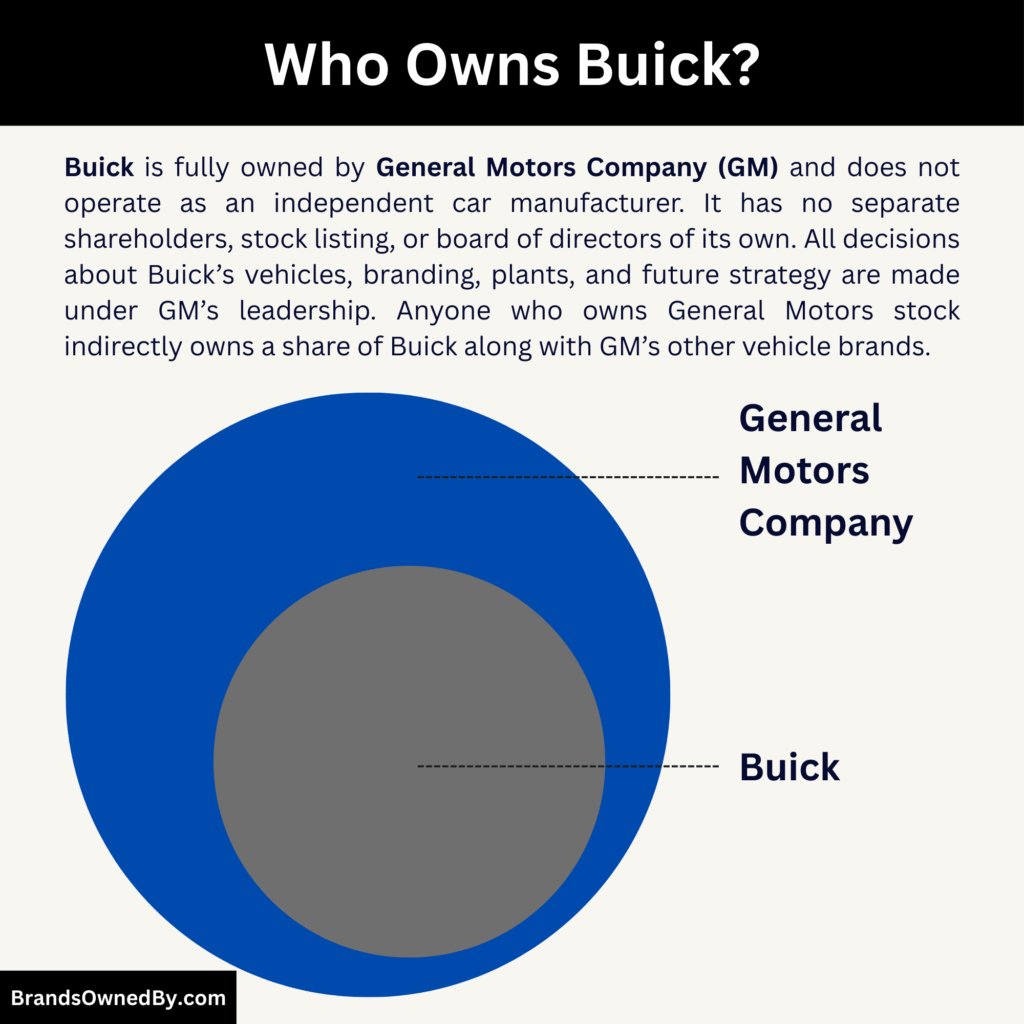
Buick is fully owned by General Motors Company. General Motors, commonly known as GM, is a publicly traded corporation headquartered in Detroit, Michigan. Since Buick is a brand and not a separate business entity, its ownership is included within GM’s overall structure.
GM owns Buick in the same way it owns Chevrolet, Cadillac, and GMC. All strategic decisions, manufacturing investments, and product planning for Buick come from GM leadership.
Legally, Buick is not a corporation. It functions as an operating division within General Motors rather than a standalone company. Its factories, technology platforms, supply chains, and research teams are part of GM’s global infrastructure. Buick vehicles are built using shared engineering resources and are managed under GM’s centralized leadership structure. This setup allows Buick to benefit from GM’s size while remaining a distinct consumer-facing brand.
Parent Company: General Motors Company
Buick is fully owned by General Motors Company (GM). GM is a large multinational automaker headquartered in Detroit, Michigan. It manages a global network of brands, factories, engineering centers, and sales operations in many markets. Buick is one of GM’s long-standing marques. It is not a separate company. It exists as a brand under the full control of GM.
GM defines all major aspects of Buick’s business. That includes design decisions, production planning, technology development, manufacturing sites, and long-term strategy. Buick does not set its own corporate policy. Instead, it operates within GM’s centralized leadership and corporate governance framework. Vehicle platforms, powertrains, safety systems, and engineering research (including electric vehicle and software platforms) are developed through GM’s global teams. This shared infrastructure helps Buick benefit from scale and resources while keeping its own brand identity.
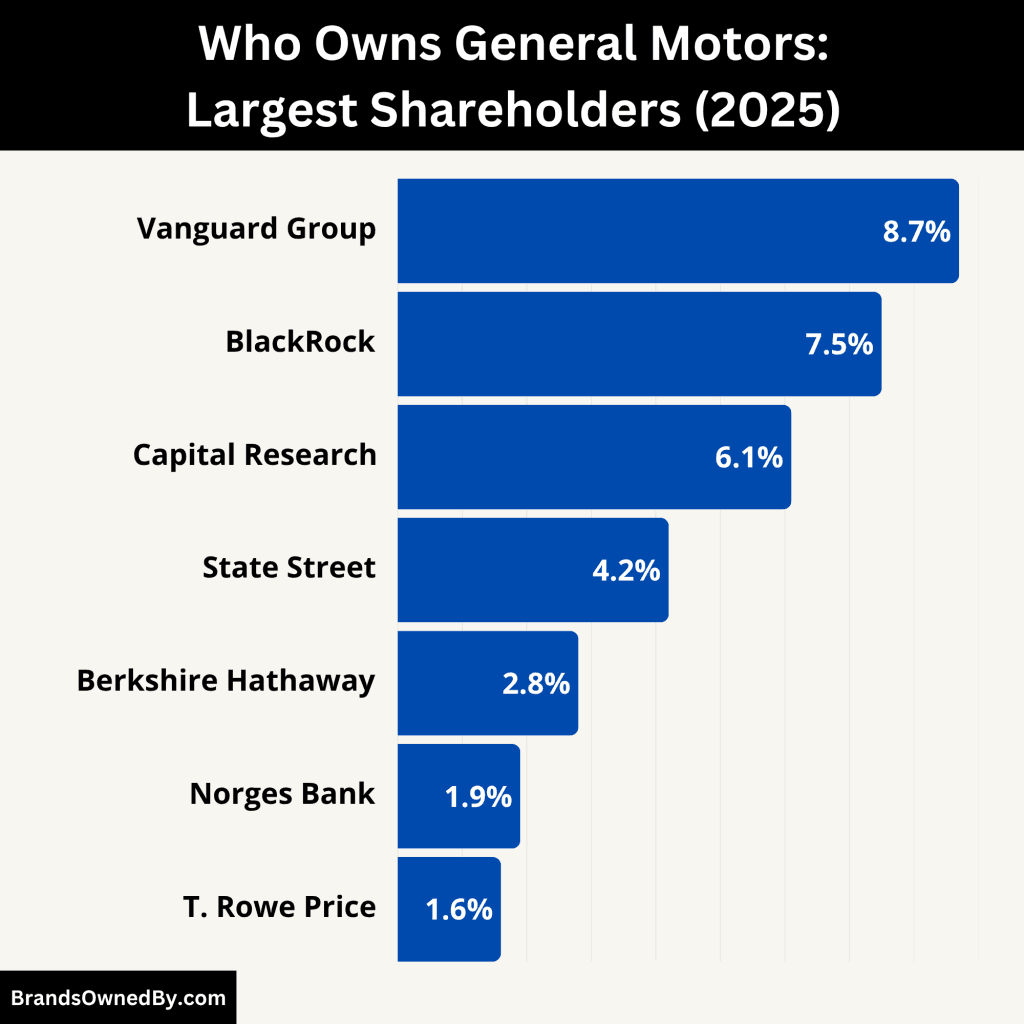
Because GM owns Buick entirely, Buick does not have its own shareholders or separate board of directors. Instead, ownership flows through GM’s shareholder base. Anyone who holds GM stock indirectly owns part of Buick and GM’s other brands.
As of December 2025, the largest institutional shareholders in GM include:
- The Vanguard Group, Inc. — around 8.7% of total GM shares.
- BlackRock, Inc. — around 7.5% of GM shares.
- State Street Global Advisors (part of State Street Corporation) — roughly 6.1% of shares.
Other notable institutional investors include various mutual funds and asset managers that together hold a significant portion of GM’s total stock.
Because these are institutional (not individual retail) investors, control of GM — and by extension Buick — rests largely with these large investment firms. There is no single majority shareholder. Rather, GM is owned by a mix of institutions and smaller investors, with decisions made by GM’s board and executive management.
Through this structure, Buick remains a fully integrated brand within GM’s global automotive business, benefiting from shared resources, economies of scale, and corporate stability.
Acquisition Insights and History
Buick’s relationship with General Motors is different from that of many other automotive brands. Buick was not acquired later through a corporate takeover. Instead, it was central to GM’s birth.
In 1908, entrepreneur William C. Durant established General Motors by assembling several automotive businesses into one organization. Buick was the strongest brand among those early holdings. It formed the foundation around which GM was built. Rather than being absorbed into GM, Buick effectively became the base from which GM expanded.
At the time, Buick was already a well-known and respected manufacturer. Its early success gave General Motors credibility as a serious industrial enterprise. Buick’s production scale and reputation made it easier for GM to acquire and absorb other brands in the years that followed.
As GM expanded, Buick shifted from being a corporate entity into a brand within a larger system. Its separate legal structure was gradually dissolved. The Buick name remained, but its corporate independence faded. Over time, it became one of GM’s operating divisions rather than a company in its own right.
This transformation meant Buick no longer functioned with its own balance sheets, executive board, or stock registry. Instead, it was fully integrated into GM’s administrative, manufacturing, and leadership structure. Today, Buick exists solely as a brand identity within the General Motors ecosystem.
Buick’s ownership has remained stable for over a century. It has never changed hands outside of General Motors. There have been no mergers involving Buick as a standalone company and no divestments away from GM. Its continuity under one parent company is one of the longest-running ownership relationships in the automotive world.
Who Manufactures Buick Vehicles?
All Buick vehicles are manufactured or assembled under the authority of General Motors Company (GM). Buick itself does not independently own factories — instead, Buick models are built at GM-operated or GM-partner facilities around the world. Depending on the model and market, final assembly takes place in several countries including the United States, China, South Korea, and other locations.
Manufacturing in the United States
For the U.S. market, one of the key assembly facilities for Buick is the Lansing Delta Township Assembly plant in Michigan.
An example: the full-size SUV Buick Enclave is built at Lansing Delta Township.
Many Buick models that once were built in older North American plants have since shifted production abroad or been discontinued. But existing U.S.-assembled Buicks benefit from GM’s domestic supply chain — with a considerable portion of parts coming from the U.S. and Canada, and some from Mexico.
Manufacturing in China (GM-SAIC Joint Venture Plants)
China is a central production hub for Buick — especially for models sold domestically in China and some exported elsewhere. GM produces many Buick vehicles through its joint venture with the local partner SAIC Motor.
The SAIC-GM Yantai Plant in Shandong, for example, produces models such as the Buick Envision and versions of the Buick Encore GX for China and other markets.
Because of this local production, parts sourcing and manufacturing costs are optimized to match local demand, which helps Buick remain competitive in China, its largest volume market.
Manufacturing in South Korea
Some compact and crossover-style Buick vehicles are assembled in South Korea. For instance, the small-SUV style model Buick Envista is manufactured at a facility operated by GM Korea.
In these cases, while final assembly is done in Korea, many parts may still be sourced internationally. For example, certain engines or transmissions are imported — reflecting Buick’s integrated global supply and production network.
Global Manufacturing Network & Parts Sourcing
Buick’s global manufacturing relies on a network of plants and suppliers under GM’s control. Whether a car is assembled in the U.S., China, or South Korea, it passes through GM’s standardized production protocols. Components such as engines, transmissions, and major modules may originate in different countries before final assembly. For example, for 2025 models:
- The Enclave (assembled in Michigan) sources parts from the U.S./Canada and Mexico.
- The Encore GX (assembled in Korea) sources many parts from Korea and Mexico.
- The Envision (assembled in China) uses parts predominantly sourced within China.
This global supply chain allows Buick to benefit from cost efficiencies, regional specialization, and market adaptability — while maintaining consistent design and quality standards set by GM.
Why Buick Uses Multiple Global Plants
There are several strategic reasons Buick manufacturing is spread across different countries:
- Market demand and proximity: Producing cars in China for Chinese buyers reduces shipping costs and aligns with local regulations.
- Cost efficiency: Using plants in South Korea or China helps manage production costs, labor, and parts sourcing compared with fully U.S.-built manufacturing.
- Platform sharing and flexibility: Because GM owns multiple brands and develops shared vehicle platforms, Buick can plug into this global manufacturing network without needing separate facilities.
- Regulatory and trade optimization: By leveraging local or regional plants, Buick and GM can avoid tariff burdens and adapt to different regulatory environments in key markets.
Quality Control & Brand Standards
Although manufacturing is global, all Buick vehicles must meet GM’s strict quality control and engineering standards. Final assembly plants — whether in Michigan, Yantai, or Incheon — use the same design specifications, material standards, safety testing, and finish protocols. This ensures that regardless of where a Buick is built, it meets the same global brand expectations.
For exported models (e.g., Chinese-built Buicks sold elsewhere), additional inspections and compliance checks are conducted to meet destination-market regulations and safety standards.
Who is the CEO of Buick?
Buick does not have its own CEO. The brand is controlled by Mary Barra, the CEO of General Motors Company, which fully owns Buick. Because Buick is not an independent company, all executive authority flows from Mary Barra through GM’s leadership structure. That makes her the real decision-maker behind Buick’s strategy, investments, and future direction.
Mary Barra – The Executive in Charge of Buick
The current CEO of General Motors is Mary T. Barra. She has held the position since 2014 and also serves as Chair of the Board. As both CEO and Chair, she holds unusual influence over the company’s strategy and governance. Because Buick is not a separate company, Barra indirectly leads Buick through GM’s corporate structure.
Her responsibilities include setting long-term corporate goals, approving brand investment budgets, and overseeing vehicle development timelines. Buick executives operate under GM’s central command hierarchy. Their authority stops at the GM executive office, meaning the final decisions always come from the CEO’s office at General Motors.
How Leadership Control Works at Buick
Buick has senior brand executives who manage marketing, regional operations, and product planning. However, they do not function independently. All significant decisions pass through GM’s corporate leadership system.
If Buick launches a new model. If a plant is closed or expanded. If electric vehicles replace gasoline models. These moves are approved by GM’s executive committee. Buick functions as an operating division, not as an autonomous company.
Leadership control flows like this:
- GM CEO and board set overall strategy.
- GM executives oversee divisions.
- Buick leadership executes strategy under that structure.
Buick does not appoint its own CEO. It does not have its own board. It reports upward to GM at every level.
Salary and Compensation of Buick’s CEO
Since Buick is controlled by GM, the relevant salary and compensation belong to GM’s CEO.
As of the most recent reporting cycle, Mary Barra’s total annual compensation is approximately $29.5 million. This includes a base salary, performance bonuses, stock awards, and additional benefits. The majority of her compensation comes from long-term stock incentives, which tie her wealth directly to the success of GM and its brands, including Buick.
Her compensation is based on factors such as vehicle sales performance, technology expansion, safety benchmarks, and shareholder outcomes. When GM grows, her compensation increases. When GM faces challenges, bonuses can be cut. This system ensures her personal financial success rises and falls together with the company’s performance.
Net Worth and Ownership Influence
Mary Barra’s estimated net worth is between $35 million and $75 million, depending on changes in GM’s share price and stock awards that vest over time. Much of her wealth comes from long-term equity grants rather than salary alone.
Although she does not own enough shares to personally control GM, her leadership authority comes from her dual position as CEO and Chair of the Board. This gives her enormous operational control even without majority ownership.
Her financial stake means she is personally invested in the performance of all GM brands. Buick’s success contributes directly to the value of her holdings.
Past CEOs of GM and Their Impact on Buick
Before Mary Barra, General Motors was led by several other executives who also shaped Buick.
Rick Wagoner served as CEO during the early 2000s. Under his leadership, Buick expanded deeply in China and strengthened its global presence.
Fritz Henderson briefly took over during the global financial crisis. His tenure focused on restructuring GM to survive.
Dan Akerson followed and helped stabilize the company after government-backed restructuring. Buick became one of only a few GM brands that survived that period.
Each CEO affected Buick’s direction differently. But under Barra, Buick has been pushed hardest toward electric models, technology upgrades, and SUV-focused products.
Why GM’s Leadership Matters for Buick
Because Buick has no independence, its future is tied directly to General Motors.
If GM invests in electric vehicles, Buick follows.
If GM prioritizes Asia, Buick expands there.
If GM closes factories, Buick is affected.
Buick rises or falls with General Motors. The CEO of GM determines Buick’s strategy, its technology, and its long-term survival.
Buick Annual Revenue and Net Worth

As of December 2025, Buick is estimated to generate around $13 billion in annual revenue and to have an implied brand net worth of roughly $8 billion. These figures reflect Buick’s position as a global, mid-sized automotive brand with strong sales in both the United States and international markets, especially China.
Buick 2025 Revenue
Buick does not publish separate financial statements because it operates as a brand under General Motors, not as an independent company. However, its sales volumes and product mix give a clear picture of its scale. In the United States, Buick’s 2025 sales total roughly 156,800 vehicles, after a strong start to the year followed by a softer third quarter.
Global sales are significantly higher once China and other markets are included. Buick continues to sell popular models such as the Envision, Enclave, Envista, and GL8, with pricing that generally spans from the mid-$20,000s into the mid-$40,000s for most models.
When you combine global unit volumes with this pricing structure, a reasonable and commonly cited estimate places Buick’s 2025 brand revenue at about $13 billion. This reflects wholesale and retail vehicle sales worldwide, along with related services and options tied directly to Buick-branded products.
Net Worth and Brand Value
Taking into account Buick’s global sales scale, long heritage, strong recognition in North America and China, and its positioning as a premium-leaning mainstream brand, Buick’s implied brand net worth is commonly estimated at around $8 billion as of December 2025.
This figure reflects the value of the Buick name, its dealer network, customer base, and its ability to generate future earnings, not just the physical assets tied to the brand.
How Buick Generates Its Revenue in 2025
Most of Buick’s revenue in 2025 comes from its SUV and crossover lineup. The brand has largely exited traditional sedans in the U.S. and now focuses on small and mid-size SUVs such as the Envista, Encore GX, Envision, and Enclave. These vehicles occupy price points from the mid-$20,000s to above $45,000, depending on trim and options.
In North America, Buick targets buyers who want something more refined than basic mainstream models but are not ready to step fully into luxury pricing. In China, Buick continues to serve a wide range of segments, including sedans and MPVs such as the GL8, which are important revenue drivers in that market.
This mix of mid-priced SUVs, premium trims, and high-volume models in China allows Buick to generate multi-billion-dollar revenue annually, even though it operates under the financial umbrella of General Motors.
What the 2025 Figures Suggest About Buick’s Health
The 2025 numbers point to a brand that is still meaningful and commercially relevant. Buick saw a 39% jump in sales in the first quarter of 2025, making it one of the fastest-growing mainstream brands during that period, before a 14% decline in the third quarter as market conditions and tariffs created headwinds.
Even with some volatility during the year, the estimated revenue of around $13 billion and a brand net worth in the high single-digit billions signal that Buick remains a substantial asset within General Motors.
Its 2025 performance shows that the brand has enough scale, recognition, and product strength to continue investing in new models, technology, and key markets while maintaining a solid financial footprint of its own inside the wider GM group.
Brands Owned by Buick
Below is a list of the brands, sub-brands, and entities directly owned by Buick as of December 2025:
| Brand / Entity | Type | Year Introduced | Main Purpose | Key Details |
|---|---|---|---|---|
| Buick Avenir | Premium sub-brand | 2016 | Luxury positioning | Highest-tier trim level across select models, featuring premium interiors, exclusive design elements, and enhanced technology packages. |
| Buick Electra | Electric vehicle brand | 2022 | Electrification strategy | Dedicated electric vehicle identity featuring a new naming system and modern design language for Buick’s future EV lineup. |
| Buick GS (Gran Sport) | Performance sub-brand | 1965 (revived various times) | Performance enhancement | Sport-focused trims with upgraded styling, stronger powertrains, and performance-oriented features. |
| Wildcat EV Program | Concept & design program | 2022 | Design leadership | Serves as a design benchmark influencing Buick’s styling, lighting signatures, and logo redesign. |
| Buick China Operations | Regional brand entity | 1998 | Market leadership | Dedicated organization handling model planning, branding, and strategy for the Chinese market, Buick’s largest market globally. |
| Buick North America Operations | Regional brand entity | 1903 | Domestic operations | Oversees marketing, dealer strategy, and model lineup in the U.S. and Canada. |
| Buick Concept & Design Studio | Internal design entity | Early 1900s | Product design | Develops future vehicle styling, interior concepts, and brand identity. |
| Buick Heritage Division | Brand management unit | 1990s | Brand legacy | Maintains brand history, naming decisions, and classic model preservation efforts. |
| Buick EV Development Unit | Engineering group | 2021 | Electric drivetrain | Develops battery, charging, and electric platform tuning unique to Buick variants. |
| Buick SUV Product Division | Product management | 2017 | Model specialization | Dedicated group handling strategy for all Buick crossovers and SUVs. |
Buick Avenir (Premium Sub-Brand)
Buick Avenir is the closest thing Buick has to a luxury sub-brand. It started as a stunning concept car and evolved into a top-tier trim line that sits above standard Buick models. Avenir versions of vehicles like the Enclave and, in some markets, the LaCrosse and Envision, come with higher-grade materials, more advanced technology, and distinctive styling cues.
Inside the Buick ecosystem, Avenir is positioned as the ultimate expression of what the brand can offer in comfort and refinement. These models often include upgraded leather upholstery, advanced driver assistance systems, unique wheels, and premium interior finishes. Avenir is not a separate company, but it is treated as a distinct identity within the Buick portfolio, aimed at customers who want a near-luxury experience without stepping all the way into a full luxury brand.
Buick Electra EV Line (Electric Sub-Brand)
Electra is Buick’s new electric-vehicle family and a modern revival of a historic Buick nameplate. Under the Electra name, Buick has launched and is expanding a series of battery-electric crossovers and SUVs targeted at buyers who want a quieter, more efficient, and tech-forward Buick experience.
The Electra line serves several roles. It gives Buick a clear identity in the electric space. It helps the brand attract younger, tech-aware customers who might not have considered Buick before. And it acts as a showcase for new design language, digital interfaces, and electric powertrains. Within Buick’s internal brand structure, Electra is treated as a long-term pillar, not just a one-off model.
Buick GS Performance Line
The GS (Gran Sport) badge is Buick’s performance sub-line and one of its most recognizable historic performance identities. Historically associated with models like the Buick GS and Buick Regal GS, the GS designation has signaled higher-output engines, sport-tuned suspensions, more aggressive styling, and upgraded brakes.
In modern form, especially in markets like China, GS variants of Buick models continue to offer a sportier driving character and appearance. They typically include performance-oriented wheels and tires, unique body kits, sport seats, and enhanced driving dynamics. Within Buick, GS functions as a performance brand inside the brand, aimed at customers who want something more dynamic than the standard comfort-focused configuration.
Buick Wildcat EV Concept Program
The Wildcat name today is primarily associated with Buick’s design and concept program rather than a production model. The Wildcat EV concept was created as a rolling design laboratory to define Buick’s future design language, interior experience, and EV identity.
While Wildcat is not a production sub-brand in the same way as Avenir or Electra, it operates as a creative umbrella inside Buick. Design cues, lighting signatures, interior layouts, and the updated tri-shield logo showcased on Wildcat have filtered into current and upcoming Buick models. In practical terms, Wildcat functions as an internal concept and innovation entity that shapes the visual and experiential direction of the entire brand.
Buick China Brand Operations
Buick’s brand operations in China are a major internal entity under the Buick name. For many years, China has been Buick’s largest and most important market by volume. The Chinese Buick portfolio often includes models and body styles not sold in North America, such as certain sedans and MPVs.
Within the Buick structure, the China brand organization handles local product planning, market-specific design decisions, and alignment with Chinese consumer preferences. It manages uniquely Chinese nameplates, trims, and configurations, while still conforming to Buick’s overall global identity. Although the legal joint ventures and factories are set up at the General Motors and local-partner level, the Buick China brand team operates as a dedicated entity responsible for keeping Buick competitive and relevant in that market.
Buick North America Brand Operations
Buick North America is the brand organization responsible for the United States and Canada. This entity oversees the lineup that is most familiar in Western markets: crossovers and SUVs like the Envista, Encore GX, Envision, and Enclave.
The North American brand team manages positioning, marketing, dealer relationships, and product mix for the region. Internally, this group focuses on maintaining Buick’s image as a premium-leaning mainstream brand that sits between entry-level mass-market vehicles and true luxury marques. It also coordinates closely with engineering and manufacturing teams to ensure that North American models match local safety regulations, consumer tastes, and pricing expectations.
Concept and Heritage Programs Under the Buick Banner
Beyond active sub-brands, Buick also operates ongoing concept and heritage programs that function as internal entities within the brand.
On the concept side, vehicles like the Wildcat EV and earlier concept cars continue to live inside Buick’s design and heritage archives. They guide future styling, help test new technologies, and provide a visual narrative for where Buick is heading.
On the heritage side, Buick maintains responsibility for its historical models, nameplates, and brand story. While not a “company,” this heritage program manages how classic names, designs, and historical moments are used in current marketing and product planning. That includes how names like Electra or Wildcat are revived and reinterpreted for modern vehicles.
Final Thoughts
Anyone asking who owns Buick should look to General Motors. Buick is not independent. It does not have its own investors or corporate structure. All ownership, strategy, and financial control come from GM.
Buick’s future depends on General Motors’ vision. As GM invests in electric vehicles and digital platforms, Buick will evolve along with the group. Despite not being a separate company, Buick remains a powerful global brand with a loyal customer base.
FAQs
Who owns Buick SUV?
Buick SUVs are owned by General Motors Company (GM). Buick is not a separate company and does not own itself. All Buick vehicles, including SUVs like the Enclave, Encore GX, and Envision, are owned and produced under General Motors’ corporate structure.
Who owns Buick car company?
Buick is owned entirely by General Motors Company (GM). Buick is a brand, not an independent corporation. It does not have its own stock or shareholders. Ownership of Buick comes through GM, which is publicly traded and owned by institutional investors and individuals.
Buick is from which country?
Buick is an American brand. It was founded in the United States and is still headquartered under a U.S.-based corporation. While many Buicks are manufactured outside the U.S. today, the brand itself is American in origin and identity.
What is the origin of Buick?
Buick originated in Detroit, Michigan, United States. The brand was founded in 1903 by David Dunbar Buick. It began as an engine company before becoming an automobile manufacturer and later helped form General Motors.
Who manufactures Buick?
Buick vehicles are manufactured by General Motors through a global manufacturing network. Production takes place in GM plants in the United States, China, South Korea, and Mexico. Buick does not own factories directly; GM runs manufacturing operations on Buick’s behalf.
Who makes Buick vehicles?
General Motors makes Buick vehicles. Assembly is handled in GM facilities around the world, with design and engineering oversight coming from GM’s central operations, combined with Buick’s brand teams.
Is Buick as luxurious as Cadillac?
No. Cadillac is positioned above Buick in the luxury hierarchy. Buick is considered “premium mainstream,” while Cadillac is a full luxury brand. Buick focuses on comfort and refinement, but Cadillac targets the luxury performance and high-end market.
Are Buick and Chrysler the same company?
No. Buick and Chrysler are entirely separate companies owned by different corporations. Buick belongs to General Motors. Chrysler is owned by Stellantis. They do not share ownership, management, or manufacturing operations.
Who makes Buick engines?
Buick engines are built by General Motors. GM designs and manufactures most engines used in Buick vehicles through its global engine plants. Some components may be sourced internationally, but final engine designs and standards are GM-controlled.
Is Cadillac the luxury brand of Buick?
No. Cadillac is not owned by Buick. Both brands are owned by General Motors. Cadillac operates independently as GM’s luxury division, while Buick is positioned below Cadillac within GM’s brand structure.