

- Topgolf is majority-owned by Leonard Green & Partners (60%), making it the controlling shareholder as of 2026.
- Callaway Golf Company owns the remaining 40% stake, retaining strategic influence but not control.
- Ownership shifted in 2026 from full public company control to private equity control, marking a major structural change.
- Topgolf now operates under a hybrid model, combining private equity leadership with strategic backing from a global golf company.
Topgolf is a global sports entertainment company. It blends golf with technology, food, and social experiences. The concept is simple but highly engaging. Players hit microchipped golf balls toward targets, and points are scored based on accuracy and distance.
The company operates large venues designed like entertainment hubs. These venues include multiple hitting bays, restaurants, bars, and event spaces. The environment is social and casual. It attracts both serious golfers and beginners.
Topgolf is known for making golf more accessible. Traditional golf can feel complex and time-consuming. Topgolf removes those barriers. Games are easy to understand, and no prior experience is required.
The brand has expanded internationally. It has a strong presence in the United States and growing operations in other regions. Each venue is designed to deliver a consistent experience while adapting to local markets.
Technology is at the core of the business. Its ball-tracking system and digital scoring make gameplay interactive. This innovation helped Topgolf stand out in the entertainment industry.
Founders of Topgolf
Topgolf was founded by twin brothers Steve Jolliffe and Dave Jolliffe. They came up with the idea in the late 1990s in the United Kingdom.
The idea was born out of frustration. The brothers wanted to practice golf but found it difficult to track their shots on a traditional driving range. They saw an opportunity to improve the experience using technology.
Their solution was to create a driving range with tracked golf balls. This allowed players to see exactly where their shots landed. It also made the game more engaging and competitive.
The first Topgolf venue opened in 2000 in Watford, England. It introduced a completely new way to experience golf. The concept quickly gained attention.
While the Jolliffe brothers created the idea, scaling the business required additional leadership and investment. Over time, experienced executives and investors helped expand Topgolf into a global brand.
Their original vision remains central to the company. Making golf fun, social, and accessible continues to define Topgolf today.
Ownership History
Topgolf’s ownership history is complex and has evolved significantly over time. The company moved from a founder-led startup to institutional backing, then to full corporate ownership, and most recently to a hybrid structure involving private equity. The 2026 restructuring is especially important, as it changed how Topgolf is owned and financed.
Early Founding and Private Ownership (2000–2005)
Topgolf was founded in 2000 by Steve Jolliffe and Dave Jolliffe in the United Kingdom. The business started with a single location in Watford. At this stage, ownership was concentrated among the founders and a small group of early investors.
The company’s primary focus was on developing its core concept. This included microchipped golf balls and interactive targets. The idea was new and required testing before scaling.
Capital was limited. Expansion was slow and controlled. The founders maintained full strategic control over operations, branding, and technology development. There was no involvement from large institutional investors.
This period laid the foundation for the business. However, the company lacked the financial resources needed for international growth.
Strategic Investment and US Expansion (2006–2015)
A major turning point came in 2006 when Callaway Golf acquired a minority stake in Topgolf. This investment was both financial and strategic. Callaway recognized that Topgolf could help grow interest in golf among younger and more casual audiences.
Following this investment, Topgolf began expanding into the United States. This required significant capital. As a result, additional investors, including private equity firms and institutional backers, entered the ownership structure.
Ownership became more fragmented. It now included founders, management, Callaway, and multiple financial investors. Decision-making became more structured, with greater influence from major stakeholders.
The US market quickly became the company’s primary growth engine. New venues opened in key metropolitan areas. The brand gained traction as a social entertainment concept rather than just a golf facility.
During this phase, the founders’ ownership percentage diluted. However, their vision continued to influence the company’s direction.
Rapid Scaling and Increasing Callaway Influence (2016–2019)
Between 2016 and 2019, Topgolf experienced rapid expansion. The company opened multiple venues each year and entered new international markets. It also invested heavily in its Toptracer technology, which became a key differentiator.
Callaway steadily increased its ownership stake during this period. It was no longer just a minority investor. It became one of the most influential stakeholders in the company.
Private equity firms still held significant positions. However, ownership began to consolidate around larger institutional investors. The company’s governance structure became more formal, with increased oversight and strategic planning.
Topgolf’s valuation rose significantly. It was now seen as a leader in the emerging “golf entertainment” industry. This growth made a full acquisition by Callaway increasingly likely.
Full Acquisition by Callaway and Integration (2020–2025)
In 2020, Callaway completed its acquisition of Topgolf in an all-stock transaction. This deal made Topgolf a wholly owned subsidiary of Callaway.
The acquisition marked a major strategic shift. Callaway aimed to transform itself from a traditional golf equipment company into a broader golf and entertainment platform. Topgolf became the centerpiece of this transformation.
After the acquisition, the combined company rebranded as Topgolf Callaway Brands. This reflected the growing importance of the Topgolf business within the overall group.
During this period, ownership of Topgolf was fully consolidated under the public parent company. Shareholders of Topgolf Callaway Brands indirectly owned Topgolf through their equity in the parent.
Topgolf expanded aggressively during these years. New venues opened across North America and internationally. The company also enhanced its digital and event-based offerings.
Despite strong growth, the business required significant capital investment. Each new venue involved high upfront costs. This created pressure on the parent company’s balance sheet.
Majority Stake Sale to Leonard Green & Partners (2026–Present)
In 2026, Topgolf’s ownership changed significantly. Callaway Golf Company sold a 60% majority stake in Topgolf to Leonard Green & Partners, a private equity firm.
After the deal, the ownership structure is:
- Leonard Green & Partners: 60% (controlling owner)
- Callaway Golf Company: 40% (minority stakeholder).
This means Callaway no longer controls Topgolf. Control now sits with Leonard Green, which oversees major strategic decisions such as expansion and capital allocation.
Callaway remains involved as a minority investor. It continues to benefit from Topgolf’s growth while reducing financial pressure from the capital-intensive business.
This 2026 transaction marks a major shift. Topgolf is now a private equity-controlled company with shared ownership.
Who Owns Topgolf: Major Shareholders
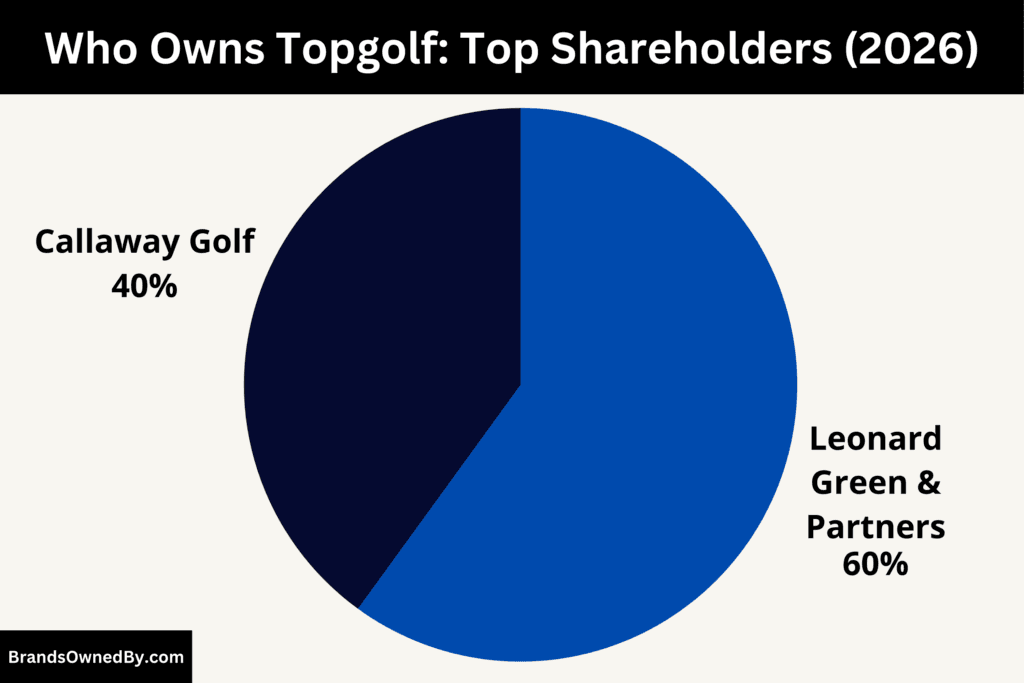
Topgolf’s ownership structure changed significantly in early 2026. It is no longer fully owned by a single public company. Instead, it operates under a dual ownership model involving private equity and a public parent company.
After the restructuring, Topgolf is majority-owned by a private equity firm, Leonard Green & Partners, while the former parent company retains a substantial minority stake. This shift was designed to reduce capital pressure and unlock value.
As of March 2026:
- Leonard Green & Partners owns 60% of Topgolf
- Callaway Golf Company (formerly Topgolf Callaway Brands) retains 40%.
This means control has shifted away from public shareholders to private equity. However, public investors still have indirect exposure through Callaway’s retained stake.
Below is a detailed breakdown of the key shareholders influencing Topgolf, both directly and indirectly.
Leonard Green & Partners (Majority Owner)
Leonard Green & Partners is now the largest and controlling shareholder of Topgolf. This private equity firm acquired a 60% stake in a deal valued at approximately $1.1 billion.
This acquisition gives Leonard Green operational control. It typically focuses on scaling consumer-facing businesses. Its involvement signals a push toward profitability and efficiency.
The firm manages tens of billions in assets. It has experience in retail, hospitality, and consumer brands. These sectors align closely with Topgolf’s business model.
With majority ownership, Leonard Green influences:
- Expansion strategy
- Capital allocation
- Operational efficiency
- Long-term exit strategy (IPO or resale).
This marks a major shift. For the first time, Topgolf is primarily controlled by private equity rather than a public corporation.
Callaway Golf Company (Minority Owner)
Callaway Golf Company remains a significant minority shareholder with about 40% ownership in Topgolf.
Even after selling control, Callaway retained a large stake. This indicates continued belief in Topgolf’s long-term growth potential.
Callaway’s role is now more strategic than operational. It benefits from Topgolf’s upside without bearing full financial risk.
The company still has influence through:
- Board representation
- Strategic alignment with golf equipment and technology
- Shared ecosystem with brands like Toptracer.
This structure allows Callaway to focus more on its core equipment and apparel business while staying connected to Topgolf’s growth.
Although Topgolf is no longer directly publicly traded, institutional investors still influence it indirectly through their holdings in Callaway Golf Company.
Institutional investors collectively own a large portion of Callaway. In recent filings, institutional ownership has remained above 80%.
These investors include major global asset managers. Their decisions impact Callaway’s strategy, which in turn affects Topgolf.
The Vanguard Group
The Vanguard Group is one of the largest shareholders in Callaway. It manages trillions in assets and represents passive investors through index funds.
Vanguard typically holds long-term positions. Its influence is indirect but significant. It supports stable governance and long-term growth strategies.
Through its stake, Vanguard has exposure to Topgolf’s performance via Callaway’s ownership.
BlackRock, Inc.
BlackRock is another major institutional investor. It often ranks among the top shareholders in Callaway, with stakes exceeding 10% in recent disclosures.
As the world’s largest asset manager, BlackRock plays a key role in corporate governance. It influences decisions through voting power and engagement with management.
Its involvement signals strong institutional confidence in the business model.
Providence Equity Partners
Providence Equity Partners is a notable shareholder with a history in media and entertainment investments. It has held meaningful stakes in Callaway and previously in Topgolf itself.
This investor understands experiential and entertainment-driven businesses. Its presence aligns with Topgolf’s hybrid model of sports and hospitality.
Dimensional Fund Advisors
Dimensional Fund Advisors is another large institutional holder. It focuses on systematic investing strategies and long-term portfolio allocation.
Its stake reflects broader institutional confidence rather than active control. However, combined with other institutions, it contributes to overall shareholder influence.
Leonard Green & Partners
Interestingly, Leonard Green is not only the majority owner of Topgolf. It has also held positions in Callaway itself.
This creates a strategic overlap. It aligns incentives between the private equity owner and the public company.
Such dual exposure strengthens coordination between both entities, especially during the transition phase.
Insider Ownership
Insider ownership in Callaway remains relatively small but important. It includes shares held by executives and board members.
These insiders influence decision-making directly. Their ownership aligns management incentives with shareholder interests.
Key executives, including the CEO, play a major role in shaping how the Topgolf stake is managed.
Competitor Ownership Comparison
Topgolf operates in the broader “competitive socializing” and golf entertainment industry. As of 2026, its ownership structure—controlled by private equity (Leonard Green & Partners) with minority backing from Callaway—is unique compared to competitors.
Most rivals fall into three categories:
- Public companies with dispersed ownership
- Privately owned growth-stage companies
- Private equity-backed entertainment concepts.
This difference in ownership directly impacts scale, funding, and expansion speed.
| Company / Brand | Ownership Type | Key Owners / Backers | Control Structure | Business Model Focus | Key Limitation vs Topgolf |
|---|---|---|---|---|---|
| Topgolf | Private Equity + Strategic | Leonard Green & Partners (60%), Callaway (40%) | Controlled by private equity | Large-scale golf entertainment venues | Capital intensive but well-funded |
| Drive Shack / Puttery | Public Company | Institutional & retail shareholders | No single controlling owner | Golf entertainment + mini golf (Puttery) | Capital constraints, slower scaling |
| Puttshack | Private Equity / Institutional | BlackRock, Promethean Investments, others | Investor-backed, centralized control | Tech-driven mini golf entertainment | Smaller scale, urban-focused |
| Five Iron Golf | Venture-backed Private | Founders, private investors, Callaway (minor stake) | Founder + investor controlled | Indoor golf simulators | Limited scale vs mega venues |
| BigShots Golf (Invited Clubs) | Private Corporate | Invited Clubs (private ownership) | Corporate-controlled | Golf entertainment within club ecosystem | Not core focus, slower expansion |
| Swingers / Mini Golf Concepts | Private / Institutional | Private investors, venture capital | Founder/investor controlled | Social mini golf entertainment | Niche formats, less scalable |
| Poolhouse (emerging) | Venture-backed Startup | VC firms, founders (Topgolf creators) | Founder-led with investor backing | Social gaming (non-golf focused) | Early stage, unproven scale |
Drive Shack and Puttery: Public Company Structure
Drive Shack is one of Topgolf’s closest direct competitors. It is a publicly traded company (Drive Shack Inc.), meaning ownership is spread across institutional and retail investors.
The company operates both traditional golf venues and its newer concept, Puttery, which focuses on tech-driven mini golf experiences.
Because it is public, Drive Shack faces:
- Market pressure from shareholders
- Capital constraints tied to stock performance
- Slower decision-making due to governance structures.
Unlike Topgolf, it does not have a single controlling shareholder or private equity sponsor. This limits its ability to aggressively fund large-scale expansion.
Puttshack: Private Equity and Institutional Capital
Puttshack is one of the most relevant competitors in the tech-enabled golf entertainment space. It focuses on gamified mini golf rather than driving ranges.
The company is backed by institutional investors and private capital, including a major $150 million investment led by BlackRock.
Earlier funding rounds also included firms like Promethean Investments and Bruin Capital.
This ownership model is closer to Topgolf’s current structure. However, there are key differences:
- Puttshack operates smaller venues
- It targets urban entertainment markets
- It has less capital intensity compared to Topgolf.
While well-funded, it does not yet match Topgolf’s scale or global footprint.
Five Iron Golf: Venture-Backed Private Ownership
Five Iron Golf operates indoor golf simulator venues. It follows a venture-backed private ownership model.
The company has raised capital from private investors and strategic backers. Notably, Callaway itself has invested in Five Iron Golf, showing overlap within the ecosystem.
Ownership remains concentrated among founders and investors. This allows:
- Fast execution
- Flexible expansion
- Lower capital requirements.
However, its model is fundamentally different. It focuses on smaller, indoor locations rather than large destination venues like Topgolf.
BigShots Golf (Invited Clubs): Private Corporate Ownership
BigShots Golf operates under Invited Clubs (formerly ClubCorp), a privately held company focused on golf and country clubs.
This means:
- Ownership is centralized within a private corporate structure
- Golf entertainment is not the core business
- Expansion is more conservative.
BigShots does compete directly with Topgolf in some markets. However, its growth has been slower due to its position within a broader portfolio.
Emerging Competitors: Capital-Backed “Social Gaming” Concepts
The competitive landscape is expanding beyond golf. Several new entrants are backed by strong investors and target similar audiences.
Examples include:
- Puttery (Drive Shack) backed by corporate capital and venture investment
- Swingers and other mini-golf concepts backed by private investors and institutional funding
- New ventures like Poolhouse (founded by Topgolf creators) backed by venture capital and strategic investors.
These companies operate in the same “eatertainment” category. They compete for the same consumer spending, even if the format differs.
Ownership Comparison: Why Topgolf Has an Edge
Topgolf’s 2026 ownership structure stands out because it combines:
- Private equity control (Leonard Green & Partners)
- Strategic minority backing (Callaway).
This hybrid model provides:
- Access to large-scale capital for expansion
- Faster decision-making than public companies
- Strategic alignment with the golf industry
- Ability to build large, high-cost venues.
Most competitors lack this combination.
- Public companies like Drive Shack face capital constraints.
- Smaller private firms like Five Iron lack scale.
- Private equity-backed firms like Puttshack operate in narrower formats.
This is why Topgolf continues to lead the industry. Its ownership structure directly supports aggressive growth, operational control, and long-term strategic flexibility.
Who Controls Topgolf?
Control of Topgolf as of 2026 is defined by a clear separation between ownership, governance, and execution. The company is no longer controlled by a public parent alone. Instead, it operates under a private equity-led control model, where authority flows from the majority owner down to the board and then to executive leadership.
This structure is more centralized and performance-driven than before. It reflects Topgolf’s transition from a corporate division into a standalone, investment-backed business.
Leonard Green & Partners: Majority Control and Strategic Direction
Leonard Green & Partners holds a 60% majority stake, which gives it full controlling authority over Topgolf. This level of ownership provides decisive power over all major strategic and financial decisions.
The firm’s control is exercised primarily through the board. It determines how aggressively Topgolf expands, how capital is deployed, and how the business is positioned for long-term value creation.
Private equity ownership typically comes with a defined investment horizon. This means Topgolf’s strategy is now shaped around scaling efficiently, improving margins, and increasing enterprise value. Expansion decisions are more disciplined, with a focus on return on invested capital rather than pure growth.
This is a clear shift from the earlier phase, where Topgolf was used as a growth engine within a public company structure. Now, it is managed as a standalone asset with performance accountability.
Callaway Golf Company: Strategic Alignment Without Control
Callaway Golf Company retains a 40% minority stake, making it a significant but non-controlling shareholder.
Its influence exists at the governance level. It has board representation and participates in high-level strategic discussions. However, it cannot unilaterally direct the company.
Callaway’s importance lies in ecosystem alignment. Topgolf venues continue to integrate Callaway’s equipment, golf balls, and technology platforms like Toptracer. This relationship ensures that both companies benefit commercially from shared growth.
At the same time, Callaway is no longer responsible for funding Topgolf’s expansion at scale. The 2026 transaction reduced its financial exposure while preserving upside through its retained stake.
This creates a balanced dynamic. Callaway contributes industry expertise and brand integration, while Leonard Green drives financial and strategic control.
Board of Directors: Where Control is Exercised
Real control of Topgolf sits at the board level, where ownership translates into decision-making power.
Following the 2026 deal, the board structure reflects the new ownership split. Leonard Green, as the majority owner, holds dominant influence over board composition and voting outcomes. Callaway maintains representation but does not control board decisions.
The board is responsible for:
- Approving expansion plans and new market entry
- Setting capital budgets and investment thresholds
- Hiring and evaluating senior executives
- Defining long-term strategic priorities.
Compared to a public company board, this structure is more concentrated. Decisions are made with fewer external pressures, such as quarterly earnings expectations or broad shareholder activism.
This allows Topgolf to operate with a longer-term perspective while still maintaining financial discipline.
Executive Leadership: Operational Control and Execution
Day-to-day control of Topgolf sits with its executive leadership team. This includes the President, COO, and senior leaders responsible for operations, marketing, technology, and development.
As of 2026, leadership includes figures such as Erin Chamberlin, who has played a key role in overseeing operations and venue performance.
The executive team is responsible for executing strategy across all markets. This includes managing venue operations, maintaining customer experience standards, and rolling out new locations.
While executives handle operations, they operate within clear boundaries set by the board. Their performance is measured against financial targets, growth milestones, and operational efficiency metrics defined by the controlling shareholders.
This structure ensures accountability. Leadership has autonomy in execution but not in strategic direction.
Control Over Expansion and Capital Allocation
One of the most important aspects of control is who decides how fast Topgolf grows. This is especially critical because the business is capital-intensive.
Under the current structure, Leonard Green has primary authority over capital allocation decisions. This includes:
- Approving new venue investments
- Determining geographic expansion priorities
- Balancing growth with profitability.
This represents a shift from the earlier model, where expansion was more aggressive under a public company strategy.
Now, growth is more selective. Each new venue must meet stricter return thresholds. This approach is typical of private equity ownership and is designed to improve long-term financial performance.
Strategic vs Operational Control: Clear Separation
Topgolf’s control model in 2026 works because of a clear separation between strategic and operational authority.
Strategic control sits with Leonard Green through ownership and board dominance. Callaway contributes at a strategic level but does not control outcomes.
Operational control sits with the executive team. They manage the business on a daily basis, ensuring that strategy is executed effectively across all locations.
This separation allows the company to move quickly while maintaining discipline. Strategy is centralized, but execution is decentralized.
Evolution of Control: From Founders to Private Equity
Topgolf’s control structure has evolved significantly over time. Initially, the founders controlled the company. This shifted to institutional investors during the expansion phase, and then to full corporate control under Callaway in 2020.
The 2026 transaction represents the latest evolution. Control has moved to private equity, which brings a different management approach focused on efficiency, scalability, and value creation.
This evolution explains why Topgolf operates differently today. Decision-making is faster, capital is allocated more selectively, and performance expectations are more defined.
Topgolf Annual Revenue and Net Worth
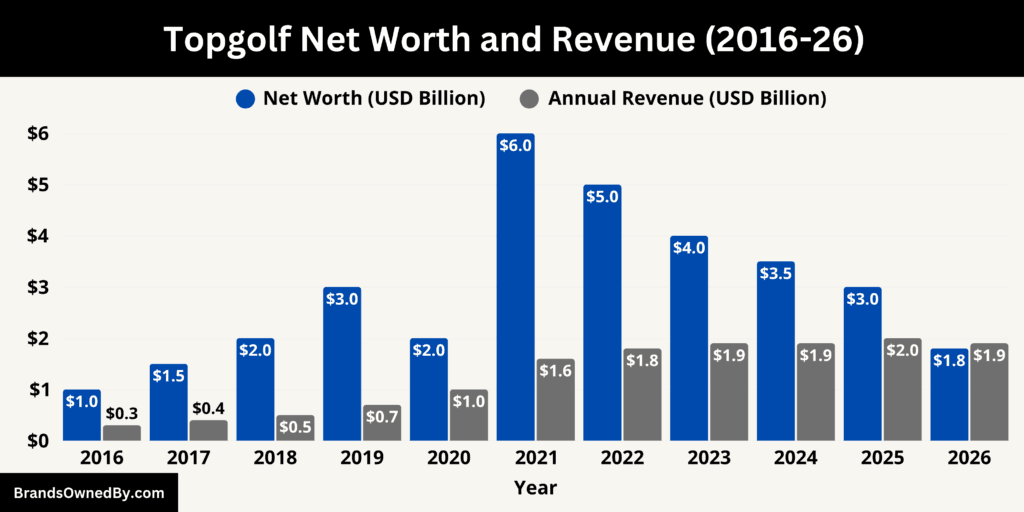
As of March 2026, Topgolf generates $1.9 billion in annual revenue and has an estimated net worth of $1.8 billion. These figures reflect a business that has reached scale, with a large global venue footprint and multiple monetization streams, while also operating under a more disciplined capital structure after its ownership transition.
Revenue Composition by Segment (2026)
Topgolf’s $1.9 billion revenue is heavily concentrated in its venue operations, which account for the majority of total income. The company operates 80+ venues globally, with the United States contributing the largest share.
On a unit basis, a typical Topgolf venue generates $18–$25 million annually, depending on location, maturity, and utilization rates. With over 80 venues, this explains the core revenue base exceeding $1.5 billion from venue operations alone.
Within each venue, revenue is split across three primary streams. Gameplay remains the largest contributor, typically accounting for 50% to 55% of total venue revenue. This includes hourly bay rentals, which benefit from high utilization during evenings and weekends.
Food and beverage is the second-largest component, contributing roughly 30% to 35% of revenue. Topgolf operates full-service kitchens and bars, with high per-guest spending driven by group visits and longer dwell times.
Events and group bookings contribute the remaining 10% to 15%. These include corporate events, parties, and sponsored gatherings. This segment delivers higher margins due to bundled pricing and premium services.
Beyond venues, Topgolf generates additional revenue from its Toptracer technology platform, which is installed at thousands of driving ranges globally. While smaller in absolute size, this segment provides recurring, higher-margin income and expands the company’s reach beyond physical locations.
Revenue Efficiency and Unit Economics
Topgolf’s financial performance is closely tied to venue-level economics. Each venue requires an upfront investment of approximately $15 million to $50 million, depending on size and market.
Once operational, venues are designed to achieve high utilization. A standard location includes 90 to 120 hitting bays, each capable of generating revenue for 10–14 hours per day. Peak-time pricing and dynamic booking systems further optimize revenue per bay.
Average spend per visit typically ranges between $45 and $65 per guest, combining gameplay and food and beverage purchases. Group visits increase this figure significantly, especially for corporate bookings.
Mature venues tend to deliver stronger margins due to stabilized operating costs and consistent customer traffic. This is why Topgolf’s recent strategy focuses more on optimizing existing locations rather than purely adding new ones.
Net Worth and Valuation Metrics (2026)
Topgolf’s estimated net worth of $1.8 billion as of March 2026 reflects its standalone valuation following the majority stake sale.
When compared to its $1.9 billion revenue, this implies a revenue multiple of approximately 0.95x. This is relatively low for a high-growth entertainment brand, but it reflects the capital-intensive nature of the business and the cost of continuous expansion.
The valuation also incorporates:
- High upfront capital requirements for new venues
- Ongoing maintenance and operating costs
- Variability in same-venue sales growth.
Despite this, Topgolf maintains strong underlying asset value. Its venues are large-scale physical assets located in prime urban and suburban areas. These properties contribute significantly to the company’s overall valuation.
The 2026 valuation represents a more realistic pricing of the business. It reflects a shift from growth-driven expectations to a focus on profitability and efficiency.
Revenue Growth Drivers and Constraints
Topgolf’s historical growth has been driven primarily by new venue openings. Each new location adds a substantial revenue stream, often reaching full capacity within a few years.
However, this growth model has natural limits. The number of viable locations is finite, and each new venue requires significant capital. As a result, the company has shifted toward improving same-venue sales performance.
Key growth drivers now include:
- Increasing utilization during off-peak hours
- Expanding event and corporate bookings
- Enhancing food and beverage offerings
- Scaling Toptracer installations globally.
At the same time, constraints remain. Rising construction costs, labor expenses, and economic conditions can impact both expansion and profitability.
This balance between growth and efficiency defines Topgolf’s current financial strategy.
Financial Position After 2026 Ownership Change
Following the 2026 ownership restructuring, Topgolf operates with a clearer financial framework. The business is now evaluated independently, with defined revenue and valuation metrics.
The company’s financial position can be summarized as:
- Revenue: $1.9 billion annually
- Net worth: $1.8 billion
- Primary revenue source: Venue operations
- Secondary revenue source: Technology (Toptracer).
This structure allows for more focused financial management. Investment decisions are now based on return thresholds rather than purely expansion targets.
The involvement of private equity also introduces stricter performance monitoring. This is expected to improve margins over time.
Future Revenue Forecast (2027–2030)
Based on current unit economics, expansion plans, and operational improvements, Topgolf’s revenue is projected to grow steadily:
- 2027: $2.1 billion
- 2028: $2.3 billion
- 2029: $2.5 billion
- 2030: $2.8 billion.
This growth assumes the addition of 5–8 new venues per year, along with improved performance at existing locations. Increased adoption of Toptracer and higher per-guest spending are also expected to contribute.
The focus going forward is not just growth, but profitable growth, with stronger returns from each new and existing location.
Brands Owned by Topgolf
Topgolf owns and operates a focused ecosystem of brands, technologies, and venue concepts that support its core golf entertainment business. As of 2026, these entities are tightly integrated and designed to enhance revenue, customer experience, and global reach.
| Company / Brand | Type / Category | Core Function | Revenue Contribution | Key Details |
|---|---|---|---|---|
| Topgolf Venues | Physical Entertainment | Golf entertainment complexes with bays, dining, events | ~80%+ | 80+ locations globally; each venue generates ~$18–$25 million annually |
| Toptracer | Technology Platform | Ball-tracking system for gameplay and third-party ranges | Medium (growing) | Installed at thousands of ranges globally; high-margin recurring revenue |
| Topgolf Media | Digital & Content | Content production, in-venue entertainment, sponsorships | Low to Medium | Enhances engagement and creates advertising revenue opportunities |
| Topgolf Events | Events & Hospitality | Corporate events, parties, and group bookings | ~10–15% | High-margin segment; drives weekday utilization and premium pricing |
| Topgolf International | Global Operations | Manages expansion and operations outside the US | Medium (growing) | Covers UK, UAE, Australia, and other markets via owned venues and partnerships |
| Topgolf Coach | Training & Instruction | Golf lessons and skill development programs | Low | Uses Toptracer data; improves retention and repeat visits |
| Topgolf Retail & Merchandise | Retail & Lifestyle | Apparel, accessories, and branded merchandise | Low | Sold in venues and online; strengthens brand identity |
| Topgolf Digital Platform | Technology & Data | Mobile app, booking system, and customer analytics | Indirect | Drives reservations, personalization, and customer retention |
| Topgolf Leagues & Tournaments | Community & Engagement | Organized competitions and league play | Indirect | Increases visit frequency and builds long-term customer loyalty |
Topgolf Venues
Topgolf venues are the company’s primary and most valuable asset. As of 2026, the company operates 80+ venues globally, with the majority located in the United States.
Each venue is a large-scale entertainment complex. It typically includes 90 to 120 climate-controlled hitting bays, multiple bars, full-service restaurants, rooftop terraces, and private event spaces.
These venues are not franchised. They are owned and operated directly by Topgolf, which allows the company to maintain control over pricing, customer experience, and operations.
A mature venue generates $18 million to $25 million annually, making each location a significant revenue-producing asset. The venue network collectively drives over 80% of Topgolf’s total revenue.
Expansion remains selective. New venues are typically built in high-density urban or suburban markets where demand for social entertainment is strong.
Toptracer Technology
Toptracer is Topgolf’s proprietary ball-tracking technology platform. It is one of the company’s most important non-venue assets.
The technology tracks the flight of a golf ball in real time. It provides data such as distance, speed, trajectory, and accuracy. This system powers the gameplay experience inside Topgolf venues.
Beyond internal use, Toptracer is licensed to third-party driving ranges worldwide. As of 2026, it is installed at thousands of golf facilities across more than 30 countries.
This makes Toptracer a scalable, asset-light business. It generates recurring revenue through licensing, subscriptions, and upgrades.
It also strengthens Topgolf’s ecosystem. Players who experience Toptracer at independent ranges are more likely to engage with Topgolf venues.
Topgolf Media
Topgolf Media is the company’s content and digital engagement division. It focuses on producing and distributing golf-related entertainment content.
This includes:
- Live event broadcasting within venues
- Original digital content and gameplay formats
- Brand partnerships and sponsored experiences.
Topgolf Media enhances customer engagement. It turns venues into entertainment platforms rather than just physical locations.
It also creates additional revenue opportunities through advertising and sponsorship deals.
Topgolf Events
Topgolf Events is a dedicated business unit focused on corporate and group bookings.
This division manages:
- Corporate events
- Private parties
- Team-building experiences
- Sponsored brand activations.
Events are a high-margin segment. They combine gameplay, food, and premium services into bundled packages.
In many locations, events contribute 10% to 15% of total venue revenue, but a higher share of profitability due to premium pricing.
This segment also drives weekday traffic, improving overall venue utilization.
Topgolf International
Topgolf International manages the company’s global expansion outside the United States.
This includes both wholly owned venues and partnerships in regions such as:
- United Kingdom
- United Arab Emirates
- Australia
- Southeast Asia.
In some markets, Topgolf uses joint ventures or local partners to reduce capital risk. However, it maintains control over branding, technology, and customer experience.
International operations are a key growth area. They provide access to new markets with rising demand for experiential entertainment.
Topgolf Coach
Topgolf Coach is the company’s instruction and training platform. It is integrated directly into venue operations.
This service allows customers to book lessons with certified golf instructors. It uses Toptracer data to provide real-time feedback and performance tracking.
Topgolf Coach targets both beginners and experienced players. It adds a skill-development layer to the entertainment experience.
While smaller in revenue contribution, it increases customer retention and repeat visits.
Topgolf Retail and Merchandise
Topgolf operates its own retail and merchandise business within venues and online.
This includes:
- Branded apparel
- Golf accessories
- Equipment and lifestyle products.
Retail sales are driven by on-site experiences. Customers often purchase merchandise as part of their visit.
This segment also strengthens brand identity. It extends Topgolf beyond venues into the everyday consumer lifestyle.
Topgolf Digital Platform
Topgolf’s digital platform includes its mobile app, booking system, and customer data infrastructure.
The app allows users to:
- Reserve bays
- Track scores and gameplay history
- Participate in digital competitions
- Access promotions and loyalty programs.
This platform is critical for customer engagement. It supports personalized marketing and improves repeat visitation rates.
It also provides valuable data on customer behavior, which helps optimize pricing and operations.
Topgolf Tournament and League Systems
Topgolf operates structured tournaments and leagues across its venues. These programs turn casual gameplay into organized competition.
Players can participate in:
- Local leagues
- Seasonal tournaments
- National competitions.
This creates a community-driven experience. It increases the frequency of visits and builds long-term customer loyalty.
It also supports sponsorship and media opportunities through organized play.
Final Words
Understanding who owns Topgolf comes down to its current private equity-led structure. The company is now controlled by Leonard Green & Partners, with Callaway Golf Company holding a significant minority stake.
This ownership model reflects Topgolf’s evolution from a startup concept to a scaled global entertainment business. It also explains its shift toward more disciplined growth and operational efficiency.
Topgolf continues to stand out because of its integrated model. It combines venues, technology, and experiences into one system. That structure, supported by its ownership, positions it for steady long-term expansion in the competitive social entertainment industry.
FAQs
What happened to Topgolf?
Topgolf went through a major ownership change in 2026. After being fully owned by Callaway Golf Company since 2020, the company sold a 60% stake to Leonard Green & Partners. As a result, Topgolf is no longer fully owned by Callaway and now operates under private equity control with a minority corporate partner.
Is Topgolf owned by Callaway?
Topgolf is no longer fully owned by Callaway. As of 2026, Callaway Golf Company owns about 40% of Topgolf. It remains a significant shareholder but does not have controlling authority.
Who bought Topgolf?
Leonard Green & Partners bought a majority stake in Topgolf in 2026. The firm acquired approximately 60% ownership, making it the controlling shareholder.
What company owns Topgolf?
Topgolf is owned by two main entities. Leonard Green & Partners is the majority owner with 60%, while Callaway Golf Company holds a 40% minority stake.
Who are the investors in Topgolf?
The primary investors in Topgolf are Leonard Green & Partners and Callaway Golf Company. There are no public shareholders directly invested in Topgolf anymore, as it operates as a privately controlled business.
Why did Topgolf get sued?
Topgolf has faced lawsuits over the years, mainly related to employment practices, customer injuries, and intellectual property disputes. These cases are common for large entertainment and hospitality businesses. None of these lawsuits have significantly impacted the company’s overall operations or ownership structure.