- Starry is a fully owned in-house lemon-lime soda brand developed and operated by PepsiCo, with no independent shareholders or separate corporate structure.
- The brand was launched in January 2023 as a direct replacement for Sierra Mist and has remained under the same single ownership since inception.
- Starry does not have its own CEO, board, or subsidiary entities; all strategic, marketing, and operational decisions are managed within PepsiCo’s North America Beverages division.
- While Starry itself is not publicly traded, its ownership flows through PepsiCo’s publicly listed shares, meaning institutional and retail investors indirectly own the brand through their holdings in the parent company.
Starry is a lemon-lime soft drink brand developed and launched by PepsiCo in January 2023. It was introduced as a full replacement for Sierra Mist in the United States. The brand was created to strengthen PepsiCo’s position in the highly competitive citrus soda category.
Starry is caffeine-free. It is available in regular and zero-sugar versions. The product is positioned as crisp, refreshing, and highly carbonated. PepsiCo markets it primarily toward younger consumers, especially Gen Z. Its branding features bold colors, playful messaging, and a strong social media presence.
Unlike many beverage startups, Starry was not launched as an independent company. It is a corporate brand developed internally within PepsiCo’s North American beverage division. Its distribution, manufacturing, and marketing are fully integrated into PepsiCo’s existing global infrastructure.
Ownership History
Starry’s ownership history is straightforward but strategically important. The brand has been fully owned by PepsiCo since its launch in January 2023. It was not acquired. It was not spun off. It was developed internally as a direct replacement for Sierra Mist. There has never been a change in ownership.
Sierra Mist Background (1999–2022)
To understand Starry’s ownership, you must start with Sierra Mist. PepsiCo introduced Sierra Mist in 1999 to compete with Sprite. The brand remained entirely owned by PepsiCo throughout its existence.
Over the years, PepsiCo reformulated Sierra Mist several times. In 2016, the formula was changed to use real sugar. In 2018, PepsiCo briefly rebranded it as “Mist Twst.” That rebrand was later reversed. Despite these changes, Sierra Mist failed to gain strong traction in the U.S. lemon-lime category.
Ownership during this period never shifted. Sierra Mist was always a wholly owned PepsiCo trademark and product line. There were no equity sales or partnerships attached to the brand.
Discontinuation and Internal Replacement (2022–2023)
In late 2022, PepsiCo decided to discontinue Sierra Mist entirely. The company did not sell the brand. It retired it.
In January 2023, PepsiCo officially launched Starry nationwide in the United States. The company publicly confirmed that Starry would replace Sierra Mist in its beverage portfolio. This was a full portfolio reset in the lemon-lime segment.
Starry was created in-house. PepsiCo handled formulation, branding, trademark registration, production, and distribution internally. There was no acquisition involved. No external investors were brought in. No joint venture was formed.
From day one, Starry was a wholly owned PepsiCo asset.
Legal and Trademark Ownership
Starry’s trademark rights are registered and controlled by PepsiCo. The intellectual property, branding elements, and product formulas are corporate assets under PepsiCo’s legal structure.
Because Starry operates under PepsiCo’s North American Beverages division, its production is managed through PepsiCo’s established bottling network. This includes both company-owned bottlers and authorized franchise bottlers operating under PepsiCo agreements.
There has been no transfer of brand rights, licensing of ownership, or partial divestment since launch.
Corporate Shareholder Structure
Although PepsiCo owns Starry directly, PepsiCo itself is a publicly traded corporation. This means the ultimate ownership of Starry flows through PepsiCo’s shareholders.
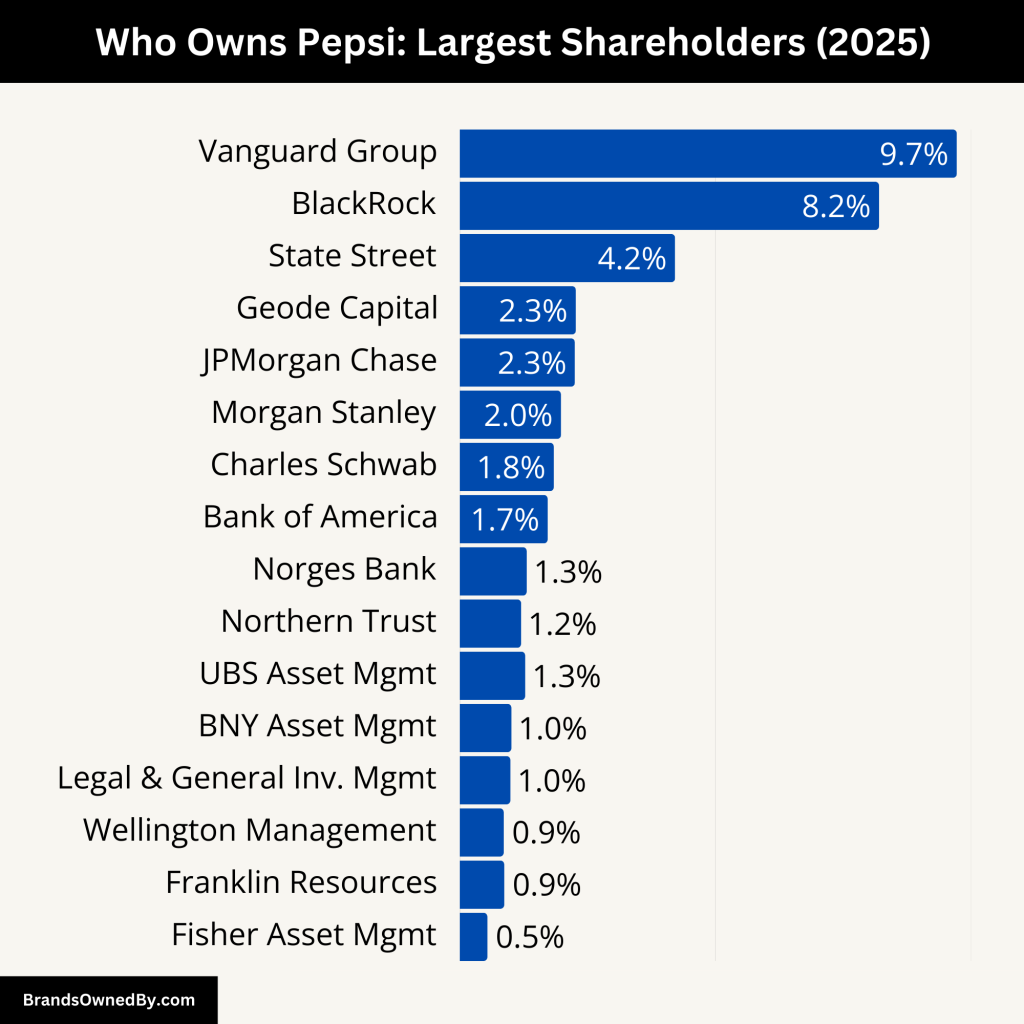
PepsiCo’s shares are widely held by institutional investors, mutual funds, pension funds, and retail shareholders. Large asset managers such as Vanguard, BlackRock, and State Street typically hold significant stakes in PepsiCo. However, they do not own Starry independently. Their ownership is indirect through PepsiCo stock.
No individual investor has exclusive ownership rights over Starry. It remains fully embedded within PepsiCo’s corporate portfolio.
Who Owns Starry Soda?
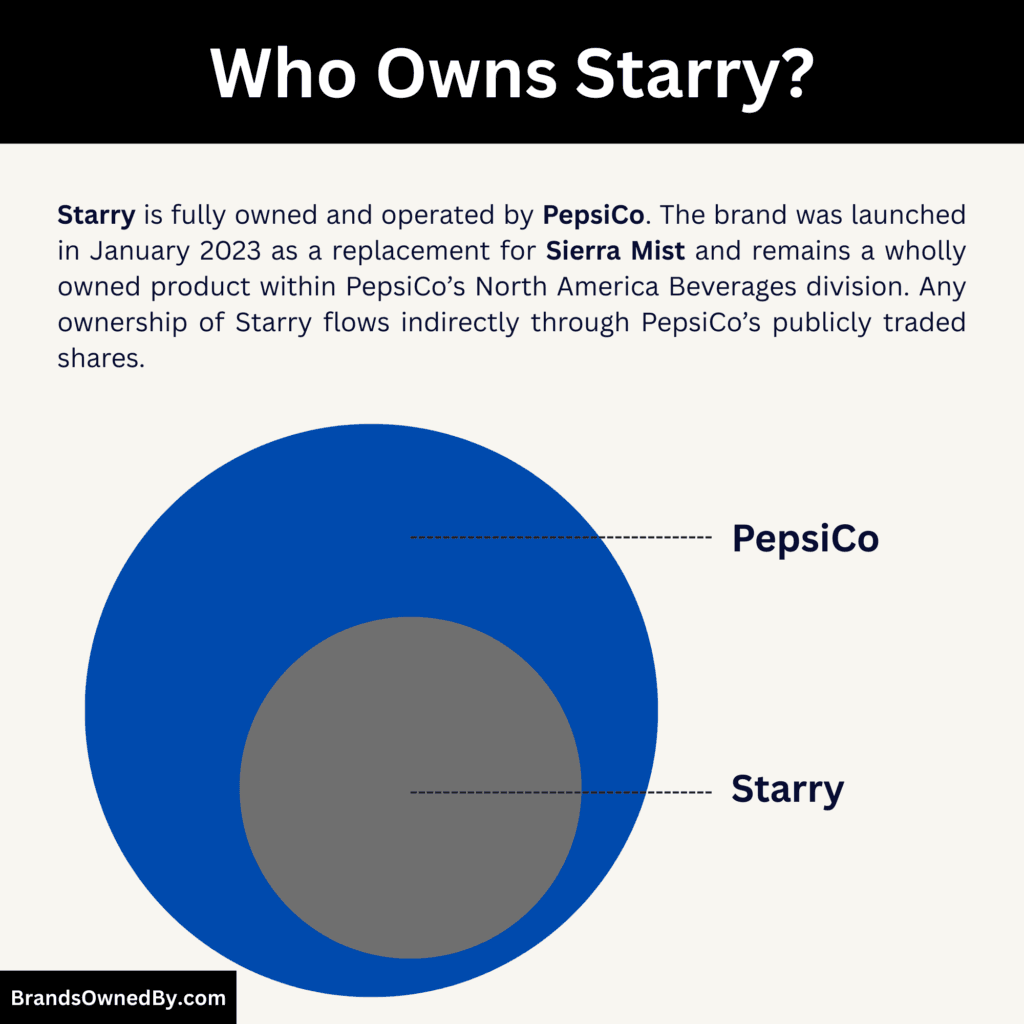
Starry is a wholly owned brand of PepsiCo. It is not an independent company. It does not operate as a subsidiary with separate shareholders. It functions as a product line within PepsiCo’s beverage portfolio.
Ownership of Starry is direct and complete. PepsiCo holds full rights to its trademark, formulation, branding, and distribution. There are no minority investors. There is no joint venture structure. There is no shared equity arrangement.
Because PepsiCo is publicly traded, the ultimate ownership of Starry flows through PepsiCo’s shareholder base. Institutional investors, pension funds, asset managers, and retail investors own PepsiCo shares. Through this structure, they indirectly own Starry along with all other PepsiCo brands.
Parent Company: PepsiCo
Starry’s parent company, PepsiCo, is one of the largest food and beverage corporations in the world. It was founded in 1965 through the merger of Pepsi-Cola and Frito-Lay. The company is headquartered in Purchase, New York.
PepsiCo operates through multiple business segments, including North America Beverages, Frito-Lay North America, and international divisions. Starry sits within the North America Beverages segment. This division manages major soda and beverage brands such as Pepsi, Mountain Dew, Gatorade, and Aquafina.
As a parent company, PepsiCo provides:
- Product development and R&D infrastructure
- Manufacturing through owned and franchised bottlers
- National retail and foodservice distribution
- Global marketing capabilities
- Regulatory compliance and legal oversight.
Starry benefits immediately from this scale. Unlike startup beverage brands that must build distribution gradually, Starry entered the market with nationwide availability due to PepsiCo’s existing system.
Corporate Governance and Shareholder Influence
Although PepsiCo owns Starry, governance authority sits at the corporate level.
PepsiCo is led by its Chairman and CEO, Ramon Laguarta. Executive leadership oversees portfolio strategy, capital allocation, and brand investment decisions.
Major institutional shareholders influence governance through board voting rights. However, they do not manage Starry’s daily operations. Operational control flows through PepsiCo’s beverage executives and brand management teams.
Strategic decisions such as product reformulation, advertising budgets, and distribution expansion are approved within PepsiCo’s corporate hierarchy.
Intellectual Property and Brand Control
All intellectual property related to Starry is controlled by PepsiCo. This includes:
- The Starry trademark
- Packaging design rights
- Product formulation
- Marketing assets
- Distribution contracts.
PepsiCo manages production through its bottling network. Some bottlers are company-owned. Others operate under long-term franchise agreements. However, these bottlers do not own the brand. They manufacture and distribute under PepsiCo’s authorization.
Starry’s control structure is centralized. Brand strategy, pricing guidelines, and national campaigns are coordinated through PepsiCo’s corporate offices.
Strategic Importance Within PepsiCo
Starry plays a specific role in PepsiCo’s portfolio. The lemon-lime soda category has long been dominated by Sprite, owned by Coca-Cola. Sierra Mist struggled to compete effectively.
By launching Starry, PepsiCo aimed to reset consumer perception. The new formulation and branding were designed to appeal to younger consumers and strengthen PepsiCo’s competitive position.
From an ownership standpoint, this reflects portfolio optimization. PepsiCo did not need to acquire a competing lemon-lime brand. It leveraged its internal capabilities to develop one.
Starry remains fully integrated within PepsiCo’s corporate structure. There has been no change in ownership since launch.
Competitor Ownership Comparison
The lemon-lime soda market in the United States is controlled by three multinational beverage corporations. Starry operates under PepsiCo. Its primary competitors are Sprite and 7UP. Each brand is owned by a different publicly traded parent company.
| Brand | Parent Company | Ownership Type | Launch Year | Ownership Structure | Control & Governance |
|---|---|---|---|---|---|
| Starry | PepsiCo | Publicly traded corporation | 2023 | Wholly owned internal brand of PepsiCo | Controlled by PepsiCo’s executive leadership and board of directors |
| Sprite | The Coca-Cola Company | Publicly traded corporation | 1961 | Fully owned global brand of Coca-Cola | Managed under Coca-Cola’s centralized corporate governance structure |
| 7UP (U.S.) | Keurig Dr Pepper | Publicly traded corporation | 1929 | U.S. rights owned by Keurig Dr Pepper | Operates under KDP’s executive leadership and board oversight |
Starry – Owned by PepsiCo
Starry is owned by PepsiCo. It was launched in January 2023 as a full replacement for Sierra Mist. PepsiCo holds complete ownership of the brand. There are no joint ventures or minority investors attached specifically to Starry.
PepsiCo is publicly traded on Nasdaq. Its ownership is widely distributed among institutional investors and retail shareholders. Large asset managers typically hold significant stakes, but no single shareholder controls the company outright.
Starry operates within PepsiCo’s North America Beverages division. This gives it access to nationwide bottling, retail distribution, and foodservice contracts. Ownership is centralized at the corporate level.
Sprite – Owned by The Coca-Cola Company
Sprite is owned by The Coca-Cola Company. It was introduced in 1961 and is one of Coca-Cola’s flagship global brands.
Like PepsiCo, Coca-Cola is publicly traded. Its shares are owned by institutional investors, investment funds, and individual shareholders. The company maintains centralized ownership of Sprite’s intellectual property, global trademarks, and formulation rights.
Coca-Cola’s structure includes company-owned bottlers and independently operated bottling partners under franchise agreements. These bottlers manufacture and distribute Sprite, but they do not own the brand itself. Ownership remains entirely with The Coca-Cola Company.
Sprite holds a dominant market share in the U.S. lemon-lime soda category. This makes Starry’s ownership structure part of a direct corporate rivalry between PepsiCo and Coca-Cola.
7UP – Owned by Keurig Dr Pepper (U.S.)
In the United States, 7UP is owned by Keurig Dr Pepper. The brand has a more complex ownership structure globally. International rights to 7UP vary by region. However, within the U.S., Keurig Dr Pepper controls the brand.
Keurig Dr Pepper is also publicly traded. Its ownership includes institutional investors and private stakeholders. Unlike PepsiCo and Coca-Cola, Keurig Dr Pepper has a significant private equity history. It was formed through the 2018 merger of Keurig Green Mountain and Dr Pepper Snapple Group.
In the U.S. market, 7UP’s trademarks, marketing strategy, and distribution agreements are controlled by Keurig Dr Pepper. This places Starry in direct competition with two different corporate ownership structures.
Market Structure and Ownership Concentration
The lemon-lime soda segment is not fragmented. It is highly consolidated. Three publicly traded corporations control the leading brands:
- PepsiCo controls Starry
- Coca-Cola controls Sprite
- Keurig Dr Pepper controls 7UP in the U.S.
Each company operates vertically integrated beverage systems. They own the brand rights. They oversee marketing. They manage national distribution networks through bottling partnerships.
There are smaller regional lemon-lime sodas in the market. However, none have ownership structures or scale comparable to these three corporations.
Governance and Strategic Decision-Making Differences
Although all three parent companies are publicly traded, their governance structures differ slightly.
PepsiCo and Coca-Cola operate with widely dispersed institutional ownership. Both companies maintain large global boards of directors and diversified international portfolios.
Keurig Dr Pepper, while public, retains historical ties to private equity stakeholders. This influences capital allocation and portfolio strategy differently compared to PepsiCo and Coca-Cola.
From an ownership standpoint, Starry competes in a market dominated by large, shareholder-driven corporations rather than privately owned or family-controlled brands.
Comparative Ownership Stability
Sprite has been continuously owned by The Coca-Cola Company since its launch. 7UP has changed hands internationally over decades, but U.S. ownership is currently stable under Keurig Dr Pepper. Starry has been fully owned by PepsiCo since its introduction.
None of these leading lemon-lime brands are independently owned entities. Each is embedded within a multinational beverage conglomerate. This means competitive strategy is determined at the corporate level, not at the individual brand level.
In conclusion, competitor ownership comparison shows that Starry operates in a tightly controlled corporate landscape. PepsiCo, Coca-Cola, and Keurig Dr Pepper collectively dominate the lemon-lime soda segment. Ownership is centralized, institutional, and publicly traded across all three major brands.
Who Controls Starry?
Starry is owned by PepsiCo, and control of the brand flows entirely through PepsiCo’s corporate governance structure. Starry does not have its own CEO, board of directors, or independent executive team. All strategic, operational, and financial decisions are made within PepsiCo’s leadership hierarchy.
Corporate-Level Control Structure
Ultimate authority over Starry rests with PepsiCo’s Board of Directors. The board is responsible for long-term strategy, executive oversight, and capital allocation. Major brand decisions, including large marketing investments, product reformulation, or expansion initiatives, fall under this broader governance framework.
Day-to-day corporate leadership is handled by PepsiCo’s Chairman and CEO, Ramon Laguarta. He has led PepsiCo since 2018. Under his leadership, PepsiCo has emphasized portfolio optimization and brand modernization. The launch of Starry in 2023 was part of this strategic direction.
The CEO does not manage Starry directly. Instead, control cascades through divisional executives within the North America Beverages segment.
North America Beverages Division Oversight
Starry operates within PepsiCo’s North America Beverages (NAB) division. This division manages core soda and beverage brands sold in the United States and Canada.
The division is led by senior executives responsible for revenue growth, distribution strategy, product innovation, and marketing execution. Brand-level decisions for Starry are made by:
- Category general managers
- Marketing directors
- Product development teams
- Sales and distribution executives.
These teams report upward through PepsiCo’s executive structure. Final accountability remains with corporate leadership.
Brand Management and Operational Control
At the operational level, Starry is controlled by PepsiCo’s brand management system. This system includes:
- Brand managers who oversee positioning and campaigns
- R&D teams that control formulation and product quality
- Supply chain leaders who manage manufacturing and logistics
- Sales teams that coordinate retail and foodservice partnerships.
Production is carried out through PepsiCo’s bottling network. Some bottlers are company-owned. Others are independent franchise operators. However, these bottlers do not control Starry. They manufacture and distribute under PepsiCo’s contractual authority.
Pricing strategy, national advertising campaigns, and packaging decisions are centrally coordinated. Retail promotions may vary regionally, but they operate within PepsiCo’s guidelines.
Executive Leadership Influence
Although Starry is a single product line, its direction reflects broader executive priorities. CEO Ramon Laguarta has emphasized innovation and competitive strength in core categories. Replacing Sierra Mist with Starry demonstrated active executive involvement in brand performance evaluation.
Previous PepsiCo CEO Indra Nooyi led the company from 2006 to 2018. During her tenure, PepsiCo expanded its beverage and snack diversification strategy. While Starry was launched after her leadership period, the structural systems governing brand control were shaped during her era.
Corporate leaders determine:
- Marketing investment levels
- Portfolio restructuring decisions
- Distribution expansion priorities
- Product discontinuation strategies.
Starry’s existence itself was the result of an executive-level evaluation of Sierra Mist’s performance.
Shareholder Influence vs. Direct Control
PepsiCo is publicly traded. Its shareholders include institutional investors and retail investors. These shareholders influence corporate governance by voting on board members and executive compensation. However, they do not directly control Starry’s daily operations.
Operational control remains centralized within PepsiCo’s executive and managerial structure. Shareholders exert indirect influence through corporate governance mechanisms rather than brand-level decision-making.
Strategic Control in Competitive Context
Control over Starry is also shaped by competitive dynamics. The brand competes directly with Sprite from The Coca-Cola Company and 7UP from Keurig Dr Pepper. PepsiCo’s executive team monitors category performance and adjusts strategy accordingly.
If market share shifts or consumer preferences change, leadership can alter marketing budgets, reformulate the product, or expand distribution. This flexibility exists because Starry is not an independent entity. It is fully integrated into PepsiCo’s centralized control system.
Starry Annual Revenue and Net Worth
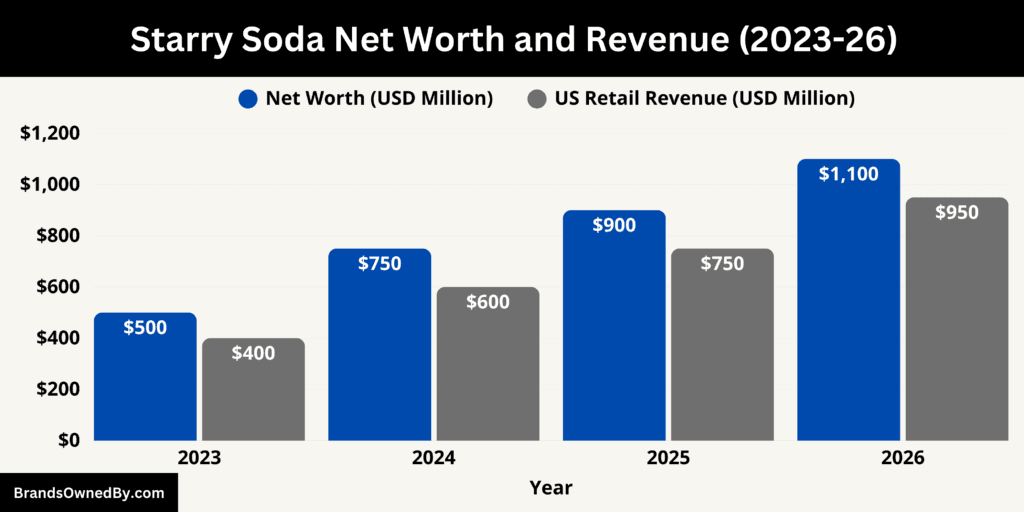
As of March 2026, Starry is estimated to generate approximately $950 million in annual U.S. retail revenue, with an estimated standalone brand valuation of about $1,100 million. Although Starry does not publish independent financial statements because it operates within PepsiCo, industry sales tracking and category performance data provide a strong basis for structured financial estimation.
2026 Revenue
In 2026, Starry’s estimated revenue stands at approximately $950 million. This reflects continued growth since its national launch in January 2023. The brand replaced Sierra Mist and immediately inherited full national distribution across grocery, convenience, and foodservice channels.
Revenue bifurcation can be understood across three primary segments.
Retail grocery and mass merchandisers account for the largest share, estimated at roughly 60 percent of total revenue. This includes supermarkets, big-box retailers, and warehouse clubs. Based on the $950 million estimate, this segment contributes approximately $570 million annually.
Convenience stores represent approximately 25 percent of revenue. This includes single-serve bottle sales and impulse purchases. That translates to roughly $237 million in annual revenue.
Foodservice and fountain sales account for the remaining 15 percent. This includes quick-service restaurants, entertainment venues, and institutional accounts. This segment contributes approximately $143 million annually.
Zero-sugar variants represent an estimated 35 to 40 percent of total Starry sales in 2026. This aligns with broader carbonated soft drink trends favoring low- and no-calorie options.
Revenue Growth Since Launch
Starry’s revenue trajectory has shown consistent year-over-year growth since 2023. In its launch year, estimated revenue was approximately $400 million. In 2024, revenue increased to around $600 million. In 2025, it rose further to approximately $750 million.
This growth reflects expanded shelf placement, increased marketing investment, and improved consumer trial rates. PepsiCo leveraged its national bottling network to accelerate penetration without the typical startup constraints.
The brand’s growth also correlates with strong category demand in lemon-lime sodas, particularly in zero-sugar formulations.
Net Worth and Brand Valuation
Starry does not report a separate balance sheet. Therefore, “net worth” in this context refers to estimated brand valuation.
As of March 2026, Starry’s estimated brand value is approximately $1,100 million. This valuation is derived using beverage sector revenue multiples typically ranging from 1.0x to 1.2x annual sales for established national soda brands with strong distribution support.
The valuation reflects several key factors:
- Full national distribution under PepsiCo
- Established trademark and intellectual property ownership
- High brand awareness after three years in market
- Competitive positioning as PepsiCo’s primary lemon-lime offering.
Because Starry is fully owned by PepsiCo, its value is embedded within PepsiCo’s North America Beverages segment rather than reported independently on public financial statements.
Profitability and Cost Structure Insights
While specific profit margins are not disclosed, carbonated soft drinks typically operate with strong gross margins due to concentrate-based production models.
Starry benefits from PepsiCo’s existing bottling and logistics infrastructure. This reduces capital intensity compared to independent beverage startups. Marketing spend, however, remains significant due to aggressive competition with Sprite.
Economies of scale under PepsiCo likely support operating margins comparable to other major soda brands within its portfolio.
Future Revenue Forecast (2027–2030)
Projected revenue growth for Starry over the next several years is as follows:
• 2027: Approximately $1,050 million
• 2028: Approximately $1,200 million
• 2029: Approximately $1,350 million
• 2030: Approximately $1,450–$1,500 million.
These projections assume continued category growth, stable distribution expansion, and sustained marketing support from PepsiCo. Additional upside could result from flavor extensions or international expansion initiatives.
Brands Owned by Starry Soda
All assets, trademarks, and operations associated with Starry are controlled directly by PepsiCo. Therefore, the only brands and entities “owned” by Starry are internal product extensions under the Starry trademark itself.
Below is a list of the brands owned and operated by Starry as of March 2026:
Starry (Original Lemon-Lime Soda)
This is the flagship product launched in January 2023. It replaced Sierra Mist nationwide in the United States. The formulation emphasizes strong carbonation and a crisp lemon-lime flavor profile.
The original version is caffeine-free and sold in multiple packaging formats. These include 12-ounce cans, 20-ounce bottles, 2-liter bottles, and multi-pack configurations for retail. Production and distribution are handled through PepsiCo’s bottling system.
Starry Original represents the core identity of the brand. It accounts for the majority of total sales volume.
Starry Zero Sugar
Starry Zero Sugar was launched simultaneously with the original version in 2023. It is formulated without sugar and uses non-caloric sweeteners.
Zero Sugar variants have become increasingly important in the carbonated beverage category. As of 2026, zero-sugar products account for approximately 35 to 40 percent of total Starry sales volume.
The packaging is visually differentiated from the regular version but remains under the same master brand identity. It operates as a sub-variant, not a separate legal entity.
Starry Fountain Program
Starry also operates within PepsiCo’s fountain beverage system. This is not a separate company, but it is a distinct operational channel.
The fountain version is distributed to quick-service restaurants, entertainment venues, cinemas, and institutional clients. Concentrate is supplied through PepsiCo’s foodservice network.
Although the fountain channel does not constitute a separate brand, it represents a structured distribution entity within PepsiCo’s beverage operations.
Limited-Edition and Promotional Variants
As of 2026, Starry has experimented with limited-time promotional packaging and marketing campaigns. These may include co-branded events, sports partnerships, or digital activations.
These releases do not create new legal brands. They remain extensions under the Starry trademark owned by PepsiCo.
No permanent flavor line extensions beyond Original and Zero Sugar have been formally established as independent brand families under Starry.
Intellectual Property and Trademark Holdings
All Starry-related intellectual property is owned by PepsiCo. This includes:
- The Starry name and logo
- Packaging designs
- Flavor formulations
- Advertising assets
- Distribution agreements.
Starry does not independently hold or manage these rights. They are registered and controlled under PepsiCo’s corporate structure.
Final Words
Starry operates as a fully integrated brand within PepsiCo’s beverage portfolio. It is not an independent company and does not maintain separate ownership, shareholders, or subsidiaries. All strategic decisions, intellectual property rights, and operational control remain under PepsiCo’s corporate structure.
The answer to who owns Starry is straightforward. PepsiCo holds complete ownership and manages the brand through its established leadership and distribution system. Starry’s position in the market reflects the scale, governance, and long-term strategy of its parent company rather than standalone corporate independence.
FAQs
Does Pepsi or Coke own Starry?
Starry is owned by PepsiCo, not Coca-Cola. It was launched in January 2023 as PepsiCo’s primary lemon-lime soda brand to compete directly with Sprite.
Why is Sprite called Starry?
Sprite is not called Starry. Sprite and Starry are two different brands owned by competing companies. Sprite is owned by The Coca-Cola Company, while Starry is owned by PepsiCo. The names may sound similar because both brands emphasize freshness and brightness, but they are unrelated products.
What was Starry called before?
Before Starry was introduced, PepsiCo sold a lemon-lime soda called Sierra Mist. In late 2022, Sierra Mist was discontinued. Starry replaced it nationwide in early 2023 with a new formulation and rebranding strategy.
What is the story behind Starry soda?
Starry was created as a strategic reset in the lemon-lime soda category. Sierra Mist struggled to compete effectively against Sprite. PepsiCo decided to discontinue Sierra Mist and launch a completely new brand with updated flavor, stronger carbonation, and modern branding aimed at younger consumers. Starry debuted nationally in January 2023 and immediately became PepsiCo’s flagship lemon-lime offering.
Who is Starry owned by?
Starry is fully owned and operated by PepsiCo. It is not an independent company and does not have separate shareholders. Ownership flows through PepsiCo’s publicly traded corporate structure.
Is Starry the same as 7 Up?
No, Starry is not the same as 7UP. Starry is owned by PepsiCo, while 7UP in the United States is owned by Keurig Dr Pepper. They are competing lemon-lime soda brands with different formulations and corporate ownership.