- Reese’s is not an independent company. It is fully owned and operated by The Hershey Company, which acquired the H.B. Reese Candy Company in 1963 through a stock-based merger.
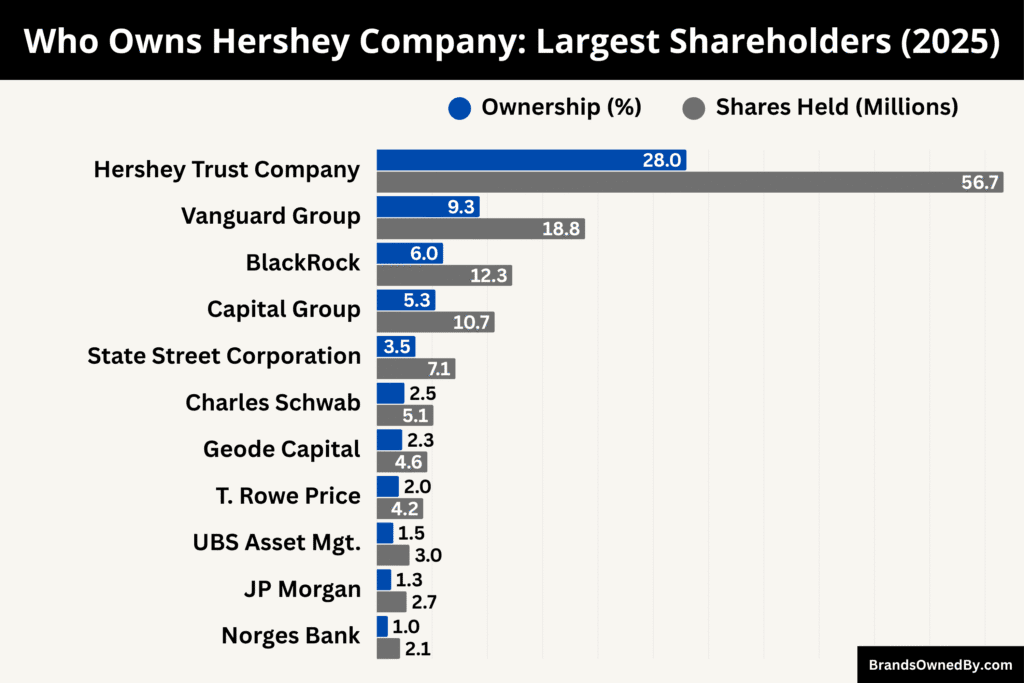
- The Hershey Trust Company is the controlling shareholder of The Hershey Company, holding the majority voting power and ultimate decision-making authority over the company and the Reese’s brand.
- Major institutional investors such as Vanguard, BlackRock, and State Street own significant economic stakes in The Hershey Company, but they do not control corporate decisions due to the Trust’s dominant voting control.
- This unique ownership structure gives Reese’s long-term strategic stability, centralized governance, and consistent brand direction, helping it remain one of the most powerful confectionery brands in the world.
Reese’s is one of the most recognizable confectionery brands in the world. It is famous for combining peanut butter and chocolate into a simple but powerful formula. The brand operates under The Hershey Company and serves as its flagship product line. Reese’s products are sold across North America, Europe, Asia, and many emerging markets.
The brand includes Peanut Butter Cups, Pieces, Sticks, seasonal editions, spreads, and snack variations. Reese’s is widely known for strong customer loyalty, consistent product innovation, and dominant market leadership in the peanut butter chocolate category.
It plays a central role in Hershey’s global confectionery strategy and continues to expand into snacks, frozen treats, and limited-edition flavors.
Reese’s Founder
Reese’s was founded by Harry Burnett Reese, commonly known as H.B. Reese. He was born in 1879 in Pennsylvania, United States. Before starting his candy business, Reese worked as a dairy farmer and later joined Milton S. Hershey’s chocolate company as a shipping foreman. His experience at Hershey helped him understand chocolate manufacturing and distribution.
In 1928, H.B. Reese started the H.B. Reese Candy Company in the basement of his home in Hershey, Pennsylvania. He experimented with several candy products, but his peanut butter cups quickly became the most successful. Reese focused on simple ingredients and consistent quality.
This helped his brand grow during difficult economic periods such as the Great Depression. Over time, Reese built a strong regional candy business. After his death in 1956, his sons continued operating the company.
In 1963, the Reese family agreed to merge the business with The Hershey Company, turning Reese’s into a national and later global brand.
Ownership History
Reese’s ownership history began in 1928 when H.B. Reese founded the H.B. Reese Candy Company as an independent business in Pennsylvania. The brand remained family-owned until 1963, when The Hershey Company acquired it through a stock-based merger. Since then, Reese’s has operated as a core brand within Hershey’s portfolio.
Today, Reese’s is fully owned and managed by The Hershey Company, with ultimate control held by the Hershey Trust Company, which maintains majority voting power in the parent company.
Independent Beginnings (1928–1963)
Reese’s started as an independent candy business founded by Harry Burnett Reese in 1928. He launched the H.B. Reese Candy Company in Hershey, Pennsylvania. Reese worked alone at first and produced candy in his home’s basement. He created several products, but peanut butter cups quickly became the most popular.
The business grew steadily across local and regional markets. Reese focused on simple recipes, consistent taste, and affordable pricing. This helped the company survive during the Great Depression and wartime shortages. By the 1950s, H.B. Reese Candy Company had become a well-known name in the American candy market.
After H.B. Reese passed away in 1956, his sons took over operations. They expanded production and strengthened distribution. The company remained family-owned and independent during this period. Reese’s Peanut Butter Cups continued to dominate sales and became the company’s core product.
Acquisition by The Hershey Company (1963)
A major shift happened in 1963 when the Reese family agreed to merge the H.B. Reese Candy Company with The Hershey Company. The deal was structured as a stock-based acquisition rather than a cash purchase. This made the Reese family shareholders in Hershey instead of completely exiting the business.
The acquisition was strategically important for Hershey. Reese’s was growing fast and had strong consumer demand. By bringing Reese’s under its umbrella, Hershey strengthened its product portfolio and expanded its reach in the peanut butter chocolate category. For the Reese family, the merger ensured long-term growth, larger distribution, and access to Hershey’s manufacturing strength.
Integration into Hershey’s Brand Portfolio (1960s–1980s)
After the acquisition, Reese’s operated fully under The Hershey Company. Production scaled significantly due to Hershey’s advanced manufacturing systems. National distribution expanded rapidly. Reese’s Peanut Butter Cups became one of Hershey’s flagship products during the 1970s.
In the 1980s, Reese’s Pieces gained worldwide recognition after appearing in the film E.T. the Extra-Terrestrial. This moment strengthened Reese’s brand identity globally. During this period, Reese’s transformed from a regional candy into a national powerhouse within Hershey’s portfolio.
Expansion and Global Growth (1990s–2010s)
Throughout the 1990s and 2000s, Reese’s continued to expand under Hershey’s ownership. The brand introduced new variations such as mini cups, seasonal shapes, and snack-sized packaging. International expansion increased brand visibility beyond North America. Reese’s became Hershey’s top-performing brand and one of the most recognized confectionery names worldwide.
During the 2010s, Hershey invested heavily in brand innovation and marketing. Reese’s expanded into spreads, snack bars, dessert products, and limited-edition flavors. This period strengthened Reese’s leadership in the peanut butter chocolate segment.
Modern Ownership Structure (2020–2026)
Today, Reese’s remains fully owned by The Hershey Company. It is not a separate company or publicly traded entity. Strategic decisions, brand management, and product innovation are controlled by Hershey’s executive leadership.
The ultimate controlling authority behind Hershey is the Hershey Trust Company. The trust holds the majority of voting power in Hershey, giving it strong influence over long-term corporate direction. Through this structure, Reese’s continues to operate as Hershey’s flagship and most powerful brand, maintaining global market leadership and steady expansion.
Who Owns Reese’s?
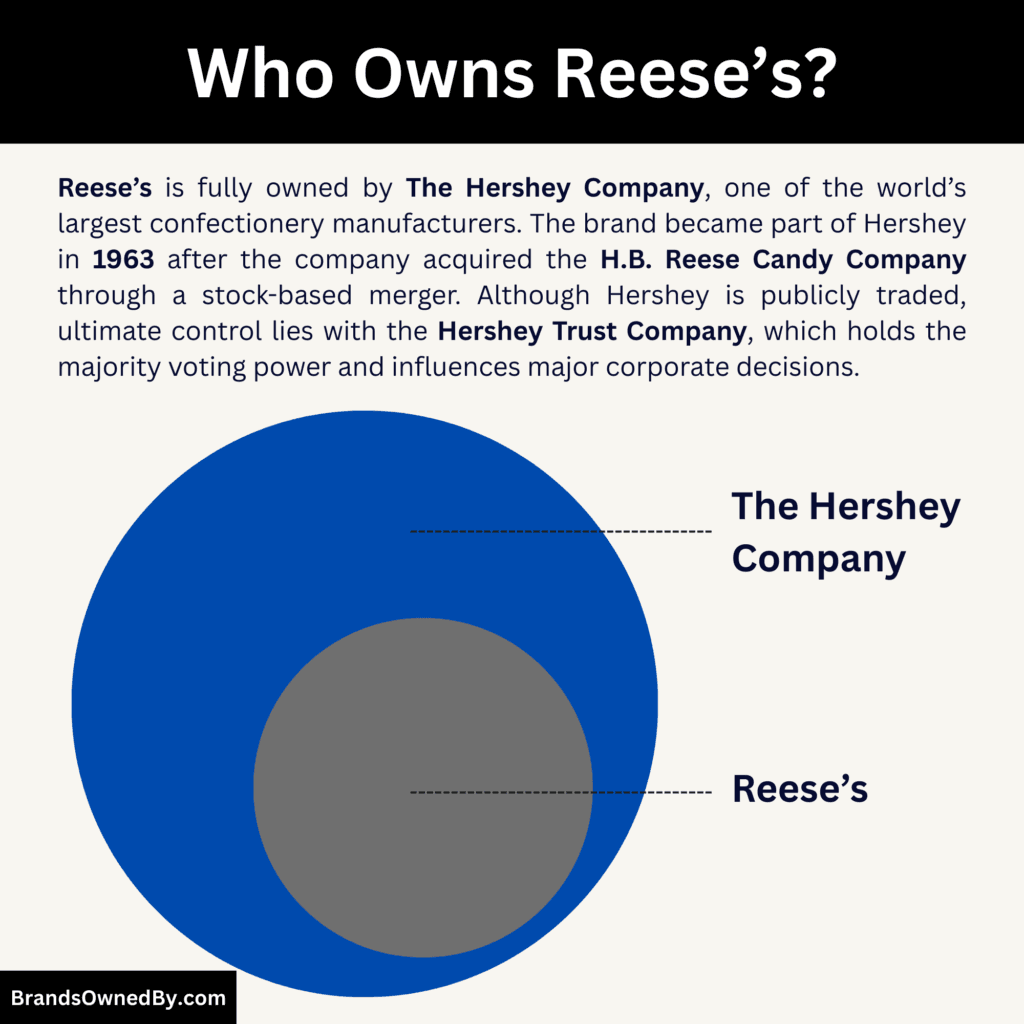
Reese’s is a wholly owned brand of The Hershey Company. It is not a separate legal entity and does not trade independently on the stock market. All trademarks, product lines, and business operations of Reese’s belong to Hershey. This means revenue, profits, and strategic control flow directly through the parent company. Reese’s functions as Hershey’s flagship brand and one of its most valuable assets worldwide.
Parent Company: The Hershey Company
The Hershey Company is a global confectionery and snack leader headquartered in Hershey, Pennsylvania. Founded in 1894 by Milton S. Hershey, the company built its reputation on mass-produced chocolate and later expanded into a diversified snacking powerhouse.
Its portfolio includes chocolate, candy, mints, protein snacks, popcorn, and salty snacks. Hershey operates across North America and selected international markets, with a strong retail presence in supermarkets, convenience stores, e-commerce, and specialty channels.
Hershey follows a unique governance model. Although it is publicly traded, the Hershey Trust Company controls the majority of voting power. This structure protects the company from hostile takeovers and encourages long-term strategic planning rather than short-term market pressure. The company focuses on brand strength, product innovation, category leadership, and steady expansion into high-growth snack segments.
Strategic Importance of Reese’s to The Hershey Company
Reese’s is the most important brand in Hershey’s entire portfolio. It is widely considered the company’s flagship and innovation engine. The brand consistently ranks among the top-selling confectionery products in North America and has strong global recognition. Because of its massive popularity and customer loyalty, Reese’s plays a central role in Hershey’s long-term strategy.
One of Reese’s key strategic roles is category leadership. It dominates the peanut butter chocolate segment, a niche with limited direct competition. This leadership strengthens Hershey’s overall market position in the confectionery industry. Reese’s also drives brand visibility and consumer engagement through seasonal products, limited editions, and constant flavor innovation.
Role in Financial Strength and Growth
Reese’s is a primary growth driver for The Hershey Company. The brand generates a significant portion of Hershey’s confectionery sales and consistently delivers strong demand. Its high product turnover, premium pricing power, and loyal customer base support Hershey’s overall profitability and margin stability.
Reese’s also supports expansion into adjacent categories. The brand has successfully moved beyond traditional chocolate into snack bars, spreads, frozen desserts, and cross-category collaborations. This helps Hershey diversify revenue streams and reduce dependence on seasonal chocolate sales. In many cases, new Hershey product innovations are tested under the Reese’s brand first because of its strong consumer trust.
Role in Long-Term Corporate Strategy
From a strategic perspective, Reese’s serves as Hershey’s global growth platform. The company uses the brand to expand internationally, introduce new product formats, and strengthen retail partnerships. Reese’s also plays a key role in Hershey’s marketing strategy due to its strong emotional connection with consumers.
The brand’s consistent performance supports Hershey’s long-term goals of market leadership, product diversification, and sustainable growth. Reese’s is not just a product line. It is a core strategic asset that shapes Hershey’s direction, innovation pipeline, and competitive strength in the global confectionery and snacking industry.
Competitor Ownership Comparison
Reese’s operates in the global confectionery market where ownership structures vary widely. Its main competitors are controlled either by private family ownership or widely distributed public shareholders. Understanding who owns these competing brands helps explain how Reese’s compares in strategy, stability, and long-term growth positioning.
| Company | Major Brands | Ownership Type | Controlling Shareholder | Strategic Focus | Direct Competition with Reese’s |
|---|---|---|---|---|---|
| The Hershey Company (Owner of Reese’s) | Reese’s, Hershey’s, Kisses, KitKat (U.S.), Jolly Rancher | Public company with concentrated control | Hershey Trust Company (majority voting power) | Chocolate, confectionery, and expanding snack portfolio | Category leader in peanut butter chocolate |
| Mars Inc. | Snickers, M&M’s, Milky Way, Twix, Dove | Private company | Mars family | Global confectionery, pet care, and snacking | Strong competitor in chocolate snacks but not dominant in peanut butter chocolate |
| Mondelez International | Cadbury, Toblerone, Milka, Oreo | Public company with dispersed ownership | No single controlling shareholder | Global chocolate, biscuits, and snack expansion | Competes in chocolate but limited direct overlap with Reese’s core segment |
| Ferrero Group | Kinder, Nutella, Ferrero Rocher, Tic Tac | Private company | Ferrero family | Premium chocolate and hazelnut products | Indirect competition in confectionery, not focused on peanut butter chocolate |
| Nestlé | KitKat (global), Smarties, Aero | Public company with global shareholders | No dominant controlling shareholder | Diversified food, beverage, and nutrition | Broad confectionery competition, limited direct rivalry with Reese’s core products |
Mars Inc. (Owner of Snickers, M&M’s, Milky Way)
Mars Inc. is one of Reese’s biggest competitors. It owns major chocolate brands such as Snickers, M&M’s, Milky Way, and Twix. Unlike Hershey, Mars is a privately held company. It is fully owned by the Mars family, one of the richest business families in the world.
Because Mars is private, it does not face stock market pressure. This allows it to focus on long-term brand building and product expansion. Its ownership structure is similar to Hershey’s in terms of stability, but different because control remains within a business family rather than a charitable trust. Mars competes directly with Reese’s in the chocolate snack category, though it does not dominate the peanut butter chocolate niche the way Reese’s does.
Mondelez International (Owner of Cadbury, Toblerone, Milka)
Mondelez International is another major competitor in the global chocolate industry. It owns well-known brands such as Cadbury, Toblerone, and Milka. Mondelez is a publicly traded company with dispersed institutional ownership. Major shareholders include global asset managers like Vanguard and BlackRock.
Unlike Hershey, Mondelez does not have a controlling trust or dominant shareholder. Corporate decisions are influenced by the board, executive leadership, and institutional investors. Mondelez focuses heavily on global markets, especially Europe and emerging economies. While Cadbury competes with Hershey in traditional chocolate, it does not directly challenge Reese’s leadership in peanut butter chocolate products.
Ferrero Group (Owner of Kinder, Nutella, Ferrero Rocher)
Ferrero is a privately owned confectionery company controlled by the Ferrero family. It owns globally recognized brands such as Kinder, Nutella, and Ferrero Rocher. Ferrero has grown rapidly through acquisitions and global expansion.
Its private ownership allows long-term planning similar to Mars. Ferrero focuses strongly on premium chocolate and hazelnut-based products rather than peanut butter chocolate. This means Ferrero competes with Hershey in the broader confectionery space but not directly against Reese’s core product segment.
Nestlé (Global Confectionery and Snack Competitor)
Nestlé is one of the largest food companies in the world and competes with Hershey in confectionery and snacks. It owns brands such as KitKat globally, Smarties, and Aero. Nestlé is publicly traded with widely distributed global shareholders.
Unlike Hershey, Nestlé does not control Reese’s category in North America. In fact, Hershey holds the rights to manufacture and sell KitKat in the United States. Nestlé focuses more on global food, beverage, and nutrition markets rather than specializing in peanut butter chocolate.
Ownership Structure Comparison
Reese’s stands in a unique position among competitors. It is owned by a public company, The Hershey Company, but controlled by the Hershey Trust Company through dominant voting power. This provides long-term strategic stability similar to private companies like Mars and Ferrero, while still benefiting from public market access.
Mars and Ferrero are family-controlled private companies focused on long-term growth. Mondelez and Nestlé are widely held public corporations influenced by institutional investors. Hershey’s trust-controlled structure combines elements of both systems. This gives Reese’s a stable ownership foundation while maintaining strong market competitiveness and strategic consistency.
Who Controls Reese’s?
Reese’s is controlled through its parent company, The Hershey Company. Since Reese’s is not an independent legal entity, it does not have its own separate leadership or board. All key decisions related to strategy, product development, expansion, and brand positioning are made within Hershey’s corporate governance system.
Control flows from executive leadership to the board of directors, with ultimate voting authority resting in the hands of the Hershey Trust Company.
This layered control structure ensures consistent brand direction, long-term planning, and centralized management across Hershey’s global operations.
Role of The Hershey Company’s CEO
The chief executive officer of The Hershey Company plays the most important operational role in controlling Reese’s. As of 2026, Michele Buck leads the company and oversees all major business functions. Her responsibilities include setting corporate strategy, driving innovation, managing global operations, and strengthening market leadership.
Reese’s sits at the center of Hershey’s growth strategy, so the CEO closely guides its expansion and positioning. Decisions such as launching new Reese’s products, entering new markets, expanding into snacks, and strengthening brand visibility are aligned with the CEO’s long-term strategic vision. The CEO also ensures that Reese’s continues to maintain category leadership in peanut butter chocolate while expanding into adjacent snack segments.
Executive Leadership and Decision-Making Process
Control of Reese’s is also exercised through Hershey’s executive leadership team. This group includes senior leaders responsible for marketing, supply chain, finance, innovation, and global strategy. Each department plays a role in shaping Reese’s performance and growth.
The marketing leadership manages brand strategy, advertising campaigns, and consumer engagement for Reese’s. The innovation and product teams develop new flavors, formats, and seasonal offerings. Operations and supply chain teams ensure consistent production and distribution worldwide. Financial leadership monitors profitability and investment decisions related to Reese’s expansion. Major strategic initiatives are reviewed collectively, ensuring decisions are aligned with Hershey’s long-term objectives.
Role of the Board of Directors
The board of directors provides oversight and governance for The Hershey Company and, by extension, the Reese’s brand. The board evaluates corporate performance, approves long-term strategies, and monitors executive leadership. It also reviews major decisions such as acquisitions, large investments, and structural changes that could affect key brands like Reese’s.
Because Reese’s is Hershey’s flagship brand, its performance and strategy are regularly reviewed at the board level. The board ensures that the brand continues to support Hershey’s overall market leadership, innovation pipeline, and long-term growth goals.
Ultimate Authority: Hershey Trust Company
The Hershey Trust Company holds the majority of voting power in The Hershey Company, giving it ultimate control over corporate governance. This voting control allows the trust to influence board composition, long-term strategy, and major corporate decisions. Through this structure, the trust indirectly controls Reese’s.
The trust was originally established to support the Milton Hershey School, and its governance philosophy focuses on long-term stability rather than short-term financial pressure. This control structure protects Hershey from hostile takeovers and ensures consistent leadership direction. As a result, Reese’s benefits from stable governance, strategic continuity, and long-term brand development.
Reese’s Annual Revenue and Net Worth
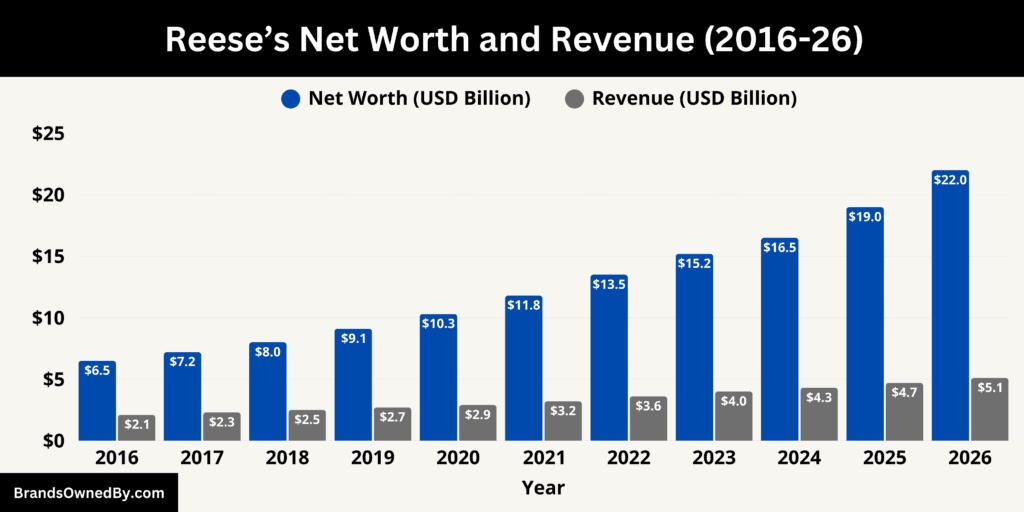
As of February 2026, Reese’s remains the largest and most profitable brand within The Hershey Company. The brand’s estimated annual revenue stands at $5.1 billion, while its estimated brand net worth is approximately $22.0 billion. Reese’s continues to dominate the global peanut butter chocolate category with strong sales volume, high retail penetration, and premium pricing power. Its financial strength is driven by high product turnover, strong seasonal demand, and expanding snack-based product lines.
Reese’s Revenue Breakdown by Product Category (2026)
In 2026, Reese’s generated around $5.1 billion in estimated total revenue. The majority of this revenue comes from its core product, Reese’s Peanut Butter Cups, which alone contributes roughly 58% of total brand sales, equivalent to about $3.0 billion. This product remains the highest-selling chocolate item in the United States.
Seasonal and limited-edition products account for nearly 18% of annual revenue, contributing about $920 million. These include Halloween pumpkins, Easter eggs, Christmas trees, and Valentine’s shapes, which sell at higher margins due to limited availability and strong holiday demand.
Snack extensions such as Reese’s Sticks, Fast Break, Nutrageous, and snack-size multipacks contribute approximately 14% of revenue, equal to around $714 million. These products support year-round demand and improve non-seasonal sales stability.
New category expansions including spreads, frozen desserts, baking ingredients, and collaborations, generate about 10% of revenue, contributing roughly $510 million. These products are growing rapidly and support Hershey’s broader snack diversification strategy.
Revenue Breakdown by Geographic Region (2026)
North America remains Reese’s largest market, generating approximately 82% of total revenue, equal to about $4.18 billion. The United States alone accounts for the majority of these sales due to strong brand loyalty and widespread retail distribution.
International markets contribute about 18% of revenue, or roughly $920 million. Europe is the fastest-growing international region, followed by expansion in parts of Asia and Latin America. Global distribution continues to expand as Hershey strengthens international partnerships and retail penetration.
Reese’s Net Worth and Brand Valuation Drivers (2026)
Reese’s estimated brand net worth as of February 2026 is approximately $22 billion. This valuation is driven primarily by brand equity rather than physical assets. The brand’s strong consumer recognition, category leadership, and pricing strength contribute heavily to its valuation.
Brand loyalty remains one of Reese’s strongest financial drivers. Repeat purchase rates in North America are among the highest in the confectionery industry. High shelf visibility across supermarkets, convenience stores, and online retail platforms further strengthens the brand’s long-term value.
Seasonal demand also plays a major role in valuation. Reese’s consistently ranks as the top-selling candy during major holidays such as Halloween and Easter, which significantly boosts annual sales and profit margins.
Profitability and Margin Strength
Reese’s is one of the highest-margin brands in the global confectionery industry. Premium pricing, strong brand loyalty, and efficient manufacturing contribute to stable operating margins. Peanut butter chocolate products typically have higher margin stability compared to pure chocolate products due to lower cocoa dependency and consistent ingredient sourcing.
High product turnover ensures strong cash generation and low inventory risk. Reese’s also benefits from scale advantages through Hershey’s manufacturing and distribution network, further strengthening profitability.
Future Revenue Forecast (2027–2030)
Based on current growth trends, category leadership, and global expansion strategy, Reese’s is projected to continue steady financial growth through 2030.
- 2027 – Estimated revenue projected to reach $5.4 billion, supported by international expansion and new snack innovations.
- 2028 – Revenue expected to grow to approximately $5.7 billion driven by strong seasonal performance and product diversification.
- 2029 – Projected revenue of around $6.0 billion as global retail penetration and snack category expansion continue.
- 2030 – Estimated revenue could reach $6.4 billion, supported by continued dominance in peanut butter chocolate and long-term brand loyalty.
Long-term growth is expected to be driven by expanding international markets, continuous product innovation, strong seasonal sales, and increasing demand for convenient snack products. Reese’s is positioned to remain one of the most financially powerful and dominant confectionery brands worldwide.
Brands Owned by Reese’s
Reese’s is not a separate corporation and does not own independent subsidiaries. However, the brand operates multiple internal product divisions, licensed product ecosystems, and category extensions under the Reese’s name. These function as operational brand units that drive revenue, expand market reach, and strengthen category leadership.
Below is a detailed breakdown of the major Reese’s operated product entities and brand divisions as of 2026:
Reese’s Peanut Butter Cups
Reese’s Peanut Butter Cups are the core foundation of the entire brand and the single largest revenue contributor. Introduced in 1928, this product line remains the highest-selling chocolate item in the United States and one of the most recognized confectionery products globally. The division includes standard cups, mini cups, king-size packs, thin cups, big cups, and stuffed variations. Seasonal shapes such as pumpkins, eggs, hearts, and Christmas trees generate significant annual demand and higher retail margins.
This division dominates shelf space in supermarkets and convenience stores and drives the majority of Reese’s repeat purchases. It also serves as the testing platform for innovation such as new fillings, reduced sugar versions, and premium editions. The strong loyalty and high-volume consumption of Peanut Butter Cups form the financial backbone of Reese’s.
Reese’s Pieces
Reese’s Pieces operates as a major non-cup product division and plays a key role in expanding Reese’s presence beyond traditional chocolate formats. The candy consists of peanut butter centers coated in a crunchy candy shell, making it suitable for snacking, sharing, and baking. Since its global recognition surge in the 1980s, this product has become a staple in retail candy aisles.
Reese’s Pieces contributes strong year-round sales and is widely used in desserts, cookies, and ice cream inclusions. It also supports Reese’s expansion into family-sharing packs and multipack retail formats. The product strengthens Reese’s position in the candy-coated confectionery segment and broadens its consumer base beyond chocolate bar buyers.
Reese’s Sticks
Reese’s Sticks represent the brand’s entry into the wafer chocolate snack category. The product consists of layered crispy wafers filled with peanut butter cream and coated in milk chocolate. This division targets consumers seeking lighter, crunchy chocolate snacks rather than dense chocolate bars.
Reese’s Sticks help diversify the brand’s product portfolio and improve non-seasonal revenue stability. The product performs strongly in convenience stores and vending channels where lighter snack options are preferred. It also helps Reese’s compete with wafer-based chocolate snacks from rival confectionery brands.
Reese’s Fast Break
Reese’s Fast Break is positioned as a performance-style chocolate snack combining peanut butter, nougat, and chocolate coating. This division targets consumers looking for a richer and more filling chocolate bar experience compared to traditional candy products. The product is widely consumed as an energy snack and benefits from strong repeat purchase behavior.
Fast Break strengthens Reese’s presence in the competitive chocolate bar segment and supports cross-category positioning between candy and snack bars. Its balanced texture and high peanut butter content differentiate it from pure chocolate competitors.
Reese’s Nutrageous
Reese’s Nutrageous represents the brand’s premium layered chocolate segment. The bar includes peanut butter, roasted peanuts, caramel, and milk chocolate. This product targets consumers seeking multi-texture confectionery experiences and premium chocolate snacks.
Nutrageous expands Reese’s beyond simple peanut butter chocolate into nut and caramel-based confectionery. It supports higher price positioning and contributes to the brand’s premiumization strategy. The product also strengthens Reese’s competitiveness against layered chocolate bars from global rivals.
Reese’s Snack and Miniatures Division
This division includes snack-size cups, miniatures, bite-size packs, and multipack assortments. These products are designed for impulse buying, sharing, and portion-controlled snacking. They are widely distributed across supermarkets, convenience stores, vending machines, and online retail channels.
This segment generates high-volume sales and plays a major role in everyday consumption. Multipack formats are especially important for family purchases and seasonal stocking. The division ensures consistent year-round revenue outside major seasonal spikes.
Reese’s Seasonal Product Division
The seasonal division produces limited-time products aligned with major holidays such as Halloween, Easter, Christmas, and Valentine’s Day. Seasonal shapes including pumpkins, eggs, hearts, and trees often outperform standard products in certain months due to strong consumer demand and gifting behavior.
Seasonal products typically generate higher profit margins because of premium pricing and limited availability. Reese’s consistently ranks among the top-selling candy brands during Halloween and Easter, making this division a major contributor to annual revenue spikes.
Reese’s Spreads and Baking Products
Reese’s operates a baking and spreads division that includes peanut butter chocolate spreads, baking chips, dessert toppings, and flavored peanut butter. This segment expands the brand into home baking and kitchen usage rather than only ready-to-eat confectionery.
These products strengthen Reese’s presence in grocery aisles and increase brand usage frequency beyond snacking. Baking chips and spreads are widely used in cookies, cakes, and desserts, reinforcing Reese’s integration into everyday food consumption.
Reese’s Frozen and Dessert Products
Reese’s has expanded into frozen desserts including ice cream, frozen bars, milkshakes, and dessert inclusions. These products are produced through licensed manufacturing partnerships but operate under the Reese’s brand identity. This division extends Reese’s into the premium dessert and frozen snack category.
Frozen Reese’s products are popular in both retail and foodservice channels. The segment supports brand diversification and strengthens Reese’s presence in the broader sweet snacks and dessert market.
Reese’s Limited Edition and Innovation Division
This division focuses on product innovation, experimental formats, and limited-edition flavors. It includes new flavor launches, seasonal experiments, cross-brand collaborations, and special product releases. Limited editions help maintain consumer excitement and generate media and retail buzz.
This division plays a strategic role in testing new concepts before large-scale launches. Many successful permanent products began as limited-edition releases. Innovation remains a core driver of Reese’s long-term growth and market relevance.
Reese’s Licensing and Brand Collaboration Entity
Reese’s operates an extensive licensing and co-branding ecosystem that allows its brand to appear in cereals, cookies, snack mixes, and ready-to-eat products. Through licensing agreements, Reese’s expands its market presence without direct manufacturing investment.
This entity helps extend Reese’s into broader grocery and snack categories, increasing brand visibility and consumption occasions. Licensing partnerships also contribute to long-term brand value and strengthen Reese’s global recognition.
Final Words
Reese’s remains one of the most dominant confectionery brands in the world, backed by strong consumer loyalty and consistent innovation. For anyone wondering who owns Reese’s, the brand operates under The Hershey Company and benefits from a stable, long-term focused ownership structure. Its leadership in the peanut butter chocolate category, wide product ecosystem, and powerful brand identity continue to sustain its global relevance. With steady demand and continuous product evolution, Reese’s is positioned to remain a cornerstone of the confectionery market for years to come.
FAQs
Does Hershey’s own Reese’s?
Yes. Reese’s is fully owned by The Hershey Company. It operates as one of Hershey’s flagship and most valuable brands.
Who owns Reese’s company?
Reese’s is not a separate company. It is owned and operated by The Hershey Company, with ultimate control held by the Hershey Trust Company through majority voting power.
Who created Reese’s?
Reese’s was created by Harry Burnett Reese, also known as H.B. Reese, in 1928 in Hershey, Pennsylvania.
When did Hershey buy Reese’s?
The Hershey Company acquired the H.B. Reese Candy Company in 1963 through a stock-based merger.
Is Reese’s made by Hershey?
Yes. All Reese’s products are manufactured and distributed by The Hershey Company.
Is Reese’s owned by Nestlé?
No. Reese’s is not owned by Nestlé. It is owned by The Hershey Company.
Are M&M and Reese’s owned by the same company?
No. Reese’s is owned by The Hershey Company, while M&M’s is owned by Mars, Incorporated. They are separate competing companies.
How much did Hershey buy Reese’s for?
Hershey acquired Reese’s in 1963 in a stock-based deal valued at approximately $23.5 million, giving the Reese family shares in The Hershey Company instead of cash.
Does Unilever own Reese’s?
No. Unilever does not own Reese’s. The brand is owned by The Hershey Company.