- Powerade is fully owned and operated by The Coca-Cola Company, and it does not exist as a separate legal or publicly traded company.
- Ownership of Powerade is indirect for investors, meaning its control and value flow through Coca-Cola’s shareholder base rather than brand-level equity.
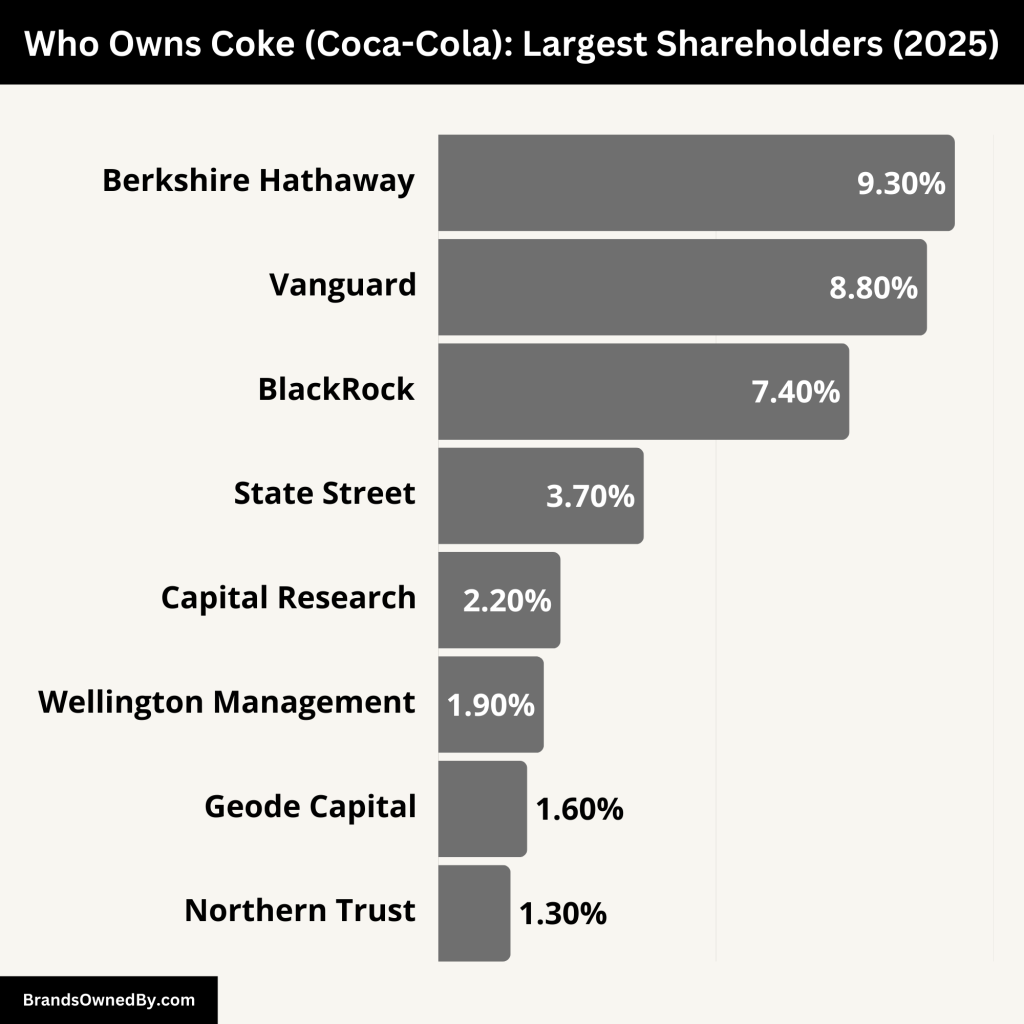
- The largest shareholders of Coca-Cola—and therefore indirect owners of Powerade—include Berkshire Hathaway, Vanguard Group, and BlackRock, all of which influence governance at the parent-company level.
- Strategic decisions, brand investment, and long-term direction for Powerade are controlled by Coca-Cola’s board and executive leadership, not by any independent Powerade management or shareholders.
Powerade is a global sports drink brand developed to support hydration and performance for athletes and active consumers. It was created to compete in the fast-paced sports beverage market and to provide an alternative to other electrolyte-enhanced drinks. Powerade combines electrolytes, minerals, and carbohydrates to help replace nutrients lost during physical activity.
The brand operates as part of the beverage portfolio of The Coca-Cola Company, one of the largest beverage corporations in the world. Powerade is distributed across dozens of countries and is available in multiple flavors and packaging formats. The product is marketed toward a broad audience that includes professional athletes, fitness enthusiasts, and everyday consumers who engage in physical exercise.
Powerade’s positioning emphasizes hydration, electrolyte balance, and sustained energy. It is widely present at sporting events and through partnerships with teams, leagues, and athletic organizations.
Founders and Origins
Powerade was developed within The Coca-Cola Company, meaning it was not founded by an individual entrepreneur or an independent startup. The concept, formulation, and initial deployment were managed by Coca-Cola’s research and product development teams.
Coca-Cola created Powerade in response to the growing demand for sports drinks in the late 1980s. At that time, the category was expanding rapidly, and competitors were gaining strong market share. Coca-Cola’s internal beverage scientists and marketing strategists collaborated to design a product that integrated key performance hydration elements, such as electrolytes and carbohydrates, tailored to active lifestyles.
Although not ascribed to a single founder in the traditional sense, Powerade reflects the innovation direction of Coca-Cola’s beverage development leadership during the 1980s and 1990s. The initiative aligned with Coca-Cola’s broader strategy to diversify beyond carbonated soft drinks and gain traction in growth segments of the beverage industry.
Major Milestones
- 1988: Powerade is launched in the United States by The Coca-Cola Company as its first dedicated sports drink brand.
- 1989: Initial regional expansion begins across key U.S. states, targeting athletic and collegiate markets.
- 1991: Powerade secures early sponsorships with college athletic programs, increasing visibility among young athletes.
- 1993: Distribution expands nationwide in the U.S., supported by Coca-Cola’s bottling network.
- 1996: Powerade gains wider recognition through partnerships linked to major sporting events during an Olympic year.
- 1998: International rollout begins, with entry into select markets in Latin America and Asia.
- 2001: Coca-Cola introduces new Powerade flavor variants to appeal to a broader consumer base.
- 2004: Powerade strengthens its presence in professional sports through league and team-level sponsorships.
- 2007: Packaging formats are diversified to include multi-serve bottles for team and training use.
- 2010: Powerade increases investment in grassroots and youth sports initiatives globally.
- 2012: Updated formulations are introduced in several markets, emphasizing electrolyte balance for endurance activities.
- 2014: Powerade refreshes its brand identity to align with modern athletic performance and lifestyle branding.
- 2016: Expansion accelerates in emerging markets, particularly in parts of Africa and Southeast Asia.
- 2018: Powerade marks its 30th anniversary as a global sports drink brand.
- 2019: The brand increases its digital marketing presence, focusing on fitness communities and social platforms.
- 2020: Powerade adapts distribution and marketing strategies amid global changes in sports and fitness routines.
- 2021: New limited-edition flavors are introduced in select regions to boost consumer engagement.
- 2022: Powerade expands partnerships with fitness influencers and training programs.
- 2023: Sustainability-focused packaging initiatives are rolled out in multiple international markets.
- 2024: The brand increases visibility at global athletic competitions and regional sports tournaments.
- 2025: Powerade reinforces its position as Coca-Cola’s flagship sports drink through refreshed campaigns and broader retail reach.
- 2026: Powerade continues to evolve as a core hydration brand within Coca-Cola’s portfolio, with a strong focus on performance, accessibility, and global sports culture.
Who Owns Powerade?
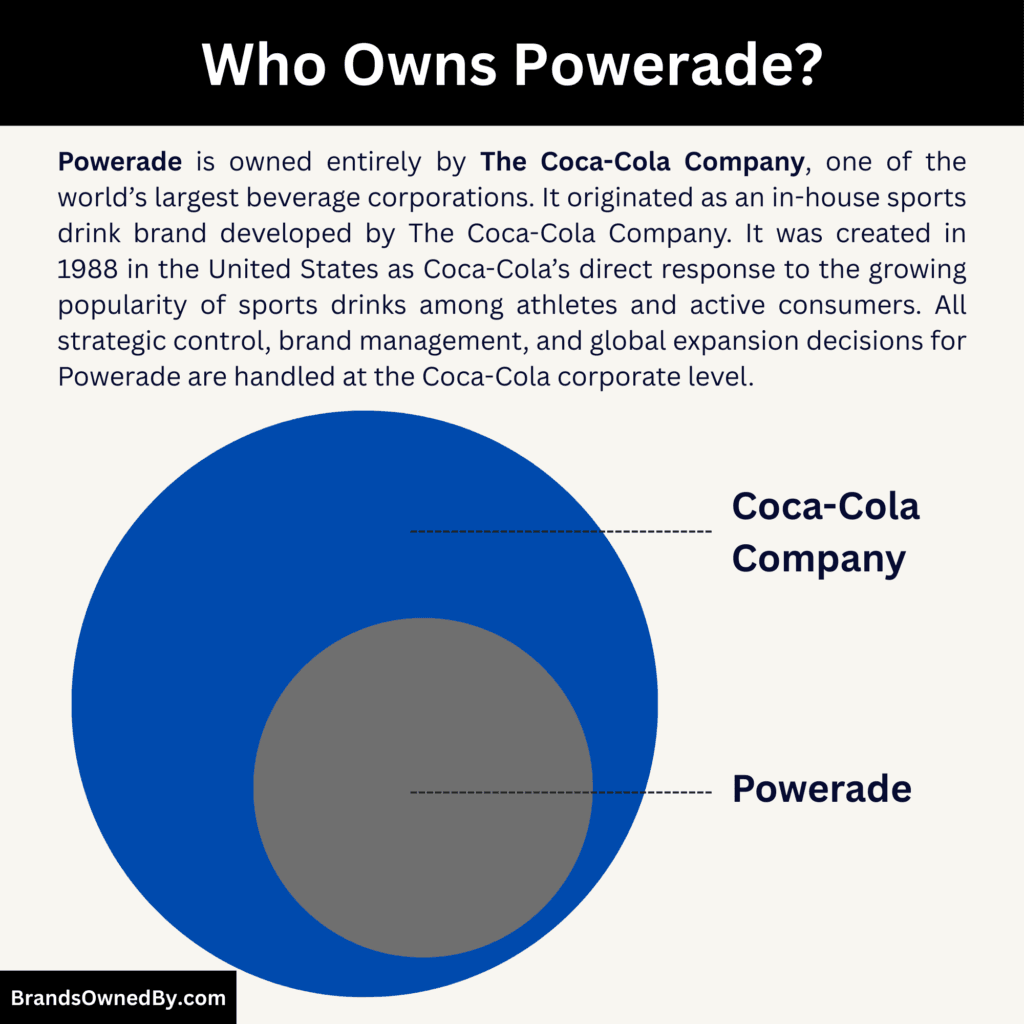
Powerade is fully owned by The Coca-Cola Company. Coca-Cola controls the brand outright. It does not have outside shareholders specific to Powerade itself.
The ownership structure means all strategic decisions, branding, and international expansion are managed under Coca-Cola’s corporate leadership. Powerade is positioned as Coca-Cola’s primary sports drink brand. It competes directly with Gatorade in both professional and consumer sports markets.
Below is an overview of the Powerade ownership as of January 2026:
- Brand Name: Powerade
- Business Type: Sports drink
- Ownership Status: Fully owned
- Parent Company: The Coca-Cola Company
- Ownership Nature: Wholly controlled
- Independent Entity: No
- Public Listing: Not listed
- Parent Listing: NYSE (KO)
- Founding Origin: In-house brand
- Acquisition History: Not acquired
- Founder Type: Corporate-developed
- Decision Authority: Parent company
- Strategic Control: Coca-Cola executives
- Board Oversight: Coca-Cola board
- Global Operations: Coca-Cola system
- Distribution Model: Franchise bottlers
- Market Position: Flagship sports drink
- Competitive Role: Gatorade rival
- Brand Governance: Centralized
- Portfolio Segment: Hydration beverages.
Parent Company: The Coca-Cola Company
The Coca-Cola Company is the global parent of Powerade. It is one of the largest and most influential beverage corporations in history. Coca-Cola began in 1892 when the Coca-Cola beverage was first sold as a soda fountain drink in Atlanta, Georgia.
Over the decades, the company expanded beyond a single drink into a diversified beverage portfolio. Today, Coca-Cola operates as a total beverage company that produces, markets, and sells a wide range of non-alcoholic drinks.
These include sparkling soft drinks, water, and enhanced water products, juices and juice drinks, teas and coffees, sports drinks like Powerade, and energy beverages.
Coca-Cola’s headquarters remain in Atlanta, Georgia, where its executive leadership and global strategy are directed.
Unlike a single-brand business, Coca-Cola manages a vast array of beverage brands under one corporate structure. This multi-brand approach allows it to serve diverse consumer preferences and rapidly evolving beverage trends worldwide.
Global Reach and Scale
Coca-Cola’s products, including the Powerade brand, are sold in more than 200 countries and territories. This remarkable reach means consumers from nearly every part of the world can access at least one Coca-Cola beverage.
The company’s distribution model combines central strategic control with a network of bottling partners. Independent bottlers produce, package, and distribute Coca-Cola beverages locally under agreements with the parent company. This structure enhances efficiency, reduces logistical complexity, and strengthens local market penetration.
Portfolio Strength and Brand Recognition
Coca-Cola boasts a portfolio of more than 30 brands that each generate annual retail sales of at least $1 billion. The iconic Coca-Cola soda remains the cornerstone of this portfolio, but the company’s strength also comes from a broad range of beverages tailored to global tastes. Powerade fits into this strategy as a leading sports hydration brand within the portfolio.
Coca-Cola’s brand value is among the highest globally. In recent years, its flagship trademark has been valued at tens of billions of dollars, reflecting its enduring influence and consumer loyalty.
Market Position and Reach in the Beverage Industry
Coca-Cola is a dominant player in the non-alcoholic beverage market. It holds a significant share across various categories, particularly in soft drinks and hydration beverages where Powerade competes. Its annual bottling volume surpasses 30 billion unit cases worldwide, and it maintains a strong presence across major geographic regions.
The company also actively promotes sustainability and environmental initiatives—for example, programs intended to recycle or reuse packaging and efforts to replenish water used in beverage production. These efforts support long-term viability and align with current consumer expectations for corporate responsibility.
Strategic Business and Bottling Network
Although Coca-Cola centralizes brand ownership and global strategy, much of its physical beverage production and distribution is conducted by independent or semi-independent bottling partners. These partners operate in specific regions and are crucial to ensuring drinks like Powerade reach retail outlets, restaurants, and consumers efficiently.
Examples include major bottlers such as Coca-Cola Europacific Partners and Coca-Cola HBC, which operate across multiple countries and handle significant volumes of Coca-Cola products. These bottlers are strategic extensions of Coca-Cola’s global system and help tailor operations to local markets.
Who is the CEO of Powerade?
As of January 2026, the Chief Executive Officer (CEO) of The Coca-Cola Company—the parent company that owns Powerade—is James Quincey, who continues in the role through the current quarter. An upcoming leadership transition is scheduled: Henrique Braun is set to become the next CEO effective March 31, 2026. This planned succession reflects Coca-Cola’s internal leadership strategy and long-term planning.
Strategic Influence on Powerade
Under James Quincey’s leadership, Coca-Cola placed a stronger emphasis on becoming a “total beverage company.” This shift affected how Powerade is positioned within the portfolio. Rather than treating it as a niche sports drink, Coca-Cola integrated Powerade into its broader hydration and functional beverage strategy.
Quincey’s approach prioritizes brands that align with changing consumer behavior, including fitness, wellness, and active lifestyles. Powerade benefits from this strategy through continued product relevance, access to Coca-Cola’s global sponsorship ecosystem, and alignment with sports and athletic performance narratives. These priorities are set at the CEO level and cascaded down through regional and brand leadership teams.
Incoming CEO and Planned Transition
Coca-Cola has announced a formal succession plan. Henrique Braun has been appointed as the next CEO and is scheduled to assume the role later in 2026.
Until the transition is completed, James Quincey retains full executive authority. The early announcement of Braun’s appointment reflects Coca-Cola’s emphasis on continuity and internal leadership development.
Professional Background of James Quincey
James Quincey joined Coca-Cola in 1996 and built his career across multiple international markets. His leadership experience spans Latin America, Europe, and global operations. Before becoming CEO, he served as President and Chief Operating Officer, where he played a key role in reshaping Coca-Cola’s organizational structure.
His background in both strategy and operations allows him to balance brand growth with efficiency and scale. This experience is particularly relevant for Powerade, which relies on Coca-Cola’s bottling system and global supply chain to compete in the sports drink market.
Professional Background of Henrique Braun
Henrique Braun is a long-tenured Coca-Cola executive with nearly three decades at the company. His career includes leadership roles in supply chain management, marketing, and regional operations. He has managed major Coca-Cola markets, including Brazil, Greater China, and parts of Asia.
Before being named CEO-designate, Braun served in senior executive roles that involved overseeing large geographic segments and coordinating complex operations. His appointment signals Coca-Cola’s preference for internal leadership continuity rather than external hiring. For Powerade, this suggests ongoing alignment with Coca-Cola’s existing hydration and performance beverage strategy.
Decision-Making Authority Over Powerade
Strategic control over Powerade sits at the corporate level. The CEO works alongside Coca-Cola’s executive committee and board of directors to determine:
- Brand investment priorities
- Global sponsorship and partnership strategies
- Product innovation and reformulation
- Geographic expansion and market focus.
Powerade’s regional teams execute these strategies within Coca-Cola’s broader framework.
CEO Compensation and Salary
As CEO of The Coca-Cola Company, James Quincey receives a compensation package that reflects the leadership of a global public corporation.
His base salary is approximately $1.6 million per year. In addition to salary, he receives performance-based bonuses, long-term stock awards, and other executive incentives. These components bring his total annual compensation into the high eight-figure range in recent reporting periods.
Compensation levels are tied to company performance, shareholder returns, and long-term strategic goals.
Net Worth of the CEO
James Quincey’s estimated net worth is widely reported to be in the range of $30 million to over $100 million. This variation is due to differences in how equity holdings, stock awards, and long-term incentives are valued.
A significant portion of his net worth is linked to Coca-Cola shares accumulated through compensation plans over many years. His financial position reflects long-term service at the executive level within the company.
Powerade Annual Revenue and Net Worth
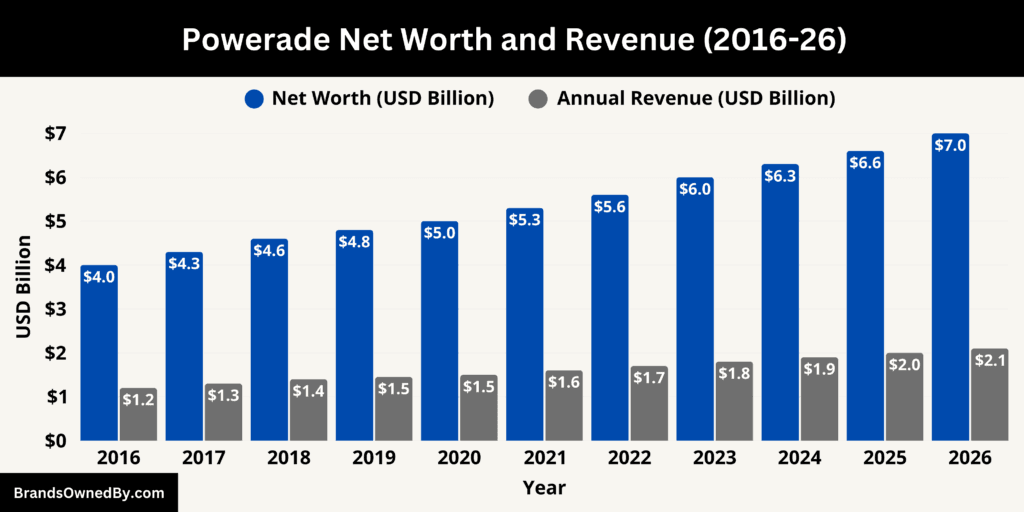
As of January 2026, Powerade records an estimated annual revenue of $2.1 billion and an estimated brand net worth of $7 billion. These figures position Powerade as one of the most valuable and commercially significant sports drink brands in the global beverage industry. While Powerade’s financials are not reported separately in public filings, its scale and valuation reflect its strong market presence and strategic importance within The Coca-Cola Company.
Annual Revenue Breakdown
Powerade’s annual revenue of $2.1 billion in 2026 primarily stems from sales of beverage units across North America, Latin America, Europe, and select Asia-Pacific markets. This revenue estimate aligns with industry data indicating that Coca-Cola’s sports drink portfolio—primarily Powerade and Powerade Zero—holds a significant share of sports drink sales globally.
In the U.S., Coca-Cola’s sports drink sales accounted for nearly 10.8 % of total sports drink revenue, with Powerade representing the largest share within the Coca-Cola sports drink lineup. Consumer purchases span traditional bottled formats, zero-sugar variants, and performance-oriented products.
Powerade’s revenue performance in 2026 reflects both volume growth and pricing trends. In markets where sports drink consumption is strong—such as the United States and Mexico—Powerade benefits from broad retail distribution.
Outside North America, revenue contributions are supported by Coca-Cola’s extensive bottling and distribution infrastructure. These operational advantages enable Powerade to maintain high shelf visibility and compete effectively with larger incumbent brands.
Annual revenue also incorporates incremental sales from partnerships and sponsorships with professional leagues, collegiate athletic programs, and national sporting events, which elevate brand exposure and drive purchase demand among active lifestyle consumers.
Brand Net Worth and Valuation
Powerade’s estimated net worth of $7 billion in 2026 reflects its accumulated brand equity, market recognition, and projected future revenue streams. Brand net worth is distinct from annual revenue; it represents the underlying value of the brand as an intangible asset that contributes to Coca-Cola’s overall business value.
Several factors reinforce Powerade’s net worth:
- Longstanding category presence: Powerade has competed in the global sports drink market for decades since its launch.
- Market share within Coca-Cola’s portfolio: Studies indicate Coca-Cola’s sports drink portfolio commands nearly one-fifth of U.S. sports drink sales revenue, with Powerade representing the majority of that share.
- Brand equity: Powerade’s association with hydration science, athletic sponsorships, and Coca-Cola’s marketing scale enhances consumer perception and loyalty.
- Growth prospects: Continued consumer interest in wellness, fitness, and on-the-go hydration supports Powerade’s sustained demand across demographic segments.
Brand valuation methodologies typically incorporate discounted future earnings, competitive positioning, and category dynamics, all of which underpin Powerade’s estimated $7 billion net worth. This positions Powerade among the more valuable non-carbonated beverage brands in the sports drink segment, particularly when compared with smaller niche competitors.
Key Trends Affecting Revenue and Net Worth
Current industry trends that influence Powerade’s revenue and brand valuation include the overall size and growth of the global sports drink market, which analysts estimate to be substantial and expanding. Global sports drink market growth supports sales and valuation for major brands like Powerade, even amid competitive pressures from larger rivals.
Consumer shifts toward health and hydration, as well as increasing participation in fitness activities, contribute to sustained demand. Although the largest competitor in U.S. retail is significantly ahead in market share, Powerade’s position within Coca-Cola’s broader beverage ecosystem provides it with structural advantages in distribution and marketing investment.
Brands Owned by Powerade
Powerade operates as a single-brand business unit and does not function as a holding company. It does not own independent companies, subsidiaries, or externally acquired businesses. Instead, Powerade manages and operates a portfolio of in-house product lines and brand extensions developed internally to address different hydration and performance needs.
Below is a list of the major brands and internal divisions owned by Powerade as of January 2026:
| Brand / Entity | Type | Launch Period | Primary Purpose | Key Markets | Description |
|---|---|---|---|---|---|
| Powerade Core | Flagship product line | 1988 | Athletic hydration | Global | The original Powerade sports drink range. Focused on replenishing electrolytes and fluids lost during physical activity. This line drives the majority of Powerade’s global volume and brand recognition. |
| Powerade Zero | Sugar-free product line | Late 2000s | Zero-calorie hydration | Global | A no-sugar, no-calorie extension retaining electrolytes. Designed for fitness-focused and health-conscious consumers seeking hydration without carbohydrates. |
| Powerade Ultra | Performance-focused variant | 2010s | High-intensity hydration | Select global markets | A more concentrated electrolyte formulation targeting endurance athletes and high-performance sports scenarios. Positioned as a premium performance option within the brand. |
| Powerade Power Water | Functional hydration line | Early 2020s | Light electrolyte hydration | North America and select markets | A hybrid between bottled water and sports drinks. Contains electrolytes without the sweetness of traditional sports beverages. Aimed at everyday hydration occasions. |
| Powerade ION4 | Regional formulation | 2010s | Electrolyte balance | Europe, Latin America, Asia | An internationally tailored formulation emphasizing four key electrolytes. Adapted to regional taste profiles and consumption habits outside the U.S. |
| Powerade Flavor Variants | Product extensions | Ongoing | Market engagement | Global | Includes permanent and limited-edition flavors developed to suit local preferences and seasonal demand. Used to maintain relevance and boost short-term sales. |
| Powerade Limited Editions | Marketing-driven variants | Periodic | Brand activation | Select markets | Short-run products tied to sporting events, sponsorships, or campaigns. Designed to increase brand visibility rather than operate as standalone businesses. |
Powerade Core (Original Powerade)
Powerade Core represents the flagship and original product line. It includes the classic electrolyte sports drinks formulated to replenish fluids, sodium, and carbohydrates lost during physical activity.
This line forms the backbone of Powerade’s global presence and is widely distributed across retail, sports venues, and fitness environments. The Core range targets general athletic hydration and remains the highest-volume segment within the Powerade brand.
Powerade Zero
Powerade Zero is a sugar-free extension of the core brand. It is designed for consumers seeking hydration without added calories or sugar. This product line retains electrolytes while removing carbohydrates, making it popular among fitness-focused and weight-conscious consumers. Powerade Zero has become a strategically important offering as consumer demand shifts toward low- and no-sugar beverages.
Powerade Ultra
Powerade Ultra is positioned as a higher-performance variant within the brand. It features a more concentrated electrolyte profile compared to standard Powerade. This line targets endurance athletes and consumers engaged in prolonged or intense physical activity. Powerade Ultra is often marketed around competitive sports and high-performance training contexts.
Powerade Power Water
Powerade Power Water is a functional hydration extension that blends purified water with electrolytes but without traditional sports drink sweetness. It is positioned between bottled water and sports drinks. This product appeals to consumers who want light hydration support without the taste or density of conventional sports beverages. Powerade Power Water reflects the brand’s expansion beyond traditional sports drink formats.
Powerade ION4
Powerade ION4 is an electrolyte-focused formulation available primarily in international markets. The name references four key electrolytes used in the formulation. This line is tailored to regional taste preferences and hydration needs outside North America. ION4 plays a significant role in Powerade’s market presence in Europe, Latin America, and parts of Asia.
Powerade Flavors and Limited Variants
Powerade periodically introduces region-specific flavors and limited-edition variants under the core brand umbrella. These are not separate companies or subsidiaries but short- to medium-term product extensions designed to drive engagement and adapt to local preferences. Flavor innovation remains an important operational function within the brand.
Final Thoughts
For anyone wondering who owns Powerade, the answer is straightforward. Powerade is fully owned and controlled by The Coca-Cola Company. This ownership gives the brand unmatched global reach and long-term stability. Powerade remains a key pillar in Coca-Cola’s sports hydration strategy, backed by strong institutional shareholders and centralized executive leadership.
FAQs
Who owns Powerade brand?
Powerade is owned by The Coca-Cola Company. It is not a standalone business and operates as a brand within Coca-Cola’s global beverage portfolio.
Is Powerade owned by Coke?
Yes. Powerade is fully owned by The Coca-Cola Company. Coca-Cola created the brand internally and continues to control it.
Who makes Powerade drinks?
Powerade drinks are produced by Coca-Cola’s authorized bottling partners. While Coca-Cola owns the brand and sets formulas and standards, independent bottlers manufacture and distribute Powerade in their assigned regions.
Where is Powerade manufactured?
Powerade is manufactured in multiple countries worldwide. Production takes place at regional Coca-Cola bottling facilities, allowing the brand to be produced locally in major markets such as the United States, Latin America, Europe, and parts of Asia.
Does Coca-Cola own Powerade?
Yes. Coca-Cola owns Powerade outright. All branding, strategy, and global distribution decisions for Powerade are made under Coca-Cola’s corporate structure.
Did Gatorade ever sue Powerade?
Yes. Gatorade and Coca-Cola have been involved in legal disputes in the past related to advertising claims. These cases were primarily about marketing and competitive positioning, not ownership or intellectual property transfer.
Did BodyArmor buy Powerade?
No. BODYARMOR did not buy Powerade. BODYARMOR is a separate sports drink brand in which Coca-Cola holds an ownership stake, but Powerade remains a distinct brand fully owned and operated by Coca-Cola.
Is Powerade an energy drink?
No. Powerade is a sports drink, not an energy drink. It is formulated to provide hydration and electrolytes for physical activity. Unlike energy drinks, Powerade does not contain stimulants such as caffeine.